How to develop
Guideline and Protocol
ผศ.ดร.กรองได อุณหสูต RN, Ed.D
krongdai@gmail.com
TE Nurse Coordinator
แนวทางการดูแลและแนวทางปฏิบัติ
การดูแลผู้บาดเจ็บตามหลักฐานเชิงประจักษ์
วิธีการพัฒนา
ความรู้พื้นฐาน
1. หลักสาคัญการพัฒนา guideline
2. ระดับหลักฐานเชิงประจักษ์
krongdai@gmail.com
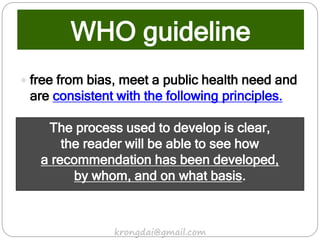
WHO guideline
 containing recommendations about
health interventions; clinical, public health
or policy recommendations.
Recommendations are based on
a comprehensive and objective assessment
of the available evidence.
krongdai@gmail.com
 free from bias, meet a public health need and
are consistent with the following principles.
The process used to develop is clear,
the reader will be able to see how
a recommendation has been developed,
by whom, and on what basis.
WHO guideline
krongdai@gmail.com
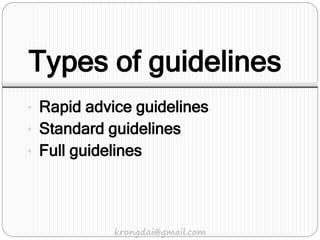
Types of guidelines
• Rapid advice guidelines
• Standard guidelines
• Full guidelines
krongdai@gmail.com
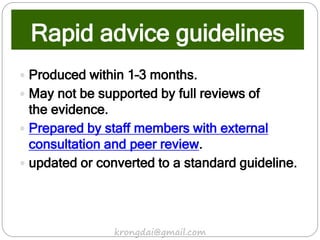
Rapid advice guidelines
 Produced within 1–3 months.
 May not be supported by full reviews of
the evidence.
 Prepared by staff members with external
consultation and peer review.
 updated or converted to a standard guideline.
krongdai@gmail.com
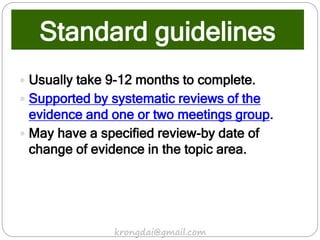
Standard guidelines
 Usually take 9-12 months to complete.
 Supported by systematic reviews of the
evidence and one or two meetings group.
 May have a specified review-by date of
change of evidence in the topic area.
krongdai@gmail.com
Full guidelines
 Would be expected to include
recommendations in relation to all aspects
of the topic.
 Fully based on systematic reviews of the
evidence for each aspect.
 Likely to take 2-3 years to complete.
krongdai@gmail.com
Compilations of guidelines
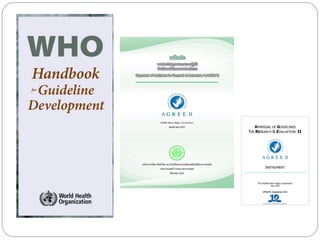
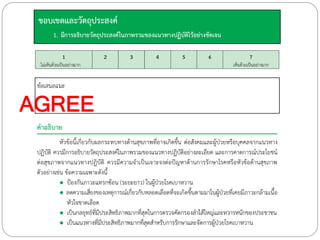
 Using the Appraisal of Guidelines for
Research and Evaluation (AGREE) tool.
 http://www.agreetrust.org/
 Some guideline do not require GRC
(Guideline Review Committe) review:
have previously been clear.
krongdai@gmail.com
AGREE
Adaptations of guidelines
 Intended for one setting may be adapted
for use in another.
 Adaptations of guidelines must follow
standard GRC procedures.
krongdai@gmail.com
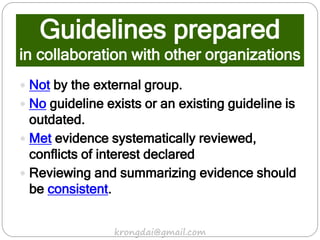
Guidelines prepared
in collaboration with other organizations
 Not by the external group.
 No guideline exists or an existing guideline is
outdated.
 Met evidence systematically reviewed,
conflicts of interest declared
 Reviewing and summarizing evidence should
be consistent.
krongdai@gmail.com
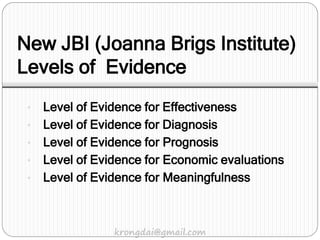
New JBI (Joanna Brigs Institute)
Levels of Evidence
• Level of Evidence for Effectiveness
• Level of Evidence for Diagnosis
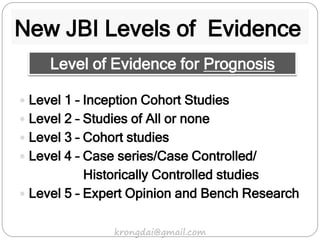
• Level of Evidence for Prognosis
• Level of Evidence for Economic evaluations
• Level of Evidence for Meaningfulness
krongdai@gmail.com
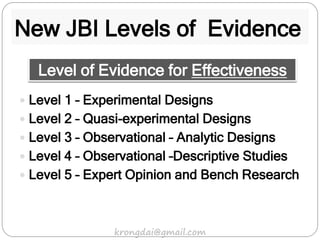
New JBI Levels of Evidence
 Level 1 – Experimental Designs
 Level 2 – Quasi-experimental Designs
 Level 3 – Observational – Analytic Designs
 Level 4 – Observational –Descriptive Studies
 Level 5 – Expert Opinion and Bench Research
Level of Evidence for Effectiveness
krongdai@gmail.com
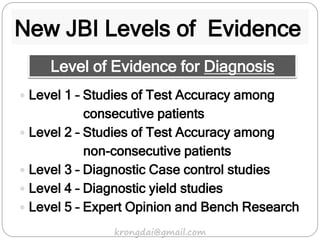
New JBI Levels of Evidence
 Level 1 – Studies of Test Accuracy among
consecutive patients
 Level 2 – Studies of Test Accuracy among
non-consecutive patients
 Level 3 – Diagnostic Case control studies
 Level 4 – Diagnostic yield studies
 Level 5 – Expert Opinion and Bench Research
Level of Evidence for Diagnosis
krongdai@gmail.com
New JBI Levels of Evidence
 Level 1 – Inception Cohort Studies
 Level 2 – Studies of All or none
 Level 3 – Cohort studies
 Level 4 – Case series/Case Controlled/
Historically Controlled studies
 Level 5 – Expert Opinion and Bench Research
Level of Evidence for Prognosis
krongdai@gmail.com
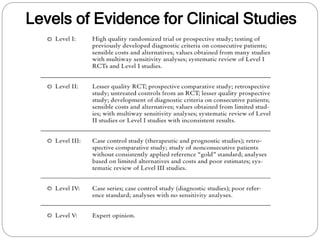
Levels of Evidence for Clinical Studies
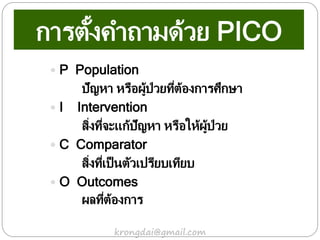
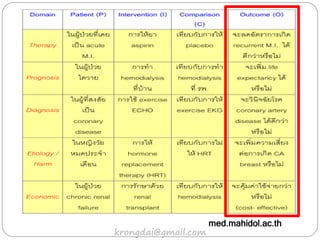
การตั้งคาถามด้วย PICO
 P Population
ปัญหา หรือผู้ป่วยที่ต้องการศึกษา
 I Intervention
สิ่งที่จะแก้ปัญหา หรือให้ผู้ป่วย
 C Comparator
สิ่งที่เป็นตัวเปรียบเทียบ
 O Outcomes
ผลที่ต้องการ
krongdai@gmail.com
med.mahidol.ac.th
krongdai@gmail.com
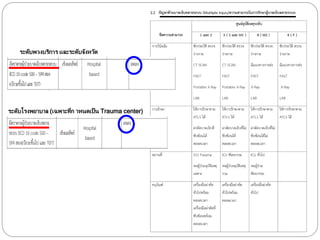
ระดับพวงบริการ และระดับจังหวัด
ระดับโรงพยาบาล (เฉพาะที่ก าหนดเป็น Trauma center)
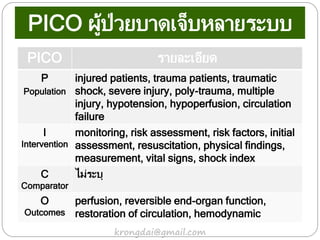
PICO รายละเอียด
P
Population
injured patients, trauma patients, traumatic
shock, severe injury, poly-trauma, multiple
injury, hypotension, hypoperfusion, circulation
failure
I
Intervention
monitoring, risk assessment, risk factors, initial
assessment, resuscitation, physical findings,
measurement, vital signs, shock index
C
Comparator
ไม่ระบุ
O
Outcomes
perfusion, reversible end-organ function,
restoration of circulation, hemodynamic
krongdai@gmail.com
PICO ผู้ป่วยบาดเจ็บหลายระบบ
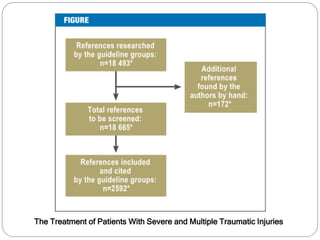
The Treatment of Patients With Severe and Multiple Traumatic Injuries
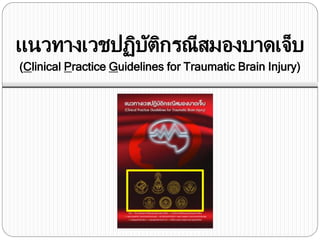
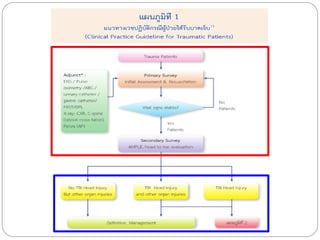
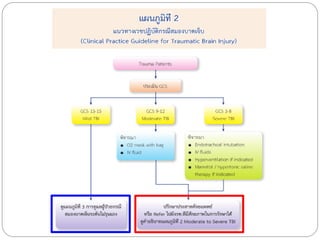
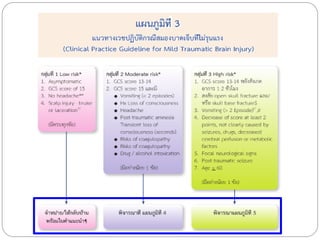
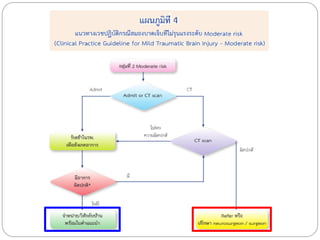
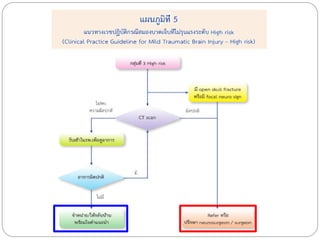
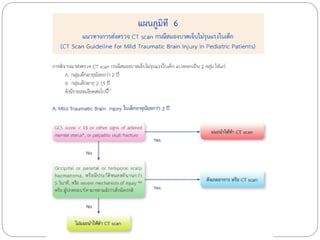
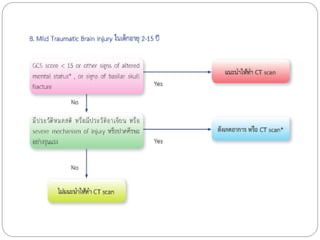
แนวทางเวชปฏิบัติกรณีสมองบาดเจ็บ
(Clinical Practice Guidelines for Traumatic Brain Injury)
เริ่มต้นอย่างไร?
ค้นหาประเด็นปัจจุบันเพื่อ
การพัฒนาแนวทางการดูแล
1. ปัญหาที่พบบ่อยในการดูแลผู้บาดเจ็บ
2. นโยบาย; Service Plan, ER คุณภาพ
3. สมรรถนะหลักของพยาบาลอุบัติเหตุ
4. การดูแลผู้บาดเจ็บที่อยู่ในภาวะคุกคามชีวิต;
สมรรถนะหลักของ trauma team
5. Trauma Management Flow, guideline,
protocol
krongdai@gmail.com
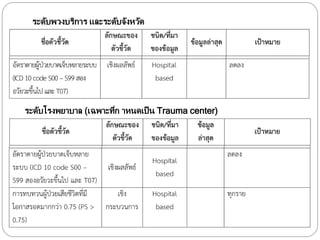
ระดับพวงบริการ และระดับจังหวัด
ระดับโรงพยาบาล (เฉพาะที่ก าหนดเป็น Trauma center)
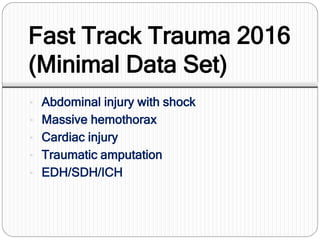
Fast Track Trauma 2016
(Minimal Data Set)
• Abdominal injury with shock
• Massive hemothorax
• Cardiac injury
• Traumatic amputation
• EDH/SDH/ICH
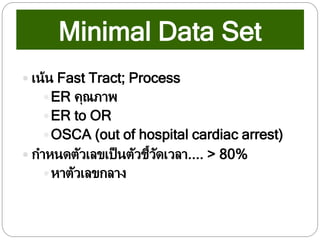
Minimal Data Set
 เน้น Fast Tract; Process
ER คุณภาพ
ER to OR
OSCA (out of hospital cardiac arrest)
 กาหนดตัวเลขเป็นตัวชี้วัดเวลา.... > 80%
หาตัวเลขกลาง
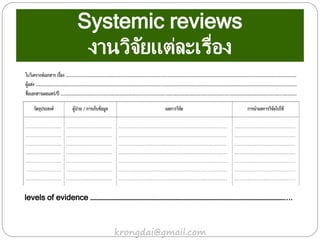
Systemic reviews
งานวิจัยแต่ละเรื่อง
levels of evidence …………………………………………………………………………………………………………………....
krongdai@gmail.com
วารสารอุบัติเหตุ 2557 ปีที่ 33 ฉบับที่ 2
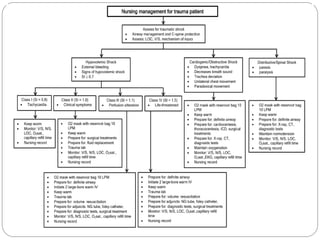
การเฝ้ าระวังภาวะช็อกจากการบาดเจ็บ
ของผู้ป่วยอุบัติเหตุที่ห้องฉุกเฉิน:
การทบทวนหลักฐานเชิงประจักษ์
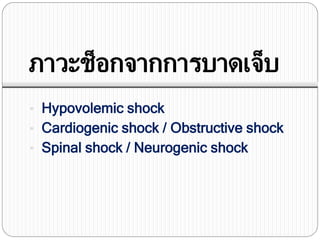
ภาวะช็อกจากการบาดเจ็บ
• Hypovolemic shock
• Cardiogenic shock / Obstructive shock
• Spinal shock / Neurogenic shock
วิธีการศึกษา
 ใช้กรอบ PICO สืบค้น ประเมินระดับหลักฐานเชิง
ประจักษ์ตามรูปแบบ Prognosis Domain
 หลักฐานเชิงประจักษ์ในการศึกษา คือ งานวิจัยฉบับ
สมบูรณ์ เกี่ยวข้องกับการติดตามเฝ้ าระวังอาการช็อก
จากการบาดเจ็บของผู้ป่วยอุบัติเหตุที่ห้องฉุกเฉิน อายุ
18 ปีขึ้นไป และตีพิมพ์เผยแพร่ทั้งภาษาไทย และ
ภาษาอังกฤษ ระหว่าง ปี พ.ศ. 2548-2555
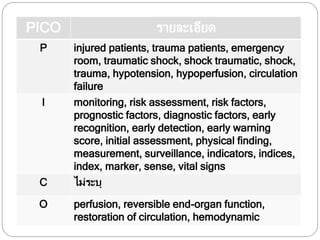
PICO รายละเอียด
P injured patients, trauma patients, emergency
room, traumatic shock, shock traumatic, shock,
trauma, hypotension, hypoperfusion, circulation
failure
I monitoring, risk assessment, risk factors,
prognostic factors, diagnostic factors, early
recognition, early detection, early warning
score, initial assessment, physical finding,
measurement, surveillance, indicators, indices,
index, marker, sense, vital signs
C ไม่ระบุ
O perfusion, reversible end-organ function,
restoration of circulation, hemodynamic
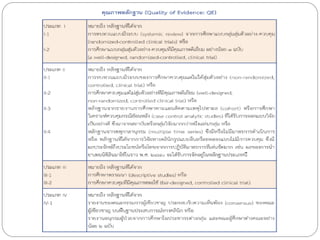
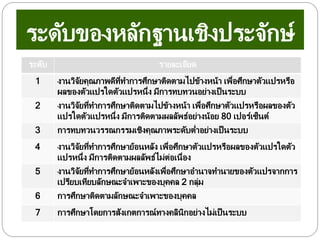
ระดับของหลักฐานเชิงประจักษ์
ระดับ รายละเอียด
1 งานวิจัยคุณภาพดีที่ทาการศึกษาติดตามไปข้างหน้า เพื่อศึกษาตัวแปรหรือ
ผลของตัวแปรใดตัวแปรหนึ่ง มีการทบทวนอย่างเป็นระบบ
2 งานวิจัยที่ทาการศึกษาติดตามไปข้างหน้า เพื่อศึกษาตัวแปรหรือผลของตัว
แปรใดตัวแปรหนึ่ง มีการติดตามผลลัพธ์อย่างน้อย 80 เปอร์เซ็นต์
3 การทบทวนวรรณกรรมเชิงคุณภาพระดับต่าอย่างเป็นระบบ
4 งานวิจัยที่ทาการศึกษาย้อนหลัง เพื่อศึกษาตัวแปรหรือผลของตัวแปรใดตัว
แปรหนึ่ง มีการติดตามผลลัพธ์ไม่ต่อเนื่อง
5 งานวิจัยที่ทาการศึกษาย้อนหลังเพื่อศึกษาอานาจทานายของตัวแปรจากการ
เปรียบเทียบลักษณะจาเพาะของบุคคล 2 กลุ่ม
6 การศึกษาติดตามลักษณะจาเพาะของบุคคล
7 การศึกษาโดยการสังเกตการณ์ทางคลินิกอย่างไม่เป็นระบบ
การเฝ้ าระวังภาวะช็อกจากการบาดเจ็บ
ของผู้ป่วยอุบัติเหตุที่ห้องฉุกเฉิน
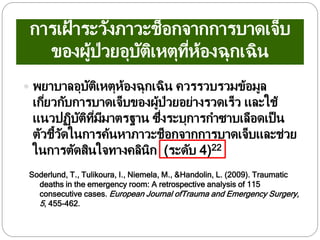
 พยาบาลอุบัติเหตุห้องฉุกเฉิน ควรรวบรวมข้อมูล
เกี่ยวกับการบาดเจ็บของผู้ป่วยอย่างรวดเร็ว และใช้
แนวปฏิบัติที่มีมาตรฐาน ซึ่งระบุการกาซาบเลือดเป็น
ตัวชี้วัดในการค้นหาภาวะช็อกจากการบาดเจ็บและช่วย
ในการตัดสินใจทางคลินิก (ระดับ 4)22
Soderlund, T., Tulikoura, I., Niemela, M., &Handolin, L. (2009). Traumatic
deaths in the emergency room: A retrospective analysis of 115
consecutive cases. European Journal ofTrauma and Emergency Surgery,
5, 455-462.
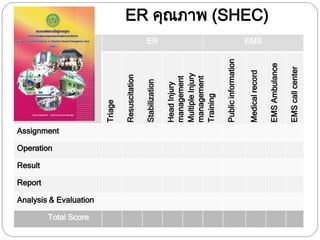
การประเมิน
ER EMS
Triage
Resuscitation
Stabilization
HeadInjury
management
MultipleInjury
management
Training
Publicinformation
Medicalrecord
EMSAmbulance
EMScallcenter
Assignment
Operation
Result
Report
Analysis & Evaluation
Total Score
ER คุณภาพ (SHEC)
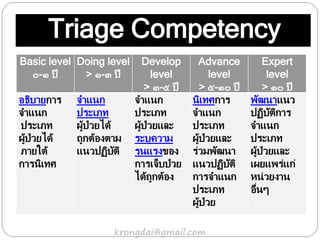
Triage Competency
Basic level
๐-๑ ปี
Doing level
> ๑-๓ ปี
Develop
level
> ๓-๕ ปี
Advance
level
> ๕-๑๐ ปี
Expert
level
> ๑๐ ปี
อธิบายการ
จาแนก
ประเภท
ผู้ป่วยได้
ภายใต้
การนิเทศ
จาแนก
ประเภท
ผู้ป่วยได้
ถูกต้องตาม
แนวปฏิบัติ
จาแนก
ประเภท
ผู้ป่วยและ
ระบุความ
รุนแรงของ
การเจ็บป่วย
ได้ถูกต้อง
นิเทศการ
จาแนก
ประเภท
ผู้ป่วยและ
ร่วมพัฒนา
แนวปฏิบัติ
การจาแนก
ประเภท
ผู้ป่วย
พัฒนาแนว
ปฏิบัติการ
จาแนก
ประเภท
ผู้ป่วยและ
เผยแพร่แก่
หน่วยงาน
อื่นๆ
krongdai@gmail.com
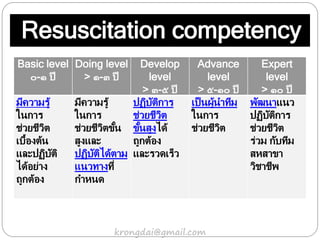
Resuscitation competency
Basic level
๐-๑ ปี
Doing level
> ๑-๓ ปี
Develop
level
> ๓-๕ ปี
Advance
level
> ๕-๑๐ ปี
Expert
level
> ๑๐ ปี
มีความรู้
ในการ
ช่วยชีวิต
เบื้องต้น
และปฏิบัติ
ได้อย่าง
ถูกต้อง
มีความรู้
ในการ
ช่วยชีวิตขั้น
สูงและ
ปฏิบัติได้ตาม
แนวทางที่
กาหนด
ปฏิบัติการ
ช่วยชีวิต
ขั้นสูงได้
ถูกต้อง
และรวดเร็ว
เป็ นผู้นาทีม
ในการ
ช่วยชีวิต
พัฒนาแนว
ปฏิบัติการ
ช่วยชีวิต
ร่วม กับทีม
สหสาขา
วิชาชีพ
krongdai@gmail.com
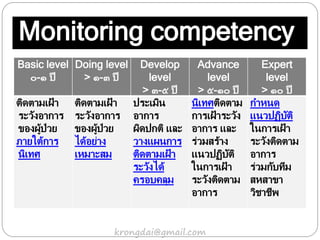
Monitoring competency
Basic level
๐-๑ ปี
Doing level
> ๑-๓ ปี
Develop
level
> ๓-๕ ปี
Advance
level
> ๕-๑๐ ปี
Expert
level
> ๑๐ ปี
ติดตามเฝ้ า
ระวังอาการ
ของผู้ป่วย
ภายใต้การ
นิเทศ
ติดตามเฝ้ า
ระวังอาการ
ของผู้ป่วย
ได้อย่าง
เหมาะสม
ประเมิน
อาการ
ผิดปกติ และ
วางแผนการ
ติดตามเฝ้ า
ระวังได้
ครอบคลุม
นิเทศติดตาม
การเฝ้ าระวัง
อาการ และ
ร่วมสร้าง
แนวปฏิบัติ
ในการเฝ้ า
ระวังติดตาม
อาการ
กาหนด
แนวปฏิบัติ
ในการเฝ้ า
ระวังติดตาม
อาการ
ร่วมกับทีม
สหสาขา
วิชาชีพ
krongdai@gmail.com
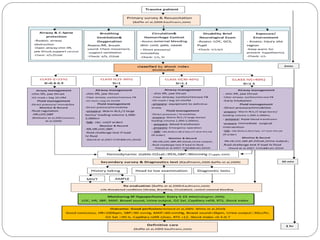
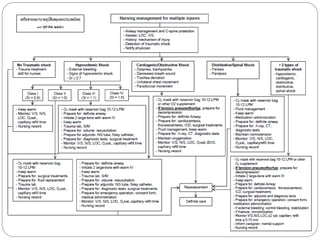
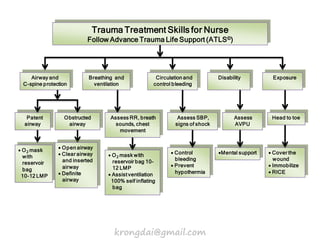
Trauma Treatment Skills for Nurse
Follow Advance Trauma Life Support (ATLS©)
Airway and
C-spine protection
Breathing and
ventilation
Circulation and
control bleeding
Disability Exposure
Patent
airway
Obstructed
airway
Assess RR, breath
sounds, chest
movement
Assess SBP,
signs of shock
Assess
AVPU
Head to toe
 O2 mask
with
reservoir
bag
10-12 LMP
 Open airway
 Clear airway
and inserted
airway
 Definite
airway
 O2 mask with
reservoir bag 10-
12 LMP
 Assist ventilation
100% self inflating
bag
 Control
bleeding
 Prevent
hypothermia
 Cover the
wound
 Immobilize
 RICE
Mental support
krongdai@gmail.com
เครือข่ายพยาบาลอุบัติเหตุแห่งประเทศไทย
3  how to develop guideline and protocol  _ update 17 เมยฬ 2560

3 how to develop guideline and protocol _ update 17 เมยฬ 2560

  • 1.
    How to develop Guidelineand Protocol ผศ.ดร.กรองได อุณหสูต RN, Ed.D krongdai@gmail.com TE Nurse Coordinator
  • 2.
  • 3.
    ความรู้พื้นฐาน 1. หลักสาคัญการพัฒนา guideline 2.ระดับหลักฐานเชิงประจักษ์ krongdai@gmail.com
  • 5.
    WHO guideline  containingrecommendations about health interventions; clinical, public health or policy recommendations. Recommendations are based on a comprehensive and objective assessment of the available evidence. krongdai@gmail.com
  • 6.
     free frombias, meet a public health need and are consistent with the following principles. The process used to develop is clear, the reader will be able to see how a recommendation has been developed, by whom, and on what basis. WHO guideline krongdai@gmail.com
  • 7.
    Types of guidelines •Rapid advice guidelines • Standard guidelines • Full guidelines krongdai@gmail.com
  • 8.
    Rapid advice guidelines Produced within 1–3 months.  May not be supported by full reviews of the evidence.  Prepared by staff members with external consultation and peer review.  updated or converted to a standard guideline. krongdai@gmail.com
  • 9.
    Standard guidelines  Usuallytake 9-12 months to complete.  Supported by systematic reviews of the evidence and one or two meetings group.  May have a specified review-by date of change of evidence in the topic area. krongdai@gmail.com
  • 10.
    Full guidelines  Wouldbe expected to include recommendations in relation to all aspects of the topic.  Fully based on systematic reviews of the evidence for each aspect.  Likely to take 2-3 years to complete. krongdai@gmail.com
  • 11.
    Compilations of guidelines Using the Appraisal of Guidelines for Research and Evaluation (AGREE) tool.  http://www.agreetrust.org/  Some guideline do not require GRC (Guideline Review Committe) review: have previously been clear. krongdai@gmail.com
  • 12.
  • 13.
    Adaptations of guidelines Intended for one setting may be adapted for use in another.  Adaptations of guidelines must follow standard GRC procedures. krongdai@gmail.com
  • 14.
    Guidelines prepared in collaborationwith other organizations  Not by the external group.  No guideline exists or an existing guideline is outdated.  Met evidence systematically reviewed, conflicts of interest declared  Reviewing and summarizing evidence should be consistent. krongdai@gmail.com
  • 15.
    New JBI (JoannaBrigs Institute) Levels of Evidence • Level of Evidence for Effectiveness • Level of Evidence for Diagnosis • Level of Evidence for Prognosis • Level of Evidence for Economic evaluations • Level of Evidence for Meaningfulness krongdai@gmail.com
  • 16.
    New JBI Levelsof Evidence  Level 1 – Experimental Designs  Level 2 – Quasi-experimental Designs  Level 3 – Observational – Analytic Designs  Level 4 – Observational –Descriptive Studies  Level 5 – Expert Opinion and Bench Research Level of Evidence for Effectiveness krongdai@gmail.com
  • 17.
    New JBI Levelsof Evidence  Level 1 – Studies of Test Accuracy among consecutive patients  Level 2 – Studies of Test Accuracy among non-consecutive patients  Level 3 – Diagnostic Case control studies  Level 4 – Diagnostic yield studies  Level 5 – Expert Opinion and Bench Research Level of Evidence for Diagnosis krongdai@gmail.com
  • 18.
    New JBI Levelsof Evidence  Level 1 – Inception Cohort Studies  Level 2 – Studies of All or none  Level 3 – Cohort studies  Level 4 – Case series/Case Controlled/ Historically Controlled studies  Level 5 – Expert Opinion and Bench Research Level of Evidence for Prognosis krongdai@gmail.com
  • 19.
    Levels of Evidencefor Clinical Studies
  • 20.
    การตั้งคาถามด้วย PICO  PPopulation ปัญหา หรือผู้ป่วยที่ต้องการศึกษา  I Intervention สิ่งที่จะแก้ปัญหา หรือให้ผู้ป่วย  C Comparator สิ่งที่เป็นตัวเปรียบเทียบ  O Outcomes ผลที่ต้องการ krongdai@gmail.com
  • 21.
  • 22.
  • 23.
    PICO รายละเอียด P Population injured patients,trauma patients, traumatic shock, severe injury, poly-trauma, multiple injury, hypotension, hypoperfusion, circulation failure I Intervention monitoring, risk assessment, risk factors, initial assessment, resuscitation, physical findings, measurement, vital signs, shock index C Comparator ไม่ระบุ O Outcomes perfusion, reversible end-organ function, restoration of circulation, hemodynamic krongdai@gmail.com PICO ผู้ป่วยบาดเจ็บหลายระบบ
  • 24.
    The Treatment ofPatients With Severe and Multiple Traumatic Injuries
  • 25.
  • 38.
  • 39.
    ค้นหาประเด็นปัจจุบันเพื่อ การพัฒนาแนวทางการดูแล 1. ปัญหาที่พบบ่อยในการดูแลผู้บาดเจ็บ 2. นโยบาย;Service Plan, ER คุณภาพ 3. สมรรถนะหลักของพยาบาลอุบัติเหตุ 4. การดูแลผู้บาดเจ็บที่อยู่ในภาวะคุกคามชีวิต; สมรรถนะหลักของ trauma team 5. Trauma Management Flow, guideline, protocol krongdai@gmail.com
  • 40.
  • 41.
    Fast Track Trauma2016 (Minimal Data Set) • Abdominal injury with shock • Massive hemothorax • Cardiac injury • Traumatic amputation • EDH/SDH/ICH
  • 42.
    Minimal Data Set เน้น Fast Tract; Process ER คุณภาพ ER to OR OSCA (out of hospital cardiac arrest)  กาหนดตัวเลขเป็นตัวชี้วัดเวลา.... > 80% หาตัวเลขกลาง
  • 43.
    Systemic reviews งานวิจัยแต่ละเรื่อง levels ofevidence ………………………………………………………………………………………………………………….... krongdai@gmail.com
  • 45.
    วารสารอุบัติเหตุ 2557 ปีที่33 ฉบับที่ 2 การเฝ้ าระวังภาวะช็อกจากการบาดเจ็บ ของผู้ป่วยอุบัติเหตุที่ห้องฉุกเฉิน: การทบทวนหลักฐานเชิงประจักษ์
  • 46.
    ภาวะช็อกจากการบาดเจ็บ • Hypovolemic shock •Cardiogenic shock / Obstructive shock • Spinal shock / Neurogenic shock
  • 47.
    วิธีการศึกษา  ใช้กรอบ PICOสืบค้น ประเมินระดับหลักฐานเชิง ประจักษ์ตามรูปแบบ Prognosis Domain  หลักฐานเชิงประจักษ์ในการศึกษา คือ งานวิจัยฉบับ สมบูรณ์ เกี่ยวข้องกับการติดตามเฝ้ าระวังอาการช็อก จากการบาดเจ็บของผู้ป่วยอุบัติเหตุที่ห้องฉุกเฉิน อายุ 18 ปีขึ้นไป และตีพิมพ์เผยแพร่ทั้งภาษาไทย และ ภาษาอังกฤษ ระหว่าง ปี พ.ศ. 2548-2555
  • 48.
    PICO รายละเอียด P injuredpatients, trauma patients, emergency room, traumatic shock, shock traumatic, shock, trauma, hypotension, hypoperfusion, circulation failure I monitoring, risk assessment, risk factors, prognostic factors, diagnostic factors, early recognition, early detection, early warning score, initial assessment, physical finding, measurement, surveillance, indicators, indices, index, marker, sense, vital signs C ไม่ระบุ O perfusion, reversible end-organ function, restoration of circulation, hemodynamic
  • 49.
    ระดับของหลักฐานเชิงประจักษ์ ระดับ รายละเอียด 1 งานวิจัยคุณภาพดีที่ทาการศึกษาติดตามไปข้างหน้าเพื่อศึกษาตัวแปรหรือ ผลของตัวแปรใดตัวแปรหนึ่ง มีการทบทวนอย่างเป็นระบบ 2 งานวิจัยที่ทาการศึกษาติดตามไปข้างหน้า เพื่อศึกษาตัวแปรหรือผลของตัว แปรใดตัวแปรหนึ่ง มีการติดตามผลลัพธ์อย่างน้อย 80 เปอร์เซ็นต์ 3 การทบทวนวรรณกรรมเชิงคุณภาพระดับต่าอย่างเป็นระบบ 4 งานวิจัยที่ทาการศึกษาย้อนหลัง เพื่อศึกษาตัวแปรหรือผลของตัวแปรใดตัว แปรหนึ่ง มีการติดตามผลลัพธ์ไม่ต่อเนื่อง 5 งานวิจัยที่ทาการศึกษาย้อนหลังเพื่อศึกษาอานาจทานายของตัวแปรจากการ เปรียบเทียบลักษณะจาเพาะของบุคคล 2 กลุ่ม 6 การศึกษาติดตามลักษณะจาเพาะของบุคคล 7 การศึกษาโดยการสังเกตการณ์ทางคลินิกอย่างไม่เป็นระบบ
  • 50.
    การเฝ้ าระวังภาวะช็อกจากการบาดเจ็บ ของผู้ป่วยอุบัติเหตุที่ห้องฉุกเฉิน  พยาบาลอุบัติเหตุห้องฉุกเฉินควรรวบรวมข้อมูล เกี่ยวกับการบาดเจ็บของผู้ป่วยอย่างรวดเร็ว และใช้ แนวปฏิบัติที่มีมาตรฐาน ซึ่งระบุการกาซาบเลือดเป็น ตัวชี้วัดในการค้นหาภาวะช็อกจากการบาดเจ็บและช่วย ในการตัดสินใจทางคลินิก (ระดับ 4)22 Soderlund, T., Tulikoura, I., Niemela, M., &Handolin, L. (2009). Traumatic deaths in the emergency room: A retrospective analysis of 115 consecutive cases. European Journal ofTrauma and Emergency Surgery, 5, 455-462.
  • 51.
  • 54.
    Triage Competency Basic level ๐-๑ปี Doing level > ๑-๓ ปี Develop level > ๓-๕ ปี Advance level > ๕-๑๐ ปี Expert level > ๑๐ ปี อธิบายการ จาแนก ประเภท ผู้ป่วยได้ ภายใต้ การนิเทศ จาแนก ประเภท ผู้ป่วยได้ ถูกต้องตาม แนวปฏิบัติ จาแนก ประเภท ผู้ป่วยและ ระบุความ รุนแรงของ การเจ็บป่วย ได้ถูกต้อง นิเทศการ จาแนก ประเภท ผู้ป่วยและ ร่วมพัฒนา แนวปฏิบัติ การจาแนก ประเภท ผู้ป่วย พัฒนาแนว ปฏิบัติการ จาแนก ประเภท ผู้ป่วยและ เผยแพร่แก่ หน่วยงาน อื่นๆ krongdai@gmail.com
  • 55.
    Resuscitation competency Basic level ๐-๑ปี Doing level > ๑-๓ ปี Develop level > ๓-๕ ปี Advance level > ๕-๑๐ ปี Expert level > ๑๐ ปี มีความรู้ ในการ ช่วยชีวิต เบื้องต้น และปฏิบัติ ได้อย่าง ถูกต้อง มีความรู้ ในการ ช่วยชีวิตขั้น สูงและ ปฏิบัติได้ตาม แนวทางที่ กาหนด ปฏิบัติการ ช่วยชีวิต ขั้นสูงได้ ถูกต้อง และรวดเร็ว เป็ นผู้นาทีม ในการ ช่วยชีวิต พัฒนาแนว ปฏิบัติการ ช่วยชีวิต ร่วม กับทีม สหสาขา วิชาชีพ krongdai@gmail.com
  • 56.
    Monitoring competency Basic level ๐-๑ปี Doing level > ๑-๓ ปี Develop level > ๓-๕ ปี Advance level > ๕-๑๐ ปี Expert level > ๑๐ ปี ติดตามเฝ้ า ระวังอาการ ของผู้ป่วย ภายใต้การ นิเทศ ติดตามเฝ้ า ระวังอาการ ของผู้ป่วย ได้อย่าง เหมาะสม ประเมิน อาการ ผิดปกติ และ วางแผนการ ติดตามเฝ้ า ระวังได้ ครอบคลุม นิเทศติดตาม การเฝ้ าระวัง อาการ และ ร่วมสร้าง แนวปฏิบัติ ในการเฝ้ า ระวังติดตาม อาการ กาหนด แนวปฏิบัติ ในการเฝ้ า ระวังติดตาม อาการ ร่วมกับทีม สหสาขา วิชาชีพ krongdai@gmail.com
  • 57.
    Trauma Treatment Skillsfor Nurse Follow Advance Trauma Life Support (ATLS©) Airway and C-spine protection Breathing and ventilation Circulation and control bleeding Disability Exposure Patent airway Obstructed airway Assess RR, breath sounds, chest movement Assess SBP, signs of shock Assess AVPU Head to toe  O2 mask with reservoir bag 10-12 LMP  Open airway  Clear airway and inserted airway  Definite airway  O2 mask with reservoir bag 10- 12 LMP  Assist ventilation 100% self inflating bag  Control bleeding  Prevent hypothermia  Cover the wound  Immobilize  RICE Mental support krongdai@gmail.com
  • 58.