Trauma Scoring
Systems
Dr. Apoorv Jain
D’Ortho, DNB Ortho
drapoorvjain23@gmail.com
+91-9845669975
Purpose of scoring systems
• Appropriate triage and classification of trauma
patients
• Predict outcomes (for patient and family counseling)
• Quality assurance
• Research
– extremely useful for the study of outcomes
• Reimbursement purposes
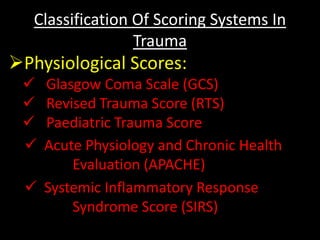
Classification Of Scoring Systems In
Trauma
Physiological Scores:
 Glasgow Coma Scale (GCS)
 Revised Trauma Score (RTS)
 Paediatric Trauma Score
 Acute Physiology and Chronic Health
Evaluation (APACHE)
 Systemic Inflammatory Response
Syndrome Score (SIRS)
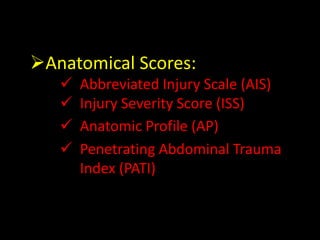
Anatomical Scores:
 Abbreviated Injury Scale (AIS)
 Injury Severity Score (ISS)
 Anatomic Profile (AP)
 Penetrating Abdominal Trauma
Index (PATI)
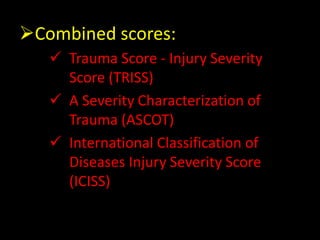
Combined scores:
 Trauma Score - Injury Severity
Score (TRISS)
 A Severity Characterization of
Trauma (ASCOT)
 International Classification of
Diseases Injury Severity Score
(ICISS)
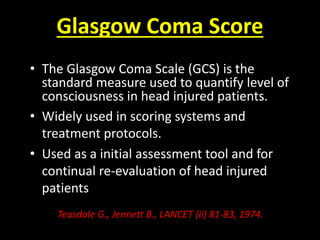
Glasgow Coma Score
• The Glasgow Coma Scale (GCS) is the
standard measure used to quantify level of
consciousness in head injured patients.
• Widely used in scoring systems and
treatment protocols.
• Used as a initial assessment tool and for
continual re-evaluation of head injured
patients
Teasdale G., Jennett B., LANCET (ii) 81-83, 1974.
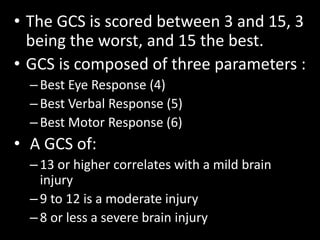
• The GCS is scored between 3 and 15, 3
being the worst, and 15 the best.
• GCS is composed of three parameters :
–Best Eye Response (4)
–Best Verbal Response (5)
–Best Motor Response (6)
• A GCS of:
–13 or higher correlates with a mild brain
injury
–9 to 12 is a moderate injury
–8 or less a severe brain injury
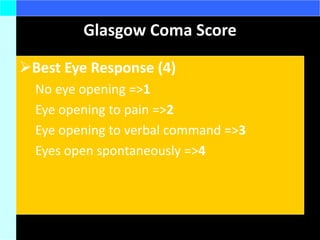
Glasgow Coma Score
Best Eye Response (4)
No eye opening =>1
Eye opening to pain =>2
Eye opening to verbal command =>3
Eyes open spontaneously =>4
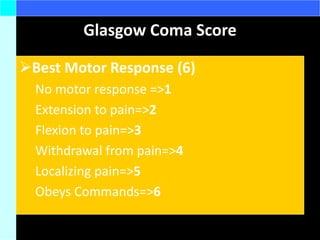
Glasgow Coma Score
Best Motor Response (6)
No motor response =>1
Extension to pain=>2
Flexion to pain=>3
Withdrawal from pain=>4
Localizing pain=>5
Obeys Commands=>6
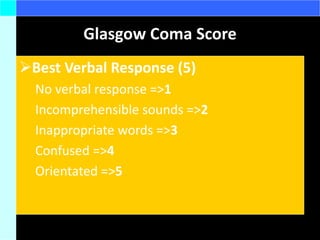
Glasgow Coma Score
Best Verbal Response (5)
No verbal response =>1
Incomprehensible sounds =>2
Inappropriate words =>3
Confused =>4
Orientated =>5
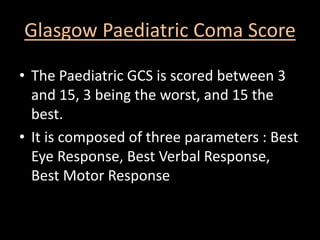
Glasgow Paediatric Coma Score
• The Paediatric GCS is scored between 3
and 15, 3 being the worst, and 15 the
best.
• It is composed of three parameters : Best
Eye Response, Best Verbal Response,
Best Motor Response
• Best Eye Response. (4)
–No eye opening.
–Eye opening to pain.
–Eye opening to verbal command.
–Eyes open spontaneously.
• Best Verbal Response. (5)
–No vocal response
–Inconsolable, agitated
–Inconsistently consolable, moaning.
–Cries but is consolable, inappropriate
interactions.
–Smiles, oriented to sounds, follows
objects, interacts.
• Best Motor Response. (6)
–No motor response.
–Extension to pain.
–Flexion to pain.
–Withdrawal from pain.
–Localising pain.
–Obeys Commands.
• Total GCS=
Motor response + Verbal response + Eye
opening
• Interpretation brain injury
–severe <9
–moderate 9-12
–minor 13 and above
• Note that the phrase 'GCS of 11' is
essentially meaningless, and it is
important to break the figure down
into its components, such as E3V3M5
= GCS 11.
Glasgow Coma scale
• Pros:
– Reliably predicts outcomes for diffuse
and focal lesions
• Cons:
– It does not take into account
• focal or lateralizing signs
• diffuse metabolic processes
• intoxication
Revised Trauma Score (RTS)
• Introduction
–most widely used pre-hospital field
triage tool
• Variables
–Glasgow Coma Scale (GCS)
–systolic blood pressure
–respiratory rate
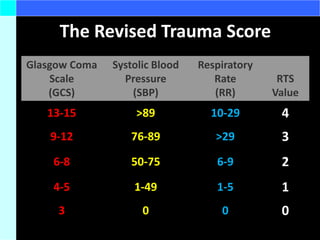
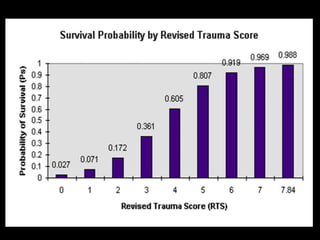
The Revised Trauma Score
0003
11-51-494-5
26-950-756-8
3>2976-899-12
410-29>8913-15
RTS
Value
Respiratory
Rate
(RR)
Systolic Blood
Pressure
(SBP)
Glasgow Coma
Scale
(GCS)
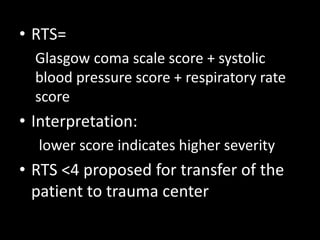
• RTS=
Glasgow coma scale score + systolic
blood pressure score + respiratory rate
score
• Interpretation:
lower score indicates higher severity
• RTS <4 proposed for transfer of the
patient to trauma center
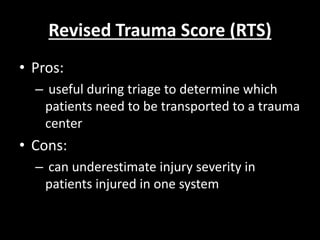
Revised Trauma Score (RTS)
• Pros:
– useful during triage to determine which
patients need to be transported to a trauma
center
• Cons:
– can underestimate injury severity in
patients injured in one system
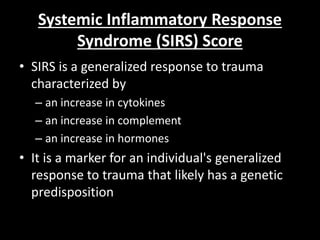
Systemic Inflammatory Response
Syndrome (SIRS) Score
• SIRS is a generalized response to trauma
characterized by
– an increase in cytokines
– an increase in complement
– an increase in hormones
• It is a marker for an individual's generalized
response to trauma that likely has a genetic
predisposition
• associated with conditions such as
–disseminated intravascular coagulopathy
(DIC)
–acute respiratory distress syndrome (ARDS)
–renal failure
–multisystem organ failure
–shock
• Variables
–heart rate > 90 beats/min
–WBC count <4000cells/mm³ OR >12,000
cells/mm³
–respiratory rate > 20 or PaCO2 < 32mm
(4.3kPa)
–temperature less than 36 degrees or greater
than 38 degrees
• Calculation
–each component (heart rate, WBC
count, respiratory rate,
temperature) is given 1 point if it
meets the above criteria
• Interpretation
–A score of 2 or more is consistent
with SIRS
Mangled Extremity Severity Score
• Described by Johansen et al (1990)
• Components include:
– Skeletal / soft-tissue injury
– Limb ischemia
– Shock
– Age
• Interpretation:
– a MESS score of greater than or equal to 7 had a 100%
predictable value for amputation
Clin Orthop Relat Res. 1990 Jul;(256):80-6
Johansen K et al
Limb salvage versus amputation. Preliminary results of the Mangled Extremity
Severity Score
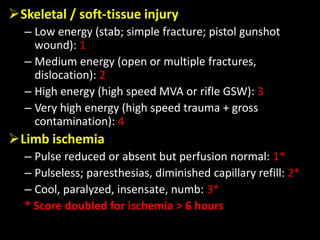
Skeletal / soft-tissue injury
– Low energy (stab; simple fracture; pistol gunshot
wound): 1
– Medium energy (open or multiple fractures,
dislocation): 2
– High energy (high speed MVA or rifle GSW): 3
– Very high energy (high speed trauma + gross
contamination): 4
Limb ischemia
– Pulse reduced or absent but perfusion normal: 1*
– Pulseless; paresthesias, diminished capillary refill: 2*
– Cool, paralyzed, insensate, numb: 3*
* Score doubled for ischemia > 6 hours
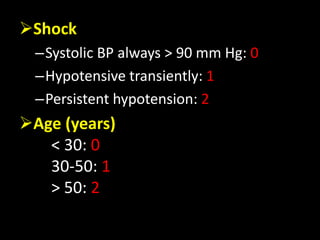
Shock
–Systolic BP always > 90 mm Hg: 0
–Hypotensive transiently: 1
–Persistent hypotension: 2
Age (years)
< 30: 0
30-50: 1
> 50: 2
Mangled Extremity Severity
Score
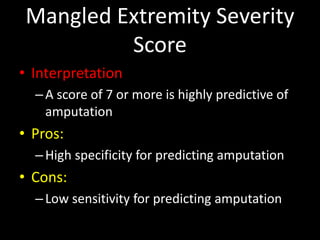
• Interpretation
–A score of 7 or more is highly predictive of
amputation
• Pros:
–High specificity for predicting amputation
• Cons:
–Low sensitivity for predicting amputation
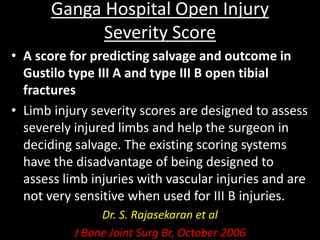
Ganga Hospital Open Injury
Severity Score
• A score for predicting salvage and outcome in
Gustilo type III A and type III B open tibial
fractures
• Limb injury severity scores are designed to assess
severely injured limbs and help the surgeon in
deciding salvage. The existing scoring systems
have the disadvantage of being designed to
assess limb injuries with vascular injuries and are
not very sensitive when used for III B injuries.
Dr. S. Rajasekaran et al
J Bone Joint Surg Br, October 2006
• Ganga Hospital Open Injury Severity Score
was evolved to overcome the above
disadvantages.
• The severity of injury to the covering
structures, skeletal structures and
musculotendinous & nerve units were
assessed individually on an incremental
score of one to five.
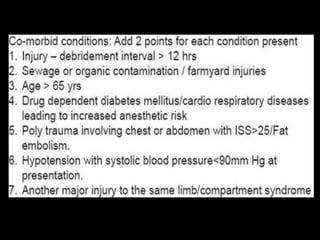
• Seven Co-morbid conditions known to
influence the management and prognosis
were each given a score of two.
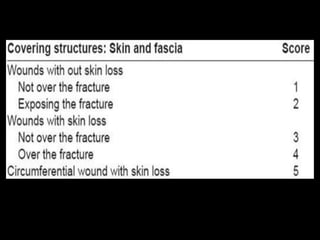
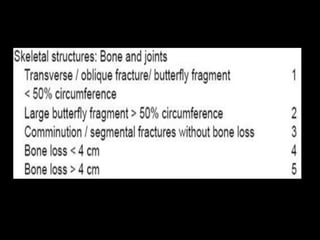
• The score comprises of following
components:
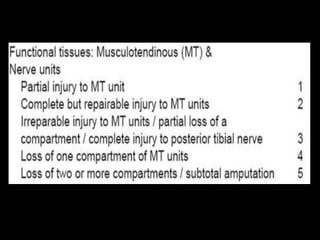
–Covering structures: skin and fascia (1-5)
–Skeletal structures: bone and joints (1-5)
–Functional tissues: musculotendinous
(MT) and nerve units (1-5)
–Co-morbid conditions (0-14)
• The total score was used to predict
salvage and a score of 14 had the
highest specificity and sensitivity for
indicating amputation.
• The individual scores for covering
and functional tissues were also
found to offer specific guidelines in
the reconstruction protocols of these
complex injury.
Injury Severity Score (ISS)
• The Injury Severity Score (ISS) is an established
medical score to assess trauma severity.
• It correlates with mortality, morbidity and
hospitalization time after trauma.
• The AIS Committee of the “Association for the
Advancement of Automotive Medicine” (AAAM)
designed and improves upon the scale.
• It is the
– first scoring system to be based on anatomic
criteria
– defines injury severity for comparative purposes
• To calculate an ISS for an injured person, the
body is divided into six ISS body regions:
– Head or neck - including cervical spine
– Face - including the facial skeleton, nose, mouth,
eyes and ears
– Chest - thoracic spine and diaphragm
– Abdomen or pelvic contents - abdominal organs
and lumbar spine
– Extremities or pelvic girdle - pelvic skeleton
– External
• Calculation is based upon the Abbreviated
Injury Scale (AIS) grades
– 0 - no injury
– 1 - minor
– 2 - moderate
– 3 - severe (not life-threatening)
– 4 - severe (life-threatening, survival probable)
– 5 - severe (critical, survival uncertain)
– 6 - maximal, possibly fatal
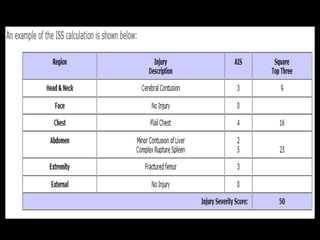
• ISS = sum of squares for the highest
AIS grades in the three most severely
injured ISS body regions
–ISS = A2 + B2 + C2
• where A, B, C are the AIS scores of the
three most severely injured ISS
body regions
–scores range from 1 to 75
• If an injury is assigned an AIS of 6
(unsurvivable injury), the ISS score is
automatically assigned to 75
• It is used to define the term
major trauma. A major trauma
(or polytrauma) is defined as the
Injury Severity Score being
greater than 15.
• Interpretation ISS > 15 associated
with mortality of 10%
• Pros:
– integrates anatomic areas of injury in formulating a
prediction of outcomes
• Cons:
– difficult to calculate during initial evaluation and
resuscitation in emergency room
– difficult to predict outcomes for patients with severe
single body area injury
• New Injury Severity Score (NISS) overcomes this
deficit
• New Injury Severity Score (NISS)
– takes three highest scores regardless of anatomic area
– more predictive of complications and mortality than
ISS
• Modified Injury Severity Score (MISS)
– similar to ISS but for pediatric trauma
– categorizes body into 5 areas, instead of 6
– sum of the squares for the highest injury score
grades in the three most severely injured body
regions
Trauma Score - Injury Severity Score :
TRISS
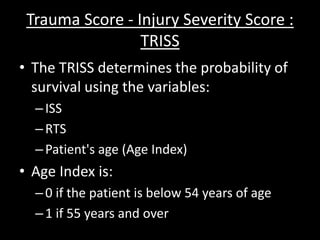
• The TRISS determines the probability of
survival using the variables:
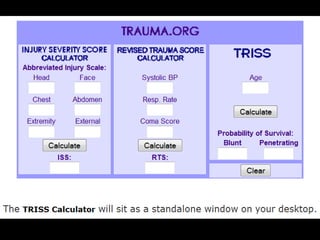
–ISS
–RTS
–Patient's age (Age Index)
• Age Index is:
–0 if the patient is below 54 years of age
–1 if 55 years and over
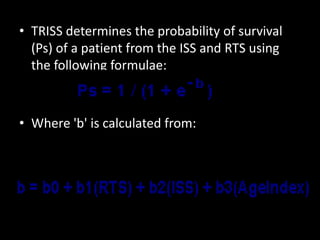
• TRISS determines the probability of survival
(Ps) of a patient from the ISS and RTS using
the following formulae:
• Where 'b' is calculated from:
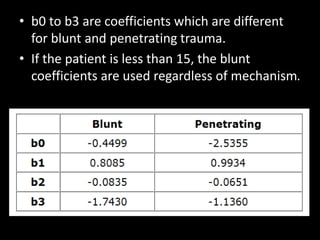
• b0 to b3 are coefficients which are different
for blunt and penetrating trauma.
• If the patient is less than 15, the blunt
coefficients are used regardless of mechanism.
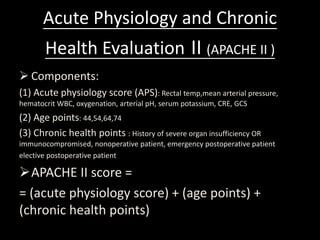
Acute Physiology and Chronic
Health Evaluation II (APACHE II )
 Components:
(1) Acute physiology score (APS): Rectal temp,mean arterial pressure,
hematocrit WBC, oxygenation, arterial pH, serum potassium, CRE, GCS
(2) Age points: 44,54,64,74
(3) Chronic health points : History of severe organ insufficiency OR
immunocompromised, nonoperative patient, emergency postoperative patient
elective postoperative patient
APACHE II score =
= (acute physiology score) + (age points) +
(chronic health points)
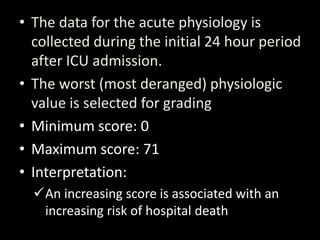
• The data for the acute physiology is
collected during the initial 24 hour period
after ICU admission.
• The worst (most deranged) physiologic
value is selected for grading
• Minimum score: 0
• Maximum score: 71
• Interpretation:
An increasing score is associated with an
increasing risk of hospital death
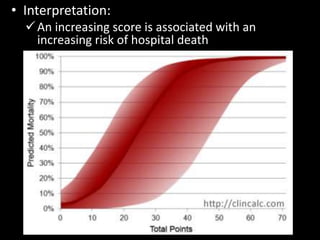
• Interpretation:
An increasing score is associated with an
increasing risk of hospital death
Thank You

Trauma scoring systems

  • 1.
    Trauma Scoring Systems Dr. ApoorvJain D’Ortho, DNB Ortho drapoorvjain23@gmail.com +91-9845669975
  • 2.
    Purpose of scoringsystems • Appropriate triage and classification of trauma patients • Predict outcomes (for patient and family counseling) • Quality assurance • Research – extremely useful for the study of outcomes • Reimbursement purposes
  • 3.
    Classification Of ScoringSystems In Trauma Physiological Scores:  Glasgow Coma Scale (GCS)  Revised Trauma Score (RTS)  Paediatric Trauma Score  Acute Physiology and Chronic Health Evaluation (APACHE)  Systemic Inflammatory Response Syndrome Score (SIRS)
  • 4.
    Anatomical Scores:  AbbreviatedInjury Scale (AIS)  Injury Severity Score (ISS)  Anatomic Profile (AP)  Penetrating Abdominal Trauma Index (PATI)
  • 5.
    Combined scores:  TraumaScore - Injury Severity Score (TRISS)  A Severity Characterization of Trauma (ASCOT)  International Classification of Diseases Injury Severity Score (ICISS)
  • 6.
    Glasgow Coma Score •The Glasgow Coma Scale (GCS) is the standard measure used to quantify level of consciousness in head injured patients. • Widely used in scoring systems and treatment protocols. • Used as a initial assessment tool and for continual re-evaluation of head injured patients Teasdale G., Jennett B., LANCET (ii) 81-83, 1974.
  • 7.
    • The GCSis scored between 3 and 15, 3 being the worst, and 15 the best. • GCS is composed of three parameters : –Best Eye Response (4) –Best Verbal Response (5) –Best Motor Response (6) • A GCS of: –13 or higher correlates with a mild brain injury –9 to 12 is a moderate injury –8 or less a severe brain injury
  • 8.
    Glasgow Coma Score BestEye Response (4) No eye opening =>1 Eye opening to pain =>2 Eye opening to verbal command =>3 Eyes open spontaneously =>4
  • 9.
    Glasgow Coma Score BestMotor Response (6) No motor response =>1 Extension to pain=>2 Flexion to pain=>3 Withdrawal from pain=>4 Localizing pain=>5 Obeys Commands=>6
  • 10.
    Glasgow Coma Score BestVerbal Response (5) No verbal response =>1 Incomprehensible sounds =>2 Inappropriate words =>3 Confused =>4 Orientated =>5
  • 11.
    Glasgow Paediatric ComaScore • The Paediatric GCS is scored between 3 and 15, 3 being the worst, and 15 the best. • It is composed of three parameters : Best Eye Response, Best Verbal Response, Best Motor Response
  • 12.
    • Best EyeResponse. (4) –No eye opening. –Eye opening to pain. –Eye opening to verbal command. –Eyes open spontaneously.
  • 13.
    • Best VerbalResponse. (5) –No vocal response –Inconsolable, agitated –Inconsistently consolable, moaning. –Cries but is consolable, inappropriate interactions. –Smiles, oriented to sounds, follows objects, interacts.
  • 14.
    • Best MotorResponse. (6) –No motor response. –Extension to pain. –Flexion to pain. –Withdrawal from pain. –Localising pain. –Obeys Commands.
  • 15.
    • Total GCS= Motorresponse + Verbal response + Eye opening • Interpretation brain injury –severe <9 –moderate 9-12 –minor 13 and above
  • 16.
    • Note thatthe phrase 'GCS of 11' is essentially meaningless, and it is important to break the figure down into its components, such as E3V3M5 = GCS 11.
  • 17.
    Glasgow Coma scale •Pros: – Reliably predicts outcomes for diffuse and focal lesions • Cons: – It does not take into account • focal or lateralizing signs • diffuse metabolic processes • intoxication
  • 18.
    Revised Trauma Score(RTS) • Introduction –most widely used pre-hospital field triage tool • Variables –Glasgow Coma Scale (GCS) –systolic blood pressure –respiratory rate
  • 19.
    The Revised TraumaScore 0003 11-51-494-5 26-950-756-8 3>2976-899-12 410-29>8913-15 RTS Value Respiratory Rate (RR) Systolic Blood Pressure (SBP) Glasgow Coma Scale (GCS)
  • 20.
    • RTS= Glasgow comascale score + systolic blood pressure score + respiratory rate score • Interpretation: lower score indicates higher severity • RTS <4 proposed for transfer of the patient to trauma center
  • 22.
    Revised Trauma Score(RTS) • Pros: – useful during triage to determine which patients need to be transported to a trauma center • Cons: – can underestimate injury severity in patients injured in one system
  • 23.
    Systemic Inflammatory Response Syndrome(SIRS) Score • SIRS is a generalized response to trauma characterized by – an increase in cytokines – an increase in complement – an increase in hormones • It is a marker for an individual's generalized response to trauma that likely has a genetic predisposition
  • 24.
    • associated withconditions such as –disseminated intravascular coagulopathy (DIC) –acute respiratory distress syndrome (ARDS) –renal failure –multisystem organ failure –shock
  • 25.
    • Variables –heart rate> 90 beats/min –WBC count <4000cells/mm³ OR >12,000 cells/mm³ –respiratory rate > 20 or PaCO2 < 32mm (4.3kPa) –temperature less than 36 degrees or greater than 38 degrees
  • 26.
    • Calculation –each component(heart rate, WBC count, respiratory rate, temperature) is given 1 point if it meets the above criteria • Interpretation –A score of 2 or more is consistent with SIRS
  • 27.
    Mangled Extremity SeverityScore • Described by Johansen et al (1990) • Components include: – Skeletal / soft-tissue injury – Limb ischemia – Shock – Age • Interpretation: – a MESS score of greater than or equal to 7 had a 100% predictable value for amputation Clin Orthop Relat Res. 1990 Jul;(256):80-6 Johansen K et al Limb salvage versus amputation. Preliminary results of the Mangled Extremity Severity Score
  • 28.
    Skeletal / soft-tissueinjury – Low energy (stab; simple fracture; pistol gunshot wound): 1 – Medium energy (open or multiple fractures, dislocation): 2 – High energy (high speed MVA or rifle GSW): 3 – Very high energy (high speed trauma + gross contamination): 4 Limb ischemia – Pulse reduced or absent but perfusion normal: 1* – Pulseless; paresthesias, diminished capillary refill: 2* – Cool, paralyzed, insensate, numb: 3* * Score doubled for ischemia > 6 hours
  • 29.
    Shock –Systolic BP always> 90 mm Hg: 0 –Hypotensive transiently: 1 –Persistent hypotension: 2 Age (years) < 30: 0 30-50: 1 > 50: 2
  • 30.
    Mangled Extremity Severity Score •Interpretation –A score of 7 or more is highly predictive of amputation • Pros: –High specificity for predicting amputation • Cons: –Low sensitivity for predicting amputation
  • 31.
    Ganga Hospital OpenInjury Severity Score • A score for predicting salvage and outcome in Gustilo type III A and type III B open tibial fractures • Limb injury severity scores are designed to assess severely injured limbs and help the surgeon in deciding salvage. The existing scoring systems have the disadvantage of being designed to assess limb injuries with vascular injuries and are not very sensitive when used for III B injuries. Dr. S. Rajasekaran et al J Bone Joint Surg Br, October 2006
  • 32.
    • Ganga HospitalOpen Injury Severity Score was evolved to overcome the above disadvantages. • The severity of injury to the covering structures, skeletal structures and musculotendinous & nerve units were assessed individually on an incremental score of one to five. • Seven Co-morbid conditions known to influence the management and prognosis were each given a score of two.
  • 33.
    • The scorecomprises of following components: –Covering structures: skin and fascia (1-5) –Skeletal structures: bone and joints (1-5) –Functional tissues: musculotendinous (MT) and nerve units (1-5) –Co-morbid conditions (0-14)
  • 38.
    • The totalscore was used to predict salvage and a score of 14 had the highest specificity and sensitivity for indicating amputation. • The individual scores for covering and functional tissues were also found to offer specific guidelines in the reconstruction protocols of these complex injury.
  • 39.
    Injury Severity Score(ISS) • The Injury Severity Score (ISS) is an established medical score to assess trauma severity. • It correlates with mortality, morbidity and hospitalization time after trauma. • The AIS Committee of the “Association for the Advancement of Automotive Medicine” (AAAM) designed and improves upon the scale.
  • 40.
    • It isthe – first scoring system to be based on anatomic criteria – defines injury severity for comparative purposes • To calculate an ISS for an injured person, the body is divided into six ISS body regions: – Head or neck - including cervical spine – Face - including the facial skeleton, nose, mouth, eyes and ears – Chest - thoracic spine and diaphragm – Abdomen or pelvic contents - abdominal organs and lumbar spine – Extremities or pelvic girdle - pelvic skeleton – External
  • 41.
    • Calculation isbased upon the Abbreviated Injury Scale (AIS) grades – 0 - no injury – 1 - minor – 2 - moderate – 3 - severe (not life-threatening) – 4 - severe (life-threatening, survival probable) – 5 - severe (critical, survival uncertain) – 6 - maximal, possibly fatal
  • 42.
    • ISS =sum of squares for the highest AIS grades in the three most severely injured ISS body regions –ISS = A2 + B2 + C2 • where A, B, C are the AIS scores of the three most severely injured ISS body regions –scores range from 1 to 75 • If an injury is assigned an AIS of 6 (unsurvivable injury), the ISS score is automatically assigned to 75
  • 44.
    • It isused to define the term major trauma. A major trauma (or polytrauma) is defined as the Injury Severity Score being greater than 15. • Interpretation ISS > 15 associated with mortality of 10%
  • 45.
    • Pros: – integratesanatomic areas of injury in formulating a prediction of outcomes • Cons: – difficult to calculate during initial evaluation and resuscitation in emergency room – difficult to predict outcomes for patients with severe single body area injury • New Injury Severity Score (NISS) overcomes this deficit • New Injury Severity Score (NISS) – takes three highest scores regardless of anatomic area – more predictive of complications and mortality than ISS
  • 46.
    • Modified InjurySeverity Score (MISS) – similar to ISS but for pediatric trauma – categorizes body into 5 areas, instead of 6 – sum of the squares for the highest injury score grades in the three most severely injured body regions
  • 47.
    Trauma Score -Injury Severity Score : TRISS • The TRISS determines the probability of survival using the variables: –ISS –RTS –Patient's age (Age Index) • Age Index is: –0 if the patient is below 54 years of age –1 if 55 years and over
  • 48.
    • TRISS determinesthe probability of survival (Ps) of a patient from the ISS and RTS using the following formulae: • Where 'b' is calculated from:
  • 49.
    • b0 tob3 are coefficients which are different for blunt and penetrating trauma. • If the patient is less than 15, the blunt coefficients are used regardless of mechanism.
  • 51.
    Acute Physiology andChronic Health Evaluation II (APACHE II )  Components: (1) Acute physiology score (APS): Rectal temp,mean arterial pressure, hematocrit WBC, oxygenation, arterial pH, serum potassium, CRE, GCS (2) Age points: 44,54,64,74 (3) Chronic health points : History of severe organ insufficiency OR immunocompromised, nonoperative patient, emergency postoperative patient elective postoperative patient APACHE II score = = (acute physiology score) + (age points) + (chronic health points)
  • 52.
    • The datafor the acute physiology is collected during the initial 24 hour period after ICU admission. • The worst (most deranged) physiologic value is selected for grading • Minimum score: 0 • Maximum score: 71 • Interpretation: An increasing score is associated with an increasing risk of hospital death
  • 53.
    • Interpretation: An increasingscore is associated with an increasing risk of hospital death
  • 54.