POLYTRAUMA/
MULTIPLE INJURIES/
MULTIPLE FRACTURES
DR.LUQMAN FAZAL WAHID
HOUSE OFFICER
CASE PRESENTATION
• Male patient 28 years presented to the ER following a
motor car accident 30 min ago complaining of chest
pain, cut wound in the forehead with minimal bleeding,
pain in the right forearm and multiple
fractures(including open fractures)
• By history the patient had a blunt trauma to the head
and chest in the dashboard. Other previous medical
history is irrelevant.
ON EXAMINATION:
Airway: Clear
• Cervical Spine immobilization after neck examination
with no major abnormality
Breathing:
• RR: 20/min
• Equal air entry bilateral with no adventitious sounds.
• Tenderness over the sternum.
• SpO2: 95% on room air.
Circulation:
There is no major site of bleeding, vital signs include:
• HR: 100/min felt central and peripheral, equal on
both sides.
• Blood pressure: 90/60 mmHg.
• Capillary refill time: 1.5 sec.
• Temp: 37.1C
• Neck veins not congested
• There is wound in the forehead 5X3 cm.
Disability
• GCS 15/15
• No loss of cons, no nausea or vomiting, no
bleeding per orifices, no transient amnesia and
no fits.
• Pupils are equal bilateral and reactive to light.
• Blood sugar 140 mg/dl.
POLYTRAUMA
• Polytrauma or multiple trauma is a medical term describing the condition of a
person who has been subjected to multiple traumatic injuries, such as a
serious head injury in addition to a serious burn. It is defined via an Injury
Severity Score ISS >=16 OR
Patient with anyone of the following combination of injuries
TWO MAJOR SYSTEM INJURY + ONE MAJOR LIMB INJURY.
ONE MAJOR SYSTEM INJURY + TWO MAJOR LIMB INJURY.
ONE MAJOR SYSTEM INJURY + ONE OPEN GRADE III SKELETAL
INJURY.
UNSTABLE PELVIS FRACTURE WITH ASSOCIATED VISCERAL
INJURY.
• Polytrauma is a multi-system injury and needs management by a
team of surgeons and physicians. Orthopedic surgeon is one of the
team member of trauma unit.
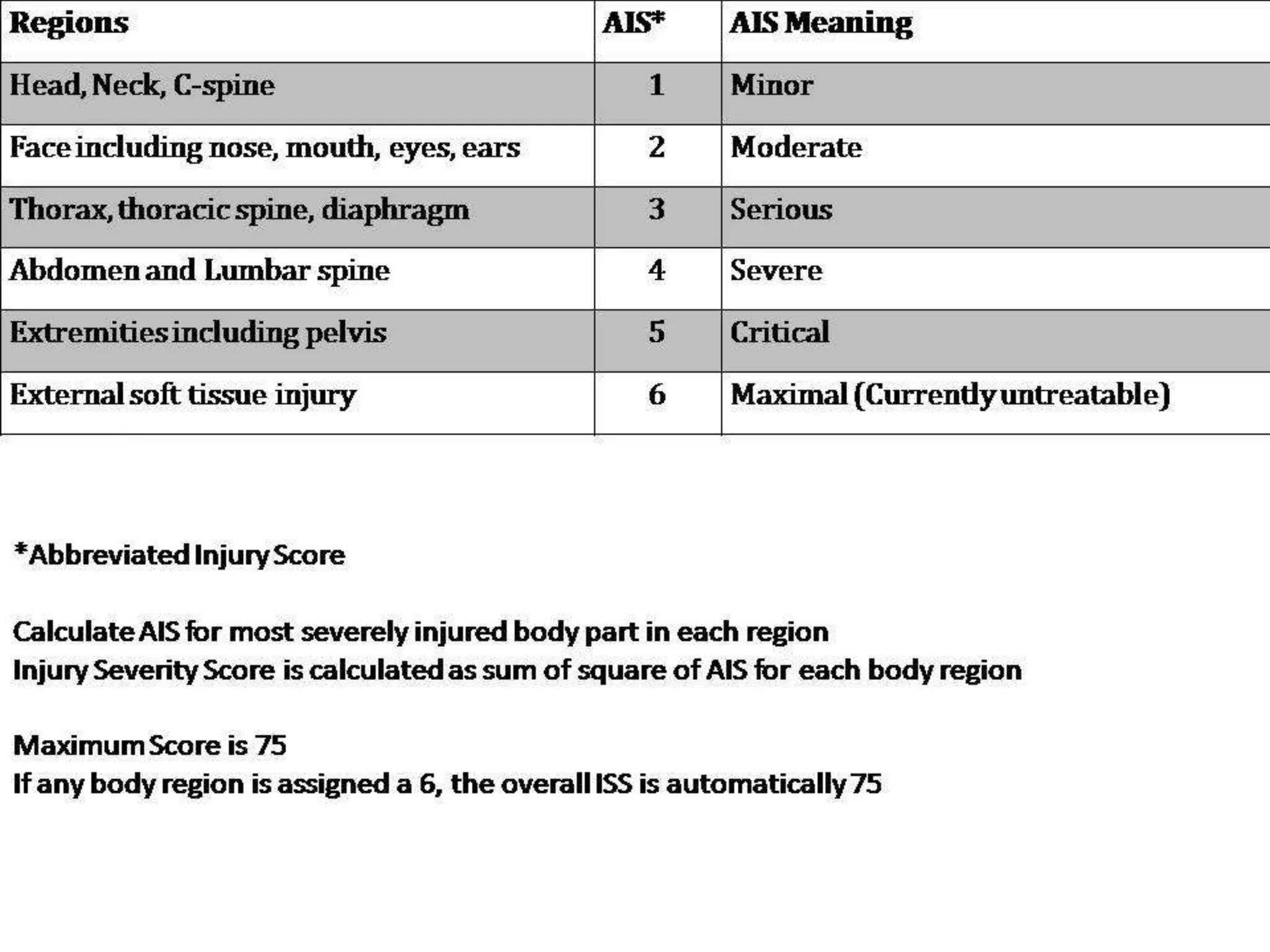
• The Injury Severity Score (ISS) is an established medical score to
assess trauma severity. It correlates with mortality, morbidity and
hospitalization time after trauma. It is used to define the term major
trauma. A major trauma (or polytrauma) is defined as the Injury
Severity Score being greater than 15.
• CLASSIFICATION OF TRAUMA SCORING SYSTEMS
• physiologic
• Revised Trauma Score (RTS)
• Acute Physiology and Chronic Health Evaluation (APACHE)
• Sequential Organ Failure Assessment Score (SOFA)
• Systemic Inflammatory Response Syndrome Score (SIRS)
• Emergency Trauma Score
• anatomic
• Abbreviated Injury Score (AIS)
• Injury Severity Score (ISS)
• New Injury Severity Score (NISS)
• Anatomic Profile (AP)
• Penetrating Abdominal Trauma Index (PATI)
• ICD-based Injury Severity Score (ICISS)
• Trauma Mortality Prediction Model (TMPM-ICD9)
• combined
• Trauma Score - Injury Severity Score (TRISS)
• A Severity Characterization of Trauma (ASCOT)
• International Classification of Diseases Injury Severity Score (ICISS)
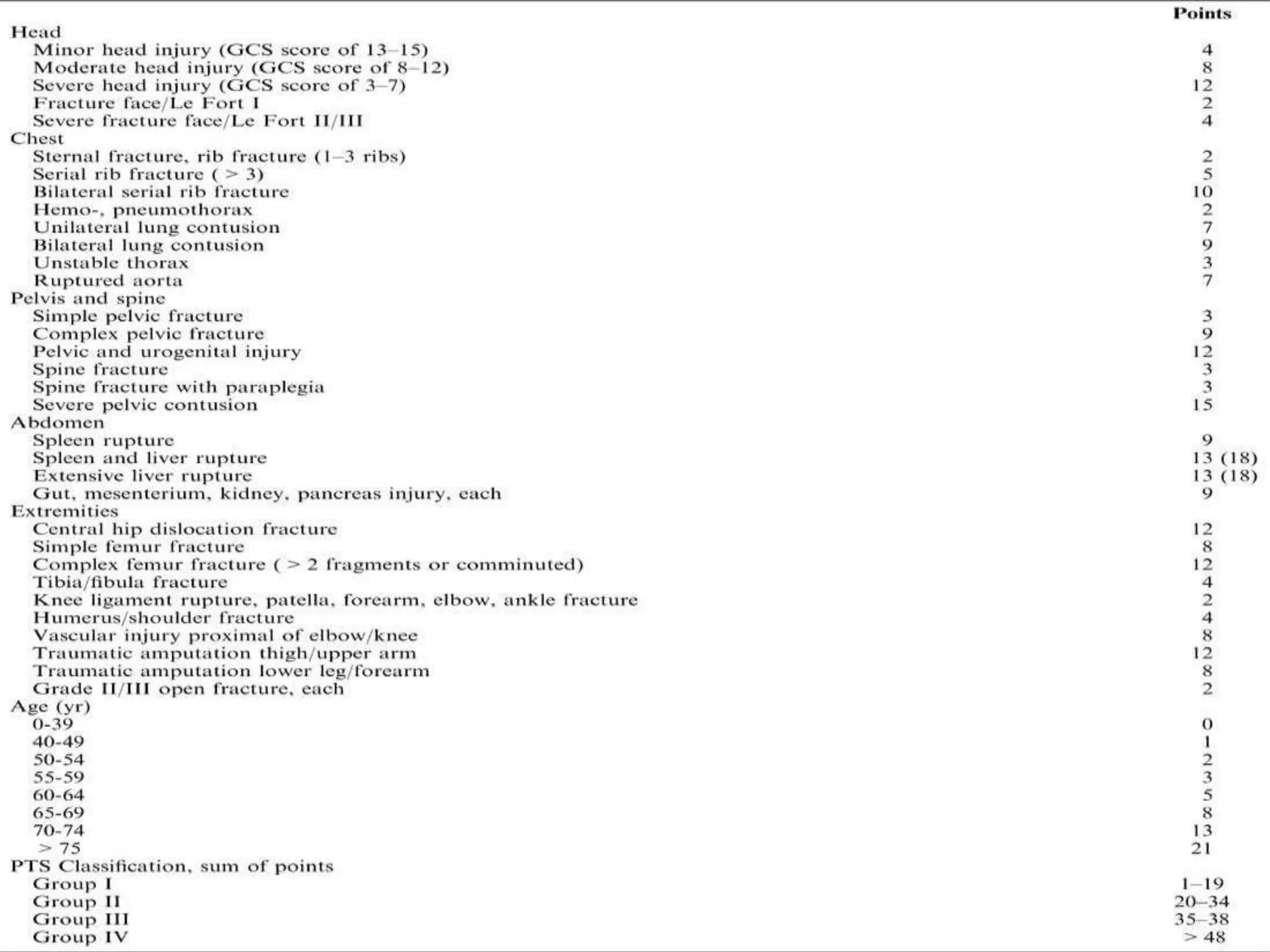
HANNOVER POLYTRAUMA
SCORE
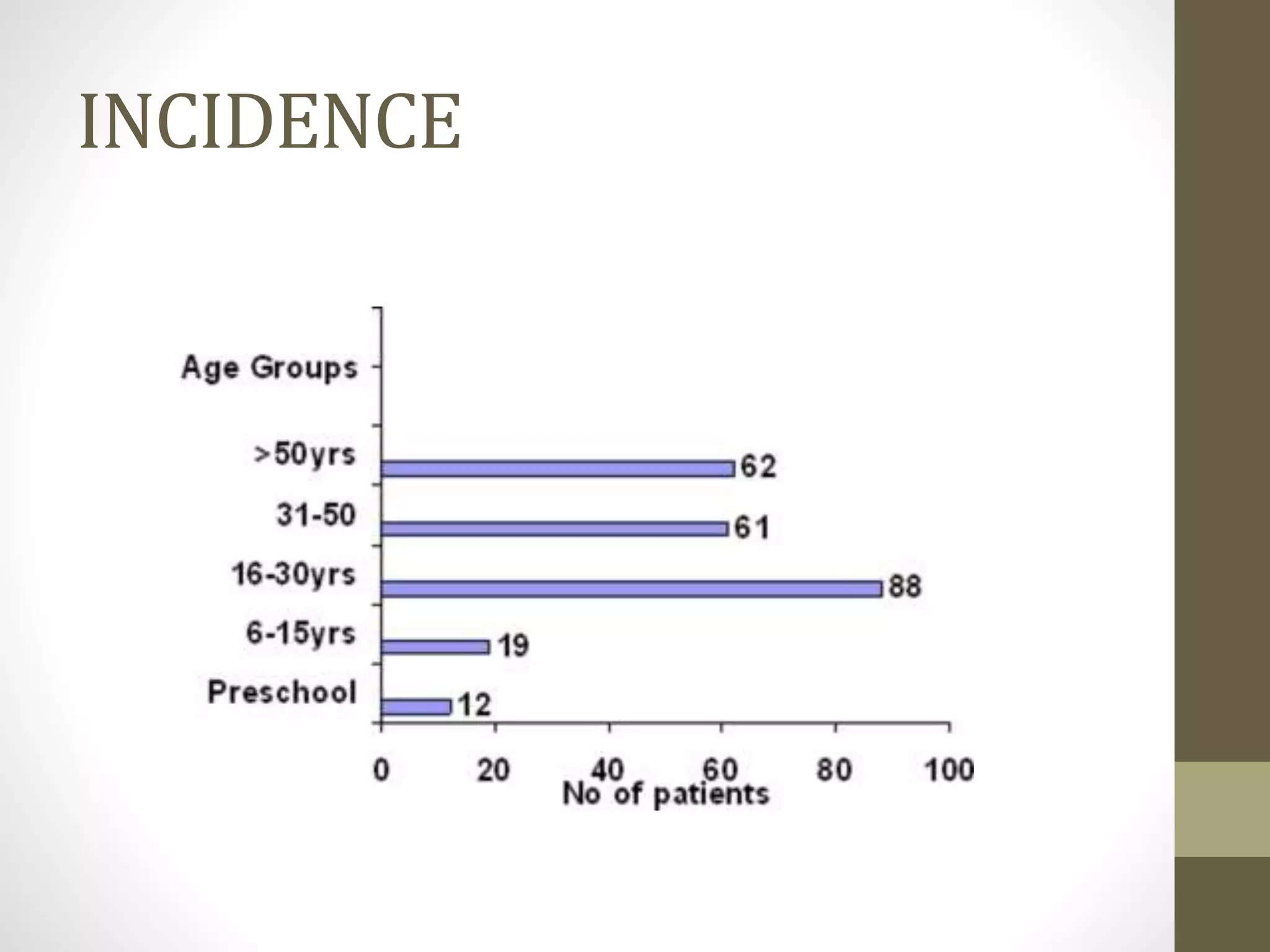
INCIDENCE
• MORE THAN 75% MALE OF AGE GROUP(15YRS-35YRS) ARE
AFFECTED (WORLDWIDE)
• MORE THAN 200,000 PEOPLE DIE EVERY YEAR BECAUSE OF
POLYTRAUMA IN PAKISTAN. MAJOR CAUSE OF POLYTRAUMA
IS MOTORBIKE ACCIDENTS.
• POLYTRAUMA -IS THE MOST DANGEROUS AND SILENT
KILLER.
• AND NOW A DAYS TRAUMA IS KNOWN AS THE MOST
NEGLECTED DISEASE.
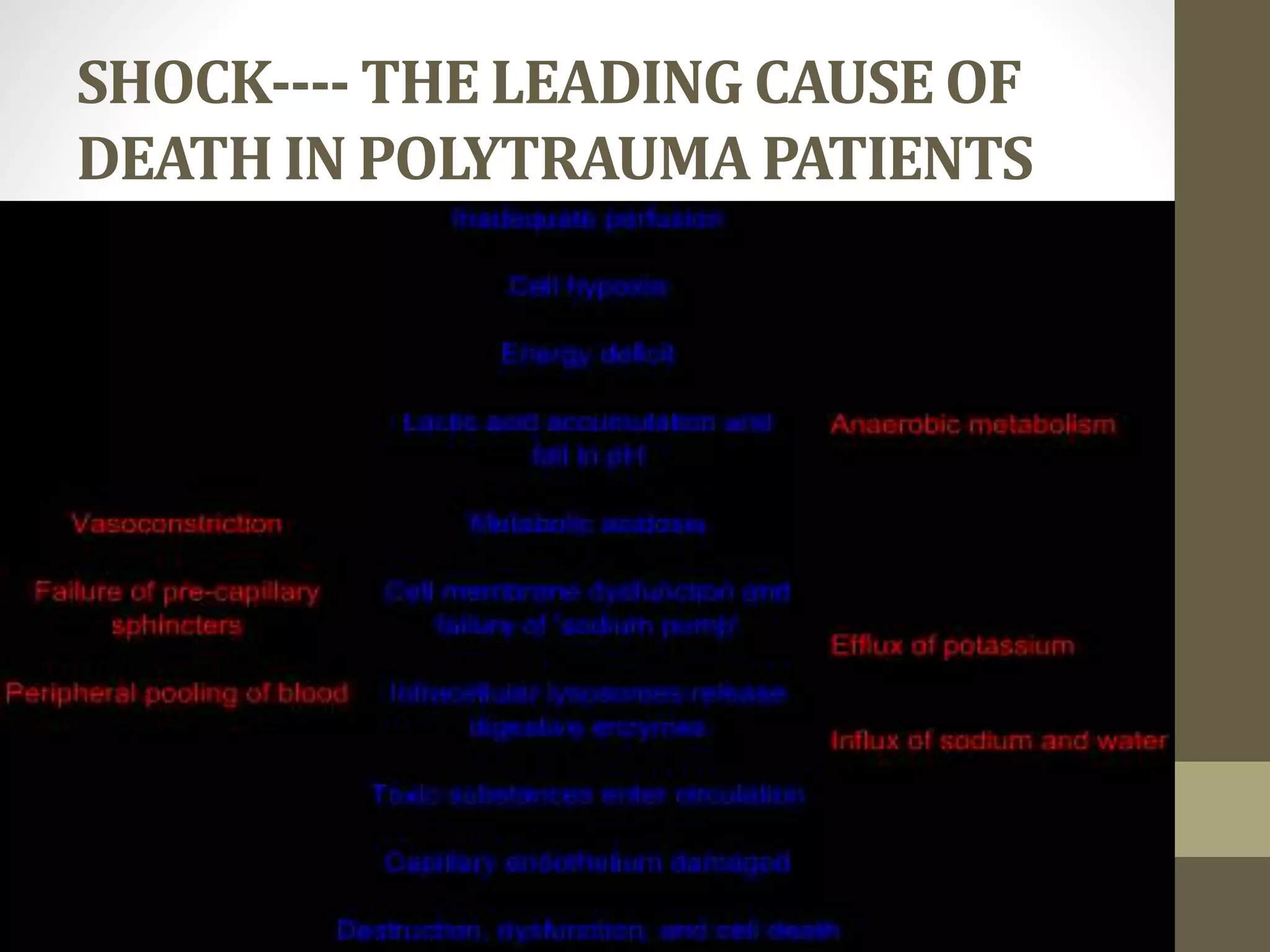
PATHOPHYSIOLOGY
SHOCK---- THE LEADING CAUSE OF
DEATH IN POLYTRAUMA PATIENTS
MANAGEMENT AND
INVESTIGATION IN ER
TO MANAGE THE CASE OF POLYTRAUMA, ATLS APPROACH IS
REQUIRED.
THE COMPONENTS OF ATLS ARE
 PRIMARY SURVEY--- WHAT IS KILLING THE PT.
 RESUSCITATION--- TREAT WHAT IS KILLING THE PT.
 SECONDARY SURVEY--- TO IDENTIFY ALL OTHER INJURIES.
 DEFINITIVE CARE--- TO DEVELOP A DEFINITIVE
MANAGEMENT PLAN
THE GOLDEN HOUR
• The Golden Hour is a theory stating that
the best chance of survival occurs when a
seriously injured patient has emergency
management within ONE hour of the
injury.
Primary survey
• Airway with cervical spine control.
• Breathing and ventilation
• Circulation –control external bleeding.
• Dysfunction of the central nervous system
• Exposure (undress)/Environment(temp.)
Control
Airway and cervical spine
• Always assume that patient has cervical spine
injury
• If patient can talk then he is able to maintain
own airway
• If airway compromised initially attempt a chin lift
and clear airway of foreign bodies
• Intubate or cricothyroidotomy
• Give 100% Oxygen
BREATHING
• Check position of trachea, respiratory rate and
air entry
• If clinical evidence of tension pneumothorax will
need immediate relief
• Place venous cannula through second intercostal
space in the mid-clavicular line
• If open chest wound seal with occlusive dressing
Circulation and
haemorrhage control
• Assess pulse, capillary return and state of neck
veins
• Identify exsanguinating haemorrhage and apply
direct pressure
• Place two large calibre intravenous cannulas
Give intravenous fluids (crystalloid or colloid)
• Attach patient to ECG monitor
Dysfunction
Assess level of consciousness using AVPU
method
A = alert
V = responding to voice
P = responding to pain
U = unresponsive
Assess pupil size, equality and
responsiveness
Exposure
• Avoid hypothermia
Fully undress patients
Avoid hypothermia
RESPONSE TO EARLY
RESUSCITATION
RADIOLOGY
 Once the patient is stabilized the patient is sent to
radiology for the survey:
 Cervical spine X-ray (AP and lateral view)
 Chest X- ray (Rib cage)
 Pelvis X-ray
 Abdomen and Pelvis U/S
 CT brain is ordered if there is suspicion of head
trauma
 X-ray of extremities if fracture is suspected.
ADJUNCT TO PRIMARY SURVEY &
RESUSCITATION
A. Electro-cardiographic Monitoring
B. Urinary & Gastric Catheter
C. X-Ray & Diagnostic Studies
• C-spine lateral , CXR, Pelvic film (TRAUMA SERIES)
• Essential x-ray should NOT be avoid in pregnant pt.
SECONDARY SURVEY
• Does not begin until the primary survey (ABCDEs) is
completed, resuscitative effort are well established &
the pt is demonstrating normalization of vital sign.
• Head to Toe evaluation & reassessment of all vital signs.
• A complete neurological exam is performed including a
GCS score.
• Special procedure is order.
End point of resuscitation
• Stable hemodynamics
• Stable oxygen saturation
• Lactate level below 2 mmol / L
• No cogaulation disturbance
• Normal temp
• Urinary output > 1ml /kg/hr
• No requirement of inotropic support
•Management of
life threatening
orthopedic
injuries
• Any pt suspected of spinal injury must be
immobilised unless spine has been cleared
• Cervical collar
• Spine board
• Log roll technique
Signs in an Unconcious patients
• Neurological shock (Low BP & HR)
• Spinal shock - Flaccid areflexia
• Flexed upper limbs (loss of extensor
innervation below C5)
• Responds to pain above the clavicle only
• Priapism – may be incomplete.
• Diaphragmatic breathing
Spine clearance
Purpose:
• to identify accurately and early following blunt injury to the
spine the presence or absence of a diagnosis of spinal column
injury
Ensure that
• There is no spinal injury to produce avoidable disabiity or
symtomps
• There is no important Fracture
• We avoid overprotection with its attendant risk
• In all pt consistent with spinal injury maintain spinal
preacutions untill thorough clinical and radiographic
evaluation of spine is completed
Pelvic injuries
• Pelvic injury is one of few bony injury that can lead to pt
death
• Pelvic injuries are assesed during secondary survey
• Pelvis x ray is mandatory in polytrauma pt
• Can lead to life threatening hemorrhage
• Open pelvic # 50% mortality
Early total care (ETC)
• That is definitive fracture treatment within 24 hr
,unreamed nail preferred
• Used in stable pts
• Avoid in severe thoracic injuries
hemorrhagic shock
head injury
• Advantage pain relief , less infection, early
mobilization, Dec. thromboembolism
Damage control
• THE DEFINITIVE TREATMENT FOR POLY TRAUMA PTS. IS
DAMAGE CONTROL SURGERY.
• Surgical treatments intend to control but not to definitively repair
the trauma induced injuries early after trauma
• Used in unstable and extremis pts.
Damage Control Surgery
STAGED LAPROTOMY
• Arrest bleeding , and the resulting coagulopathy.
• Limit contamination and the sequelae .
• Close the abdomen to limit heat and fluid loss,
• and to protect viscera.
• Damage control orthopedics'
• 1st stage temporary stabilization of #
• 2nd stage resuscitation and optimization
• 3rd stage definitive fracture fixation
• External fixator is most commonly used for temporary
stabilization
• Change to definitive # fixation is done in 2nd week
PRIORITIES
•Tibia
•Femur
•Pelvis
•Spine
•Upper extremity
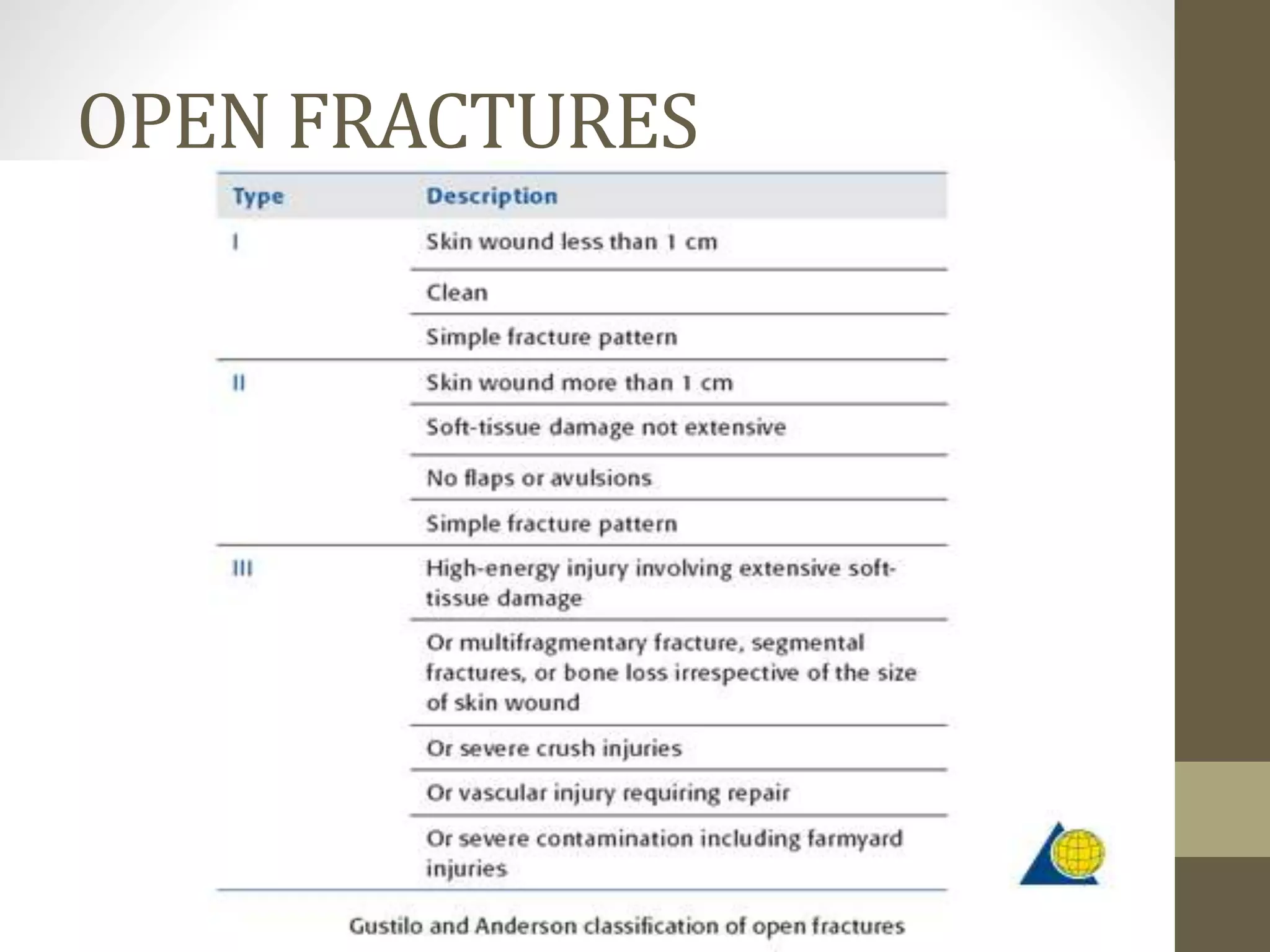
OPEN FRACTURES
Emergency management of
open fractures
• ATLS resuscitation
Photograph
Wound swab
Remove gross contamination and apply moist sterile
dressing (Betadine)
Antibiotics (Give ASAP, make sure they are given not just
written on the drug chart)
Splint the limb
Check tetanus prophylaxis (click here)
Arrange for urgent surgical debridement/ washout and
stabilization of the fracture
Conventional treatment advocates debridement and
washout within 6-8 hours
DEFINITIVE TREATMENT
• Early administration of systemic antibiotics and timely surgical
debridement, skeletal stabilisation and delayed wound closure
are the mainstay principles of treatment in open fractures
• The restoration of skeletal stability is very important for the
treatment of the soft tissues and prevention of infection.
Conventional timing of definitive debridement and washout is
6-8 hours
Polytrauma

Polytrauma

  • 2.
  • 3.
    CASE PRESENTATION • Malepatient 28 years presented to the ER following a motor car accident 30 min ago complaining of chest pain, cut wound in the forehead with minimal bleeding, pain in the right forearm and multiple fractures(including open fractures) • By history the patient had a blunt trauma to the head and chest in the dashboard. Other previous medical history is irrelevant.
  • 4.
    ON EXAMINATION: Airway: Clear •Cervical Spine immobilization after neck examination with no major abnormality Breathing: • RR: 20/min • Equal air entry bilateral with no adventitious sounds. • Tenderness over the sternum. • SpO2: 95% on room air.
  • 5.
    Circulation: There is nomajor site of bleeding, vital signs include: • HR: 100/min felt central and peripheral, equal on both sides. • Blood pressure: 90/60 mmHg. • Capillary refill time: 1.5 sec. • Temp: 37.1C • Neck veins not congested • There is wound in the forehead 5X3 cm.
  • 6.
    Disability • GCS 15/15 •No loss of cons, no nausea or vomiting, no bleeding per orifices, no transient amnesia and no fits. • Pupils are equal bilateral and reactive to light. • Blood sugar 140 mg/dl.
  • 7.
    POLYTRAUMA • Polytrauma ormultiple trauma is a medical term describing the condition of a person who has been subjected to multiple traumatic injuries, such as a serious head injury in addition to a serious burn. It is defined via an Injury Severity Score ISS >=16 OR Patient with anyone of the following combination of injuries TWO MAJOR SYSTEM INJURY + ONE MAJOR LIMB INJURY. ONE MAJOR SYSTEM INJURY + TWO MAJOR LIMB INJURY. ONE MAJOR SYSTEM INJURY + ONE OPEN GRADE III SKELETAL INJURY. UNSTABLE PELVIS FRACTURE WITH ASSOCIATED VISCERAL INJURY.
  • 8.
    • Polytrauma isa multi-system injury and needs management by a team of surgeons and physicians. Orthopedic surgeon is one of the team member of trauma unit. • The Injury Severity Score (ISS) is an established medical score to assess trauma severity. It correlates with mortality, morbidity and hospitalization time after trauma. It is used to define the term major trauma. A major trauma (or polytrauma) is defined as the Injury Severity Score being greater than 15.
  • 9.
    • CLASSIFICATION OFTRAUMA SCORING SYSTEMS • physiologic • Revised Trauma Score (RTS) • Acute Physiology and Chronic Health Evaluation (APACHE) • Sequential Organ Failure Assessment Score (SOFA) • Systemic Inflammatory Response Syndrome Score (SIRS) • Emergency Trauma Score • anatomic • Abbreviated Injury Score (AIS) • Injury Severity Score (ISS) • New Injury Severity Score (NISS) • Anatomic Profile (AP) • Penetrating Abdominal Trauma Index (PATI) • ICD-based Injury Severity Score (ICISS) • Trauma Mortality Prediction Model (TMPM-ICD9) • combined • Trauma Score - Injury Severity Score (TRISS) • A Severity Characterization of Trauma (ASCOT) • International Classification of Diseases Injury Severity Score (ICISS)
  • 12.
  • 14.
  • 15.
    • MORE THAN75% MALE OF AGE GROUP(15YRS-35YRS) ARE AFFECTED (WORLDWIDE) • MORE THAN 200,000 PEOPLE DIE EVERY YEAR BECAUSE OF POLYTRAUMA IN PAKISTAN. MAJOR CAUSE OF POLYTRAUMA IS MOTORBIKE ACCIDENTS. • POLYTRAUMA -IS THE MOST DANGEROUS AND SILENT KILLER. • AND NOW A DAYS TRAUMA IS KNOWN AS THE MOST NEGLECTED DISEASE.
  • 16.
  • 17.
    SHOCK---- THE LEADINGCAUSE OF DEATH IN POLYTRAUMA PATIENTS
  • 18.
    MANAGEMENT AND INVESTIGATION INER TO MANAGE THE CASE OF POLYTRAUMA, ATLS APPROACH IS REQUIRED. THE COMPONENTS OF ATLS ARE  PRIMARY SURVEY--- WHAT IS KILLING THE PT.  RESUSCITATION--- TREAT WHAT IS KILLING THE PT.  SECONDARY SURVEY--- TO IDENTIFY ALL OTHER INJURIES.  DEFINITIVE CARE--- TO DEVELOP A DEFINITIVE MANAGEMENT PLAN
  • 19.
    THE GOLDEN HOUR •The Golden Hour is a theory stating that the best chance of survival occurs when a seriously injured patient has emergency management within ONE hour of the injury.
  • 20.
    Primary survey • Airwaywith cervical spine control. • Breathing and ventilation • Circulation –control external bleeding. • Dysfunction of the central nervous system • Exposure (undress)/Environment(temp.) Control
  • 21.
    Airway and cervicalspine • Always assume that patient has cervical spine injury • If patient can talk then he is able to maintain own airway • If airway compromised initially attempt a chin lift and clear airway of foreign bodies • Intubate or cricothyroidotomy • Give 100% Oxygen
  • 22.
    BREATHING • Check positionof trachea, respiratory rate and air entry • If clinical evidence of tension pneumothorax will need immediate relief • Place venous cannula through second intercostal space in the mid-clavicular line • If open chest wound seal with occlusive dressing
  • 23.
    Circulation and haemorrhage control •Assess pulse, capillary return and state of neck veins • Identify exsanguinating haemorrhage and apply direct pressure • Place two large calibre intravenous cannulas Give intravenous fluids (crystalloid or colloid) • Attach patient to ECG monitor
  • 24.
    Dysfunction Assess level ofconsciousness using AVPU method A = alert V = responding to voice P = responding to pain U = unresponsive Assess pupil size, equality and responsiveness
  • 25.
    Exposure • Avoid hypothermia Fullyundress patients Avoid hypothermia
  • 26.
  • 27.
    RADIOLOGY  Once thepatient is stabilized the patient is sent to radiology for the survey:  Cervical spine X-ray (AP and lateral view)  Chest X- ray (Rib cage)  Pelvis X-ray  Abdomen and Pelvis U/S  CT brain is ordered if there is suspicion of head trauma  X-ray of extremities if fracture is suspected.
  • 28.
    ADJUNCT TO PRIMARYSURVEY & RESUSCITATION A. Electro-cardiographic Monitoring B. Urinary & Gastric Catheter C. X-Ray & Diagnostic Studies • C-spine lateral , CXR, Pelvic film (TRAUMA SERIES) • Essential x-ray should NOT be avoid in pregnant pt.
  • 29.
    SECONDARY SURVEY • Doesnot begin until the primary survey (ABCDEs) is completed, resuscitative effort are well established & the pt is demonstrating normalization of vital sign. • Head to Toe evaluation & reassessment of all vital signs. • A complete neurological exam is performed including a GCS score. • Special procedure is order.
  • 30.
    End point ofresuscitation • Stable hemodynamics • Stable oxygen saturation • Lactate level below 2 mmol / L • No cogaulation disturbance • Normal temp • Urinary output > 1ml /kg/hr • No requirement of inotropic support
  • 31.
  • 32.
    • Any ptsuspected of spinal injury must be immobilised unless spine has been cleared • Cervical collar • Spine board • Log roll technique
  • 33.
    Signs in anUnconcious patients • Neurological shock (Low BP & HR) • Spinal shock - Flaccid areflexia • Flexed upper limbs (loss of extensor innervation below C5) • Responds to pain above the clavicle only • Priapism – may be incomplete. • Diaphragmatic breathing
  • 34.
    Spine clearance Purpose: • toidentify accurately and early following blunt injury to the spine the presence or absence of a diagnosis of spinal column injury Ensure that • There is no spinal injury to produce avoidable disabiity or symtomps • There is no important Fracture • We avoid overprotection with its attendant risk • In all pt consistent with spinal injury maintain spinal preacutions untill thorough clinical and radiographic evaluation of spine is completed
  • 35.
    Pelvic injuries • Pelvicinjury is one of few bony injury that can lead to pt death • Pelvic injuries are assesed during secondary survey • Pelvis x ray is mandatory in polytrauma pt • Can lead to life threatening hemorrhage • Open pelvic # 50% mortality
  • 37.
    Early total care(ETC) • That is definitive fracture treatment within 24 hr ,unreamed nail preferred • Used in stable pts • Avoid in severe thoracic injuries hemorrhagic shock head injury • Advantage pain relief , less infection, early mobilization, Dec. thromboembolism
  • 38.
    Damage control • THEDEFINITIVE TREATMENT FOR POLY TRAUMA PTS. IS DAMAGE CONTROL SURGERY. • Surgical treatments intend to control but not to definitively repair the trauma induced injuries early after trauma • Used in unstable and extremis pts.
  • 40.
    Damage Control Surgery STAGEDLAPROTOMY • Arrest bleeding , and the resulting coagulopathy. • Limit contamination and the sequelae . • Close the abdomen to limit heat and fluid loss, • and to protect viscera. • Damage control orthopedics' • 1st stage temporary stabilization of # • 2nd stage resuscitation and optimization • 3rd stage definitive fracture fixation • External fixator is most commonly used for temporary stabilization • Change to definitive # fixation is done in 2nd week
  • 41.
  • 42.
  • 43.
    Emergency management of openfractures • ATLS resuscitation Photograph Wound swab Remove gross contamination and apply moist sterile dressing (Betadine) Antibiotics (Give ASAP, make sure they are given not just written on the drug chart) Splint the limb Check tetanus prophylaxis (click here) Arrange for urgent surgical debridement/ washout and stabilization of the fracture Conventional treatment advocates debridement and washout within 6-8 hours
  • 44.
    DEFINITIVE TREATMENT • Earlyadministration of systemic antibiotics and timely surgical debridement, skeletal stabilisation and delayed wound closure are the mainstay principles of treatment in open fractures • The restoration of skeletal stability is very important for the treatment of the soft tissues and prevention of infection. Conventional timing of definitive debridement and washout is 6-8 hours