Multiple Trauma Management
Concepts & Pitfalls
Special Situations :
Blast Injury & Ballistic Injury
พรทิพย์ สายสุด
โรงพยาบาลเลิดสิน
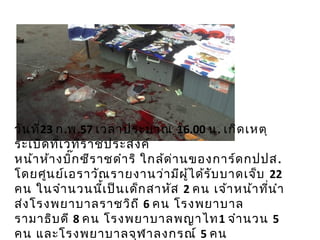
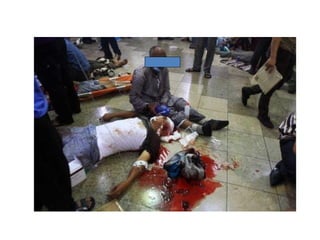
วันที่23 ก.พ.57 เวลาประมาณ 16.00 น. เกิดเหตุ
ระเบิดที่เวทีราชประสงค์
หน้าห้างบิ๊กซีราชดำาริ ใกล้ด่านของการ์ดกปปส.
โดยศูนย์เอราวัณรายงานว่ามีผู้ได้รับบาดเจ็บ 22
คน ในจำานวนนี้เป็นเด็กสาหัส 2 คน เจ้าหน้าที่นำา
ส่งโรงพยาบาลราชวิถี 6 คน โรงพยาบาล
รามาธิบดี 8 คน โรงพยาบาลพญาไท1 จำานวน 5
คน และโรงพยาบาลจุฬาลงกรณ์ 5 คน
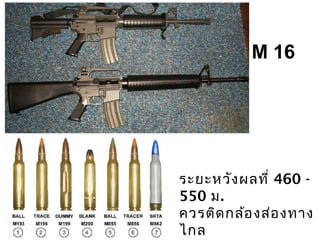
M 16
ระยะหวังผลที่ 460 -
550 ม.
ควรติดกล้องส่องทาง
ไกล
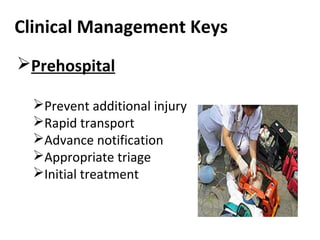
Clinical Management Keys
Prehospital
Prevent additional injury
Rapid transport
Advance notification
Appropriate triage
Initial treatment
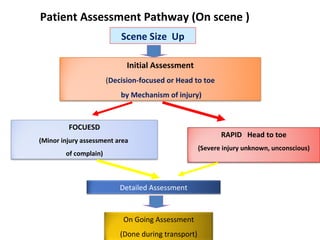
Patient Assessment Pathway (On scene )
Scene Size Up
Initial Assessment
(Decision-focused or Head to toe
by Mechanism of injury)
FOCUESD
(Minor injury assessment area
of complain)
RAPID Head to toe
(Severe injury unknown, unconscious)
Detailed Assessment
On Going Assessment
(Done during transport)
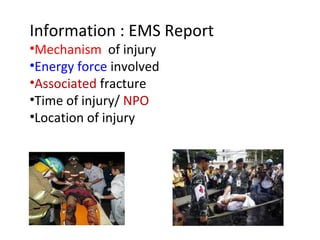
Information : EMS Report
•Mechanism of injury
•Energy force involved
•Associated fracture
•Time of injury/ NPO
•Location of injury
Mechanisms of Injury
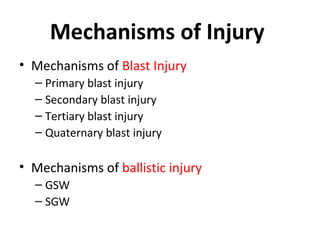
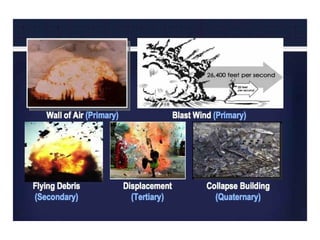
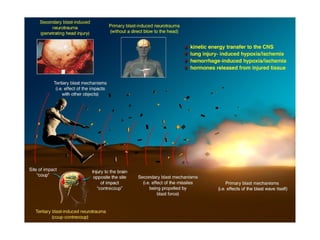
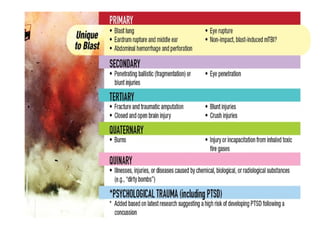
• Mechanisms of Blast Injury
– Primary blast injury
– Secondary blast injury
– Tertiary blast injury
– Quaternary blast injury
• Mechanisms of ballistic injury
– GSW
– SGW
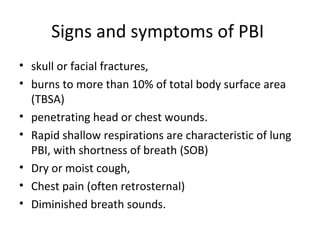
Signs and symptoms of PBI
• skull or facial fractures,
• burns to more than 10% of total body surface area
(TBSA)
• penetrating head or chest wounds.
• Rapid shallow respirations are characteristic of lung
PBI, with shortness of breath (SOB)
• Dry or moist cough,
• Chest pain (often retrosternal)
• Diminished breath sounds.
คำำถำมสำำหรับกำรประเมินกลไกกำร
บำดเจ็บ Blast injury
1. ตำำแหน่งที่เกิดเหตุ เหตุอยู่ใกล้ ผู้บำดเจ็บมำไว
2. เหตุเกิดในพื้นที่เปิดโล่ง หรือ พื้นที่ปิด
– พื้นที่เปิดโล่ง จำำนวนผู้บำดเจ็บมำกกว่ำ แต่รุนแรงน้อยกว่ำ
– พื้นที่ปิด ผู้บำดเจ็บจะรุนแรงมำกกว่ำ เช่น Crush chest
injury
3. สำเหตุจริงในสถำนกำรณ์เกิดจำกอะไร เช่น chemical plant
หรือ suicide bombing
4. เหตุระเบิดที่มีสิ่งก่อสร้ำงถล่ม ต้องใช้เวลำในกำรเคลื่อนย้ำย
ผู้บำดเจ็บออกมำนำน ให้เฝ้ำระวัง กำรเกิด crush และ
compartment syndrome
คำำถำมสำำหรับกำรประเมินกลไกกำร
บำดเจ็บ Blast injury
3. สำเหตุจริงในสถำนกำรณ์เกิดจำกอะไร เช่น
chemical plant หรือ suicide bombing
4. มีกำรปนเปื้อนด้วยหรือไม่ เช่น สำรเคมี รังสี
หรือ สำรพิษ เชื้อโรค
5. เหตุระเบิดที่มีสิ่งก่อสร้ำงถล่ม ต้องใช้เวลำใน
กำรเคลื่อนย้ำยผู้บำดเจ็บออกมำนำน ให้เฝ้ำระวัง
กำรเกิด crush และ compartment syndrome
6. เพลิงไหม้ ทรำบผู้บำดเจ็บจำกไฟ สูดสำำลักควัน และ
แผลไฟไหม้
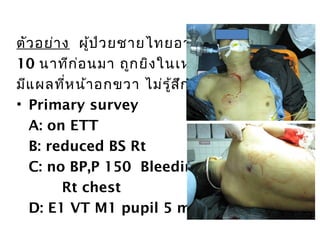
ตัวอย่ำง ผู้ป่วยชำยไทยอำยุ 40 ปี
10 นำทีก่อนมำ ถูกยิงในเหตุกำรณ์ชุมนุม
มีแผลที่หน้ำอกขวำ ไม่รู้สึกตัว มูลนิธินำำส่ง
• Primary survey
A: on ETT
B: reduced BS Rt
C: no BP,P 150 Bleeding from GSW
Rt chest
D: E1 VT M1 pupil 5 mm fixed BE
Triage
Multiple casualties
= the number and severity of the injuries
Do not exceed the ability of the facility to render
care.
Treat life-threatening injuries first.
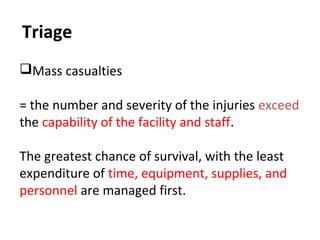
Triage
Mass casualties
= the number and severity of the injuries exceed
the capability of the facility and staff.
The greatest chance of survival, with the least
expenditure of time, equipment, supplies, and
personnel are managed first.
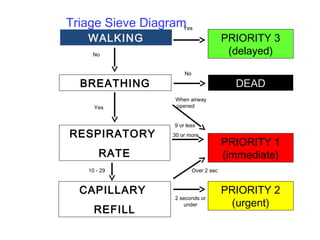
WALKING
BREATHING
RESPIRATORY
RATE
CAPILLARY
REFILL
PRIORITY 3
(delayed)
DEAD
PRIORITY 1
(immediate)
PRIORITY 2
(urgent)
Yes
Yes
No
No
When airway
opened
9 or less
30 or more
10 - 29 Over 2 sec
2 seconds or
under
Triage Sieve Diagram
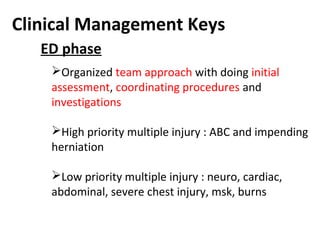
Clinical Management Keys
Organized team approach with doing initial
assessment, coordinating procedures and
investigations
High priority multiple injury : ABC and impending
herniation
Low priority multiple injury : neuro, cardiac,
abdominal, severe chest injury, msk, burns
ED phase
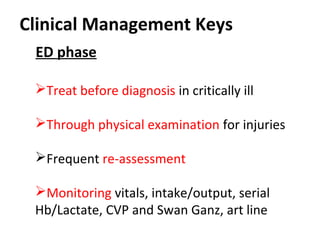
Clinical Management Keys
Treat before diagnosis in critically ill
Through physical examination for injuries
Frequent re-assessment
Monitoring vitals, intake/output, serial
Hb/Lactate, CVP and Swan Ganz, art line
ED phase
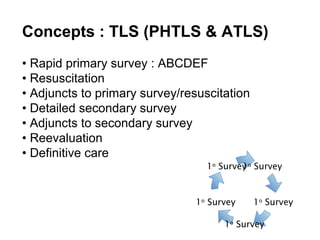
Concepts : TLS (PHTLS & ATLS)
• Rapid primary survey : ABCDEF
• Resuscitation
• Adjuncts to primary survey/resuscitation
• Detailed secondary survey
• Adjuncts to secondary survey
• Reevaluation
• Definitive care
1o
Survey
1o
Survey
1o
Survey
1o
Survey
1o
Survey
Primary Survey
•Life-saving procedures
•Step by step until problems solve
•A team approach
•Simultaneous resuscitation
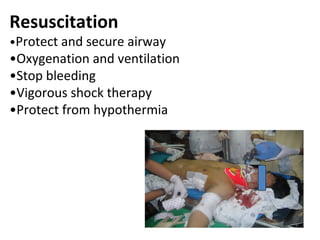
Resuscitation
•Protect and secure airway
•Oxygenation and ventilation
•Stop bleeding
•Vigorous shock therapy
•Protect from hypothermia
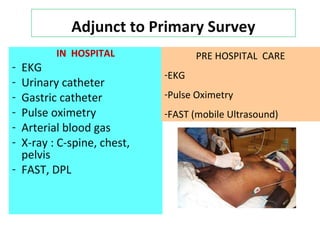
Adjunct to Primary Survey
IN HOSPITAL
- EKG
- Urinary catheter
- Gastric catheter
- Pulse oximetry
- Arterial blood gas
- X-ray : C-spine, chest,
pelvis
- FAST, DPL
PRE HOSPITAL CARE
-EKG
-Pulse Oximetry
-FAST (mobile Ultrasound)
Trauma Life Support / Advance Trauma care
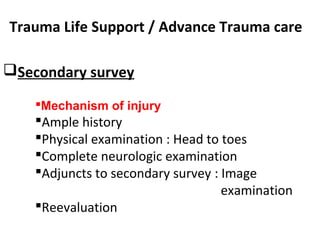
Secondary survey
Mechanism of injury
Ample history
Physical examination : Head to toes
Complete neurologic examination
Adjuncts to secondary survey : Image
examination
Reevaluation
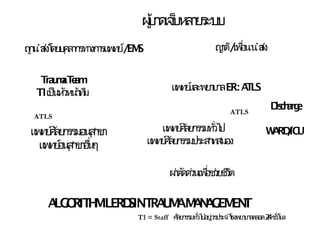
ผู้บาดเจ็บหลายระบบ
ถูกนำาส่งโดยบุคลากรทางการแพทย์/EMS ญาติ/เพื่อนนำาส่ง
TraumaTeam
T1เป็นหัวหน้าทีม
แพทย์และพยาบาลER:ATLS
แพทย์ศัลยกรรมทั่วไป
แพทย์ศัลยกรรมประสาทสมอง
ผ่าตัดด่วนเพื่อช่วยชีวิต
WARD/ICUแพทย์ศัลยกรรมอนุสาขา
แพทย์อนุสาขาอื่นๆ
ALGORITHMLERDSINTRAUMAMANAGEMENT
ATLS
ATLS
T1 = Staff ศัลยกรรมทั่วไปอยู่เวรประจำาโรงพยาบาลตลอด24ชั่วโมง
Discharge
Clinical Management Of Blast Injury
• Management of pulmonary PBI is the same as
for pulmonary contusions
• Assume wheezing is due to pulmonary
contusion ; despite a history of asthma.
• Patients with penetrating trauma between the
nipples and scapulae there is a higher
probability for injury to great vessels and
mediastinal structures.1
• ECG should be performed for all chest pain
ลักษณะอาการบาดเจ็บที่ควรส่ง
ไปยังศูนย์อุบัติเหตุ
• สมองได้รับบาดเจ็บ กะโหลกยุบ แตก มีแผลทิ่ม
แทง แผลเปิดที่กะโหลกศีรษะ
• ทรวงอก ได้รับบาดเจ็บที่หลอดเลือดแดงใหญ่
ปอดชำ้า บาดเจ็บที่หัวใจ
• Unstable pelvic –ring disruption
• Open fracture pelvic
• Fracture pelvic :Hypovolumic shock
• Crush injury
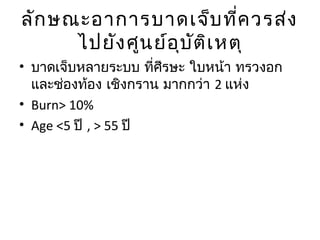
ลักษณะอาการบาดเจ็บที่ควรส่ง
ไปยังศูนย์อุบัติเหตุ
• บาดเจ็บหลายระบบ ที่ศีรษะ ใบหน้า ทรวงอก
และช่องท้อง เชิงกราน มากกว่า 2 แห่ง
• Burn> 10%
• Age <5 ปี , > 55 ปี
Pit falls / Key points
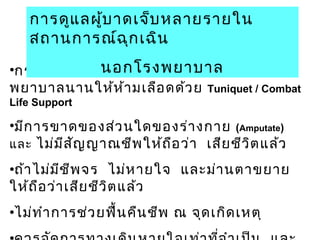
•กรณีที่เสียเลือดมาก ระยะเวลาไปโรง
พยาบาลนานให้ห้ามเลือดด้วย Tuniquet / Combat
Life Support
•มีการขาดของส่วนใดของร่างกาย (Amputate)
และ ไม่มีสัญญาณชีพให้ถือว่า เสียชีวิตแล้ว
•ถ้าไม่มีชีพจร ไม่หายใจ และม่านตาขยาย
ให้ถือว่าเสียชีวิตแล้ว
•ไม่ทำาการช่วยฟื้นคืนชีพ ณ จุดเกิดเหตุ
การดูแลผู้บาดเจ็บหลายรายใน
สถานการณ์ฉุกเฉิน
นอกโรงพยาบาล
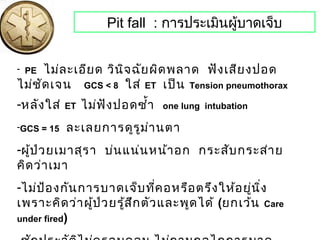
Pit fall : การประเมินผู้บาดเจ็บ
- PE ไม่ละเอียด วินิจฉัยผิดพลาด ฟังเสียงปอด
ไม่ชัดเจน GCS < 8 ใส่ ET เป็น Tension pneumothorax
-หลังใส่ ET ไม่ฟังปอดซำ้า one lung intubation
-GCS = 15 ละเลยการดูรูม่านตา
-ผู้ป่วยเมาสุรา บ่นแน่นหน้าอก กระสับกระส่าย
คิดว่าเมา
-ไม่ป้องกันการบาดเจ็บที่คอหรือตรึงให้อยู่นิ่ง
เพราะคิดว่าผู้ป่วยรู้สึกตัวและพูดได้ (ยกเว้น Care
under fired)
Pit fall : การช่วยเหลือ
-ผู้ป่วยที่ไม่รู้สึกตัว มีอาการดิ้นไปมาตลอด จะ
ทำาให้แผลที่ศีรษะหลุดง่าย ต้องพัน EB ที่แผลไว้
เสมอ
-ระหว่างใส่ ET ไม่ระวัง C-spine
-ไม่เปิด IV ในผู้ป่วย Fx. femur
-Splint ขา/ แขน ในท่าปกติเสมอ
-ผู้ป่วยที่มีกระดูกสะโพกและต้นขาหัก ไม่
support ขาทั้ง 2 ข้างไว้/ pelvic rap
-ผู้ป่วยอาจ shock หากปล่อยให้มี external
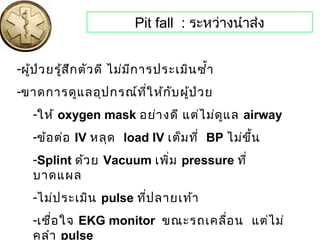
Pit fall : ระหว่างนำาส่ง
-ผู้ป่วยรู้สึกตัวดี ไม่มีการประเมินซำ้า
-ขาดการดูแลอุปกรณ์ที่ให้กับผู้ป่วย
-ให้ oxygen mask อย่างดี แต่ไม่ดูแล airway
-ข้อต่อ IV หลุด load IV เต็มที่ BP ไม่ขึ้น
-Splint ด้วย Vacuum เพิ่ม pressure ที่
บาดแผล
-ไม่ประเมิน pulse ที่ปลายเท้า
-เชื่อใจ EKG monitor ขณะรถเคลื่อน แต่ไม่
คลำา pulse
Pit fall : การเคลื่อนย้าย
-ผู้ป่วยตัวใหญ่คิดว่านอนเต็ม Stretcher ไม่รัด
belts
-ดีใจที่ถึงโรงพยาบาล กางขา Stretcher ไม่เต็ม
ที่ รถหุบ ยุบตัว ผู้ป่วยตก
ED PIT FALL
•
ความล่าช้าในการตรวจหา
ภาวะตกเลือดในผู้ที่หมดสติ
• การแปลผลอาการของช่อง
ท้องผิดพลาด
• การตรวจไม่พบการบาดเจ็บ
ของดูโอดีนัม
• การตรวจไม่พบการฉีกขาด
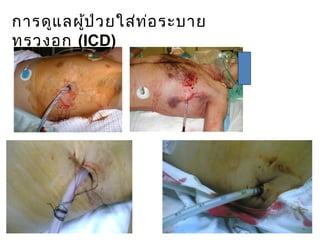
การดูแลผู้ป่วยใส่ท่อระบาย
ทรวงอก (ICD)
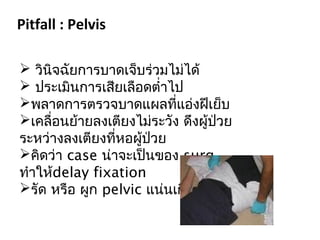
 วินิจฉัยการบาดเจ็บร่วมไม่ได้
 ประเมินการเสียเลือดตำ่าไป
พลาดการตรวจบาดแผลที่แอ่งฝีเย็บ
เคลื่อนย้ายลงเตียงไม่ระวัง ดึงผู้ป่วย
ระหว่างลงเตียงที่หอผู้ป่วย
คิดว่า case น่าจะเป็นของ surg.
ทำาให้delay fixation
รัด หรือ ผูก pelvic แน่นเกินไป
Pitfall : Pelvis
Key points
• Air emboloism
• Compartment Syndrome
• Early and subsequent chest X-ray (CXR)
• The combination of pulmonary infiltrates and
hypoxaemia defines pulmonary PBI. (gas exch
ange, using fewer tidal volume (TV) and press
ure changes )
Key points
• Fowler or Trendelenburg positioning may
increase the risk of cerebral or coronary AAE.
• Massive haemoptysis may occur with
significant contusion
การดูแลที่ถูกต้องตามหลักการดูแลผู้
บาดเจ็บขั้นสูงสากล (ATLS & PHTLS)
มีเทคนิคในการดูแลผู้บาดเจ็บ
ใช้เวลาในการดูแลในที่เกิดเหตุไม่นาน
ไม่เกิดความเสี่ยงต่อผู้บาดเจ็บและทีมที่
ไปช่วยเหลือ
สรุป
Multiple trauma in special situations
Multiple trauma in special situations