MAGNETIC MATERIAL


Electricity is not a fun but easy to
learn.
SR.
                 VERY IMPORTANT QUESTIONS
NO.
1     Diamagnetism, Para magnetism and Ferromagnetism

2     Hard and Soft magnets

3     Magnetic Parameters

4     Soft and Hard magnets

5     Ferrites

6     Hysteresis Loop
MAGNETISM
         1. Bar Magnet and its properties
         2. Current Loop as a Magnetic Dipole and Dipole Moment
         3. Current Solenoid equivalent to Bar Magnet
         4. Bar Magnet and it Dipole Moment
         5. Coulomb’s Law in Magnetism
         6. Important Terms in Magnetism
         7. Tangent Law
         8. Properties of Dia-, Para- and Ferro-magnetic substances
         9. Curie’s Law in Magnetism
         10. Hysteresis in Magnetism
         11. Hard and soft magnets
         12. Etc ……………..


Created by, Vijay Balu Raskar (Electrical Engineer – Mumbai University)
Magnetism:
- Phenomenon of attracting magnetic substances like iron, nickel, cobalt, etc.
• A body possessing the property of magnetism is called a magnet.
• A magnetic pole is a point near the end of the magnet where magnetism is
concentrated.
• Earth is a natural magnet.
•The region around a magnet in which it exerts forces on other magnets and
on objects made of iron is a magnetic field.
Properties of a bar magnet:
1. A freely suspended magnet aligns itself along North – South direction.
2. Unlike poles attract and like poles repel each other.
3. Magnetic poles always exist in pairs. i.e. Poles can not be separated.
4. A magnet can induce magnetism in other magnetic substances.
5. It attracts magnetic substances.
Repulsion is the surest test of magnetisation: A magnet attracts iron rod as well
as opposite pole of other magnet. Therefore it is not a sure test of magnetisation.
But, if a rod is repelled with strong force by a magnet, then the rod is surely
magnetised.
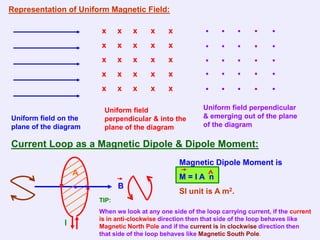
Representation of Uniform Magnetic Field:

                       x      x   x     x     x
                       x      x   x     x     x
                       x      x   x     x     x
                       x      x   x     x     x
                       x      x   x     x     x

                        Uniform field                     Uniform field perpendicular
Uniform field on the    perpendicular & into the          & emerging out of the plane
plane of the diagram    plane of the diagram              of the diagram

Current Loop as a Magnetic Dipole & Dipole Moment:
                                                  Magnetic Dipole Moment is
                   A
                                                  M=IA n
                              B
                                                  SI unit is A m2.
                       TIP:
                       When we look at any one side of the loop carrying current, if the current
                       is in anti-clockwise direction then that side of the loop behaves like
               I       Magnetic North Pole and if the current is in clockwise direction then
                       that side of the loop behaves like Magnetic South Pole.
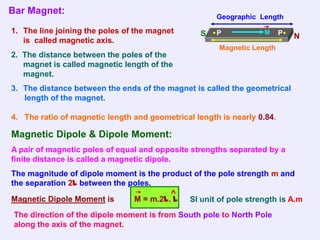
Bar Magnet:
                                                      Geographic Length

1. The line joining the poles of the magnet       S   P            M     P   N
   is called magnetic axis.
                                                       Magnetic Length
2. The distance between the poles of the
   magnet is called magnetic length of the
   magnet.
3. The distance between the ends of the magnet is called the geometrical
   length of the magnet.

4. The ratio of magnetic length and geometrical length is nearly 0.84.

Magnetic Dipole & Dipole Moment:
A pair of magnetic poles of equal and opposite strengths separated by a
finite distance is called a magnetic dipole.
The magnitude of dipole moment is the product of the pole strength m and
the separation 2l between the poles.

Magnetic Dipole Moment is       M = m.2l. l    SI unit of pole strength is A.m
 The direction of the dipole moment is from South pole to North Pole
 along the axis of the magnet.
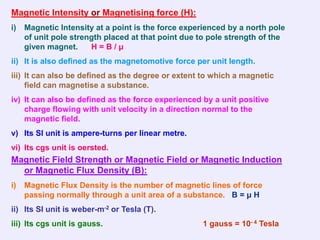
Magnetic Intensity or Magnetising force (H):
i)   Magnetic Intensity at a point is the force experienced by a north pole
     of unit pole strength placed at that point due to pole strength of the
     given magnet.     H=B/μ
ii) It is also defined as the magnetomotive force per unit length.
iii) It can also be defined as the degree or extent to which a magnetic
     field can magnetise a substance.
iv) It can also be defined as the force experienced by a unit positive
    charge flowing with unit velocity in a direction normal to the
    magnetic field.
v) Its SI unit is ampere-turns per linear metre.
vi) Its cgs unit is oersted.
Magnetic Field Strength or Magnetic Field or Magnetic Induction
  or Magnetic Flux Density (B):
i)   Magnetic Flux Density is the number of magnetic lines of force
     passing normally through a unit area of a substance. B = μ H
ii) Its SI unit is weber-m-2 or Tesla (T).
iii) Its cgs unit is gauss.                         1 gauss = 10- 4 Tesla
MAGNETIC PARAMETERS
1.Magnetic Permeability (μ):
The property of material by virtue of which it allows itself
to be magnetized.
It is the ratio of magnetic field density to magnetic field
strength.
It accept magnetization.
It varies material to material depending on temperature,
saturation.
It is the degree or extent to which magnetic lines of force
can pass enter a substance.
A good magnetic material should have high value of
permeability.
Magnetic field density is directly proportional to field
intensity.
Its SI unit is T m A-1 or   wb A-1 m-1 or H m-1
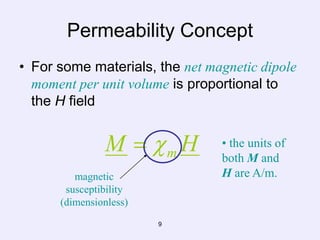
Permeability Concept
• For some materials, the net magnetic dipole
  moment per unit volume is proportional to
  the H field


               M  m H         • the units of
                                both M and
         magnetic               H are A/m.
       susceptibility
      (dimensionless)
                        9
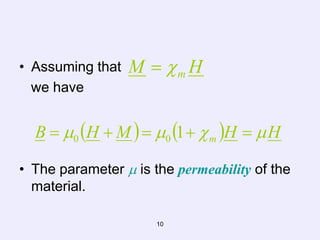
• Assuming that   M  m H
  we have


  B  m0 H  M   m0 1   m H  m H

• The parameter m is the permeability of the
  material.

                      10
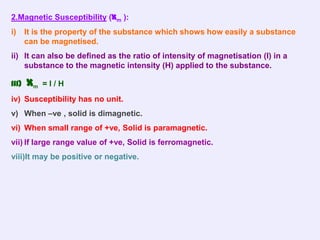
2.Magnetic Susceptibility (Xm ):
i)     It is the property of the substance which shows how easily a substance
       can be magnetised.
ii) It can also be defined as the ratio of intensity of magnetisation (I) in a
    substance to the magnetic intensity (H) applied to the substance.

iii)   Xm   =I/H
iv) Susceptibility has no unit.
v) When –ve , solid is dimagnetic.
vi) When small range of +ve, Solid is paramagnetic.
vii) If large range value of +ve, Solid is ferromagnetic.
viii)It may be positive or negative.
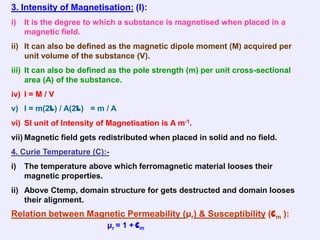
3. Intensity of Magnetisation: (I):
i)   It is the degree to which a substance is magnetised when placed in a
     magnetic field.
ii) It can also be defined as the magnetic dipole moment (M) acquired per
    unit volume of the substance (V).
iii) It can also be defined as the pole strength (m) per unit cross-sectional
     area (A) of the substance.
iv) I = M / V
v) I = m(2l) / A(2l) = m / A
vi) SI unit of Intensity of Magnetisation is A m-1.
vii) Magnetic field gets redistributed when placed in solid and no field.
4. Curie Temperature (C):-
i)   The temperature above which ferromagnetic material looses their
     magnetic properties.
ii) Above Ctemp, domain structure for gets destructed and domain looses
    their alignment.
Relation between Magnetic Permeability (μr) & Susceptibility (cm ):
                           μr = 1 + c m
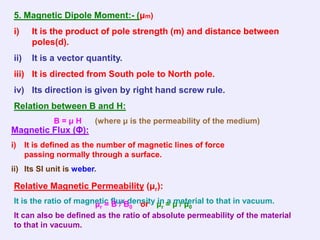
5. Magnetic Dipole Moment:- (μm)
 i)      It is the product of pole strength (m) and distance between
         poles(d).
 ii)     It is a vector quantity.
 iii) It is directed from South pole to North pole.
 iv) Its direction is given by right hand screw rule.
 Relation between B and H:
              B=μH        (where μ is the permeability of the medium)
Magnetic Flux (Φ):
i)     It is defined as the number of magnetic lines of force
       passing normally through a surface.
ii) Its SI unit is weber.

 Relative Magnetic Permeability (μr):
 It is the ratio of magnetic fluxB or μ = μ / μ
                        μ = B / density in a material to that in vacuum.
                            r       0      r       0
 It can also be defined as the ratio of absolute permeability of the material
 to that in vacuum.
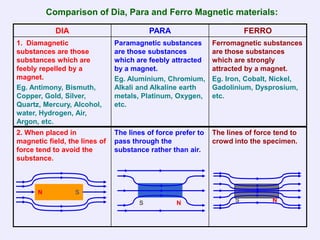
Comparison of Dia, Para and Ferro Magnetic materials:

            DIA                           PARA                           FERRO
1. Diamagnetic                 Paramagnetic substances        Ferromagnetic substances
substances are those           are those substances           are those substances
substances which are           which are feebly attracted     which are strongly
feebly repelled by a           by a magnet.                   attracted by a magnet.
magnet.                        Eg. Aluminium, Chromium,       Eg. Iron, Cobalt, Nickel,
Eg. Antimony, Bismuth,         Alkali and Alkaline earth      Gadolinium, Dysprosium,
Copper, Gold, Silver,          metals, Platinum, Oxygen,      etc.
Quartz, Mercury, Alcohol,      etc.
water, Hydrogen, Air,
Argon, etc.
2. When placed in              The lines of force prefer to   The lines of force tend to
magnetic field, the lines of   pass through the               crowd into the specimen.
force tend to avoid the        substance rather than air.
substance.


      N           S
                                      S           N                  S           N
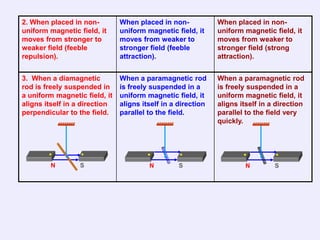
2. When placed in non-         When placed in non-            When placed in non-
uniform magnetic field, it     uniform magnetic field, it     uniform magnetic field, it
moves from stronger to         moves from weaker to           moves from weaker to
weaker field (feeble           stronger field (feeble         stronger field (strong
repulsion).                    attraction).                   attraction).


3. When a diamagnetic          When a paramagnetic rod        When a paramagnetic rod
rod is freely suspended in     is freely suspended in a       is freely suspended in a
a uniform magnetic field, it   uniform magnetic field, it     uniform magnetic field, it
aligns itself in a direction   aligns itself in a direction   aligns itself in a direction
perpendicular to the field.    parallel to the field.         parallel to the field very
                                                              quickly.


        N        S                      N         S                    N        S
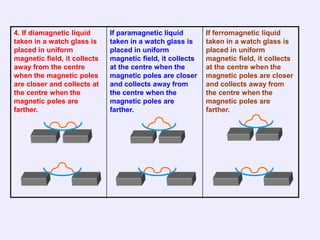
4. If diamagnetic liquid      If paramagnetic liquid        If ferromagnetic liquid
taken in a watch glass is     taken in a watch glass is     taken in a watch glass is
placed in uniform             placed in uniform             placed in uniform
magnetic field, it collects   magnetic field, it collects   magnetic field, it collects
away from the centre          at the centre when the        at the centre when the
when the magnetic poles       magnetic poles are closer     magnetic poles are closer
are closer and collects at    and collects away from        and collects away from
the centre when the           the centre when the           the centre when the
magnetic poles are            magnetic poles are            magnetic poles are
farther.                      farther.                      farther.
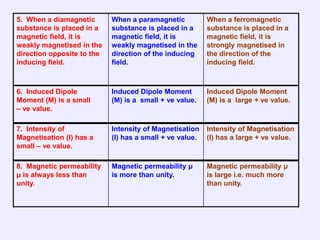
5. When a diamagnetic       When a paramagnetic           When a ferromagnetic
substance is placed in a    substance is placed in a      substance is placed in a
magnetic field, it is       magnetic field, it is         magnetic field, it is
weakly magnetised in the    weakly magnetised in the      strongly magnetised in
direction opposite to the   direction of the inducing     the direction of the
inducing field.             field.                        inducing field.


6. Induced Dipole           Induced Dipole Moment         Induced Dipole Moment
Moment (M) is a small       (M) is a small + ve value.    (M) is a large + ve value.
– ve value.

7. Intensity of             Intensity of Magnetisation    Intensity of Magnetisation
Magnetisation (I) has a     (I) has a small + ve value.   (I) has a large + ve value.
small – ve value.

8. Magnetic permeability    Magnetic permeability μ       Magnetic permeability μ
μ is always less than       is more than unity.           is large i.e. much more
unity.                                                    than unity.
9. Magnetic susceptibility
                             Magnetic susceptibility cm Magnetic susceptibility cm
cm has a small – ve value.   has a small + ve value.    has a large + ve value.


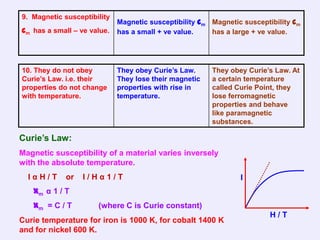
10. They do not obey         They obey Curie’s Law.     They obey Curie’s Law. At
Curie’s Law. i.e. their      They lose their magnetic   a certain temperature
properties do not change     properties with rise in    called Curie Point, they
with temperature.            temperature.               lose ferromagnetic
                                                        properties and behave
                                                        like paramagnetic
                                                        substances.

Curie’s Law:
Magnetic susceptibility of a material varies inversely
with the absolute temperature.
  IαH/T      or   I/Hα1/T                                       I
   Xm α 1 / T
   Xm = C / T         (where C is Curie constant)
                                                                         H/T
Curie temperature for iron is 1000 K, for cobalt 1400 K
and for nickel 600 K.
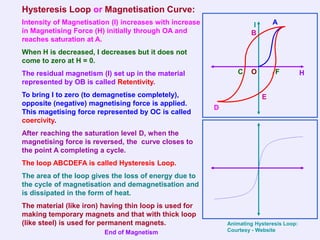
Hysteresis Loop or Magnetisation Curve:
Intensity of Magnetisation (I) increases with increase                I       A
in Magnetising Force (H) initially through OA and                    B
reaches saturation at A.
When H is decreased, I decreases but it does not
come to zero at H = 0.
The residual magnetism (I) set up in the material               C    O        F           H
represented by OB is called Retentivity.
To bring I to zero (to demagnetise completely),                           E
opposite (negative) magnetising force is applied.
                                                         D
This magetising force represented by OC is called
coercivity.
After reaching the saturation level D, when the
magnetising force is reversed, the curve closes to
the point A completing a cycle.
The loop ABCDEFA is called Hysteresis Loop.
The area of the loop gives the loss of energy due to
the cycle of magnetisation and demagnetisation and
is dissipated in the form of heat.
The material (like iron) having thin loop is used for
making temporary magnets and that with thick loop
(like steel) is used for permanent magnets.                  Animating Hysteresis Loop:
                         End of Magnetism                    Courtesy - Website
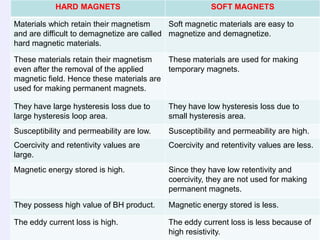
HARD MAGNETS                               SOFT MAGNETS

Materials which retain their magnetism      Soft magnetic materials are easy to
and are difficult to demagnetize are called magnetize and demagnetize.
hard magnetic materials.

These materials retain their magnetism    These materials are used for making
even after the removal of the applied     temporary magnets.
magnetic field. Hence these materials are
used for making permanent magnets.

They have large hysteresis loss due to     They have low hysteresis loss due to
large hysteresis loop area.                small hysteresis area.
Susceptibility and permeability are low.   Susceptibility and permeability are high.
Coercivity and retentivity values are      Coercivity and retentivity values are less.
large.
Magnetic energy stored is high.            Since they have low retentivity and
                                           coercivity, they are not used for making
                                           permanent magnets.
They possess high value of BH product.     Magnetic energy stored is less.

The eddy current loss is high.             The eddy current loss is less because of
                                           high resistivity.
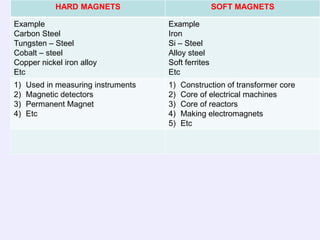
HARD MAGNETS                             SOFT MAGNETS

Example                              Example
Carbon Steel                         Iron
Tungsten – Steel                     Si – Steel
Cobalt – steel                       Alloy steel
Copper nickel iron alloy             Soft ferrites
Etc                                  Etc
1)   Used in measuring instruments   1)   Construction of transformer core
2)   Magnetic detectors              2)   Core of electrical machines
3)   Permanent Magnet                3)   Core of reactors
4)   Etc                             4)   Making electromagnets
                                     5)   Etc
Ferrites
• Ferrites are the most useful ferrimagnetic materials.
• Ferrites are ceramic material containing compounds of iron.
• Ferrites are non-conducting magnetic media so eddy current and ohmic
  losses are less than for ferromagnetic materials.
• Ferrites are often used as transformer cores at radio frequencies (RF).
• Low dielectric loss.
• Low coersive force.
• They are mechanically hard, brittle and difficult to machined.
• Very high resistivity.
• Types of Ferries are, 1) Soft, 2) Hard,3) Rectangular loop and 4)
  Microwave Ferrites.
• Some material have hysterisis loop, rectangular in shape.
• Dielectric constant is of the order of 10 to 12.
                                      22
Thank You
All the Best
 Take care

Magnetic material

  • 1.
    MAGNETIC MATERIAL Electricity isnot a fun but easy to learn.
  • 2.
    SR. VERY IMPORTANT QUESTIONS NO. 1 Diamagnetism, Para magnetism and Ferromagnetism 2 Hard and Soft magnets 3 Magnetic Parameters 4 Soft and Hard magnets 5 Ferrites 6 Hysteresis Loop
  • 3.
    MAGNETISM 1. Bar Magnet and its properties 2. Current Loop as a Magnetic Dipole and Dipole Moment 3. Current Solenoid equivalent to Bar Magnet 4. Bar Magnet and it Dipole Moment 5. Coulomb’s Law in Magnetism 6. Important Terms in Magnetism 7. Tangent Law 8. Properties of Dia-, Para- and Ferro-magnetic substances 9. Curie’s Law in Magnetism 10. Hysteresis in Magnetism 11. Hard and soft magnets 12. Etc …………….. Created by, Vijay Balu Raskar (Electrical Engineer – Mumbai University)
  • 4.
    Magnetism: - Phenomenon ofattracting magnetic substances like iron, nickel, cobalt, etc. • A body possessing the property of magnetism is called a magnet. • A magnetic pole is a point near the end of the magnet where magnetism is concentrated. • Earth is a natural magnet. •The region around a magnet in which it exerts forces on other magnets and on objects made of iron is a magnetic field. Properties of a bar magnet: 1. A freely suspended magnet aligns itself along North – South direction. 2. Unlike poles attract and like poles repel each other. 3. Magnetic poles always exist in pairs. i.e. Poles can not be separated. 4. A magnet can induce magnetism in other magnetic substances. 5. It attracts magnetic substances. Repulsion is the surest test of magnetisation: A magnet attracts iron rod as well as opposite pole of other magnet. Therefore it is not a sure test of magnetisation. But, if a rod is repelled with strong force by a magnet, then the rod is surely magnetised.
  • 5.
    Representation of UniformMagnetic Field: x x x x x x x x x x x x x x x x x x x x x x x x x Uniform field Uniform field perpendicular Uniform field on the perpendicular & into the & emerging out of the plane plane of the diagram plane of the diagram of the diagram Current Loop as a Magnetic Dipole & Dipole Moment: Magnetic Dipole Moment is A M=IA n B SI unit is A m2. TIP: When we look at any one side of the loop carrying current, if the current is in anti-clockwise direction then that side of the loop behaves like I Magnetic North Pole and if the current is in clockwise direction then that side of the loop behaves like Magnetic South Pole.
  • 6.
    Bar Magnet: Geographic Length 1. The line joining the poles of the magnet S P M P N is called magnetic axis. Magnetic Length 2. The distance between the poles of the magnet is called magnetic length of the magnet. 3. The distance between the ends of the magnet is called the geometrical length of the magnet. 4. The ratio of magnetic length and geometrical length is nearly 0.84. Magnetic Dipole & Dipole Moment: A pair of magnetic poles of equal and opposite strengths separated by a finite distance is called a magnetic dipole. The magnitude of dipole moment is the product of the pole strength m and the separation 2l between the poles. Magnetic Dipole Moment is M = m.2l. l SI unit of pole strength is A.m The direction of the dipole moment is from South pole to North Pole along the axis of the magnet.
  • 7.
    Magnetic Intensity orMagnetising force (H): i) Magnetic Intensity at a point is the force experienced by a north pole of unit pole strength placed at that point due to pole strength of the given magnet. H=B/μ ii) It is also defined as the magnetomotive force per unit length. iii) It can also be defined as the degree or extent to which a magnetic field can magnetise a substance. iv) It can also be defined as the force experienced by a unit positive charge flowing with unit velocity in a direction normal to the magnetic field. v) Its SI unit is ampere-turns per linear metre. vi) Its cgs unit is oersted. Magnetic Field Strength or Magnetic Field or Magnetic Induction or Magnetic Flux Density (B): i) Magnetic Flux Density is the number of magnetic lines of force passing normally through a unit area of a substance. B = μ H ii) Its SI unit is weber-m-2 or Tesla (T). iii) Its cgs unit is gauss. 1 gauss = 10- 4 Tesla
  • 8.
    MAGNETIC PARAMETERS 1.Magnetic Permeability(μ): The property of material by virtue of which it allows itself to be magnetized. It is the ratio of magnetic field density to magnetic field strength. It accept magnetization. It varies material to material depending on temperature, saturation. It is the degree or extent to which magnetic lines of force can pass enter a substance. A good magnetic material should have high value of permeability. Magnetic field density is directly proportional to field intensity. Its SI unit is T m A-1 or wb A-1 m-1 or H m-1
  • 9.
    Permeability Concept • Forsome materials, the net magnetic dipole moment per unit volume is proportional to the H field M  m H • the units of both M and magnetic H are A/m. susceptibility (dimensionless) 9
  • 10.
    • Assuming that M  m H we have B  m0 H  M   m0 1   m H  m H • The parameter m is the permeability of the material. 10
  • 11.
    2.Magnetic Susceptibility (Xm): i) It is the property of the substance which shows how easily a substance can be magnetised. ii) It can also be defined as the ratio of intensity of magnetisation (I) in a substance to the magnetic intensity (H) applied to the substance. iii) Xm =I/H iv) Susceptibility has no unit. v) When –ve , solid is dimagnetic. vi) When small range of +ve, Solid is paramagnetic. vii) If large range value of +ve, Solid is ferromagnetic. viii)It may be positive or negative.
  • 12.
    3. Intensity ofMagnetisation: (I): i) It is the degree to which a substance is magnetised when placed in a magnetic field. ii) It can also be defined as the magnetic dipole moment (M) acquired per unit volume of the substance (V). iii) It can also be defined as the pole strength (m) per unit cross-sectional area (A) of the substance. iv) I = M / V v) I = m(2l) / A(2l) = m / A vi) SI unit of Intensity of Magnetisation is A m-1. vii) Magnetic field gets redistributed when placed in solid and no field. 4. Curie Temperature (C):- i) The temperature above which ferromagnetic material looses their magnetic properties. ii) Above Ctemp, domain structure for gets destructed and domain looses their alignment. Relation between Magnetic Permeability (μr) & Susceptibility (cm ): μr = 1 + c m
  • 13.
    5. Magnetic DipoleMoment:- (μm) i) It is the product of pole strength (m) and distance between poles(d). ii) It is a vector quantity. iii) It is directed from South pole to North pole. iv) Its direction is given by right hand screw rule. Relation between B and H: B=μH (where μ is the permeability of the medium) Magnetic Flux (Φ): i) It is defined as the number of magnetic lines of force passing normally through a surface. ii) Its SI unit is weber. Relative Magnetic Permeability (μr): It is the ratio of magnetic fluxB or μ = μ / μ μ = B / density in a material to that in vacuum. r 0 r 0 It can also be defined as the ratio of absolute permeability of the material to that in vacuum.
  • 14.
    Comparison of Dia,Para and Ferro Magnetic materials: DIA PARA FERRO 1. Diamagnetic Paramagnetic substances Ferromagnetic substances substances are those are those substances are those substances substances which are which are feebly attracted which are strongly feebly repelled by a by a magnet. attracted by a magnet. magnet. Eg. Aluminium, Chromium, Eg. Iron, Cobalt, Nickel, Eg. Antimony, Bismuth, Alkali and Alkaline earth Gadolinium, Dysprosium, Copper, Gold, Silver, metals, Platinum, Oxygen, etc. Quartz, Mercury, Alcohol, etc. water, Hydrogen, Air, Argon, etc. 2. When placed in The lines of force prefer to The lines of force tend to magnetic field, the lines of pass through the crowd into the specimen. force tend to avoid the substance rather than air. substance. N S S N S N
  • 15.
    2. When placedin non- When placed in non- When placed in non- uniform magnetic field, it uniform magnetic field, it uniform magnetic field, it moves from stronger to moves from weaker to moves from weaker to weaker field (feeble stronger field (feeble stronger field (strong repulsion). attraction). attraction). 3. When a diamagnetic When a paramagnetic rod When a paramagnetic rod rod is freely suspended in is freely suspended in a is freely suspended in a a uniform magnetic field, it uniform magnetic field, it uniform magnetic field, it aligns itself in a direction aligns itself in a direction aligns itself in a direction perpendicular to the field. parallel to the field. parallel to the field very quickly. N S N S N S
  • 16.
    4. If diamagneticliquid If paramagnetic liquid If ferromagnetic liquid taken in a watch glass is taken in a watch glass is taken in a watch glass is placed in uniform placed in uniform placed in uniform magnetic field, it collects magnetic field, it collects magnetic field, it collects away from the centre at the centre when the at the centre when the when the magnetic poles magnetic poles are closer magnetic poles are closer are closer and collects at and collects away from and collects away from the centre when the the centre when the the centre when the magnetic poles are magnetic poles are magnetic poles are farther. farther. farther.
  • 17.
    5. When adiamagnetic When a paramagnetic When a ferromagnetic substance is placed in a substance is placed in a substance is placed in a magnetic field, it is magnetic field, it is magnetic field, it is weakly magnetised in the weakly magnetised in the strongly magnetised in direction opposite to the direction of the inducing the direction of the inducing field. field. inducing field. 6. Induced Dipole Induced Dipole Moment Induced Dipole Moment Moment (M) is a small (M) is a small + ve value. (M) is a large + ve value. – ve value. 7. Intensity of Intensity of Magnetisation Intensity of Magnetisation Magnetisation (I) has a (I) has a small + ve value. (I) has a large + ve value. small – ve value. 8. Magnetic permeability Magnetic permeability μ Magnetic permeability μ μ is always less than is more than unity. is large i.e. much more unity. than unity.
  • 18.
    9. Magnetic susceptibility Magnetic susceptibility cm Magnetic susceptibility cm cm has a small – ve value. has a small + ve value. has a large + ve value. 10. They do not obey They obey Curie’s Law. They obey Curie’s Law. At Curie’s Law. i.e. their They lose their magnetic a certain temperature properties do not change properties with rise in called Curie Point, they with temperature. temperature. lose ferromagnetic properties and behave like paramagnetic substances. Curie’s Law: Magnetic susceptibility of a material varies inversely with the absolute temperature. IαH/T or I/Hα1/T I Xm α 1 / T Xm = C / T (where C is Curie constant) H/T Curie temperature for iron is 1000 K, for cobalt 1400 K and for nickel 600 K.
  • 19.
    Hysteresis Loop orMagnetisation Curve: Intensity of Magnetisation (I) increases with increase I A in Magnetising Force (H) initially through OA and B reaches saturation at A. When H is decreased, I decreases but it does not come to zero at H = 0. The residual magnetism (I) set up in the material C O F H represented by OB is called Retentivity. To bring I to zero (to demagnetise completely), E opposite (negative) magnetising force is applied. D This magetising force represented by OC is called coercivity. After reaching the saturation level D, when the magnetising force is reversed, the curve closes to the point A completing a cycle. The loop ABCDEFA is called Hysteresis Loop. The area of the loop gives the loss of energy due to the cycle of magnetisation and demagnetisation and is dissipated in the form of heat. The material (like iron) having thin loop is used for making temporary magnets and that with thick loop (like steel) is used for permanent magnets. Animating Hysteresis Loop: End of Magnetism Courtesy - Website
  • 20.
    HARD MAGNETS SOFT MAGNETS Materials which retain their magnetism Soft magnetic materials are easy to and are difficult to demagnetize are called magnetize and demagnetize. hard magnetic materials. These materials retain their magnetism These materials are used for making even after the removal of the applied temporary magnets. magnetic field. Hence these materials are used for making permanent magnets. They have large hysteresis loss due to They have low hysteresis loss due to large hysteresis loop area. small hysteresis area. Susceptibility and permeability are low. Susceptibility and permeability are high. Coercivity and retentivity values are Coercivity and retentivity values are less. large. Magnetic energy stored is high. Since they have low retentivity and coercivity, they are not used for making permanent magnets. They possess high value of BH product. Magnetic energy stored is less. The eddy current loss is high. The eddy current loss is less because of high resistivity.
  • 21.
    HARD MAGNETS SOFT MAGNETS Example Example Carbon Steel Iron Tungsten – Steel Si – Steel Cobalt – steel Alloy steel Copper nickel iron alloy Soft ferrites Etc Etc 1) Used in measuring instruments 1) Construction of transformer core 2) Magnetic detectors 2) Core of electrical machines 3) Permanent Magnet 3) Core of reactors 4) Etc 4) Making electromagnets 5) Etc
  • 22.
    Ferrites • Ferrites arethe most useful ferrimagnetic materials. • Ferrites are ceramic material containing compounds of iron. • Ferrites are non-conducting magnetic media so eddy current and ohmic losses are less than for ferromagnetic materials. • Ferrites are often used as transformer cores at radio frequencies (RF). • Low dielectric loss. • Low coersive force. • They are mechanically hard, brittle and difficult to machined. • Very high resistivity. • Types of Ferries are, 1) Soft, 2) Hard,3) Rectangular loop and 4) Microwave Ferrites. • Some material have hysterisis loop, rectangular in shape. • Dielectric constant is of the order of 10 to 12. 22
  • 23.
    Thank You All theBest Take care