UEEP2024 Solid State Physics
Topic 4 Semiconductor
Semiconductor
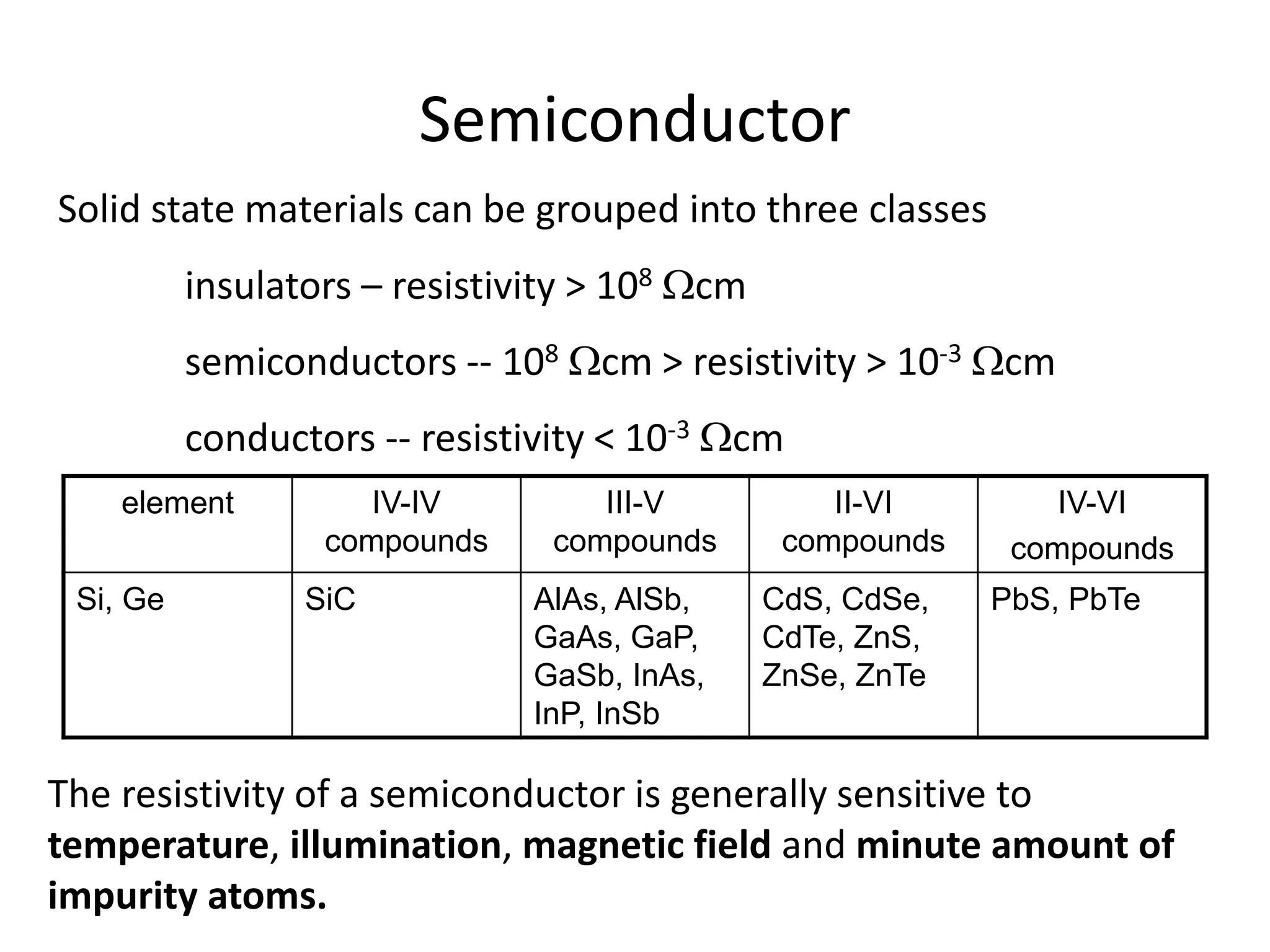
Solid state materials can be grouped into three classes
insulators – resistivity > 108 Wcm
semiconductors -- 108 Wcm > resistivity > 10-3 Wcm
conductors -- resistivity < 10-3 Wcm
The resistivity of a semiconductor is generally sensitive to
temperature, illumination, magnetic field and minute amount of
impurity atoms.
element IV-IV
compounds
III-V
compounds
II-VI
compounds
IV-VI
compounds
Si, Ge SiC AlAs, AlSb,
GaAs, GaP,
GaSb, InAs,
InP, InSb
CdS, CdSe,
CdTe, ZnS,
ZnSe, ZnTe
PbS, PbTe
Semiconductor
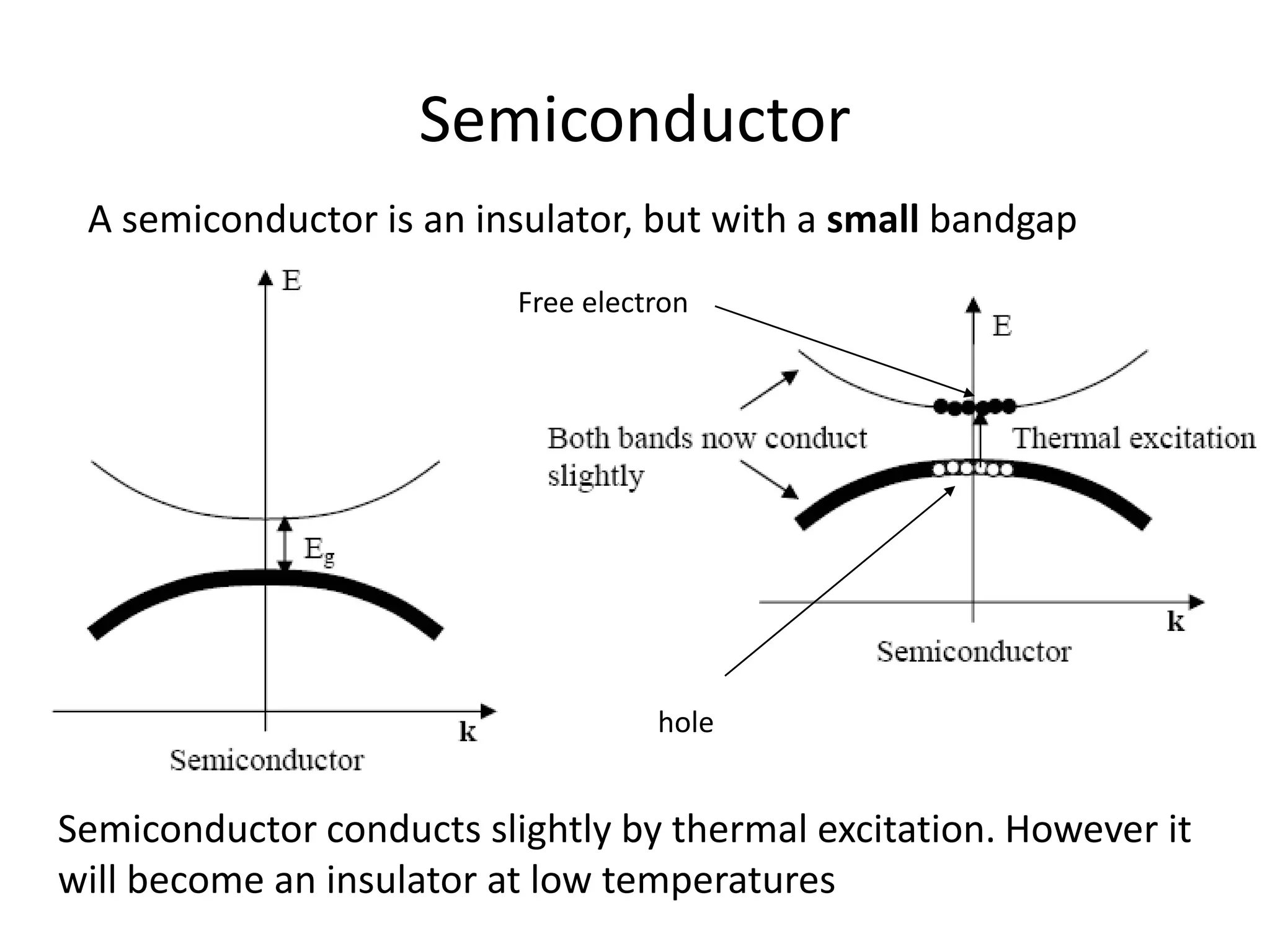
A semiconductor is an insulator, but with a small bandgap
Semiconductor conducts slightly by thermal excitation. However it
will become an insulator at low temperatures
hole
Free electron
Semiconductor
The resistivity of semiconductors are largely controlled by Eg/kT,
the ratio of the bandgap to the temperature.
Bandgap can be measured by optical absorption method
Crystal Gap Eg, eV (300K)
Si indirect 1.11
Ge indirect 0.66
InSb direct 0.17
InAs direct 0.36
InP direct 1.27
GaP indirect 2.25
GaAs direct 1.43
CdS direct 2.42
CdSe direct 1.74
Semiconductor
(direct and indirect absorption)
k
E
wg
phononphononphoton
phononphotong
kkk
E



ww 
k
E
wg 
Direct absorption process
0

photon
photong
k
E w
Indirect absorption process
Semiconductor
(direct and indirect absorption)
Semiconductor
(law of mass action)
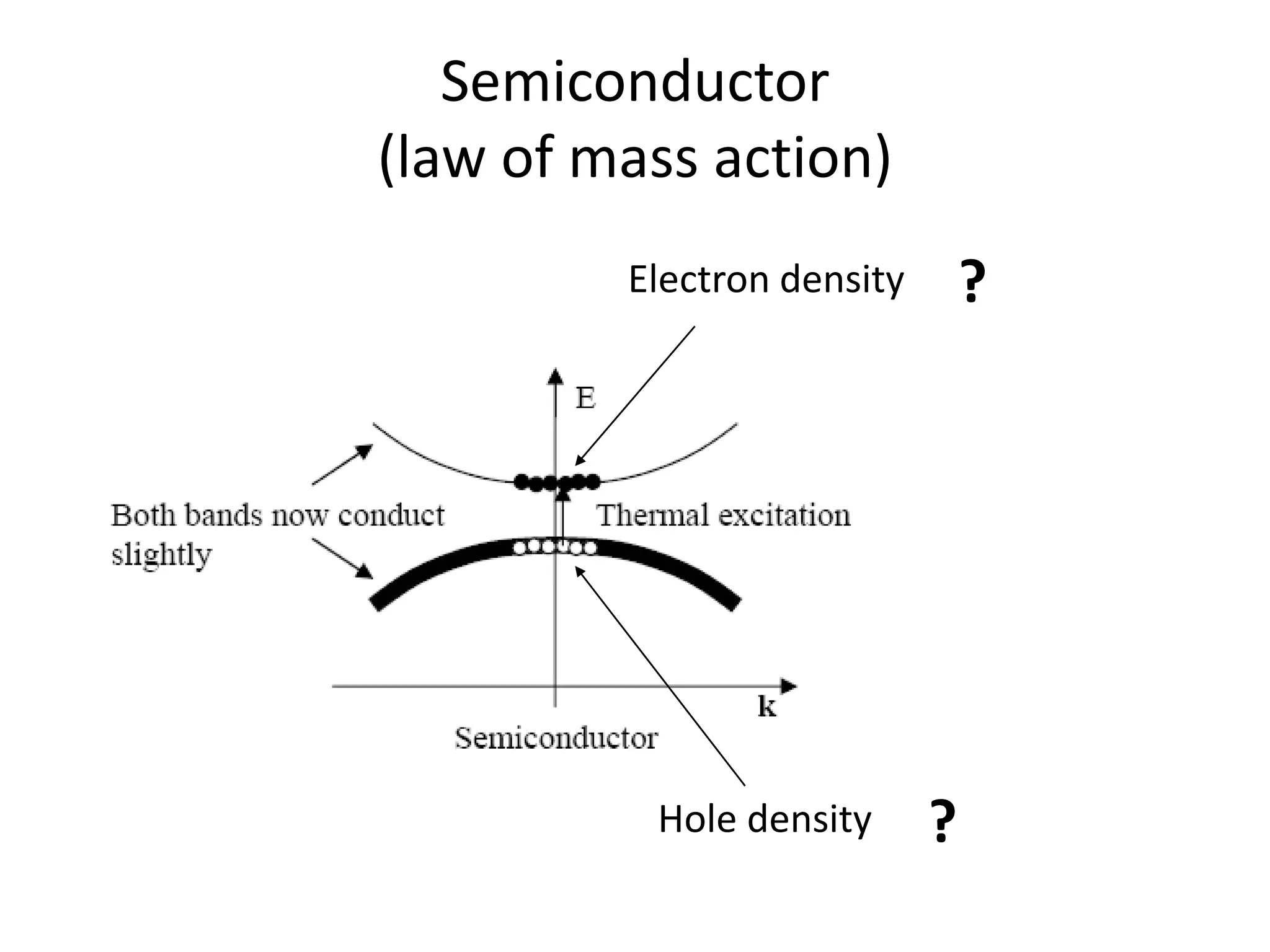
Electron density
Hole density
?
?
Semiconductor
(law of mass action)
The dispersion relation of electrons
in the c. band is
ec mkEE 2/22

The density of states for free
electrons is given by
2
1
)(
2
2
1
)(
2/3
22 C
e
n EE
m
ED 













(4)
(5)
Semiconductor
(law of mass action)
The electron density in the c. band is now given by
The Fermi function is
1
)1)/)(exp(()( 
 kTEEEf F
kTEEwhenkTEE FF  )/)(exp(
dE
kT
EE
EE
m
dEEDEfn
cE
F
C
e








 














)(
exp)(
2
2
1
)()(
2/1
2/3
22

(6)
(7)
Semiconductor
(law of mass action)
 dxxx
kT
EE
An
kT
m
Aand
kT
EE
xlet
Fc
e
e
e
C







 
















0
2/1
2/3
2/3
22
exp
)(
exp
)(
2
2
1

2


Thus,
2/3
2
2
2
)(
exp 










 


kTm
Nwhere
kT
EE
Nn e
C
Fc
C
effective density of states of the conduction band
(8)
Semiconductor
(law of mass action)
kTEEwhenkTEE FF  )/)exp((
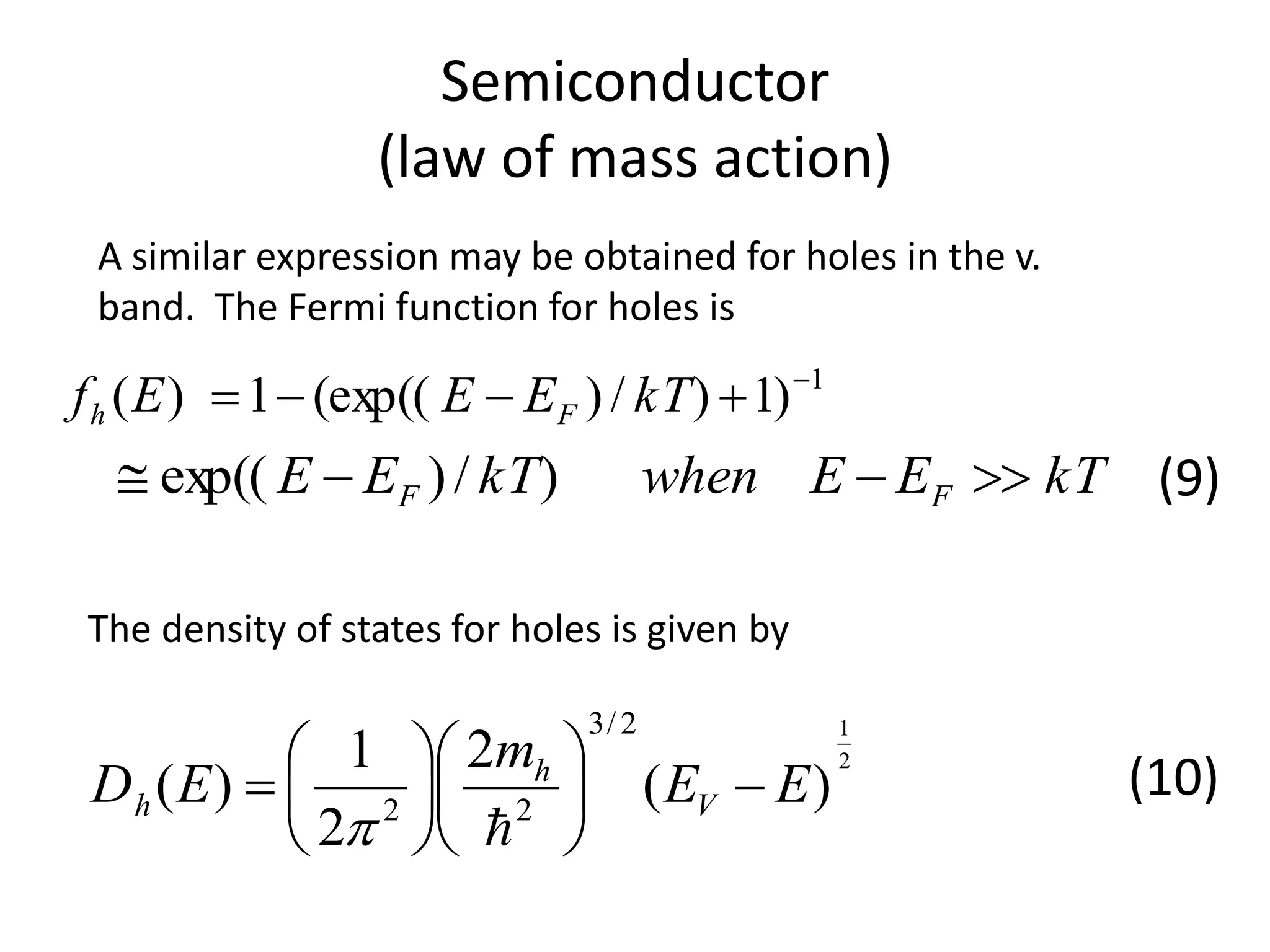
A similar expression may be obtained for holes in the v.
band. The Fermi function for holes is
1
)1)/)(exp((1)( 
 kTEEEf Fh
The density of states for holes is given by
2
1
)(
2
2
1
)(
2/3
22
EE
m
ED V
h
h 













(9)
(10)
Semiconductor
(law of mass action)
The hole density in the v. band is now given by
dE
kT
EE
EE
m
dEEDEfp
VE
F
V
e
hh








 














)(
exp)(
2
2
1
)()(
2/1
2/3
22

(11)(11) is evaluated in the same way as (7).
2/3
2
2
2
)(
exp 










 


kTm
Nwhere
kT
EE
Np h
V
FV
V
(12)effective density of states of the valence band
Semiconductor
(law of mass action)
Note that (8) and (12) are generally true as there is no assumption
about impurities or the actual position of EF. n and p only depend
upon the position of EF. Thus, we must realise that these results are
really for general situations rather than only intrinsic
semiconductors.
Multiplying (8) and (12), we obtain





 





 

kT
E
NN
kT
EE
NNnp
g
VC
CV
VC exp
)(
exp
np = constantor Law of Mass Action
(13)
Intrinsic Semiconductor
For an intrinsic semiconductor
n = p =ni or np=ni
2
)kT/Eexp()NN(pnn gvci 2
2
1

)kT/Eexp()mm()/kT( g
/
he
/
222 43232
 
on taking square root of (13), we have
Intrinsic carrier concentration
(14)
Intrinsic Semiconductor
(Intrinsic Fermi level)
Equating n and p from (8) and (12)
)kT/)EE(exp(NkT/)EE(exp(N vFvFcc 
Taking ln on both sides
)/ln(
2
1
)(
2
1
cvvcF NNkTEEE 
)/ln()4/3(
2
1
ehgF mmkTEE 
Thus, if me and mh are not too different, EF lies very close to the
middle of the forbidden gap.
or
Intrinsic Semiconductor
(Intrinsic conductivity)



m
q
v
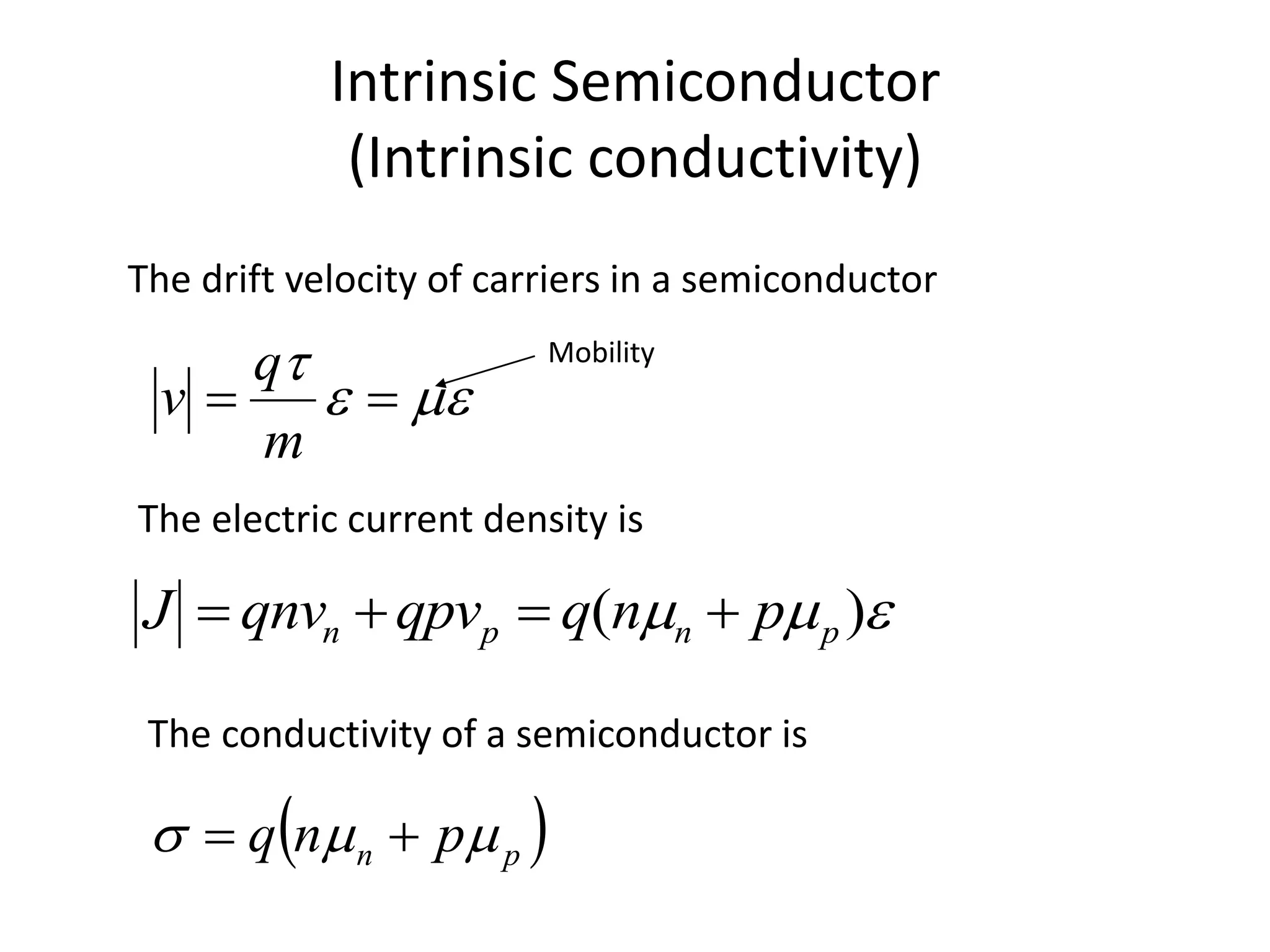
The drift velocity of carriers in a semiconductor
Mobility
 )( pnpn pnqqpvqnvJ 
The electric current density is
 pn pnq  
The conductivity of a semiconductor is
Example
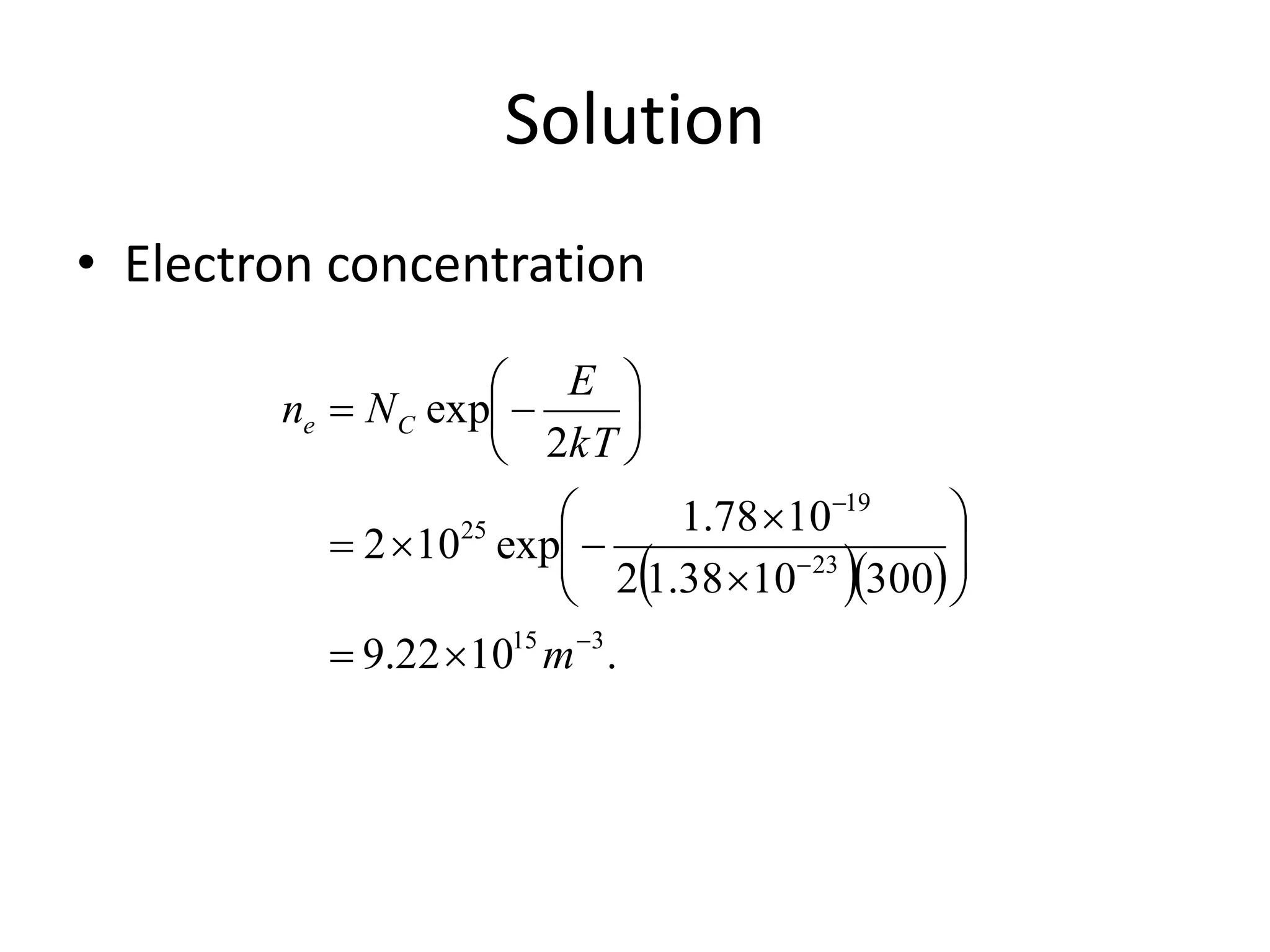
Estimate the number of conduction electrons
per cubic metre in a sample of silicon at 300 K.
Assume Nc is 2×1025 m-3, and band gap of
silicon is 1.11eV = 1.78×10⁻¹⁹J.
Solution
• Electron concentration
  
.1022.9
3001038.12
1078.1
exp102
2
exp
315
23
19
25




















m
kT
E
Nn Ce
Intrinsic Semiconductor
(Intrinsic conductivity)
 pniqn  
The conductivity of an intrinsic semiconductor is
)2/exp( kTEg
From (14) and ignore the T3/2 factor
Extrinsic Semiconductor
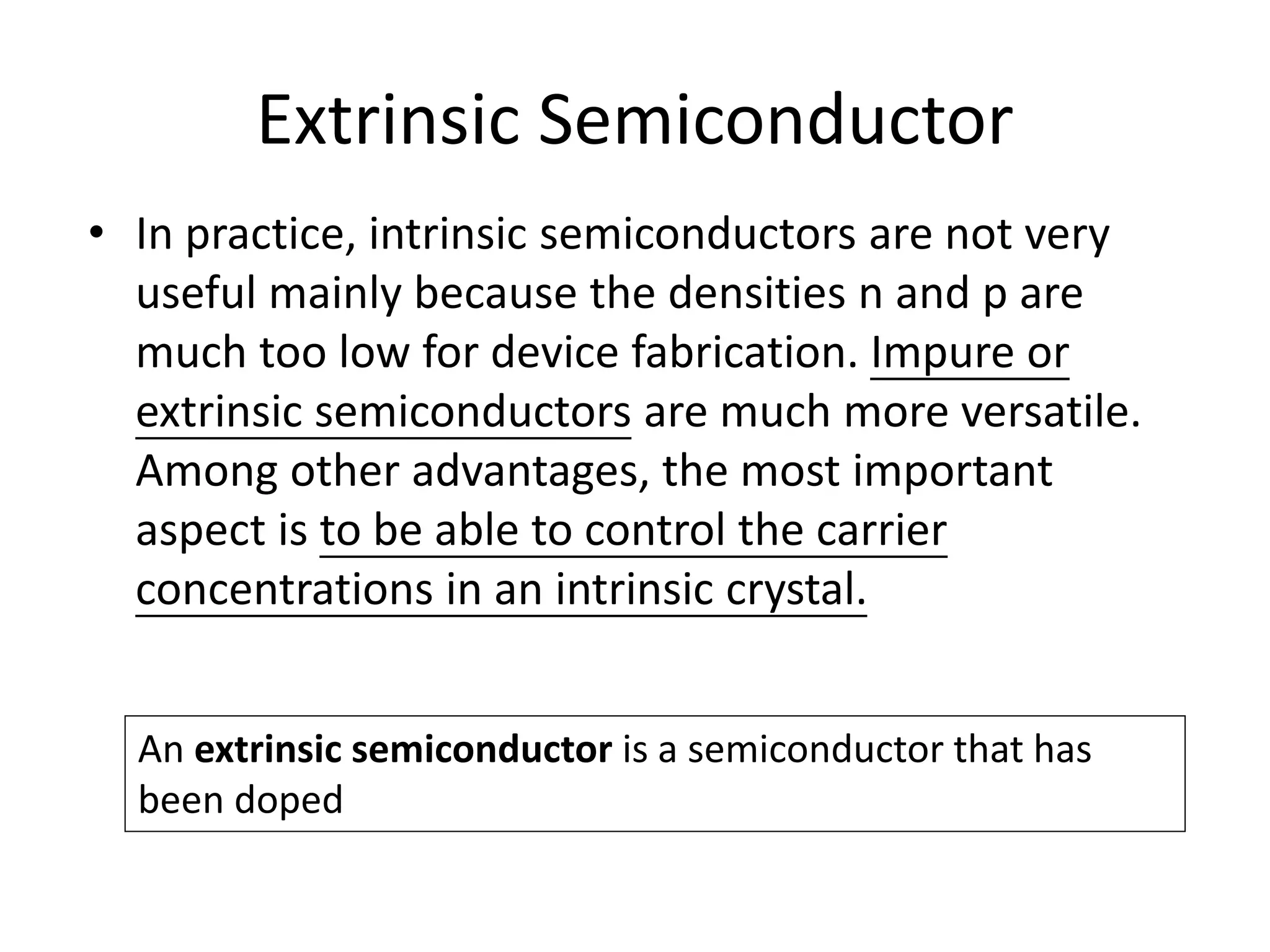
• In practice, intrinsic semiconductors are not very
useful mainly because the densities n and p are
much too low for device fabrication. Impure or
extrinsic semiconductors are much more versatile.
Among other advantages, the most important
aspect is to be able to control the carrier
concentrations in an intrinsic crystal.
An extrinsic semiconductor is a semiconductor that has
been doped
Extrinsic Semiconductor
Two types of impurities
• Donor (n-type)
– Add electrons to the conduction band. e.g. P for Si
– Introduce donor levels just below the conduction band edge
(ED)
• Acceptor (p-type)
– take electrons from the valance band. e.g. B for Si
– Introduce acceptor levels just above the valance band edge
(EA)
Extrinsic Semiconductor
According to Law of Mass Action, if we intentionally dope the
semiconductor thereby increasing n by say one million times, p must
decrease by the same order of magnitude (1/one million) in order to
maintain a constant product in (16a). In such a case, the number of
holes p would be much lower than the intrinsic case and would be
negligible. Thus, on doping with negative impurities, the process has
two effects, namely
(i) n is increased and
(ii) p is decreased by the same factor.
This is really contrary to intuition in which one might think that p
would remain constant.
In terms of the Fermi level, it will move towards the majority carrier
concentration, e.g. getting closer to the c. band for a n-type sample
with a large n value. As we shall also see, for a p-type sample with a
large p, the Fermi level is close to the v. band.
Extrinsic Semiconductor
(Charge neutrality)
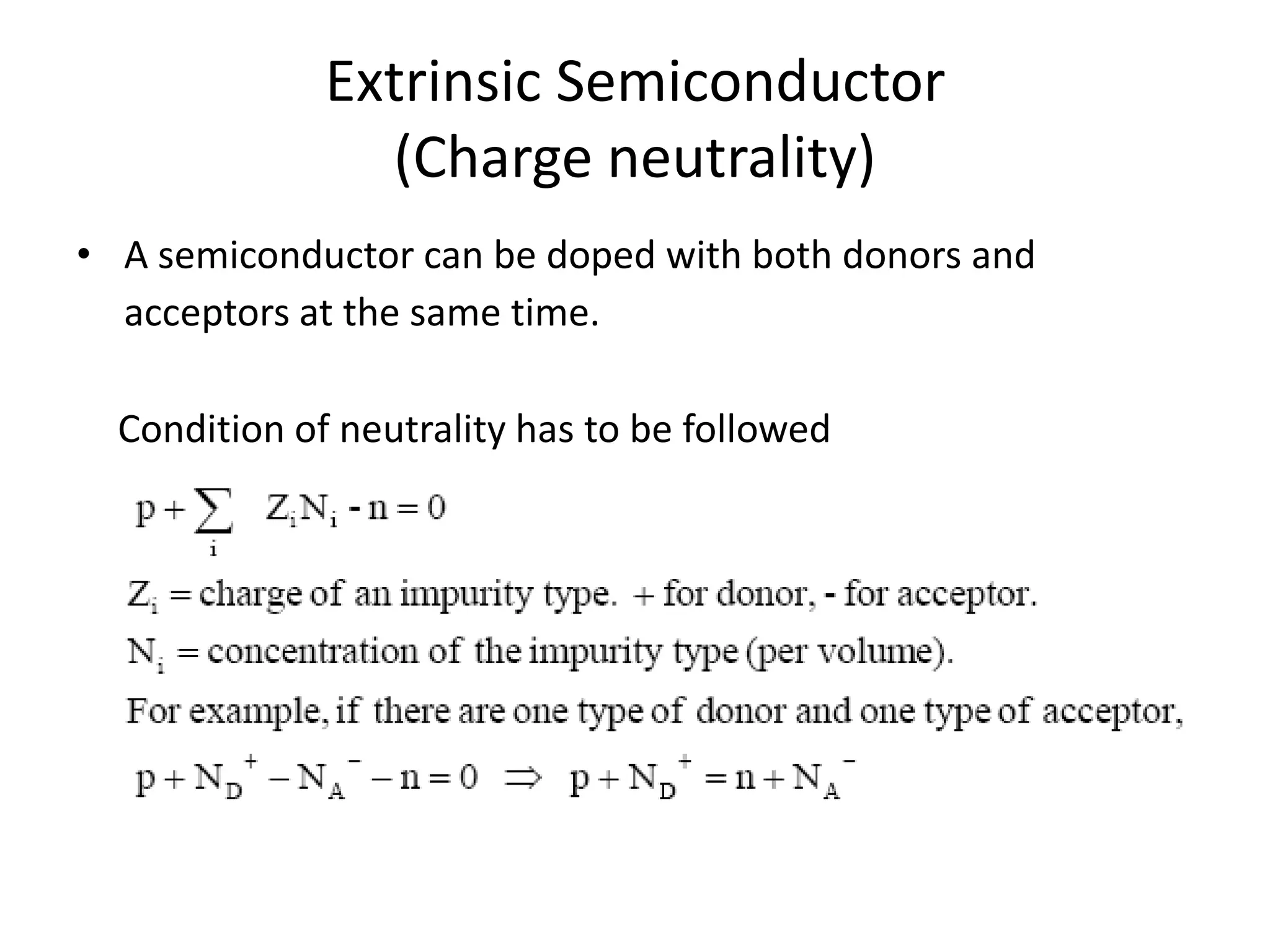
• A semiconductor can be doped with both donors and
acceptors at the same time.
Condition of neutrality has to be followed
Extrinsic Semiconductor
(Extrinsic carrier concentration)
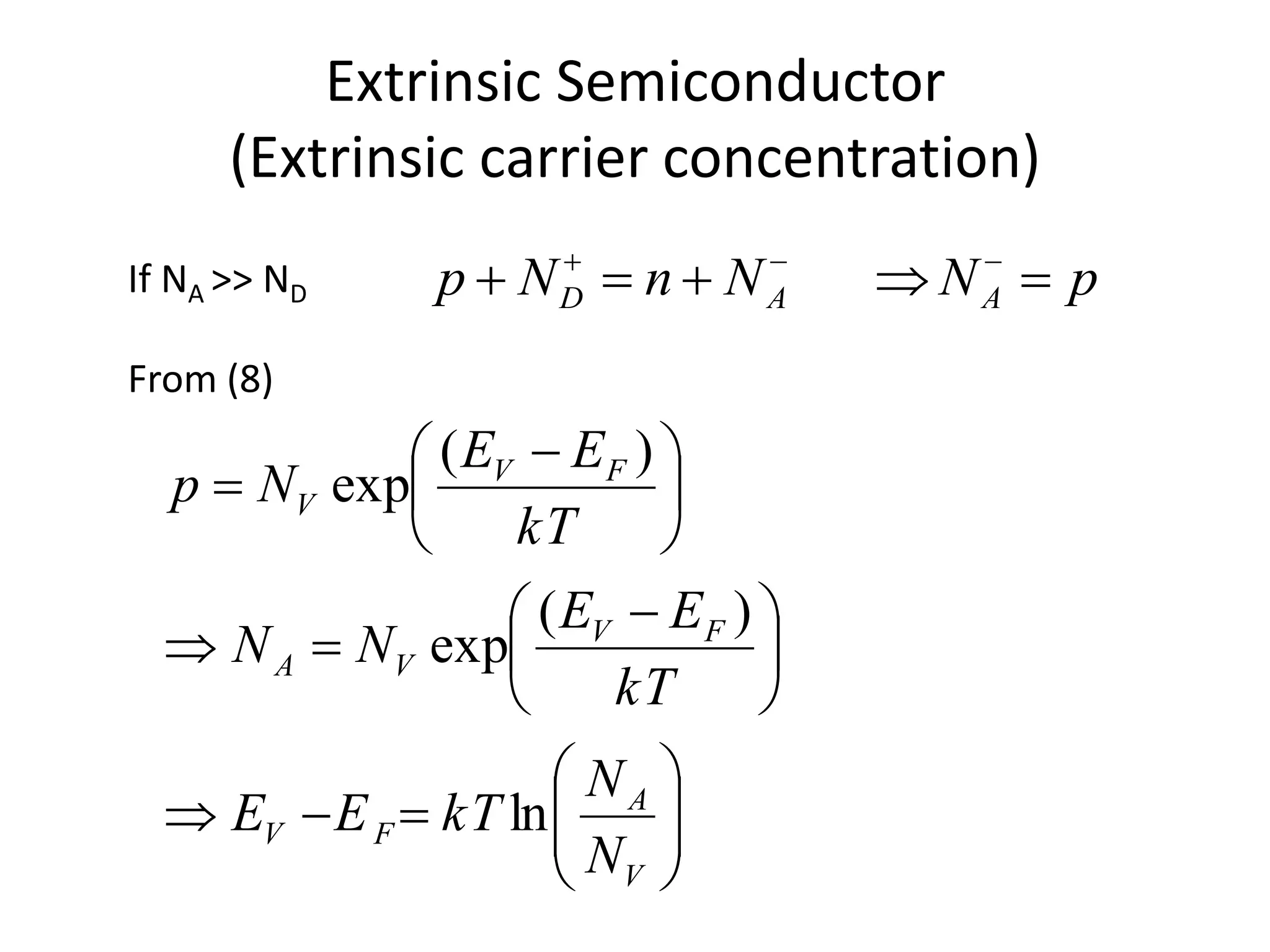
nNNnNp DAD  
If ND >> NA
From (8)












 






 

D
C
FC
FC
CD
FC
C
N
N
kTEE
kT
EE
NN
kT
EE
Nn
ln
)(
exp
)(
exp
Extrinsic Semiconductor
(Extrinsic carrier concentration)
pNNnNp AAD  
If NA >> ND
From (8)












 






 

V
A
FV
FV
VA
FV
V
N
N
kTEE
kT
EE
NN
kT
EE
Np
ln
)(
exp
)(
exp
Extrinsic Semiconductor
(Extrinsic carrier concentration)
Measured ionization energies for various impurities in GaAs
Extrinsic Semiconductor
(Extrinsic carrier concentration)
Measured ionization energies for various impurities in Si
Extrinsic Semiconductor
(Extrinsic carrier concentration)
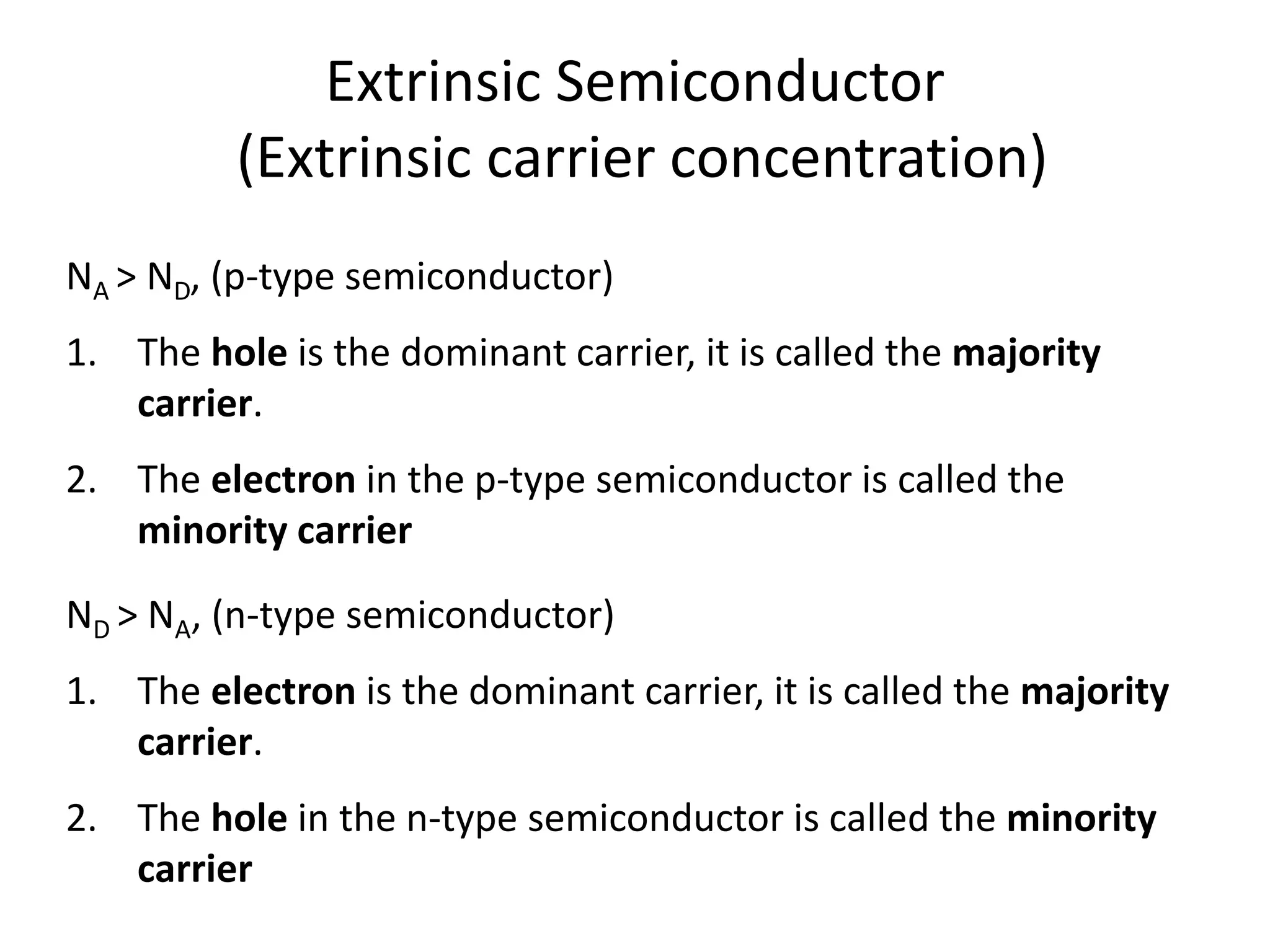
NA > ND, (p-type semiconductor)
1. The hole is the dominant carrier, it is called the majority
carrier.
2. The electron in the p-type semiconductor is called the
minority carrier
ND > NA, (n-type semiconductor)
1. The electron is the dominant carrier, it is called the majority
carrier.
2. The hole in the n-type semiconductor is called the minority
carrier
Extrinsic Semiconductor
(Extrinsic carrier concentration)
The equilibrium electron and hole concentrations in an n-type
semiconductor
 
nin
iADADn
nnp
nNNNNn
/
)2/1(4
2
22





 
The equilibrium electron and hole concentrations in an p-type
semiconductor
 
pip
iDADAp
pnn
nNNNNp
/
)2/1(4
2
22





 
Extrinsic Semiconductor
(Extrinsic carrier concentration)
Electron density as a function of temperature
Example
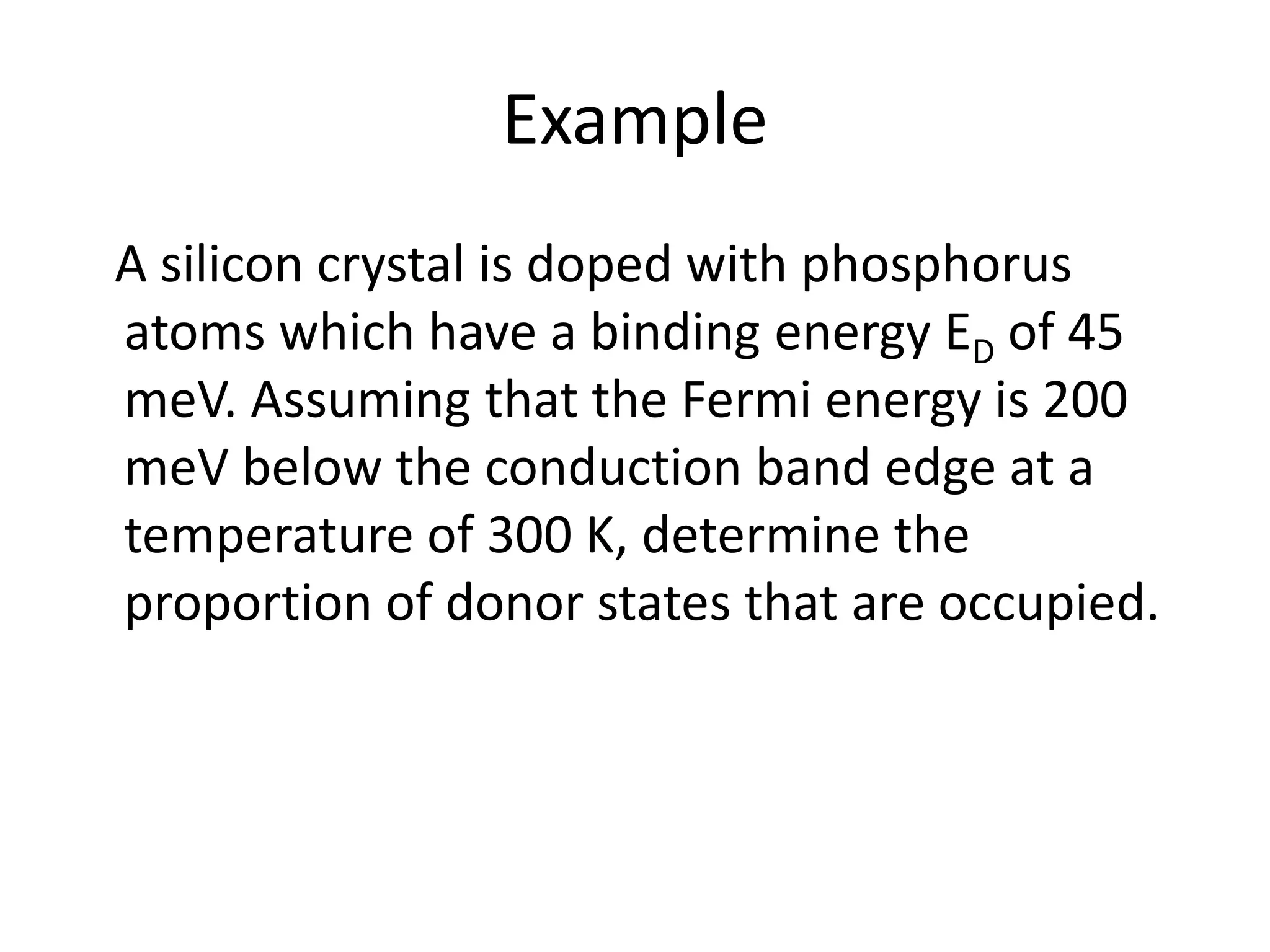
A silicon crystal is doped with phosphorus
atoms which have a binding energy ED of 45
meV. Assuming that the Fermi energy is 200
meV below the conduction band edge at a
temperature of 300 K, determine the
proportion of donor states that are occupied.
Solution
• The proportion of donor state that are
occupied, NDO, is equal to the probability of an
electron having an energy equal to the donor
state energy. Since the donor state is at energy
Eg-ED, the probability is given by Fermi-Dirac
distribution with E = Eg-ED, ie
1
1
)( /)(

  TKEEEDgDO BFDg
e
EEfN
Solution
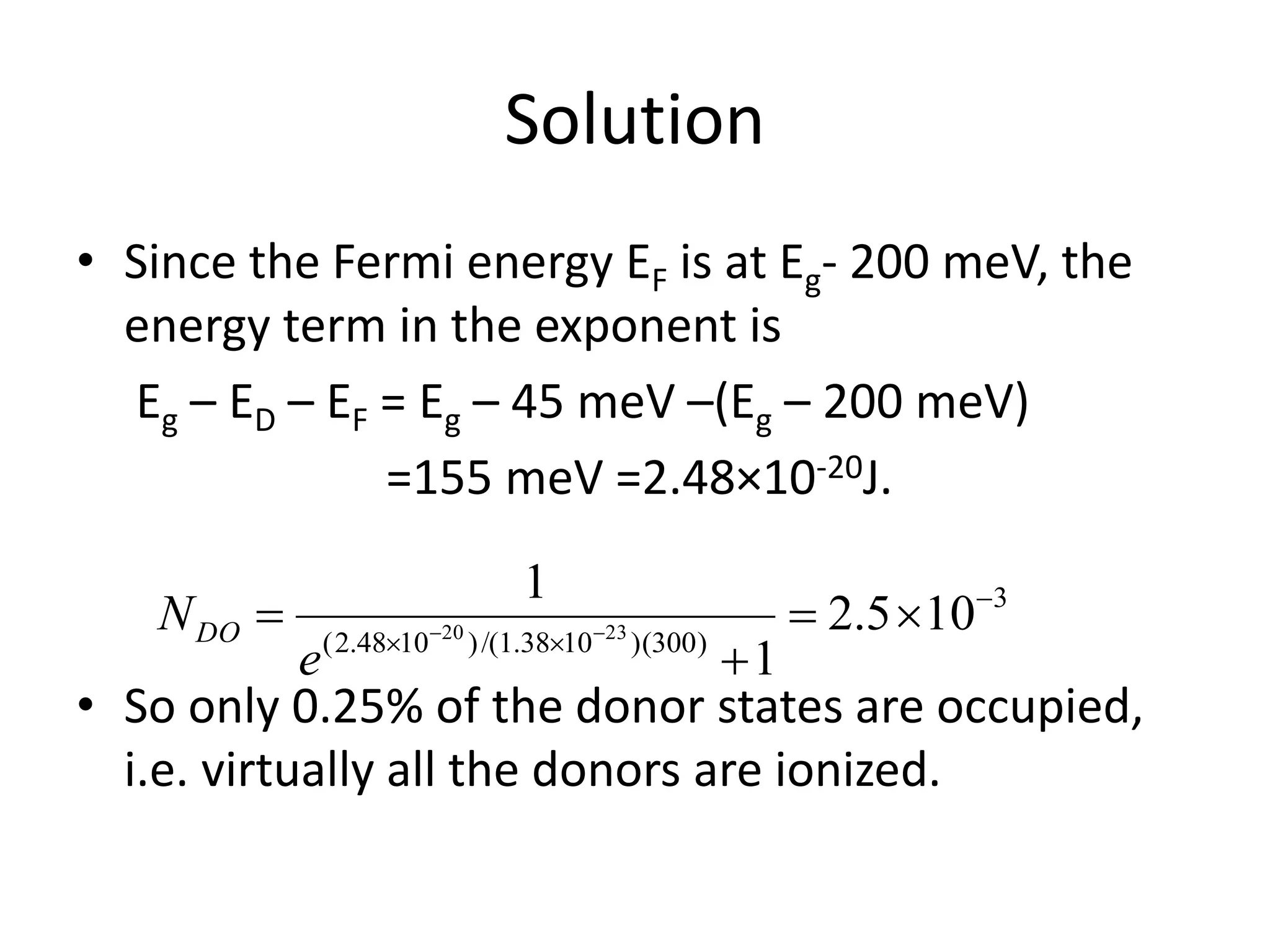
• Since the Fermi energy EF is at Eg- 200 meV, the
energy term in the exponent is
Eg – ED – EF = Eg – 45 meV –(Eg – 200 meV)
=155 meV =2.48×10⁻²⁰J.
• So only 0.25% of the donor states are occupied,
i.e. virtually all the donors are ionized.
3
)300)(1038.1/()1048.2(
105.2
1
1
2320




 
e
NDO
Example
Show that the product of the concentrations of
minority and majority carriers is a constant for
a given semiconductor at a particular
temperature.
Solution
• The product of the concentration of
conduction electrons and holes is
Since this expression is independent of the
position of the Fermi energy, we can deduce
that it is also independent of the level of
doping. Thus np = constant.





 





 

kT
E
NN
kT
EE
NNnp
g
VC
CV
VC exp
)(
exp
Extrinsic Semiconductor
(Hall effect)
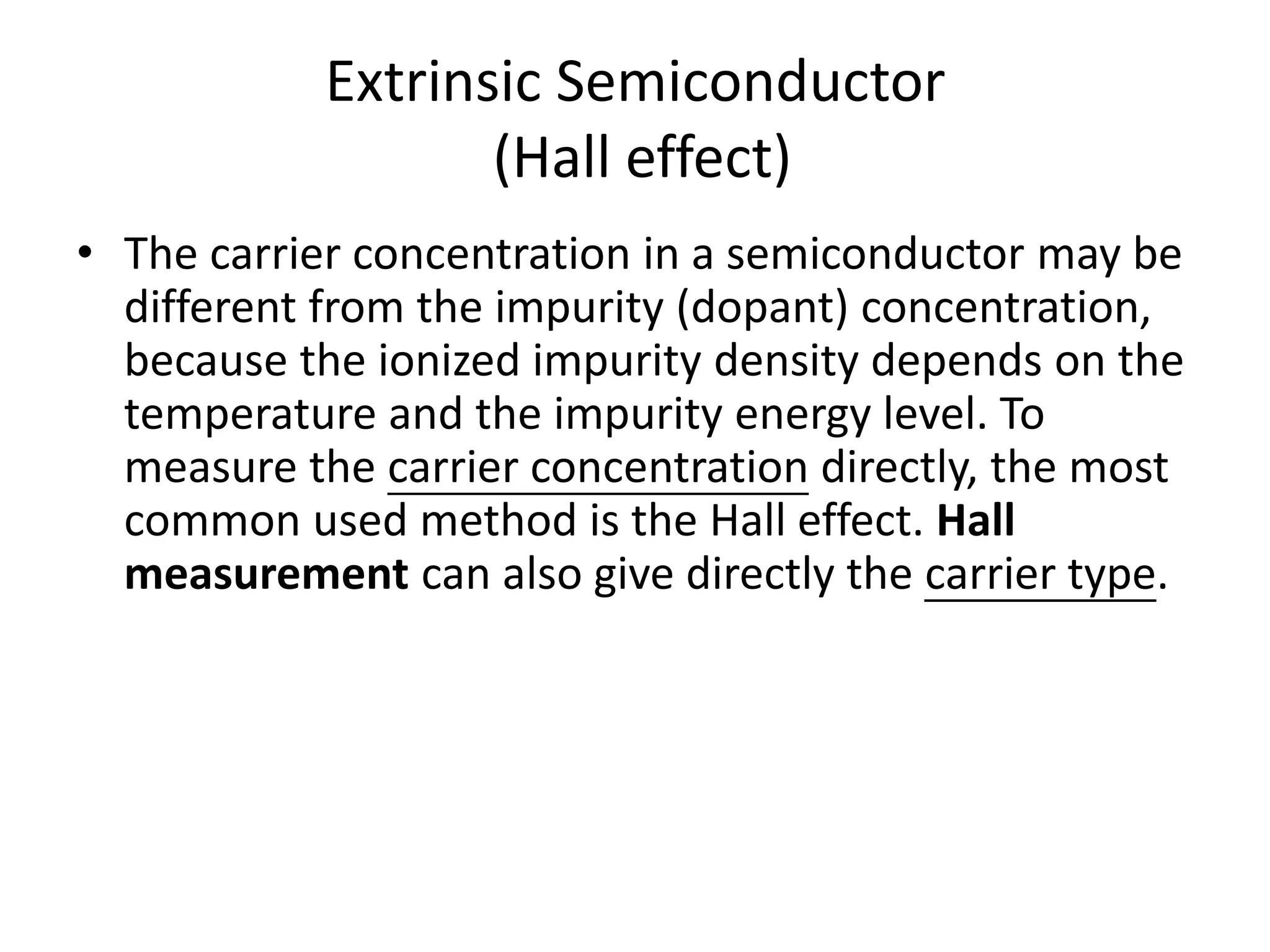
• The carrier concentration in a semiconductor may be
different from the impurity (dopant) concentration,
because the ionized impurity density depends on the
temperature and the impurity energy level. To
measure the carrier concentration directly, the most
common used method is the Hall effect. Hall
measurement can also give directly the carrier type.
Extrinsic Semiconductor
(Hall effect)
VH > 0 for n-type semiconductor
VH < 0 for p-type semiconductor
Extrinsic Semiconductor
(Hall effect)
WB
qn
J
WV
B
qn
qnv
Bv
z
x
yH
z
x
zxy
















 BvqF

 
In an electric field  and magnetic field B, the force on an
electron of charge q is
When Iy=0
Hall coefficient
qn
qp
RH
/1
/1


p-type
n-type
Extrinsic Semiconductor
(Extrinsic conductivity)
 pn pnq  
The conductivity of a semiconductor is
nn qn 
The conductivity of a n-type semiconductor is
pp qp 
The conductivity of a p-type semiconductor is
The Effective mass of electron
• What is the mass of an electron in a semiconductor?
• Surely the mass is the same as that of a free electron.
• However, certain experiments suggest that the electron
in a semiconductor behave as though they have a quite
different mass to that of a free electron.
• For example, consider the behaviour of an electron in a
uniform magnetic field B, theory suggest that the
electrons move in circular orbits with cyclotron
frequency c given by
e
c
m
Be


2

The Effective mass of electron
• This equation is well established for free
electrons.
• In general the measured cyclotron frequency of
an electron in a semiconductor does not agree
with the equation.
• An electron in a solid experiences other forces
and so it does not respond in the same way as a
free electron.
• In the crystal the electron has an effective mass
me .
Example
By considering the force acting on an electron
in a uniform magnetic field B, show that the
electrons move in circular orbits with a
frequency given by
e
c
m
Be


2

Solution
• The force on an electron due to magnetic field
• Centripetal force
• Equating these two forces
• Cyclotron frequency
.BeVFmagnetic 
.
2
r
Vm
F e
lcentripeta 
em
Ber
V 
e
c
c
m
Be
r
V
v

w
222

Values of effective mass of electrons me and holes mh
as a ratio of mass of free electron m.
me / m mh /m
Indium antimonide 0.014 0.4
Indium arsenide 0.022 0.4
Germanium 0.60 0.28
Silicon 0.43 0.54
Gallium arsenide 0.065 0.5
Sodium 1.2
Copper 0.99
Zinc 0.85
Silicon and Germanium
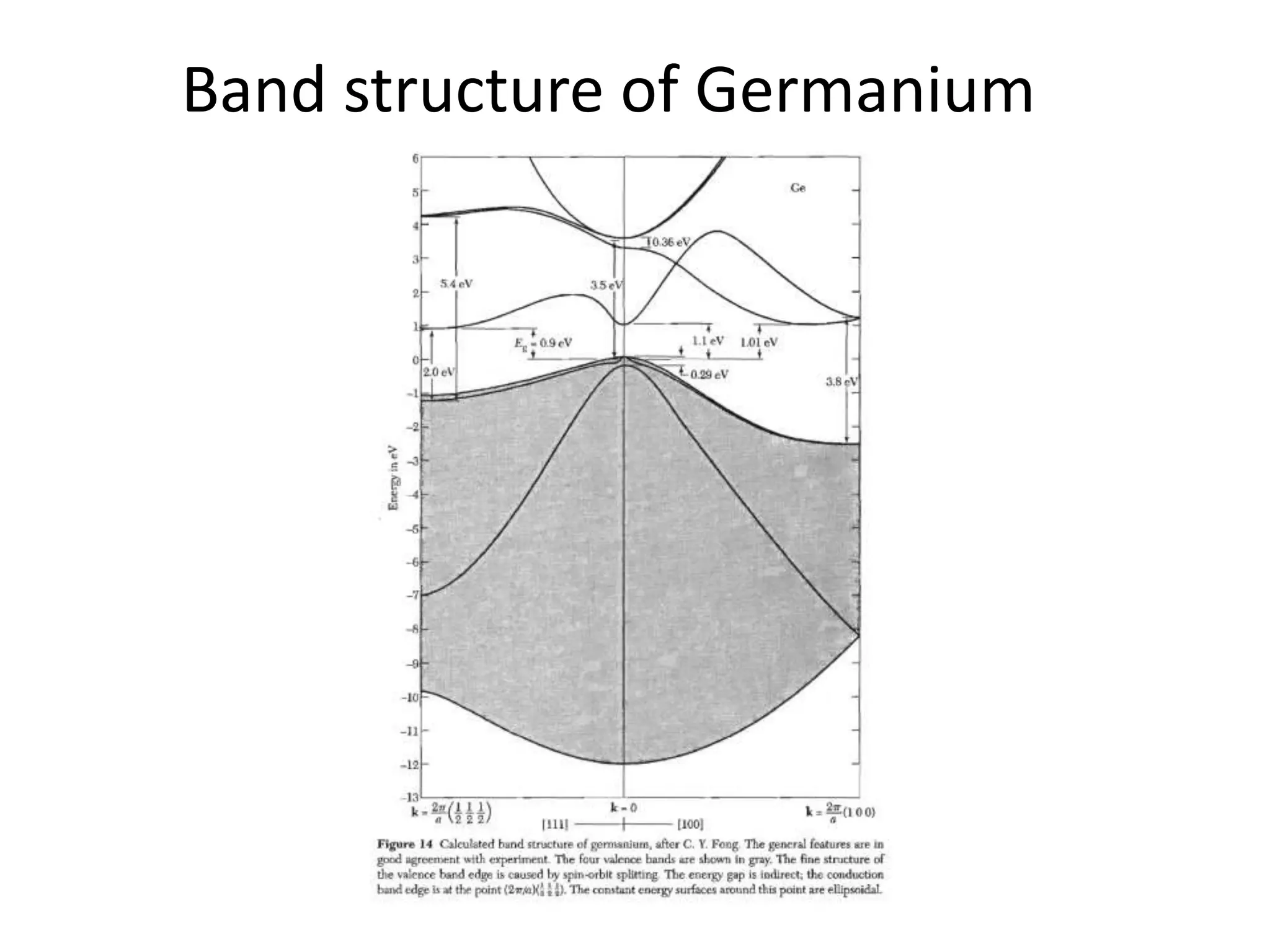
• The conduction and valence bands of
germanium are shown in Fig 14.
• The valence band edge in both Si and Ge is at
K= 0 and is derived from p3/2 and p1/2 states of
the free atoms.
• The conduction band edges in Ge are the
equivalent points L of the Brillouin Zone in Fig
15a,
Band structure of Germanium
Brillouin zones of fcc
Band structure of GaAS

Semiconductor

  • 1.
    UEEP2024 Solid StatePhysics Topic 4 Semiconductor
  • 2.
    Semiconductor Solid state materialscan be grouped into three classes insulators – resistivity > 108 Wcm semiconductors -- 108 Wcm > resistivity > 10-3 Wcm conductors -- resistivity < 10-3 Wcm The resistivity of a semiconductor is generally sensitive to temperature, illumination, magnetic field and minute amount of impurity atoms. element IV-IV compounds III-V compounds II-VI compounds IV-VI compounds Si, Ge SiC AlAs, AlSb, GaAs, GaP, GaSb, InAs, InP, InSb CdS, CdSe, CdTe, ZnS, ZnSe, ZnTe PbS, PbTe
  • 3.
    Semiconductor A semiconductor isan insulator, but with a small bandgap Semiconductor conducts slightly by thermal excitation. However it will become an insulator at low temperatures hole Free electron
  • 4.
    Semiconductor The resistivity ofsemiconductors are largely controlled by Eg/kT, the ratio of the bandgap to the temperature. Bandgap can be measured by optical absorption method Crystal Gap Eg, eV (300K) Si indirect 1.11 Ge indirect 0.66 InSb direct 0.17 InAs direct 0.36 InP direct 1.27 GaP indirect 2.25 GaAs direct 1.43 CdS direct 2.42 CdSe direct 1.74
  • 5.
    Semiconductor (direct and indirectabsorption) k E wg phononphononphoton phononphotong kkk E    ww  k E wg  Direct absorption process 0  photon photong k E w Indirect absorption process
  • 6.
  • 7.
    Semiconductor (law of massaction) Electron density Hole density ? ?
  • 8.
    Semiconductor (law of massaction) The dispersion relation of electrons in the c. band is ec mkEE 2/22  The density of states for free electrons is given by 2 1 )( 2 2 1 )( 2/3 22 C e n EE m ED               (4) (5)
  • 9.
    Semiconductor (law of massaction) The electron density in the c. band is now given by The Fermi function is 1 )1)/)(exp(()(   kTEEEf F kTEEwhenkTEE FF  )/)(exp( dE kT EE EE m dEEDEfn cE F C e                         )( exp)( 2 2 1 )()( 2/1 2/3 22  (6) (7)
  • 10.
    Semiconductor (law of massaction)  dxxx kT EE An kT m Aand kT EE xlet Fc e e e C                          0 2/1 2/3 2/3 22 exp )( exp )( 2 2 1  2   Thus, 2/3 2 2 2 )( exp                kTm Nwhere kT EE Nn e C Fc C effective density of states of the conduction band (8)
  • 11.
    Semiconductor (law of massaction) kTEEwhenkTEE FF  )/)exp(( A similar expression may be obtained for holes in the v. band. The Fermi function for holes is 1 )1)/)(exp((1)(   kTEEEf Fh The density of states for holes is given by 2 1 )( 2 2 1 )( 2/3 22 EE m ED V h h               (9) (10)
  • 12.
    Semiconductor (law of massaction) The hole density in the v. band is now given by dE kT EE EE m dEEDEfp VE F V e hh                         )( exp)( 2 2 1 )()( 2/1 2/3 22  (11)(11) is evaluated in the same way as (7). 2/3 2 2 2 )( exp                kTm Nwhere kT EE Np h V FV V (12)effective density of states of the valence band
  • 13.
    Semiconductor (law of massaction) Note that (8) and (12) are generally true as there is no assumption about impurities or the actual position of EF. n and p only depend upon the position of EF. Thus, we must realise that these results are really for general situations rather than only intrinsic semiconductors. Multiplying (8) and (12), we obtain                kT E NN kT EE NNnp g VC CV VC exp )( exp np = constantor Law of Mass Action (13)
  • 14.
    Intrinsic Semiconductor For anintrinsic semiconductor n = p =ni or np=ni 2 )kT/Eexp()NN(pnn gvci 2 2 1  )kT/Eexp()mm()/kT( g / he / 222 43232   on taking square root of (13), we have Intrinsic carrier concentration (14)
  • 15.
    Intrinsic Semiconductor (Intrinsic Fermilevel) Equating n and p from (8) and (12) )kT/)EE(exp(NkT/)EE(exp(N vFvFcc  Taking ln on both sides )/ln( 2 1 )( 2 1 cvvcF NNkTEEE  )/ln()4/3( 2 1 ehgF mmkTEE  Thus, if me and mh are not too different, EF lies very close to the middle of the forbidden gap. or
  • 16.
    Intrinsic Semiconductor (Intrinsic conductivity)    m q v Thedrift velocity of carriers in a semiconductor Mobility  )( pnpn pnqqpvqnvJ  The electric current density is  pn pnq   The conductivity of a semiconductor is
  • 17.
    Example Estimate the numberof conduction electrons per cubic metre in a sample of silicon at 300 K. Assume Nc is 2×1025 m-3, and band gap of silicon is 1.11eV = 1.78×10⁻¹⁹J.
  • 18.
    Solution • Electron concentration   .1022.9 3001038.12 1078.1 exp102 2 exp 315 23 19 25                     m kT E Nn Ce
  • 19.
    Intrinsic Semiconductor (Intrinsic conductivity) pniqn   The conductivity of an intrinsic semiconductor is )2/exp( kTEg From (14) and ignore the T3/2 factor
  • 20.
    Extrinsic Semiconductor • Inpractice, intrinsic semiconductors are not very useful mainly because the densities n and p are much too low for device fabrication. Impure or extrinsic semiconductors are much more versatile. Among other advantages, the most important aspect is to be able to control the carrier concentrations in an intrinsic crystal. An extrinsic semiconductor is a semiconductor that has been doped
  • 21.
    Extrinsic Semiconductor Two typesof impurities • Donor (n-type) – Add electrons to the conduction band. e.g. P for Si – Introduce donor levels just below the conduction band edge (ED) • Acceptor (p-type) – take electrons from the valance band. e.g. B for Si – Introduce acceptor levels just above the valance band edge (EA)
  • 22.
    Extrinsic Semiconductor According toLaw of Mass Action, if we intentionally dope the semiconductor thereby increasing n by say one million times, p must decrease by the same order of magnitude (1/one million) in order to maintain a constant product in (16a). In such a case, the number of holes p would be much lower than the intrinsic case and would be negligible. Thus, on doping with negative impurities, the process has two effects, namely (i) n is increased and (ii) p is decreased by the same factor. This is really contrary to intuition in which one might think that p would remain constant. In terms of the Fermi level, it will move towards the majority carrier concentration, e.g. getting closer to the c. band for a n-type sample with a large n value. As we shall also see, for a p-type sample with a large p, the Fermi level is close to the v. band.
  • 23.
    Extrinsic Semiconductor (Charge neutrality) •A semiconductor can be doped with both donors and acceptors at the same time. Condition of neutrality has to be followed
  • 24.
    Extrinsic Semiconductor (Extrinsic carrierconcentration) nNNnNp DAD   If ND >> NA From (8)                        D C FC FC CD FC C N N kTEE kT EE NN kT EE Nn ln )( exp )( exp
  • 25.
    Extrinsic Semiconductor (Extrinsic carrierconcentration) pNNnNp AAD   If NA >> ND From (8)                        V A FV FV VA FV V N N kTEE kT EE NN kT EE Np ln )( exp )( exp
  • 26.
    Extrinsic Semiconductor (Extrinsic carrierconcentration) Measured ionization energies for various impurities in GaAs
  • 27.
    Extrinsic Semiconductor (Extrinsic carrierconcentration) Measured ionization energies for various impurities in Si
  • 28.
    Extrinsic Semiconductor (Extrinsic carrierconcentration) NA > ND, (p-type semiconductor) 1. The hole is the dominant carrier, it is called the majority carrier. 2. The electron in the p-type semiconductor is called the minority carrier ND > NA, (n-type semiconductor) 1. The electron is the dominant carrier, it is called the majority carrier. 2. The hole in the n-type semiconductor is called the minority carrier
  • 29.
    Extrinsic Semiconductor (Extrinsic carrierconcentration) The equilibrium electron and hole concentrations in an n-type semiconductor   nin iADADn nnp nNNNNn / )2/1(4 2 22        The equilibrium electron and hole concentrations in an p-type semiconductor   pip iDADAp pnn nNNNNp / )2/1(4 2 22       
  • 30.
    Extrinsic Semiconductor (Extrinsic carrierconcentration) Electron density as a function of temperature
  • 31.
    Example A silicon crystalis doped with phosphorus atoms which have a binding energy ED of 45 meV. Assuming that the Fermi energy is 200 meV below the conduction band edge at a temperature of 300 K, determine the proportion of donor states that are occupied.
  • 32.
    Solution • The proportionof donor state that are occupied, NDO, is equal to the probability of an electron having an energy equal to the donor state energy. Since the donor state is at energy Eg-ED, the probability is given by Fermi-Dirac distribution with E = Eg-ED, ie 1 1 )( /)(    TKEEEDgDO BFDg e EEfN
  • 33.
    Solution • Since theFermi energy EF is at Eg- 200 meV, the energy term in the exponent is Eg – ED – EF = Eg – 45 meV –(Eg – 200 meV) =155 meV =2.48×10⁻²⁰J. • So only 0.25% of the donor states are occupied, i.e. virtually all the donors are ionized. 3 )300)(1038.1/()1048.2( 105.2 1 1 2320       e NDO
  • 34.
    Example Show that theproduct of the concentrations of minority and majority carriers is a constant for a given semiconductor at a particular temperature.
  • 35.
    Solution • The productof the concentration of conduction electrons and holes is Since this expression is independent of the position of the Fermi energy, we can deduce that it is also independent of the level of doping. Thus np = constant.                kT E NN kT EE NNnp g VC CV VC exp )( exp
  • 36.
    Extrinsic Semiconductor (Hall effect) •The carrier concentration in a semiconductor may be different from the impurity (dopant) concentration, because the ionized impurity density depends on the temperature and the impurity energy level. To measure the carrier concentration directly, the most common used method is the Hall effect. Hall measurement can also give directly the carrier type.
  • 37.
    Extrinsic Semiconductor (Hall effect) VH> 0 for n-type semiconductor VH < 0 for p-type semiconductor
  • 38.
    Extrinsic Semiconductor (Hall effect) WB qn J WV B qn qnv Bv z x yH z x zxy                 BvqF    In an electric field  and magnetic field B, the force on an electron of charge q is When Iy=0 Hall coefficient qn qp RH /1 /1   p-type n-type
  • 39.
    Extrinsic Semiconductor (Extrinsic conductivity) pn pnq   The conductivity of a semiconductor is nn qn  The conductivity of a n-type semiconductor is pp qp  The conductivity of a p-type semiconductor is
  • 40.
    The Effective massof electron • What is the mass of an electron in a semiconductor? • Surely the mass is the same as that of a free electron. • However, certain experiments suggest that the electron in a semiconductor behave as though they have a quite different mass to that of a free electron. • For example, consider the behaviour of an electron in a uniform magnetic field B, theory suggest that the electrons move in circular orbits with cyclotron frequency c given by e c m Be   2 
  • 41.
    The Effective massof electron • This equation is well established for free electrons. • In general the measured cyclotron frequency of an electron in a semiconductor does not agree with the equation. • An electron in a solid experiences other forces and so it does not respond in the same way as a free electron. • In the crystal the electron has an effective mass me .
  • 42.
    Example By considering theforce acting on an electron in a uniform magnetic field B, show that the electrons move in circular orbits with a frequency given by e c m Be   2 
  • 43.
    Solution • The forceon an electron due to magnetic field • Centripetal force • Equating these two forces • Cyclotron frequency .BeVFmagnetic  . 2 r Vm F e lcentripeta  em Ber V  e c c m Be r V v  w 222 
  • 44.
    Values of effectivemass of electrons me and holes mh as a ratio of mass of free electron m. me / m mh /m Indium antimonide 0.014 0.4 Indium arsenide 0.022 0.4 Germanium 0.60 0.28 Silicon 0.43 0.54 Gallium arsenide 0.065 0.5 Sodium 1.2 Copper 0.99 Zinc 0.85
  • 45.
    Silicon and Germanium •The conduction and valence bands of germanium are shown in Fig 14. • The valence band edge in both Si and Ge is at K= 0 and is derived from p3/2 and p1/2 states of the free atoms. • The conduction band edges in Ge are the equivalent points L of the Brillouin Zone in Fig 15a,
  • 46.
  • 47.
  • 48.