UEEP2024 Solid State Physics
Topic 2 Crystal dynamics
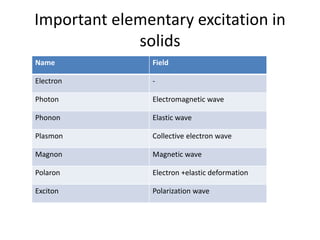
Important elementary excitation in
solids
Name Field
Electron -
Photon Electromagnetic wave
Phonon Elastic wave
Plasmon Collective electron wave
Magnon Magnetic wave
Polaron Electron +elastic deformation
Exciton Polarization wave
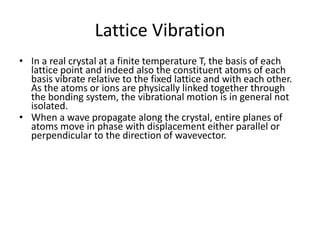
Lattice Vibration
• In a real crystal at a finite temperature T, the basis of each
lattice point and indeed also the constituent atoms of each
basis vibrate relative to the fixed lattice and with each other.
As the atoms or ions are physically linked together through
the bonding system, the vibrational motion is in general not
isolated.
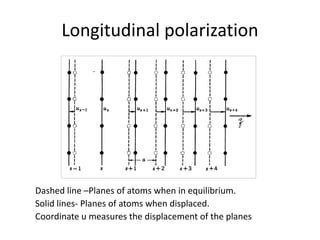
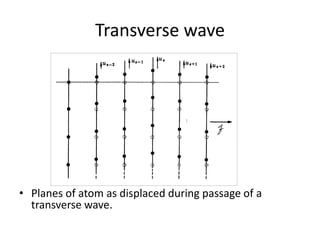
• When a wave propagate along the crystal, entire planes of
atoms move in phase with displacement either parallel or
perpendicular to the direction of wavevector.
Longitudinal polarization
Dashed line –Planes of atoms when in equilibrium.
Solid lines- Planes of atoms when displaced.
Coordinate u measures the displacement of the planes
Transverse wave
• Planes of atom as displaced during passage of a
transverse wave.
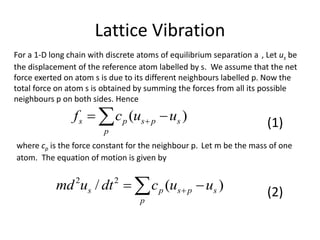
Lattice Vibration
  
p
spsps uucf )(
where cp is the force constant for the neighbour p. Let m be the mass of one
atom. The equation of motion is given by
For a 1-D long chain with discrete atoms of equilibrium separation a , Let us be
the displacement of the reference atom labelled by s. We assume that the net
force exerted on atom s is due to its different neighbours labelled p. Now the
total force on atom s is obtained by summing the forces from all its possible
neighbours p on both sides. Hence
  
p
spsps uucdtumd )(/ 22
(1)
(2)
Lattice Vibration
The wave-like solution is
)](exp[)( tqxiAxu  (3)
ω is the angular frequency
q is the wavevector
P = h/2 x q
E = h/2 x ω
The vibrational motion in the crystal is regarded as a kind of wave
propagation. Because of the finite extent of the crystal, the wave motion is
often regarded as a standing wave system. the phonon is defined to be
the quantised energy of elastic waves in a crystal. The phonons are similar
to the photons in electromagnetic waves in many respects. Both of these
two excitations exhibit the duality property, namely possessing both wave-
like and particle-like behaviour.
Lattice Vibration
Remember that we are dealing with discrete atoms of equilibrium
separation a. Thus for any general atoms with label s + p, x should be
replaced by (s + p)a.
)exp(])(exp[ tiqapsiuu ps  (4)
Substituting this solution (4) in the equation of motion, we obtain
]1)[exp(2
  ipqacm pp (5)
for the lattice with inversion symmetry about the origin, (5) may be
re-written as
)]cos(1[)/2(2
pqacm pp   (6)
Lattice Vibration
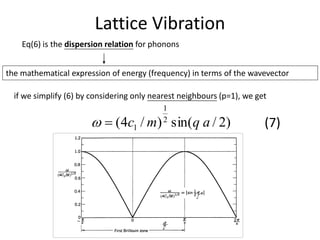
Eq(6) is the dispersion relation for phonons
the mathematical expression of energy (frequency) in terms of the wavevector
if we simplify (6) by considering only nearest neighbours (p=1), we get
)2/sin()/4( 2
1
1 aqmc (7)
Group Velocity of Phonons
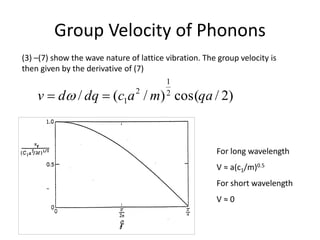
(3) –(7) show the wave nature of lattice vibration. The group velocity is
then given by the derivative of (7)
)2/cos()/(/ 2
1
2
1 qamacdqdv  
For long wavelength
V ≈ a(c1/m)0.5
For short wavelength
V ≈ 0
The Brillouin zone
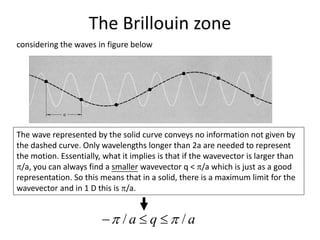
considering the waves in figure below
The wave represented by the solid curve conveys no information not given by
the dashed curve. Only wavelengths longer than 2a are needed to represent
the motion. Essentially, what it implies is that if the wavevector is larger than
/a, you can always find a smaller wavevector q < /a which is just as a good
representation. So this means that in a solid, there is a maximum limit for the
wavevector and in 1 D this is /a.
aqa //  
The Brillouin zone
“if the wavevector is larger than /a, you can always find a smaller
wavevector q < /a which is just as a good representation”
How ??
Consider two wavevector q and q + n(2π/a) where n is an integer
)exp()2exp()exp(
])/2(exp[
iqaniiqa
aanqi




)/2(' anqq 
 q outside the first zone
q' the corresponding value inside the zone
Photons in Diatomic Crystals
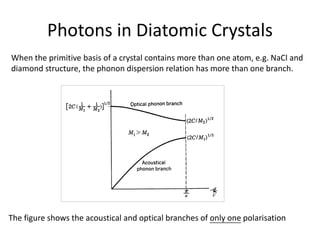
When the primitive basis of a crystal contains more than one atom, e.g. NaCl and
diamond structure, the phonon dispersion relation has more than one branch.
The figure shows the acoustical and optical branches of only one polarisation
Photons in Diatomic Crystals
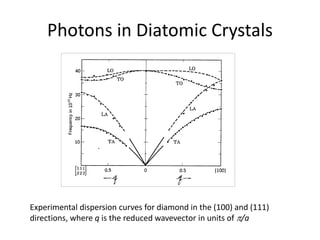
• For both the acoustical and the optical frequency
ranges there should be two transverse and one
longitudinal polarisations.
• For a diatomic crystal, there are three optical
branches (one longitudinal LO and two transverse TO)
and three acoustical branches (one longitudinal LA
and two transverse TA).
• For a general basis with p atoms, there are three
acoustical branches and (3p - 3) optical branches.
Photons in Diatomic Crystals
Experimental dispersion curves for diamond in the (100) and (111)
directions, where q is the reduced wavevector in units of /a
Quantization of Elastic Waves
• The energy of a lattice vibration is quantized.
• The quantum of energy is called a phonon in
analogy with the photon of the
electromagnetic wave.
• The energy of an elastic mode of angular
frequency w is E = (n + ½) ħw when the mode
is excited to quantum number n.
• The term ½ ħw is the zero energy of the mode.
Phonon Momentum
• A phonon of wavevector q will interact with particles such
as photons, neutrons and electrons as if it had a
momentum ħq.
• Phonon does not carry physical momentum.
• In crystal there exist wavevector selection rules for allowed
transitions between quantum states.
• In elastic scattering of a crystal is governed by the
wavevector selection rule K’ = K +G, where G is a vector in
the reciprocal lattice, K is the wavevector of the incident
photon and K’ is the wavevector of the scattered photon.
• If scattering is inelastic, with the creation of phonon of
wavevector q, then the selection rule is K’+q = K +G.
• If a phonon q is absorbed in the process, K’ =q + K +G.
Inelastic scattering by phonons
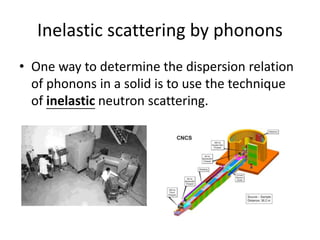
• One way to determine the dispersion relation
of phonons in a solid is to use the technique
of inelastic neutron scattering.
Inelastic scattering by phonons
• elastic
– the energy of the incident particles is conserved,
only their direction of propagation is modified.
• Inelastic
– the energy of the incident particle is not
conserved. In this scattering process, the energy
of the incident particle is lost or gained.
Inelastic scattering by phonons
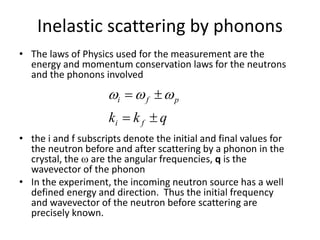
• The laws of Physics used for the measurement are the
energy and momentum conservation laws for the neutrons
and the phonons involved
• the i and f subscripts denote the initial and final values for
the neutron before and after scattering by a phonon in the
crystal, the  are the angular frequencies, q is the
wavevector of the phonon
• In the experiment, the incoming neutron source has a well
defined energy and direction. Thus the initial frequency
and wavevector of the neutron before scattering are
precisely known.
qkk fi
pfi

 
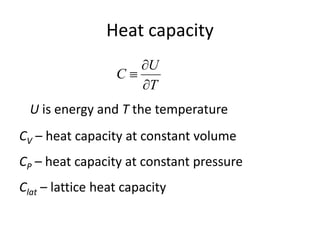
Heat capacity
U is energy and T the temperature
T
U
C



CV – heat capacity at constant volume
CP – heat capacity at constant pressure
Clat – lattice heat capacity
Heat Capacity of the lattice
• Classical statistical mechanics explained the
heat capacity of insulators at room
temperature fairly well but failed for lower
temperatures and it totally failed for metals.
• Metals were expected to have much higher
heat capacity than insulators because of of
many free electrons but it turn out that a
metal’s heat capacity at room temperature is
similar to that of insulator.
Classical theory and experimental
results
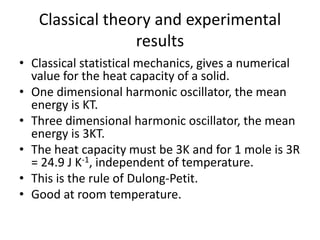
• Classical statistical mechanics, gives a numerical
value for the heat capacity of a solid.
• One dimensional harmonic oscillator, the mean
energy is KT.
• Three dimensional harmonic oscillator, the mean
energy is 3KT.
• The heat capacity must be 3K and for 1 mole is 3R
= 24.9 J K-1, independent of temperature.
• This is the rule of Dulong-Petit.
• Good at room temperature.
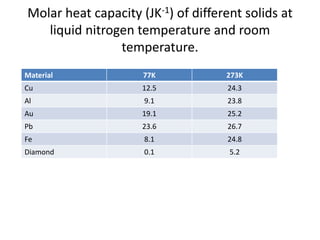
Molar heat capacity (JK-1) of different solids at
liquid nitrogen temperature and room
temperature.
Material 77K 273K
Cu 12.5 24.3
Al 9.1 23.8
Au 19.1 25.2
Pb 23.6 26.7
Fe 8.1 24.8
Diamond 0.1 5.2
Classical theory and experimental
results
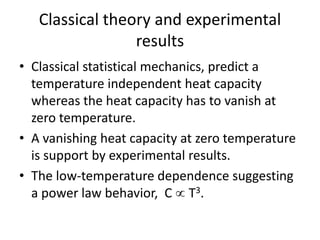
• Classical statistical mechanics, predict a
temperature independent heat capacity
whereas the heat capacity has to vanish at
zero temperature.
• A vanishing heat capacity at zero temperature
is support by experimental results.
• The low-temperature dependence suggesting
a power law behavior, C  T3.
Einstein Model
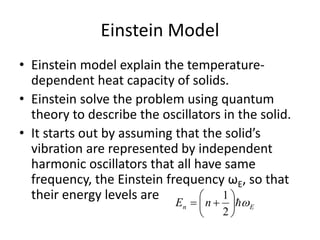
• Einstein model explain the temperature-
dependent heat capacity of solids.
• Einstein solve the problem using quantum
theory to describe the oscillators in the solid.
• It starts out by assuming that the solid’s
vibration are represented by independent
harmonic oscillators that all have same
frequency, the Einstein frequency ωE, so that
their energy levels are
En nE 






2
1
Einstein Model
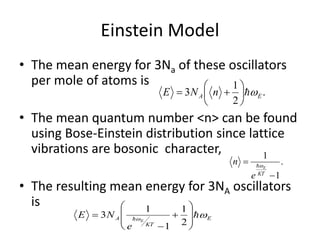
• The mean energy for 3Na of these oscillators
per mole of atoms is
• The mean quantum number <n> can be found
using Bose-Einstein distribution since lattice
vibrations are bosonic character,
• The resulting mean energy for 3NA oscillators
is
.
2
1
3 EA nNE 






.
1
1


KT
E
e
n 
E
KT
A E
e
NE 
 










2
1
1
1
3
Einstein Model
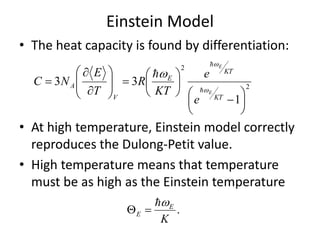
• The heat capacity is found by differentiation:
• At high temperature, Einstein model correctly
reproduces the Dulong-Petit value.
• High temperature means that temperature
must be as high as the Einstein temperature
2
2
1
33
























KT
KT
E
V
A
E
E
e
e
KT
R
T
E
NC






.
K
E
E


Einstein Model
• The heat capacity drops to zero at absolute
zero temperature.
• At low temperature, it shows exponential
behavior whereas the experimental shows a
power law behavior C  T3.
Debye Model
• Use a more realistic model for the lattice
vibration at low energies.
• The excitations with the lowest energies near
k =0 are those with the longest wavelength
corresponds to sound waves with ω(k) = vk.
• For low temperature, the Debye assumption is
appropriate and it leads to good results.
Heat capacity

q p
pqpqnU ,, 
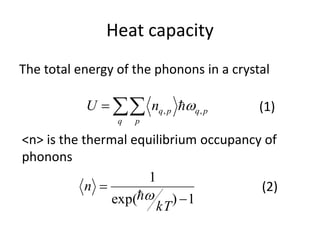
The total energy of the phonons in a crystal
<n> is the thermal equilibrium occupancy of
phonons
1)exp(
1


kT
n

(1)
(2)
Heat capacity



q p pq
pq
kT
U
1)exp( ,
,




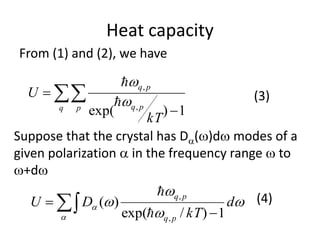
From (1) and (2), we have
(3)
Suppose that the crystal has Da()d modes of a
given polarization a in the frequency range  to
+d




a
a d
kT
DU
pq
pq
1)/exp(
)(
,
,

  

(4)
Heat capacity


d
dN
D )(
Density of states
(The number of modes per
unit frequency range)
lattice heat capacity





a
a d
kT
kT
kT
Dk
T
U
C
pq
pq
pq
lat
2
,
,
2
,
]1)/[exp(
)/exp(
)(











 


Density of states
L
s = 0 s = M+1
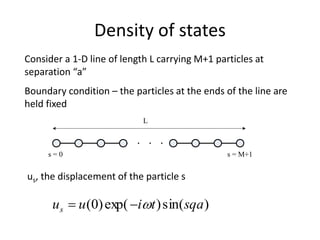
Consider a 1-D line of length L carrying M+1 particles at
separation “a”
Boundary condition – the particles at the ends of the line are
held fixed
us, the displacement of the particle s
)sin()exp()0( sqatiuus 
Density of states
L
M
LLLL
q
 )1(
,......,
4
,
3
,
2
,


 


 d
dqL
d
dN
D
Lq
N 
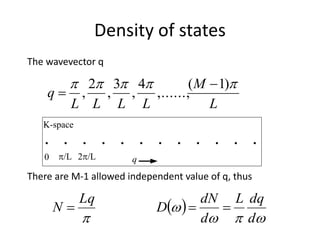
The wavevector q
There are M-1 allowed independent value of q, thus
0 /L 2/L
K-space
q
Density of states
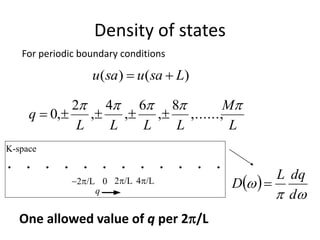
)()( Lsausau 
L
M
LLLL
q

,......,
8
,
6
,
4
,
2
,0 
0 2/L 4/L
K-space
q
2/L
For periodic boundary conditions
 


d
dqL
D 
One allowed value of q per 2/L
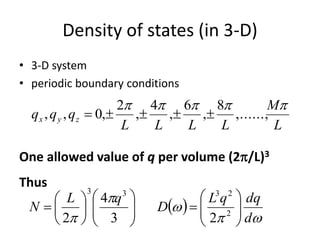
Density of states (in 3-D)
• 3-D system
• periodic boundary conditions
L
M
LLLL
qqq zyx

,......,
8
,
6
,
4
,
2
,0,, 
One allowed value of q per volume (2/L)3
Thus
 



 d
dqqL
D
qL
N 

















 2
2333
23
4
2
Debye Model
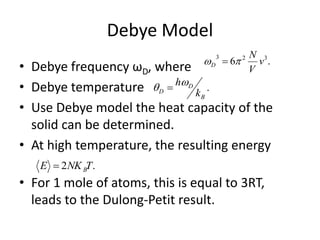
• Debye frequency ωD, where
• Debye temperature
• Use Debye model the heat capacity of the
solid can be determined.
• At high temperature, the resulting energy
• For 1 mole of atoms, this is equal to 3RT,
leads to the Dulong-Petit result.
.6 323
v
V
N
D  
.
B
D
D k
h 
.2 TNKE B
Debye Model
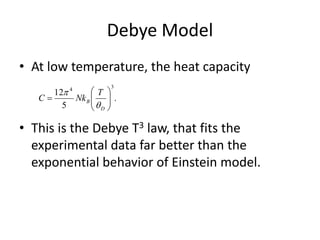
• At low temperature, the heat capacity
• This is the Debye T3 law, that fits the
experimental data far better than the
exponential behavior of Einstein model.
.
5
12
34







D
B
T
NkC


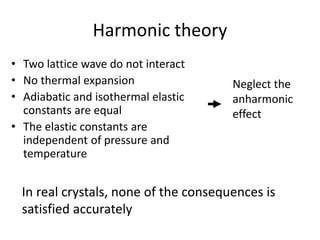
Harmonic theory
• Two lattice wave do not interact
• No thermal expansion
• Adiabatic and isothermal elastic
constants are equal
• The elastic constants are
independent of pressure and
temperature
In real crystals, none of the consequences is
satisfied accurately
Neglect the
anharmonic
effect
Thermal Conductivity
• Transport of heat through a crystal by lattice vibrations.
• Metals usually have much better thermal conductivity
than insulators.
• Contribution of the electrons to thermal conductivity is
generally more important than the lattice contribution.
• However this is not always the case, example is the
insulator diamond that has one of the highest thermal
conductivities of all materials at room temperature.
• The total thermal conductivity is the sum of the lattice
and electron thermal conductivity.
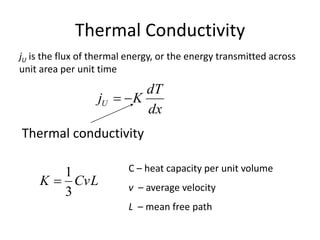
Thermal Conductivity
dx
dT
KjU 
jU is the flux of thermal energy, or the energy transmitted across
unit area per unit time
CvLK
3
1

Thermal conductivity
C – heat capacity per unit volume
v – average velocity
L – mean free path
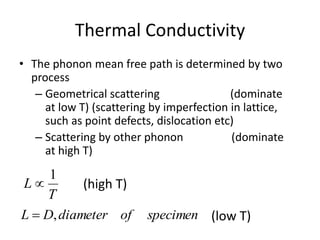
Thermal Conductivity
• The phonon mean free path is determined by two
process
– Geometrical scattering (dominate
at low T) (scattering by imperfection in lattice,
such as point defects, dislocation etc)
– Scattering by other phonon (dominate
at high T)
T
L
1

specimenofdiameterDL ,
(high T)
(low T)
Thermal Conductivity at low
temperature
• At low temperature, heat capacity decrease
and causing thermal conductivity to decease.
• At low temperature, as phonons propagated
through the crystal, they can be scattered by
imperfection in the lattice, such as point
defects, dislocations and the like.
• It is possible to grow crystal of such high
perfection that scattering effects become
unimportant.
• The scattering of phonon at the sample
boundary can be observed experimentally.
Thermal Conductivity at high
temperature
• At high temperature another scattering
process become dominant.
• The number of phonon increases and
phonon can be scattered from other
phonons.
• This causes the mean free path to decrease.
• Thermal conductivity decreases with
temperature.
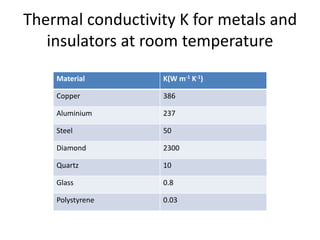
Thermal conductivity K for metals and
insulators at room temperature
Material K(W m-1 K-1)
Copper 386
Aluminium 237
Steel 50
Diamond 2300
Quartz 10
Glass 0.8
Polystyrene 0.03
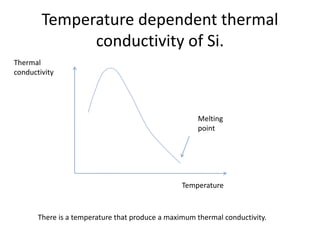
Temperature dependent thermal
conductivity of Si.
Temperature
Thermal
conductivity
Melting
point
There is a temperature that produce a maximum thermal conductivity.

Crystal dynamics

  • 1.
    UEEP2024 Solid StatePhysics Topic 2 Crystal dynamics
  • 2.
    Important elementary excitationin solids Name Field Electron - Photon Electromagnetic wave Phonon Elastic wave Plasmon Collective electron wave Magnon Magnetic wave Polaron Electron +elastic deformation Exciton Polarization wave
  • 3.
    Lattice Vibration • Ina real crystal at a finite temperature T, the basis of each lattice point and indeed also the constituent atoms of each basis vibrate relative to the fixed lattice and with each other. As the atoms or ions are physically linked together through the bonding system, the vibrational motion is in general not isolated. • When a wave propagate along the crystal, entire planes of atoms move in phase with displacement either parallel or perpendicular to the direction of wavevector.
  • 4.
    Longitudinal polarization Dashed line–Planes of atoms when in equilibrium. Solid lines- Planes of atoms when displaced. Coordinate u measures the displacement of the planes
  • 5.
    Transverse wave • Planesof atom as displaced during passage of a transverse wave.
  • 6.
    Lattice Vibration   p spsps uucf )( where cp is the force constant for the neighbour p. Let m be the mass of one atom. The equation of motion is given by For a 1-D long chain with discrete atoms of equilibrium separation a , Let us be the displacement of the reference atom labelled by s. We assume that the net force exerted on atom s is due to its different neighbours labelled p. Now the total force on atom s is obtained by summing the forces from all its possible neighbours p on both sides. Hence    p spsps uucdtumd )(/ 22 (1) (2)
  • 7.
    Lattice Vibration The wave-likesolution is )](exp[)( tqxiAxu  (3) ω is the angular frequency q is the wavevector P = h/2 x q E = h/2 x ω The vibrational motion in the crystal is regarded as a kind of wave propagation. Because of the finite extent of the crystal, the wave motion is often regarded as a standing wave system. the phonon is defined to be the quantised energy of elastic waves in a crystal. The phonons are similar to the photons in electromagnetic waves in many respects. Both of these two excitations exhibit the duality property, namely possessing both wave- like and particle-like behaviour.
  • 8.
    Lattice Vibration Remember thatwe are dealing with discrete atoms of equilibrium separation a. Thus for any general atoms with label s + p, x should be replaced by (s + p)a. )exp(])(exp[ tiqapsiuu ps  (4) Substituting this solution (4) in the equation of motion, we obtain ]1)[exp(2   ipqacm pp (5) for the lattice with inversion symmetry about the origin, (5) may be re-written as )]cos(1[)/2(2 pqacm pp   (6)
  • 9.
    Lattice Vibration Eq(6) isthe dispersion relation for phonons the mathematical expression of energy (frequency) in terms of the wavevector if we simplify (6) by considering only nearest neighbours (p=1), we get )2/sin()/4( 2 1 1 aqmc (7)
  • 10.
    Group Velocity ofPhonons (3) –(7) show the wave nature of lattice vibration. The group velocity is then given by the derivative of (7) )2/cos()/(/ 2 1 2 1 qamacdqdv   For long wavelength V ≈ a(c1/m)0.5 For short wavelength V ≈ 0
  • 11.
    The Brillouin zone consideringthe waves in figure below The wave represented by the solid curve conveys no information not given by the dashed curve. Only wavelengths longer than 2a are needed to represent the motion. Essentially, what it implies is that if the wavevector is larger than /a, you can always find a smaller wavevector q < /a which is just as a good representation. So this means that in a solid, there is a maximum limit for the wavevector and in 1 D this is /a. aqa //  
  • 12.
    The Brillouin zone “ifthe wavevector is larger than /a, you can always find a smaller wavevector q < /a which is just as a good representation” How ?? Consider two wavevector q and q + n(2π/a) where n is an integer )exp()2exp()exp( ])/2(exp[ iqaniiqa aanqi     )/2(' anqq   q outside the first zone q' the corresponding value inside the zone
  • 13.
    Photons in DiatomicCrystals When the primitive basis of a crystal contains more than one atom, e.g. NaCl and diamond structure, the phonon dispersion relation has more than one branch. The figure shows the acoustical and optical branches of only one polarisation
  • 14.
    Photons in DiatomicCrystals • For both the acoustical and the optical frequency ranges there should be two transverse and one longitudinal polarisations. • For a diatomic crystal, there are three optical branches (one longitudinal LO and two transverse TO) and three acoustical branches (one longitudinal LA and two transverse TA). • For a general basis with p atoms, there are three acoustical branches and (3p - 3) optical branches.
  • 15.
    Photons in DiatomicCrystals Experimental dispersion curves for diamond in the (100) and (111) directions, where q is the reduced wavevector in units of /a
  • 16.
    Quantization of ElasticWaves • The energy of a lattice vibration is quantized. • The quantum of energy is called a phonon in analogy with the photon of the electromagnetic wave. • The energy of an elastic mode of angular frequency w is E = (n + ½) ħw when the mode is excited to quantum number n. • The term ½ ħw is the zero energy of the mode.
  • 17.
    Phonon Momentum • Aphonon of wavevector q will interact with particles such as photons, neutrons and electrons as if it had a momentum ħq. • Phonon does not carry physical momentum. • In crystal there exist wavevector selection rules for allowed transitions between quantum states. • In elastic scattering of a crystal is governed by the wavevector selection rule K’ = K +G, where G is a vector in the reciprocal lattice, K is the wavevector of the incident photon and K’ is the wavevector of the scattered photon. • If scattering is inelastic, with the creation of phonon of wavevector q, then the selection rule is K’+q = K +G. • If a phonon q is absorbed in the process, K’ =q + K +G.
  • 18.
    Inelastic scattering byphonons • One way to determine the dispersion relation of phonons in a solid is to use the technique of inelastic neutron scattering.
  • 19.
    Inelastic scattering byphonons • elastic – the energy of the incident particles is conserved, only their direction of propagation is modified. • Inelastic – the energy of the incident particle is not conserved. In this scattering process, the energy of the incident particle is lost or gained.
  • 20.
    Inelastic scattering byphonons • The laws of Physics used for the measurement are the energy and momentum conservation laws for the neutrons and the phonons involved • the i and f subscripts denote the initial and final values for the neutron before and after scattering by a phonon in the crystal, the  are the angular frequencies, q is the wavevector of the phonon • In the experiment, the incoming neutron source has a well defined energy and direction. Thus the initial frequency and wavevector of the neutron before scattering are precisely known. qkk fi pfi   
  • 21.
    Heat capacity U isenergy and T the temperature T U C    CV – heat capacity at constant volume CP – heat capacity at constant pressure Clat – lattice heat capacity
  • 22.
    Heat Capacity ofthe lattice • Classical statistical mechanics explained the heat capacity of insulators at room temperature fairly well but failed for lower temperatures and it totally failed for metals. • Metals were expected to have much higher heat capacity than insulators because of of many free electrons but it turn out that a metal’s heat capacity at room temperature is similar to that of insulator.
  • 23.
    Classical theory andexperimental results • Classical statistical mechanics, gives a numerical value for the heat capacity of a solid. • One dimensional harmonic oscillator, the mean energy is KT. • Three dimensional harmonic oscillator, the mean energy is 3KT. • The heat capacity must be 3K and for 1 mole is 3R = 24.9 J K-1, independent of temperature. • This is the rule of Dulong-Petit. • Good at room temperature.
  • 24.
    Molar heat capacity(JK-1) of different solids at liquid nitrogen temperature and room temperature. Material 77K 273K Cu 12.5 24.3 Al 9.1 23.8 Au 19.1 25.2 Pb 23.6 26.7 Fe 8.1 24.8 Diamond 0.1 5.2
  • 25.
    Classical theory andexperimental results • Classical statistical mechanics, predict a temperature independent heat capacity whereas the heat capacity has to vanish at zero temperature. • A vanishing heat capacity at zero temperature is support by experimental results. • The low-temperature dependence suggesting a power law behavior, C  T3.
  • 26.
    Einstein Model • Einsteinmodel explain the temperature- dependent heat capacity of solids. • Einstein solve the problem using quantum theory to describe the oscillators in the solid. • It starts out by assuming that the solid’s vibration are represented by independent harmonic oscillators that all have same frequency, the Einstein frequency ωE, so that their energy levels are En nE        2 1
  • 27.
    Einstein Model • Themean energy for 3Na of these oscillators per mole of atoms is • The mean quantum number <n> can be found using Bose-Einstein distribution since lattice vibrations are bosonic character, • The resulting mean energy for 3NA oscillators is . 2 1 3 EA nNE        . 1 1   KT E e n  E KT A E e NE              2 1 1 1 3
  • 28.
    Einstein Model • Theheat capacity is found by differentiation: • At high temperature, Einstein model correctly reproduces the Dulong-Petit value. • High temperature means that temperature must be as high as the Einstein temperature 2 2 1 33                         KT KT E V A E E e e KT R T E NC       . K E E  
  • 29.
    Einstein Model • Theheat capacity drops to zero at absolute zero temperature. • At low temperature, it shows exponential behavior whereas the experimental shows a power law behavior C  T3.
  • 30.
    Debye Model • Usea more realistic model for the lattice vibration at low energies. • The excitations with the lowest energies near k =0 are those with the longest wavelength corresponds to sound waves with ω(k) = vk. • For low temperature, the Debye assumption is appropriate and it leads to good results.
  • 31.
    Heat capacity  q p pqpqnU,,  The total energy of the phonons in a crystal <n> is the thermal equilibrium occupancy of phonons 1)exp( 1   kT n  (1) (2)
  • 32.
    Heat capacity    q ppq pq kT U 1)exp( , ,     From (1) and (2), we have (3) Suppose that the crystal has Da()d modes of a given polarization a in the frequency range  to +d     a a d kT DU pq pq 1)/exp( )( , ,      (4)
  • 33.
    Heat capacity   d dN D )( Densityof states (The number of modes per unit frequency range) lattice heat capacity      a a d kT kT kT Dk T U C pq pq pq lat 2 , , 2 , ]1)/[exp( )/exp( )(               
  • 34.
    Density of states L s= 0 s = M+1 Consider a 1-D line of length L carrying M+1 particles at separation “a” Boundary condition – the particles at the ends of the line are held fixed us, the displacement of the particle s )sin()exp()0( sqatiuus 
  • 35.
    Density of states L M LLLL q )1( ,......, 4 , 3 , 2 ,        d dqL d dN D Lq N  The wavevector q There are M-1 allowed independent value of q, thus 0 /L 2/L K-space q
  • 36.
    Density of states )()(Lsausau  L M LLLL q  ,......, 8 , 6 , 4 , 2 ,0  0 2/L 4/L K-space q 2/L For periodic boundary conditions     d dqL D  One allowed value of q per 2/L
  • 37.
    Density of states(in 3-D) • 3-D system • periodic boundary conditions L M LLLL qqq zyx  ,......, 8 , 6 , 4 , 2 ,0,,  One allowed value of q per volume (2/L)3 Thus       d dqqL D qL N                    2 2333 23 4 2
  • 38.
    Debye Model • Debyefrequency ωD, where • Debye temperature • Use Debye model the heat capacity of the solid can be determined. • At high temperature, the resulting energy • For 1 mole of atoms, this is equal to 3RT, leads to the Dulong-Petit result. .6 323 v V N D   . B D D k h  .2 TNKE B
  • 39.
    Debye Model • Atlow temperature, the heat capacity • This is the Debye T3 law, that fits the experimental data far better than the exponential behavior of Einstein model. . 5 12 34        D B T NkC  
  • 40.
    Harmonic theory • Twolattice wave do not interact • No thermal expansion • Adiabatic and isothermal elastic constants are equal • The elastic constants are independent of pressure and temperature In real crystals, none of the consequences is satisfied accurately Neglect the anharmonic effect
  • 41.
    Thermal Conductivity • Transportof heat through a crystal by lattice vibrations. • Metals usually have much better thermal conductivity than insulators. • Contribution of the electrons to thermal conductivity is generally more important than the lattice contribution. • However this is not always the case, example is the insulator diamond that has one of the highest thermal conductivities of all materials at room temperature. • The total thermal conductivity is the sum of the lattice and electron thermal conductivity.
  • 42.
    Thermal Conductivity dx dT KjU  jUis the flux of thermal energy, or the energy transmitted across unit area per unit time CvLK 3 1  Thermal conductivity C – heat capacity per unit volume v – average velocity L – mean free path
  • 43.
    Thermal Conductivity • Thephonon mean free path is determined by two process – Geometrical scattering (dominate at low T) (scattering by imperfection in lattice, such as point defects, dislocation etc) – Scattering by other phonon (dominate at high T) T L 1  specimenofdiameterDL , (high T) (low T)
  • 44.
    Thermal Conductivity atlow temperature • At low temperature, heat capacity decrease and causing thermal conductivity to decease. • At low temperature, as phonons propagated through the crystal, they can be scattered by imperfection in the lattice, such as point defects, dislocations and the like. • It is possible to grow crystal of such high perfection that scattering effects become unimportant. • The scattering of phonon at the sample boundary can be observed experimentally.
  • 45.
    Thermal Conductivity athigh temperature • At high temperature another scattering process become dominant. • The number of phonon increases and phonon can be scattered from other phonons. • This causes the mean free path to decrease. • Thermal conductivity decreases with temperature.
  • 46.
    Thermal conductivity Kfor metals and insulators at room temperature Material K(W m-1 K-1) Copper 386 Aluminium 237 Steel 50 Diamond 2300 Quartz 10 Glass 0.8 Polystyrene 0.03
  • 47.
    Temperature dependent thermal conductivityof Si. Temperature Thermal conductivity Melting point There is a temperature that produce a maximum thermal conductivity.