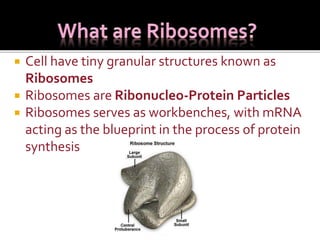
 Cell have tiny granular structures known as
Ribosomes
 Ribosomes are Ribonucleo-Protein Particles
 Ribosomes serves as workbenches, with mRNA
acting as the blueprint in the process of protein
synthesis
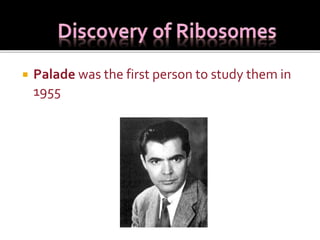
 Palade was the first person to study them in
1955
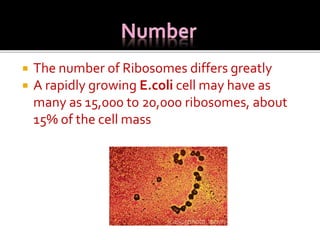
 The number of Ribosomes differs greatly
 A rapidly growing E.coli cell may have as
many as 15,000 to 20,000 ribosomes, about
15% of the cell mass
 Matrix Ribosomes: These synthesize
proteins destined to remain within the cell
 Plasma Membrane Ribosomes:These make
proteins for transport to the outside
 There are two domains of Ribosomes
 Translational Domain: The region responsible
for translation is called theTranslational domain
 Both subunits contribute to this domain,
located in the upper half of the small subunit and
in the associated areas of the large subunit
 Exit Domain:The growing peptide chain
emerges from the large subunit at the exit
domain
 This is located on the side of the subunit
 Prokaryotic Ribosomes are commonly called
70S Ribosomes
 These have dimensions of about 14 to 15nm
by 20nm
 A Molecular Weight of approximately 2.7
million daltons(2.7×10⁶ daltons)
 These are constructed of a 50S and a 30S
subunit
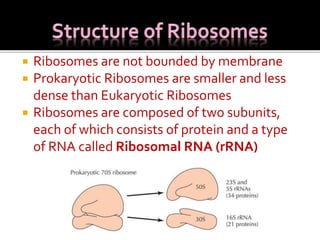
 Ribosomes are not bounded by membrane
 Prokaryotic Ribosomes are smaller and less
dense than Eukaryotic Ribosomes
 Ribosomes are composed of two subunits,
each of which consists of protein and a type
of RNA called Ribosomal RNA (rRNA)
 Each subunit is constructed from one to two
rRNA molecules and many polypeptides
 30S smaller Subunit
 50S larger Subunit
 The S in 70S and similar values stand for
Svedberg units
 The faster a particle travels when
centrifuged, the greater its Svedberg value
or Sedimentation coefficient
 The sedimentation coefficient is a function
of a particles molecular weight, volume
and shape
 Heavier and more compact particles
normally have larger Svedberg numbers or
sediment faster
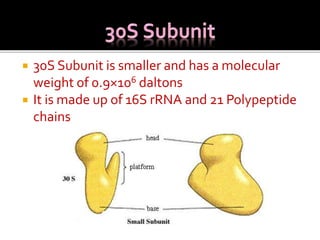
 30S Subunit is smaller and has a molecular
weight of 0.9×10⁶ daltons
 It is made up of 16S rRNA and 21 Polypeptide
chains
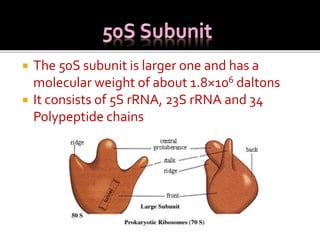
 The 50S subunit is larger one and has a
molecular weight of about 1.8×10⁶ daltons
 It consists of 5S rRNA, 23S rRNA and 34
Polypeptide chains
 rRNA is transcribed from certain portions of
DNA by the same energy-requiring process used
for the synthesis of mRNA and tRNA
 rRNA is thought to have two roles
i. The 16S rRNA of the 30S subunit may aid in the
initiation of protein synthesis
 The 3` end of the 16S rRNA complexes with an
initiating signal site on the mRNA and helps
position the mRNA on the ribosome
ii. 16S rRNA binds initiation factor-3 and the 3`
CCA end of aminoacyl-tRNA
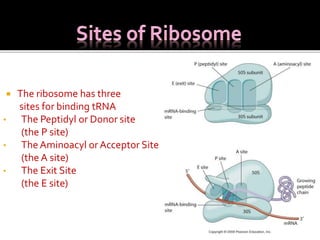
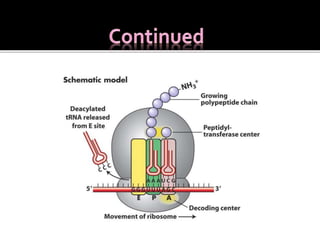
 The ribosome has three
sites for binding tRNA
• The Peptidyl or Donor site
(the P site)
• The Aminoacyl or Acceptor Site
(the A site)
• The Exit Site
(the E site)
 The Ribosome is involved in the process of
Protein Synthesis
 Protein Synthesis is divided into three stages:
1. Initiation
2. Elongation
3. Termination
 The necessary Components Assemble:
i. The two ribosomal subunits
ii. A tRNA with the anticodon UAC
iii. The mRNA molecule to be translated
iv. Along with several additional protein factors
 In E.coli and most bacteria translation begin with
specially modified aminoacyl tRNA, N-
formylmethionyl tRNA
 Because the α-amino is blocked by a formyl group,
this aminoacyl tRNA can be used only for initiation
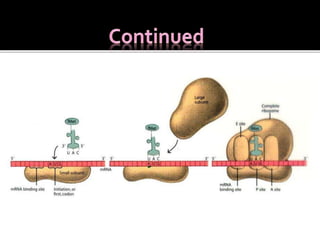
 This N-formylmethionyl-tRNA attaches itself to the
P Site of ribosome(Peptidyl Site)
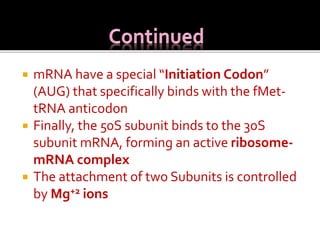
 mRNA have a special “Initiation Codon”
(AUG) that specifically binds with the fMet-
tRNA anticodon
 Finally, the 50S subunit binds to the 30S
subunit mRNA, forming an active ribosome-
mRNA complex
 The attachment of two Subunits is controlled
by Mg+2 ions
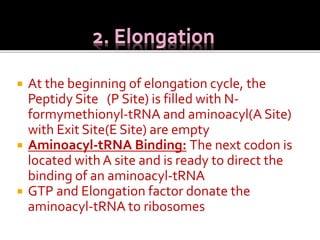
 At the beginning of elongation cycle, the
Peptidy Site (P Site) is filled with N-
formymethionyl-tRNA and aminoacyl(A Site)
with Exit Site(E Site) are empty
 Aminoacyl-tRNA Binding: The next codon is
located with A site and is ready to direct the
binding of an aminoacyl-tRNA
 GTP and Elongation factor donate the
aminoacyl-tRNA to ribosomes
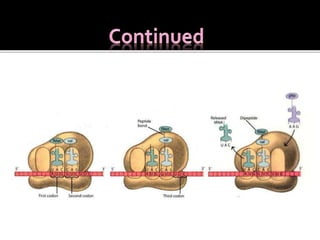
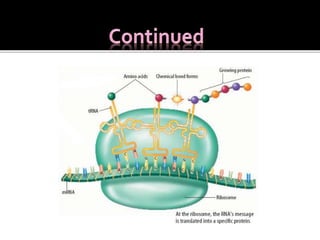
 Transpeptidation Reaction: Peptidyl
transferase, located on 50S Subunit catalyze
the transpeptidation reaction
 The α-amino group of A site amino acid
attacks α-carboxyl group of C-terminal amino
acid on P site tRNA in this reaction resulting
in peptide bond formation
 A specific adenine base seems to participate
in catalyzing peptide bond formation
 Translocation: Movement of Ribosome on
mRNA is calledTranslocation
 There are three Phases ofTranslocation
1. The peptidyl-tRNA moves from the A site to P
site
2. The ribosome moves one codon along mRNA so
that a new codon is positioned in the A site
3. The empty tRNA leaves the P site
 Translocation requires GTP and elongation
factor complex to proceed
 Protein Synthesis stops when the ribosomes reaches one
of three special non-sense codons- UAA, UAG, UGA
 Three release factors(RF-1, RF-2, RF-3) aid the ribosomes
in recognizing these codons
 After the ribosome has stopped, peptidyl transferase
hydrolyzes the peptide free from its tRNA, and the empty
tRNA is released
 GTP hydrolyzes required for this process
 Next the ribosome dissociates from its mRNA and
separates into 30S and 50S subunits. IF-3 binds to 30S
subunit and prevent it from re-associating with 50S
subunit till next initiation starts
 Several antibiotics work by inhibiting protein
synthesis on prokaryotic ribosomes
 Antibiotics such as Streptomycin and
gentamicin attach to the 30S subunit and
interfere with protein synthesis
 OtherAntibiotics, such as Erythromycin and
Chloramphenicol, interfere with protein
synthesis by attaching to the 50S subunit
 Because of differences in prokaryotic and
eukaryotic ribosomes, the microbial cell can
be killed by the antibiotic while the
eukaryotic host cell remains unaffected
Thank You

Ribosomes structure & function

  • 2.
     Cell havetiny granular structures known as Ribosomes  Ribosomes are Ribonucleo-Protein Particles  Ribosomes serves as workbenches, with mRNA acting as the blueprint in the process of protein synthesis
  • 3.
     Palade wasthe first person to study them in 1955
  • 4.
     The numberof Ribosomes differs greatly  A rapidly growing E.coli cell may have as many as 15,000 to 20,000 ribosomes, about 15% of the cell mass
  • 5.
     Matrix Ribosomes:These synthesize proteins destined to remain within the cell  Plasma Membrane Ribosomes:These make proteins for transport to the outside
  • 6.
     There aretwo domains of Ribosomes  Translational Domain: The region responsible for translation is called theTranslational domain  Both subunits contribute to this domain, located in the upper half of the small subunit and in the associated areas of the large subunit  Exit Domain:The growing peptide chain emerges from the large subunit at the exit domain  This is located on the side of the subunit
  • 7.
     Prokaryotic Ribosomesare commonly called 70S Ribosomes  These have dimensions of about 14 to 15nm by 20nm  A Molecular Weight of approximately 2.7 million daltons(2.7×10⁶ daltons)  These are constructed of a 50S and a 30S subunit
  • 8.
     Ribosomes arenot bounded by membrane  Prokaryotic Ribosomes are smaller and less dense than Eukaryotic Ribosomes  Ribosomes are composed of two subunits, each of which consists of protein and a type of RNA called Ribosomal RNA (rRNA)
  • 9.
     Each subunitis constructed from one to two rRNA molecules and many polypeptides  30S smaller Subunit  50S larger Subunit
  • 10.
     The Sin 70S and similar values stand for Svedberg units  The faster a particle travels when centrifuged, the greater its Svedberg value or Sedimentation coefficient  The sedimentation coefficient is a function of a particles molecular weight, volume and shape  Heavier and more compact particles normally have larger Svedberg numbers or sediment faster
  • 11.
     30S Subunitis smaller and has a molecular weight of 0.9×10⁶ daltons  It is made up of 16S rRNA and 21 Polypeptide chains
  • 12.
     The 50Ssubunit is larger one and has a molecular weight of about 1.8×10⁶ daltons  It consists of 5S rRNA, 23S rRNA and 34 Polypeptide chains
  • 13.
     rRNA istranscribed from certain portions of DNA by the same energy-requiring process used for the synthesis of mRNA and tRNA  rRNA is thought to have two roles i. The 16S rRNA of the 30S subunit may aid in the initiation of protein synthesis  The 3` end of the 16S rRNA complexes with an initiating signal site on the mRNA and helps position the mRNA on the ribosome ii. 16S rRNA binds initiation factor-3 and the 3` CCA end of aminoacyl-tRNA
  • 14.
     The ribosomehas three sites for binding tRNA • The Peptidyl or Donor site (the P site) • The Aminoacyl or Acceptor Site (the A site) • The Exit Site (the E site)
  • 15.
     The Ribosomeis involved in the process of Protein Synthesis  Protein Synthesis is divided into three stages: 1. Initiation 2. Elongation 3. Termination
  • 16.
     The necessaryComponents Assemble: i. The two ribosomal subunits ii. A tRNA with the anticodon UAC iii. The mRNA molecule to be translated iv. Along with several additional protein factors  In E.coli and most bacteria translation begin with specially modified aminoacyl tRNA, N- formylmethionyl tRNA  Because the α-amino is blocked by a formyl group, this aminoacyl tRNA can be used only for initiation  This N-formylmethionyl-tRNA attaches itself to the P Site of ribosome(Peptidyl Site)
  • 17.
     mRNA havea special “Initiation Codon” (AUG) that specifically binds with the fMet- tRNA anticodon  Finally, the 50S subunit binds to the 30S subunit mRNA, forming an active ribosome- mRNA complex  The attachment of two Subunits is controlled by Mg+2 ions
  • 19.
     At thebeginning of elongation cycle, the Peptidy Site (P Site) is filled with N- formymethionyl-tRNA and aminoacyl(A Site) with Exit Site(E Site) are empty  Aminoacyl-tRNA Binding: The next codon is located with A site and is ready to direct the binding of an aminoacyl-tRNA  GTP and Elongation factor donate the aminoacyl-tRNA to ribosomes
  • 21.
     Transpeptidation Reaction:Peptidyl transferase, located on 50S Subunit catalyze the transpeptidation reaction  The α-amino group of A site amino acid attacks α-carboxyl group of C-terminal amino acid on P site tRNA in this reaction resulting in peptide bond formation  A specific adenine base seems to participate in catalyzing peptide bond formation
  • 23.
     Translocation: Movementof Ribosome on mRNA is calledTranslocation  There are three Phases ofTranslocation 1. The peptidyl-tRNA moves from the A site to P site 2. The ribosome moves one codon along mRNA so that a new codon is positioned in the A site 3. The empty tRNA leaves the P site  Translocation requires GTP and elongation factor complex to proceed
  • 25.
     Protein Synthesisstops when the ribosomes reaches one of three special non-sense codons- UAA, UAG, UGA  Three release factors(RF-1, RF-2, RF-3) aid the ribosomes in recognizing these codons  After the ribosome has stopped, peptidyl transferase hydrolyzes the peptide free from its tRNA, and the empty tRNA is released  GTP hydrolyzes required for this process  Next the ribosome dissociates from its mRNA and separates into 30S and 50S subunits. IF-3 binds to 30S subunit and prevent it from re-associating with 50S subunit till next initiation starts
  • 26.
     Several antibioticswork by inhibiting protein synthesis on prokaryotic ribosomes  Antibiotics such as Streptomycin and gentamicin attach to the 30S subunit and interfere with protein synthesis  OtherAntibiotics, such as Erythromycin and Chloramphenicol, interfere with protein synthesis by attaching to the 50S subunit
  • 27.
     Because ofdifferences in prokaryotic and eukaryotic ribosomes, the microbial cell can be killed by the antibiotic while the eukaryotic host cell remains unaffected
  • 28.