PRESENTATION
ON
PEROXISOMES
MadeBy: Suman Shaikh
1st Year DPT
(Subject: Physiology)
outline of the
topic:
Introduction to
Peroxisomes
Structure of Peroxisome
Functions of Peroxisome
Disorders related to
Peroxisomes
PEROXISOMES (Introduction)
What are Peroxisomes??
Peroxisomes are membrane bound organelles,
occurring in the cytoplasm of almost all eukaryotic
cells.
 Also called Microbodies.
 Their existence was first discovered by J. Rhodin in
1954.
PEROXISOMES (Introduction)
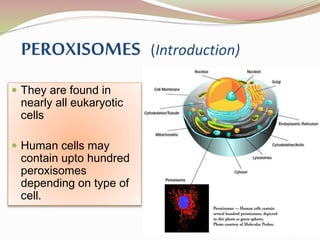
 They are found in
nearly all eukaryotic
cells
 Human cells may
contain upto hundred
peroxisomes
depending on type of
cell.
 They are called “Peroxisomes” because they are
the site of synthesis and degradation of Hydrogen
Peroxide [H2O2], a highly reactive and toxic
oxidizing agent.
PEROXISOMES (Introduction)
PEROXISOMES (continued)
 Peroxisomes contain
Oxidase enzymes
 they originate from
Endoplasmic
reticulum,
 Lysosomes contain
hydrolase enzymes
 lysosomes come from
Golgi apparatus.
They are similar to Lysosomes, being filled with enzymes.
Difference with lysosomes
Similarity with lysosomes
 An enzyme catalase(a type of oxidase) present in
large quantity in peroxisomes.
 Peroxisomes are replicated by fission. They are
believed to be formed from self replication.
 Their life span is 1 day. And they are self assembling.
PEROXISOMES (continued)
 They are abundant in cells of liver and kidney, where
they are required the most.
PEROXISOMES (continued)
liver
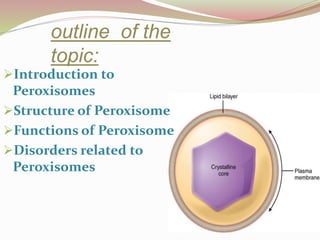
Structure of Peroxisome
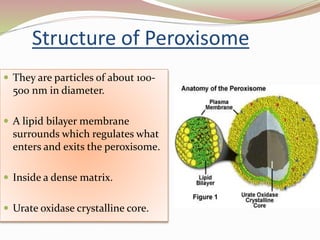
 They are particles of about 100-
500 nm in diameter.
 A lipid bilayer membrane
surrounds which regulates what
enters and exits the peroxisome.
 Inside a dense matrix.
 Urate oxidase crystalline core.
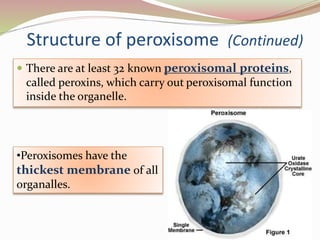
 There are at least 32 known peroxisomal proteins,
called peroxins, which carry out peroxisomal function
inside the organelle.
Structure of peroxisome (Continued)
•Peroxisomes have the
thickest membrane of all
organalles.
 It has a dense matrix that contain
enzymes.
 More than 30 different enzymes
are present in peroxisomes.
Structure of Peroxisome (Continued)
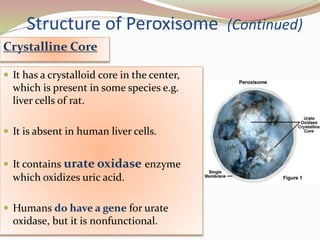
 It has a crystalloid core in the center,
which is present in some species e.g.
liver cells of rat.
 It is absent in human liver cells.
 It contains urate oxidase enzyme
which oxidizes uric acid.
 Humans do have a gene for urate
oxidase, but it is nonfunctional.
Crystalline Core
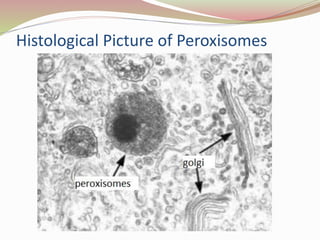
Histological Picture of Peroxisomes
Functions of Peroxisomes
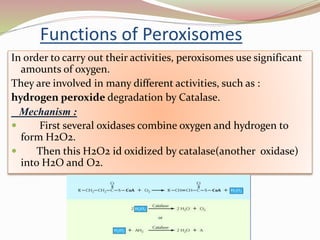
In order to carry out their activities, peroxisomes use significant
amounts of oxygen.
They are involved in many different activities, such as :
hydrogen peroxide degradation by Catalase.
Mechanism :
 First several oxidases combine oxygen and hydrogen to
form H2O2.
 Then this H2O2 id oxidized by catalase(another oxidase)
into H2O and O2.
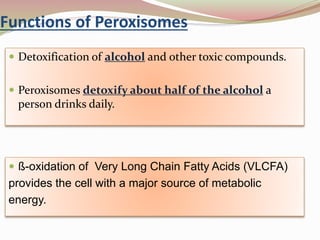
 ß-oxidation of Very Long Chain Fatty Acids (VLCFA)
provides the cell with a major source of metabolic
energy.
Functions of Peroxisomes
 Detoxification of alcohol and other toxic compounds.
 Peroxisomes detoxify about half of the alcohol a
person drinks daily.
Functions of Peroxisomes
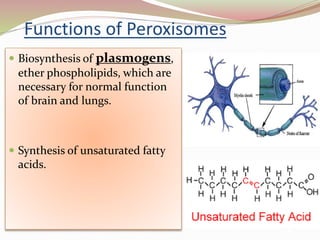
 Biosynthesis of plasmogens,
ether phospholipids, which are
necessary for normal function
of brain and lungs.
 Synthesis of unsaturated fatty
acids.
 Participates in the synthesis of bile acids ion liver
cells.
 Participates in the synthesis of cholesterol
 Participates in the synthesis of the lipids used to
make myelin.
Functions of Peroxisomes
 Peroxisomes are important for normal brain and lungs
functioning.
 Absence of peroxisomes can lead to abnormalities,
specially brain disorders.
Functions of Peroxisomes
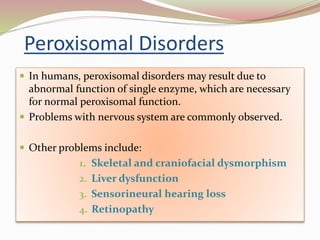
Peroxisomal Disorders
 In humans, peroxisomal disorders may result due to
abnormal function of single enzyme, which are necessary
for normal peroxisomal function.
 Problems with nervous system are commonly observed.
 Other problems include:
1. Skeletal and craniofacial dysmorphism
2. Liver dysfunction
3. Sensorineural hearing loss
4. Retinopathy
 We will discuss here two nervous problems.
1. Adrenoleukodystrophy
2. Zellweger’s syndrome.
Peroxisomal Disorders
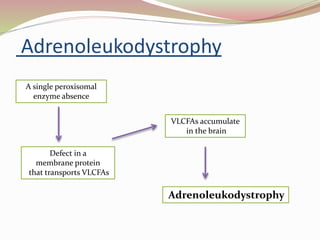
 It is a fatal inherited disorder that leads to extensive
brain damage and adrenal gland failure.
 disorder results from a failure to metabolize Very
long chain fatty acids(VLCFA) properly.
 One result is deterioration of the myelin
sheaths of neurons.
 The disorder occurs in young boys because the gene
is X-linked
Adrenoleukodystrophy
A single peroxisomal
enzyme absence
Defect in a
membrane protein
that transports VLCFAs
VLCFAs accumulate
in the brain
Adrenoleukodystrophy
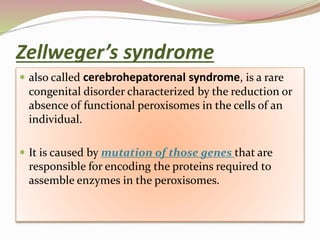
 also called cerebrohepatorenal syndrome, is a rare
congenital disorder characterized by the reduction or
absence of functional peroxisomes in the cells of an
individual.
 It is caused by mutation of those genes that are
responsible for encoding the proteins required to
assemble enzymes in the peroxisomes.
Zellweger’s syndrome
Gene mutation Of Proteins involved in transport
of enzymes to peroxisomes
Empty peroxisomes
Zellwegers syndrome
Enzymes failed to be
transported
Thank you
for your attention

Peroxisomes

  • 2.
  • 3.
    outline of the topic: Introductionto Peroxisomes Structure of Peroxisome Functions of Peroxisome Disorders related to Peroxisomes
  • 4.
    PEROXISOMES (Introduction) What arePeroxisomes?? Peroxisomes are membrane bound organelles, occurring in the cytoplasm of almost all eukaryotic cells.  Also called Microbodies.  Their existence was first discovered by J. Rhodin in 1954.
  • 5.
    PEROXISOMES (Introduction)  Theyare found in nearly all eukaryotic cells  Human cells may contain upto hundred peroxisomes depending on type of cell.
  • 6.
     They arecalled “Peroxisomes” because they are the site of synthesis and degradation of Hydrogen Peroxide [H2O2], a highly reactive and toxic oxidizing agent. PEROXISOMES (Introduction)
  • 7.
    PEROXISOMES (continued)  Peroxisomescontain Oxidase enzymes  they originate from Endoplasmic reticulum,  Lysosomes contain hydrolase enzymes  lysosomes come from Golgi apparatus. They are similar to Lysosomes, being filled with enzymes. Difference with lysosomes Similarity with lysosomes
  • 8.
     An enzymecatalase(a type of oxidase) present in large quantity in peroxisomes.  Peroxisomes are replicated by fission. They are believed to be formed from self replication.  Their life span is 1 day. And they are self assembling. PEROXISOMES (continued)
  • 9.
     They areabundant in cells of liver and kidney, where they are required the most. PEROXISOMES (continued) liver
  • 10.
    Structure of Peroxisome They are particles of about 100- 500 nm in diameter.  A lipid bilayer membrane surrounds which regulates what enters and exits the peroxisome.  Inside a dense matrix.  Urate oxidase crystalline core.
  • 11.
     There areat least 32 known peroxisomal proteins, called peroxins, which carry out peroxisomal function inside the organelle. Structure of peroxisome (Continued) •Peroxisomes have the thickest membrane of all organalles.
  • 12.
     It hasa dense matrix that contain enzymes.  More than 30 different enzymes are present in peroxisomes. Structure of Peroxisome (Continued)
  • 13.
    Structure of Peroxisome(Continued)  It has a crystalloid core in the center, which is present in some species e.g. liver cells of rat.  It is absent in human liver cells.  It contains urate oxidase enzyme which oxidizes uric acid.  Humans do have a gene for urate oxidase, but it is nonfunctional. Crystalline Core
  • 14.
  • 15.
    Functions of Peroxisomes Inorder to carry out their activities, peroxisomes use significant amounts of oxygen. They are involved in many different activities, such as : hydrogen peroxide degradation by Catalase. Mechanism :  First several oxidases combine oxygen and hydrogen to form H2O2.  Then this H2O2 id oxidized by catalase(another oxidase) into H2O and O2.
  • 16.
     ß-oxidation ofVery Long Chain Fatty Acids (VLCFA) provides the cell with a major source of metabolic energy. Functions of Peroxisomes  Detoxification of alcohol and other toxic compounds.  Peroxisomes detoxify about half of the alcohol a person drinks daily.
  • 17.
    Functions of Peroxisomes Biosynthesis of plasmogens, ether phospholipids, which are necessary for normal function of brain and lungs.  Synthesis of unsaturated fatty acids.
  • 18.
     Participates inthe synthesis of bile acids ion liver cells.  Participates in the synthesis of cholesterol  Participates in the synthesis of the lipids used to make myelin. Functions of Peroxisomes
  • 19.
     Peroxisomes areimportant for normal brain and lungs functioning.  Absence of peroxisomes can lead to abnormalities, specially brain disorders. Functions of Peroxisomes
  • 20.
    Peroxisomal Disorders  Inhumans, peroxisomal disorders may result due to abnormal function of single enzyme, which are necessary for normal peroxisomal function.  Problems with nervous system are commonly observed.  Other problems include: 1. Skeletal and craniofacial dysmorphism 2. Liver dysfunction 3. Sensorineural hearing loss 4. Retinopathy
  • 21.
     We willdiscuss here two nervous problems. 1. Adrenoleukodystrophy 2. Zellweger’s syndrome. Peroxisomal Disorders
  • 22.
     It isa fatal inherited disorder that leads to extensive brain damage and adrenal gland failure.  disorder results from a failure to metabolize Very long chain fatty acids(VLCFA) properly.  One result is deterioration of the myelin sheaths of neurons.  The disorder occurs in young boys because the gene is X-linked Adrenoleukodystrophy
  • 23.
    Adrenoleukodystrophy A single peroxisomal enzymeabsence Defect in a membrane protein that transports VLCFAs VLCFAs accumulate in the brain Adrenoleukodystrophy
  • 24.
     also calledcerebrohepatorenal syndrome, is a rare congenital disorder characterized by the reduction or absence of functional peroxisomes in the cells of an individual.  It is caused by mutation of those genes that are responsible for encoding the proteins required to assemble enzymes in the peroxisomes. Zellweger’s syndrome
  • 25.
    Zellweger’s syndrome Gene mutationOf Proteins involved in transport of enzymes to peroxisomes Empty peroxisomes Zellwegers syndrome Enzymes failed to be transported
  • 26.

Editor's Notes

  • #5 using electron microscopy in kidney cells of mouse .
  • #17 Purine catabolism by urate oxidase(not in all animals)
  • #18 production of plasmalogens is critical to proper functioning of the nervous system since a lack of plasmalogens causes abnormalities in the myelination of nerve cells. These  are considered to be more health beneficial than saturated fats or trans fats.