POLYTENE
CHROMOSOME
&
Lampbrush chromosome
1
Presented by: Sepideh saroughi
What are Polytene and Lampbrush
chromosomes?
These are also giant chromosomes but relatively smaller than
lampbrush chromosomes, found in the larvae of certain dipterans.
Because of their large size showing numerous strands these are
named as polytene chromosomes (name suggested by Kollar) or
commonly salivary gland chromosomes.
2
POLYTENE
CHROMOSOME
3
Polytene chromosomes are large chromosomes which
have thousands of DNA strands.
Salivary glands of insects
First reported by E.G.Balbiani in 1881
Drosophila, Chironomus , Rhynchosciara
In insects salivary glands when the cells are not
dividing
4
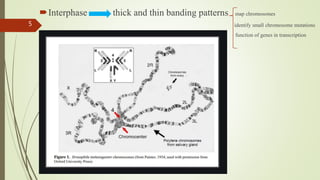
Interphase thick and thin banding patterns map chromosomes
identify small chromosome mutations
function of genes in transcription
5
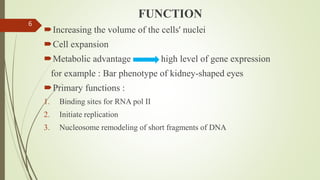
FUNCTION
Increasing the volume of the cells' nuclei
Cell expansion
Metabolic advantage high level of gene expression
for example : Bar phenotype of kidney-shaped eyes
Primary functions :
1. Binding sites for RNA pol II
2. Initiate replication
3. Nucleosome remodeling of short fragments of DNA
6
STRUCTURE
Salivary gland chromosomes
The large size of the chromosome is due to the presence of many
longitudinal strands called chromonemata.
0.5 mm in length and 20 μm in diameter
The chromosomal strands in the absence of cytoplasmic division
Endomitosis
Two types of bands dark bands darkly : more DNA
interbands lightly stained with nuclear stains: more
RNA
The amount of DNA in interbands ranges from 0.8 - 25%.
7
The bands of polytene chromosomes become enlarged at certain
times to form swellings puffs : the chromonemata uncoil and open
The puffs indicate the site of active genes : mRNA synthesis
The chromonemata of puffs give out a series of many loops
Balbiani rings
Balbiani rings : They are formed of DNA, RNA and a few proteins /
transcription site / RNA polymerase / ribonucleoproteins
In protozoans, there is no transcription, since the puff consists only
of DNA.
8
HISTORY
Observed by Édouard-Gérard Balbiani in 1881
In 1890, he observed similar spireme in a ciliated protozoan
Loxophyllum meleagris.
The existence of such spireme in Drosophila melanogaster was
reported by Bulgarian geneticist Dontcho Kostoff in 1930.
Kostoff predicted that the discs (bands) which he observed were
"the actual packets in which inherited characters are passed from
generation to generation.“
In 1930, Heitz studied different species of Drosophila and found
that all their interphase chromatins in certain cells were swollen and
messy.
9
In 1932, Karl Heinrich Bauer : bands in salivary glands, midgut,
Malphigian tubules, and brain of the flies Bibio hurtulunus and
Drosophila funebris.
P.C. Koller hesitantly introduced the name "polytene" to describe
the giant chromosome they are "polytene" rather than
pachytene
10
OCCURRENCE
In secretory tissues of dipteran insects such as the Malpighian
tubules of Sciara , plants, mammals, or in cells from other insects.
Largest polytene chromosomes in larval salivary gland cells of
the chironomid genus Axarus.
In plants ovary and immature seed tissues such as in Phaseolus
coccineus and P. vulgaris
Used to identify the species of chironomid larvae .
Karyotypes are used to confirm the presence of specific species and
to study genetic diversity in species with a wide range of genetic
variation.
11
Genes Containing Long Introns Occupy Series of Bands
and Interbands In Drosophila melanogaster polytene
Chromosomes
 To analyze it, we used bioinformatic approaches and characterized genome-
wide distribution of introns in gene bodies and in different chromatin states,
and using fluorescent in situ hybridization we juxtaposed them with the
chromosome structures.
 The mapping of the 15 long genes showed that they could occupy extended
sections of polytene chromosomes containing band and interband series, with
promoters located in the interband fragments.
 Introns in polytene chromosomes form independent bands, which can contain
either both introns and exons or intron material only.
 Thus, a novel type of the gene arrangement in polytene chromosomes was
discovered.
12
Do humans have polytene chromosomes?
Are polytene chromosomes haploid or diploid?
How does a polytene chromosome differ from a typical
eukaryotic chromosome?
Do polytene chromosomes show somatic pairing?
13
Lampbrush chromosome
14
Lampbrush chromosome
15
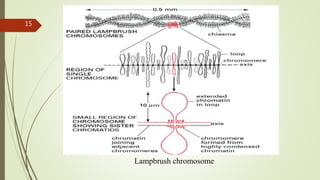
Oocyte development takes place during the meiotic prophase and for the
majority of species ends in the metaphase of the first meiotic division
Diplotene
vertebrates, amphibians and birds
The loops are transcriptionally active sites.
Lampbrush chromosome (immature eggs) of most animals, except
mammals.
Intermediate structure
 In a prolonged diplotene stage very large chromosomal structures
LBCs’ length ranges from 400 to 800 mm up to 30 times larger than
their mitotic counterparts.
16
STRUCTURE
LBC is a bivalent
Inactive chromatin / side loops of decondensed chromatin
In the homologous sections of the bivalent, chromatin is
condensed.
The loop constitutes a part of the chromosome axis. It is
extensible as well as contractible contraction and dilation
of the chromomere
17
Lampbrush chromosomes include domains of open chromatin in
which the genes can be potentially transcriptive and domains of
locked chromatin without expression.
Lampbrush chromosome loops are considered an example of open
chromatin.
Their analogues are thought to be the “puffs” of polytenic
chromosomes.They differ between each other.
 Polytenic chromosomes parallel chromatids
lampbrush chromosome chromatin single DNA helix
18
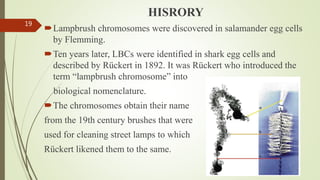
HISRORY
Lampbrush chromosomes were discovered in salamander egg cells
by Flemming.
Ten years later, LBCs were identified in shark egg cells and
described by Rückert in 1892. It was Rückert who introduced the
term “lampbrush chromosome” into
biological nomenclature.
The chromosomes obtain their name
from the 19th century brushes that were
used for cleaning street lamps to which
Rückert likened them to the same.
19
 Visible in the light microscope
Each lateral loop contains one or several transcription units with
polarized RNP-matrix coating the DNA axis of the loop.
Used for high-resolution mapping of DNA sequences and
construction of detail cytological maps of individual
chromosomes.
Lampbrush chromosomes are also involved in the production of
“masked” mRNAs for early development 1. mRNAs are packaged
2. specific alterations of the
deoxyribonucleoprotein
20
What is the function of Lampbrush chromosome?
Do humans have Lampbrush chromosomes?
Where is Lampbrush chromosome found?
21
22

Polytene & Lampbrush

  • 1.
  • 2.
    What are Polyteneand Lampbrush chromosomes? These are also giant chromosomes but relatively smaller than lampbrush chromosomes, found in the larvae of certain dipterans. Because of their large size showing numerous strands these are named as polytene chromosomes (name suggested by Kollar) or commonly salivary gland chromosomes. 2
  • 3.
  • 4.
    Polytene chromosomes arelarge chromosomes which have thousands of DNA strands. Salivary glands of insects First reported by E.G.Balbiani in 1881 Drosophila, Chironomus , Rhynchosciara In insects salivary glands when the cells are not dividing 4
  • 5.
    Interphase thick andthin banding patterns map chromosomes identify small chromosome mutations function of genes in transcription 5
  • 6.
    FUNCTION Increasing the volumeof the cells' nuclei Cell expansion Metabolic advantage high level of gene expression for example : Bar phenotype of kidney-shaped eyes Primary functions : 1. Binding sites for RNA pol II 2. Initiate replication 3. Nucleosome remodeling of short fragments of DNA 6
  • 7.
    STRUCTURE Salivary gland chromosomes Thelarge size of the chromosome is due to the presence of many longitudinal strands called chromonemata. 0.5 mm in length and 20 μm in diameter The chromosomal strands in the absence of cytoplasmic division Endomitosis Two types of bands dark bands darkly : more DNA interbands lightly stained with nuclear stains: more RNA The amount of DNA in interbands ranges from 0.8 - 25%. 7
  • 8.
    The bands ofpolytene chromosomes become enlarged at certain times to form swellings puffs : the chromonemata uncoil and open The puffs indicate the site of active genes : mRNA synthesis The chromonemata of puffs give out a series of many loops Balbiani rings Balbiani rings : They are formed of DNA, RNA and a few proteins / transcription site / RNA polymerase / ribonucleoproteins In protozoans, there is no transcription, since the puff consists only of DNA. 8
  • 9.
    HISTORY Observed by Édouard-GérardBalbiani in 1881 In 1890, he observed similar spireme in a ciliated protozoan Loxophyllum meleagris. The existence of such spireme in Drosophila melanogaster was reported by Bulgarian geneticist Dontcho Kostoff in 1930. Kostoff predicted that the discs (bands) which he observed were "the actual packets in which inherited characters are passed from generation to generation.“ In 1930, Heitz studied different species of Drosophila and found that all their interphase chromatins in certain cells were swollen and messy. 9
  • 10.
    In 1932, KarlHeinrich Bauer : bands in salivary glands, midgut, Malphigian tubules, and brain of the flies Bibio hurtulunus and Drosophila funebris. P.C. Koller hesitantly introduced the name "polytene" to describe the giant chromosome they are "polytene" rather than pachytene 10
  • 11.
    OCCURRENCE In secretory tissuesof dipteran insects such as the Malpighian tubules of Sciara , plants, mammals, or in cells from other insects. Largest polytene chromosomes in larval salivary gland cells of the chironomid genus Axarus. In plants ovary and immature seed tissues such as in Phaseolus coccineus and P. vulgaris Used to identify the species of chironomid larvae . Karyotypes are used to confirm the presence of specific species and to study genetic diversity in species with a wide range of genetic variation. 11
  • 12.
    Genes Containing LongIntrons Occupy Series of Bands and Interbands In Drosophila melanogaster polytene Chromosomes  To analyze it, we used bioinformatic approaches and characterized genome- wide distribution of introns in gene bodies and in different chromatin states, and using fluorescent in situ hybridization we juxtaposed them with the chromosome structures.  The mapping of the 15 long genes showed that they could occupy extended sections of polytene chromosomes containing band and interband series, with promoters located in the interband fragments.  Introns in polytene chromosomes form independent bands, which can contain either both introns and exons or intron material only.  Thus, a novel type of the gene arrangement in polytene chromosomes was discovered. 12
  • 13.
    Do humans havepolytene chromosomes? Are polytene chromosomes haploid or diploid? How does a polytene chromosome differ from a typical eukaryotic chromosome? Do polytene chromosomes show somatic pairing? 13
  • 14.
  • 15.
  • 16.
    Oocyte development takesplace during the meiotic prophase and for the majority of species ends in the metaphase of the first meiotic division Diplotene vertebrates, amphibians and birds The loops are transcriptionally active sites. Lampbrush chromosome (immature eggs) of most animals, except mammals. Intermediate structure  In a prolonged diplotene stage very large chromosomal structures LBCs’ length ranges from 400 to 800 mm up to 30 times larger than their mitotic counterparts. 16
  • 17.
    STRUCTURE LBC is abivalent Inactive chromatin / side loops of decondensed chromatin In the homologous sections of the bivalent, chromatin is condensed. The loop constitutes a part of the chromosome axis. It is extensible as well as contractible contraction and dilation of the chromomere 17
  • 18.
    Lampbrush chromosomes includedomains of open chromatin in which the genes can be potentially transcriptive and domains of locked chromatin without expression. Lampbrush chromosome loops are considered an example of open chromatin. Their analogues are thought to be the “puffs” of polytenic chromosomes.They differ between each other.  Polytenic chromosomes parallel chromatids lampbrush chromosome chromatin single DNA helix 18
  • 19.
    HISRORY Lampbrush chromosomes werediscovered in salamander egg cells by Flemming. Ten years later, LBCs were identified in shark egg cells and described by Rückert in 1892. It was Rückert who introduced the term “lampbrush chromosome” into biological nomenclature. The chromosomes obtain their name from the 19th century brushes that were used for cleaning street lamps to which Rückert likened them to the same. 19
  • 20.
     Visible inthe light microscope Each lateral loop contains one or several transcription units with polarized RNP-matrix coating the DNA axis of the loop. Used for high-resolution mapping of DNA sequences and construction of detail cytological maps of individual chromosomes. Lampbrush chromosomes are also involved in the production of “masked” mRNAs for early development 1. mRNAs are packaged 2. specific alterations of the deoxyribonucleoprotein 20
  • 21.
    What is thefunction of Lampbrush chromosome? Do humans have Lampbrush chromosomes? Where is Lampbrush chromosome found? 21
  • 22.