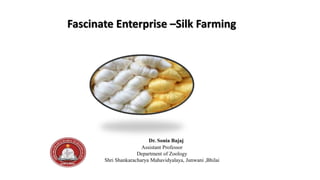
Fascinate Enterprise –Silk Farming
Dr. Sonia Bajaj
Assistant Professor
Department of Zoology
Shri Shankaracharya Mahavidyalaya, Junwani ,Bhilai
Geographically
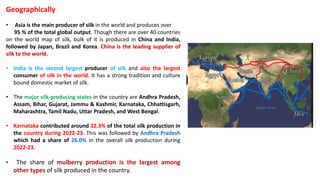
• Asia is the main producer of silk in the world and produces over
95 % of the total global output. Though there are over 40 countries
on the world map of silk, bulk of it is produced in China and India,
followed by Japan, Brazil and Korea. China is the leading supplier of
silk to the world.
• India is the second largest producer of silk and also the largest
consumer of silk in the world. It has a strong tradition and culture
bound domestic market of silk.
• The major silk-producing states in the country are Andhra Pradesh,
Assam, Bihar, Gujarat, Jammu & Kashmir, Karnataka, Chhattisgarh,
Maharashtra, Tamil Nadu, Uttar Pradesh, and West Bengal.
• Karnataka contributed around 32.3% of the total silk production in
the country during 2022-23. This was followed by Andhra Pradesh
which had a share of 26.0% in the overall silk production during
2022-23.
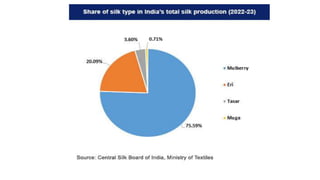
• The share of mulberry production is the largest among
other types of silk produced in the country.
Introduction
• The word sericulture is derived from the Greek word “ Sericos ”. “Seri” means silk and “Cos” means culture.
• Sericulture- It is the cultivation of silkworms to produce silk.
• It is a kind of Agro-industry (Agriculture & Industry).
• First of all the silkworm were discovered in chain by Lotzu Empress of kwang in 2697 B.C.
.
• India is the second-largest producer of silk in the world after the China.
• The total annual production of raw silk in India is about 31 lakhs kg.
• Silk is called "Queen of Textiles".
• Sericulture or silk farming is involves cultivation of host plants & rearing of silkworm for production of Cocoon- Raw
Silk.
• Sericulture playing vital role in rural employment, development & economy growth.
• Sericulture is a very important domestic industry in many countries. India and China are the world’s leading
producers of silk.
Breeds of silkworm
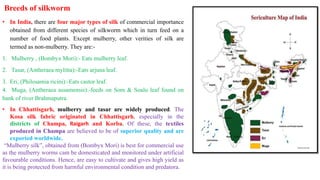
• In India, there are four major types of silk of commercial importance
obtained from different species of silkworm which in turn feed on a
number of food plants. Except mulberry, other verities of silk are
termed as non-mulberry. They are:-
1. Mulberry , (Bombyx Mori):- Eats mulberry leaf.
2. Tasar, (Antheraea mylitta):-Eats arjuna leaf.
3. Eri, (Philosamia ricini):-Eats castor leaf.
4. Muga, (Antheraea assamensis):-feeds on Som & Soalu leaf found on
bank of river Brahmaputra.
• In Chhattisgarh, mulberry and tasar are widely produced. The
Kosa silk fabric originated in Chhattisgarh, especially in the
districts of Champa, Raigarh and Korba. Of these, the textiles
produced in Champa are believed to be of superior quality and are
exported worldwide.
“Mulberry silk”, obtained from (Bombyx Mori) is best for commercial use
as the mulberry worms cam be domesticated and monitored under artificial
favourable conditions. Hence, are easy to cultivate and gives high yield as
it is being protected from harmful environmental condition and predatora.
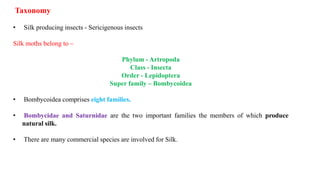
Taxonomy
• Silk producing insects - Sericigenous insects
Silk moths belong to –
Phylum - Artropoda
Class - Insecta
Order - Lepidoptera
Super family – Bombycoidea
• Bombycoidea comprises eight families.
• Bombycidae and Saturnidae are the two important families the members of which produce
natural silk.
• There are many commercial species are involved for Silk.
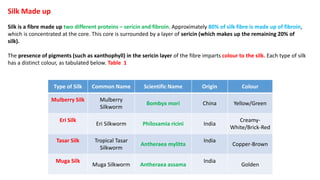
Type of Silk Common Name Scientific Name Origin Colour
Mulberry Silk Mulberry
Silkworm
Bombyx mori China Yellow/Green
Eri Silk
Eri Silkworm Philosamia ricini India
Creamy-
White/Brick-Red
Tasar Silk Tropical Tasar
Silkworm
Antheraea mylitta
India
Copper-Brown
Muga Silk
Muga Silkworm Antheraea assama
India
Golden
Silk Made up
Silk is a fibre made up two different proteins – sericin and fibroin. Approximately 80% of silk fibre is made up of fibroin,
which is concentrated at the core. This core is surrounded by a layer of sericin (which makes up the remaining 20% of
silk).
The presence of pigments (such as xanthophyll) in the sericin layer of the fibre imparts colour to the silk. Each type of silk
has a distinct colour, as tabulated below. Table 1
Mulberry silk
• It is superior in quality.
• Mulberry is the food plant of mulberry silkworm Bombyx mori & B.
mandarina. Domesticated & reared indoors.
• About 92 % of the total production in India.
• Bivoltine silk is superior than Multivoltine.
• Well practiced in KA, TN AP, KL MH, WB & JK .
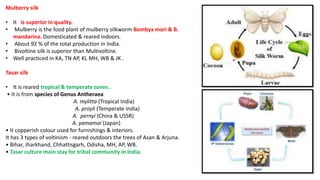
Tasar silk
• It is reared tropical & temperate zones .
• It is from species of Genus Antheraea
A. mylitta (Tropical India)
A. proyli (Temperate India)
A. pernyi (China & USSR)
A. yamamai (Japan)
• It copperish colour used for furnishings & interiors.
It has 3 types of voltinism - reared outdoors the trees of Asan & Arjuna.
• Bihar, Jharkhand, Chhattisgarh, Odisha, MH, AP, WB.
• Tasar culture main stay for tribal community in India.
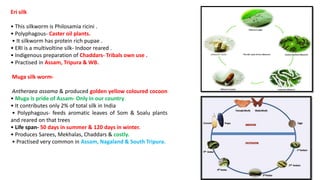
Eri silk
• This silkworm is Philosamia ricini .
• Polyphagous- Caster oil plants.
• It silkworm has protein rich pupae .
• ERI is a multivoltine silk- Indoor reared .
• Indigenous preparation of Chaddars- Tribals own use .
• Practised in Assam, Tripura & WB.
Muga silk worm-
Antheraea assama & produced golden yellow coloured cocoon
• Muga is pride of Assam- Only in our country
• It contributes only 2% of total silk in India
• Polyphagous- feeds aromatic leaves of Som & Soalu plants
and reared on that trees
• Life span- 50 days in summer & 120 days in winter.
• Produces Sarees, Mekhalas, Chaddars & costly.
• Practised very common in Assam, Nagaland & South Tripura.
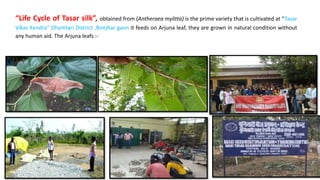
“Life Cycle of Tasar silk”, obtained from (Antheraea mylitta) is the prime variety that is cultivated at “Tasar
Vikas Kendra” Dhamtari District ,Birejhar gaon it feeds on Arjuna leaf, they are grown in natural condition without
any human aid. The Arjuna leafs :-
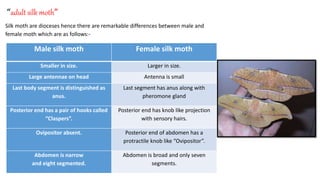
“adult silk moth”
Silk moth are dioceses hence there are remarkable differences between male and
female moth which are as follows:-
Male silk moth Female silk moth
Smaller in size. Larger in size.
Large antennae on head Antenna is small
Last body segment is distinguished as
anus.
Last segment has anus along with
pheromone gland
Posterior end has a pair of hooks called
“Claspers”.
Posterior end has knob like projection
with sensory hairs.
Ovipositor absent. Posterior end of abdomen has a
protractile knob like “Ovipositor”.
Abdomen is narrow
and eight segmented.
Abdomen is broad and only seven
segments.
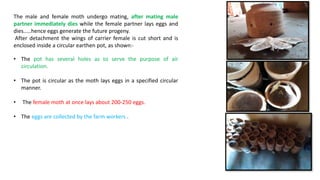
The male and female moth undergo mating, after mating male
partner immediately dies while the female partner lays eggs and
dies.....hence eggs generate the future progeny.
After detachment the wings of carrier female is cut short and is
enclosed inside a circular earthen pot, as shown:-
• The pot has several holes as to serve the purpose of air
circulation.
• The pot is circular as the moth lays eggs in a specified circular
manner.
• The female moth at once lays about 200-250 eggs.
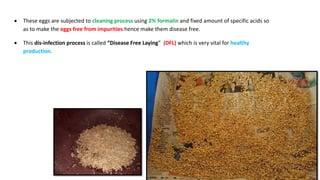
• The eggs are collected by the farm workers .
 These eggs are subjected to cleaning process using 2% formalin and fixed amount of specific acids so
as to make the eggs free from impurities hence make them disease free.
 This dis-infection process is called “Disease Free Laying” (DFL) which is very vital for healthy
production.
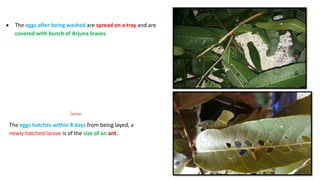
 The eggs after being washed are spread on a tray and are
covered with bunch of Arjuna leaves.
larvae
The eggs hatches within 8 days from being layed, a
newly hatched larvae is of the size of an ant.
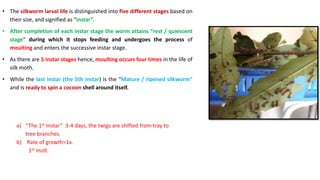
• The silkworm larval life is distinguished into five different stages based on
their size, and signified as “instar”.
• After completion of each instar stage the worm attains “rest / quiescent
stage” during which it stops feeding and undergoes the process of
moulting and enters the successive instar stage.
• As there are 5 instar stages hence, moulting occurs four times in the life of
silk moth.
• While the last instar (the 5th instar) is the “Mature / ripened silkworm”
and is ready to spin a cocoon shell around itself.
a) “The 1st Instar” 3-4 days, the twigs are shifted from tray to
tree branches.
b) Rate of growth=1x.
1st molt.
b. “The 2nd Instar”
Rate of growth=20x.
2-3 days.
2nd molt
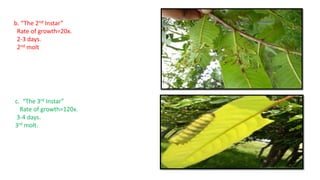
c. “The 3rd Instar”
Rate of growth=120x.
3-4 days.
3rd molt.
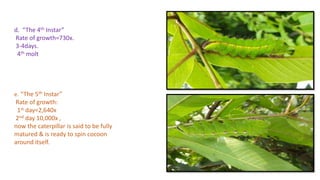
d. “The 4th Instar”
Rate of growth=730x.
3-4days.
4th molt
e. “The 5th Instar”
Rate of growth:
1st day=2,640x
2nd day 10,000x ,
now the caterpillar is said to be fully
matured & is ready to spin cocoon
around itself.
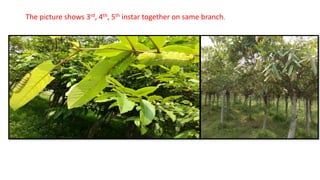
The picture shows 3rd, 4th, 5th instar together on same branch.
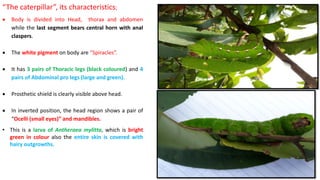
“The caterpillar”, its characteristics;
 Body is divided into Head, thorax and abdomen
while the last segment bears central horn with anal
claspers.
 The white pigment on body are “Spiracles”.
 It has 3 pairs of Thoracic legs (black coloured) and 4
pairs of Abdominal pro legs (large and green).
 Prosthetic shield is clearly visible above head.
 In inverted position, the head region shows a pair of
“Ocelli (small eyes)” and mandibles.
• This is a larva of Antheraea mylitta, which is bright
green in colour also the entire skin is covered with
hairy outgrowths.
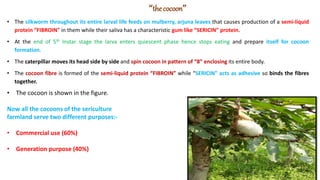
“the cocoon”
• The silkworm throughout its entire larval life feeds on mulberry, arjuna leaves that causes production of a semi-liquid
protein “FIBROIN” in them while their saliva has a characteristic gum like “SERICIN” protein.
• At the end of 5th Instar stage the larva enters quiescent phase hence stops eating and prepare itself for cocoon
formation.
• The caterpillar moves its head side by side and spin cocoon in pattern of “8” enclosing its entire body.
• The cocoon fibre is formed of the semi-liquid protein “FIBROIN” while “SERICIN” acts as adhesive so binds the fibres
together.
• The cocoon is shown in the figure.
Now all the cocoons of the sericulture
farmland serve two different purposes:-
• Commercial use (60%)
• Generation purpose (40%)
“GENERATION PURPOSE”:-
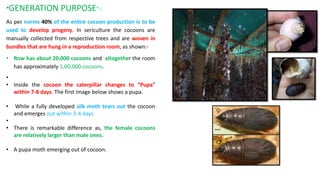
As per norms 40% of the entire cocoon production is to be
used to develop progeny. In sericulture the cocoons are
manually collected from respective trees and are woven in
bundles that are hung in a reproduction room, as shown:-
• Row has about 20,000 cocoons and altogether the room
has approximately 1,00,000 cocoons.
•
• Inside the cocoon the caterpillar changes to “Pupa”
within 7-8 days. The first image below shows a pupa.
• While a fully developed silk moth tears out the cocoon
and emerges out within 3-4 days.
•
• There is remarkable difference as, the female cocoons
are relatively larger than male ones.
• A pupa moth emerging out of cocoon.
COMMERCIAL PURPOSE”
• The silk moth since many years are exploited for the
production of silk fibers, that is obtained from cocoon.
Hence cocoon stage is significant.
• The process of silk production is as follows:-
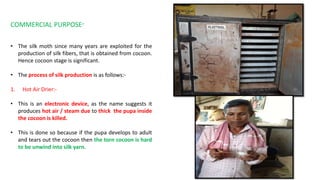
1. Hot Air Drier:-
• This is an electronic device, as the name suggests it
produces hot air / steam due to thick the pupa inside
the cocoon is killed.
• This is done so because if the pupa develops to adult
and tears out the cocoon then the torn cocoon is hard
to be unwind into silk yarn.
2. Reeling-
• After being subjected to hot air the cocoons are immersed into
hot boiling water as a result “SERACIN” is dissolved which was
responsible for adhesion of silk fibers.
• The fibers are now separated, this process is also termed as
“Degumming”.
3. Brushing-
• Now into each cocoon brush is inserted to find the starting point
of the silk fiber from where the thread will be pulled out.
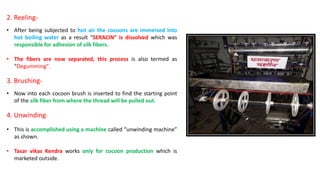
4. Unwinding-
• This is accomplished using a machine called “unwinding machine”
as shown.
• Tasar vikas Kendra works only for cocoon production which is
marketed outside.
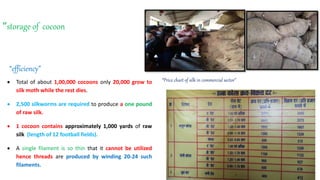
“storage of cocoon
“efficiency”
 Total of about 1,00,000 cocoons only 20,000 grow to
silk moth while the rest dies.
 2,500 silkworms are required to produce a one pound
of raw silk.
 1 cocoon contains approximately 1,000 yards of raw
silk (length of 12 football fields).
 A single filament is so thin that it cannot be utilized
hence threads are produced by winding 20-24 such
filaments.
“Price chart of silk in commercial sector”
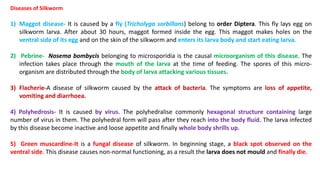
Diseases of Silkworm
1) Maggot disease- It is caused by a fly (Tricholyga sorbillans) belong to order Diptera. This fly lays egg on
silkworm larva. After about 30 hours, maggot formed inside the egg. This maggot makes holes on the
ventral side of its egg and on the skin of the silkworm and enters its larva body and start eating larva.
2) Pebrine- Nosema bombycis belonging to microsporidia is the causal microorganism of this disease. The
infection takes place through the mouth of the larva at the time of feeding. The spores of this micro-
organism are distributed through the body of larva attacking various tissues.
3) Flacherie-A disease of silkworm caused by the attack of bacteria. The symptoms are loss of appetite,
vomiting and diarrhoea.
4) Polyhedrosis- It is caused by virus. The polyhedralise commonly hexagonal structure containing large
number of virus in them. The polyhedral form will pass after they reach into the body fluid. The larva infected
by this disease become inactive and loose appetite and finally whole body shrills up.
5) Green muscardine-It is a fungal disease of silkworm. In beginning stage, a black spot observed on the
ventral side. This disease causes non-normal functioning, as a result the larva does not mould and finally die.
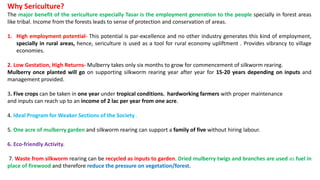
Why Sericulture?
The major benefit of the sericulture especially Tasar is the employment generation to the people specially in forest areas
like tribal. Income from the forests leads to sense of protection and conservation of areas.
1. High employment potential- This potential is par-excellence and no other industry generates this kind of employment,
specially in rural areas, hence, sericulture is used as a tool for rural economy upliftment . Provides vibrancy to village
economies.
2. Low Gestation, High Returns- Mulberry takes only six months to grow for commencement of silkworm rearing.
Mulberry once planted will go on supporting silkworm rearing year after year for 15-20 years depending on inputs and
management provided.
3. Five crops can be taken in one year under tropical conditions. hardworking farmers with proper maintenance
and inputs can reach up to an income of 2 lac per year from one acre.
4. Ideal Program for Weaker Sections of the Society .
5. One acre of mulberry garden and silkworm rearing can support a family of five without hiring labour.
6. Eco-friendly Activity.
7. Waste from silkworm rearing can be recycled as inputs to garden. Dried mulberry twigs and branches are used as fuel in
place of firewood and therefore reduce the pressure on vegetation/forest.
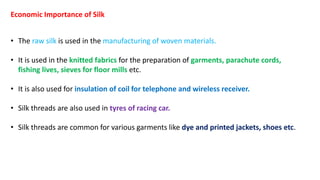
Economic Importance of Silk
• The raw silk is used in the manufacturing of woven materials.
• It is used in the knitted fabrics for the preparation of garments, parachute cords,
fishing lives, sieves for floor mills etc.
• It is also used for insulation of coil for telephone and wireless receiver.
• Silk threads are also used in tyres of racing car.
• Silk threads are common for various garments like dye and printed jackets, shoes etc.
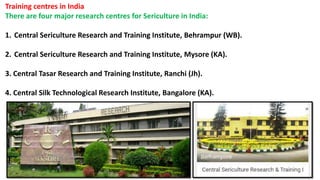
Training centres in India
There are four major research centres for Sericulture in India:
1. Central Sericulture Research and Training Institute, Behrampur (WB).
2. Central Sericulture Research and Training Institute, Mysore (KA).
3. Central Tasar Research and Training Institute, Ranchi (Jh).
4. Central Silk Technological Research Institute, Bangalore (KA).
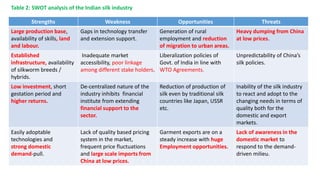
Strengths Weakness Opportunities Threats
Large production base,
availability of skills, land
and labour.
Gaps in technology transfer
and extension support.
Generation of rural
employment and reduction
of migration to urban areas.
Heavy dumping from China
at low prices.
Established
infrastructure, availability
of silkworm breeds /
hybrids.
Inadequate market
accessibility, poor linkage
among different stake holders.
Liberalization policies of
Govt. of India in line with
WTO Agreements.
Unpredictability of China’s
silk policies.
Low investment, short
gestation period and
higher returns.
De-centralized nature of the
industry inhibits financial
institute from extending
financial support to the
sector.
Reduction of production of
silk even by traditional silk
countries like Japan, USSR
etc.
Inability of the silk industry
to react and adopt to the
changing needs in terms of
quality both for the
domestic and export
markets.
Easily adoptable
technologies and
strong domestic
demand-pull.
Lack of quality based pricing
system in the market,
frequent price fluctuations
and large scale imports from
China at low prices.
Garment exports are on a
steady increase with huge
Employment opportunities.
Lack of awareness in the
domestic market to
respond to the demand-
driven milieu.
Table 2: SWOT analysis of the Indian silk industry
References –
Text Book of Applied Zoology -Pradip jabde
Elementary Applied Zoology- Debajyoti Chattopadhyay
Economic Zoology-N. Arumugam
Economic Zoology-S. K. Mishra
Economic Zoology-Vinita Jaiswal & K.K. Jaiswal