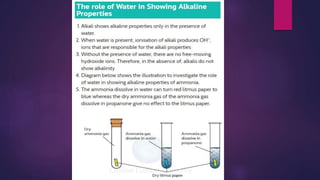
7. ACIDS AND BASES
7.1 Analysing Characteristics And
Properties Of Acids And Bases
LEARNING OUTCOME :
 State the meaning of acid, base and alkali
 State the uses of acids, bases and alkalis in daily life
 Explain the role of water in the formation of hydrogen ions to show properties of acids
 Explain the role of water in the formation of hydroxide ions to show the properties of
alkalis
 Describe the chemical properties of acids and alkalis
7.1.1 State the meaning of acid, base and alkali
In 1884 . . .
 A Swedish Chemist, Arrhenius
proposed that compounds can be
classified into two :
 Acids and Bases
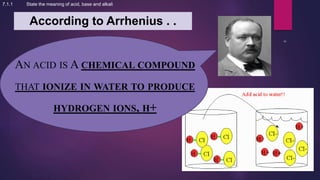
According to Arrhenius . .
AN ACID IS A CHEMICAL COMPOUND
THAT IONIZE IN WATER TO PRODUCE
HYDROGEN IONS, H+
7.1.1 State the meaning of acid, base and alkali
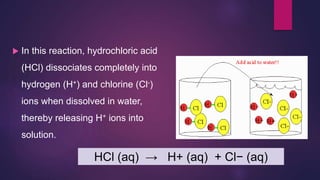
 In this reaction, hydrochloric acid
(HCl) dissociates completely into
hydrogen (H+) and chlorine (Cl-)
ions when dissolved in water,
thereby releasing H+ ions into
solution.
HCl (aq) → H+ (aq) + Cl− (aq)
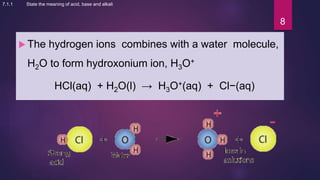
 The hydrogen ions combines with a water molecule,
H2O to form hydroxonium ion, H3O+
HCl(aq) + H2O(l) → H3O+(aq) + Cl−(aq)
8
7.1.1 State the meaning of acid, base and alkali
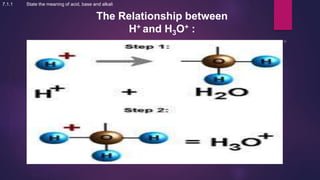
The Relationship between
H+ and H3O+ :
7.1.1 State the meaning of acid, base and alkali
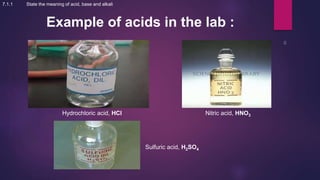
Example of acids in the lab :
Hydrochloric acid, HCl Nitric acid, HNO3
Sulfuric acid, H2SO4
7.1.1 State the meaning of acid, base and alkali
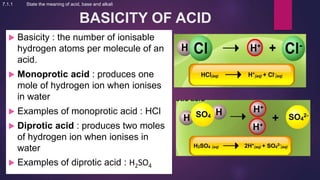
BASICITY OF ACID
 Basicity : the number of ionisable
hydrogen atoms per molecule of an
acid.
 Monoprotic acid : produces one
mole of hydrogen ion when ionises
in water
 Examples of monoprotic acid : HCl
 Diprotic acid : produces two moles
of hydrogen ion when ionises in
water
 Examples of diprotic acid : H2SO4
7.1.1 State the meaning of acid, base and alkali
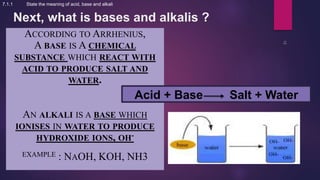
Next, what is bases and alkalis ?
ACCORDING TO ARRHENIUS,
A BASE IS A CHEMICAL
SUBSTANCE WHICH REACT WITH
ACID TO PRODUCE SALT AND
WATER.
AN ALKALI IS A BASE WHICH
IONISES IN WATER TO PRODUCE
HYDROXIDE IONS, OH-
EXAMPLE : NAOH, KOH, NH3
7.1.1 State the meaning of acid, base and alkali
Acid + Base Salt + Water
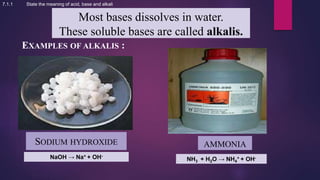
Most bases dissolves in water.
These soluble bases are called alkalis.
EXAMPLES OF ALKALIS :
SODIUM HYDROXIDE AMMONIA
NaOH → Na+ + OH-
NH3 + H2O → NH4
+ + OH-
7.1.1 State the meaning of acid, base and alkali
ROLE OF WATER ON THE PROPERTIES OF
ACIDS
7.1.1 Explain the role of water in the formation of hydrogen ions and hydroxide ions
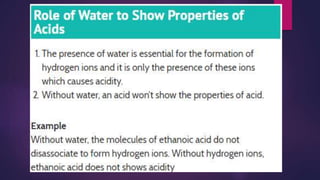
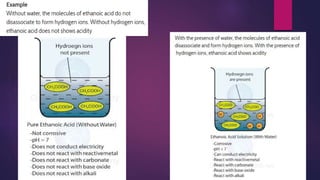
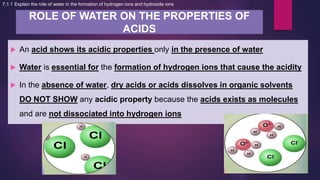
 An acid shows its acidic properties only in the presence of water
 Water is essential for the formation of hydrogen ions that cause the acidity
 In the absence of water, dry acids or acids dissolves in organic solvents
DO NOT SHOW any acidic property because the acids exists as molecules
and are not dissociated into hydrogen ions
ROLE OF WATER ON THE PROPERTIES
OF ACID
Acids
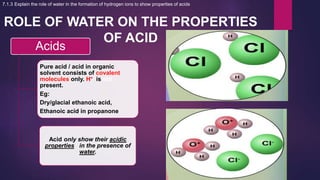
Pure acid / acid in organic
solvent consists of covalent
molecules only. H+ is not
present.
Eg:
Dry/glacial ethanoic acid,
Ethanoic acid in propanone
Acid only show their acidic
properties in the presence of
water.
7.1.3 Explain the role of water in the formation of hydrogen ions to show properties of acids
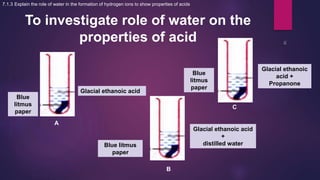
To investigate role of water on the
properties of acid
Blue
litmus
paper
Glacial ethanoic acid
Blue litmus
paper
Glacial ethanoic acid
+
distilled water
Glacial ethanoic
acid +
Propanone
Blue
litmus
paper
A
B
C
7.1.3 Explain the role of water in the formation of hydrogen ions to show properties of acids
ROLE OF WATER ON THE PROPERTIES OF
ALKALIS
7.1.1 Explain the role of water in the formation of hydrogen ions and hydroxide ions
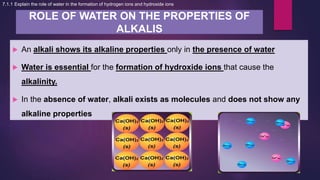
 An alkali shows its alkaline properties only in the presence of water
 Water is essential for the formation of hydroxide ions that cause the
alkalinity.
 In the absence of water, alkali exists as molecules and does not show any
alkaline properties
ROLE OF WATER ON THE
PROPERTIES OF ALKALI
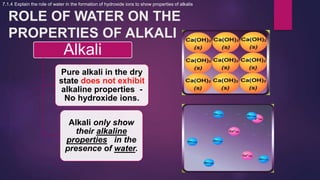
Alkali
Pure alkali in the dry
state does not exhibit
alkaline properties -
No hydroxide ions.
Alkali only show
their alkaline
properties in the
presence of water.
7.1.4 Explain the role of water in the formation of hydroxide ions to show properties of alkalis
ROLE OF WATER ON THE PROPERTIES OF
ACID/ALKALI
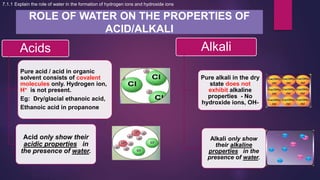
Acids
Pure acid / acid in organic
solvent consists of covalent
molecules only. Hydrogen ion,
H+ is not present.
Eg: Dry/glacial ethanoic acid,
Ethanoic acid in propanone
Acid only show their
acidic properties in
the presence of water.
Alkali
Pure alkali in the dry
state does not
exhibit alkaline
properties - No
hydroxide ions, OH-
Alkali only show
their alkaline
properties in the
presence of water.
7.1.1 Explain the role of water in the formation of hydrogen ions and hydroxide ions
Uses of Acids, Bases and Alkalis in daily life :
 Acids and bases are widely used in our daily life in agriculture,
medicine, industry and preparation of food
7.1.2 State the uses of acids, bases and alkali in daily life.
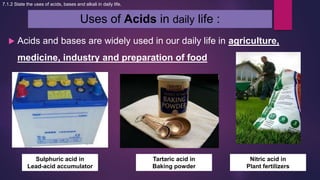
Uses of Acids in daily life :
 Acids and bases are widely used in our daily life in agriculture,
medicine, industry and preparation of food
7.1.2 State the uses of acids, bases and alkali in daily life.
Sulphuric acid in
Lead-acid accumulator
Tartaric acid in
Baking powder
Nitric acid in
Plant fertilizers
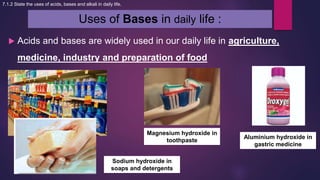
Uses of Bases in daily life :
 Acids and bases are widely used in our daily life in agriculture,
medicine, industry and preparation of food
7.1.2 State the uses of acids, bases and alkali in daily life.
Sodium hydroxide in
soaps and detergents
Aluminium hydroxide in
gastric medicine
Magnesium hydroxide in
toothpaste
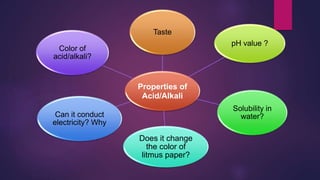
Properties of
Acid/Alkali
Taste
pH value ?
Solubility in
water?
Does it change
the color of
litmus paper?
Can it conduct
electricity? Why
Color of
acid/alkali?
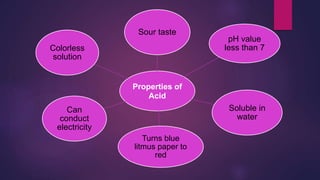
Properties of
Acid
Sour taste
pH value
less than 7
Soluble in
water
Turns blue
litmus paper to
red
Can
conduct
electricity
Colorless
solution
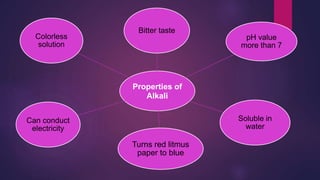
Properties of
Alkali
Bitter taste
pH value
more than 7
Soluble in
water
Turns red litmus
paper to blue
Can conduct
electricity
Colorless
solution
leenl@
chemf4
29
Explain the following:
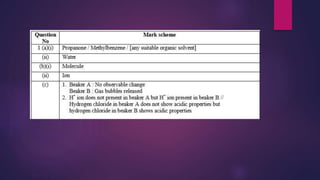
A solution of hydrogen chloride in toluene does not react
with marble whereas a solution of hydrogen chloride in
water does.
[6 marks]
7.1.1 State the meaning of acid, base and alkali
leenl@
chemf4
30
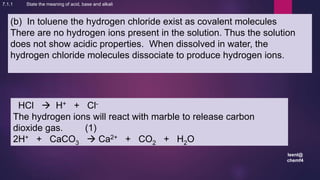
(b) In toluene the hydrogen chloride exist as covalent molecules
There are no hydrogen ions present in the solution. Thus the solution
does not show acidic properties. When dissolved in water, the
hydrogen chloride molecules dissociate to produce hydrogen ions.
HCl  H+ + Cl-
The hydrogen ions will react with marble to release carbon
dioxide gas. (1)
2H+ + CaCO3  Ca2+ + CO2 + H2O
7.1.1 State the meaning of acid, base and alkali
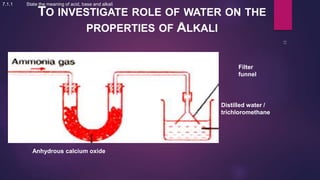
TO INVESTIGATE ROLE OF WATER ON THE
PROPERTIES OF ALKALI
Filter
funnel
Distilled water /
trichloromethane
Anhydrous calcium oxide
7.1.1 State the meaning of acid, base and alkali
What are the products when . .
 Acids react with base
 Acids reacts with metals
 Acids reacts with carbonate
 Alkali reacts with acids
 Alkali reacts with metal ions
 Alkali reacts with ammonium
salts
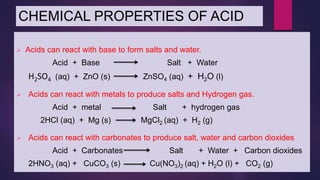
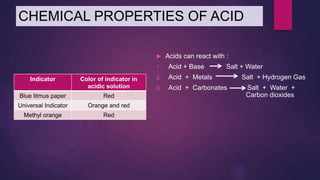
CHEMICAL PROPERTIES OF ACID
 Acids can react with base to form salts and water.
Acid + Base Salt + Water
H2SO4 (aq) + ZnO (s) ZnSO4 (aq) + H2O (l)
 Acids can react with metals to produce salts and Hydrogen gas.
Acid + metal Salt + hydrogen gas
2HCl (aq) + Mg (s) MgCl2 (aq) + H2 (g)
 Acids can react with carbonates to produce salt, water and carbon dioxides
Acid + Carbonates Salt + Water + Carbon dioxides
2HNO3 (aq) + CuCO3 (s) Cu(NO3)2 (aq) + H2O (l) + CO2 (g)
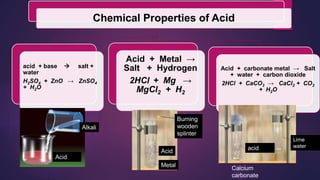
Chemical Properties of Acid
acid + base  salt +
water
H2SO4 + ZnO → ZnSO4
+ H2O
Acid + Metal →
Salt + Hydrogen
2HCl + Mg →
MgCl2 + H2
Acid + carbonate metal → Salt
+ water + carbon dioxide
2HCl + CaCO3 → CaCl2 + CO2
+ H2O
Acid
Alkali
Acid
Metal
Burning
wooden
splinter
Calcium
carbonate
acid
Lime
water
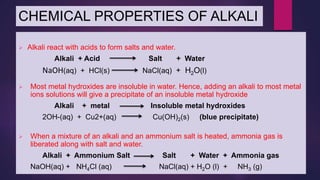
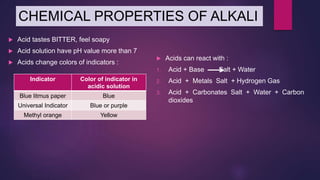
CHEMICAL PROPERTIES OF ALKALI
 Alkali react with acids to form salts and water.
Alkali + Acid Salt + Water
NaOH(aq) + HCl(s) NaCl(aq) + H2O(l)
 Most metal hydroxides are insoluble in water. Hence, adding an alkali to most metal
ions solutions will give a precipitate of an insoluble metal hydroxide
Alkali + metal Insoluble metal hydroxides
2OH-(aq) + Cu2+(aq) Cu(OH)2(s) (blue precipitate)
 When a mixture of an alkali and an ammonium salt is heated, ammonia gas is
liberated along with salt and water.
Alkali + Ammonium Salt Salt + Water + Ammonia gas
NaOH(aq) + NH4Cl (aq) NaCl(aq) + H2O (l) + NH3 (g)
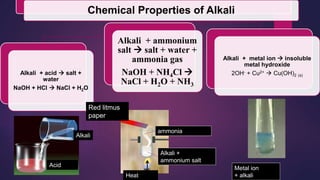
Chemical Properties of Alkali
Alkali + acid  salt +
water
NaOH + HCl  NaCl + H2O
Alkali + ammonium
salt  salt + water +
ammonia gas
NaOH + NH4Cl 
NaCl + H2O + NH3
Alkali + metal ion  insoluble
metal hydroxide
2OH- + Cu2+  Cu(OH)2 (s)
Acid
Alkali
Alkali +
ammonium salt
Red litmus
paper
ammonia
Heat
Metal ion
+ alkali
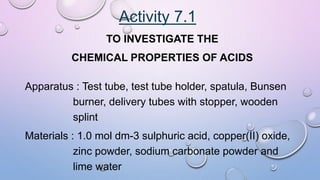
Activity 7.1
TO INVESTIGATE THE
CHEMICAL PROPERTIES OF ACIDS
Apparatus : Test tube, test tube holder, spatula, Bunsen
burner, delivery tubes with stopper, wooden
splint
Materials : 1.0 mol dm-3 sulphuric acid, copper(II) oxide,
zinc powder, sodium carbonate powder and
lime water
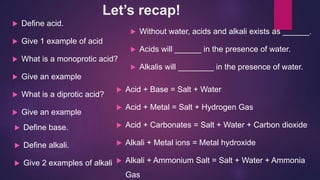
Let’s recap!
 Define acid.
 Give 1 example of acid
 What is a monoprotic acid?
 Give an example
 What is a diprotic acid?
 Give an example
 Without water, acids and alkali exists as ______.
 Acids will ______ in the presence of water.
 Alkalis will ________ in the presence of water.
 Define base.
 Define alkali.
 Give 2 examples of alkali
 Acid + Base = Salt + Water
 Acid + Metal = Salt + Hydrogen Gas
 Acid + Carbonates = Salt + Water + Carbon dioxide
 Alkali + Metal ions = Metal hydroxide
 Alkali + Ammonium Salt = Salt + Water + Ammonia
Gas
7.1 Analysing Characteristics And
Properties Of Acids And Bases
LEARNING OUTCOME :
 State the meaning of acid, base and alkali
 State the uses of acids, bases and alkalis in daily life
 Explain the role of water in the formation of hydrogen ions to show properties of acids
 Explain the role of water in the formation of hydroxide ions to show the properties of
alkalis
 Describe the chemical properties of acids and alkalis
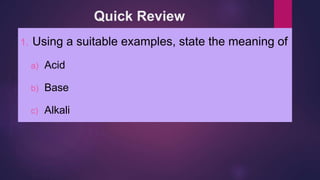
Quick Review
1. Using a suitable examples, state the meaning of
a) Acid
b) Base
c) Alkali
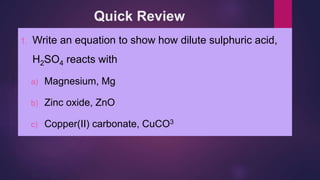
Quick Review
1. Write an equation to show how dilute sulphuric acid,
H2SO4 reacts with
a) Magnesium, Mg
b) Zinc oxide, ZnO
c) Copper(II) carbonate, CuCO3
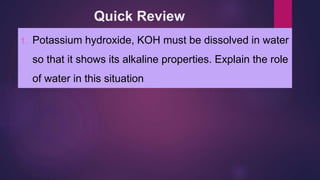
Quick Review
1. Potassium hydroxide, KOH must be dissolved in water
so that it shows its alkaline properties. Explain the role
of water in this situation
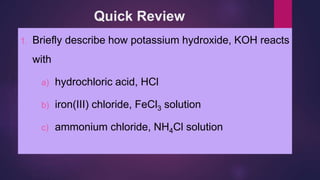
Quick Review
1. Briefly describe how potassium hydroxide, KOH reacts
with
a) hydrochloric acid, HCl
b) iron(III) chloride, FeCl3 solution
c) ammonium chloride, NH4Cl solution
Quick Review
1. Briefly describe how potassium hydroxide, KOH reacts
with
a) hydrochloric acid, HCl
b) iron(III) chloride, FeCl3 solution
c) ammonium chloride, NH4Cl solution
CHEMICAL PROPERTIES OF ACID
Indicator Color of indicator in
acidic solution
Blue litmus paper Red
Universal Indicator Orange and red
Methyl orange Red
 Acids can react with :
1. Acid + Base Salt + Water
2. Acid + Metals Salt + Hydrogen Gas
3. Acid + Carbonates Salt + Water +
Carbon dioxides
CHEMICAL PROPERTIES OF ALKALI
 Acid tastes BITTER, feel soapy
 Acid solution have pH value more than 7
 Acids change colors of indicators :
Indicator Color of indicator in
acidic solution
Blue litmus paper Blue
Universal Indicator Blue or purple
Methyl orange Yellow
 Acids can react with :
1. Acid + Base Salt + Water
2. Acid + Metals Salt + Hydrogen Gas
3. Acid + Carbonates Salt + Water + Carbon
dioxides
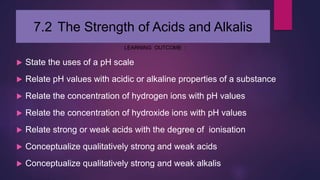
7.2 The Strength of Acids and Alkalis
LEARNING OUTCOME :
 State the uses of a pH scale
 Relate pH values with acidic or alkaline properties of a substance
 Relate the concentration of hydrogen ions with pH values
 Relate the concentration of hydroxide ions with pH values
 Relate strong or weak acids with the degree of ionisation
 Conceptualize qualitatively strong and weak acids
 Conceptualize qualitatively strong and weak alkalis
How to determine the pH of a solution?
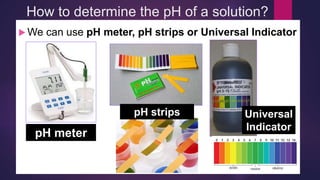
 We can use pH meter, pH strips or Universal Indicator
pH meter
pH strips Universal
Indicator
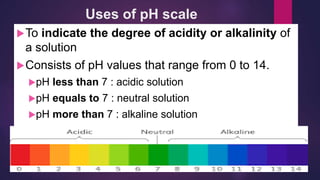
Uses of pH scale
To indicate the degree of acidity or alkalinity of
a solution
Consists of pH values that range from 0 to 14.
pH less than 7 : acidic solution
pH equals to 7 : neutral solution
pH more than 7 : alkaline solution
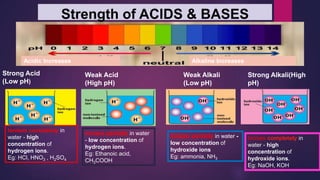
Strength of ACIDS & BASES
Acidic Increases Alkaline Increases
Strong Acid
(Low pH)
Weak Acid
(High pH)
Weak Alkali
(Low pH)
Strong Alkali(High
pH)
Ionises completely in
water - high
concentration of
hydrogen ions.
Eg: HCl, HNO3 , H2SO4
Ionises partially in water
- low concentration of
hydrogen ions.
Eg: Ethanoic acid,
CH3COOH
Ionises completely in
water - high
concentration of
hydroxide ions.
Eg: NaOH, KOH
Ionises partially in water -
low concentration of
hydroxide ions
Eg: ammonia, NH3
Strong and Weak Acids
 The strength of an acid depends on the degree of
ionisation or degree of dissociation of the acid in
water.
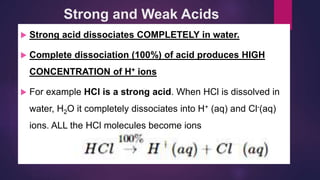
Strong and Weak Acids
 Strong acid dissociates COMPLETELY in water.
 Complete dissociation (100%) of acid produces HIGH
CONCENTRATION of H+ ions
 For example HCl is a strong acid. When HCl is dissolved in
water, H2O it completely dissociates into H+ (aq) and Cl-(aq)
ions. ALL the HCl molecules become ions
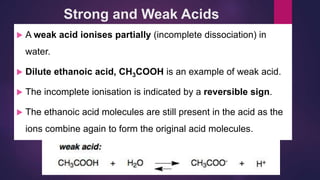
Strong and Weak Acids
 A weak acid ionises partially (incomplete dissociation) in
water.
 Dilute ethanoic acid, CH3COOH is an example of weak acid.
 The incomplete ionisation is indicated by a reversible sign.
 The ethanoic acid molecules are still present in the acid as the
ions combine again to form the original acid molecules.
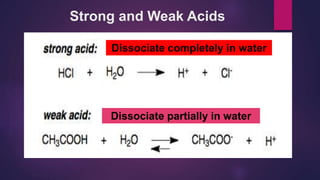
Strong and Weak Acids
Dissociate completely in water
Dissociate partially in water
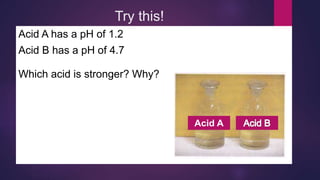
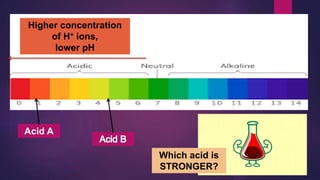
Acid A has a pH of 1.2
Acid B has a pH of 4.7
Which acid is stronger? Why?
Try this!
Acid A
Try this!
1. What is the use of the pH scale?
To indicate the degree of acidity or alkalinity of a
solution
2. If a solution is acidic, can u predict the pH value?
pH < 7
3. Solution B has a pH of 13. Solution X is
____________ solution.
an alkali
 The pH value is actually a measure of the
concentration of hdyrogen ions, H+ and hydroxide
ions, OH-.
 The HIGHER THE CONCENTRATION OF H+ IONS, the
LOWER the pH
 The HIGHER THE CONCENTRATION OF OH- IONS,
the HIGHER the pH
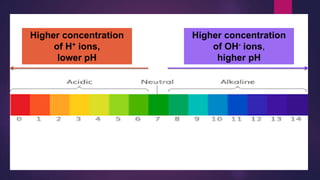
Higher concentration
of H+ ions,
lower pH
Higher concentration
of OH- ions,
higher pH
Higher concentration
of H+ ions,
lower pH
Acid A
Which acid is
STRONGER?
Strong and Weak Alkalis
 The strength of an alkali depends on the degree of
ionisation/ degree of dissociation of the alkali in water.
Strong and Weak Alkalis
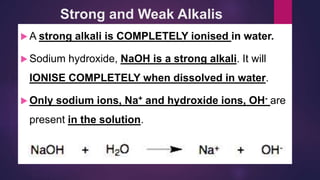
 A strong alkali is COMPLETELY ionised in water.
 Sodium hydroxide, NaOH is a strong alkali. It will
IONISE COMPLETELY when dissolved in water.
 Only sodium ions, Na+ and hydroxide ions, OH- are
present in the solution.
Strong and Weak Alkalis
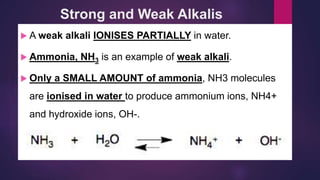
 A weak alkali IONISES PARTIALLY in water.
 Ammonia, NH3 is an example of weak alkali.
 Only a SMALL AMOUNT of ammonia, NH3 molecules
are ionised in water to produce ammonium ions, NH4+
and hydroxide ions, OH-.
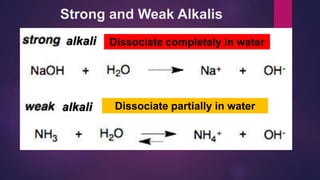
Strong and Weak Alkalis
Dissociate completely in water
Dissociate partially in water
alkali
alkali
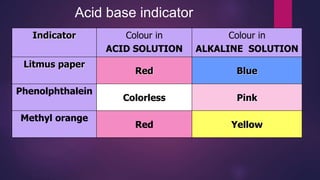
Acid base indicator
Indicator Colour in
ACID SOLUTION
Colour in
ALKALINE SOLUTION
Litmus paper
Red Blue
Phenolphthalein
Colorless Pink
Methyl orange
Red Yellow
CONCENTRATIONS OF
ACIDS AND ALKALIS
7.3 Analysing concentration of acids and
alkalis
LEARNING OUTCOME :
 State the meaning of concentration,
 State the meaning of molarity,
 State the relationship between the number of moles with
molarity and volume of a solution,
 Describe methods for preparing standard solutions,
 Describe the preparation of a solution with a specified
concentration using dilution method,
 Relate pH value with molarity of acid and alkali,
 Solve numerical problems involving molarity of acids and alkalis
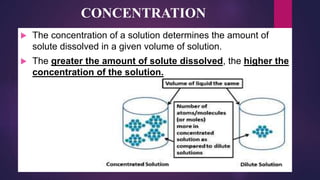
CONCENTRATION
 The concentration of a solution determines the amount of
solute dissolved in a given volume of solution.
 The greater the amount of solute dissolved, the higher the
concentration of the solution.
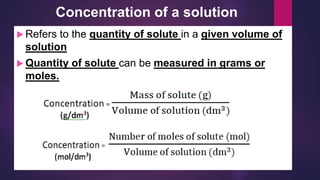
Concentration of a solution
 Refers to the quantity of solute in a given volume of
solution
 Quantity of solute can be measured in grams or
moles.
Concentration of a solution
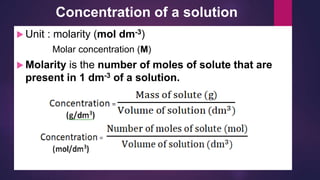
 Unit : molarity (mol dm-3)
Molar concentration (M)
 Molarity is the number of moles of solute that are
present in 1 dm-3 of a solution.
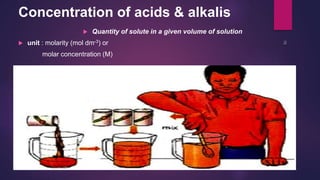
Concentration of acids & alkalis
 Quantity of solute in a given volume of solution
 unit : molarity (mol dm-3) or
molar concentration (M)
Solute (g) + water (dm3)
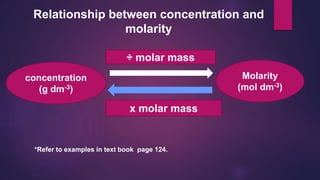
Relationship between concentration and
molarity
concentration
(g dm-3)
Molarity
(mol dm-3)
÷ molar mass
x molar mass
*Refer to examples in text book page 124.
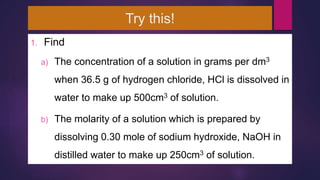
Try this!
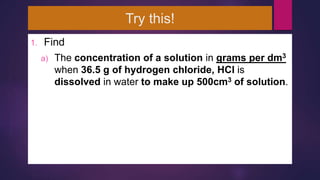
1. Find
a) The concentration of a solution in grams per dm3
when 36.5 g of hydrogen chloride, HCl is dissolved in
water to make up 500cm3 of solution.
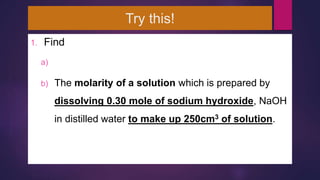
b) The molarity of a solution which is prepared by
dissolving 0.30 mole of sodium hydroxide, NaOH in
distilled water to make up 250cm3 of solution.
Try this!
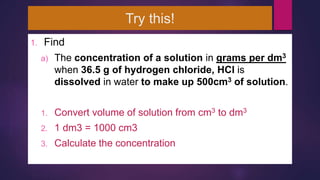
1. Find
a) The concentration of a solution in grams per dm3
when 36.5 g of hydrogen chloride, HCl is
dissolved in water to make up 500cm3 of solution.
Try this!
1. Find
a) The concentration of a solution in grams per dm3
when 36.5 g of hydrogen chloride, HCl is
dissolved in water to make up 500cm3 of solution.
1. Convert volume of solution from cm3 to dm3
2. 1 dm3 = 1000 cm3
3. Calculate the concentration
Try this!
1. Find
a) M
b) The molarity of a solution which is prepared by
dissolving 0.30 mole of sodium hydroxide, NaOH
in distilled water to make up 250cm3 of solution.
Try this!
The molarity of a bottle of nitric acid, HNO3 solution
is 2.0 mol dm-3. What is the concentration of the
solution in g dm-3?
[Relative atomic masses : H, 1; N, 14; O, 16]
*Refer to concentration formula.
What information do u have?
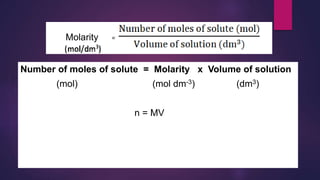
Number of moles of solute = Molarity x Volume of solution
(mol) (mol dm-3) (dm3)
n = MV
Molarity
Concentrations of acids and alkalis
M = Concentration in mol dm-3 [Molarity]
V = Volume in cm3
1000 cm3 = 1 dm3
No. of mol
MV_
1000
84
leenl@
chemf4
85
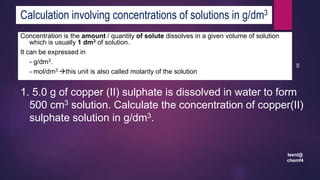
Calculation involving concentrations of solutions in g/dm3
Concentration is the amount / quantity of solute dissolves in a given volume of solution
which is usually 1 dm3 of solution.
It can be expressed in
- g/dm3.
- mol/dm3 this unit is also called molarity of the solution
1. 5.0 g of copper (II) sulphate is dissolved in water to form
500 cm3 solution. Calculate the concentration of copper(II)
sulphate solution in g/dm3.
leenl@
chemf4
86
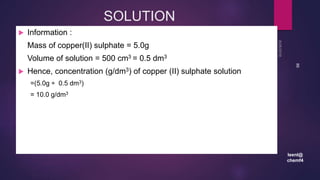
SOLUTION
 Information :
Mass of copper(II) sulphate = 5.0g
Volume of solution = 500 cm3 = 0.5 dm3
 Hence, concentration (g/dm3) of copper (II) sulphate solution
=(5.0g ÷ 0.5 dm3)
= 10.0 g/dm3
leenl@
chemf4
87
1. What is the mass of sodium carbonate required to dissolve
in water to prepare a 200cm3 solution that contains 50
g/dm3?
 Volume of solution = 200 cm3 = 0.2 dm3
 Concentration (g/dm3)
=[(mass of Na2CO3 dissolved (g)] ÷ [volume of solution (dm3)]
Hence, mass of Na2CO3 required
= concentration (g/dm3) x volume of solution (dm3)
= 50 g/dm3 x 0.2 dm3
= 10 g
leenl@
chemf4
88
Calculation involving concentrations of solutions in mol/dm3
Molarity, M (mol/dm3) = No. of moles of solute, n (mol)
Volume of solution, V (dm3)
No. of moles,n (mol) = Molarity (M) x Volume (V) dm3
OR
No. of moles (mol) = Molarity (M) x [Volume (V) / 1000 cm3 ]
= MV/1000
leenl@
chemf4
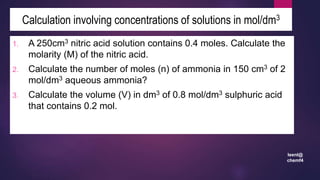
1. A 250cm3 nitric acid solution contains 0.4 moles. Calculate the
molarity (M) of the nitric acid.
2. Calculate the number of moles (n) of ammonia in 150 cm3 of 2
mol/dm3 aqueous ammonia?
3. Calculate the volume (V) in dm3 of 0.8 mol/dm3 sulphuric acid
that contains 0.2 mol.
Calculation involving concentrations of solutions in mol/dm3
leenl@
chemf4
90
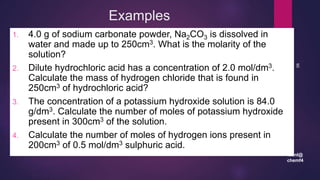
Examples
1. 4.0 g of sodium carbonate powder, Na2CO3 is dissolved in
water and made up to 250cm3. What is the molarity of the
solution?
2. Dilute hydrochloric acid has a concentration of 2.0 mol/dm3.
Calculate the mass of hydrogen chloride that is found in
250cm3 of hydrochloric acid?
3. The concentration of a potassium hydroxide solution is 84.0
g/dm3. Calculate the number of moles of potassium hydroxide
present in 300cm3 of the solution.
4. Calculate the number of moles of hydrogen ions present in
200cm3 of 0.5 mol/dm3 sulphuric acid.
7.3 Analysing concentration of acids and
alkalis
LEARNING OUTCOME :
 State the meaning of concentration,
 State the meaning of molarity,
 State the relationship between the number of moles with
molarity and volume of a solution,
 Relate pH value with molarity of acid and alkali,
 Solve numerical problems involving molarity of acids and alkalis
Preparation of Standard Solution
leenl@
chemf4
93
STANDARD SOLUTION
 A solution in which its concentration is accurately
known.
 A solution of known concentration
leenl@
chemf4
94
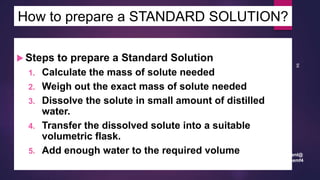
How to prepare a STANDARD SOLUTION?
 Steps to prepare a Standard Solution
1. Calculate the mass of solute needed
2. Weigh out the exact mass of solute needed
3. Dissolve the solute in small amount of distilled
water.
4. Transfer the dissolved solute into a suitable
volumetric flask.
5. Add enough water to the required volume
leenl@
chemf4
95
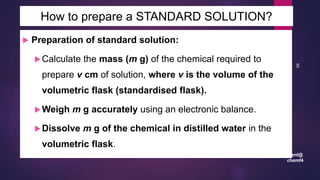
 Preparation of standard solution:
Calculate the mass (m g) of the chemical required to
prepare v cm of solution, where v is the volume of the
volumetric flask (standardised flask).
Weigh m g accurately using an electronic balance.
Dissolve m g of the chemical in distilled water in the
volumetric flask.
How to prepare a STANDARD SOLUTION?
Activity 7.8
TO PREPARE A STANDARD SOLUTION
Apparatus : Electronic balance, 100cm3 volumetric flask,
filter funnel, dropper and washing bottle
Materials : Sodium hydroxide solid and distilled water
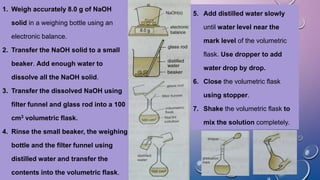
1. Weigh accurately 8.0 g of NaOH
solid in a weighing bottle using an
electronic balance.
2. Transfer the NaOH solid to a small
beaker. Add enough water to
dissolve all the NaOH solid.
3. Transfer the dissolved NaOH using
filter funnel and glass rod into a 100
cm3 volumetric flask.
4. Rinse the small beaker, the weighing
bottle and the filter funnel using
distilled water and transfer the
contents into the volumetric flask.
5. Add distilled water slowly
until water level near the
mark level of the volumetric
flask. Use dropper to add
water drop by drop.
6. Close the volumetric flask
using stopper.
7. Shake the volumetric flask to
mix the solution completely.
Preparing 100 cm3 of 1.0 mol/dm3
aqueous sodium hydroxide solution
 Mass of NaOH required to prepare 100cm3 of 1.0 mol/dm3
= [(MV)/1000] x RMM of NaOH
= [(10 x 100)/1000] x (23 + 16 + 1)
= 4 g
 4.0 g of NaOH is weighed accurately
 4.0 g of NaOH is transferred to a small beaker. Distilled water is added to dissolve the
solid NaOH.
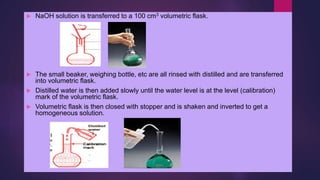
 NaOH solution is transferred to a 100 cm3 volumetric flask.
 The small beaker, weighing bottle, etc are all rinsed with distilled and are transferred
into volumetric flask.
 Distilled water is then added slowly until the water level is at the level (calibration)
mark of the volumetric flask.
 Volumetric flask is then closed with stopper and is shaken and inverted to get a
homogeneous solution.
Preparation of Solution
by Dilution Method
Dilution
 A process of diluting a concentrated solution by
adding a solvent such as water to obtain a more
diluted solution.
 When a solution is diluted, the volume of solvent
increases but the number of moles of solute
remains constant.
Steps Involved In The Preparation Of A
Standard Solution By Dilution
1. The volume of the stock solution, V1 required is calculated.
2. The required volume of stock solution is pipetted into a
volumetric flask.
3. Enough distilled water is added to the volumetric flask to
the required volume, V2.
7.3 Analysing concentration of acids and
alkalis
LEARNING OUTCOME :
 State the meaning of concentration,
 State the meaning of molarity,
 State the relationship between the number of moles with
molarity and volume of a solution,
 Describe methods for preparing standard solutions,
 Describe the preparation of a solution with a specified
concentration using dilution method,
Relationship between pH values and
Molarities of Acids or Alkalis
 The pH value of an acid or an alkali depends on two factors
 The degree of dissociation
 The molarity or concentration
 At the same concentration, the pH value of an acid or an alkali
depends on the degree of dissociation.
 The higher the degree of dissociation of an acid, the lower the pH
value of an acid.
 The higher the degree of dissociation of an alkali, the higher the pH
value of the alkali
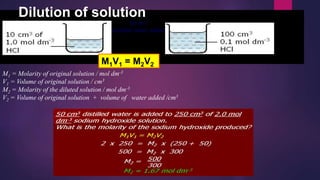
90 cm3
distilled water added
Dilution of solution
M1 = Molarity of original solution / mol dm-3
V1 = Volume of original solution / cm3
M2 = Molarity of the diluted solution / mol dm-3
V2 = Volume of original solution + volume of water added /cm3
M1V1 = M2V2
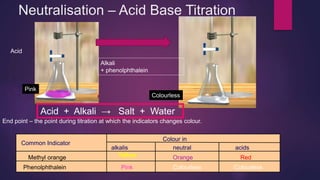
Neutralisation – Acid Base Titration
Pink
Colourless
Alkali
+ phenolphthalein
Acid
Acid + Alkali → Salt + Water
End point – the point during titration at which the indicators changes colour.
Common Indicator
alkalis acidsneutral
Colour in
Methyl orange
Phenolphthalein
Yellow Orange Red
Pink Colourless Colourless
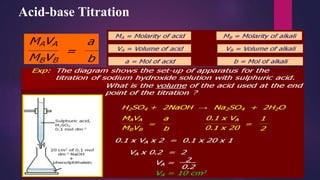
Acid-base Titration
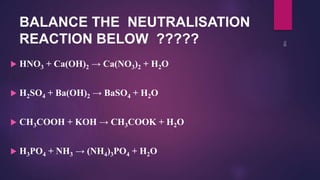
BALANCE THE NEUTRALISATION
REACTION BELOW ?????
 HNO3 + Ca(OH)2 → Ca(NO3)2 + H2O
 H2SO4 + Ba(OH)2 → BaSO4 + H2O
 CH3COOH + KOH → CH3COOK + H2O
 H3PO4 + NH3 → (NH4)3PO4 + H2O
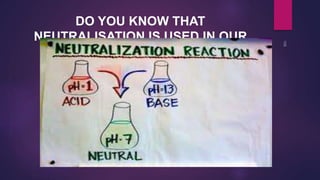
DO YOU KNOW THAT
NEUTRALISATION IS USED IN OUR
DAILY LIFE ???
1. Agriculture : acidic soil is treated with CaO
2. Industries : ammonia is used to prevent coagulation of latex
3. Health :Baking powder to cure bee stings
Toothpaste to neutralise acid in the mouth
NEUTRALISATION IN DAILY LIFE :

FORM 4 CHAPTER 7 ACIDS AND BASES

  • 3.
  • 4.
    7.1 Analysing CharacteristicsAnd Properties Of Acids And Bases LEARNING OUTCOME :  State the meaning of acid, base and alkali  State the uses of acids, bases and alkalis in daily life  Explain the role of water in the formation of hydrogen ions to show properties of acids  Explain the role of water in the formation of hydroxide ions to show the properties of alkalis  Describe the chemical properties of acids and alkalis 7.1.1 State the meaning of acid, base and alkali
  • 5.
    In 1884 .. .  A Swedish Chemist, Arrhenius proposed that compounds can be classified into two :  Acids and Bases
  • 6.
    According to Arrhenius. . AN ACID IS A CHEMICAL COMPOUND THAT IONIZE IN WATER TO PRODUCE HYDROGEN IONS, H+ 7.1.1 State the meaning of acid, base and alkali
  • 7.
     In thisreaction, hydrochloric acid (HCl) dissociates completely into hydrogen (H+) and chlorine (Cl-) ions when dissolved in water, thereby releasing H+ ions into solution. HCl (aq) → H+ (aq) + Cl− (aq)
  • 8.
     The hydrogenions combines with a water molecule, H2O to form hydroxonium ion, H3O+ HCl(aq) + H2O(l) → H3O+(aq) + Cl−(aq) 8 7.1.1 State the meaning of acid, base and alkali
  • 9.
    The Relationship between H+and H3O+ : 7.1.1 State the meaning of acid, base and alkali
  • 10.
    Example of acidsin the lab : Hydrochloric acid, HCl Nitric acid, HNO3 Sulfuric acid, H2SO4 7.1.1 State the meaning of acid, base and alkali
  • 11.
    BASICITY OF ACID Basicity : the number of ionisable hydrogen atoms per molecule of an acid.  Monoprotic acid : produces one mole of hydrogen ion when ionises in water  Examples of monoprotic acid : HCl  Diprotic acid : produces two moles of hydrogen ion when ionises in water  Examples of diprotic acid : H2SO4 7.1.1 State the meaning of acid, base and alkali
  • 12.
    Next, what isbases and alkalis ? ACCORDING TO ARRHENIUS, A BASE IS A CHEMICAL SUBSTANCE WHICH REACT WITH ACID TO PRODUCE SALT AND WATER. AN ALKALI IS A BASE WHICH IONISES IN WATER TO PRODUCE HYDROXIDE IONS, OH- EXAMPLE : NAOH, KOH, NH3 7.1.1 State the meaning of acid, base and alkali Acid + Base Salt + Water
  • 13.
    Most bases dissolvesin water. These soluble bases are called alkalis. EXAMPLES OF ALKALIS : SODIUM HYDROXIDE AMMONIA NaOH → Na+ + OH- NH3 + H2O → NH4 + + OH- 7.1.1 State the meaning of acid, base and alkali
  • 16.
    ROLE OF WATERON THE PROPERTIES OF ACIDS 7.1.1 Explain the role of water in the formation of hydrogen ions and hydroxide ions  An acid shows its acidic properties only in the presence of water  Water is essential for the formation of hydrogen ions that cause the acidity  In the absence of water, dry acids or acids dissolves in organic solvents DO NOT SHOW any acidic property because the acids exists as molecules and are not dissociated into hydrogen ions
  • 17.
    ROLE OF WATERON THE PROPERTIES OF ACID Acids Pure acid / acid in organic solvent consists of covalent molecules only. H+ is not present. Eg: Dry/glacial ethanoic acid, Ethanoic acid in propanone Acid only show their acidic properties in the presence of water. 7.1.3 Explain the role of water in the formation of hydrogen ions to show properties of acids
  • 18.
    To investigate roleof water on the properties of acid Blue litmus paper Glacial ethanoic acid Blue litmus paper Glacial ethanoic acid + distilled water Glacial ethanoic acid + Propanone Blue litmus paper A B C 7.1.3 Explain the role of water in the formation of hydrogen ions to show properties of acids
  • 20.
    ROLE OF WATERON THE PROPERTIES OF ALKALIS 7.1.1 Explain the role of water in the formation of hydrogen ions and hydroxide ions  An alkali shows its alkaline properties only in the presence of water  Water is essential for the formation of hydroxide ions that cause the alkalinity.  In the absence of water, alkali exists as molecules and does not show any alkaline properties
  • 21.
    ROLE OF WATERON THE PROPERTIES OF ALKALI Alkali Pure alkali in the dry state does not exhibit alkaline properties - No hydroxide ions. Alkali only show their alkaline properties in the presence of water. 7.1.4 Explain the role of water in the formation of hydroxide ions to show properties of alkalis
  • 22.
    ROLE OF WATERON THE PROPERTIES OF ACID/ALKALI Acids Pure acid / acid in organic solvent consists of covalent molecules only. Hydrogen ion, H+ is not present. Eg: Dry/glacial ethanoic acid, Ethanoic acid in propanone Acid only show their acidic properties in the presence of water. Alkali Pure alkali in the dry state does not exhibit alkaline properties - No hydroxide ions, OH- Alkali only show their alkaline properties in the presence of water. 7.1.1 Explain the role of water in the formation of hydrogen ions and hydroxide ions
  • 23.
    Uses of Acids,Bases and Alkalis in daily life :  Acids and bases are widely used in our daily life in agriculture, medicine, industry and preparation of food 7.1.2 State the uses of acids, bases and alkali in daily life.
  • 24.
    Uses of Acidsin daily life :  Acids and bases are widely used in our daily life in agriculture, medicine, industry and preparation of food 7.1.2 State the uses of acids, bases and alkali in daily life. Sulphuric acid in Lead-acid accumulator Tartaric acid in Baking powder Nitric acid in Plant fertilizers
  • 25.
    Uses of Basesin daily life :  Acids and bases are widely used in our daily life in agriculture, medicine, industry and preparation of food 7.1.2 State the uses of acids, bases and alkali in daily life. Sodium hydroxide in soaps and detergents Aluminium hydroxide in gastric medicine Magnesium hydroxide in toothpaste
  • 26.
    Properties of Acid/Alkali Taste pH value? Solubility in water? Does it change the color of litmus paper? Can it conduct electricity? Why Color of acid/alkali?
  • 27.
    Properties of Acid Sour taste pHvalue less than 7 Soluble in water Turns blue litmus paper to red Can conduct electricity Colorless solution
  • 28.
    Properties of Alkali Bitter taste pHvalue more than 7 Soluble in water Turns red litmus paper to blue Can conduct electricity Colorless solution
  • 29.
    leenl@ chemf4 29 Explain the following: Asolution of hydrogen chloride in toluene does not react with marble whereas a solution of hydrogen chloride in water does. [6 marks] 7.1.1 State the meaning of acid, base and alkali
  • 30.
    leenl@ chemf4 30 (b) In toluenethe hydrogen chloride exist as covalent molecules There are no hydrogen ions present in the solution. Thus the solution does not show acidic properties. When dissolved in water, the hydrogen chloride molecules dissociate to produce hydrogen ions. HCl  H+ + Cl- The hydrogen ions will react with marble to release carbon dioxide gas. (1) 2H+ + CaCO3  Ca2+ + CO2 + H2O 7.1.1 State the meaning of acid, base and alkali
  • 31.
    TO INVESTIGATE ROLEOF WATER ON THE PROPERTIES OF ALKALI Filter funnel Distilled water / trichloromethane Anhydrous calcium oxide 7.1.1 State the meaning of acid, base and alkali
  • 32.
    What are theproducts when . .  Acids react with base  Acids reacts with metals  Acids reacts with carbonate  Alkali reacts with acids  Alkali reacts with metal ions  Alkali reacts with ammonium salts
  • 33.
    CHEMICAL PROPERTIES OFACID  Acids can react with base to form salts and water. Acid + Base Salt + Water H2SO4 (aq) + ZnO (s) ZnSO4 (aq) + H2O (l)  Acids can react with metals to produce salts and Hydrogen gas. Acid + metal Salt + hydrogen gas 2HCl (aq) + Mg (s) MgCl2 (aq) + H2 (g)  Acids can react with carbonates to produce salt, water and carbon dioxides Acid + Carbonates Salt + Water + Carbon dioxides 2HNO3 (aq) + CuCO3 (s) Cu(NO3)2 (aq) + H2O (l) + CO2 (g)
  • 34.
    Chemical Properties ofAcid acid + base  salt + water H2SO4 + ZnO → ZnSO4 + H2O Acid + Metal → Salt + Hydrogen 2HCl + Mg → MgCl2 + H2 Acid + carbonate metal → Salt + water + carbon dioxide 2HCl + CaCO3 → CaCl2 + CO2 + H2O Acid Alkali Acid Metal Burning wooden splinter Calcium carbonate acid Lime water
  • 35.
    CHEMICAL PROPERTIES OFALKALI  Alkali react with acids to form salts and water. Alkali + Acid Salt + Water NaOH(aq) + HCl(s) NaCl(aq) + H2O(l)  Most metal hydroxides are insoluble in water. Hence, adding an alkali to most metal ions solutions will give a precipitate of an insoluble metal hydroxide Alkali + metal Insoluble metal hydroxides 2OH-(aq) + Cu2+(aq) Cu(OH)2(s) (blue precipitate)  When a mixture of an alkali and an ammonium salt is heated, ammonia gas is liberated along with salt and water. Alkali + Ammonium Salt Salt + Water + Ammonia gas NaOH(aq) + NH4Cl (aq) NaCl(aq) + H2O (l) + NH3 (g)
  • 36.
    Chemical Properties ofAlkali Alkali + acid  salt + water NaOH + HCl  NaCl + H2O Alkali + ammonium salt  salt + water + ammonia gas NaOH + NH4Cl  NaCl + H2O + NH3 Alkali + metal ion  insoluble metal hydroxide 2OH- + Cu2+  Cu(OH)2 (s) Acid Alkali Alkali + ammonium salt Red litmus paper ammonia Heat Metal ion + alkali
  • 37.
    Activity 7.1 TO INVESTIGATETHE CHEMICAL PROPERTIES OF ACIDS Apparatus : Test tube, test tube holder, spatula, Bunsen burner, delivery tubes with stopper, wooden splint Materials : 1.0 mol dm-3 sulphuric acid, copper(II) oxide, zinc powder, sodium carbonate powder and lime water
  • 38.
    Let’s recap!  Defineacid.  Give 1 example of acid  What is a monoprotic acid?  Give an example  What is a diprotic acid?  Give an example  Without water, acids and alkali exists as ______.  Acids will ______ in the presence of water.  Alkalis will ________ in the presence of water.  Define base.  Define alkali.  Give 2 examples of alkali  Acid + Base = Salt + Water  Acid + Metal = Salt + Hydrogen Gas  Acid + Carbonates = Salt + Water + Carbon dioxide  Alkali + Metal ions = Metal hydroxide  Alkali + Ammonium Salt = Salt + Water + Ammonia Gas
  • 39.
    7.1 Analysing CharacteristicsAnd Properties Of Acids And Bases LEARNING OUTCOME :  State the meaning of acid, base and alkali  State the uses of acids, bases and alkalis in daily life  Explain the role of water in the formation of hydrogen ions to show properties of acids  Explain the role of water in the formation of hydroxide ions to show the properties of alkalis  Describe the chemical properties of acids and alkalis
  • 40.
    Quick Review 1. Usinga suitable examples, state the meaning of a) Acid b) Base c) Alkali
  • 41.
    Quick Review 1. Writean equation to show how dilute sulphuric acid, H2SO4 reacts with a) Magnesium, Mg b) Zinc oxide, ZnO c) Copper(II) carbonate, CuCO3
  • 42.
    Quick Review 1. Potassiumhydroxide, KOH must be dissolved in water so that it shows its alkaline properties. Explain the role of water in this situation
  • 43.
    Quick Review 1. Brieflydescribe how potassium hydroxide, KOH reacts with a) hydrochloric acid, HCl b) iron(III) chloride, FeCl3 solution c) ammonium chloride, NH4Cl solution
  • 44.
    Quick Review 1. Brieflydescribe how potassium hydroxide, KOH reacts with a) hydrochloric acid, HCl b) iron(III) chloride, FeCl3 solution c) ammonium chloride, NH4Cl solution
  • 49.
    CHEMICAL PROPERTIES OFACID Indicator Color of indicator in acidic solution Blue litmus paper Red Universal Indicator Orange and red Methyl orange Red  Acids can react with : 1. Acid + Base Salt + Water 2. Acid + Metals Salt + Hydrogen Gas 3. Acid + Carbonates Salt + Water + Carbon dioxides
  • 50.
    CHEMICAL PROPERTIES OFALKALI  Acid tastes BITTER, feel soapy  Acid solution have pH value more than 7  Acids change colors of indicators : Indicator Color of indicator in acidic solution Blue litmus paper Blue Universal Indicator Blue or purple Methyl orange Yellow  Acids can react with : 1. Acid + Base Salt + Water 2. Acid + Metals Salt + Hydrogen Gas 3. Acid + Carbonates Salt + Water + Carbon dioxides
  • 52.
    7.2 The Strengthof Acids and Alkalis LEARNING OUTCOME :  State the uses of a pH scale  Relate pH values with acidic or alkaline properties of a substance  Relate the concentration of hydrogen ions with pH values  Relate the concentration of hydroxide ions with pH values  Relate strong or weak acids with the degree of ionisation  Conceptualize qualitatively strong and weak acids  Conceptualize qualitatively strong and weak alkalis
  • 53.
    How to determinethe pH of a solution?  We can use pH meter, pH strips or Universal Indicator pH meter pH strips Universal Indicator
  • 54.
    Uses of pHscale To indicate the degree of acidity or alkalinity of a solution Consists of pH values that range from 0 to 14. pH less than 7 : acidic solution pH equals to 7 : neutral solution pH more than 7 : alkaline solution
  • 55.
  • 56.
    Strength of ACIDS& BASES Acidic Increases Alkaline Increases Strong Acid (Low pH) Weak Acid (High pH) Weak Alkali (Low pH) Strong Alkali(High pH) Ionises completely in water - high concentration of hydrogen ions. Eg: HCl, HNO3 , H2SO4 Ionises partially in water - low concentration of hydrogen ions. Eg: Ethanoic acid, CH3COOH Ionises completely in water - high concentration of hydroxide ions. Eg: NaOH, KOH Ionises partially in water - low concentration of hydroxide ions Eg: ammonia, NH3
  • 57.
    Strong and WeakAcids  The strength of an acid depends on the degree of ionisation or degree of dissociation of the acid in water.
  • 58.
    Strong and WeakAcids  Strong acid dissociates COMPLETELY in water.  Complete dissociation (100%) of acid produces HIGH CONCENTRATION of H+ ions  For example HCl is a strong acid. When HCl is dissolved in water, H2O it completely dissociates into H+ (aq) and Cl-(aq) ions. ALL the HCl molecules become ions
  • 59.
    Strong and WeakAcids  A weak acid ionises partially (incomplete dissociation) in water.  Dilute ethanoic acid, CH3COOH is an example of weak acid.  The incomplete ionisation is indicated by a reversible sign.  The ethanoic acid molecules are still present in the acid as the ions combine again to form the original acid molecules.
  • 60.
    Strong and WeakAcids Dissociate completely in water Dissociate partially in water
  • 61.
    Acid A hasa pH of 1.2 Acid B has a pH of 4.7 Which acid is stronger? Why? Try this! Acid A
  • 62.
    Try this! 1. Whatis the use of the pH scale? To indicate the degree of acidity or alkalinity of a solution 2. If a solution is acidic, can u predict the pH value? pH < 7 3. Solution B has a pH of 13. Solution X is ____________ solution. an alkali
  • 63.
     The pHvalue is actually a measure of the concentration of hdyrogen ions, H+ and hydroxide ions, OH-.  The HIGHER THE CONCENTRATION OF H+ IONS, the LOWER the pH  The HIGHER THE CONCENTRATION OF OH- IONS, the HIGHER the pH
  • 64.
    Higher concentration of H+ions, lower pH Higher concentration of OH- ions, higher pH
  • 65.
    Higher concentration of H+ions, lower pH Acid A Which acid is STRONGER?
  • 66.
    Strong and WeakAlkalis  The strength of an alkali depends on the degree of ionisation/ degree of dissociation of the alkali in water.
  • 67.
    Strong and WeakAlkalis  A strong alkali is COMPLETELY ionised in water.  Sodium hydroxide, NaOH is a strong alkali. It will IONISE COMPLETELY when dissolved in water.  Only sodium ions, Na+ and hydroxide ions, OH- are present in the solution.
  • 68.
    Strong and WeakAlkalis  A weak alkali IONISES PARTIALLY in water.  Ammonia, NH3 is an example of weak alkali.  Only a SMALL AMOUNT of ammonia, NH3 molecules are ionised in water to produce ammonium ions, NH4+ and hydroxide ions, OH-.
  • 69.
    Strong and WeakAlkalis Dissociate completely in water Dissociate partially in water alkali alkali
  • 70.
    Acid base indicator IndicatorColour in ACID SOLUTION Colour in ALKALINE SOLUTION Litmus paper Red Blue Phenolphthalein Colorless Pink Methyl orange Red Yellow
  • 71.
  • 72.
    7.3 Analysing concentrationof acids and alkalis LEARNING OUTCOME :  State the meaning of concentration,  State the meaning of molarity,  State the relationship between the number of moles with molarity and volume of a solution,  Describe methods for preparing standard solutions,  Describe the preparation of a solution with a specified concentration using dilution method,  Relate pH value with molarity of acid and alkali,  Solve numerical problems involving molarity of acids and alkalis
  • 73.
    CONCENTRATION  The concentrationof a solution determines the amount of solute dissolved in a given volume of solution.  The greater the amount of solute dissolved, the higher the concentration of the solution.
  • 74.
    Concentration of asolution  Refers to the quantity of solute in a given volume of solution  Quantity of solute can be measured in grams or moles.
  • 75.
    Concentration of asolution  Unit : molarity (mol dm-3) Molar concentration (M)  Molarity is the number of moles of solute that are present in 1 dm-3 of a solution.
  • 76.
    Concentration of acids& alkalis  Quantity of solute in a given volume of solution  unit : molarity (mol dm-3) or molar concentration (M) Solute (g) + water (dm3)
  • 77.
    Relationship between concentrationand molarity concentration (g dm-3) Molarity (mol dm-3) ÷ molar mass x molar mass *Refer to examples in text book page 124.
  • 78.
    Try this! 1. Find a)The concentration of a solution in grams per dm3 when 36.5 g of hydrogen chloride, HCl is dissolved in water to make up 500cm3 of solution. b) The molarity of a solution which is prepared by dissolving 0.30 mole of sodium hydroxide, NaOH in distilled water to make up 250cm3 of solution.
  • 79.
    Try this! 1. Find a)The concentration of a solution in grams per dm3 when 36.5 g of hydrogen chloride, HCl is dissolved in water to make up 500cm3 of solution.
  • 80.
    Try this! 1. Find a)The concentration of a solution in grams per dm3 when 36.5 g of hydrogen chloride, HCl is dissolved in water to make up 500cm3 of solution. 1. Convert volume of solution from cm3 to dm3 2. 1 dm3 = 1000 cm3 3. Calculate the concentration
  • 81.
    Try this! 1. Find a)M b) The molarity of a solution which is prepared by dissolving 0.30 mole of sodium hydroxide, NaOH in distilled water to make up 250cm3 of solution.
  • 82.
    Try this! The molarityof a bottle of nitric acid, HNO3 solution is 2.0 mol dm-3. What is the concentration of the solution in g dm-3? [Relative atomic masses : H, 1; N, 14; O, 16] *Refer to concentration formula. What information do u have?
  • 83.
    Number of molesof solute = Molarity x Volume of solution (mol) (mol dm-3) (dm3) n = MV Molarity
  • 84.
    Concentrations of acidsand alkalis M = Concentration in mol dm-3 [Molarity] V = Volume in cm3 1000 cm3 = 1 dm3 No. of mol MV_ 1000 84
  • 85.
    leenl@ chemf4 85 Calculation involving concentrationsof solutions in g/dm3 Concentration is the amount / quantity of solute dissolves in a given volume of solution which is usually 1 dm3 of solution. It can be expressed in - g/dm3. - mol/dm3 this unit is also called molarity of the solution 1. 5.0 g of copper (II) sulphate is dissolved in water to form 500 cm3 solution. Calculate the concentration of copper(II) sulphate solution in g/dm3.
  • 86.
    leenl@ chemf4 86 SOLUTION  Information : Massof copper(II) sulphate = 5.0g Volume of solution = 500 cm3 = 0.5 dm3  Hence, concentration (g/dm3) of copper (II) sulphate solution =(5.0g ÷ 0.5 dm3) = 10.0 g/dm3
  • 87.
    leenl@ chemf4 87 1. What isthe mass of sodium carbonate required to dissolve in water to prepare a 200cm3 solution that contains 50 g/dm3?  Volume of solution = 200 cm3 = 0.2 dm3  Concentration (g/dm3) =[(mass of Na2CO3 dissolved (g)] ÷ [volume of solution (dm3)] Hence, mass of Na2CO3 required = concentration (g/dm3) x volume of solution (dm3) = 50 g/dm3 x 0.2 dm3 = 10 g
  • 88.
    leenl@ chemf4 88 Calculation involving concentrationsof solutions in mol/dm3 Molarity, M (mol/dm3) = No. of moles of solute, n (mol) Volume of solution, V (dm3) No. of moles,n (mol) = Molarity (M) x Volume (V) dm3 OR No. of moles (mol) = Molarity (M) x [Volume (V) / 1000 cm3 ] = MV/1000
  • 89.
    leenl@ chemf4 1. A 250cm3nitric acid solution contains 0.4 moles. Calculate the molarity (M) of the nitric acid. 2. Calculate the number of moles (n) of ammonia in 150 cm3 of 2 mol/dm3 aqueous ammonia? 3. Calculate the volume (V) in dm3 of 0.8 mol/dm3 sulphuric acid that contains 0.2 mol. Calculation involving concentrations of solutions in mol/dm3
  • 90.
    leenl@ chemf4 90 Examples 1. 4.0 gof sodium carbonate powder, Na2CO3 is dissolved in water and made up to 250cm3. What is the molarity of the solution? 2. Dilute hydrochloric acid has a concentration of 2.0 mol/dm3. Calculate the mass of hydrogen chloride that is found in 250cm3 of hydrochloric acid? 3. The concentration of a potassium hydroxide solution is 84.0 g/dm3. Calculate the number of moles of potassium hydroxide present in 300cm3 of the solution. 4. Calculate the number of moles of hydrogen ions present in 200cm3 of 0.5 mol/dm3 sulphuric acid.
  • 91.
    7.3 Analysing concentrationof acids and alkalis LEARNING OUTCOME :  State the meaning of concentration,  State the meaning of molarity,  State the relationship between the number of moles with molarity and volume of a solution,  Relate pH value with molarity of acid and alkali,  Solve numerical problems involving molarity of acids and alkalis
  • 92.
  • 93.
    leenl@ chemf4 93 STANDARD SOLUTION  Asolution in which its concentration is accurately known.  A solution of known concentration
  • 94.
    leenl@ chemf4 94 How to preparea STANDARD SOLUTION?  Steps to prepare a Standard Solution 1. Calculate the mass of solute needed 2. Weigh out the exact mass of solute needed 3. Dissolve the solute in small amount of distilled water. 4. Transfer the dissolved solute into a suitable volumetric flask. 5. Add enough water to the required volume
  • 95.
    leenl@ chemf4 95  Preparation ofstandard solution: Calculate the mass (m g) of the chemical required to prepare v cm of solution, where v is the volume of the volumetric flask (standardised flask). Weigh m g accurately using an electronic balance. Dissolve m g of the chemical in distilled water in the volumetric flask. How to prepare a STANDARD SOLUTION?
  • 96.
    Activity 7.8 TO PREPAREA STANDARD SOLUTION Apparatus : Electronic balance, 100cm3 volumetric flask, filter funnel, dropper and washing bottle Materials : Sodium hydroxide solid and distilled water
  • 97.
    1. Weigh accurately8.0 g of NaOH solid in a weighing bottle using an electronic balance. 2. Transfer the NaOH solid to a small beaker. Add enough water to dissolve all the NaOH solid. 3. Transfer the dissolved NaOH using filter funnel and glass rod into a 100 cm3 volumetric flask. 4. Rinse the small beaker, the weighing bottle and the filter funnel using distilled water and transfer the contents into the volumetric flask. 5. Add distilled water slowly until water level near the mark level of the volumetric flask. Use dropper to add water drop by drop. 6. Close the volumetric flask using stopper. 7. Shake the volumetric flask to mix the solution completely.
  • 98.
    Preparing 100 cm3of 1.0 mol/dm3 aqueous sodium hydroxide solution  Mass of NaOH required to prepare 100cm3 of 1.0 mol/dm3 = [(MV)/1000] x RMM of NaOH = [(10 x 100)/1000] x (23 + 16 + 1) = 4 g  4.0 g of NaOH is weighed accurately  4.0 g of NaOH is transferred to a small beaker. Distilled water is added to dissolve the solid NaOH.
  • 99.
     NaOH solutionis transferred to a 100 cm3 volumetric flask.  The small beaker, weighing bottle, etc are all rinsed with distilled and are transferred into volumetric flask.  Distilled water is then added slowly until the water level is at the level (calibration) mark of the volumetric flask.  Volumetric flask is then closed with stopper and is shaken and inverted to get a homogeneous solution.
  • 100.
  • 101.
    Dilution  A processof diluting a concentrated solution by adding a solvent such as water to obtain a more diluted solution.  When a solution is diluted, the volume of solvent increases but the number of moles of solute remains constant.
  • 102.
    Steps Involved InThe Preparation Of A Standard Solution By Dilution 1. The volume of the stock solution, V1 required is calculated. 2. The required volume of stock solution is pipetted into a volumetric flask. 3. Enough distilled water is added to the volumetric flask to the required volume, V2.
  • 103.
    7.3 Analysing concentrationof acids and alkalis LEARNING OUTCOME :  State the meaning of concentration,  State the meaning of molarity,  State the relationship between the number of moles with molarity and volume of a solution,  Describe methods for preparing standard solutions,  Describe the preparation of a solution with a specified concentration using dilution method,
  • 104.
    Relationship between pHvalues and Molarities of Acids or Alkalis  The pH value of an acid or an alkali depends on two factors  The degree of dissociation  The molarity or concentration  At the same concentration, the pH value of an acid or an alkali depends on the degree of dissociation.  The higher the degree of dissociation of an acid, the lower the pH value of an acid.  The higher the degree of dissociation of an alkali, the higher the pH value of the alkali
  • 105.
    90 cm3 distilled wateradded Dilution of solution M1 = Molarity of original solution / mol dm-3 V1 = Volume of original solution / cm3 M2 = Molarity of the diluted solution / mol dm-3 V2 = Volume of original solution + volume of water added /cm3 M1V1 = M2V2
  • 106.
    Neutralisation – AcidBase Titration Pink Colourless Alkali + phenolphthalein Acid Acid + Alkali → Salt + Water End point – the point during titration at which the indicators changes colour. Common Indicator alkalis acidsneutral Colour in Methyl orange Phenolphthalein Yellow Orange Red Pink Colourless Colourless
  • 107.
  • 108.
    BALANCE THE NEUTRALISATION REACTIONBELOW ?????  HNO3 + Ca(OH)2 → Ca(NO3)2 + H2O  H2SO4 + Ba(OH)2 → BaSO4 + H2O  CH3COOH + KOH → CH3COOK + H2O  H3PO4 + NH3 → (NH4)3PO4 + H2O
  • 109.
    DO YOU KNOWTHAT NEUTRALISATION IS USED IN OUR DAILY LIFE ???
  • 110.
    1. Agriculture :acidic soil is treated with CaO 2. Industries : ammonia is used to prevent coagulation of latex 3. Health :Baking powder to cure bee stings Toothpaste to neutralise acid in the mouth NEUTRALISATION IN DAILY LIFE :