CHAPTER 4
Periodic Table
of Elements
A. The Periodic Table of Elements
Historical Development of the
Periodic Table
Arrangement of elements in the
Periodic Table
• Arranged in an increasing order of proton
number (from 1 → 113)
• Elements with similar chemical properties are
placed in the same vertical column
Each vertical column of elements is called a group.
The vertical columns are known as Group 1 to Group 18.
The number of valance electrons in an atom decides the
position of the group of an element in the Periodic Table.
For elements with 1 to 2 valence electrons,
The group of an element
= The number of valence electrons in its atom
For elements with 3 to 8 valence electrons,
The group of an element
= The number of valence electrons in its atom + 10
Each of these horizontal rows of elements is called period.
The horizontal rows are known as Period 1 to Period 7.
The number of shells occupied with electrons in the
atom decides the position of the period of an element
in the Periodic Table.
B. Group 18 Elements
• Helium (He), Neon (Ne), Argon (Ar), Krypton
(Kr), Xenon (Xe) and Radon (Ra).
• The elements are known as noble gases.
• Noble gases are monoatomic.
Physical properties
1. Low melting point/boiling point
2. Low density
3. Colourless gases
4. Very small atomic size
5. Insoluble in water
6. Cannot conduct electricity
7. Poor conductor of heat
Inert property of Group 18
• All noble gases are inert (chemically
unreactive)
• 2 valence electron – duplet electron
arrangement
• 8 valence electron – octet electron
arrangement
Why noble gases exist as monoatomic gases
and chemically unreactive?
Ans:
• Because the outermost shell occupied with
electron are full / achieve the duplet or octet
electron arrangement.
• So, noble gas does not donate, receive or
share electron with other elements.
Going down Group 18
Size of atom increase
• Going down Group 18 elements, the numbers
of shells occupied with electron in the atom
increase.
• The size of atom increase.
Melting & boiling points increase
• Going down the group, size of atom increase /
become bigger
• The forces of attraction between the atoms
become stronger
• Thus, more heat energy is needed to
overcome the stronger forces of attraction
Use of Group 18 elements
Helium
• Used to filled airships and weather balloons
Neon
• Used in advertising light and television tubes
Argon
• Fill light bulbs
• Used to provide inert atmosphere for welding
at high temperature
Krypton
• Used in lasers to repair the retina of the
eye
• Used to fill photographic flash lamps
Radon
• Used in the treatment of cancer
Xenon
• Used for making electron tubes and
stroboscopic lamps
• Used in bubble chambers in atomic energy
reactors
C. Group 1 Elements
• Lithium (Li), Sodium (Na), Potassium (K),
Rubidium (Rb), Caesium (Cs), Francium (Fr)
• The elements are known as alkali metals.
Physical properties:
1. Low melting point/boiling point
2. Low density
3. Surfaces
4. Silvery and shiny surface
5. Good conductor of heat & electricity
Chemical properties:
With water
2M + 2H2O → 2MOH + H2
Example:
• 2Li + 2H2O → 2LiOH + H2
• 2Na + 2H2O → 2NaOH + H2
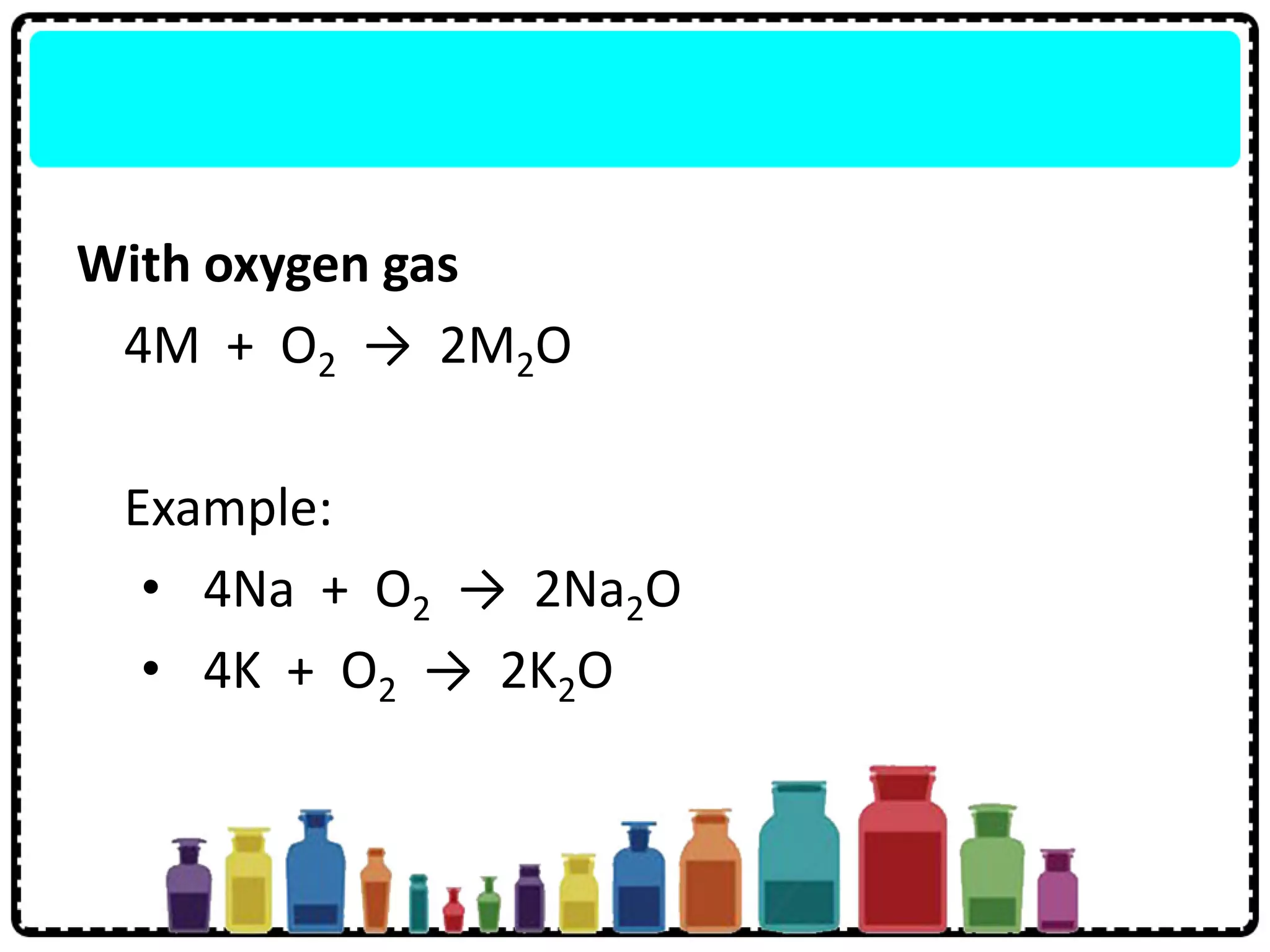
With oxygen gas
4M + O2 → 2M2O
Example:
• 4Na + O2 → 2Na2O
• 4K + O2 → 2K2O
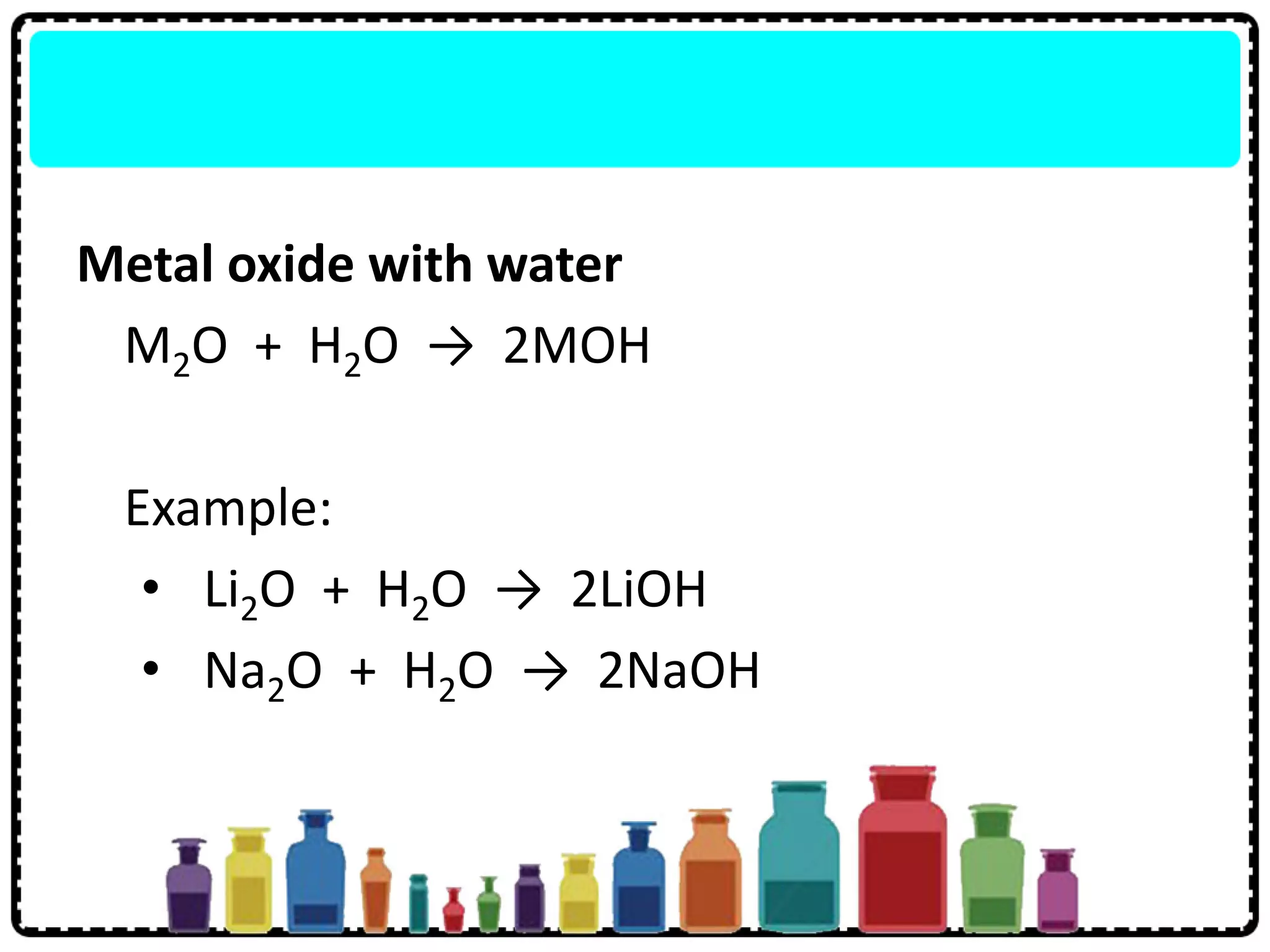
Metal oxide with water
M2O + H2O → 2MOH
Example:
• Li2O + H2O → 2LiOH
• Na2O + H2O → 2NaOH
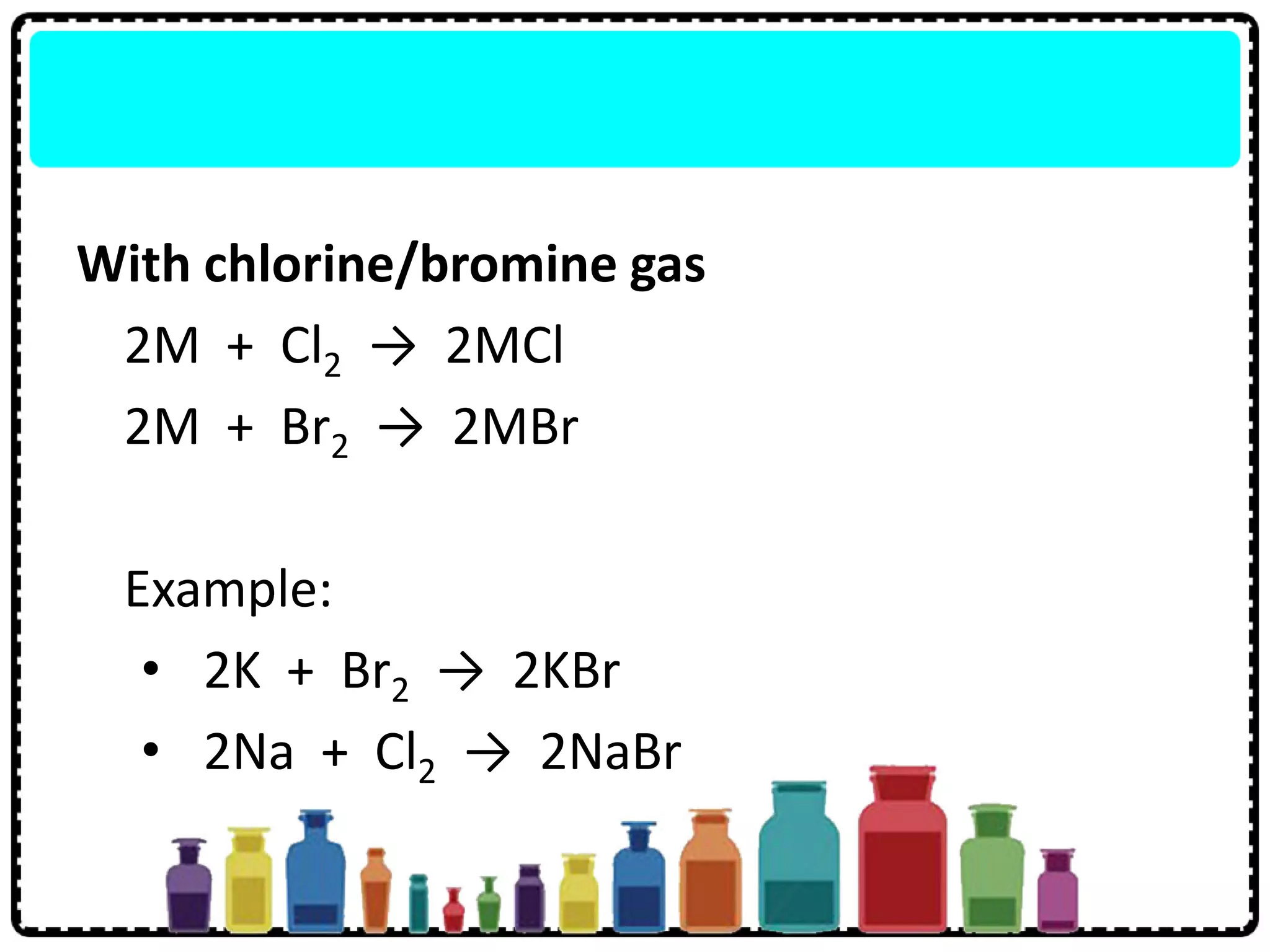
With chlorine/bromine gas
2M + Cl2 → 2MCl
2M + Br2 → 2MBr
Example:
• 2K + Br2 → 2KBr
• 2Na + Cl2 → 2NaBr
Going down Group 1
Size of atom increase
• Going down Group 1 elements, the numbers
of shells occupied with electron in the atom
increase.
• The size of atom increase.
Melting & boiling points decrease
• Going down the group, size of atom increase /
become bigger
• The forces of attraction between the atoms
become weaker
• Thus, less heat energy is needed to overcome
the weak forces of attraction
Reactivity increase
• Going down the group, size of atom increase / become
bigger
• The single valence electron in the outermost occupied
shell become further away from nucleus
• The attraction between the nucleus and valence
electron becomes weaker
• It is easier for the atom to release/donate the single
valence electron to achieve the stable electron
arrangement
• Reactivity increase
Safety precautions
• Must stored in paraffin oil in bottles
• Do not hold alkali metals with your bare hands
• Use forceps to take alkali metals
• Wear safety goggles and gloves
• Used only small pieces of alkali metal when
conducting experiments
D. Group 17 Elements
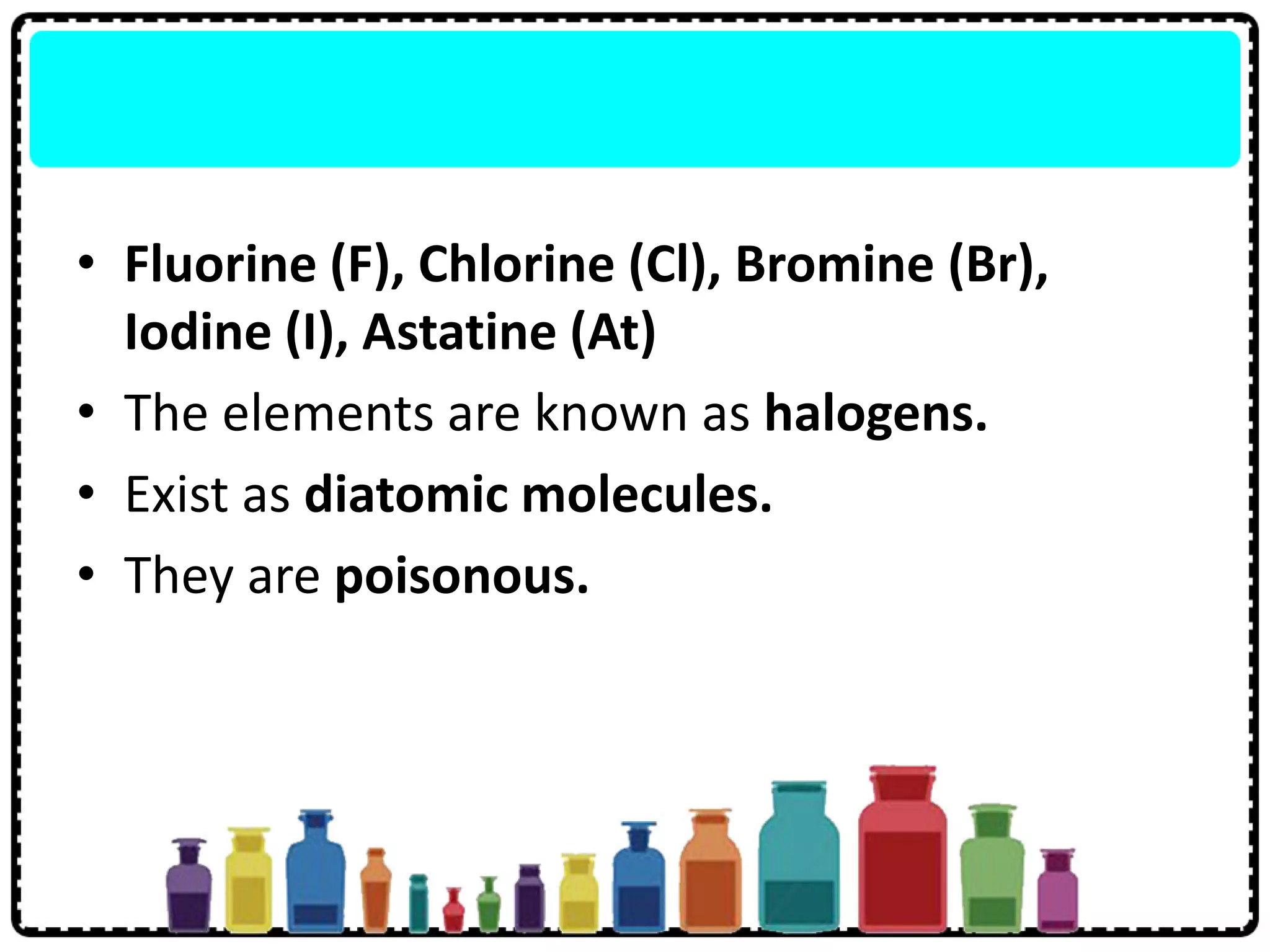
• Fluorine (F), Chlorine (Cl), Bromine (Br),
Iodine (I), Astatine (At)
• The elements are known as halogens.
• Exist as diatomic molecules.
• They are poisonous.
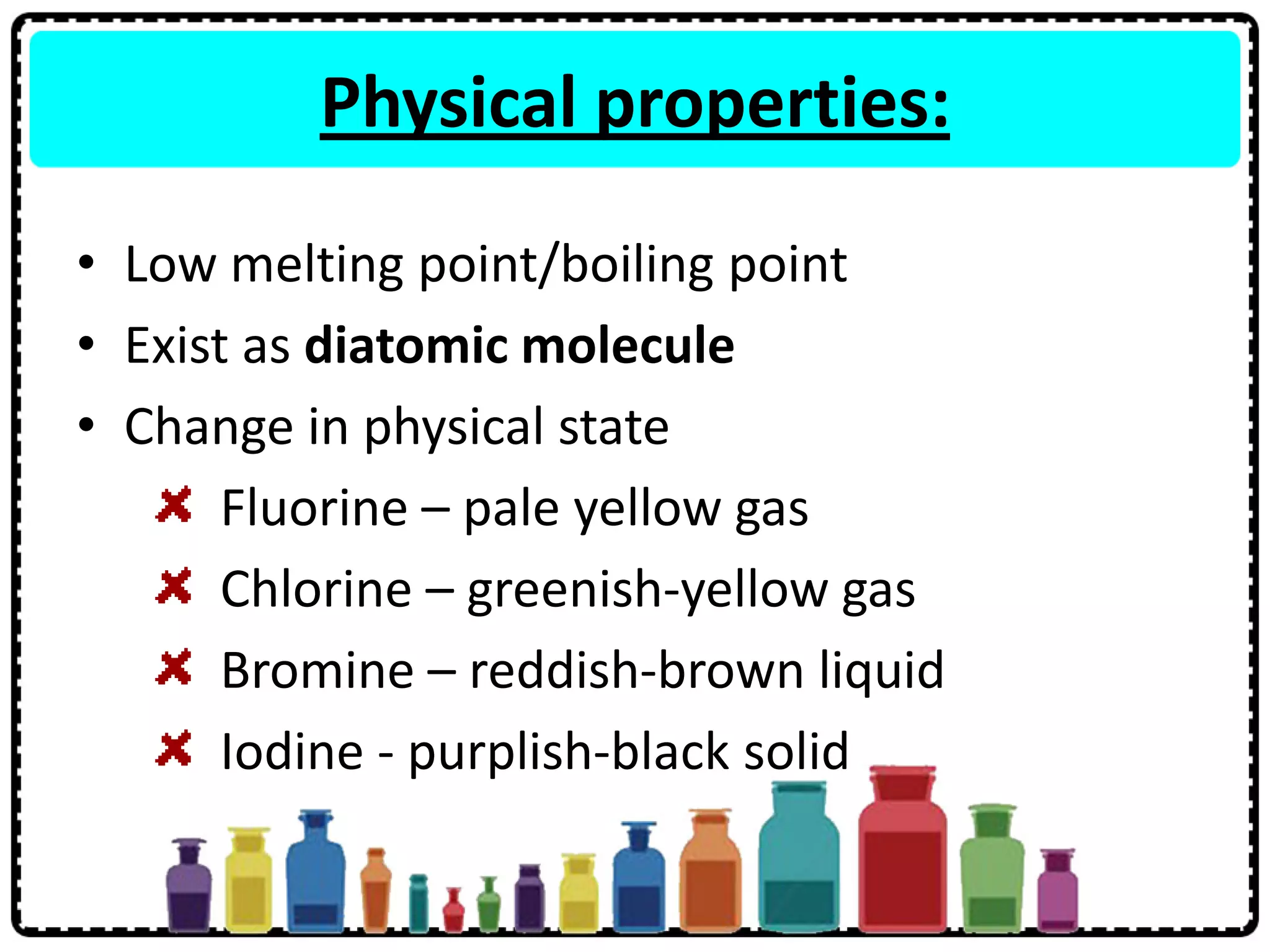
Physical properties:
• Low melting point/boiling point
• Exist as diatomic molecule
• Change in physical state
Fluorine – pale yellow gas
Chlorine – greenish-yellow gas
Bromine – reddish-brown liquid
Iodine - purplish-black solid
Chemical properties:
Reaction with water to form 2 acids
X2 + H2O → HX + HOX
Example:
• Cl2 + H2O → HCl + HOCl
HX & HOX solution – acidic
HOX solution –
bleaching
properties
Hydrochloric
acid
Hypochlorus
acid
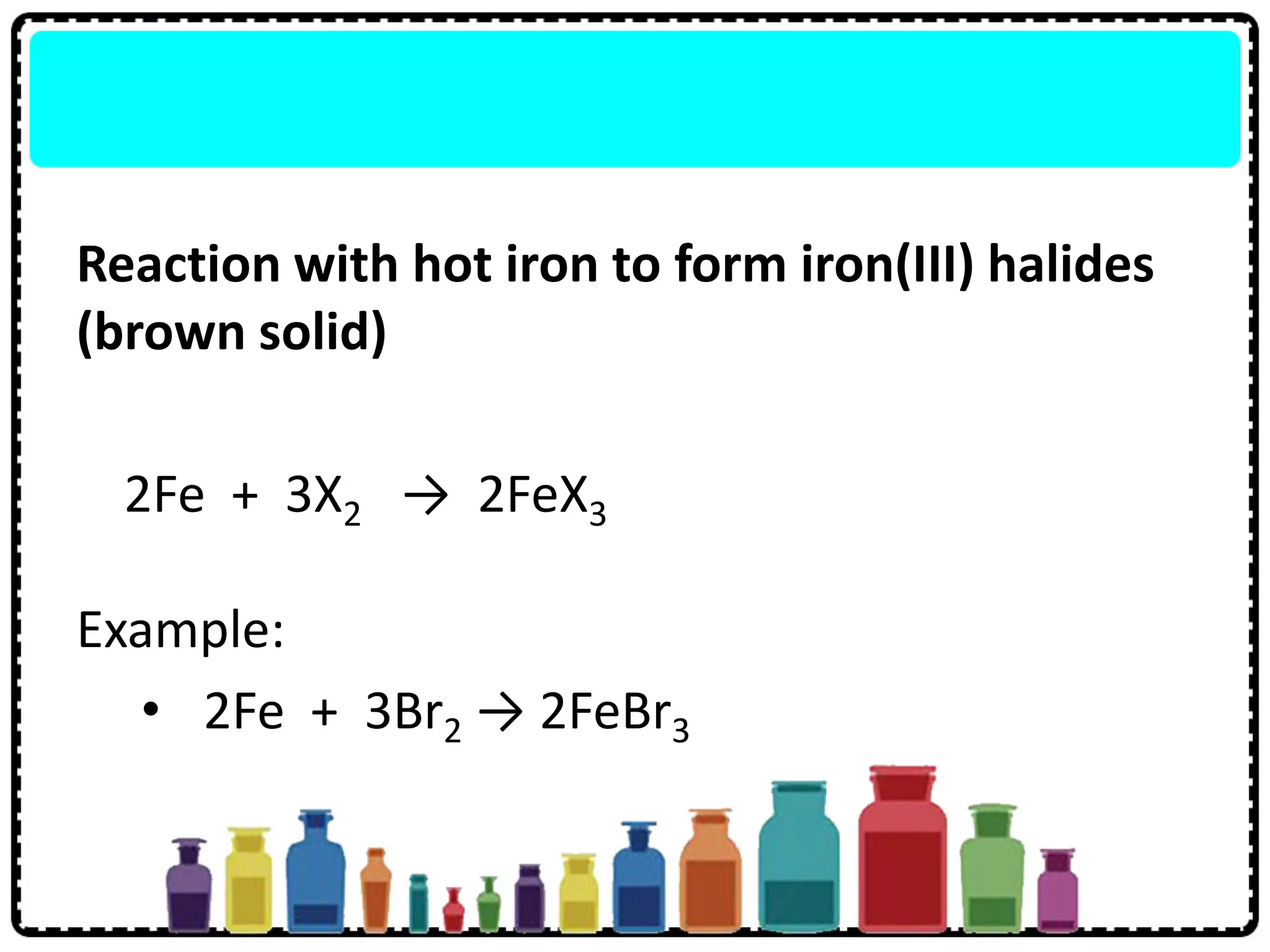
Reaction with hot iron to form iron(III) halides
(brown solid)
2Fe + 3X2 → 2FeX3
Example:
• 2Fe + 3Br2 → 2FeBr3
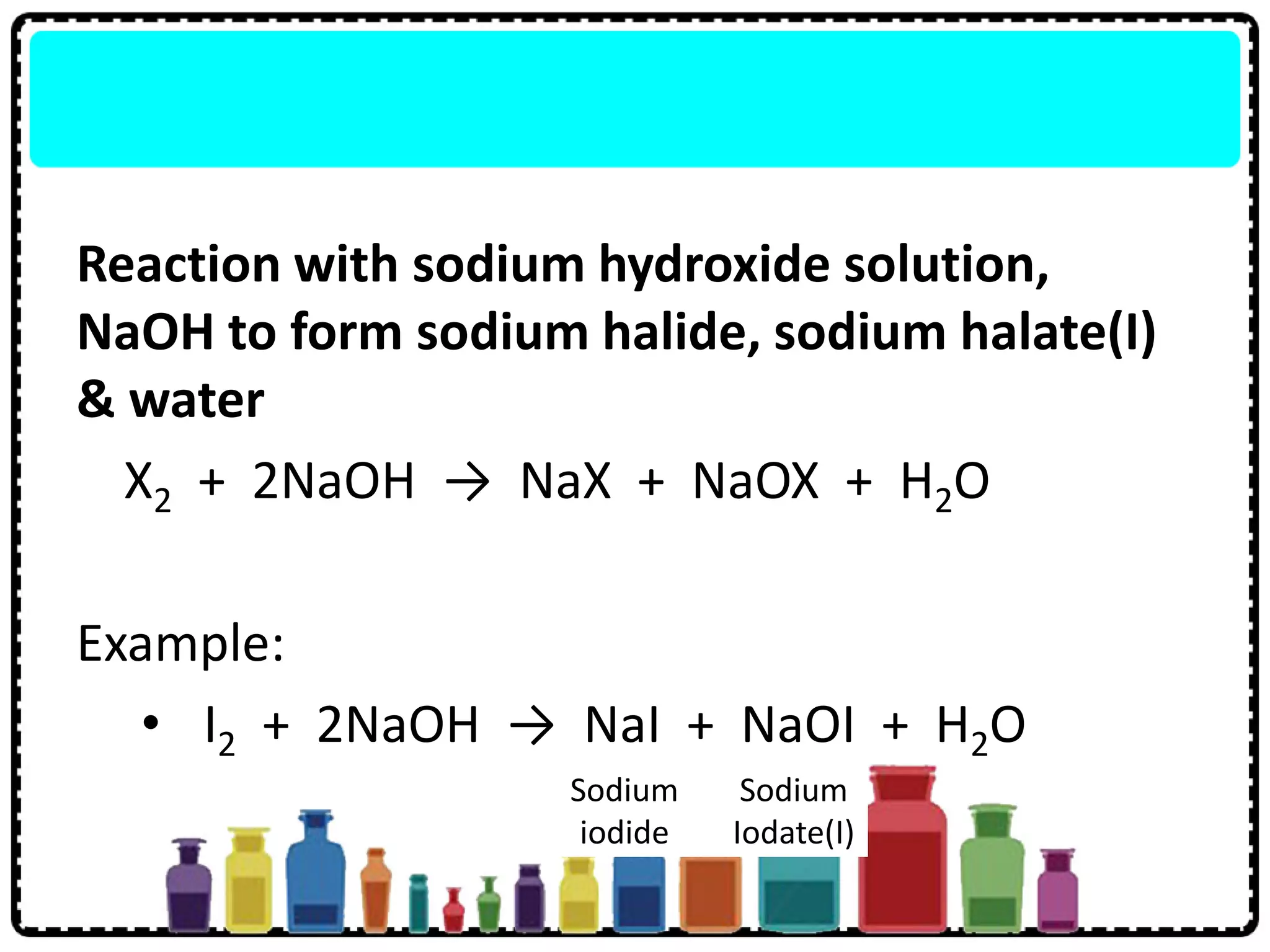
Reaction with sodium hydroxide solution,
NaOH to form sodium halide, sodium halate(I)
& water
X2 + 2NaOH → NaX + NaOX + H2O
Example:
• I2 + 2NaOH → NaI + NaOI + H2O
Sodium
iodide
Sodium
Iodate(I)
Going down Group 17
Size of atom
• Going down Group 17 elements, the numbers
of shells occupied with electron in the atom
increase.
• The size of atom increase.
Melting & boiling points increase
• Going down the group, size of atom increase /
become bigger
• The forces of attraction between the atoms
become stronger
• Thus, more heat energy is needed to
overcome the stronger forces of attraction
Reactivity decrease
• Going down the group, size of atom increase /
become bigger
• The attraction between the nucleus and
valence electron becomes weaker
• It is difficult for the atom to receive/attract
one electron to achieve the stable electron
arrangement
• Reactivity decrease
Safety precautions
• Handle the elements in a fume chamber
• Wear safety goggles and gloves when handling
halogens
E. Elements in Period
(Period 3)
Elements
• Sodium, Magnesium, Aluminium, Silicon,
Phosphorus, Sulphur, Clorine, Argon
Acid-base properties of oxides of
elements on Period 3
• Metal oxide:
Metal oxide that show basic properties
• Amphoteric oxide:
Metal oxide that show basic and acidic
properties
• Non-metal oxide:
Metal oxide that show acidic properties
Elements in:
• Basic metal oxide:
Na, Mg
• Amphoteric oxide:
Al
• Acidic non-metal oxide:
Si, P, S, Cl
Across the period
• The proton number increase by one
• All the atoms have three shells occupied with
electrons
• The number of valence electron increase by
one
• All element exist as solid except chlorine and
argon (gases)
• Size of atom decrease – force attraction
between nucleus and valence electron
become stronger
• Electronegativity increase:
• Size of atom become smaller
• Force attraction between nucleus and
valence electron stronger
• It is easier for nucleus to attract electron
into the atom
Use of semi-metal
• Semi-metal (metalloid) – weak conductors of
electricity
Used as semiconductor
• Used of semiconductor:
Make diodes and transistors (making
microchips for computer, mobile phones,
televisions, video recorders etc.)
F. Transition Elements
(Metals)
Elements
• Element from Group 3 to Group 12
Physical properties
1. Shiny surfaces
2. Ductile
3. Malleable
4. High tensile strength
5. High melting & boiling points
6. High density
7. Good conductor of heat & electricity
Special characteristics of
transition elements
• Shows different oxidation numbers in
their compounds
• Form coloured ions or compounds
• Useful as catalyst
Use in industries
Haber process:
• Manufactured of ammonia, NH3
• Catalyst: Iron, Fe
Ostwald process:
• Manufactured of nitric acid, HNO3
• Catalyst: Platinum, Pt
Contact process:
• Manufactured of sulphuric acid, H2SO4
• Catalyst: Vanadium(V) oxide, V2O5
Manufacture of margarine
• Catalyst: Nickel, Ni

Chapter 4 The Periodic Table

  • 1.
  • 2.
    A. The PeriodicTable of Elements
  • 3.
    Historical Development ofthe Periodic Table
  • 4.
    Arrangement of elementsin the Periodic Table • Arranged in an increasing order of proton number (from 1 → 113) • Elements with similar chemical properties are placed in the same vertical column
  • 5.
    Each vertical columnof elements is called a group. The vertical columns are known as Group 1 to Group 18. The number of valance electrons in an atom decides the position of the group of an element in the Periodic Table. For elements with 1 to 2 valence electrons, The group of an element = The number of valence electrons in its atom For elements with 3 to 8 valence electrons, The group of an element = The number of valence electrons in its atom + 10
  • 6.
    Each of thesehorizontal rows of elements is called period. The horizontal rows are known as Period 1 to Period 7. The number of shells occupied with electrons in the atom decides the position of the period of an element in the Periodic Table.
  • 7.
    B. Group 18Elements
  • 8.
    • Helium (He),Neon (Ne), Argon (Ar), Krypton (Kr), Xenon (Xe) and Radon (Ra). • The elements are known as noble gases. • Noble gases are monoatomic.
  • 9.
    Physical properties 1. Lowmelting point/boiling point 2. Low density 3. Colourless gases 4. Very small atomic size 5. Insoluble in water 6. Cannot conduct electricity 7. Poor conductor of heat
  • 10.
    Inert property ofGroup 18 • All noble gases are inert (chemically unreactive) • 2 valence electron – duplet electron arrangement • 8 valence electron – octet electron arrangement
  • 11.
    Why noble gasesexist as monoatomic gases and chemically unreactive? Ans: • Because the outermost shell occupied with electron are full / achieve the duplet or octet electron arrangement. • So, noble gas does not donate, receive or share electron with other elements.
  • 12.
    Going down Group18 Size of atom increase • Going down Group 18 elements, the numbers of shells occupied with electron in the atom increase. • The size of atom increase.
  • 13.
    Melting & boilingpoints increase • Going down the group, size of atom increase / become bigger • The forces of attraction between the atoms become stronger • Thus, more heat energy is needed to overcome the stronger forces of attraction
  • 14.
    Use of Group18 elements Helium • Used to filled airships and weather balloons Neon • Used in advertising light and television tubes Argon • Fill light bulbs • Used to provide inert atmosphere for welding at high temperature
  • 15.
    Krypton • Used inlasers to repair the retina of the eye • Used to fill photographic flash lamps Radon • Used in the treatment of cancer
  • 16.
    Xenon • Used formaking electron tubes and stroboscopic lamps • Used in bubble chambers in atomic energy reactors
  • 17.
    C. Group 1Elements
  • 18.
    • Lithium (Li),Sodium (Na), Potassium (K), Rubidium (Rb), Caesium (Cs), Francium (Fr) • The elements are known as alkali metals.
  • 19.
    Physical properties: 1. Lowmelting point/boiling point 2. Low density 3. Surfaces 4. Silvery and shiny surface 5. Good conductor of heat & electricity
  • 20.
    Chemical properties: With water 2M+ 2H2O → 2MOH + H2 Example: • 2Li + 2H2O → 2LiOH + H2 • 2Na + 2H2O → 2NaOH + H2
  • 21.
    With oxygen gas 4M+ O2 → 2M2O Example: • 4Na + O2 → 2Na2O • 4K + O2 → 2K2O
  • 22.
    Metal oxide withwater M2O + H2O → 2MOH Example: • Li2O + H2O → 2LiOH • Na2O + H2O → 2NaOH
  • 23.
    With chlorine/bromine gas 2M+ Cl2 → 2MCl 2M + Br2 → 2MBr Example: • 2K + Br2 → 2KBr • 2Na + Cl2 → 2NaBr
  • 24.
    Going down Group1 Size of atom increase • Going down Group 1 elements, the numbers of shells occupied with electron in the atom increase. • The size of atom increase.
  • 25.
    Melting & boilingpoints decrease • Going down the group, size of atom increase / become bigger • The forces of attraction between the atoms become weaker • Thus, less heat energy is needed to overcome the weak forces of attraction
  • 26.
    Reactivity increase • Goingdown the group, size of atom increase / become bigger • The single valence electron in the outermost occupied shell become further away from nucleus • The attraction between the nucleus and valence electron becomes weaker • It is easier for the atom to release/donate the single valence electron to achieve the stable electron arrangement • Reactivity increase
  • 27.
    Safety precautions • Muststored in paraffin oil in bottles • Do not hold alkali metals with your bare hands • Use forceps to take alkali metals • Wear safety goggles and gloves • Used only small pieces of alkali metal when conducting experiments
  • 28.
    D. Group 17Elements
  • 29.
    • Fluorine (F),Chlorine (Cl), Bromine (Br), Iodine (I), Astatine (At) • The elements are known as halogens. • Exist as diatomic molecules. • They are poisonous.
  • 30.
    Physical properties: • Lowmelting point/boiling point • Exist as diatomic molecule • Change in physical state Fluorine – pale yellow gas Chlorine – greenish-yellow gas Bromine – reddish-brown liquid Iodine - purplish-black solid
  • 31.
    Chemical properties: Reaction withwater to form 2 acids X2 + H2O → HX + HOX Example: • Cl2 + H2O → HCl + HOCl HX & HOX solution – acidic HOX solution – bleaching properties Hydrochloric acid Hypochlorus acid
  • 32.
    Reaction with hotiron to form iron(III) halides (brown solid) 2Fe + 3X2 → 2FeX3 Example: • 2Fe + 3Br2 → 2FeBr3
  • 33.
    Reaction with sodiumhydroxide solution, NaOH to form sodium halide, sodium halate(I) & water X2 + 2NaOH → NaX + NaOX + H2O Example: • I2 + 2NaOH → NaI + NaOI + H2O Sodium iodide Sodium Iodate(I)
  • 34.
    Going down Group17 Size of atom • Going down Group 17 elements, the numbers of shells occupied with electron in the atom increase. • The size of atom increase.
  • 35.
    Melting & boilingpoints increase • Going down the group, size of atom increase / become bigger • The forces of attraction between the atoms become stronger • Thus, more heat energy is needed to overcome the stronger forces of attraction
  • 36.
    Reactivity decrease • Goingdown the group, size of atom increase / become bigger • The attraction between the nucleus and valence electron becomes weaker • It is difficult for the atom to receive/attract one electron to achieve the stable electron arrangement • Reactivity decrease
  • 37.
    Safety precautions • Handlethe elements in a fume chamber • Wear safety goggles and gloves when handling halogens
  • 38.
    E. Elements inPeriod (Period 3)
  • 39.
    Elements • Sodium, Magnesium,Aluminium, Silicon, Phosphorus, Sulphur, Clorine, Argon
  • 40.
    Acid-base properties ofoxides of elements on Period 3 • Metal oxide: Metal oxide that show basic properties • Amphoteric oxide: Metal oxide that show basic and acidic properties • Non-metal oxide: Metal oxide that show acidic properties
  • 41.
    Elements in: • Basicmetal oxide: Na, Mg • Amphoteric oxide: Al • Acidic non-metal oxide: Si, P, S, Cl
  • 42.
    Across the period •The proton number increase by one • All the atoms have three shells occupied with electrons • The number of valence electron increase by one • All element exist as solid except chlorine and argon (gases)
  • 43.
    • Size ofatom decrease – force attraction between nucleus and valence electron become stronger • Electronegativity increase: • Size of atom become smaller • Force attraction between nucleus and valence electron stronger • It is easier for nucleus to attract electron into the atom
  • 44.
    Use of semi-metal •Semi-metal (metalloid) – weak conductors of electricity Used as semiconductor • Used of semiconductor: Make diodes and transistors (making microchips for computer, mobile phones, televisions, video recorders etc.)
  • 45.
  • 46.
    Elements • Element fromGroup 3 to Group 12
  • 47.
    Physical properties 1. Shinysurfaces 2. Ductile 3. Malleable 4. High tensile strength 5. High melting & boiling points 6. High density 7. Good conductor of heat & electricity
  • 48.
    Special characteristics of transitionelements • Shows different oxidation numbers in their compounds • Form coloured ions or compounds • Useful as catalyst
  • 49.
    Use in industries Haberprocess: • Manufactured of ammonia, NH3 • Catalyst: Iron, Fe Ostwald process: • Manufactured of nitric acid, HNO3 • Catalyst: Platinum, Pt
  • 50.
    Contact process: • Manufacturedof sulphuric acid, H2SO4 • Catalyst: Vanadium(V) oxide, V2O5 Manufacture of margarine • Catalyst: Nickel, Ni