Unit 7:
Material
changes
Table of contents
7.1
7.3
7.2
7.4
Acid & Alkalis Is it an acid or an
alkali
The pH scale Neutralisation
7.5 7.6
Neutralisation in
action
Investigations
acids and alkali
Whoa!
This can be the part of the presentation
where you introduce yourself, write your
email…
Acids and
Alkalis
7.1
Many thing contain acids.
Some foods contain acids.
They have sour, sharp, tangy
taste.
Common acids in laboratory
are hydrochloric acid, sulfuric
acid and nitric acid.
When acids mix with metals
or carbonate rocks, they can
cause a fizzing or bubbling
reaction.
Acids are everywhere
Some acids are strong. They
are corrosive. If a strong
acid gets on your skin, you
will get a chemical burn.
Acids can be diluted with
water, this makes them less
dangerous.
Some acids are
dangerous
An alkali is a substance that
can neutralize an acid, often
having a slippery or soapy
feel, and a bitter taste.
Examples of alkalis include
substances like baking soda
and certain cleaning agents.
When diluted with water, they
become less dangerous.
Common alkalis are sodium
hydroxides, potassium
hydroxides and calcium
hydroxides.
Alkalis are everywhere
• Stand up to work.
• Wear safety glasses
• Take the top off the bottle
and place it upside down
on the work surface.
• Replace the bottle top as
soon as you finish using
the bottle.
Work safely with acids &
alkalis
Do question answers of topic 7.1 (page # 90, 91) on your nb.
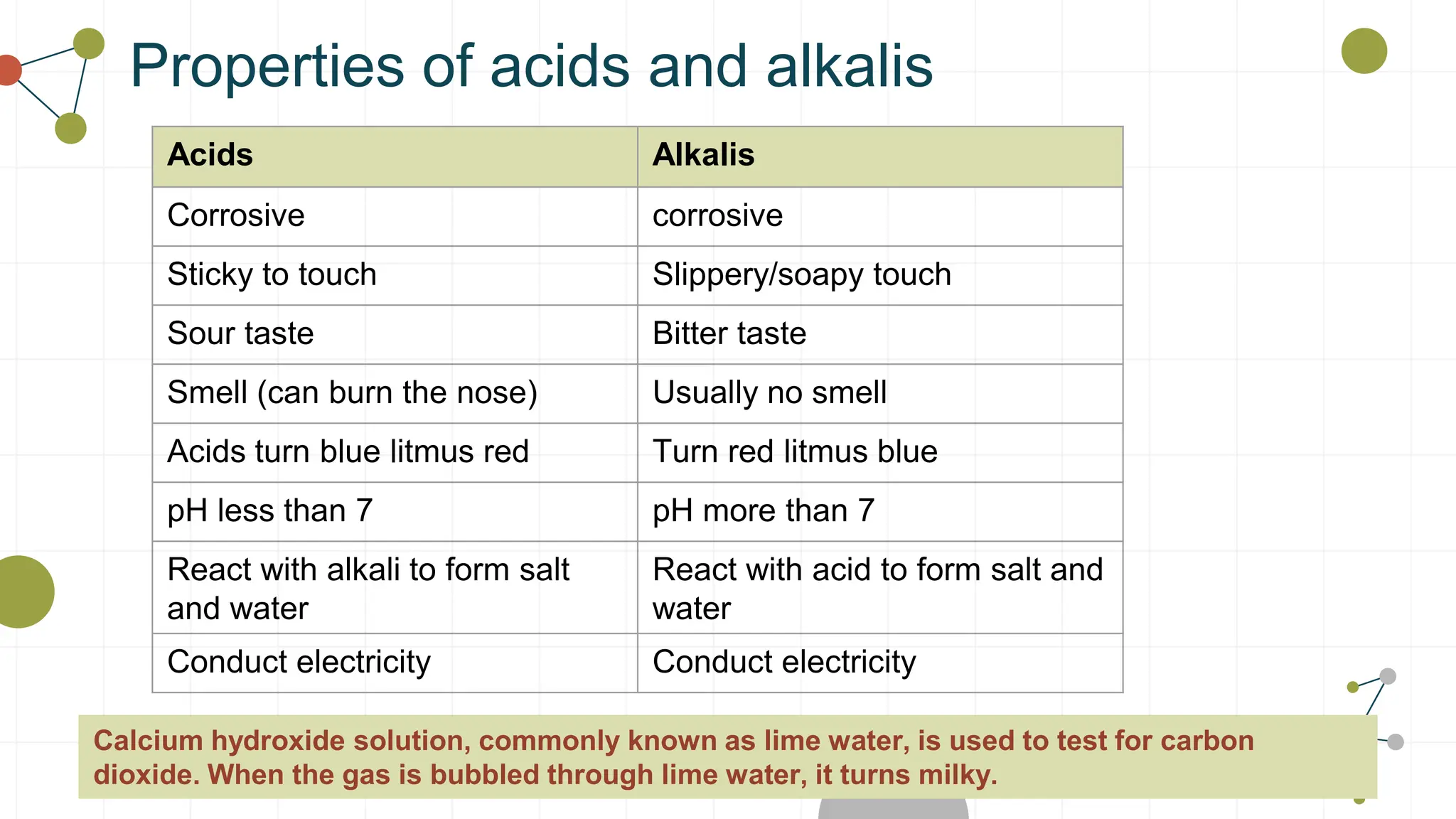
Properties of acids and alkalis
Acids Alkalis
Corrosive corrosive
Sticky to touch Slippery/soapy touch
Sour taste Bitter taste
Smell (can burn the nose) Usually no smell
Acids turn blue litmus red Turn red litmus blue
pH less than 7 pH more than 7
React with alkali to form salt
and water
React with acid to form salt and
water
Conduct electricity Conduct electricity
Calcium hydroxide solution, commonly known as lime water, is used to test for carbon
dioxide. When the gas is bubbled through lime water, it turns milky.
Is it an acid or
alkali
7.2
An indicator is a dye that
changes color when it is put
into an acid or an alkali and
shows whether a solution is
acid or alkali.
Indicators
Litmus is an indicator; it is a
blue/purple die which comes from
small plants called lichens. Litmus
paper is a quick way to identify an
acid or an alkali. Blue litmus paper
is used to test an acid. It turns
from blue to red, indicating acid.
Red litmus paper is used to test an
alkali. Red litmus paper turns blue
in an alkali solution.
Litmus
The pH scale
7.3
Universal
indicator
Universal indicator shows how
acidic or alkaline a substance is.
Type of substances Color of universal
indicator
Strongly acidic
Weakly acidic
Neutral
Weakly alkaline
Strongly alkaline
Neutralisation
7.4
Neutralisation
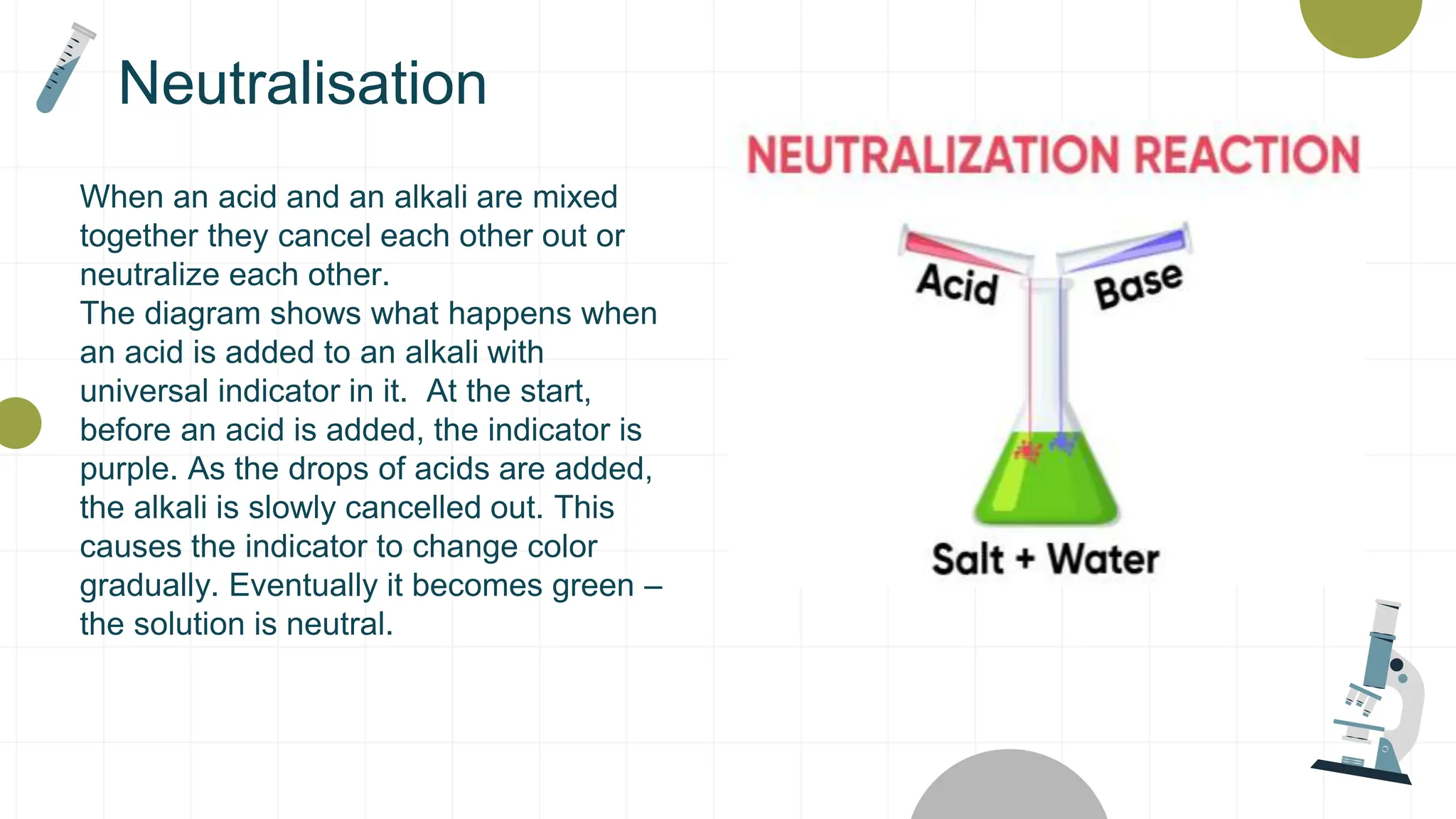
When an acid and an alkali are mixed
together they cancel each other out or
neutralize each other.
The diagram shows what happens when
an acid is added to an alkali with
universal indicator in it. At the start,
before an acid is added, the indicator is
purple. As the drops of acids are added,
the alkali is slowly cancelled out. This
causes the indicator to change color
gradually. Eventually it becomes green –
the solution is neutral.
Neutralisation in
action
7.5
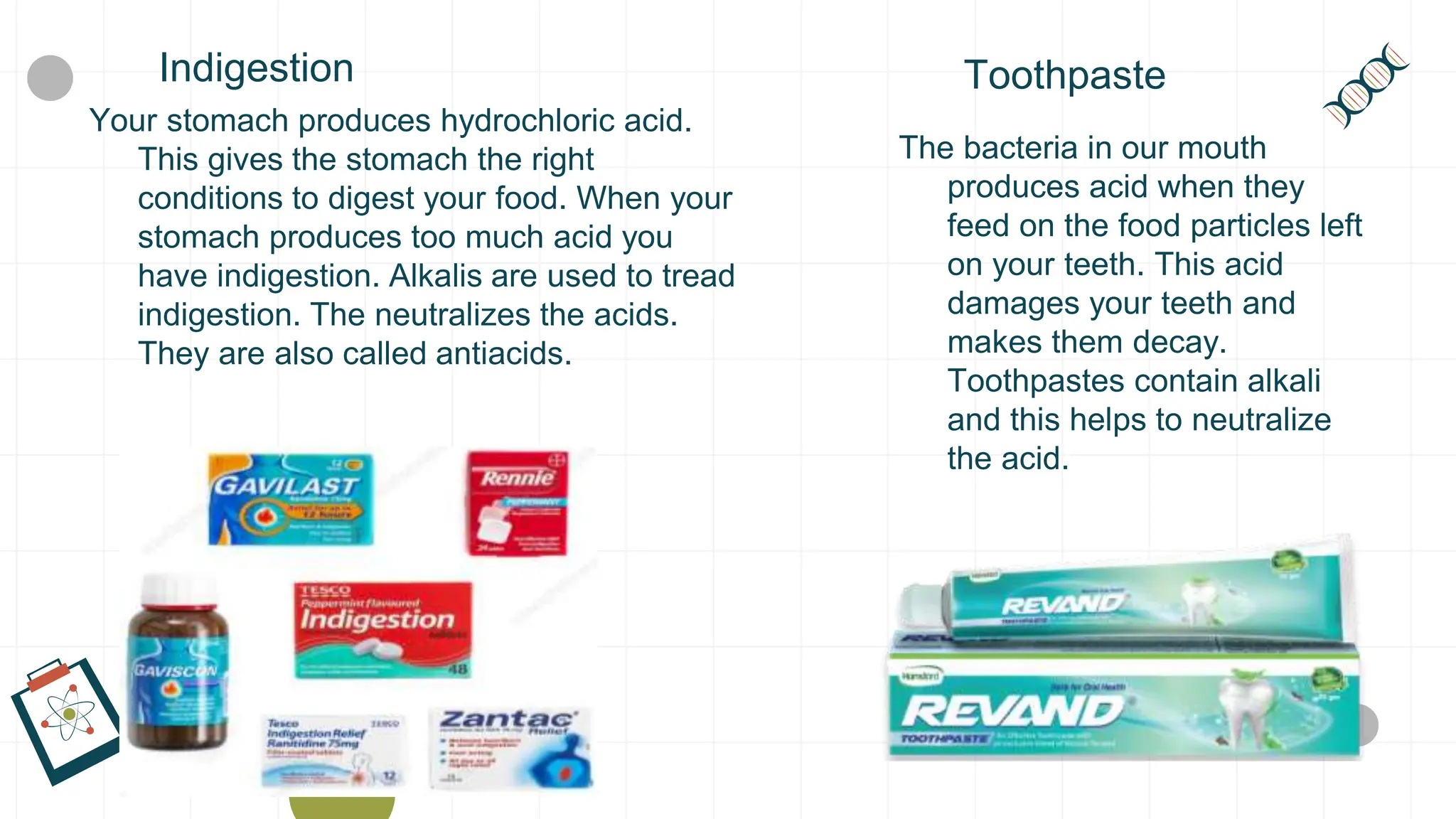
Your stomach produces hydrochloric acid.
This gives the stomach the right
conditions to digest your food. When your
stomach produces too much acid you
have indigestion. Alkalis are used to tread
indigestion. The neutralizes the acids.
They are also called antiacids.
The bacteria in our mouth
produces acid when they
feed on the food particles left
on your teeth. This acid
damages your teeth and
makes them decay.
Toothpastes contain alkali
and this helps to neutralize
the acid.
Indigestion Toothpaste
Investigation
acids and alkalis
7.6

Material changes, Acids, AlKali, neutralization reaction

  • 1.
  • 2.
    Table of contents 7.1 7.3 7.2 7.4 Acid& Alkalis Is it an acid or an alkali The pH scale Neutralisation 7.5 7.6 Neutralisation in action Investigations acids and alkali
  • 3.
    Whoa! This can bethe part of the presentation where you introduce yourself, write your email…
  • 4.
  • 5.
    Many thing containacids. Some foods contain acids. They have sour, sharp, tangy taste. Common acids in laboratory are hydrochloric acid, sulfuric acid and nitric acid. When acids mix with metals or carbonate rocks, they can cause a fizzing or bubbling reaction. Acids are everywhere Some acids are strong. They are corrosive. If a strong acid gets on your skin, you will get a chemical burn. Acids can be diluted with water, this makes them less dangerous. Some acids are dangerous
  • 6.
    An alkali isa substance that can neutralize an acid, often having a slippery or soapy feel, and a bitter taste. Examples of alkalis include substances like baking soda and certain cleaning agents. When diluted with water, they become less dangerous. Common alkalis are sodium hydroxides, potassium hydroxides and calcium hydroxides. Alkalis are everywhere • Stand up to work. • Wear safety glasses • Take the top off the bottle and place it upside down on the work surface. • Replace the bottle top as soon as you finish using the bottle. Work safely with acids & alkalis Do question answers of topic 7.1 (page # 90, 91) on your nb.
  • 7.
    Properties of acidsand alkalis Acids Alkalis Corrosive corrosive Sticky to touch Slippery/soapy touch Sour taste Bitter taste Smell (can burn the nose) Usually no smell Acids turn blue litmus red Turn red litmus blue pH less than 7 pH more than 7 React with alkali to form salt and water React with acid to form salt and water Conduct electricity Conduct electricity Calcium hydroxide solution, commonly known as lime water, is used to test for carbon dioxide. When the gas is bubbled through lime water, it turns milky.
  • 8.
    Is it anacid or alkali 7.2
  • 9.
    An indicator isa dye that changes color when it is put into an acid or an alkali and shows whether a solution is acid or alkali. Indicators Litmus is an indicator; it is a blue/purple die which comes from small plants called lichens. Litmus paper is a quick way to identify an acid or an alkali. Blue litmus paper is used to test an acid. It turns from blue to red, indicating acid. Red litmus paper is used to test an alkali. Red litmus paper turns blue in an alkali solution. Litmus
  • 10.
  • 11.
    Universal indicator Universal indicator showshow acidic or alkaline a substance is. Type of substances Color of universal indicator Strongly acidic Weakly acidic Neutral Weakly alkaline Strongly alkaline
  • 12.
  • 13.
    Neutralisation When an acidand an alkali are mixed together they cancel each other out or neutralize each other. The diagram shows what happens when an acid is added to an alkali with universal indicator in it. At the start, before an acid is added, the indicator is purple. As the drops of acids are added, the alkali is slowly cancelled out. This causes the indicator to change color gradually. Eventually it becomes green – the solution is neutral.
  • 14.
  • 15.
    Your stomach produceshydrochloric acid. This gives the stomach the right conditions to digest your food. When your stomach produces too much acid you have indigestion. Alkalis are used to tread indigestion. The neutralizes the acids. They are also called antiacids. The bacteria in our mouth produces acid when they feed on the food particles left on your teeth. This acid damages your teeth and makes them decay. Toothpastes contain alkali and this helps to neutralize the acid. Indigestion Toothpaste
  • 16.

Editor's Notes

  • #6 Corrosive substances are defined as materials that can attack and destroy, by chemical action, living tissue, organic compounds and metal
  • #7 Corrosive substances are defined as materials that can attack and destroy, by chemical action, living tissue, organic compounds and metal
  • #10 Corrosive substances are defined as materials that can attack and destroy, by chemical action, living tissue, organic compounds and metal