Chapter 5
Chemical Bonds
Formation of Chemical Bonds
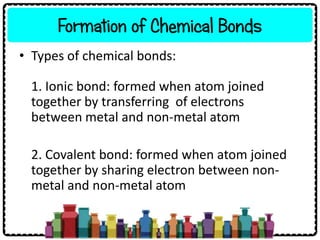
• Types of chemical bonds:
1. Ionic bond: formed when atom joined
together by transferring of electrons
between metal and non-metal atom
2. Covalent bond: formed when atom joined
together by sharing electron between non-
metal and non-metal atom
Ionic Bonds
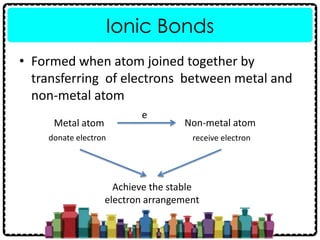
• Formed when atom joined together by
transferring of electrons between metal and
non-metal atom
Metal atom Non-metal atom
e
donate electron receive electron
Achieve the stable
electron arrangement
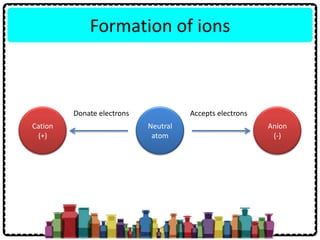
Formation of ions
Neutral
atom
Cation
(+)
Anion
(-)
Donate electrons Accepts electrons
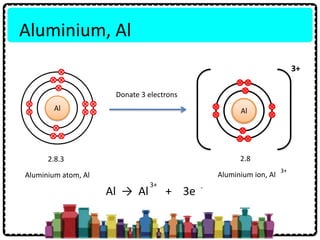
Aluminium, Al
2.8.3
Al
Donate 3 electrons
Al
3+
2.8
Aluminium atom, Al Aluminium ion, Al
3+
Al → Al + 3e
3+ -
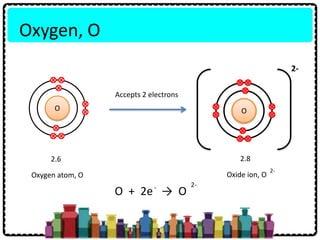
Oxygen, O
2.6
O
Accepts 2 electrons
O
2-
2.8
Oxygen atom, O Oxide ion, O
2-
O + 2e → O
2--
Formation of ionic bonds
• Ionic compounds
Compounds that are formed through ionic
bonds
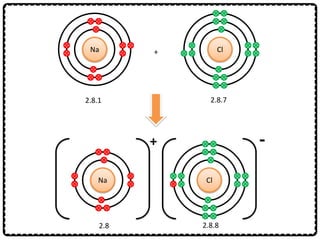
Lets investigate the formation of
sodium chloride, NaCl
2.8.1
Na Cl+
2.8.7
2.8 2.8.8
Cl
-
Na
+
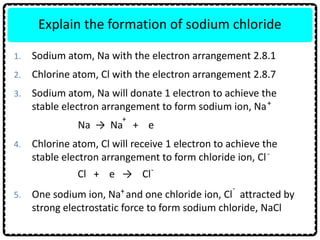
Explain the formation of sodium chloride
+
-
-+
+
-
1. Sodium atom, Na with the electron arrangement 2.8.1
2. Chlorine atom, Cl with the electron arrangement 2.8.7
3. Sodium atom, Na will donate 1 electron to achieve the
stable electron arrangement to form sodium ion, Na
Na → Na + e
4. Chlorine atom, Cl will receive 1 electron to achieve the
stable electron arrangement to form chloride ion, Cl
Cl + e → Cl
5. One sodium ion, Na and one chloride ion, Cl attracted by
strong electrostatic force to form sodium chloride, NaCl
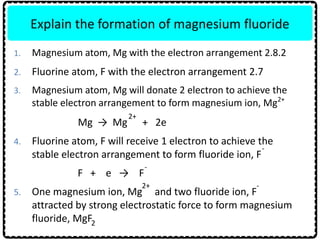
F + e → F
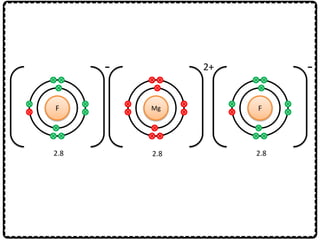
5. One magnesium ion, Mg and two fluoride ion, F
attracted by strong electrostatic force to form magnesium
fluoride, MgF
4. Fluorine atom, F will receive 1 electron to achieve the
stable electron arrangement to form fluoride ion, F
Mg → Mg + 2e
3. Magnesium atom, Mg will donate 2 electron to achieve the
stable electron arrangement to form magnesium ion, Mg
Explain the formation of magnesium fluoride
2+
-
-2+
2+
-
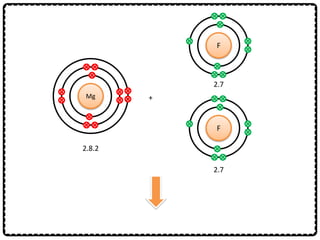
1. Magnesium atom, Mg with the electron arrangement 2.8.2
2. Fluorine atom, F with the electron arrangement 2.7
2
2.8.2
Mg
F
+
2.7
2.7
F
2.8 2.8
F
-
Mg
2+
2.8
F
-
Exercise
• Explain the formation of ionic bond of:
1. Lithium fluoride
2. Sodium oxide
3. Magnesium oxide
4. Boron oxide
5. Aluminium oxide
Covalent Bonds
• Formed when atom joined together by sharing
electron between non-metal and non-metal
atom
• Types of covalent bonds:
1. single covalent bonds
2. double covalent bonds
3. triple covalent bonds
Single covalent bonds
• A covalent bond formed when a pair of
electrons is shared between two atoms
Lets investigate the formation of
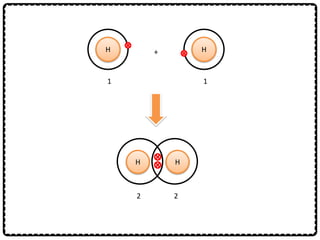
hydrogen molecule
H
1
H+
1
H H
2 2
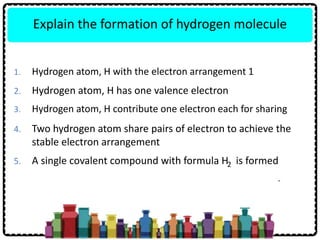
5. A single covalent compound with formula H is formed
4. Two hydrogen atom share pairs of electron to achieve the
stable electron arrangement
3. Hydrogen atom, H contribute one electron each for sharing
Explain the formation of hydrogen molecule
-
1. Hydrogen atom, H with the electron arrangement 1
2. Hydrogen atom, H has one valence electron
2
Double covalent bonds
• A covalent bond formed when a 2 pair of
electrons is shared between two atoms
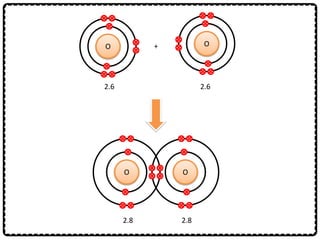
Lets investigate the formation of
oxygen molecule
2.6
+
2.6
2.8 2.8
O O
O O
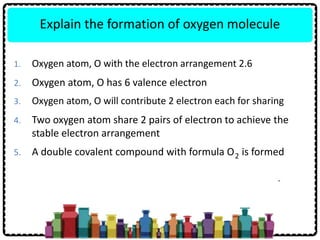
5. A double covalent compound with formula O is formed
4. Two oxygen atom share 2 pairs of electron to achieve the
stable electron arrangement
3. Oxygen atom, O will contribute 2 electron each for sharing
Explain the formation of oxygen molecule
-
1. Oxygen atom, O with the electron arrangement 2.6
2. Oxygen atom, O has 6 valence electron
2
Triple covalent bonds
• A covalent bond formed when a 3 pair of
electrons is shared between two atoms
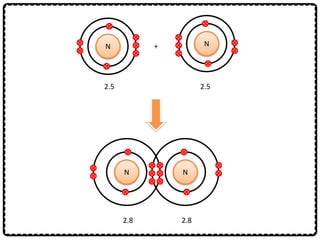
Lets investigate the formation of
nitrogen molecule
2.5
+
2.5
2.8 2.8
N N
N N
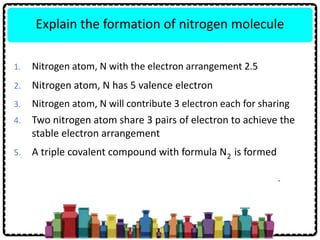
5. A triple covalent compound with formula N is formed
4. Two nitrogen atom share 3 pairs of electron to achieve the
stable electron arrangement
3. Nitrogen atom, N will contribute 3 electron each for sharing
Explain the formation of nitrogen molecule
-
1. Nitrogen atom, N with the electron arrangement 2.5
2. Nitrogen atom, N has 5 valence electron
2
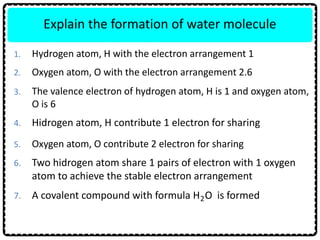
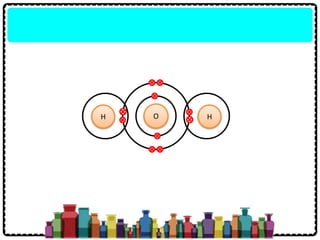
7. A covalent compound with formula H O is formed
6. Two hidrogen atom share 1 pairs of electron with 1 oxygen
atom to achieve the stable electron arrangement
5. Oxygen atom, O contribute 2 electron for sharing
Explain the formation of water molecule
1. Hydrogen atom, H with the electron arrangement 1
4. Hidrogen atom, H contribute 1 electron for sharing
2
2. Oxygen atom, O with the electron arrangement 2.6
3. The valence electron of hydrogen atom, H is 1 and oxygen atom,
O is 6
OH H
Explain the formation of:
-
1. Carbon dioxide molecule
42. Methane, CH
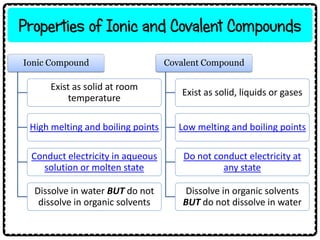
Properties of Ionic and Covalent Compounds
Ionic Compound
Exist as solid at room
temperature
High melting and boiling points
Conduct electricity in aqueous
solution or molten state
Dissolve in water BUT do not
dissolve in organic solvents
Covalent Compound
Exist as solid, liquids or gases
Low melting and boiling points
Do not conduct electricity at
any state
Dissolve in organic solvents
BUT do not dissolve in water
Electrical conductivity
• In solid state, ions do not move freely. Hence, ionic
compound does not conduct electricity in solid state
• In aqueous or molten state, ions are free to move.
Hence, the compound can conduct electricity
Electrical conductivity
• A covalent compound consist of neutral molecules
• There are no free moving ions in covalent compound
• Hence, covalent compounds do not conduct electricity
at any state
Melting and boiling points
• Ionic compounds are held together by strong
electrostatic forces
• More heat energy is needed to overcome the strong
forces
Melting and boiling points
• Covalent compounds are held together by weak
intermolecular forces
• Less heat energy is needed to overcome the weak
forces

Chapter 5 Chemical Bonds

  • 1.
  • 2.
    Formation of ChemicalBonds • Types of chemical bonds: 1. Ionic bond: formed when atom joined together by transferring of electrons between metal and non-metal atom 2. Covalent bond: formed when atom joined together by sharing electron between non- metal and non-metal atom
  • 3.
    Ionic Bonds • Formedwhen atom joined together by transferring of electrons between metal and non-metal atom Metal atom Non-metal atom e donate electron receive electron Achieve the stable electron arrangement
  • 4.
  • 5.
    Aluminium, Al 2.8.3 Al Donate 3electrons Al 3+ 2.8 Aluminium atom, Al Aluminium ion, Al 3+ Al → Al + 3e 3+ -
  • 6.
    Oxygen, O 2.6 O Accepts 2electrons O 2- 2.8 Oxygen atom, O Oxide ion, O 2- O + 2e → O 2--
  • 7.
    Formation of ionicbonds • Ionic compounds Compounds that are formed through ionic bonds Lets investigate the formation of sodium chloride, NaCl
  • 8.
  • 9.
    Explain the formationof sodium chloride + - -+ + - 1. Sodium atom, Na with the electron arrangement 2.8.1 2. Chlorine atom, Cl with the electron arrangement 2.8.7 3. Sodium atom, Na will donate 1 electron to achieve the stable electron arrangement to form sodium ion, Na Na → Na + e 4. Chlorine atom, Cl will receive 1 electron to achieve the stable electron arrangement to form chloride ion, Cl Cl + e → Cl 5. One sodium ion, Na and one chloride ion, Cl attracted by strong electrostatic force to form sodium chloride, NaCl
  • 10.
    F + e→ F 5. One magnesium ion, Mg and two fluoride ion, F attracted by strong electrostatic force to form magnesium fluoride, MgF 4. Fluorine atom, F will receive 1 electron to achieve the stable electron arrangement to form fluoride ion, F Mg → Mg + 2e 3. Magnesium atom, Mg will donate 2 electron to achieve the stable electron arrangement to form magnesium ion, Mg Explain the formation of magnesium fluoride 2+ - -2+ 2+ - 1. Magnesium atom, Mg with the electron arrangement 2.8.2 2. Fluorine atom, F with the electron arrangement 2.7 2
  • 11.
  • 12.
  • 13.
    Exercise • Explain theformation of ionic bond of: 1. Lithium fluoride 2. Sodium oxide 3. Magnesium oxide 4. Boron oxide 5. Aluminium oxide
  • 14.
    Covalent Bonds • Formedwhen atom joined together by sharing electron between non-metal and non-metal atom • Types of covalent bonds: 1. single covalent bonds 2. double covalent bonds 3. triple covalent bonds
  • 15.
    Single covalent bonds •A covalent bond formed when a pair of electrons is shared between two atoms Lets investigate the formation of hydrogen molecule
  • 16.
  • 17.
    5. A singlecovalent compound with formula H is formed 4. Two hydrogen atom share pairs of electron to achieve the stable electron arrangement 3. Hydrogen atom, H contribute one electron each for sharing Explain the formation of hydrogen molecule - 1. Hydrogen atom, H with the electron arrangement 1 2. Hydrogen atom, H has one valence electron 2
  • 18.
    Double covalent bonds •A covalent bond formed when a 2 pair of electrons is shared between two atoms Lets investigate the formation of oxygen molecule
  • 19.
  • 20.
    5. A doublecovalent compound with formula O is formed 4. Two oxygen atom share 2 pairs of electron to achieve the stable electron arrangement 3. Oxygen atom, O will contribute 2 electron each for sharing Explain the formation of oxygen molecule - 1. Oxygen atom, O with the electron arrangement 2.6 2. Oxygen atom, O has 6 valence electron 2
  • 21.
    Triple covalent bonds •A covalent bond formed when a 3 pair of electrons is shared between two atoms Lets investigate the formation of nitrogen molecule
  • 22.
  • 23.
    5. A triplecovalent compound with formula N is formed 4. Two nitrogen atom share 3 pairs of electron to achieve the stable electron arrangement 3. Nitrogen atom, N will contribute 3 electron each for sharing Explain the formation of nitrogen molecule - 1. Nitrogen atom, N with the electron arrangement 2.5 2. Nitrogen atom, N has 5 valence electron 2
  • 24.
    7. A covalentcompound with formula H O is formed 6. Two hidrogen atom share 1 pairs of electron with 1 oxygen atom to achieve the stable electron arrangement 5. Oxygen atom, O contribute 2 electron for sharing Explain the formation of water molecule 1. Hydrogen atom, H with the electron arrangement 1 4. Hidrogen atom, H contribute 1 electron for sharing 2 2. Oxygen atom, O with the electron arrangement 2.6 3. The valence electron of hydrogen atom, H is 1 and oxygen atom, O is 6
  • 25.
  • 26.
    Explain the formationof: - 1. Carbon dioxide molecule 42. Methane, CH
  • 27.
    Properties of Ionicand Covalent Compounds Ionic Compound Exist as solid at room temperature High melting and boiling points Conduct electricity in aqueous solution or molten state Dissolve in water BUT do not dissolve in organic solvents Covalent Compound Exist as solid, liquids or gases Low melting and boiling points Do not conduct electricity at any state Dissolve in organic solvents BUT do not dissolve in water
  • 28.
    Electrical conductivity • Insolid state, ions do not move freely. Hence, ionic compound does not conduct electricity in solid state • In aqueous or molten state, ions are free to move. Hence, the compound can conduct electricity
  • 29.
    Electrical conductivity • Acovalent compound consist of neutral molecules • There are no free moving ions in covalent compound • Hence, covalent compounds do not conduct electricity at any state
  • 30.
    Melting and boilingpoints • Ionic compounds are held together by strong electrostatic forces • More heat energy is needed to overcome the strong forces
  • 31.
    Melting and boilingpoints • Covalent compounds are held together by weak intermolecular forces • Less heat energy is needed to overcome the weak forces