PROPERTIES OF LIGHT
Interference
Polarization
Huygens's Principle
Prepared by:
Karen A. Adelan
BSE 3
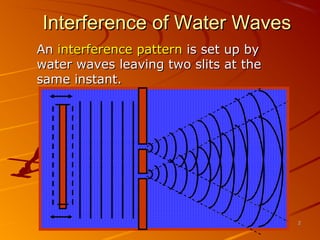
Interference of Water Waves
An interference pattern is set up by
water waves leaving two slits at the
same instant.

2
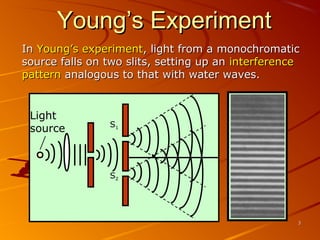
Young’s Experiment
In Young’s experiment, light from a monochromatic
source falls on two slits, setting up an interference
pattern analogous to that with water waves.

Light
source

S1

S2

3
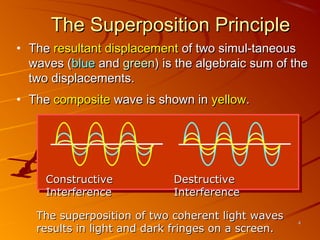
The Superposition Principle
• The resultant displacement of two simul-taneous
waves (blue and green) is the algebraic sum of the
two displacements.
• The composite wave is shown in yellow.

Constructive
Interference

Destructive
Interference

The superposition of two coherent light waves
results in light and dark fringes on a screen.

4
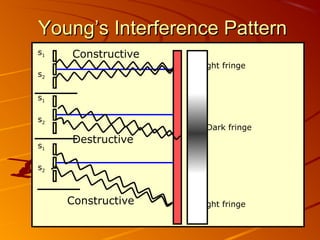
Young’s Interference Pattern
s1

Constructive
Bright fringe

s2
s1
s2
s1

Dark fringe

Destructive

s2

Constructive

Bright fringe
5
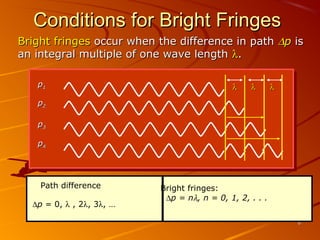
Conditions for Bright Fringes
Bright fringes occur when the difference in path ∆p is
an integral multiple of one wave length λ.
p1

λ

λ

λ

p2
p3
p4

Path difference
∆p = 0, λ , 2λ, 3λ, …

Bright fringes:
∆p = nλ, n = 0, 1, 2, . . .
6
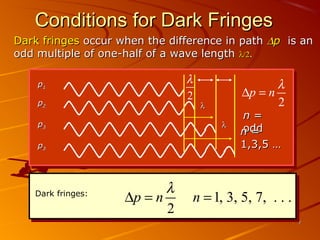
Conditions for Dark Fringes
Dark fringes occur when the difference in path ∆p is an
odd multiple of one-half of a wave length λ/2.

λ
2

p1
p2
p3

λ
λ

p3

Dark fringes:

λ
∆p = n
2

λ
∆p = n
2

n=
odd
n=
1,3,5 …

n = 1, 3, 5, 7, . . .
7
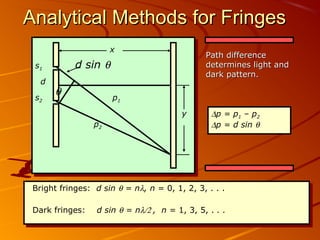
Analytical Methods for Fringes
x

d sin θ

s1
d
s2

Path difference
determines light and
dark pattern.

θ

p1
y
p2

∆p = p1 – p2
∆p = d sin θ

Bright fringes: d sin θ = nλ, n = 0, 1, 2, 3, . . .
Dark fringes:

d sin θ = nλ/2 , n = 1, 3, 5, . . .
8
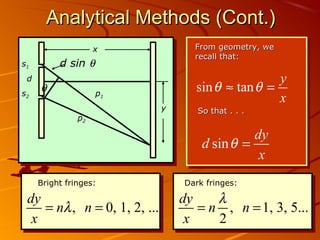
Analytical Methods (Cont.)
From geometry, we
recall that:

x

d sin θ

s1
d
s2

θ

p1
y
p2

y
sin θ ≈ tan θ =
x
So that . . .

dy
d sin θ =
x
Bright fringes:

dy
= nλ , n = 0, 1, 2, ...
x

Dark fringes:

dy
λ
= n , n = 1, 3, 5...
x
2
9
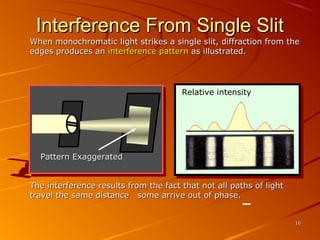
Interference From Single Slit

When monochromatic light strikes a single slit, diffraction from the
edges produces an interference pattern as illustrated.

Relative intensity

Pattern Exaggerated
The interference results from the fact that not all paths of light
travel the same distance some arrive out of phase.

10
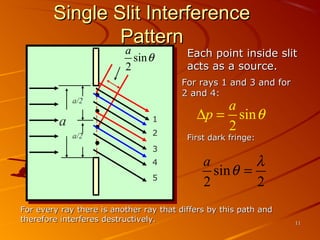
Single Slit Interference
Pattern
a
sin θ
2

For rays 1 and 3 and for
2 and 4:

a/2

a

1
a/2

Each point inside slit
acts as a source.

2
3
4
5

a
∆p = sin θ
2

First dark fringe:

a
λ
sin θ =
2
2

For every ray there is another ray that differs by this path and
therefore interferes destructively.

11
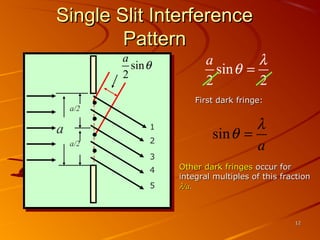
Single Slit Interference
Pattern
a
sin θ
2

First dark fringe:

a/2

a

1
a/2

a
λ
sin θ =
2
2

2
3
4
5

λ
sin θ =
a
Other dark fringes occur for
integral multiples of this fraction
λ/a.

12
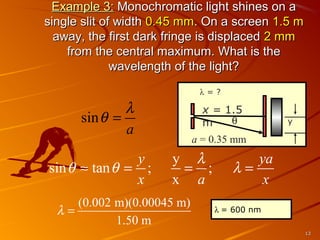
Example 3: Monochromatic light shines on a
single slit of width 0.45 mm. On a screen 1.5 m
away, the first dark fringe is displaced 2 mm
from the central maximum. What is the
wavelength of the light?
λ=?

λ
sin θ =
a
y
sin θ ≈ tan θ = ;
x

x = 1.5
θ
m

y

a = 0.35 mm

y λ
= ;
x a

(0.002 m)(0.00045 m)
λ=
1.50 m

ya
λ=
x
λ = 600 nm
13
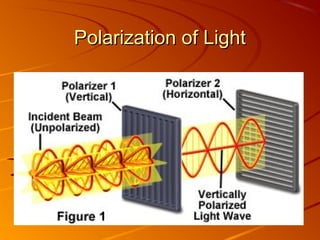
POLARIZATION
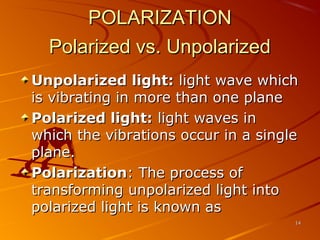
Polarized vs. Unpolarized
Unpolarized light: light wave which
is vibrating in more than one plane
Polarized light: light waves in
which the vibrations occur in a single
plane.
Polarization: The process of
transforming unpolarized light into
polarized light is known as
14
Polarized Light
Polarized Light
Vibrations lie on one
single plane only.
Unpolarized Light
Superposition of many
beams, in the same
direction of propagation,
but each with random
polarization.
15
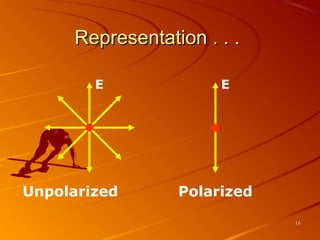
Representation . . .
E

Unpolarized

E

Polarized
16
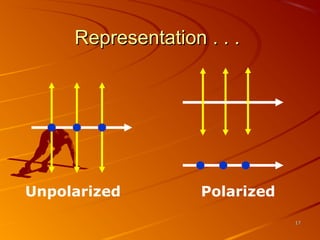
Representation . . .

Unpolarized

Polarized
17
Polarization of Light

18
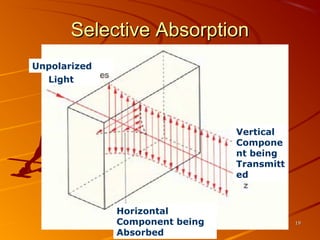
Selective Absorption
Unpolarized
Light

Vertical
Compone
nt being
Transmitt
ed

Horizontal
Component being
Absorbed

19
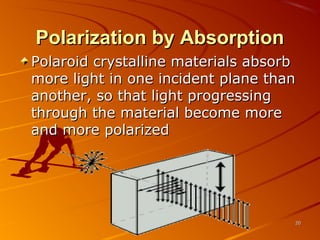
Polarization by Absorption
Polaroid crystalline materials absorb
more light in one incident plane than
another, so that light progressing
through the material become more
and more polarized

20
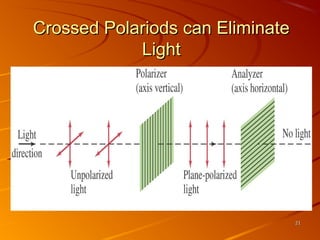
Crossed Polariods can Eliminate
Light

21
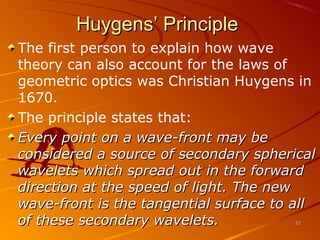
Huygens’ Principle
The first person to explain how wave
theory can also account for the laws of
geometric optics was Christian Huygens in
1670.
The principle states that:
Every point on a wave-front may be
considered a source of secondary spherical
wavelets which spread out in the forward
direction at the speed of light. The new
wave-front is the tangential surface to all
of these secondary wavelets.
22
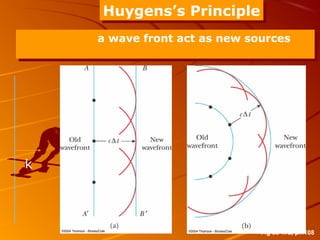
Huygens’s Principle
Huygens’s Principle
All points on a wave front act as new sources
for the production of spherical secondary waves

k

23

Fig 35-17a, p.1108
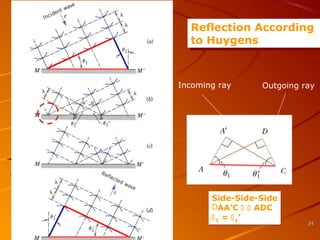
Reflection According
to Huygens
to Huygens

Incoming ray

Outgoing ray

Side-Side-Side
DAA’C   ADC
 1 =  1’

24
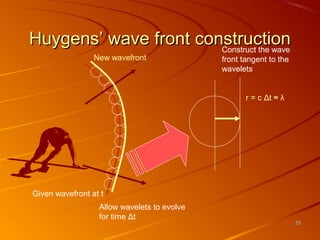
Huygens’ wave front construction
Construct the wave
New wavefront

front tangent to the
wavelets
r = c Δt ≈ λ

Given wavefront at t
Allow wavelets to evolve
for time Δt

25

properties of light

  • 1.
    PROPERTIES OF LIGHT Interference Polarization Huygens'sPrinciple Prepared by: Karen A. Adelan BSE 3
  • 2.
    Interference of WaterWaves An interference pattern is set up by water waves leaving two slits at the same instant. 2
  • 3.
    Young’s Experiment In Young’sexperiment, light from a monochromatic source falls on two slits, setting up an interference pattern analogous to that with water waves. Light source S1 S2 3
  • 4.
    The Superposition Principle •The resultant displacement of two simul-taneous waves (blue and green) is the algebraic sum of the two displacements. • The composite wave is shown in yellow. Constructive Interference Destructive Interference The superposition of two coherent light waves results in light and dark fringes on a screen. 4
  • 5.
    Young’s Interference Pattern s1 Constructive Brightfringe s2 s1 s2 s1 Dark fringe Destructive s2 Constructive Bright fringe 5
  • 6.
    Conditions for BrightFringes Bright fringes occur when the difference in path ∆p is an integral multiple of one wave length λ. p1 λ λ λ p2 p3 p4 Path difference ∆p = 0, λ , 2λ, 3λ, … Bright fringes: ∆p = nλ, n = 0, 1, 2, . . . 6
  • 7.
    Conditions for DarkFringes Dark fringes occur when the difference in path ∆p is an odd multiple of one-half of a wave length λ/2. λ 2 p1 p2 p3 λ λ p3 Dark fringes: λ ∆p = n 2 λ ∆p = n 2 n= odd n= 1,3,5 … n = 1, 3, 5, 7, . . . 7
  • 8.
    Analytical Methods forFringes x d sin θ s1 d s2 Path difference determines light and dark pattern. θ p1 y p2 ∆p = p1 – p2 ∆p = d sin θ Bright fringes: d sin θ = nλ, n = 0, 1, 2, 3, . . . Dark fringes: d sin θ = nλ/2 , n = 1, 3, 5, . . . 8
  • 9.
    Analytical Methods (Cont.) Fromgeometry, we recall that: x d sin θ s1 d s2 θ p1 y p2 y sin θ ≈ tan θ = x So that . . . dy d sin θ = x Bright fringes: dy = nλ , n = 0, 1, 2, ... x Dark fringes: dy λ = n , n = 1, 3, 5... x 2 9
  • 10.
    Interference From SingleSlit When monochromatic light strikes a single slit, diffraction from the edges produces an interference pattern as illustrated. Relative intensity Pattern Exaggerated The interference results from the fact that not all paths of light travel the same distance some arrive out of phase. 10
  • 11.
    Single Slit Interference Pattern a sinθ 2 For rays 1 and 3 and for 2 and 4: a/2 a 1 a/2 Each point inside slit acts as a source. 2 3 4 5 a ∆p = sin θ 2 First dark fringe: a λ sin θ = 2 2 For every ray there is another ray that differs by this path and therefore interferes destructively. 11
  • 12.
    Single Slit Interference Pattern a sinθ 2 First dark fringe: a/2 a 1 a/2 a λ sin θ = 2 2 2 3 4 5 λ sin θ = a Other dark fringes occur for integral multiples of this fraction λ/a. 12
  • 13.
    Example 3: Monochromaticlight shines on a single slit of width 0.45 mm. On a screen 1.5 m away, the first dark fringe is displaced 2 mm from the central maximum. What is the wavelength of the light? λ=? λ sin θ = a y sin θ ≈ tan θ = ; x x = 1.5 θ m y a = 0.35 mm y λ = ; x a (0.002 m)(0.00045 m) λ= 1.50 m ya λ= x λ = 600 nm 13
  • 14.
    POLARIZATION Polarized vs. Unpolarized Unpolarizedlight: light wave which is vibrating in more than one plane Polarized light: light waves in which the vibrations occur in a single plane. Polarization: The process of transforming unpolarized light into polarized light is known as 14
  • 15.
    Polarized Light Polarized Light Vibrationslie on one single plane only. Unpolarized Light Superposition of many beams, in the same direction of propagation, but each with random polarization. 15
  • 16.
    Representation . .. E Unpolarized E Polarized 16
  • 17.
    Representation . .. Unpolarized Polarized 17
  • 18.
  • 19.
  • 20.
    Polarization by Absorption Polaroidcrystalline materials absorb more light in one incident plane than another, so that light progressing through the material become more and more polarized 20
  • 21.
    Crossed Polariods canEliminate Light 21
  • 22.
    Huygens’ Principle The firstperson to explain how wave theory can also account for the laws of geometric optics was Christian Huygens in 1670. The principle states that: Every point on a wave-front may be considered a source of secondary spherical wavelets which spread out in the forward direction at the speed of light. The new wave-front is the tangential surface to all of these secondary wavelets. 22
  • 23.
    Huygens’s Principle Huygens’s Principle Allpoints on a wave front act as new sources All points on a wave front act as new sources for the production of spherical secondary waves for the production of spherical secondary waves k 23 Fig 35-17a, p.1108
  • 24.
    Reflection According Reflection According toHuygens to Huygens Incoming ray Outgoing ray Side-Side-Side DAA’C   ADC  1 =  1’ 24
  • 25.
    Huygens’ wave frontconstruction Construct the wave New wavefront front tangent to the wavelets r = c Δt ≈ λ Given wavefront at t Allow wavelets to evolve for time Δt 25