1. 2 REFLECTION OF WAVES
NURUL FADHILAH BINTI ALIAS
MRSM KUALA KLAWANG, NEGERI SEMBILAN
Introduction
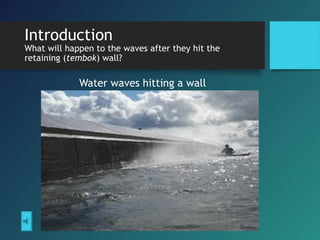
What will happen to the waves after they hit the
retaining (tembok) wall?
Water waves hitting a wall
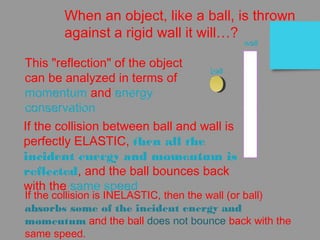
When an object, like a ball, is thrown
against a rigid wall it will…?
ball
wall
This "reflection" of the object
can be analyzed in terms of
momentum and energy
conservation
If the collision between ball and wall is
perfectly ELASTIC, then all the
incident energy and momentum is
reflected, and the ball bounces back
with the same speed
If the collision is INELASTIC, then the wall (or ball)
absorbs some of the incident energy and
momentum and the ball does not bounce back with the
same speed.
Waves also carry energy and momentum
whenever a wave
encounters an obstacle,
they are reflected by the
obstacle
reflection of waves is responsible for
echoes, radar detectors, and for allowing
standing waves which are so important
to sound production in musical
instruments.
Reflection
When a wave reaches a
boundary it is:
•Partially reflected (bounces off
surface)
•Partially transmitted through
surface.
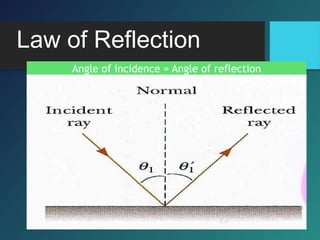
Law of Reflection
Angle of incidence = Angle of reflection
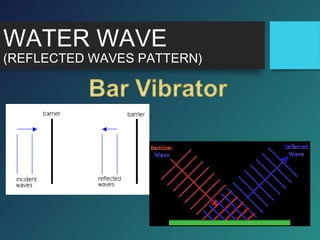
WATER WAVE
(REFLECTED WAVES PATTERN)
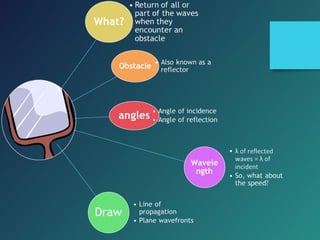
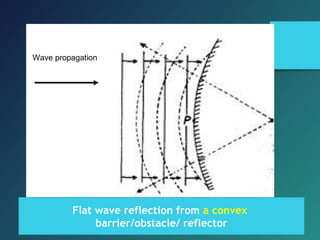
Wave propagation
Reflected waves
Flat wave reflection from a convex
barrier/obstacle/ reflector
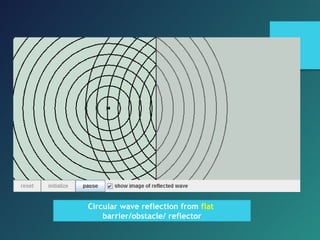
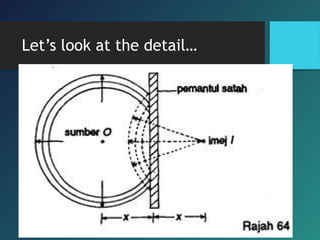
Circular wave reflection from flat
barrier/obstacle/ reflector
Let’s look at the detail…
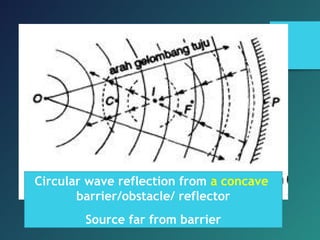
Circular wave reflection from a concave
barrier/obstacle/ reflector
Source far from barrier
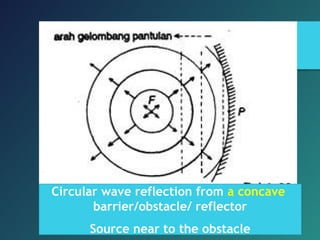
Circular wave reflection from a concave
barrier/obstacle/ reflector
Source near to the obstacle
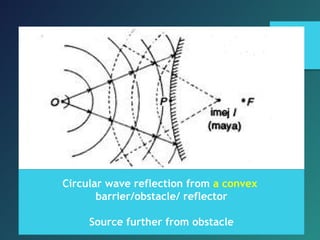
Circular wave reflection from a convex
barrier/obstacle/ reflector
Source further from obstacle
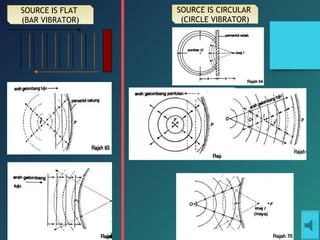
SOURCE IS FLAT
(BAR VIBRATOR)
SOURCE IS CIRCULAR
(CIRCLE VIBRATOR)
LIGHT WAVES
(REFLECTED WAVES)
• When rays of light strike any surface the rays
are reflected , unless the surface is black, when
they are absorbed.
• The reflection depend on how smooth the
surfaces are. Good mirrors reflect well over 90%
of the light that reaches them, with only a small
amount being absorbed.
• A plane mirror is a flat smooth surface which
reflects regularly most of the light falling on it.
• The phenomenon of reflection of light obeys the
law of reflection.
(a) The angle of incidence is equal to the angle of
reflection.
(b) The incident wave, the reflected wave and the normal
lie in the same plane.
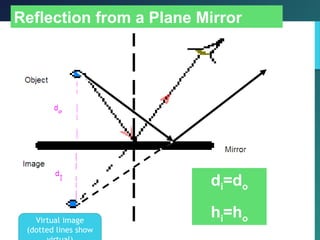
• It also can be seen that
(a) The size of the image = the size of the object
(b) The distance of the image = the distance of the object
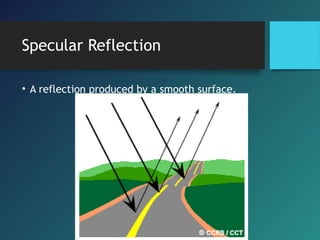
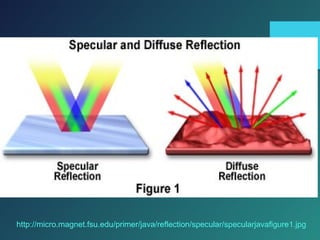
Specular Reflection
• A reflection produced by a smooth surface.
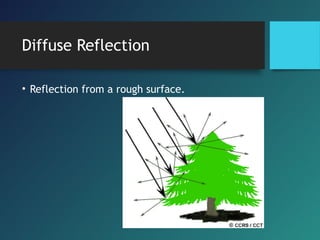
Diffuse Reflection
• Reflection from a rough surface.
http://micro.magnet.fsu.edu/primer/java/reflection/specular/specularjavafigure1.jpg
Reflection from a Plane Mirror
di=do
hi=hoVirtual image
(dotted lines show
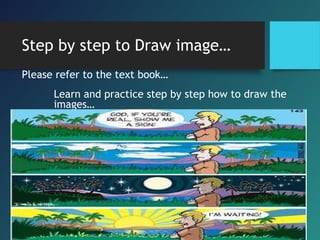
Step by step to Draw image…
Please refer to the text book…
Learn and practice step by step how to draw the
images…
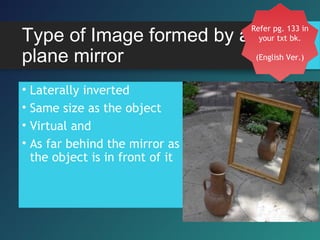
Type of Image formed by a
plane mirror
• Laterally inverted
• Same size as the object
• Virtual and
• As far behind the mirror as
the object is in front of it
Refer pg. 133 in
your txt bk.
(English Ver.)
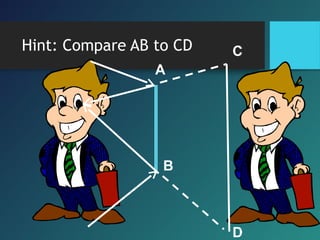
What is the minimum mirror
height required for a person to
see their full self in the mirror?
Hint: Compare AB to CD
A
D
B
C
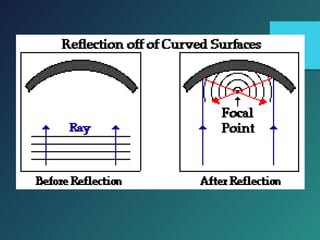
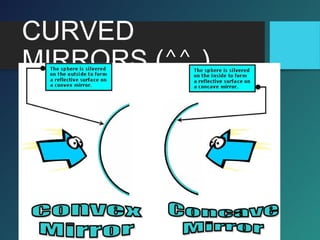
CURVED
MIRRORS (^^,)
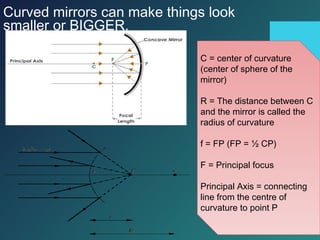
Curved mirrors can make things look
smaller or BIGGER.
C = center of curvature
(center of sphere of the
mirror)
R = The distance between C
and the mirror is called the
radius of curvature
f = FP (FP = ½ CP)
F = Principal focus
Principal Axis = connecting
line from the centre of
curvature to point P
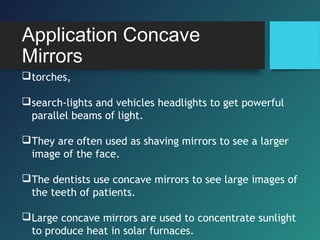
Application Concave
Mirrors
torches,
search-lights and vehicles headlights to get powerful
parallel beams of light.
They are often used as shaving mirrors to see a larger
image of the face.
The dentists use concave mirrors to see large images of
the teeth of patients.
Large concave mirrors are used to concentrate sunlight
to produce heat in solar furnaces.
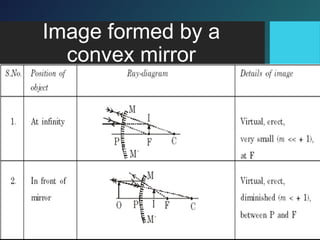
Image formed by a
convex mirror
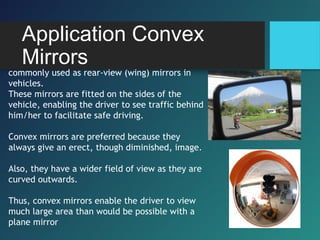
Application Convex
Mirrors
commonly used as rear-view (wing) mirrors in
vehicles.
These mirrors are fitted on the sides of the
vehicle, enabling the driver to see traffic behind
him/her to facilitate safe driving.
Convex mirrors are preferred because they
always give an erect, though diminished, image.
Also, they have a wider field of view as they are
curved outwards.
Thus, convex mirrors enable the driver to view
much large area than would be possible with a
plane mirror
Assignment (A):
If you were a sound engineer, what is the modification that you
have to do to improve a recording studio. In your explanations ,
include steps to overcome sound reflection problems.
Assignment (B):
You are engaged by an interior design company to help to design a
café in the town. You are required to make the café look more
spacious. Explain how to make the hall look bigger by fixing mirrors
on the wall.
REFLECTION OF
SOUND WAVE
Assignment (C):
Make a mind map of reflection of wave. Make sure all
important points are included. Use a manila card or a
mahjong paper.
Assignment (D):
Make a table of comparison of reflection waves of water
waves, light waves and also sound waves.
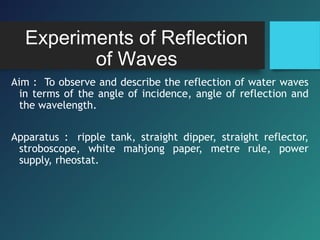
Experiments of Reflection
of Waves
Aim : To observe and describe the reflection of water waves
in terms of the angle of incidence, angle of reflection and
the wavelength.
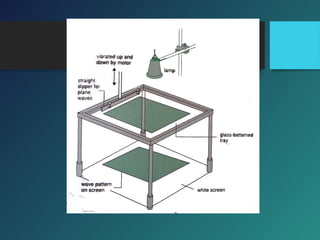
Apparatus : ripple tank, straight dipper, straight reflector,
stroboscope, white mahjong paper, metre rule, power
supply, rheostat.
Procedure :
1. Set up the apparatus as shown in the figure above.
2. Pour water into the ripple tank to a depth of about
1 cm and adjust the stands to ensure the depth of
the water in the tank is uniform.
3. Lower the straight dipper until it just touches the
surface of the water.
4. Place a straight reflector parallel to the dipper, 30
cm away.
5. Switch on the lamp and the motor. Adjust the
frequency of the motor by sliding the rheostat so
that the image of the wave is clear.
6. Use the stroboscope to freeze the image of the
wave form.
7. Mark the image on the white paper.
8. Measure the angle of incidence, angle of
reflection, wavelength of the incident waves and
reflected waves.
9. Replace the paper, repeat steps 4 – 8 with the
angle between the reflector and the dipper at 15º,
30º ,45º and 60º.
10. Tabulate your data.
11. Deduce the relationship between
i. the angle of incidence and angle of reflection;
ii. The wavelength of the incident waves and reflected
waves.
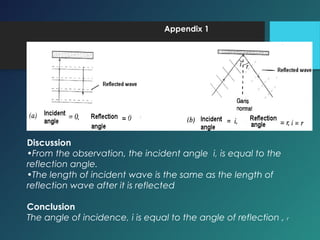
Appendix 1
Discussion
•From the observation, the incident angle i, is equal to the
reflection angle.
•The length of incident wave is the same as the length of
reflection wave after it is reflected
Conclusion
The angle of incidence, i is equal to the angle of reflection , r
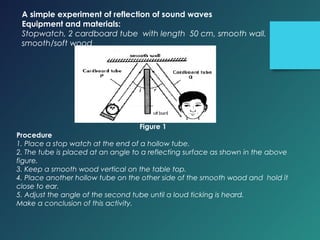
A simple experiment of reflection of sound waves
Equipment and materials:
Stopwatch, 2 cardboard tube with length 50 cm, smooth wall,
smooth/soft wood
Figure 1
Procedure
1. Place a stop watch at the end of a hollow tube.
2. The tube is placed at an angle to a reflecting surface as shown in the above
figure.
3. Keep a smooth wood vertical on the table top.
4. Place another hollow tube on the other side of the smooth wood and hold it
close to ear.
5. Adjust the angle of the second tube until a loud ticking is heard.
Make a conclusion of this activity.
Appendix 2 (Sound Wave)
 
Results
It is observed that the loudest ticking sound is heard when the angle of
incident is the same as the angle of reflection.
 
Discussion:
1.Soft board/wood is used to avoid the ticking sound of the stopwatch
from being heard directly by the listener’s ears.
2.Smooth wall reflects sound waves more efficiently.
 
Conclusion
The angle of incidence , i is equal to the angle of reflection , r.
 
WORKSHEET 1
Draw the pattern of reflected waves and describe its
characteristic. Make a comparison between incident waves and
reflected waves in terms of :
i. angle of incidence , i
ii. angle of reflection , r
iii. wavelength, frequency and speed
iv. direction of propagation of the wave
1.2 reflection of waves

1.2 reflection of waves

  • 1.
    1. 2 REFLECTIONOF WAVES NURUL FADHILAH BINTI ALIAS MRSM KUALA KLAWANG, NEGERI SEMBILAN
  • 3.
    Introduction What will happento the waves after they hit the retaining (tembok) wall? Water waves hitting a wall
  • 4.
    When an object,like a ball, is thrown against a rigid wall it will…? ball wall This "reflection" of the object can be analyzed in terms of momentum and energy conservation If the collision between ball and wall is perfectly ELASTIC, then all the incident energy and momentum is reflected, and the ball bounces back with the same speed If the collision is INELASTIC, then the wall (or ball) absorbs some of the incident energy and momentum and the ball does not bounce back with the same speed.
  • 5.
    Waves also carryenergy and momentum whenever a wave encounters an obstacle, they are reflected by the obstacle reflection of waves is responsible for echoes, radar detectors, and for allowing standing waves which are so important to sound production in musical instruments.
  • 6.
    Reflection When a wavereaches a boundary it is: •Partially reflected (bounces off surface) •Partially transmitted through surface.
  • 7.
    Law of Reflection Angleof incidence = Angle of reflection
  • 10.
  • 12.
    Wave propagation Reflected waves Flatwave reflection from a convex barrier/obstacle/ reflector
  • 13.
    Circular wave reflectionfrom flat barrier/obstacle/ reflector
  • 14.
    Let’s look atthe detail…
  • 15.
    Circular wave reflectionfrom a concave barrier/obstacle/ reflector Source far from barrier
  • 16.
    Circular wave reflectionfrom a concave barrier/obstacle/ reflector Source near to the obstacle
  • 17.
    Circular wave reflectionfrom a convex barrier/obstacle/ reflector Source further from obstacle
  • 18.
    SOURCE IS FLAT (BARVIBRATOR) SOURCE IS CIRCULAR (CIRCLE VIBRATOR)
  • 19.
    LIGHT WAVES (REFLECTED WAVES) •When rays of light strike any surface the rays are reflected , unless the surface is black, when they are absorbed. • The reflection depend on how smooth the surfaces are. Good mirrors reflect well over 90% of the light that reaches them, with only a small amount being absorbed. • A plane mirror is a flat smooth surface which reflects regularly most of the light falling on it.
  • 20.
    • The phenomenonof reflection of light obeys the law of reflection. (a) The angle of incidence is equal to the angle of reflection. (b) The incident wave, the reflected wave and the normal lie in the same plane. • It also can be seen that (a) The size of the image = the size of the object (b) The distance of the image = the distance of the object
  • 22.
    Specular Reflection • Areflection produced by a smooth surface.
  • 23.
    Diffuse Reflection • Reflectionfrom a rough surface.
  • 24.
  • 25.
    Reflection from aPlane Mirror di=do hi=hoVirtual image (dotted lines show
  • 26.
    Step by stepto Draw image… Please refer to the text book… Learn and practice step by step how to draw the images…
  • 27.
    Type of Imageformed by a plane mirror • Laterally inverted • Same size as the object • Virtual and • As far behind the mirror as the object is in front of it Refer pg. 133 in your txt bk. (English Ver.)
  • 28.
    What is theminimum mirror height required for a person to see their full self in the mirror?
  • 29.
    Hint: Compare ABto CD A D B C
  • 30.
  • 31.
    Curved mirrors canmake things look smaller or BIGGER. C = center of curvature (center of sphere of the mirror) R = The distance between C and the mirror is called the radius of curvature f = FP (FP = ½ CP) F = Principal focus Principal Axis = connecting line from the centre of curvature to point P
  • 32.
    Application Concave Mirrors torches, search-lights andvehicles headlights to get powerful parallel beams of light. They are often used as shaving mirrors to see a larger image of the face. The dentists use concave mirrors to see large images of the teeth of patients. Large concave mirrors are used to concentrate sunlight to produce heat in solar furnaces.
  • 34.
    Image formed bya convex mirror
  • 35.
    Application Convex Mirrors commonly usedas rear-view (wing) mirrors in vehicles. These mirrors are fitted on the sides of the vehicle, enabling the driver to see traffic behind him/her to facilitate safe driving. Convex mirrors are preferred because they always give an erect, though diminished, image. Also, they have a wider field of view as they are curved outwards. Thus, convex mirrors enable the driver to view much large area than would be possible with a plane mirror
  • 36.
    Assignment (A): If youwere a sound engineer, what is the modification that you have to do to improve a recording studio. In your explanations , include steps to overcome sound reflection problems. Assignment (B): You are engaged by an interior design company to help to design a café in the town. You are required to make the café look more spacious. Explain how to make the hall look bigger by fixing mirrors on the wall. REFLECTION OF SOUND WAVE
  • 37.
    Assignment (C): Make amind map of reflection of wave. Make sure all important points are included. Use a manila card or a mahjong paper. Assignment (D): Make a table of comparison of reflection waves of water waves, light waves and also sound waves.
  • 38.
    Experiments of Reflection ofWaves Aim : To observe and describe the reflection of water waves in terms of the angle of incidence, angle of reflection and the wavelength. Apparatus : ripple tank, straight dipper, straight reflector, stroboscope, white mahjong paper, metre rule, power supply, rheostat.
  • 40.
    Procedure : 1. Setup the apparatus as shown in the figure above. 2. Pour water into the ripple tank to a depth of about 1 cm and adjust the stands to ensure the depth of the water in the tank is uniform. 3. Lower the straight dipper until it just touches the surface of the water. 4. Place a straight reflector parallel to the dipper, 30 cm away. 5. Switch on the lamp and the motor. Adjust the frequency of the motor by sliding the rheostat so that the image of the wave is clear.
  • 41.
    6. Use thestroboscope to freeze the image of the wave form. 7. Mark the image on the white paper. 8. Measure the angle of incidence, angle of reflection, wavelength of the incident waves and reflected waves. 9. Replace the paper, repeat steps 4 – 8 with the angle between the reflector and the dipper at 15º, 30º ,45º and 60º. 10. Tabulate your data. 11. Deduce the relationship between i. the angle of incidence and angle of reflection; ii. The wavelength of the incident waves and reflected waves.
  • 42.
    Appendix 1 Discussion •From theobservation, the incident angle i, is equal to the reflection angle. •The length of incident wave is the same as the length of reflection wave after it is reflected Conclusion The angle of incidence, i is equal to the angle of reflection , r
  • 43.
    A simple experimentof reflection of sound waves Equipment and materials: Stopwatch, 2 cardboard tube with length 50 cm, smooth wall, smooth/soft wood Figure 1 Procedure 1. Place a stop watch at the end of a hollow tube. 2. The tube is placed at an angle to a reflecting surface as shown in the above figure. 3. Keep a smooth wood vertical on the table top. 4. Place another hollow tube on the other side of the smooth wood and hold it close to ear. 5. Adjust the angle of the second tube until a loud ticking is heard. Make a conclusion of this activity.
  • 44.
    Appendix 2 (SoundWave)   Results It is observed that the loudest ticking sound is heard when the angle of incident is the same as the angle of reflection.   Discussion: 1.Soft board/wood is used to avoid the ticking sound of the stopwatch from being heard directly by the listener’s ears. 2.Smooth wall reflects sound waves more efficiently.   Conclusion The angle of incidence , i is equal to the angle of reflection , r.  
  • 45.
    WORKSHEET 1 Draw thepattern of reflected waves and describe its characteristic. Make a comparison between incident waves and reflected waves in terms of : i. angle of incidence , i ii. angle of reflection , r iii. wavelength, frequency and speed iv. direction of propagation of the wave

Editor's Notes

  • #38 4af given, 4 ar n 4ak haven’t