
GEOSYNCHRONOUS EARTH ORBIT(GEO)
Presented To:
Chitra Biswas
Lecturer of ETE
FSET , USTC.
Presented By:
Ananda Mohan Shil
ID:15010324. Batch: 15th
Department of EEE
Satellite :
A satellite is an object that moves around a larger object. Earth is a satellite
because it moves around the sun. The moon is a satellite because it moves
around Earth. Earth and the moon are called "natural" satellites. Usually, the
word “satellite” refers to a machine that is launched into space and moves
around earth or another body in space.
Categories of Satellite:
 Low Earth Orbit(LEO).
 Medium Earth Orbit(MEO).
 Geosynchronous Earth Orbit(GEO).
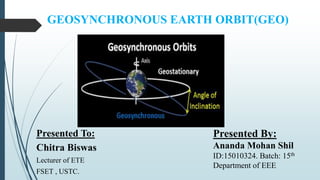
Geosynchronous Earth Orbit(GEO):
A Geosynchronous earth orbit (GEO) is a circular orbit
35786kms (22000miles) above the earth’s equator and
following the direction of the earth’s rotation.
A special case of GEO is the Geostationary Earth Orbit. In
this, the satellite rotates at an inclination of 90degree, which
means that it remains in the same spot above the equator. In
such a case the satellite will appear to remain fixed at the
same position in the sky.
Advantages of GEO:
 A GEO satellites distance from earth gives it a large coverage area,
almost a fourth of the earth’s surface
 GEO satellite have a 24 hours view of a particular area.
 This factors make it ideal for satellite broadcast and other multipoint
applications.
 The effects of Doppler shift are negligible .
 No ground station tracking required.
 Three satellites give full earth coverage.
 No problem with frequency changes.
Disadvantages of GEO:
 A GEO satellites distance also cause it o have both a comparatively weak
signal and a time delay in a signal, which is bad for point to point
communication.
 High transmission power required.
 Weak signal after traveling over 35000km.
 Polar regions are poorly served by Geostationary satellites.
Applications of GEO:
 World wide operational telecommunication systems for
telephones, TV and digitized transmission lines.
 Alarm systems – detection of rocket launches.
 Geostationary satellites are also commonly used for
communications and weather–observation.
THANK YOU
EVERYBODY
FOR GIVINHG
YOUR
COCENTRARTION
TO MY
PRESENTATION

Geosynchronous earth orbit(geo)

  • 1.
    GEOSYNCHRONOUS EARTH ORBIT(GEO) PresentedTo: Chitra Biswas Lecturer of ETE FSET , USTC. Presented By: Ananda Mohan Shil ID:15010324. Batch: 15th Department of EEE
  • 2.
    Satellite : A satelliteis an object that moves around a larger object. Earth is a satellite because it moves around the sun. The moon is a satellite because it moves around Earth. Earth and the moon are called "natural" satellites. Usually, the word “satellite” refers to a machine that is launched into space and moves around earth or another body in space. Categories of Satellite:  Low Earth Orbit(LEO).  Medium Earth Orbit(MEO).  Geosynchronous Earth Orbit(GEO).
  • 3.
    Geosynchronous Earth Orbit(GEO): AGeosynchronous earth orbit (GEO) is a circular orbit 35786kms (22000miles) above the earth’s equator and following the direction of the earth’s rotation. A special case of GEO is the Geostationary Earth Orbit. In this, the satellite rotates at an inclination of 90degree, which means that it remains in the same spot above the equator. In such a case the satellite will appear to remain fixed at the same position in the sky.
  • 4.
    Advantages of GEO: A GEO satellites distance from earth gives it a large coverage area, almost a fourth of the earth’s surface  GEO satellite have a 24 hours view of a particular area.  This factors make it ideal for satellite broadcast and other multipoint applications.  The effects of Doppler shift are negligible .  No ground station tracking required.  Three satellites give full earth coverage.  No problem with frequency changes.
  • 5.
    Disadvantages of GEO: A GEO satellites distance also cause it o have both a comparatively weak signal and a time delay in a signal, which is bad for point to point communication.  High transmission power required.  Weak signal after traveling over 35000km.  Polar regions are poorly served by Geostationary satellites.
  • 6.
    Applications of GEO: World wide operational telecommunication systems for telephones, TV and digitized transmission lines.  Alarm systems – detection of rocket launches.  Geostationary satellites are also commonly used for communications and weather–observation.
  • 7.