Grunt Productions 2005
Longitude and SphericalLongitude and Spherical
TrianglesTriangles
A Brief By Lance Grindley
Grunt Productions 2005
A few quick notes …A few quick notes …
• Nautical mileNautical mile
– One minute of Earth’s circumference at the EquatorOne minute of Earth’s circumference at the Equator
• Earth’s circumference at the equator is 360 degreesEarth’s circumference at the equator is 360 degrees
– Which is 360*60 = 21,600 minutesWhich is 360*60 = 21,600 minutes
• So, Earth’s circumference at the equator is 21,600 nautical milesSo, Earth’s circumference at the equator is 21,600 nautical miles
• One knot = one nm per hourOne knot = one nm per hour
• One nm = 1.15 land mileOne nm = 1.15 land mile
Grunt Productions 2005
More notes …More notes …
• Every meridian is perpendicular to the equatorEvery meridian is perpendicular to the equator
– Hence, the ease with which you could construct a sphericalHence, the ease with which you could construct a spherical
triangle with two right anglestriangle with two right angles
• So, if we travel along a fixed direction that is other than due east-So, if we travel along a fixed direction that is other than due east-
west or north-south but at an anglewest or north-south but at an angle
– The journey results in a spherical spiralThe journey results in a spherical spiral
• Also called a loxodromeAlso called a loxodrome
Q. What do a row of Bacardi bottles and a
loxodrome have in common?
A. Both are rum (rhumb) lines."
Grunt Productions 2005
Measuring Angles on a SphereMeasuring Angles on a Sphere
• Lines on a sphere are great circlesLines on a sphere are great circles
– intersection of sphere with a plane through the sphere’s centerintersection of sphere with a plane through the sphere’s center
• Can define the angle between two lines as the angle made by theCan define the angle between two lines as the angle made by the
two planes that create themtwo planes that create them
– the smaller of the two possible choicesthe smaller of the two possible choices
• Important to figure out what a given map projection does to anglesImportant to figure out what a given map projection does to angles
Grunt Productions 2005
Spherical TrianglesSpherical Triangles
• Formed when arcs of three greatFormed when arcs of three great
circles meet in pairscircles meet in pairs
• Any two sides together greater thanAny two sides together greater than
the third sidethe third side
• Sum of interior angles can beSum of interior angles can be
(strictly) between 180(strictly) between 180°° and 540and 540°°
– Very small triangle will be almostVery small triangle will be almost
flat, so have just over 180flat, so have just over 180°°
– Very large triangle can haveVery large triangle can have
almost 540almost 540°° degreesdegrees
• Turns out that the area is directlyTurns out that the area is directly
proportional to the “angle excess”proportional to the “angle excess”
(how much more than 180(how much more than 180°° degreesdegrees
its angles add up to)its angles add up to)
Triangle PAB v. triangle PCD
Grunt Productions 2005
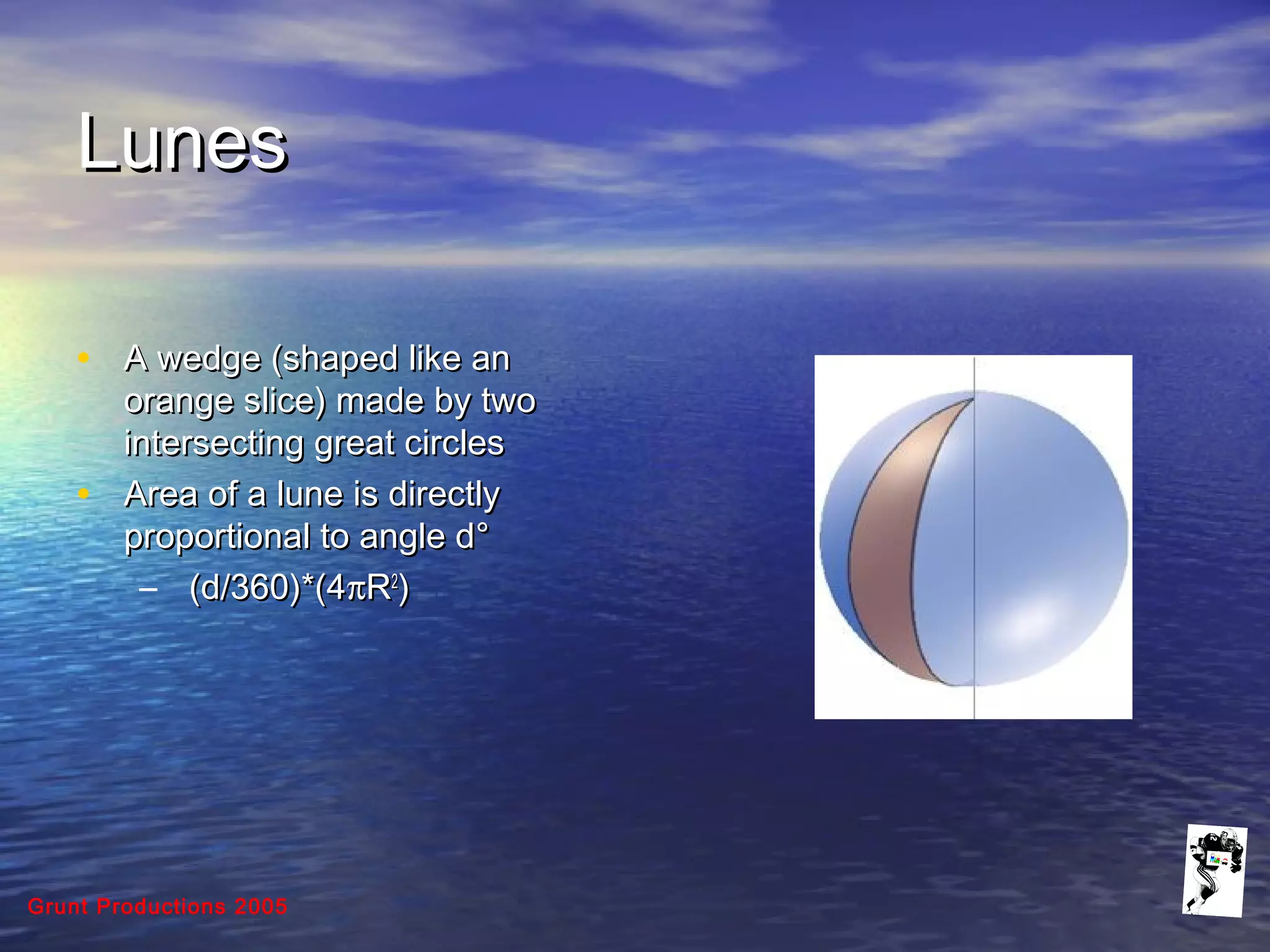
LunesLunes
• A wedge (shaped like anA wedge (shaped like an
orange slice) made by twoorange slice) made by two
intersecting great circlesintersecting great circles
• Area of a lune is directlyArea of a lune is directly
proportional to angle dproportional to angle d°°
– (d/360)*(4(d/360)*(4ππRR22
))
Grunt Productions 2005
Area of a Spherical TriangleArea of a Spherical Triangle
• For each angle d, we can consider the lune that contains that angleFor each angle d, we can consider the lune that contains that angle
– The lune is the triangle + another surfaceThe lune is the triangle + another surface
– The area of “triangle + another surface” equals d *The area of “triangle + another surface” equals d * 44ππRR22
/360/360
– So the (area of the three other surfaces + 3 times the area of theSo the (area of the three other surfaces + 3 times the area of the
triangle) = (sum of the angles) * 4triangle) = (sum of the angles) * 4ππRR22
/360/360
– The area of the 3 other surfaces and the triangle is aThe area of the 3 other surfaces and the triangle is a
hemisphere = 2hemisphere = 2ππRR22
= 180*(4= 180*(4ππRR22
/360)/360)
• So area of triangle isSo area of triangle is
(1/2)*(sum of angles – 180)*4(1/2)*(sum of angles – 180)*4ππRR22
/360/360
• Manifestation of how much “curvature” is captured within the triangleManifestation of how much “curvature” is captured within the triangle
Grunt Productions 2005
Angles determine a lot aboutAngles determine a lot about
triangles on a spheretriangles on a sphere
• Two spherical triangles with the same angle sum have the sameTwo spherical triangles with the same angle sum have the same
areaarea
– totally different from plane situation where all triangles have 180totally different from plane situation where all triangles have 180°°
• If two spherical triangles have the same angles, then they’re not justIf two spherical triangles have the same angles, then they’re not just
similar...similar...
– they have the same side lengthsthey have the same side lengths
– they’re congruent!they’re congruent!
Grunt Productions 2005
There are no ideal mapsThere are no ideal maps
• An ideal map from the sphere to the plane would preserve bothAn ideal map from the sphere to the plane would preserve both
geodesics and anglesgeodesics and angles
• What would it do to a spherical triangle?What would it do to a spherical triangle?
– Would take great circles (geodesics on sphere) to straight linesWould take great circles (geodesics on sphere) to straight lines
(geodesics on plane)(geodesics on plane)
– So it would take a spherical triangle to a plane triangle,So it would take a spherical triangle to a plane triangle,
preserving all the anglespreserving all the angles
– But plane triangle has 180But plane triangle has 180°° and spherical has > 180and spherical has > 180°°!!
• The sphere is curved, and any triangle captures some of thatThe sphere is curved, and any triangle captures some of that
– thus, cannot be flattened out totallythus, cannot be flattened out totally
Grunt Productions 2005
The Navigation ProblemThe Navigation Problem
• The ancient question: WhereThe ancient question: Where
am I?am I?
• Earth coordinates: latitude andEarth coordinates: latitude and
longitudelongitude
• Latitude can be determined byLatitude can be determined by
Sun angleSun angle
• What about longitude?What about longitude?
Grunt Productions 2005
LatitudeLatitude
• Comparatively easyComparatively easy
• Can use Eratosthenes’ methodCan use Eratosthenes’ method
– measure how far off from “directly overhead” the sun is, when itmeasure how far off from “directly overhead” the sun is, when it
is at its highest point in the sky (“local solar noon”)is at its highest point in the sky (“local solar noon”)
• Similar techniques using other astronomical bodiesSimilar techniques using other astronomical bodies
– Latitude = angle from horizon to North StarLatitude = angle from horizon to North Star
Grunt Productions 2005
Stars and other
constellations helped
sailors to figure out their
position.
The red arrow is pointing
to the North Star, which is
also known as Polaris.
It is all in your stars!It is all in your stars!
Grunt Productions 2005
This is a quadrant. A
sailor would see the North
Star along one edge, and
where the string fell would
tell approximately the
ship’s latitude.
A sailor could also use this
astrolabe.
Lined it up so the sun
shone through one hole onto
another, and the pointer
would determine the
latitude.
Grunt Productions 2005
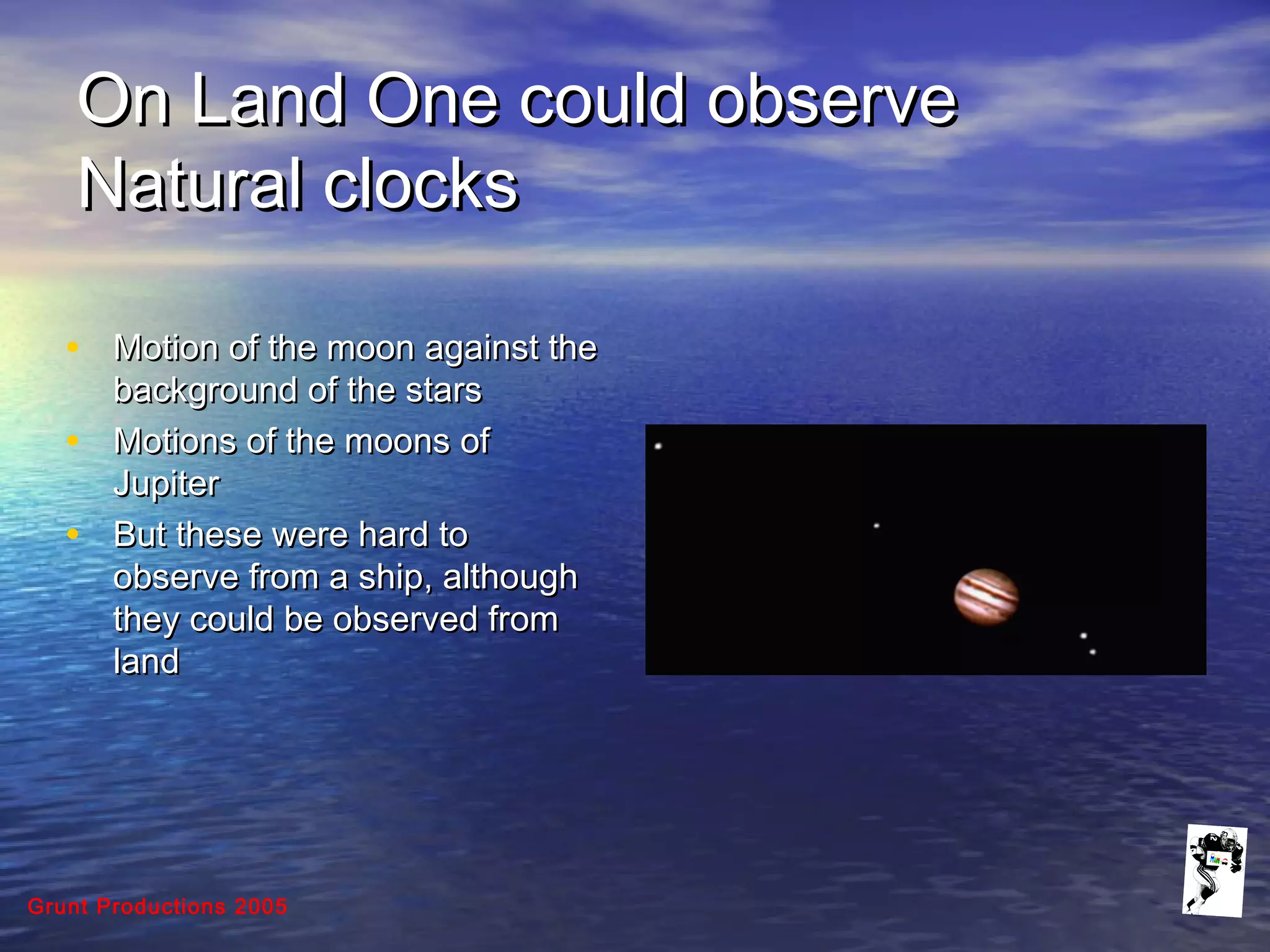
On Land One could observeOn Land One could observe
Natural clocksNatural clocks
• Motion of the moon against theMotion of the moon against the
background of the starsbackground of the stars
• Motions of the moons ofMotions of the moons of
JupiterJupiter
• But these were hard toBut these were hard to
observe from a ship, althoughobserve from a ship, although
they could be observed fromthey could be observed from
landland
Grunt Productions 2005
Techniques for measuringTechniques for measuring
longitudelongitude
• Find some astronomical events that recur with known regularityFind some astronomical events that recur with known regularity
– Tables compiled by Galileo, Cassini of motion of moons ofTables compiled by Galileo, Cassini of motion of moons of
Jupiter (lo, Europa, Ganymede, and Callisto)Jupiter (lo, Europa, Ganymede, and Callisto)
– The moons would have eclipses at regular intervalsThe moons would have eclipses at regular intervals
• Tabulate exactly what time these eclipses occurred on given daysTabulate exactly what time these eclipses occurred on given days
– e.g., you have a table that says something like “Io will have ane.g., you have a table that says something like “Io will have an
eclipse at 7:00 PM on Jan. 22 in Paris” (It’s actually rathereclipse at 7:00 PM on Jan. 22 in Paris” (It’s actually rather
messier than that)messier than that)
– You have a clock set to local timeYou have a clock set to local time
– On Jan. 22, you look through the telescope and see the eclipseOn Jan. 22, you look through the telescope and see the eclipse
at 3:00 PM local timeat 3:00 PM local time
– So you are 4 hours = 60So you are 4 hours = 60° west of Paris° west of Paris
Grunt Productions 2005
Calculating the longitudeCalculating the longitude
• Use stars or the SunUse stars or the Sun
• But in addition to making observations the need to know the time forBut in addition to making observations the need to know the time for
some location of known longitudesome location of known longitude
– local time alone is not enoughlocal time alone is not enough
• The development of the chronometerThe development of the chronometer
• To find longitude to within 0.5 degree requires a clock that loses orTo find longitude to within 0.5 degree requires a clock that loses or
gains no more than 3 seconds/daygains no more than 3 seconds/day
Grunt Productions 2005
LongitudeLongitude
• Much more challengingMuch more challenging
• Requires a way to determine how farRequires a way to determine how far
you are from a fixed meridianyou are from a fixed meridian
• Essentially the same question asEssentially the same question as
“what time is it in Paris when it’s noon“what time is it in Paris when it’s noon
here?”here?”
– Earth rotates at constant velocity,Earth rotates at constant velocity,
once around every 24 hoursonce around every 24 hours
– 1 hour = 3601 hour = 360°° /24 = 15/24 = 15° longitude° longitude
differencedifference
• Thus, need to be able to tell time atThus, need to be able to tell time at
your locationyour location
– e.g., pendulum clock, measuringe.g., pendulum clock, measuring
local noonlocal noon
Grunt Productions 2005
The problem of finding longitude atThe problem of finding longitude at
seasea
• To the middle of the 18To the middle of the 18thth
century, no mechanicalcentury, no mechanical
clock would keepclock would keep
accurate time in a sea-accurate time in a sea-
tossed shiptossed ship
Grunt Productions 2005
Longitude ProblemLongitude Problem
• No easy way to determine longitudeNo easy way to determine longitude
• On July 8, 1714 the Longitude Act established in England to solveOn July 8, 1714 the Longitude Act established in England to solve
the “longitude problem”the “longitude problem”
Grunt Productions 2005
Odd SolutionsOdd Solutions
• Anchor a series of ships across the ocean that would shoot off flaresAnchor a series of ships across the ocean that would shoot off flares
and guns at set timesand guns at set times
• Telepathic connection between animals on ship and those ashoreTelepathic connection between animals on ship and those ashore
Grunt Productions 2005
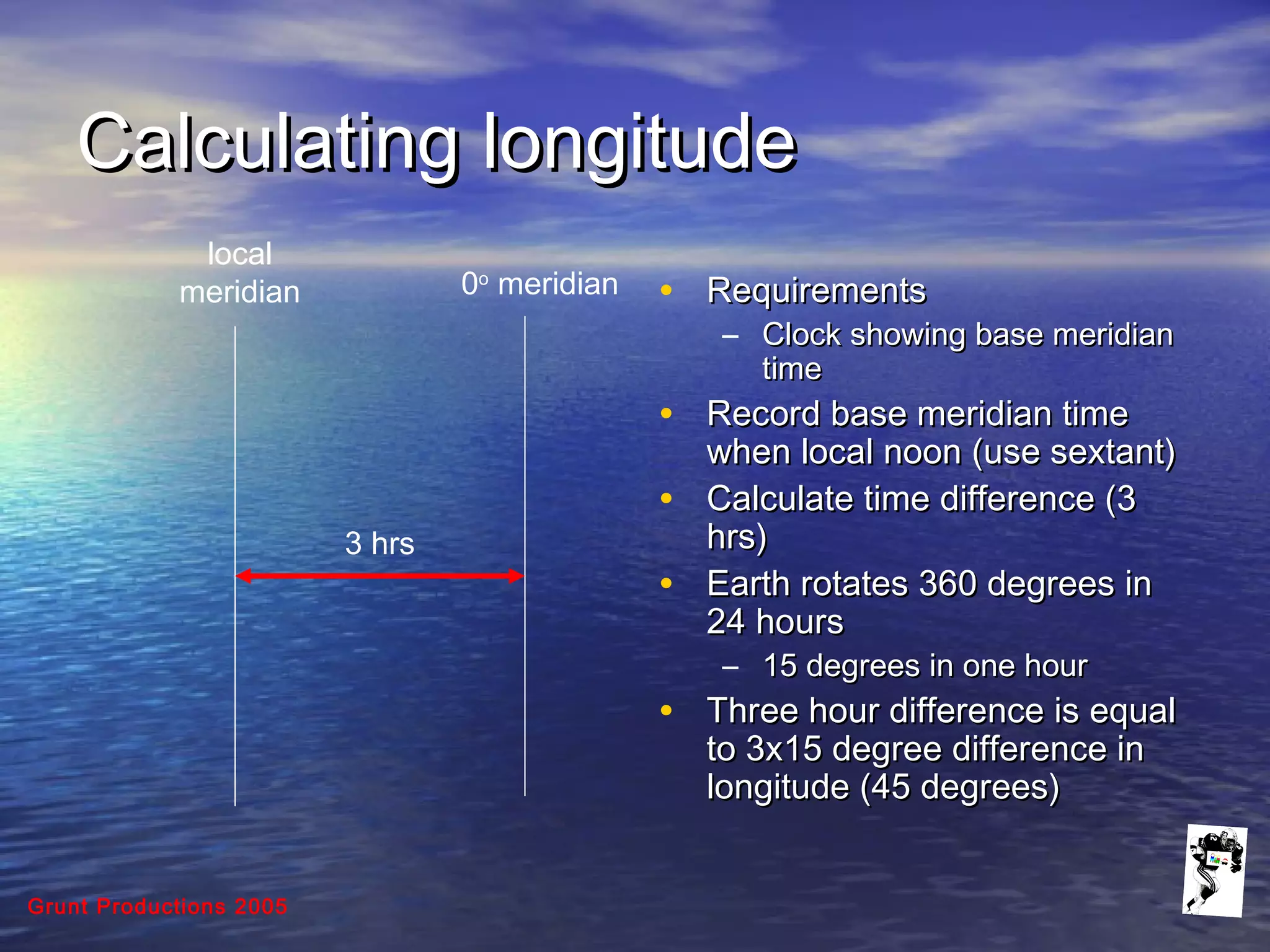
Calculating longitudeCalculating longitude
• RequirementsRequirements
– Clock showing base meridianClock showing base meridian
timetime
• Record base meridian timeRecord base meridian time
when local noon (use sextant)when local noon (use sextant)
• Calculate time difference (3Calculate time difference (3
hrs)hrs)
• Earth rotates 360 degrees inEarth rotates 360 degrees in
24 hours24 hours
– 15 degrees in one hour15 degrees in one hour
• Three hour difference is equalThree hour difference is equal
to 3x15 degree difference into 3x15 degree difference in
longitude (45 degrees)longitude (45 degrees)
0o
meridian
local
meridian
3 hrs
Grunt Productions 2005
The ChronometerThe Chronometer
• Moons of Jupiter were too hard to observe on a shipMoons of Jupiter were too hard to observe on a ship
• Jupiter’s moons still used in the 1800’sJupiter’s moons still used in the 1800’s
– Chronometers fragile for land expeditionsChronometers fragile for land expeditions
• If we could just set a clock to Paris local time, and carry it with us,If we could just set a clock to Paris local time, and carry it with us,
then when we figure out local noon, we can see what time it is inthen when we figure out local noon, we can see what time it is in
ParisParis
• Hard part is the implementationHard part is the implementation
– Pendulum clocks are sensitive to being jostledPendulum clocks are sensitive to being jostled
– Materials expand and contract due to temperature, humidity, etc.Materials expand and contract due to temperature, humidity, etc.
Grunt Productions 2005
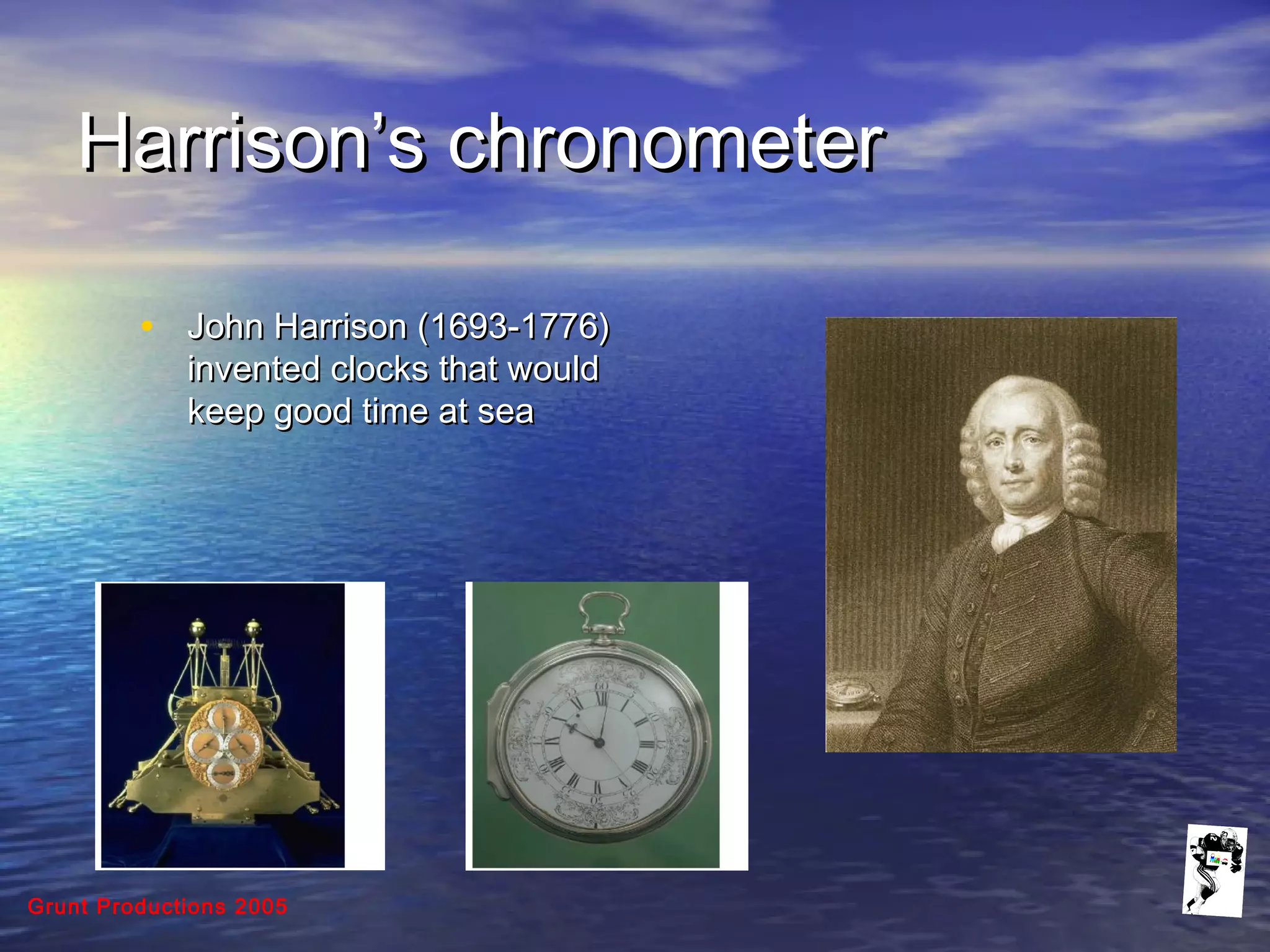
Harrison’s chronometerHarrison’s chronometer
• John Harrison (1693-1776)John Harrison (1693-1776)
invented clocks that wouldinvented clocks that would
keep good time at seakeep good time at sea
Grunt Productions 2005
Culmination of the SunCulmination of the Sun
• Set your chronometer to someSet your chronometer to some
known time, say London Time,known time, say London Time,
before you set sailbefore you set sail
Grunt Productions 2005
Local noon vs. time zonesLocal noon vs. time zones
• Local noon is different at every longitude on the earthLocal noon is different at every longitude on the earth
• Standardize time zones so it’s the same time in a longitude “region”Standardize time zones so it’s the same time in a longitude “region”
• Set by political agreementSet by political agreement
– e.g., Newfoundland is -3:30 from standarde.g., Newfoundland is -3:30 from standard
– All of China is in one time zone, even though it has about 60All of China is in one time zone, even though it has about 60° of° of
longitudelongitude
Grunt Productions 2005
Greenwich Meridian andGreenwich Meridian and
International Date LineInternational Date Line
• Greenwich Meridian (longitudeGreenwich Meridian (longitude
through the Royal Observatory inthrough the Royal Observatory in
Greenwich, England) chosen asGreenwich, England) chosen as
the prime meridian (0the prime meridian (0°)°)
– You can be up to 180You can be up to 180° East° East
(ahead)(ahead)
– OrOr up to 180up to 180° West (behind)° West (behind)
• On the other side of the world,On the other side of the world,
thethe International Date LineInternational Date Line isis
where the “discontinuity” iswhere the “discontinuity” is
Grunt Productions 2005
Three important time-relatedThree important time-related
datesdates
• 17611761
– John Harrison builds a marine chronometer with error less thanJohn Harrison builds a marine chronometer with error less than
1/51/5thth
of a second per day.of a second per day.
• Makes measurement of longitude possible while at sea.Makes measurement of longitude possible while at sea.
• 18841884
– The demands for readable railroad schedules requires adoptionThe demands for readable railroad schedules requires adoption
of Standard Time and time zones.of Standard Time and time zones.
• 19051905
– Albert Einstein shows that time is affected by motionAlbert Einstein shows that time is affected by motion
Grunt Productions 2005
GPS SegmentsGPS Segments
• Space Segment: the constellation of satellitesSpace Segment: the constellation of satellites
• Control Segment: control the satellitesControl Segment: control the satellites
• User Segment: users with receiversUser Segment: users with receivers
Grunt Productions 2005
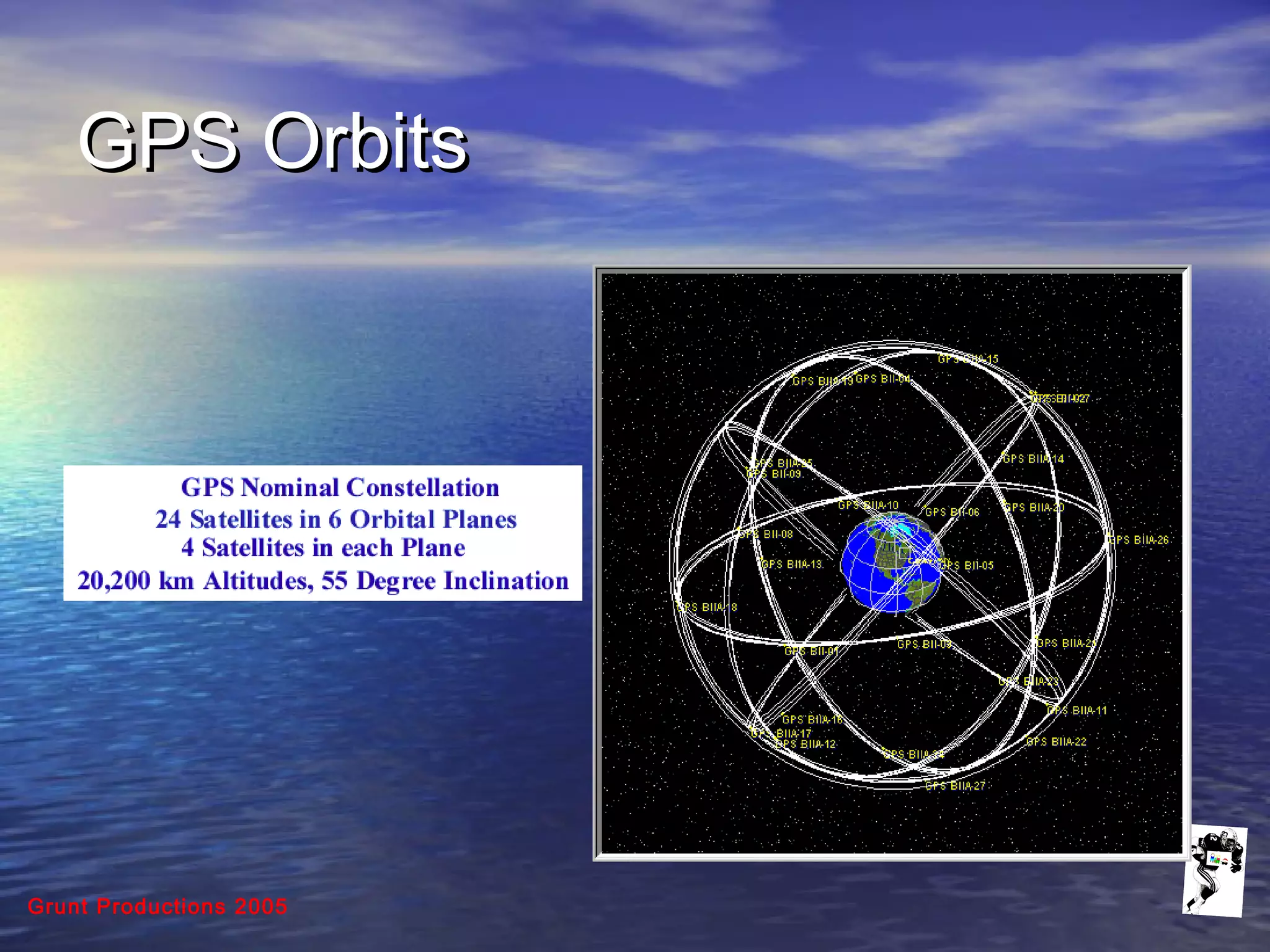
GPS OrbitsGPS Orbits
Grunt Productions 2005
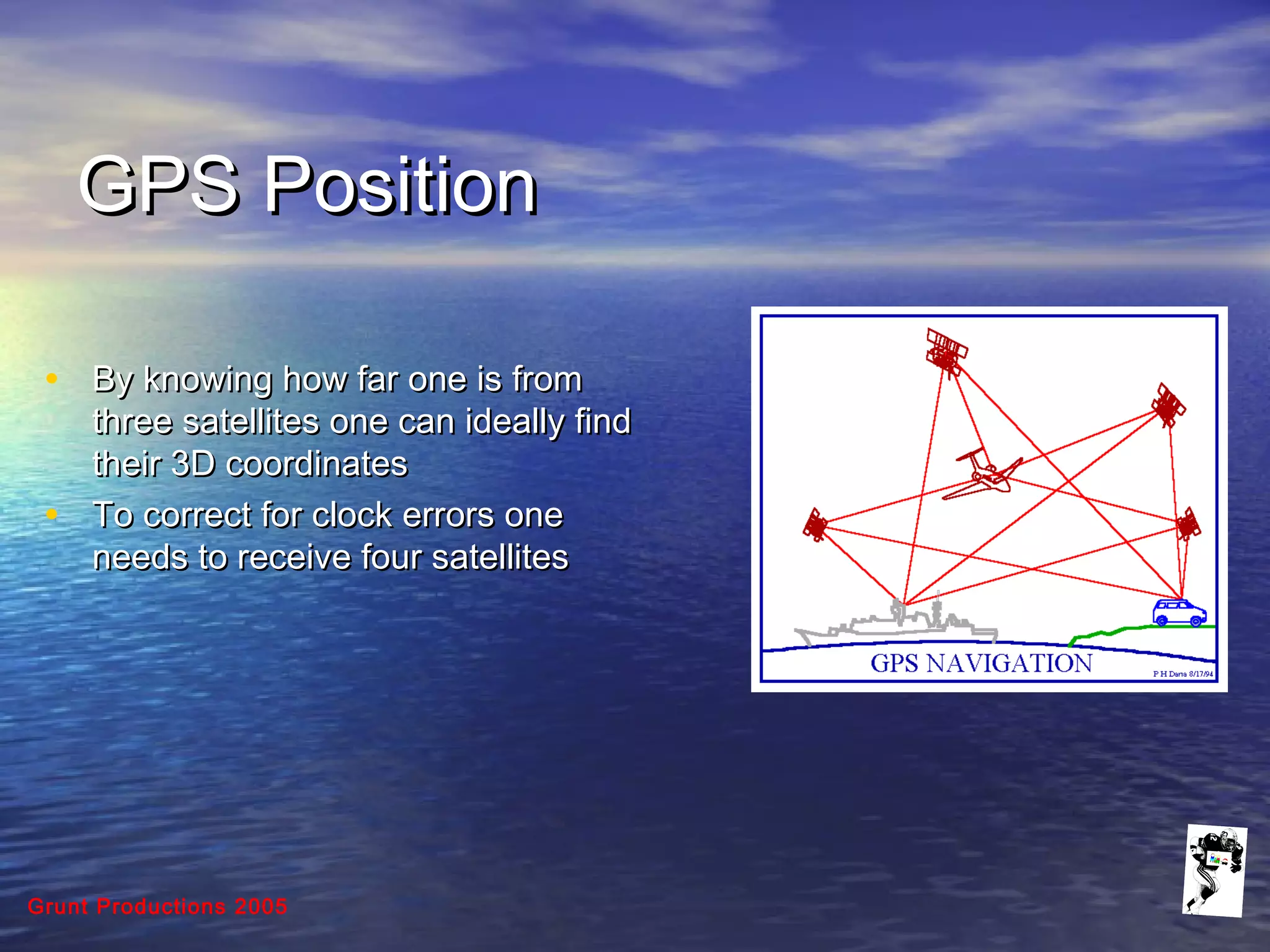
GPS PositionGPS Position
• By knowing how far one is fromBy knowing how far one is from
three satellites one can ideally findthree satellites one can ideally find
their 3D coordinatestheir 3D coordinates
• To correct for clock errors oneTo correct for clock errors one
needs to receive four satellitesneeds to receive four satellites

Longitude lrg

  • 1.
    Grunt Productions 2005 Longitudeand SphericalLongitude and Spherical TrianglesTriangles A Brief By Lance Grindley
  • 2.
    Grunt Productions 2005 Afew quick notes …A few quick notes … • Nautical mileNautical mile – One minute of Earth’s circumference at the EquatorOne minute of Earth’s circumference at the Equator • Earth’s circumference at the equator is 360 degreesEarth’s circumference at the equator is 360 degrees – Which is 360*60 = 21,600 minutesWhich is 360*60 = 21,600 minutes • So, Earth’s circumference at the equator is 21,600 nautical milesSo, Earth’s circumference at the equator is 21,600 nautical miles • One knot = one nm per hourOne knot = one nm per hour • One nm = 1.15 land mileOne nm = 1.15 land mile
  • 3.
    Grunt Productions 2005 Morenotes …More notes … • Every meridian is perpendicular to the equatorEvery meridian is perpendicular to the equator – Hence, the ease with which you could construct a sphericalHence, the ease with which you could construct a spherical triangle with two right anglestriangle with two right angles • So, if we travel along a fixed direction that is other than due east-So, if we travel along a fixed direction that is other than due east- west or north-south but at an anglewest or north-south but at an angle – The journey results in a spherical spiralThe journey results in a spherical spiral • Also called a loxodromeAlso called a loxodrome Q. What do a row of Bacardi bottles and a loxodrome have in common? A. Both are rum (rhumb) lines."
  • 4.
    Grunt Productions 2005 MeasuringAngles on a SphereMeasuring Angles on a Sphere • Lines on a sphere are great circlesLines on a sphere are great circles – intersection of sphere with a plane through the sphere’s centerintersection of sphere with a plane through the sphere’s center • Can define the angle between two lines as the angle made by theCan define the angle between two lines as the angle made by the two planes that create themtwo planes that create them – the smaller of the two possible choicesthe smaller of the two possible choices • Important to figure out what a given map projection does to anglesImportant to figure out what a given map projection does to angles
  • 5.
    Grunt Productions 2005 SphericalTrianglesSpherical Triangles • Formed when arcs of three greatFormed when arcs of three great circles meet in pairscircles meet in pairs • Any two sides together greater thanAny two sides together greater than the third sidethe third side • Sum of interior angles can beSum of interior angles can be (strictly) between 180(strictly) between 180°° and 540and 540°° – Very small triangle will be almostVery small triangle will be almost flat, so have just over 180flat, so have just over 180°° – Very large triangle can haveVery large triangle can have almost 540almost 540°° degreesdegrees • Turns out that the area is directlyTurns out that the area is directly proportional to the “angle excess”proportional to the “angle excess” (how much more than 180(how much more than 180°° degreesdegrees its angles add up to)its angles add up to) Triangle PAB v. triangle PCD
  • 6.
    Grunt Productions 2005 LunesLunes •A wedge (shaped like anA wedge (shaped like an orange slice) made by twoorange slice) made by two intersecting great circlesintersecting great circles • Area of a lune is directlyArea of a lune is directly proportional to angle dproportional to angle d°° – (d/360)*(4(d/360)*(4ππRR22 ))
  • 7.
    Grunt Productions 2005 Areaof a Spherical TriangleArea of a Spherical Triangle • For each angle d, we can consider the lune that contains that angleFor each angle d, we can consider the lune that contains that angle – The lune is the triangle + another surfaceThe lune is the triangle + another surface – The area of “triangle + another surface” equals d *The area of “triangle + another surface” equals d * 44ππRR22 /360/360 – So the (area of the three other surfaces + 3 times the area of theSo the (area of the three other surfaces + 3 times the area of the triangle) = (sum of the angles) * 4triangle) = (sum of the angles) * 4ππRR22 /360/360 – The area of the 3 other surfaces and the triangle is aThe area of the 3 other surfaces and the triangle is a hemisphere = 2hemisphere = 2ππRR22 = 180*(4= 180*(4ππRR22 /360)/360) • So area of triangle isSo area of triangle is (1/2)*(sum of angles – 180)*4(1/2)*(sum of angles – 180)*4ππRR22 /360/360 • Manifestation of how much “curvature” is captured within the triangleManifestation of how much “curvature” is captured within the triangle
  • 8.
    Grunt Productions 2005 Anglesdetermine a lot aboutAngles determine a lot about triangles on a spheretriangles on a sphere • Two spherical triangles with the same angle sum have the sameTwo spherical triangles with the same angle sum have the same areaarea – totally different from plane situation where all triangles have 180totally different from plane situation where all triangles have 180°° • If two spherical triangles have the same angles, then they’re not justIf two spherical triangles have the same angles, then they’re not just similar...similar... – they have the same side lengthsthey have the same side lengths – they’re congruent!they’re congruent!
  • 9.
    Grunt Productions 2005 Thereare no ideal mapsThere are no ideal maps • An ideal map from the sphere to the plane would preserve bothAn ideal map from the sphere to the plane would preserve both geodesics and anglesgeodesics and angles • What would it do to a spherical triangle?What would it do to a spherical triangle? – Would take great circles (geodesics on sphere) to straight linesWould take great circles (geodesics on sphere) to straight lines (geodesics on plane)(geodesics on plane) – So it would take a spherical triangle to a plane triangle,So it would take a spherical triangle to a plane triangle, preserving all the anglespreserving all the angles – But plane triangle has 180But plane triangle has 180°° and spherical has > 180and spherical has > 180°°!! • The sphere is curved, and any triangle captures some of thatThe sphere is curved, and any triangle captures some of that – thus, cannot be flattened out totallythus, cannot be flattened out totally
  • 10.
    Grunt Productions 2005 TheNavigation ProblemThe Navigation Problem • The ancient question: WhereThe ancient question: Where am I?am I? • Earth coordinates: latitude andEarth coordinates: latitude and longitudelongitude • Latitude can be determined byLatitude can be determined by Sun angleSun angle • What about longitude?What about longitude?
  • 11.
    Grunt Productions 2005 LatitudeLatitude •Comparatively easyComparatively easy • Can use Eratosthenes’ methodCan use Eratosthenes’ method – measure how far off from “directly overhead” the sun is, when itmeasure how far off from “directly overhead” the sun is, when it is at its highest point in the sky (“local solar noon”)is at its highest point in the sky (“local solar noon”) • Similar techniques using other astronomical bodiesSimilar techniques using other astronomical bodies – Latitude = angle from horizon to North StarLatitude = angle from horizon to North Star
  • 12.
    Grunt Productions 2005 Starsand other constellations helped sailors to figure out their position. The red arrow is pointing to the North Star, which is also known as Polaris. It is all in your stars!It is all in your stars!
  • 13.
    Grunt Productions 2005 Thisis a quadrant. A sailor would see the North Star along one edge, and where the string fell would tell approximately the ship’s latitude. A sailor could also use this astrolabe. Lined it up so the sun shone through one hole onto another, and the pointer would determine the latitude.
  • 14.
    Grunt Productions 2005 OnLand One could observeOn Land One could observe Natural clocksNatural clocks • Motion of the moon against theMotion of the moon against the background of the starsbackground of the stars • Motions of the moons ofMotions of the moons of JupiterJupiter • But these were hard toBut these were hard to observe from a ship, althoughobserve from a ship, although they could be observed fromthey could be observed from landland
  • 15.
    Grunt Productions 2005 Techniquesfor measuringTechniques for measuring longitudelongitude • Find some astronomical events that recur with known regularityFind some astronomical events that recur with known regularity – Tables compiled by Galileo, Cassini of motion of moons ofTables compiled by Galileo, Cassini of motion of moons of Jupiter (lo, Europa, Ganymede, and Callisto)Jupiter (lo, Europa, Ganymede, and Callisto) – The moons would have eclipses at regular intervalsThe moons would have eclipses at regular intervals • Tabulate exactly what time these eclipses occurred on given daysTabulate exactly what time these eclipses occurred on given days – e.g., you have a table that says something like “Io will have ane.g., you have a table that says something like “Io will have an eclipse at 7:00 PM on Jan. 22 in Paris” (It’s actually rathereclipse at 7:00 PM on Jan. 22 in Paris” (It’s actually rather messier than that)messier than that) – You have a clock set to local timeYou have a clock set to local time – On Jan. 22, you look through the telescope and see the eclipseOn Jan. 22, you look through the telescope and see the eclipse at 3:00 PM local timeat 3:00 PM local time – So you are 4 hours = 60So you are 4 hours = 60° west of Paris° west of Paris
  • 16.
    Grunt Productions 2005 Calculatingthe longitudeCalculating the longitude • Use stars or the SunUse stars or the Sun • But in addition to making observations the need to know the time forBut in addition to making observations the need to know the time for some location of known longitudesome location of known longitude – local time alone is not enoughlocal time alone is not enough • The development of the chronometerThe development of the chronometer • To find longitude to within 0.5 degree requires a clock that loses orTo find longitude to within 0.5 degree requires a clock that loses or gains no more than 3 seconds/daygains no more than 3 seconds/day
  • 17.
    Grunt Productions 2005 LongitudeLongitude •Much more challengingMuch more challenging • Requires a way to determine how farRequires a way to determine how far you are from a fixed meridianyou are from a fixed meridian • Essentially the same question asEssentially the same question as “what time is it in Paris when it’s noon“what time is it in Paris when it’s noon here?”here?” – Earth rotates at constant velocity,Earth rotates at constant velocity, once around every 24 hoursonce around every 24 hours – 1 hour = 3601 hour = 360°° /24 = 15/24 = 15° longitude° longitude differencedifference • Thus, need to be able to tell time atThus, need to be able to tell time at your locationyour location – e.g., pendulum clock, measuringe.g., pendulum clock, measuring local noonlocal noon
  • 18.
    Grunt Productions 2005 Theproblem of finding longitude atThe problem of finding longitude at seasea • To the middle of the 18To the middle of the 18thth century, no mechanicalcentury, no mechanical clock would keepclock would keep accurate time in a sea-accurate time in a sea- tossed shiptossed ship
  • 19.
    Grunt Productions 2005 LongitudeProblemLongitude Problem • No easy way to determine longitudeNo easy way to determine longitude • On July 8, 1714 the Longitude Act established in England to solveOn July 8, 1714 the Longitude Act established in England to solve the “longitude problem”the “longitude problem”
  • 20.
    Grunt Productions 2005 OddSolutionsOdd Solutions • Anchor a series of ships across the ocean that would shoot off flaresAnchor a series of ships across the ocean that would shoot off flares and guns at set timesand guns at set times • Telepathic connection between animals on ship and those ashoreTelepathic connection between animals on ship and those ashore
  • 21.
    Grunt Productions 2005 CalculatinglongitudeCalculating longitude • RequirementsRequirements – Clock showing base meridianClock showing base meridian timetime • Record base meridian timeRecord base meridian time when local noon (use sextant)when local noon (use sextant) • Calculate time difference (3Calculate time difference (3 hrs)hrs) • Earth rotates 360 degrees inEarth rotates 360 degrees in 24 hours24 hours – 15 degrees in one hour15 degrees in one hour • Three hour difference is equalThree hour difference is equal to 3x15 degree difference into 3x15 degree difference in longitude (45 degrees)longitude (45 degrees) 0o meridian local meridian 3 hrs
  • 22.
    Grunt Productions 2005 TheChronometerThe Chronometer • Moons of Jupiter were too hard to observe on a shipMoons of Jupiter were too hard to observe on a ship • Jupiter’s moons still used in the 1800’sJupiter’s moons still used in the 1800’s – Chronometers fragile for land expeditionsChronometers fragile for land expeditions • If we could just set a clock to Paris local time, and carry it with us,If we could just set a clock to Paris local time, and carry it with us, then when we figure out local noon, we can see what time it is inthen when we figure out local noon, we can see what time it is in ParisParis • Hard part is the implementationHard part is the implementation – Pendulum clocks are sensitive to being jostledPendulum clocks are sensitive to being jostled – Materials expand and contract due to temperature, humidity, etc.Materials expand and contract due to temperature, humidity, etc.
  • 23.
    Grunt Productions 2005 Harrison’schronometerHarrison’s chronometer • John Harrison (1693-1776)John Harrison (1693-1776) invented clocks that wouldinvented clocks that would keep good time at seakeep good time at sea
  • 24.
    Grunt Productions 2005 Culminationof the SunCulmination of the Sun • Set your chronometer to someSet your chronometer to some known time, say London Time,known time, say London Time, before you set sailbefore you set sail
  • 25.
    Grunt Productions 2005 Localnoon vs. time zonesLocal noon vs. time zones • Local noon is different at every longitude on the earthLocal noon is different at every longitude on the earth • Standardize time zones so it’s the same time in a longitude “region”Standardize time zones so it’s the same time in a longitude “region” • Set by political agreementSet by political agreement – e.g., Newfoundland is -3:30 from standarde.g., Newfoundland is -3:30 from standard – All of China is in one time zone, even though it has about 60All of China is in one time zone, even though it has about 60° of° of longitudelongitude
  • 26.
    Grunt Productions 2005 GreenwichMeridian andGreenwich Meridian and International Date LineInternational Date Line • Greenwich Meridian (longitudeGreenwich Meridian (longitude through the Royal Observatory inthrough the Royal Observatory in Greenwich, England) chosen asGreenwich, England) chosen as the prime meridian (0the prime meridian (0°)°) – You can be up to 180You can be up to 180° East° East (ahead)(ahead) – OrOr up to 180up to 180° West (behind)° West (behind) • On the other side of the world,On the other side of the world, thethe International Date LineInternational Date Line isis where the “discontinuity” iswhere the “discontinuity” is
  • 27.
    Grunt Productions 2005 Threeimportant time-relatedThree important time-related datesdates • 17611761 – John Harrison builds a marine chronometer with error less thanJohn Harrison builds a marine chronometer with error less than 1/51/5thth of a second per day.of a second per day. • Makes measurement of longitude possible while at sea.Makes measurement of longitude possible while at sea. • 18841884 – The demands for readable railroad schedules requires adoptionThe demands for readable railroad schedules requires adoption of Standard Time and time zones.of Standard Time and time zones. • 19051905 – Albert Einstein shows that time is affected by motionAlbert Einstein shows that time is affected by motion
  • 28.
    Grunt Productions 2005 GPSSegmentsGPS Segments • Space Segment: the constellation of satellitesSpace Segment: the constellation of satellites • Control Segment: control the satellitesControl Segment: control the satellites • User Segment: users with receiversUser Segment: users with receivers
  • 29.
  • 30.
    Grunt Productions 2005 GPSPositionGPS Position • By knowing how far one is fromBy knowing how far one is from three satellites one can ideally findthree satellites one can ideally find their 3D coordinatestheir 3D coordinates • To correct for clock errors oneTo correct for clock errors one needs to receive four satellitesneeds to receive four satellites