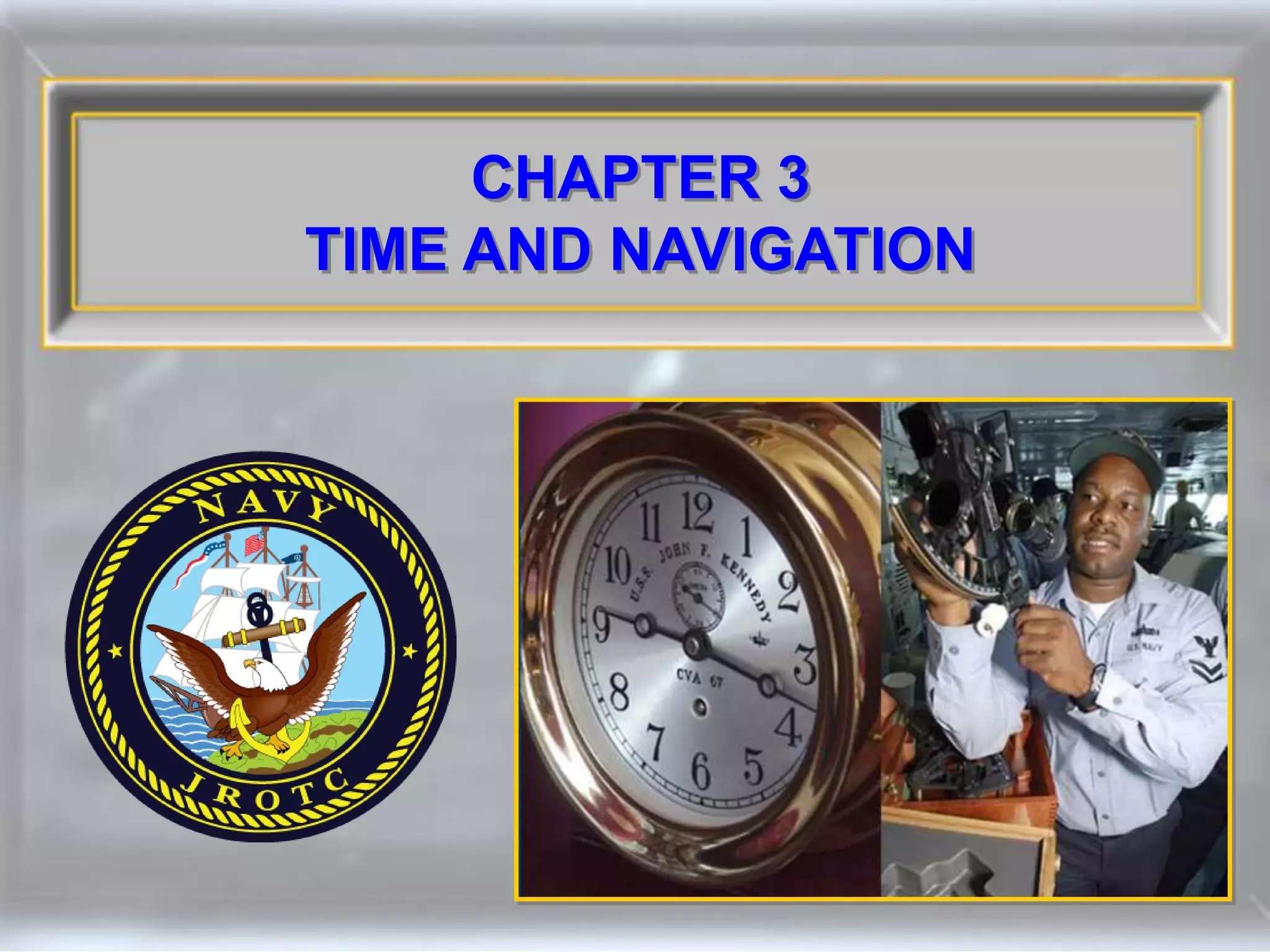
CHAPTER 3
TIME AND NAVIGATION
Jet Lag
Jet Lag

Temporary disruptions of the body’s
normal biological rhythms after
high-speed air travel through several
time zones
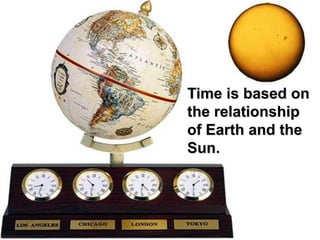
Time is based on
the relationship
of Earth and the
Sun.
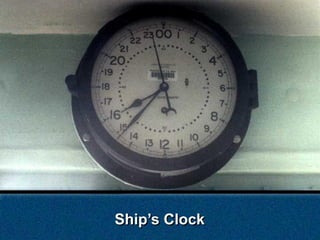
Ship’s Clock
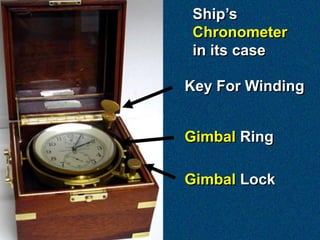
Ship’s
 Chronometer
 in its case

Key For Winding


Gimbal Ring

Gimbal Lock
Chronometer

A timepiece or timing device with a
special mechanism for ensuring and
adjusting its accuracy, for use in
determining longitude at sea or for
any purpose where very exact
measurement of time is required
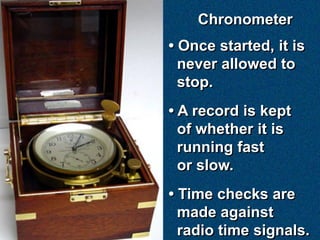
Chronometer
• Once started, it is
  never allowed to
  stop.
• A record is kept
  of whether it is
  running fast
  or slow.
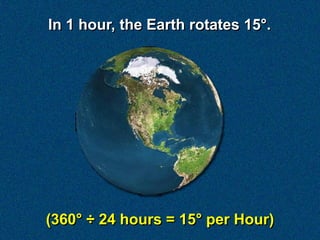
• Time checks are
  made against
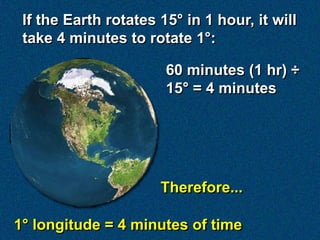
  radio time signals.
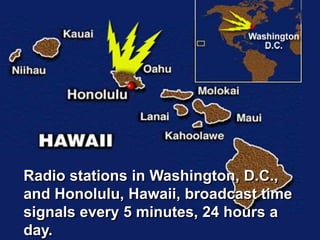
Radio stations in Washington, D.C.,
and Honolulu, Hawaii, broadcast time
signals every 5 minutes, 24 hours a
day.
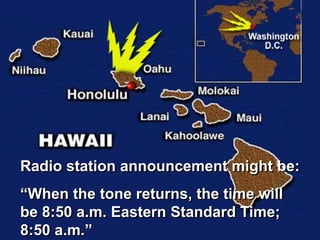
Radio station announcement might be:
―When the tone returns, the time will
be 8:50 a.m. Eastern Standard Time;
8:50 a.m.‖
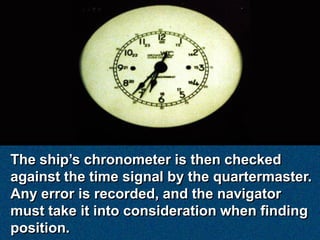
The ship’s chronometer is then checked
against the time signal by the quartermaster.
Any error is recorded, and the navigator
must take it into consideration when finding
position.
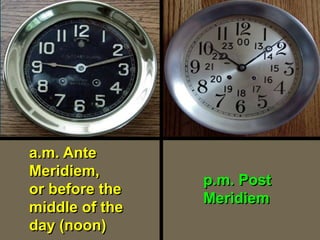
a.m. Ante
Meridiem,
                p.m. Post
or before the
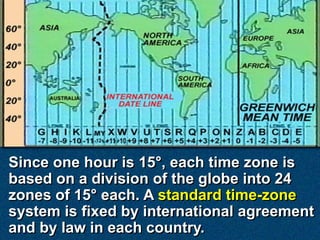
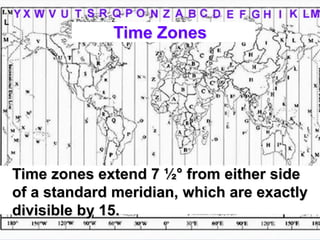
                Meridiem
middle of the
day (noon)
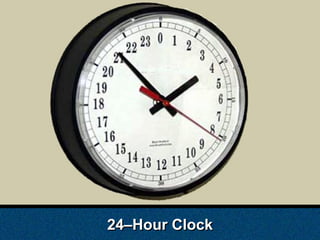
24–Hour Clock
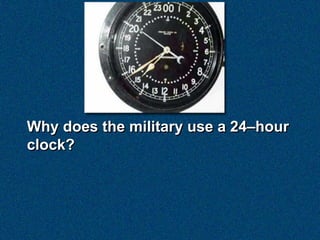
Why does the military use a 24–hour
clock?
NAVY                   AIR FORCE


                                MARINES


ARMY
  All military services use the 24–hour
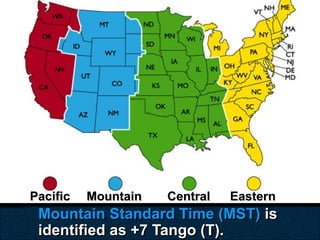
  clock.
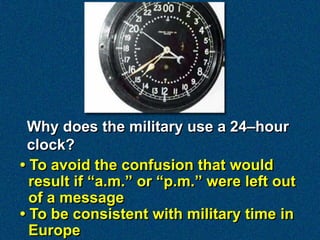
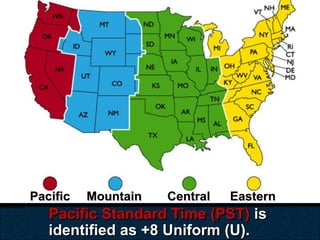
Why does the military use a 24–hour
 clock?
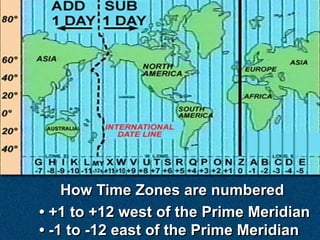
• To avoid the confusion that would
  result if ―a.m.‖ or ―p.m.‖ were left out
  of a message
• To be consistent with military time in
  Europe
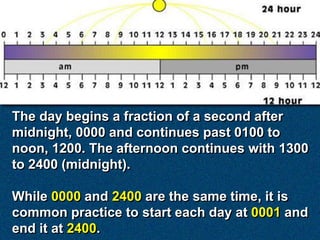
The day begins a fraction of a second after
midnight, 0000 and continues past 0100 to
noon, 1200. The afternoon continues with 1300
to 2400 (midnight).

While 0000 and 2400 are the same time, it is
common practice to start each day at 0001 and
end it at 2400.
As a cadet, you should memorize the
24–hour clock so it becomes second
nature when telling time.
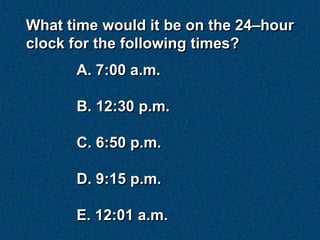
What time would it be on the 24–hour
clock for the following times?
      A. 7:00 a.m.

      B. 12:30 p.m.

      C. 6:50 p.m.

      D. 9:15 p.m.

      E. 12:01 a.m.
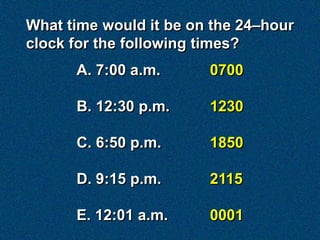
What time would it be on the 24–hour
clock for the following times?
      A. 7:00 a.m.      0700

      B. 12:30 p.m.     1230

      C. 6:50 p.m.      1850

      D. 9:15 p.m.      2115

      E. 12:01 a.m.     0001
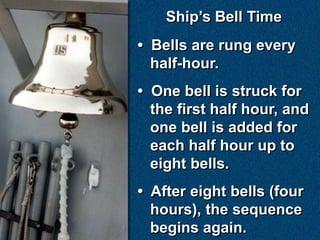
Ship’s Bell Time
• Bells are rung every
  half-hour.
• One bell is struck for
  the first half hour, and
  one bell is added for
  each half hour up to
  eight bells.
• After eight bells (four
  hours), the sequence
  begins again.
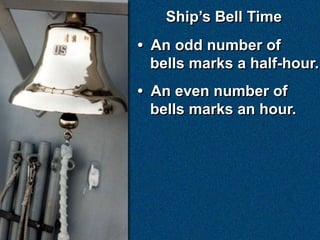
Ship’s Bell Time
• An odd number of
  bells marks a half-hour.
• An even number of
  bells marks an hour.
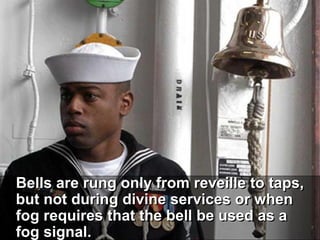
Bells are rung only from reveille to taps,
but not during divine services or when
fog requires that the bell be used as a
fog signal.
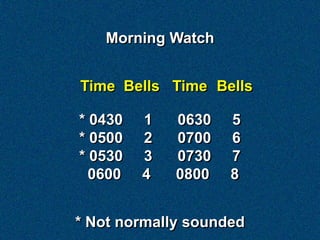
Morning Watch


Time Bells Time Bells

* 0430   1   0630   5
* 0500   2   0700   6
* 0530   3   0730   7
  0600   4   0800   8


* Not normally sounded
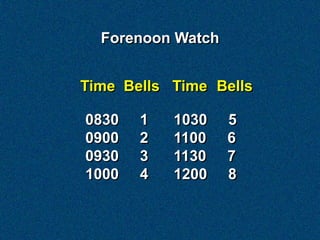
Forenoon Watch


Time Bells Time Bells

0830   1   1030    5
0900   2   1100    6
0930   3   1130    7
1000   4   1200    8
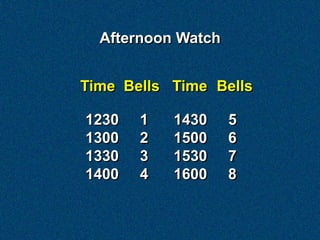
Afternoon Watch


Time Bells Time Bells

1230   1   1430     5
1300   2   1500     6
1330   3   1530     7
1400   4   1600     8
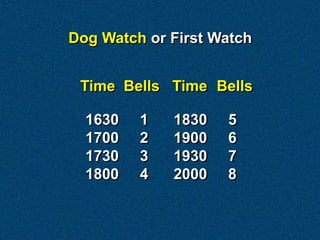
Dog Watch or First Watch


 Time Bells Time Bells

  1630   1   1830   5
  1700   2   1900   6
  1730   3   1930   7
  1800   4   2000   8
Dog Watches

1600 — 1800 First dog watch
1800 — 2000 Second dog watch
The first and second dog watches
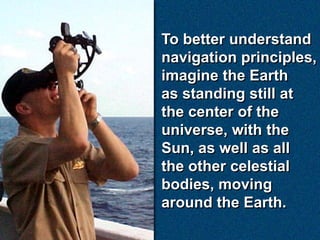
straddle the time when the evening
meal is traditionally served. Those
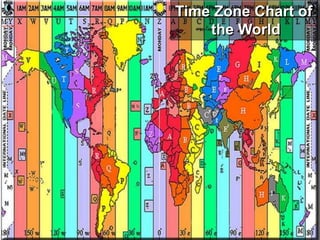
with the first dog eat the evening
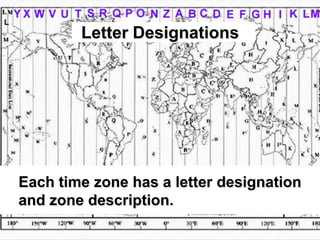
meal after being relieved and those
with the second dog eat before
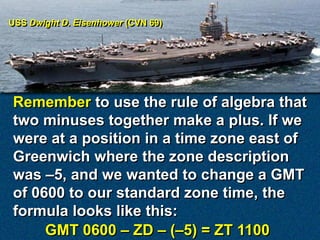
assuming the watch.
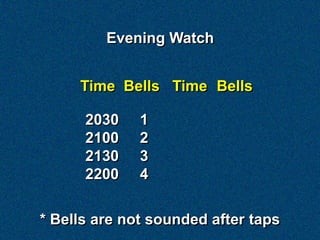
Evening Watch


     Time Bells Time Bells

      2030    1
      2100    2
      2130    3
      2200    4

* Bells are not sounded after taps
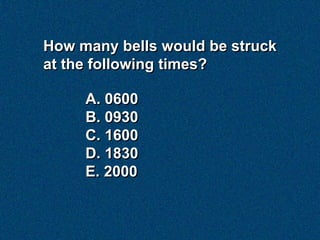
How many bells would be struck
at the following times?

     A. 0600
     B. 0930
     C. 1600
     D. 1830
     E. 2000
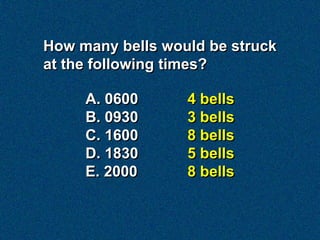
How many bells would be struck
at the following times?

     A. 0600      4 bells
     B. 0930      3 bells
     C. 1600      8 bells
     D. 1830      5 bells
     E. 2000      8 bells
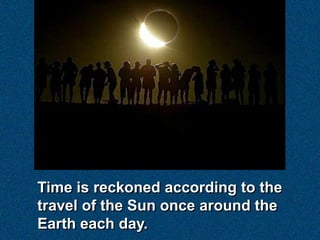
Time is reckoned according to the
travel of the Sun once around the
Earth each day.
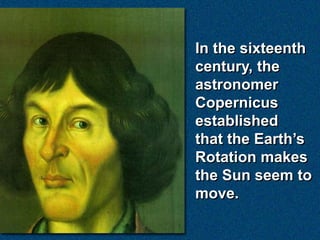
In the sixteenth
century, the
astronomer
Copernicus
established
that the Earth’s
Rotation makes
the Sun seem to
move.
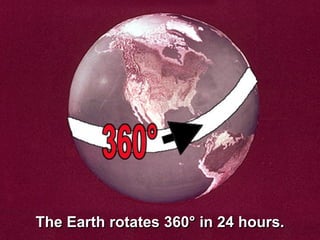
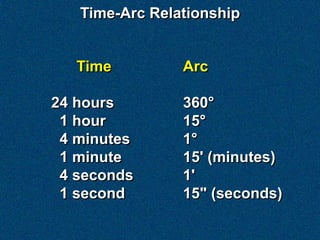
The Earth rotates 360° in 24 hours.
In 1 hour, the Earth rotates 15°.


(360° ÷ 24 hours = 15° per Hour)
If the Earth rotates 15° in 1 hour, it will
 take 4 minutes to rotate 1°:

                       60 minutes (1 hr) ÷
                       15° = 4 minutes


                      Therefore...

1° longitude = 4 minutes of time
Time-Arc Relationship


   Time         Arc

24 hours        360°
 1 hour         15°
 4 minutes      1°
 1 minute       15' (minutes)
 4 seconds      1'
 1 second       15" (seconds)
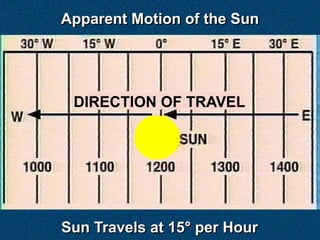
Apparent Motion of the Sun


 DIRECTION OF TRAVEL


Sun Travels at 15° per Hour
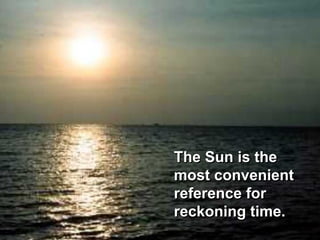
The Sun is the
most convenient
reference for
reckoning time.
Solar Time

Time based on the apparent motion
of the Sun around the Earth
Apparent Time

Time based on the apparent position
of the Sun from your position.

If the Sun is directly over the
meridian we are on, we say that it
is noon, local apparent time.
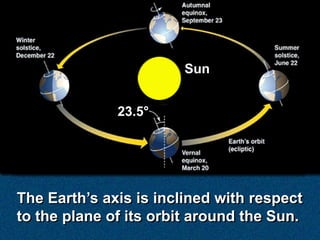
Sun


              23.5°


The Earth’s axis is inclined with respect
to the plane of its orbit around the Sun.
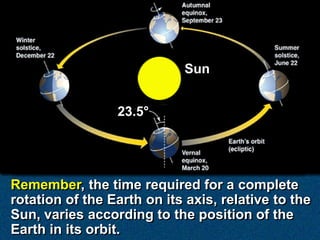
Sun


                 23.5°


Remember, the time required for a complete
rotation of the Earth on its axis, relative to the
Sun, varies according to the position of the
Earth in its orbit.
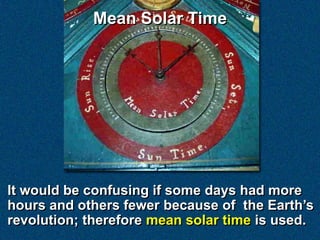
Mean Solar Time


It would be confusing if some days had more
hours and others fewer because of the Earth’s
revolution; therefore mean solar time is used.
Mean Solar Time

Average solar time, based on the
Sun’s apparent journey around the
Earth (360°) in exactly 24 hours
Local Mean Time (LMT)

The time at your location based on
the mean position of the Sun — that
is 1200, the mean Sun is over your
meridian, not the actual Sun
The Equation of Time

The difference between apparent
time and the mean time
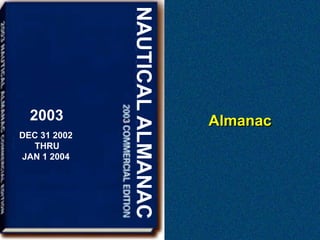
NAUTICAL ALMANAC
  2003                           Almanac
DEC 31 2002
  THRU
JAN 1 2004
Almanac

An annual publication containing a
calendar for the coming year, the times
of such events and phenomena as
anniversaries, sunrises and sunsets,
phases of the moon, tides, etc., and other
astronomical statistical information and
related topics
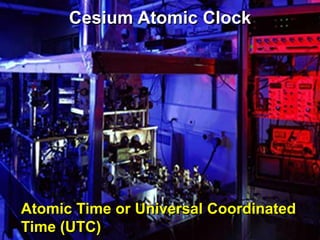
Cesium Atomic Clock


Atomic Time or Universal Coordinated
Time (UTC)
Atomic Time or Universal
   Coordinated Time (UTC)

An internationally agreed-upon time
scale based on the frequency of
vibrations of the radioactive cesium
atom
Greenwich Mean Time (GMT)

Time based on the relationship of the
mean Sun to the prime meridian
Zone Time (ZT)

Local mean time along each standard
time meridian
Since one hour is 15°, each time zone is
based on a division of the globe into 24
zones of 15° each. A standard time-zone
system is fixed by international agreement
and by law in each country.
Standard Time Zone

15°-wide zone of the Earth
that has the same time
Zone Description (ZD)


The difference in hours between your
Zone Time (ZT) and Greenwich Mean Time
 (GMT) (Use ―+‖ for longitude west, and
―-‖ for longitude east, for example +8)
Zone Description (ZD)

Letter and a negative or positive
number for 1 to 12, east or west of
the prime meridian
Daylight Savings Time

    Zone time set ahead 1 hour

The practice of advancing standard
time by 1 hour in the spring of
each year and of setting it back by
1 hour in the fall in order to gain
an extra period of daylight during
the early evening
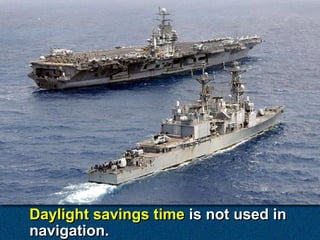
Daylight savings time is not used in
navigation.
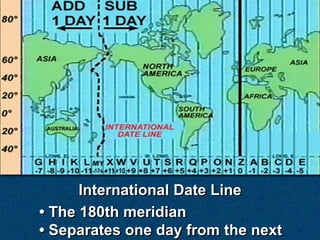
International Date Line
• The 180th meridian
• Separates one day from the next
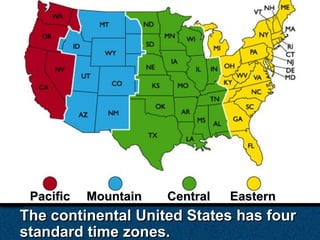
Pacific   Mountain   Central   Eastern
The continental United States has four
standard time zones.
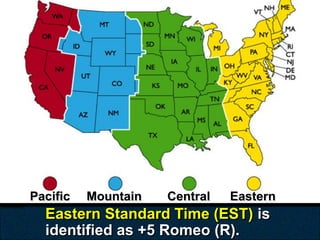
Pacific   Mountain   Central   Eastern
  Eastern Standard Time (EST) is
  identified as +5 Romeo (R).
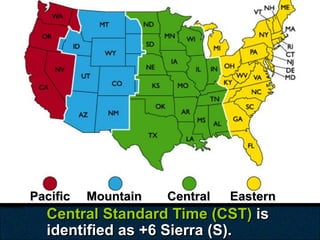
Pacific   Mountain   Central   Eastern
  Central Standard Time (CST) is
  identified as +6 Sierra (S).
Pacific   Mountain   Central   Eastern
 Mountain Standard Time (MST) is
 identified as +7 Tango (T).
Pacific   Mountain   Central   Eastern
   Pacific Standard Time (PST) is
   identified as +8 Uniform (U).
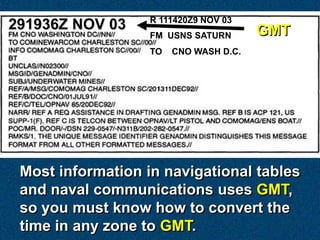
R 111420Z9 NOV 03
291936Z NOV 03                          GMT
                   FM USNS SATURN
                   TO   CNO WASH D.C.


 Most information in navigational tables
 and naval communications uses GMT,
 so you must know how to convert the
 time in any zone to GMT.
How Time Zones are numbered
• +1 to +12 west of the Prime Meridian
• -1 to -12 east of the Prime Meridian
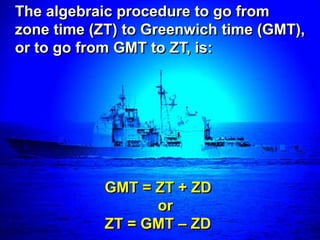
The algebraic procedure to go from
zone time (ZT) to Greenwich time (GMT),
or to go from GMT to ZT, is:


            GMT = ZT + ZD
                  or
            ZT = GMT – ZD
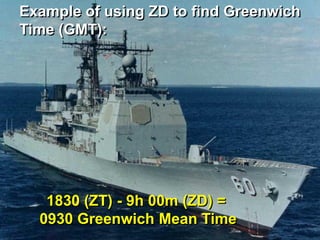
Example of using ZD to find Greenwich
Time (GMT):


   1830 (ZT) - 9h 00m (ZD) =
  0930 Greenwich Mean Time
Example of Computing GMT

Your ship is off the coast of Somalia
(ZD = –3). The local time is 1600.
What is the GMT?


          GMT = ZT + ZD
Example of Computing GMT

Your ship is off the coast of Somalia
(ZD = –3). The local time is 1600.
What is the GMT?


          GMT = ZT + ZD

     GMT = 1600 – 3h = 1300
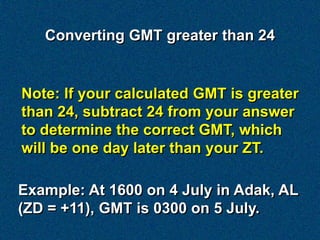
Converting GMT greater than 24


Note: If your calculated GMT is greater
than 24, subtract 24 from your answer
to determine the correct GMT, which
will be one day later than your ZT.

Example: At 1600 on 4 July in Adak, AL
(ZD = +11), GMT is 0300 on 5 July.
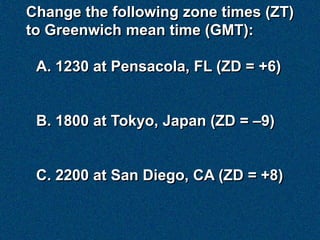
Change the following zone times (ZT)
to Greenwich mean time (GMT):

 A. 1230 at Pensacola, FL (ZD = +6)


 B. 1800 at Tokyo, Japan (ZD = –9)


 C. 2200 at San Diego, CA (ZD = +8)
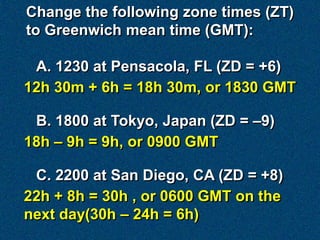
Change the following zone times (ZT)
to Greenwich mean time (GMT):

 A. 1230 at Pensacola, FL (ZD = +6)
12h 30m + 6h = 18h 30m, or 1830 GMT

 B. 1800 at Tokyo, Japan (ZD = –9)
18h – 9h = 9h, or 0900 GMT

 C. 2200 at San Diego, CA (ZD = +8)
22h + 8h = 30h , or 0600 GMT on the
next day(30h – 24h = 6h)
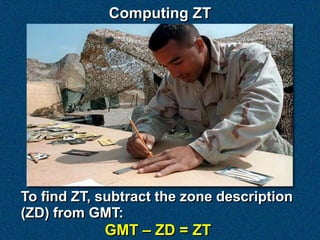
Computing ZT


To find ZT, subtract the zone description
(ZD) from GMT:
            GMT – ZD = ZT
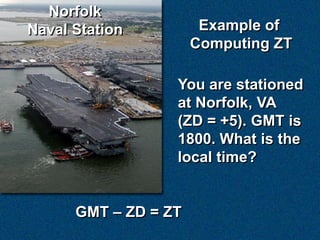
Norfolk
Naval Station          Example of
                      Computing ZT

                  You are stationed
                  at Norfolk, VA
                  (ZD = +5). GMT is
                  1800. What is the
                  local time?


      GMT – ZD = ZT
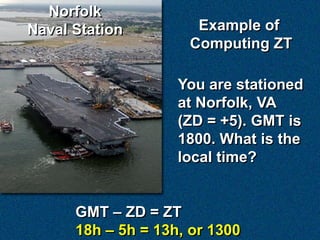
Norfolk
Naval Station         Example of
                     Computing ZT

                    You are stationed
                    at Norfolk, VA
                    (ZD = +5). GMT is
                    1800. What is the
                    local time?


      GMT – ZD = ZT
      18h – 5h = 13h, or 1300
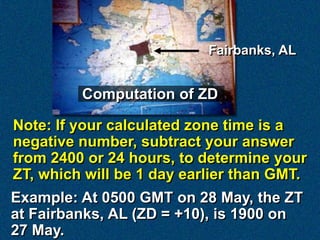
Fairbanks, AL


         Computation of ZD

Note: If your calculated zone time is a
negative number, subtract your answer
from 2400 or 24 hours, to determine your
ZT, which will be 1 day earlier than GMT.
Example: At 0500 GMT on 28 May, the ZT
at Fairbanks, AL (ZD = +10), is 1900 on
27 May.
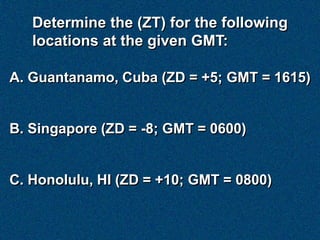
Determine the (ZT) for the following
   locations at the given GMT:

A. Guantanamo, Cuba (ZD = +5; GMT = 1615)


B. Singapore (ZD = -8; GMT = 0600)


C. Honolulu, HI (ZD = +10; GMT = 0800)
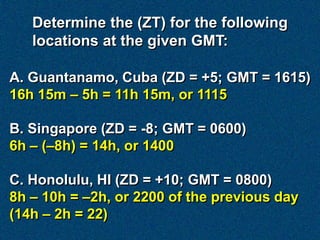
Determine the (ZT) for the following
   locations at the given GMT:

A. Guantanamo, Cuba (ZD = +5; GMT = 1615)
16h 15m – 5h = 11h 15m, or 1115

B. Singapore (ZD = -8; GMT = 0600)
6h – (–8h) = 14h, or 1400

C. Honolulu, HI (ZD = +10; GMT = 0800)
8h – 10h = –2h, or 2200 of the previous day
(14h – 2h = 22)
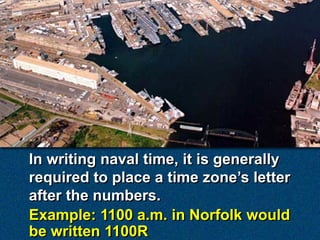
In writing naval time, it is generally
required to place a time zone’s letter
after the numbers.
Example: 1100 a.m. in Norfolk would
be written 1100R
San Diego Naval Base


If it was 6:30 p.m. in San Diego how
would you write it in naval time?
San Diego Naval Base


If it was 6:30 p.m. in San Diego how
would you write it in naval time?
              1830U
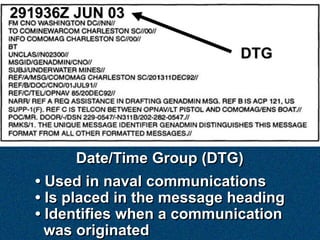
291936Z JUN 03

                              DTG


        Date/Time Group (DTG)
   • Used in naval communications
   • Is placed in the message heading
   • Identifies when a communication
     was originated
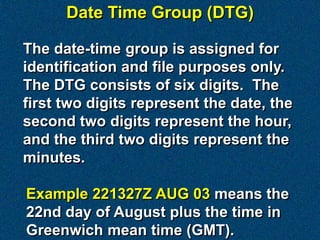
Date Time Group (DTG)

The date-time group is assigned for
identification and file purposes only.
The DTG consists of six digits. The
first two digits represent the date, the
second two digits represent the hour,
and the third two digits represent the
minutes.

Example 221327Z AUG 03 means the
22nd day of August plus the time in
Greenwich mean time (GMT).
291936Z JUN 03

                              DTG


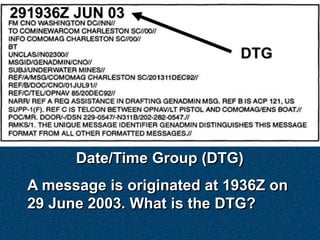
        Date/Time Group (DTG)
  A message is originated at 1936Z on
  29 June 2003. What is the DTG?
291936Z JUN 03

                              DTG


        Date/Time Group (DTG)
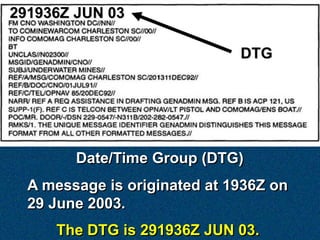
  A message is originated at 1936Z on
  29 June 2003.
     The DTG is 291936Z JUN 03.
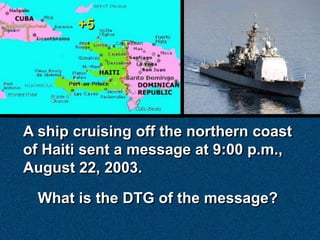
+5


A ship cruising off the northern coast
of Haiti sent a message at 9:00 p.m.,
August 22, 2003.

  What is the DTG of the message?
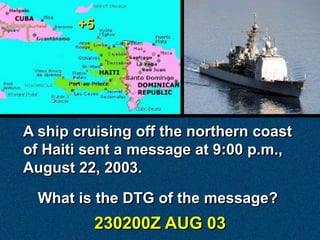
+5


A ship cruising off the northern coast
of Haiti sent a message at 9:00 p.m.,
August 22, 2003.

  What is the DTG of the message?
            230200Z AUG 03
TIME AND NAVIGATION
      THE END
Q.1. What is the time used in fixing
     position by celestial
     navigation?
Q.1. What is the time used in fixing
     position by celestial
     navigation?


A.1. Greenwich mean time
Q.2. What is celestial navigation?


A.2. Finding position by sightings of
     the Sun, stars, planets, and
     Moon
Q.3. Why is a chronometer used in
     celestial navigation?
Q.3. Why is a chronometer used in
     celestial navigation?


A.3. Because it is a very accurate
     timepiece
Q.4. Why is the ship’s bell time
     struck every half hour?
Q.4. Why is the ship’s bell time
     struck every half hour?


A.4. Bell time originated when a
     ship’s timepiece was an hour
     glass which ran out of sand
     every half hour and had to be
     turned.
Q.5. How do ships at sea ensure
     their clocks are correct?
Q.5. How do ships at sea ensure
     their clocks are correct?


A.5. Time checks broadcast on radio
     from Washington, D.C., and
     Honolulu, Hawaii
Q.6. Why does the Navy use the
     24-hour clock while civilians
     use the 12-hour clock?
Q.6. Why does the Navy use the
     24-hour clock while civilians
     use the 12-hour clock?


A.6. 1. Old maritime custom
     2. Avoid confusion in message
        communications
     3. Avoid possible confusion
        because of A.M. and P.M.
     4. To be consistent with military
        time in Europe
Q.7. How would you write and say
     the time 3:30 P.M. and 4:55 A.M.
     in Navy time?
Q.7. How would you write and say
     the time 3:30 P.M. and 4:55 A.M.
     in Navy time?


A.7. 1530, fifteen thirty hours;
     0455, zero four fifty-five hours
Q.8. How many bells should be rung
     at 0730, 1430, and 2000?
Q.8. How many bells should be rung
     at 0730, 1430, and 2000?


A.8. 7, 5, 8
Q.9. How often and why is the series
     of bells on a ship repeated?
Q.9. How often and why is the series
     of bells on a ship repeated?


A.9. Every 4 hours to coincide with
     the watch schedule
Q.10. When it is noon at our location
      (longitude), what is the local
      apparent time at the meridian
      180 degrees away from ours?
Q.10. When it is noon at our location
      (longitude), what is the local
      apparent time at the meridian
      180 degrees away from ours?


A.10. Midnight
Q.11. Why do our calendars have 366
      days in a year every four years.
Q.11. Why do our calendars have 366
      days in a year every four years.


A.11. To account for the error in the
      Earth's revolution in an
      elliptical (not perfectly circular)
      path around the Sun
Q.12. What is the relationship
      between time and the arc of the
      Sun around the Earth?
Q.12. What is the relationship
      between time and the arc of the
      Sun around the Earth?


A.12. The Sun travels an arc of 15
      degrees each hour or one
      degree of arc every four
      minutes.
Q.13. What is solar time?


A.13. Time measured by using the
      Sun as a reference point
Q.14. What is apparent time?


A.14. Time based on the apparent
      position of the Sun at any
      given position on the Earth
Q.15. What is mean solar time?


A.15. It is the average solar time that
      is a method to prevent
      confusion due to the different
      lengths of days.
Q.16. What is local mean time?


A.16. The average solar time over a
      given position for a given time
      throughout the year - not the
      true Sun position
Q.17. What is Greenwich Mean Time
      (GMT)?
Q.17. What is Greenwich Mean Time
      (GMT)?


A.17. The local mean time at the
      Royal Observatory in
      Greenwich, England
Q.18. Why is GMT important to
      remember?
Q.18. Why is GMT important to
      remember?


A.18. By international agreement,
      it is the reference time used
      for navigation and
      communications.
Q.19. How many time zones are there
      worldwide?
Q.19. How many time zones are there
      worldwide?


A.19. 24
Q.20. How many degrees of arc are
      there in a time zone?
Q.20. How many degrees of arc are
      there in a time zone?


A.20. 15 degrees
Q.21. What does a date/time group
      (DTG) include?
Q.21. What does a date/time group
      (DTG) include?


A.21. The date, the time, ZD (zone
      description, usually Z for
      GMT), month, and last 2 digits
      of the year

     Example: 151635Z APR 03
Q.22. How many time zones cover
      the contiguous U.S.?
Q.22. How many time zones cover
      the contiguous U.S.?


A.22. Four, EST, CST, MST, PST
Q.23. What are zone descriptions for
      the time zones around the
      world?
Q.23. What are zone descriptions for
      the time zones around the
      world?


A.23. Zone descriptions are the
      numbers 1 through 12,
      prefixed by + west of
      Greenwich and - east of
      Greenwich.
Q.24. What is the equation for
      converting zone time to GMT?
Q.24. What is the equation for
      converting zone time to GMT?


A.24. GMT = Zone time (ZT) + Zone
      description (ZD)
Q.25. What is Daylight Savings
      Time?
Q.25. What is Daylight Savings
      Time?


A.25. Zone time set ahead one hour
      (usually in the summer) to
      extend the time of daylight in
      the evening. It is NOT used in
      navigation.
Gimbals

A contrivance, consisting of a ring
or base on an axis, that permits an
object, as a ship's compass,
mounted in or on it to tilt freely in
any direction, in effect suspending
the object so that it will remain
horizontal even when its support is
tipped
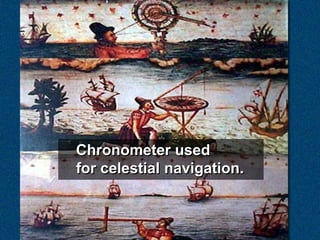
Chronometer used
for celestial navigation.
Arc

Any unbroken part of the
circumference of a circle or
other curved line
Longitude

Measurement of position east or
west from the prime meridian
To better understand
navigation principles,
imagine the Earth
as standing still at
the center of the
universe, with the
Sun, as well as all
the other celestial
bodies, moving
around the Earth.
Rotation (of Earth)

Produces the apparent motion of the
Sun


     Revolution (of Earth)

Path the Earth takes around the Sun
Time Zone Chart of
    the World
Letter Designations


Each time zone has a letter designation
and zone description.
Time Zones


Time zones extend 7 ½° from either side
of a standard meridian, which are exactly
divisible by 15.
USS Dwight D. Eisenhower (CVN 69)


Remember to use the rule of algebra that
two minuses together make a plus. If we
were at a position in a time zone east of
Greenwich where the zone description
was –5, and we wanted to change a GMT
of 0600 to our standard zone time, the
formula looks like this:
     GMT 0600 – ZD – (–5) = ZT 1100

Time and Navigation

  • 1.
  • 2.
  • 3.
    Jet Lag Temporary disruptionsof the body’s normal biological rhythms after high-speed air travel through several time zones
  • 4.
    Time is basedon the relationship of Earth and the Sun.
  • 5.
  • 6.
    Ship’s Chronometer inits case Key For Winding Gimbal Ring Gimbal Lock
  • 7.
    Chronometer A timepiece ortiming device with a special mechanism for ensuring and adjusting its accuracy, for use in determining longitude at sea or for any purpose where very exact measurement of time is required
  • 8.
    Chronometer • Once started,it is never allowed to stop. • A record is kept of whether it is running fast or slow. • Time checks are made against radio time signals.
  • 9.
    Radio stations inWashington, D.C., and Honolulu, Hawaii, broadcast time signals every 5 minutes, 24 hours a day.
  • 10.
    Radio station announcementmight be: ―When the tone returns, the time will be 8:50 a.m. Eastern Standard Time; 8:50 a.m.‖
  • 11.
    The ship’s chronometeris then checked against the time signal by the quartermaster. Any error is recorded, and the navigator must take it into consideration when finding position.
  • 12.
    a.m. Ante Meridiem, p.m. Post or before the Meridiem middle of the day (noon)
  • 13.
  • 14.
    Why does themilitary use a 24–hour clock?
  • 15.
    NAVY AIR FORCE MARINES ARMY All military services use the 24–hour clock.
  • 16.
    Why does themilitary use a 24–hour clock? • To avoid the confusion that would result if ―a.m.‖ or ―p.m.‖ were left out of a message • To be consistent with military time in Europe
  • 17.
    The day beginsa fraction of a second after midnight, 0000 and continues past 0100 to noon, 1200. The afternoon continues with 1300 to 2400 (midnight). While 0000 and 2400 are the same time, it is common practice to start each day at 0001 and end it at 2400.
  • 18.
    As a cadet,you should memorize the 24–hour clock so it becomes second nature when telling time.
  • 19.
    What time wouldit be on the 24–hour clock for the following times? A. 7:00 a.m. B. 12:30 p.m. C. 6:50 p.m. D. 9:15 p.m. E. 12:01 a.m.
  • 20.
    What time wouldit be on the 24–hour clock for the following times? A. 7:00 a.m. 0700 B. 12:30 p.m. 1230 C. 6:50 p.m. 1850 D. 9:15 p.m. 2115 E. 12:01 a.m. 0001
  • 21.
    Ship’s Bell Time •Bells are rung every half-hour. • One bell is struck for the first half hour, and one bell is added for each half hour up to eight bells. • After eight bells (four hours), the sequence begins again.
  • 22.
    Ship’s Bell Time •An odd number of bells marks a half-hour. • An even number of bells marks an hour.
  • 23.
    Bells are rungonly from reveille to taps, but not during divine services or when fog requires that the bell be used as a fog signal.
  • 24.
    Morning Watch Time BellsTime Bells * 0430 1 0630 5 * 0500 2 0700 6 * 0530 3 0730 7 0600 4 0800 8 * Not normally sounded
  • 25.
    Forenoon Watch Time BellsTime Bells 0830 1 1030 5 0900 2 1100 6 0930 3 1130 7 1000 4 1200 8
  • 26.
    Afternoon Watch Time BellsTime Bells 1230 1 1430 5 1300 2 1500 6 1330 3 1530 7 1400 4 1600 8
  • 27.
    Dog Watch orFirst Watch Time Bells Time Bells 1630 1 1830 5 1700 2 1900 6 1730 3 1930 7 1800 4 2000 8
  • 28.
    Dog Watches 1600 —1800 First dog watch 1800 — 2000 Second dog watch The first and second dog watches straddle the time when the evening meal is traditionally served. Those with the first dog eat the evening meal after being relieved and those with the second dog eat before assuming the watch.
  • 29.
    Evening Watch Time Bells Time Bells 2030 1 2100 2 2130 3 2200 4 * Bells are not sounded after taps
  • 30.
    How many bellswould be struck at the following times? A. 0600 B. 0930 C. 1600 D. 1830 E. 2000
  • 31.
    How many bellswould be struck at the following times? A. 0600 4 bells B. 0930 3 bells C. 1600 8 bells D. 1830 5 bells E. 2000 8 bells
  • 32.
    Time is reckonedaccording to the travel of the Sun once around the Earth each day.
  • 33.
    In the sixteenth century,the astronomer Copernicus established that the Earth’s Rotation makes the Sun seem to move.
  • 34.
    The Earth rotates360° in 24 hours.
  • 35.
    In 1 hour,the Earth rotates 15°. (360° ÷ 24 hours = 15° per Hour)
  • 36.
    If the Earthrotates 15° in 1 hour, it will take 4 minutes to rotate 1°: 60 minutes (1 hr) ÷ 15° = 4 minutes Therefore... 1° longitude = 4 minutes of time
  • 37.
    Time-Arc Relationship Time Arc 24 hours 360° 1 hour 15° 4 minutes 1° 1 minute 15' (minutes) 4 seconds 1' 1 second 15" (seconds)
  • 38.
    Apparent Motion ofthe Sun DIRECTION OF TRAVEL Sun Travels at 15° per Hour
  • 39.
    The Sun isthe most convenient reference for reckoning time.
  • 40.
    Solar Time Time basedon the apparent motion of the Sun around the Earth
  • 41.
    Apparent Time Time basedon the apparent position of the Sun from your position. If the Sun is directly over the meridian we are on, we say that it is noon, local apparent time.

  • 42.
    Sun 23.5° The Earth’s axis is inclined with respect to the plane of its orbit around the Sun.
  • 43.
    Sun 23.5° Remember, the time required for a complete rotation of the Earth on its axis, relative to the Sun, varies according to the position of the Earth in its orbit.
  • 44.
    Mean Solar Time Itwould be confusing if some days had more hours and others fewer because of the Earth’s revolution; therefore mean solar time is used.
  • 45.
    Mean Solar Time Averagesolar time, based on the Sun’s apparent journey around the Earth (360°) in exactly 24 hours
  • 46.
    Local Mean Time(LMT) The time at your location based on the mean position of the Sun — that is 1200, the mean Sun is over your meridian, not the actual Sun
  • 47.
    The Equation ofTime The difference between apparent time and the mean time
  • 48.
    NAUTICAL ALMANAC 2003 Almanac DEC 31 2002 THRU JAN 1 2004
  • 49.
    Almanac An annual publicationcontaining a calendar for the coming year, the times of such events and phenomena as anniversaries, sunrises and sunsets, phases of the moon, tides, etc., and other astronomical statistical information and related topics
  • 50.
    Cesium Atomic Clock AtomicTime or Universal Coordinated Time (UTC)
  • 51.
    Atomic Time orUniversal Coordinated Time (UTC) An internationally agreed-upon time scale based on the frequency of vibrations of the radioactive cesium atom
  • 52.
    Greenwich Mean Time(GMT) Time based on the relationship of the mean Sun to the prime meridian
  • 53.
    Zone Time (ZT) Localmean time along each standard time meridian
  • 54.
    Since one houris 15°, each time zone is based on a division of the globe into 24 zones of 15° each. A standard time-zone system is fixed by international agreement and by law in each country.
  • 55.
    Standard Time Zone 15°-widezone of the Earth that has the same time
  • 56.
    Zone Description (ZD) Thedifference in hours between your Zone Time (ZT) and Greenwich Mean Time (GMT) (Use ―+‖ for longitude west, and ―-‖ for longitude east, for example +8)
  • 57.
    Zone Description (ZD) Letterand a negative or positive number for 1 to 12, east or west of the prime meridian
  • 58.
    Daylight Savings Time Zone time set ahead 1 hour The practice of advancing standard time by 1 hour in the spring of each year and of setting it back by 1 hour in the fall in order to gain an extra period of daylight during the early evening
  • 59.
    Daylight savings timeis not used in navigation.
  • 60.
    International Date Line •The 180th meridian • Separates one day from the next
  • 61.
    Pacific Mountain Central Eastern The continental United States has four standard time zones.
  • 62.
    Pacific Mountain Central Eastern Eastern Standard Time (EST) is identified as +5 Romeo (R).
  • 63.
    Pacific Mountain Central Eastern Central Standard Time (CST) is identified as +6 Sierra (S).
  • 64.
    Pacific Mountain Central Eastern Mountain Standard Time (MST) is identified as +7 Tango (T).
  • 65.
    Pacific Mountain Central Eastern Pacific Standard Time (PST) is identified as +8 Uniform (U).
  • 66.
    R 111420Z9 NOV03 291936Z NOV 03 GMT FM USNS SATURN TO CNO WASH D.C. Most information in navigational tables and naval communications uses GMT, so you must know how to convert the time in any zone to GMT.
  • 67.
    How Time Zonesare numbered • +1 to +12 west of the Prime Meridian • -1 to -12 east of the Prime Meridian
  • 68.
    The algebraic procedureto go from zone time (ZT) to Greenwich time (GMT), or to go from GMT to ZT, is: GMT = ZT + ZD or ZT = GMT – ZD
  • 69.
    Example of usingZD to find Greenwich Time (GMT): 1830 (ZT) - 9h 00m (ZD) = 0930 Greenwich Mean Time
  • 70.
    Example of ComputingGMT Your ship is off the coast of Somalia (ZD = –3). The local time is 1600. What is the GMT? GMT = ZT + ZD
  • 71.
    Example of ComputingGMT Your ship is off the coast of Somalia (ZD = –3). The local time is 1600. What is the GMT? GMT = ZT + ZD GMT = 1600 – 3h = 1300
  • 72.
    Converting GMT greaterthan 24 Note: If your calculated GMT is greater than 24, subtract 24 from your answer to determine the correct GMT, which will be one day later than your ZT. Example: At 1600 on 4 July in Adak, AL (ZD = +11), GMT is 0300 on 5 July.
  • 73.
    Change the followingzone times (ZT) to Greenwich mean time (GMT): A. 1230 at Pensacola, FL (ZD = +6) B. 1800 at Tokyo, Japan (ZD = –9) C. 2200 at San Diego, CA (ZD = +8)
  • 74.
    Change the followingzone times (ZT) to Greenwich mean time (GMT): A. 1230 at Pensacola, FL (ZD = +6) 12h 30m + 6h = 18h 30m, or 1830 GMT B. 1800 at Tokyo, Japan (ZD = –9) 18h – 9h = 9h, or 0900 GMT C. 2200 at San Diego, CA (ZD = +8) 22h + 8h = 30h , or 0600 GMT on the next day(30h – 24h = 6h)
  • 75.
    Computing ZT To findZT, subtract the zone description (ZD) from GMT: GMT – ZD = ZT
  • 76.
    Norfolk Naval Station Example of Computing ZT You are stationed at Norfolk, VA (ZD = +5). GMT is 1800. What is the local time? GMT – ZD = ZT
  • 77.
    Norfolk Naval Station Example of Computing ZT You are stationed at Norfolk, VA (ZD = +5). GMT is 1800. What is the local time? GMT – ZD = ZT 18h – 5h = 13h, or 1300
  • 78.
    Fairbanks, AL Computation of ZD Note: If your calculated zone time is a negative number, subtract your answer from 2400 or 24 hours, to determine your ZT, which will be 1 day earlier than GMT. Example: At 0500 GMT on 28 May, the ZT at Fairbanks, AL (ZD = +10), is 1900 on 27 May.
  • 79.
    Determine the (ZT)for the following locations at the given GMT: A. Guantanamo, Cuba (ZD = +5; GMT = 1615) B. Singapore (ZD = -8; GMT = 0600) C. Honolulu, HI (ZD = +10; GMT = 0800)
  • 80.
    Determine the (ZT)for the following locations at the given GMT: A. Guantanamo, Cuba (ZD = +5; GMT = 1615) 16h 15m – 5h = 11h 15m, or 1115 B. Singapore (ZD = -8; GMT = 0600) 6h – (–8h) = 14h, or 1400 C. Honolulu, HI (ZD = +10; GMT = 0800) 8h – 10h = –2h, or 2200 of the previous day (14h – 2h = 22)
  • 81.
    In writing navaltime, it is generally required to place a time zone’s letter after the numbers. Example: 1100 a.m. in Norfolk would be written 1100R
  • 82.
    San Diego NavalBase If it was 6:30 p.m. in San Diego how would you write it in naval time?
  • 83.
    San Diego NavalBase If it was 6:30 p.m. in San Diego how would you write it in naval time? 1830U
  • 84.
    291936Z JUN 03 DTG Date/Time Group (DTG) • Used in naval communications • Is placed in the message heading • Identifies when a communication was originated
  • 85.
    Date Time Group(DTG) The date-time group is assigned for identification and file purposes only. The DTG consists of six digits. The first two digits represent the date, the second two digits represent the hour, and the third two digits represent the minutes. Example 221327Z AUG 03 means the 22nd day of August plus the time in Greenwich mean time (GMT).
  • 86.
    291936Z JUN 03 DTG Date/Time Group (DTG) A message is originated at 1936Z on 29 June 2003. What is the DTG?
  • 87.
    291936Z JUN 03 DTG Date/Time Group (DTG) A message is originated at 1936Z on 29 June 2003. The DTG is 291936Z JUN 03.
  • 88.
    +5 A ship cruisingoff the northern coast of Haiti sent a message at 9:00 p.m., August 22, 2003. What is the DTG of the message?
  • 89.
    +5 A ship cruisingoff the northern coast of Haiti sent a message at 9:00 p.m., August 22, 2003. What is the DTG of the message? 230200Z AUG 03
  • 90.
  • 91.
    Q.1. What isthe time used in fixing position by celestial navigation?
  • 92.
    Q.1. What isthe time used in fixing position by celestial navigation? A.1. Greenwich mean time
  • 93.
    Q.2. What iscelestial navigation?
  • 94.
    Q.2. What iscelestial navigation? A.2. Finding position by sightings of the Sun, stars, planets, and Moon
  • 95.
    Q.3. Why isa chronometer used in celestial navigation?
  • 96.
    Q.3. Why isa chronometer used in celestial navigation? A.3. Because it is a very accurate timepiece
  • 97.
    Q.4. Why isthe ship’s bell time struck every half hour?
  • 98.
    Q.4. Why isthe ship’s bell time struck every half hour? A.4. Bell time originated when a ship’s timepiece was an hour glass which ran out of sand every half hour and had to be turned.
  • 99.
    Q.5. How doships at sea ensure their clocks are correct?
  • 100.
    Q.5. How doships at sea ensure their clocks are correct? A.5. Time checks broadcast on radio from Washington, D.C., and Honolulu, Hawaii
  • 101.
    Q.6. Why doesthe Navy use the 24-hour clock while civilians use the 12-hour clock?
  • 102.
    Q.6. Why doesthe Navy use the 24-hour clock while civilians use the 12-hour clock? A.6. 1. Old maritime custom 2. Avoid confusion in message communications 3. Avoid possible confusion because of A.M. and P.M. 4. To be consistent with military time in Europe
  • 103.
    Q.7. How wouldyou write and say the time 3:30 P.M. and 4:55 A.M. in Navy time?
  • 104.
    Q.7. How wouldyou write and say the time 3:30 P.M. and 4:55 A.M. in Navy time? A.7. 1530, fifteen thirty hours; 0455, zero four fifty-five hours
  • 105.
    Q.8. How manybells should be rung at 0730, 1430, and 2000?
  • 106.
    Q.8. How manybells should be rung at 0730, 1430, and 2000? A.8. 7, 5, 8
  • 107.
    Q.9. How oftenand why is the series of bells on a ship repeated?
  • 108.
    Q.9. How oftenand why is the series of bells on a ship repeated? A.9. Every 4 hours to coincide with the watch schedule
  • 109.
    Q.10. When itis noon at our location (longitude), what is the local apparent time at the meridian 180 degrees away from ours?
  • 110.
    Q.10. When itis noon at our location (longitude), what is the local apparent time at the meridian 180 degrees away from ours? A.10. Midnight
  • 111.
    Q.11. Why doour calendars have 366 days in a year every four years.
  • 112.
    Q.11. Why doour calendars have 366 days in a year every four years. A.11. To account for the error in the Earth's revolution in an elliptical (not perfectly circular) path around the Sun
  • 113.
    Q.12. What isthe relationship between time and the arc of the Sun around the Earth?
  • 114.
    Q.12. What isthe relationship between time and the arc of the Sun around the Earth? A.12. The Sun travels an arc of 15 degrees each hour or one degree of arc every four minutes.
  • 115.
    Q.13. What issolar time?
  • 116.
    Q.13. What issolar time? A.13. Time measured by using the Sun as a reference point
  • 117.
    Q.14. What isapparent time?
  • 118.
    Q.14. What isapparent time? A.14. Time based on the apparent position of the Sun at any given position on the Earth
  • 119.
    Q.15. What ismean solar time?
  • 120.
    Q.15. What ismean solar time? A.15. It is the average solar time that is a method to prevent confusion due to the different lengths of days.
  • 121.
    Q.16. What islocal mean time?
  • 122.
    Q.16. What islocal mean time? A.16. The average solar time over a given position for a given time throughout the year - not the true Sun position
  • 123.
    Q.17. What isGreenwich Mean Time (GMT)?
  • 124.
    Q.17. What isGreenwich Mean Time (GMT)? A.17. The local mean time at the Royal Observatory in Greenwich, England
  • 125.
    Q.18. Why isGMT important to remember?
  • 126.
    Q.18. Why isGMT important to remember? A.18. By international agreement, it is the reference time used for navigation and communications.
  • 127.
    Q.19. How manytime zones are there worldwide?
  • 128.
    Q.19. How manytime zones are there worldwide? A.19. 24
  • 129.
    Q.20. How manydegrees of arc are there in a time zone?
  • 130.
    Q.20. How manydegrees of arc are there in a time zone? A.20. 15 degrees
  • 131.
    Q.21. What doesa date/time group (DTG) include?
  • 132.
    Q.21. What doesa date/time group (DTG) include? A.21. The date, the time, ZD (zone description, usually Z for GMT), month, and last 2 digits of the year Example: 151635Z APR 03
  • 133.
    Q.22. How manytime zones cover the contiguous U.S.?
  • 134.
    Q.22. How manytime zones cover the contiguous U.S.? A.22. Four, EST, CST, MST, PST
  • 135.
    Q.23. What arezone descriptions for the time zones around the world?
  • 136.
    Q.23. What arezone descriptions for the time zones around the world? A.23. Zone descriptions are the numbers 1 through 12, prefixed by + west of Greenwich and - east of Greenwich.
  • 137.
    Q.24. What isthe equation for converting zone time to GMT?
  • 138.
    Q.24. What isthe equation for converting zone time to GMT? A.24. GMT = Zone time (ZT) + Zone description (ZD)
  • 139.
    Q.25. What isDaylight Savings Time?
  • 140.
    Q.25. What isDaylight Savings Time? A.25. Zone time set ahead one hour (usually in the summer) to extend the time of daylight in the evening. It is NOT used in navigation.
  • 141.
    Gimbals A contrivance, consistingof a ring or base on an axis, that permits an object, as a ship's compass, mounted in or on it to tilt freely in any direction, in effect suspending the object so that it will remain horizontal even when its support is tipped
  • 142.
  • 143.
    Arc Any unbroken partof the circumference of a circle or other curved line
  • 144.
    Longitude Measurement of positioneast or west from the prime meridian
  • 145.
    To better understand navigationprinciples, imagine the Earth as standing still at the center of the universe, with the Sun, as well as all the other celestial bodies, moving around the Earth.
  • 146.
    Rotation (of Earth) Producesthe apparent motion of the Sun Revolution (of Earth) Path the Earth takes around the Sun
  • 147.
    Time Zone Chartof the World
  • 148.
    Letter Designations Each timezone has a letter designation and zone description.
  • 149.
    Time Zones Time zonesextend 7 ½° from either side of a standard meridian, which are exactly divisible by 15.
  • 150.
    USS Dwight D.Eisenhower (CVN 69) Remember to use the rule of algebra that two minuses together make a plus. If we were at a position in a time zone east of Greenwich where the zone description was –5, and we wanted to change a GMT of 0600 to our standard zone time, the formula looks like this: GMT 0600 – ZD – (–5) = ZT 1100