Remote Sensing of
Aerosols
Student Tutorial Series: Lecture-2
ENV6130 Aerosol Mechanics
March 29, 2016
kalaivanan murthy
Note!
this is...
an introductory material
presented in an new-age interactive fashion
best viewed with the lecture video
Contents
Remote Sensing Basics
Aerosol Application
Summary
Two Areas
remote sensing
technology to capture
optical wave changes
satellite - sensors
aerosol technology
deducing true form from remote
sensing inputs
optical properties
Remote Sensing Basics
1
What is Remote Sensing?
Science of acquiring information about an object
without having a physical contact.
Terminology
“Science – and the art – of
identifying, observing, and measuring an object
without coming into direct contact with it.”
Ms. Evelyn Pruitt
US Office of Naval Research
1950’s
Source: Earth Observatory, National Aeronautics and Space Administration
What others say?
“acquisition of information about an object or phenomenon without making physical
contact with object.. thus in contrast to site observation”
“..in modern usage.. use of aerial sensor technologies to detect and classify objects on
earth.. surface, atmosphere, oceans.. by means of propagated signals on earth”
– Wikipedia (Feb 2016)
“collecting and interpreting information about the environment and the surface.. from a
distance.. primarily by sensing radiation that is naturally emitted or reflected.. by sensing
signals transmitted from a device and reflected back to it.”
– Environmental Systems Research Institute (Feb 2016)
brief-Timeline
c.1820’s camera
1840’s photographs of earth (balloons)
1960’s aerial photography..
Physical Contact
Touch
site observation..?
What kind of information?
Changes in spatial and temporal characteristics.
spatial - space (x, y, z)
temporal - time (t)
optical
How?
Absorption and reflection of radiation by the object.
Max Planck (1858-1947)
Types (source)
based on light source,
passive active
external source self source
(sun, earth) (electromagnetic pulse)
eg. Landsat, ASTER, AVHRR eg. LIDAR, RADAR, SONAR
not only visible
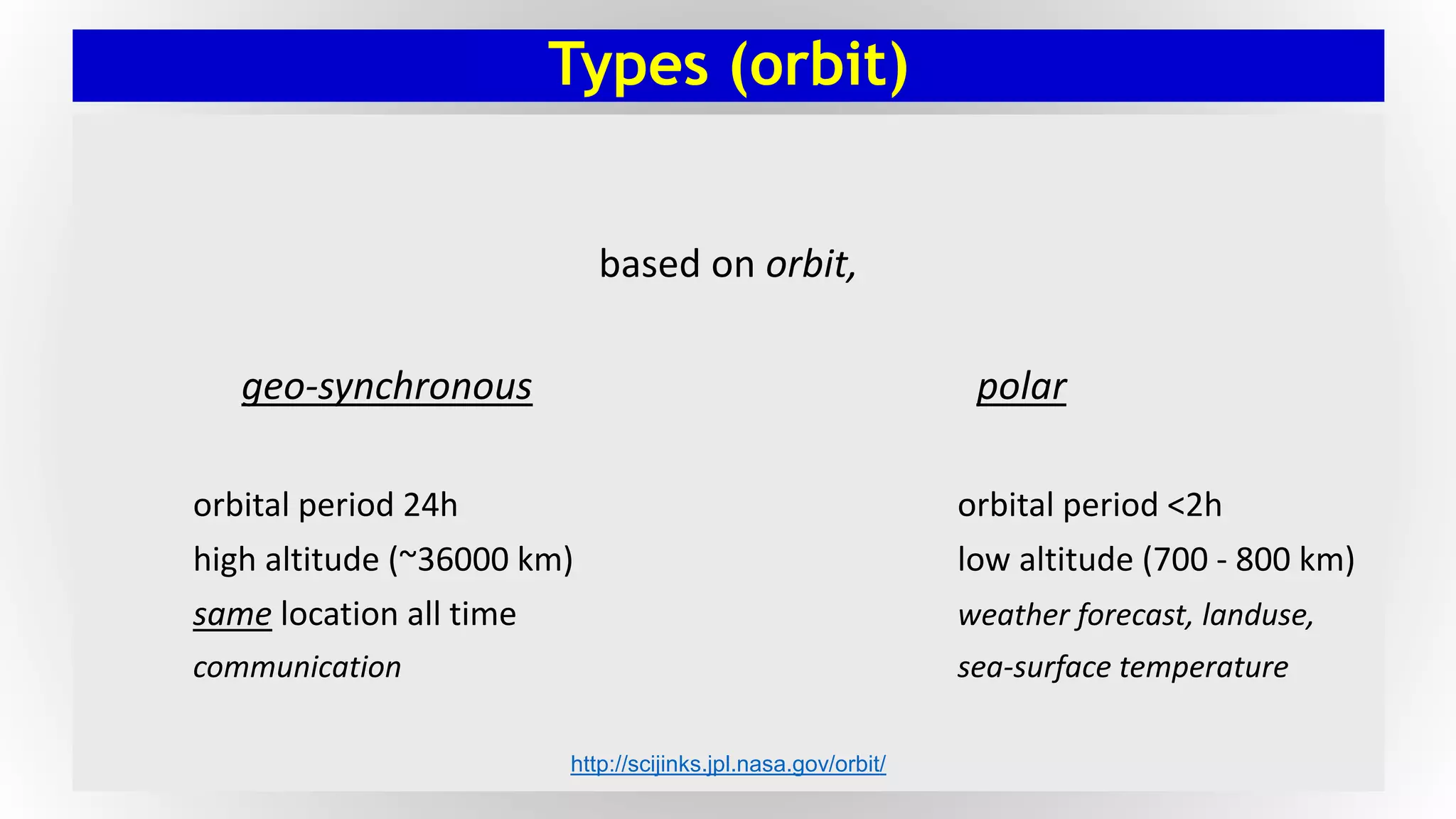
Types (orbit)
based on orbit,
geo-synchronous polar
orbital period 24h orbital period <2h
high altitude (~36000 km) low altitude (700 - 800 km)
same location all time weather forecast, landuse,
communication sea-surface temperature
http://scijinks.jpl.nasa.gov/orbit/
Characterization
Resolution and Coverage
spatial smallest unit of an image, pixel
spectral wavelength resolution (Δλ)
radiometric magnitude of detectable radiation
temporal time frequency
i) spatial
how much can it see?
how clear?
coverage
resolution (pixel)
ii) spectral
how much can it see?
how clear?
bandwidth
(Δλ)
iii) radiometric
sensitivity to magnitude
of electromagnetic energy
ability to detect minute changes
in incoming energy
bits
8 bits 11 bits
iv) temporal
how continuously can you watch?
since when?
revisit period
eg. MODIS (1 day, since 2000)
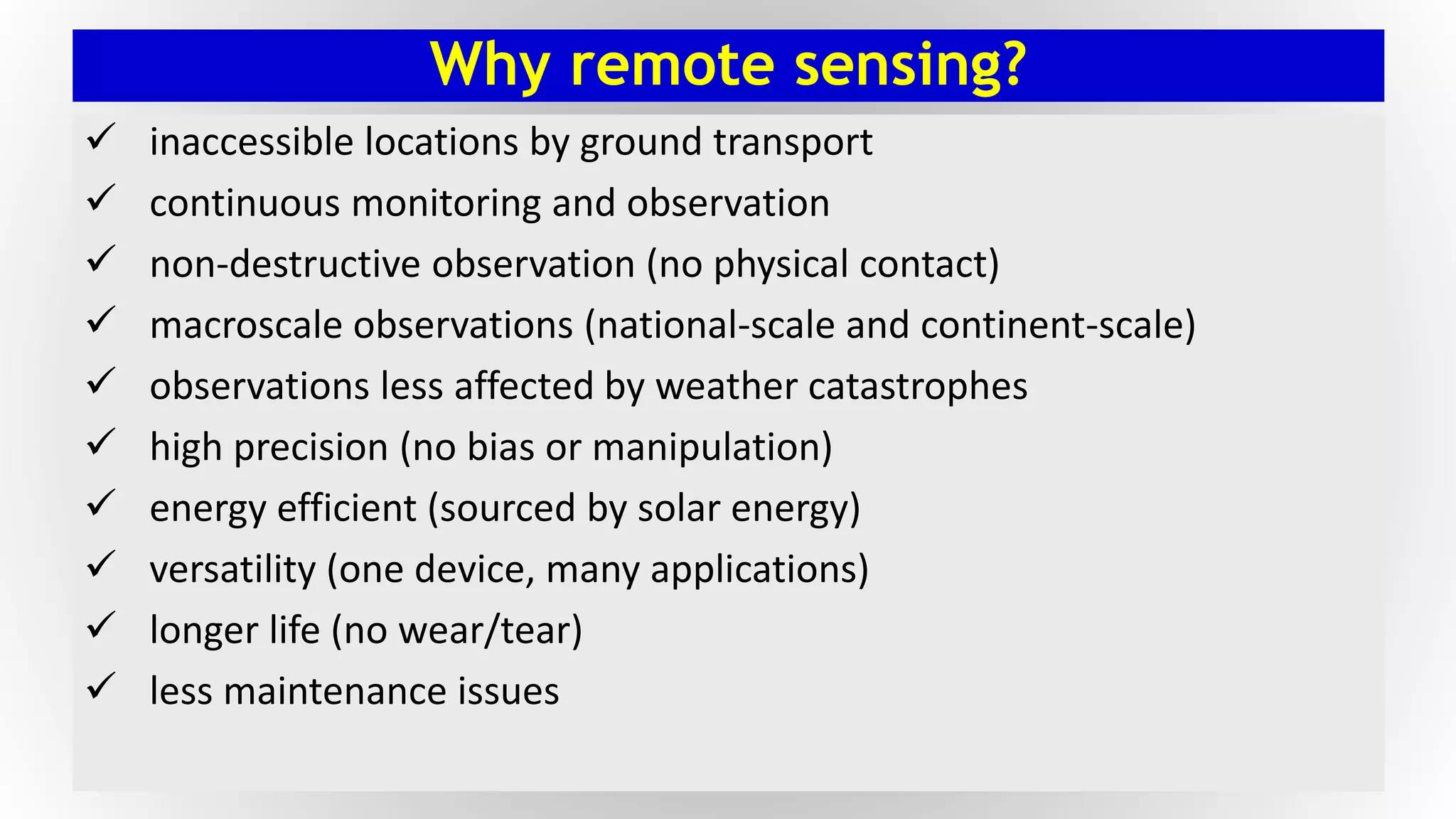
Why remote sensing?
 inaccessible locations by ground transport
 continuous monitoring and observation
 non-destructive observation (no physical contact)
 macroscale observations (national-scale and continent-scale)
 observations less affected by weather catastrophes
 high precision (no bias or manipulation)
 energy efficient (sourced by solar energy)
 versatility (one device, many applications)
 longer life (no wear/tear)
 less maintenance issues
key terms
to communicate, we need language
to be specific, vocabulary
词汇
key terms
Instantaneous Field of View
(IFOV)
key terms
Swath
key terms
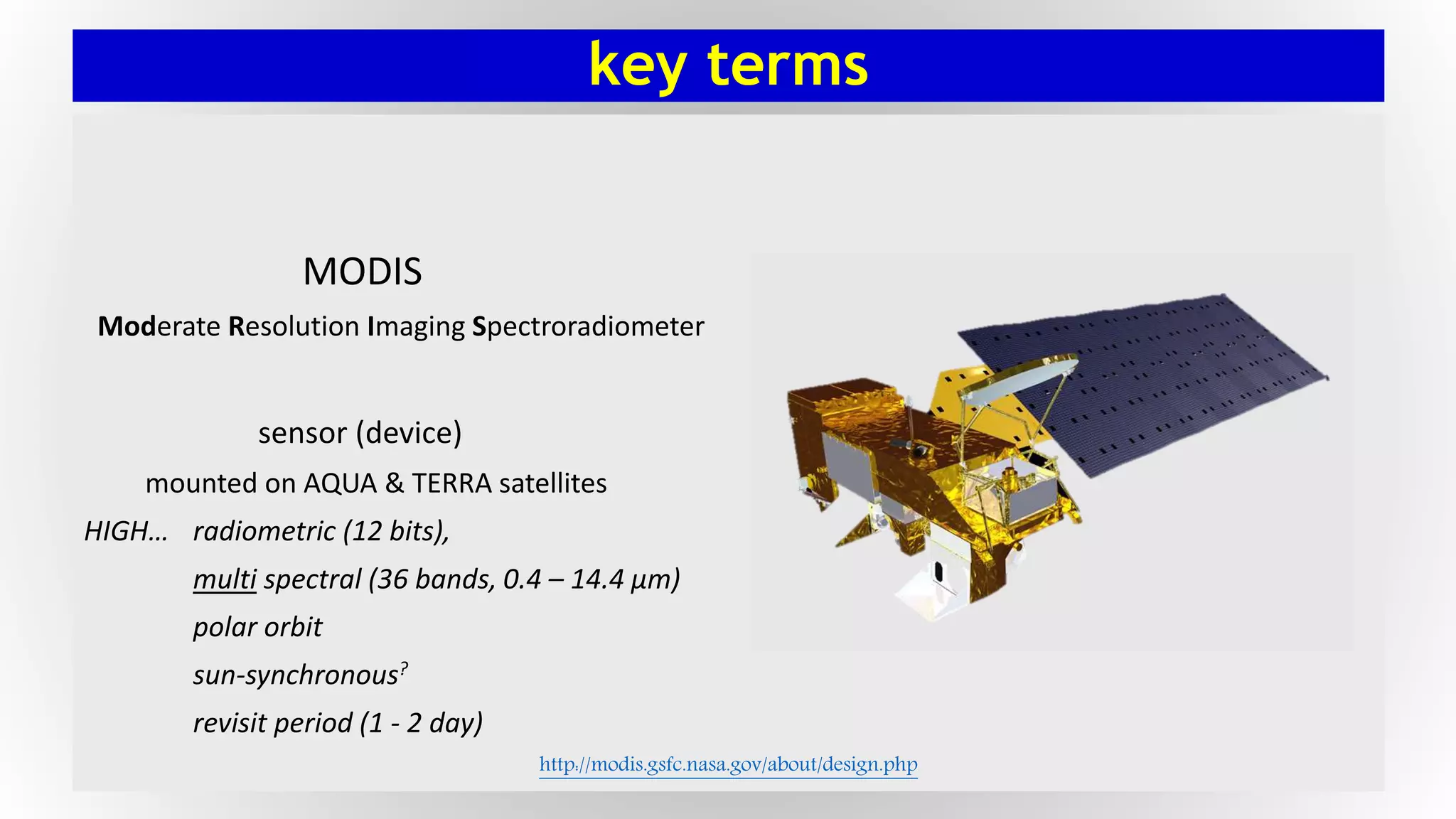
MODIS
Moderate Resolution Imaging Spectroradiometer
sensor (device)
mounted on AQUA & TERRA satellites
HIGH… radiometric (12 bits),
multi spectral (36 bands, 0.4 – 14.4 µm)
polar orbit
sun-synchronous?
revisit period (1 - 2 day)
http://modis.gsfc.nasa.gov/about/design.php
key terms
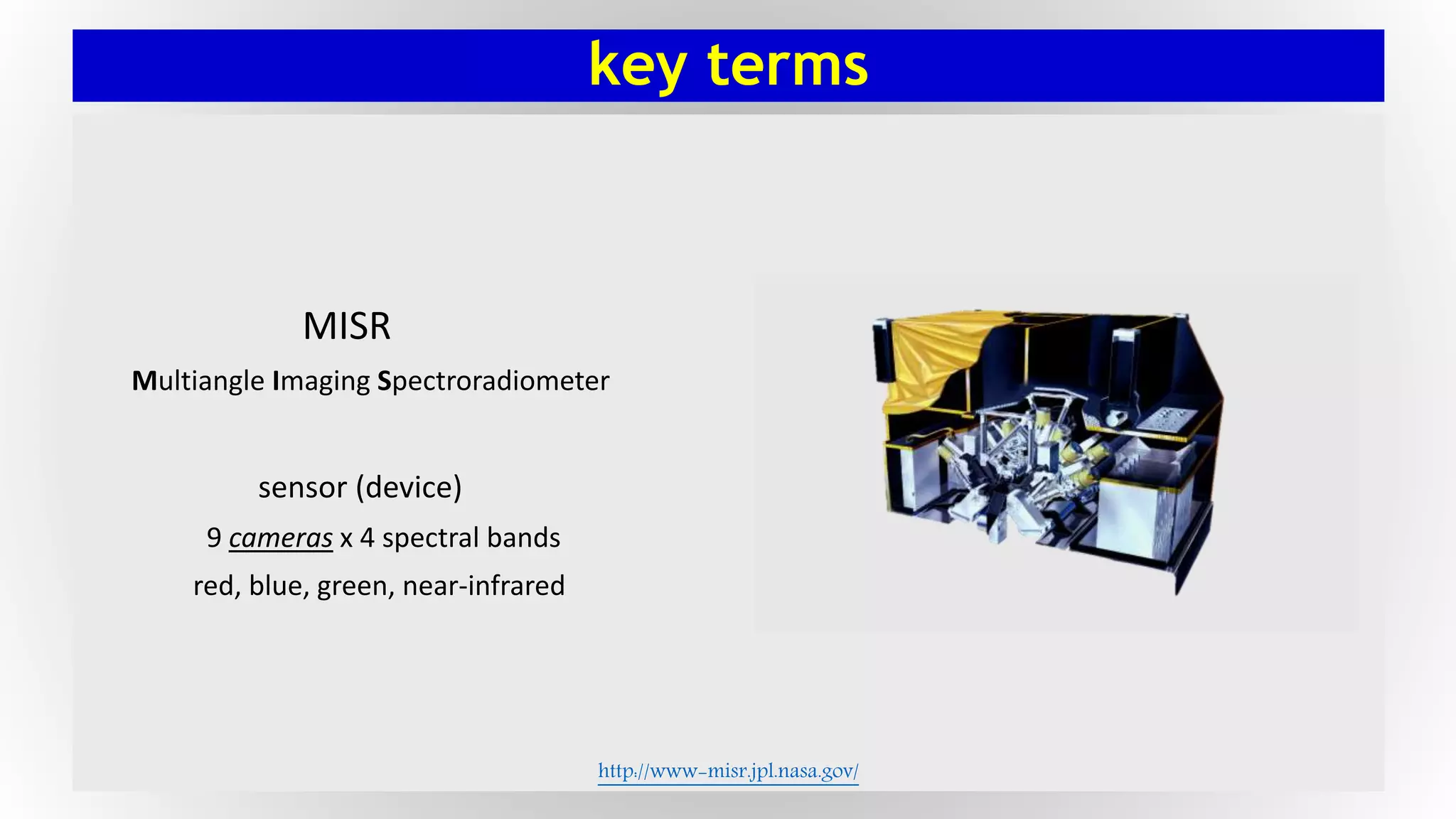
MISR
Multiangle Imaging Spectroradiometer
sensor (device)
9 cameras x 4 spectral bands
red, blue, green, near-infrared
http://www-misr.jpl.nasa.gov/
key terms
SeaWIFS
Sea-viewing Wide Field-of-view Sensor
sensor (device)
polar orbiting
8 bands
global ocean bio-optic properties
(marine phytoplankton)
http://oceancolor.gsfc.nasa.gov/SeaWiFS/SEASTAR/SPACECRAFT.html
key terms
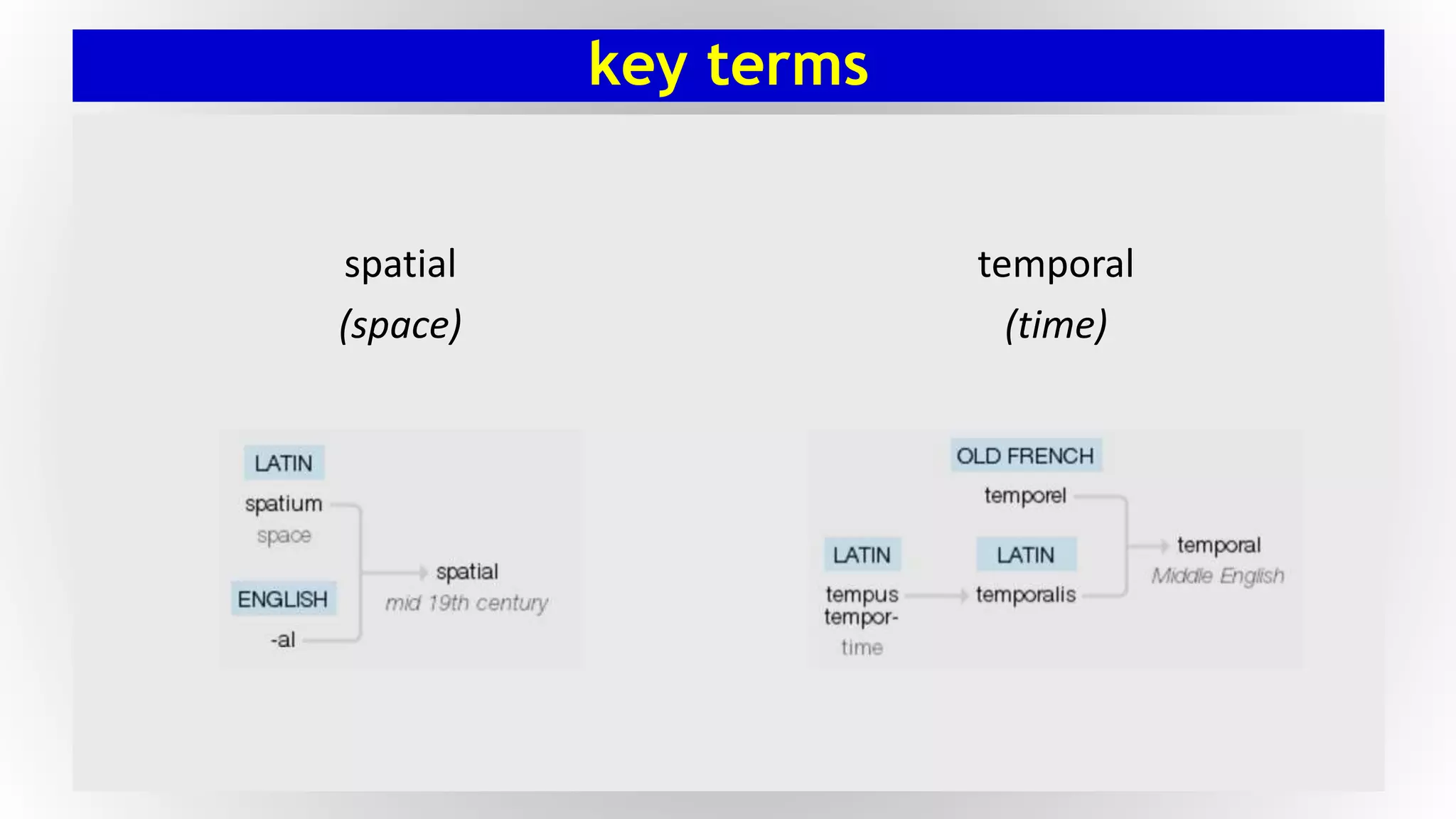
spatial
(space)
temporal
(time)
key terms
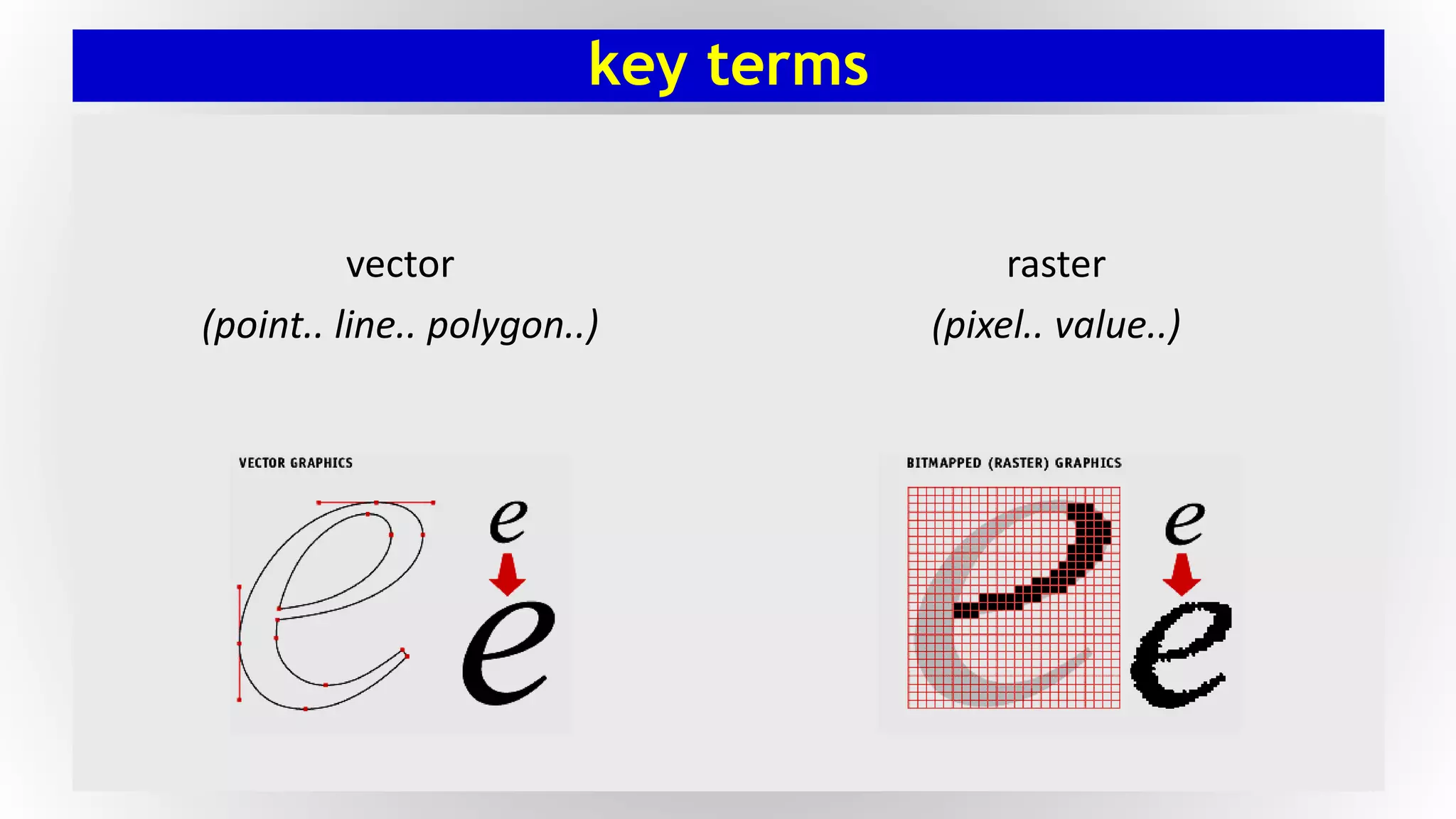
vector
(point.. line.. polygon..)
raster
(pixel.. value..)
key terms
Radiation
..coming in next section
Applications
 air quality
 road networks and urbanization
 meteorology
 disaster management
 aerosol source regions
 global transport patterns
 agriculture crop yield, land use management
 ocean and land surface characteristics
 national security
 explore terrestrial bodies
 astronomy and cosmology applications
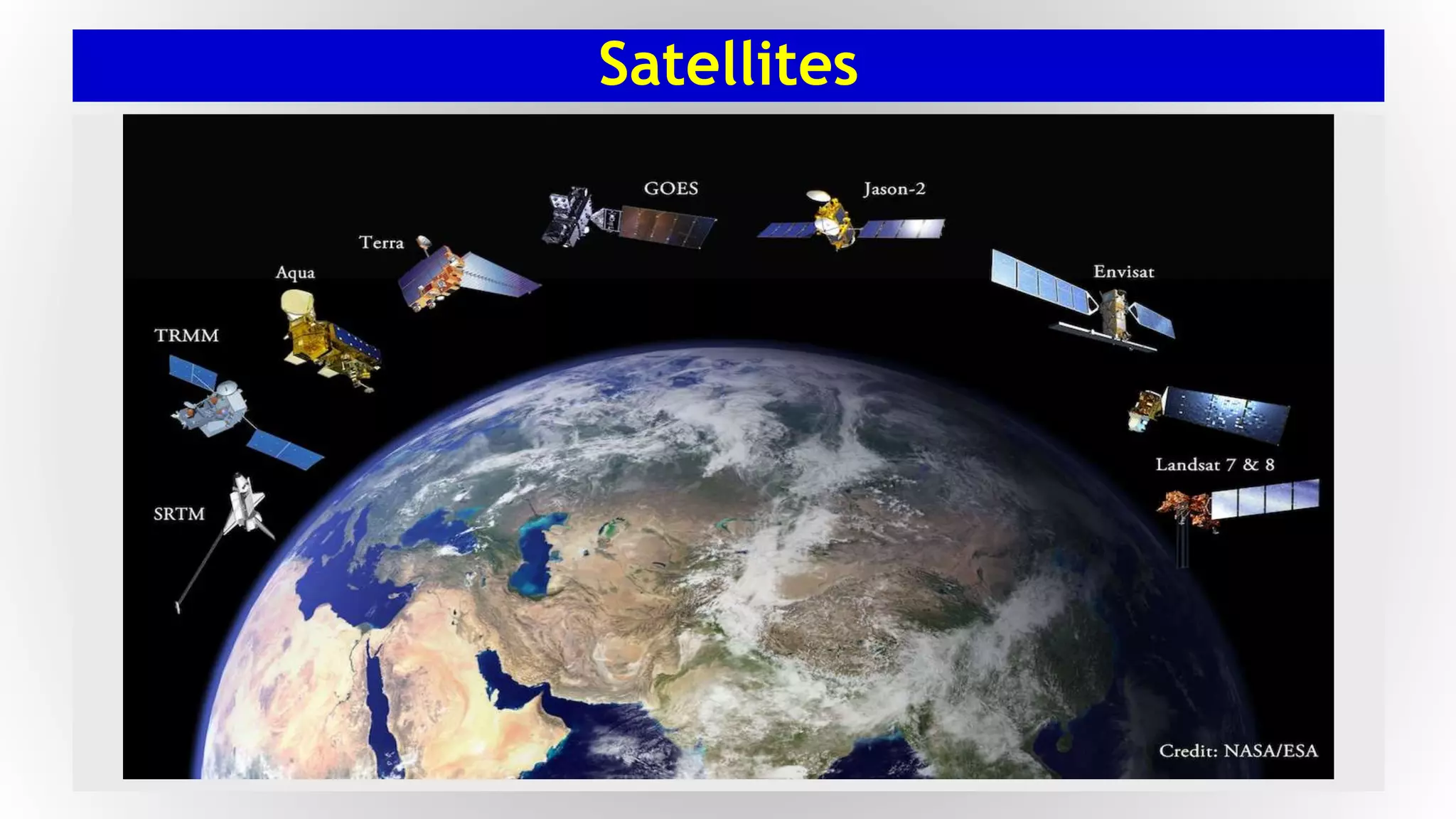
Satellites
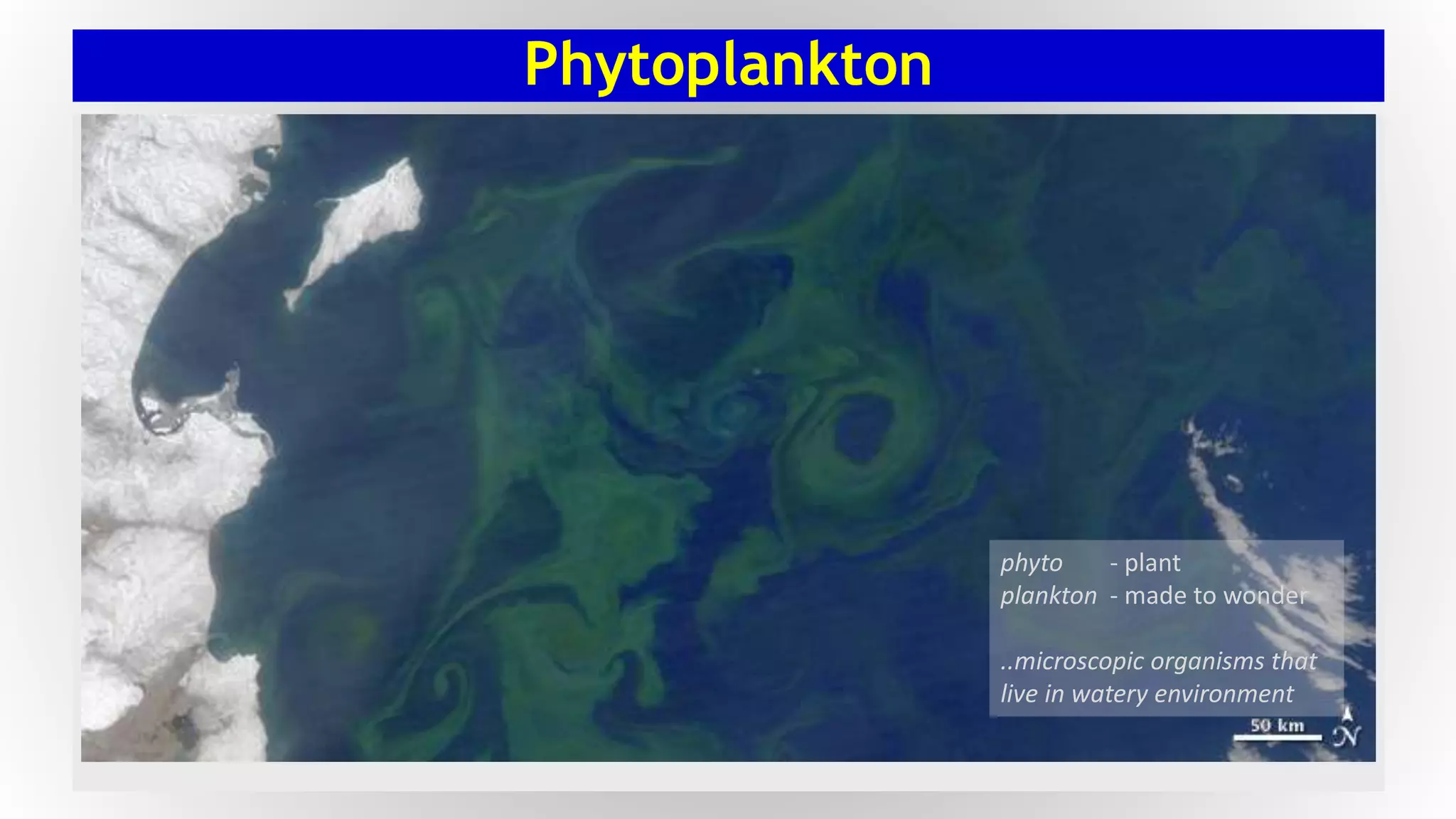
Phytoplankton
phyto - plant
plankton - made to wonder
..microscopic organisms that
live in watery environment
Organizations
founded
NASA National Aeronautics and Space Administration 1958
IKI RAN Russian Space Research Institute 1965
ISRO Indian Space Research Organization 1969
NSDAJ National Space Development Agency of Japan 1969
GAC German Aerospace Center 1969
ESA European Space Agency 1975
RSC Russian Federal Space Agency 1992
CNSA China National Space Administration 1993
Image
2D vs 3D
image
object
Aerosol Application
2
How?
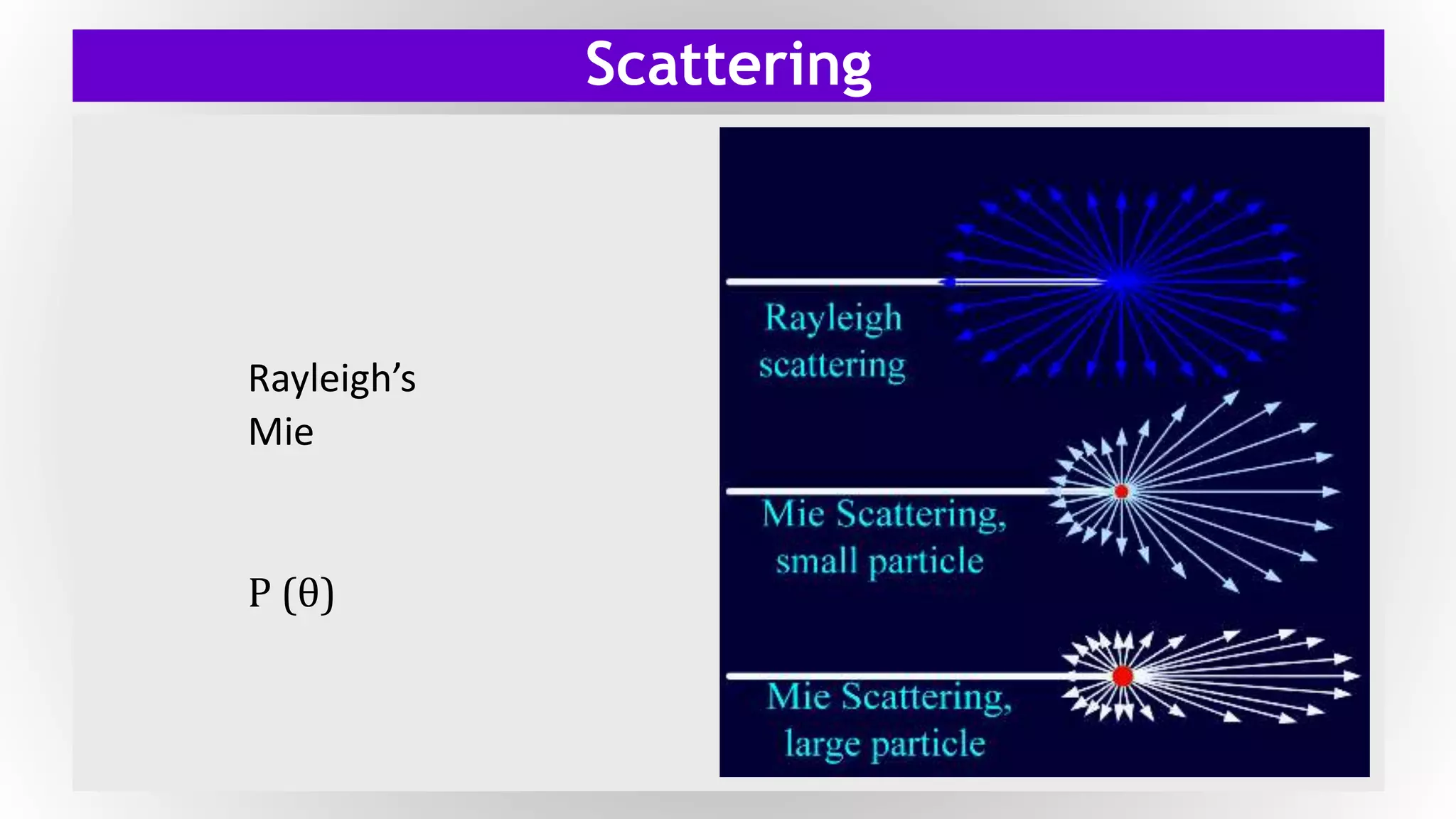
scattering
Scattering
Rayleigh’s
Mie
P (θ)
Characterization
f (x, y, z, t, D, C, S, X)
x, y = ground location
z = altitude
t = time
D = particle diameter
C = composition
S = shape
X = mixing
Factors
f (x, y, z, t, D, C, S, X)
Diameter: 0.1 - 10 µm
Composition: phase, constituents
Shape: conical, spherical..
Mixing: internal, external
Efficiency
fine particle mode has
greater scattering
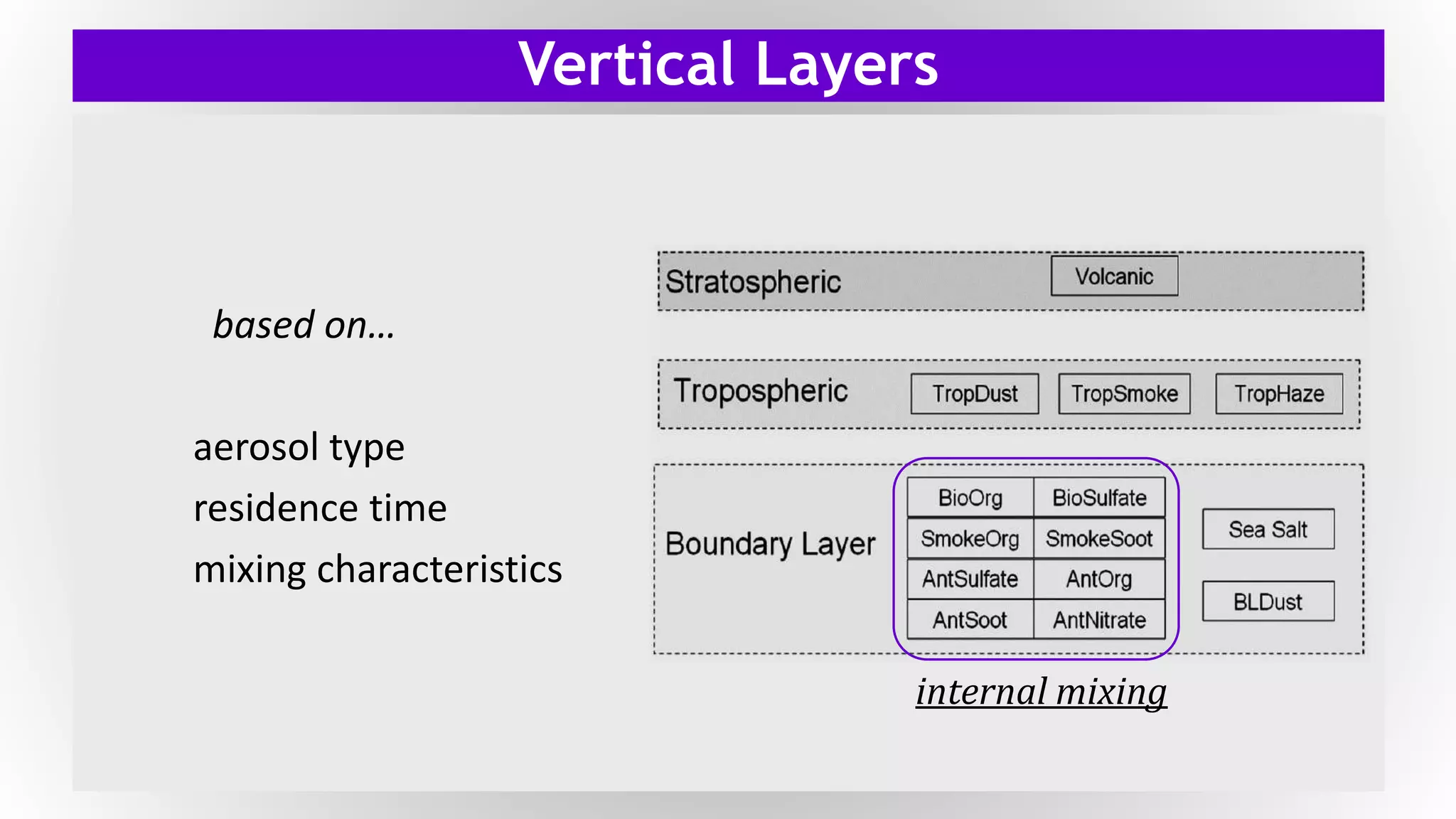
Vertical Layers
based on…
aerosol type
residence time
mixing characteristics
internal mixing
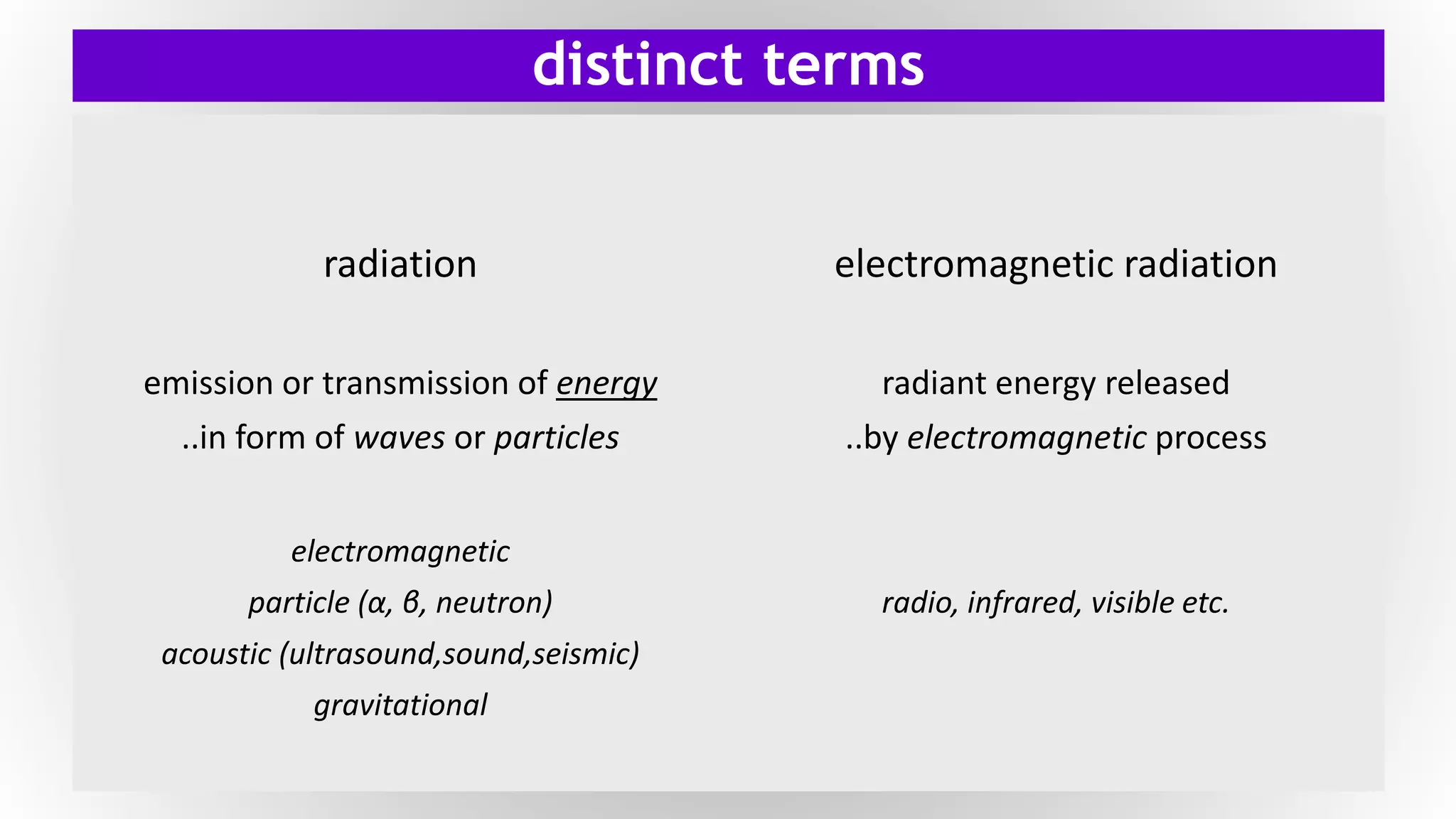
distinct terms
radiation
emission or transmission of energy
..in form of waves or particles
electromagnetic
particle (α, β, neutron)
acoustic (ultrasound,sound,seismic)
gravitational
electromagnetic radiation
radiant energy released
..by electromagnetic process
radio, infrared, visible etc.
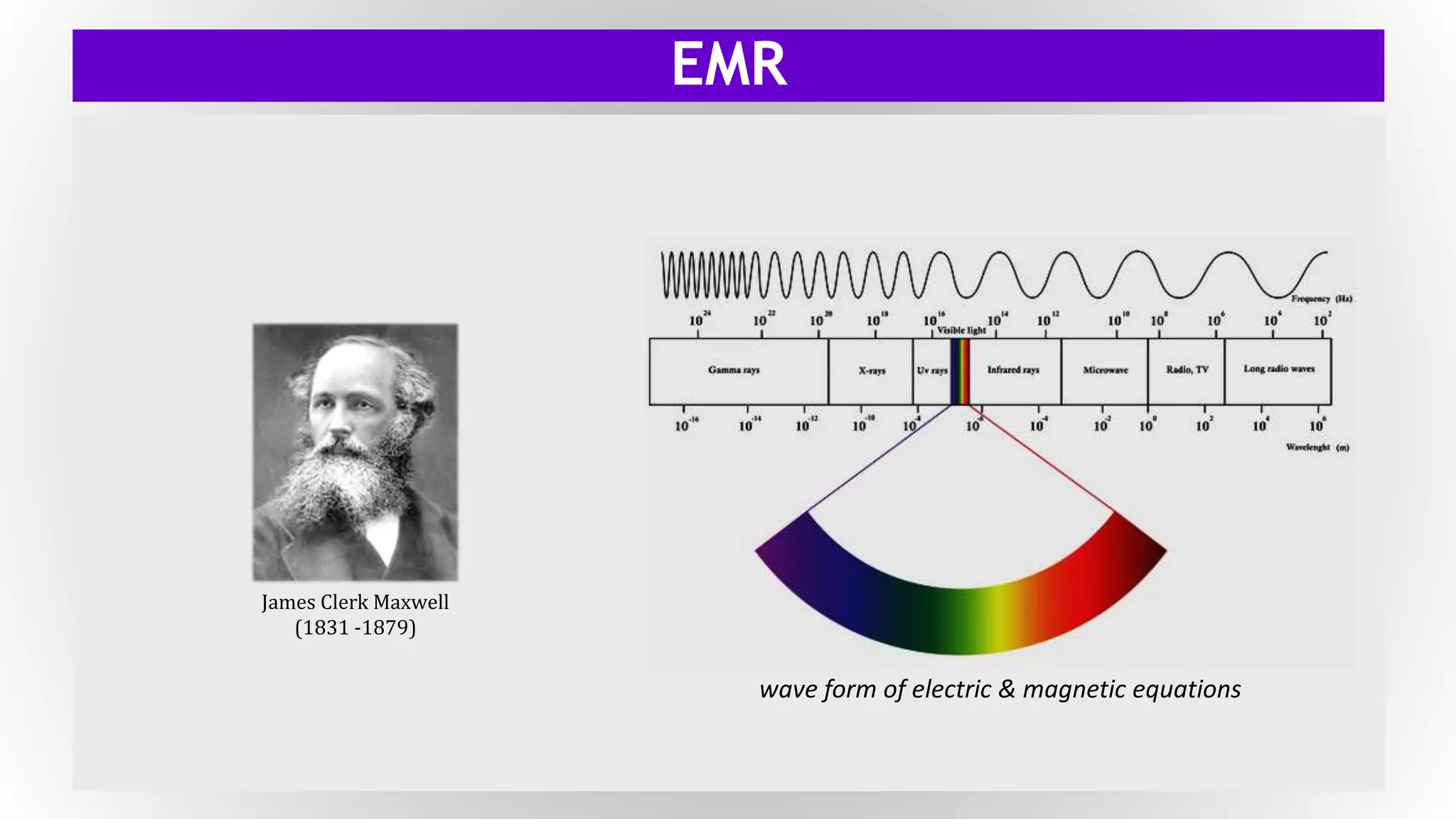
EMR
James Clerk Maxwell
(1831 -1879)
wave form of electric & magnetic equations
Reflectance
presence of aerosol can
increase
decrease
reflectance
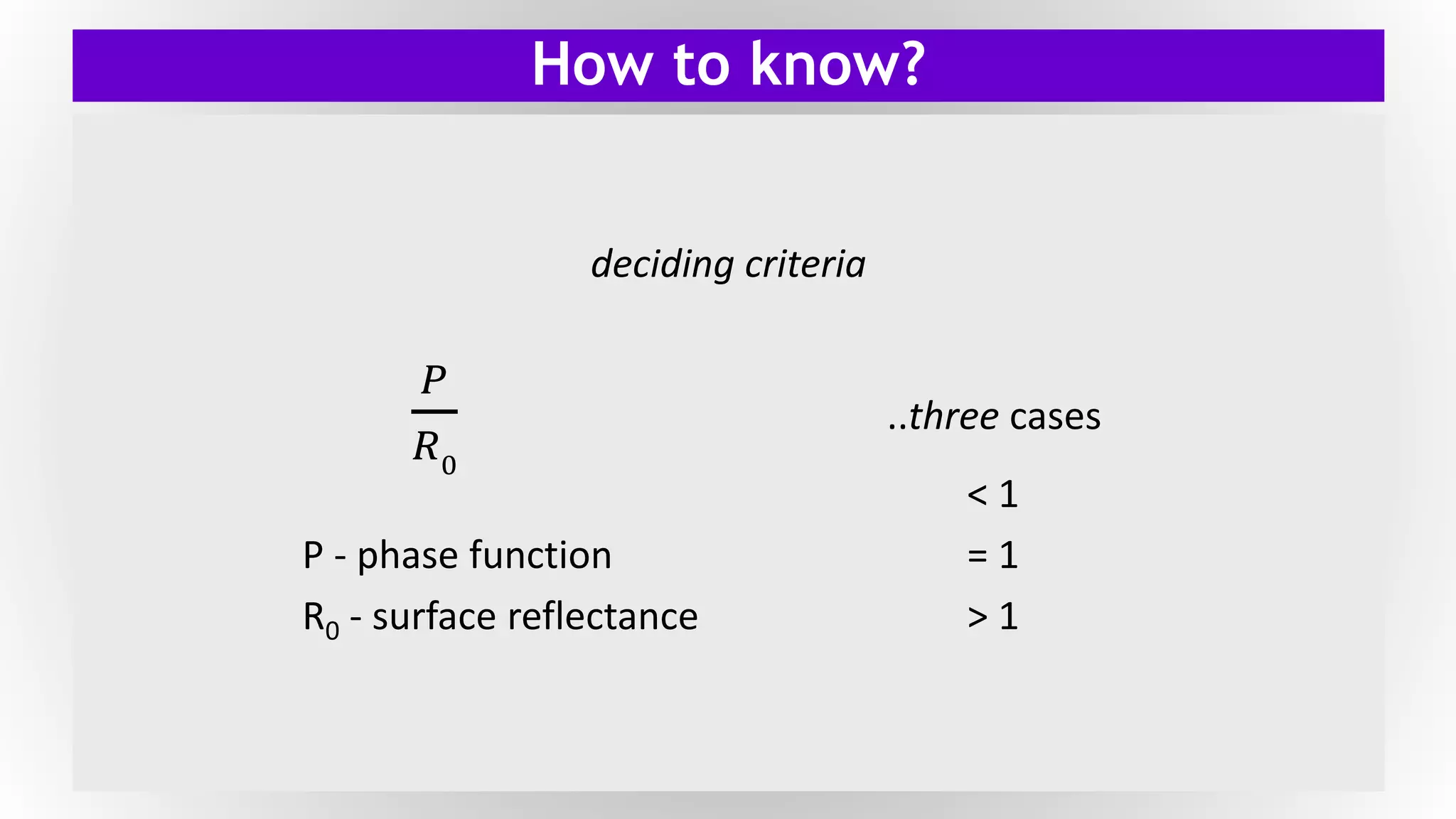
How to know?
deciding criteria
𝑃
𝑅0
..three cases
< 1
P - phase function = 1
R0 - surface reflectance > 1
case-(i)
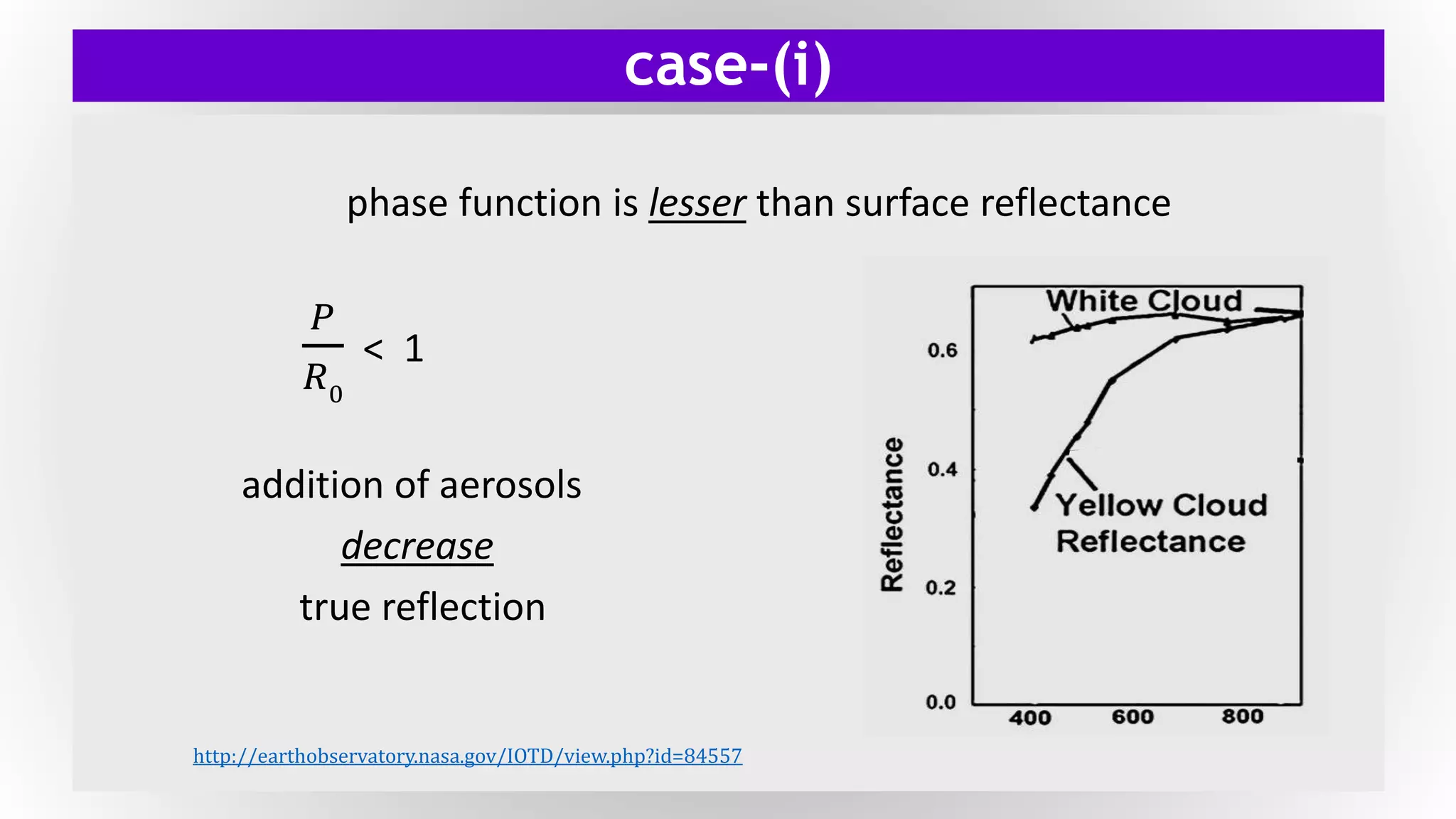
phase function is lesser than surface reflectance
𝑃
𝑅0
< 1
addition of aerosols
decrease
true reflection
http://earthobservatory.nasa.gov/IOTD/view.php?id=84557
case-(ii)
phase function is equal to surface reflectance
𝑃
𝑅0
= 1
addition of aerosols
will not change
apparent reflection
case-(iii)
phase function is greater than surface reflectance
𝑃
𝑅0
> 1
addition of aerosols
increase
apparent reflection
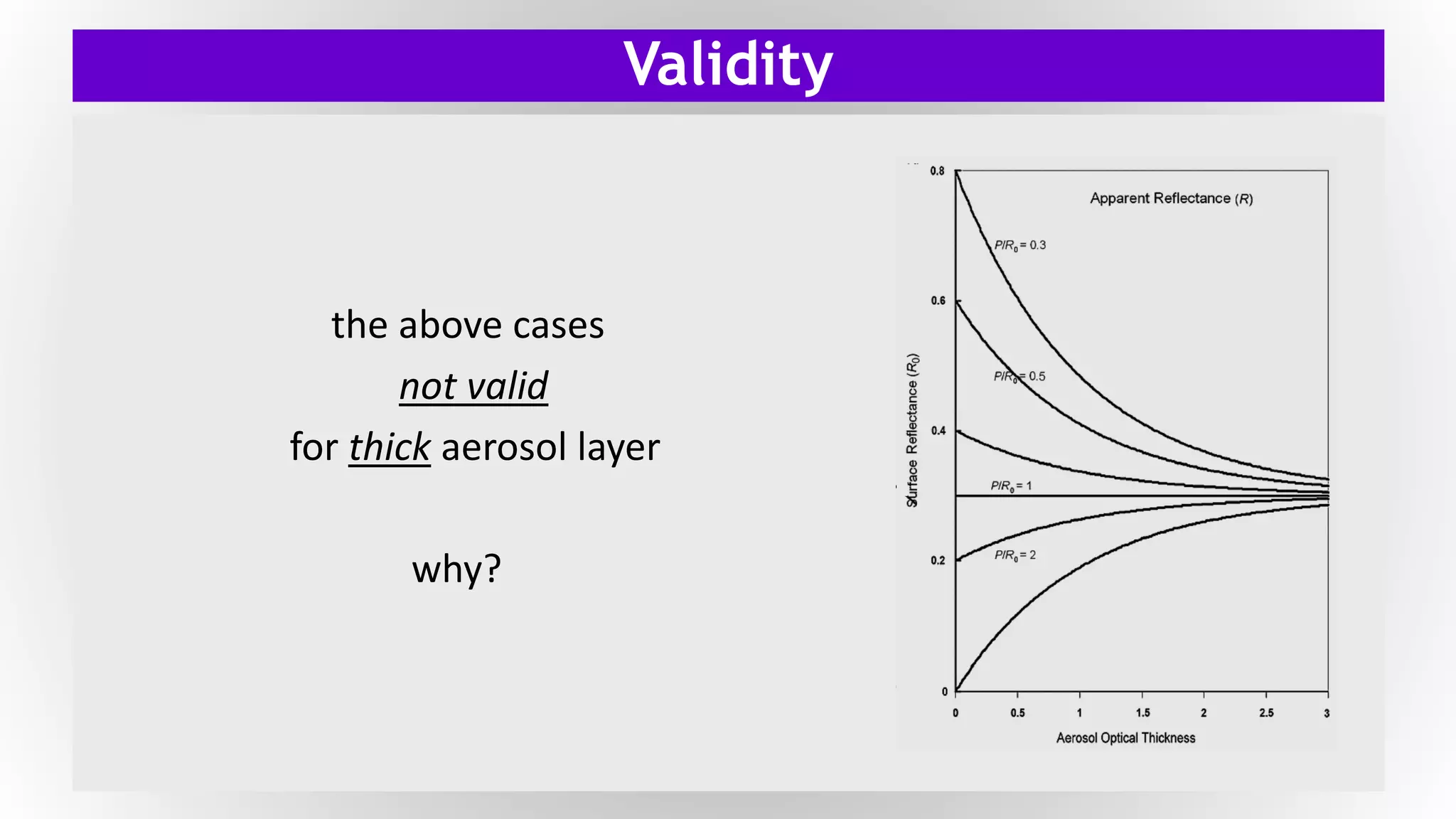
Validity
the above cases
not valid
for thick aerosol layer
why?
What do you think?
Let’s do an activity
Here is your task!
You are given a satellite image.
You are asked to deduce
aerosol, land, water features.
qualitatively
Satellite Image
here is your satellite image..
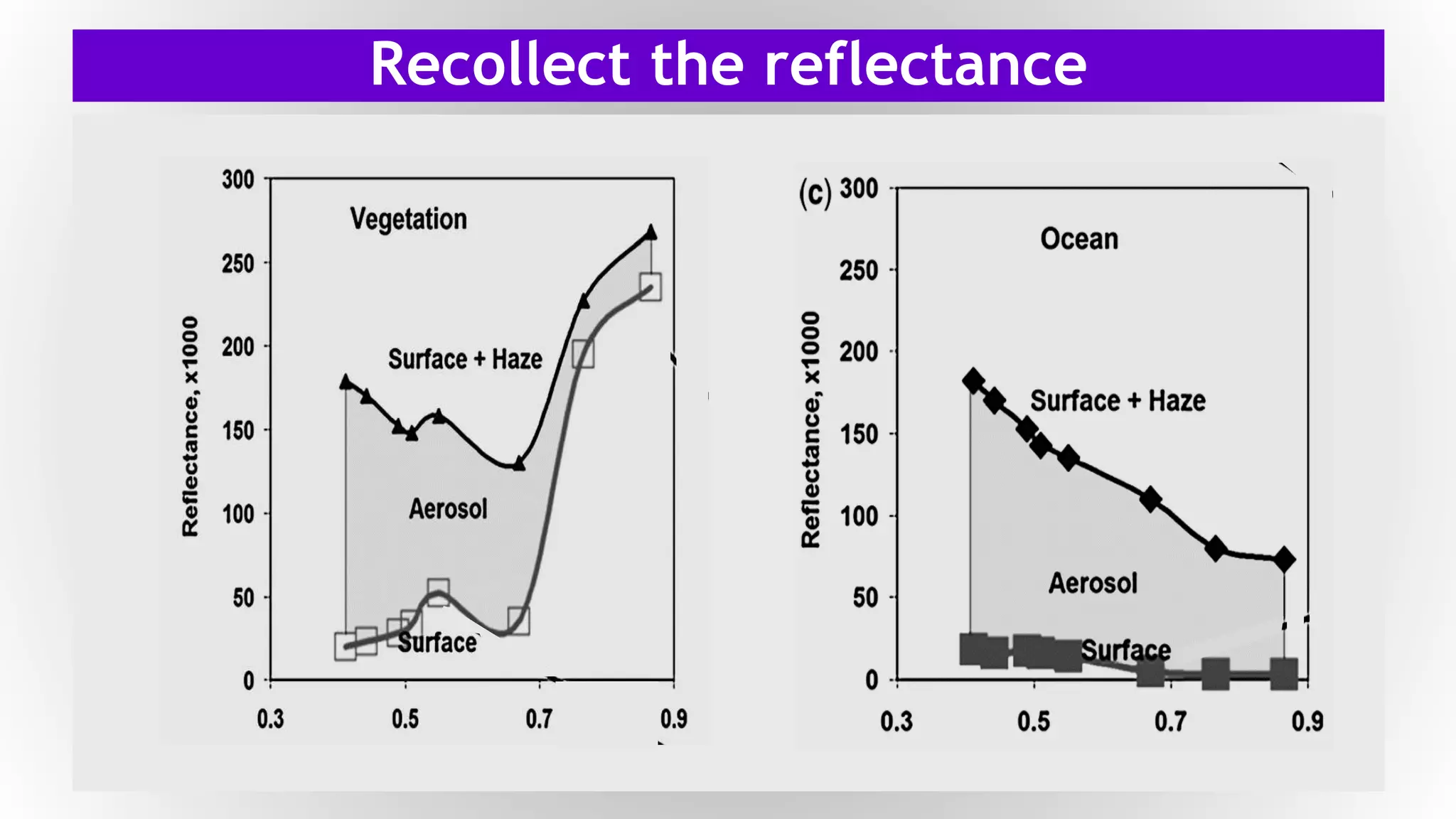
Recollect the reflectance
..three color channels
Blue (412 nm)
Green(555 nm)
Red (670 nm)
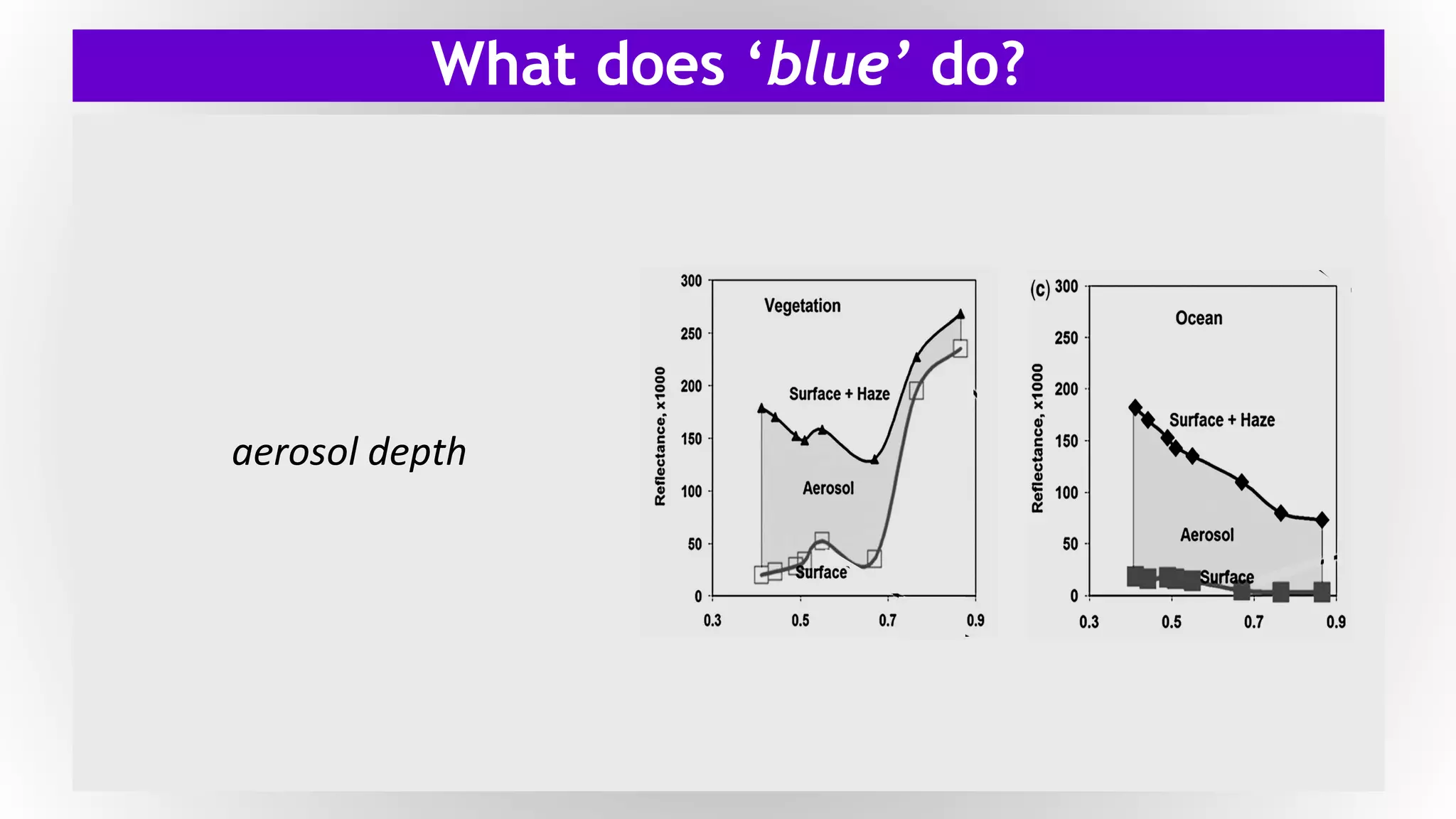
What does ‘blue’ do?
aerosol depth
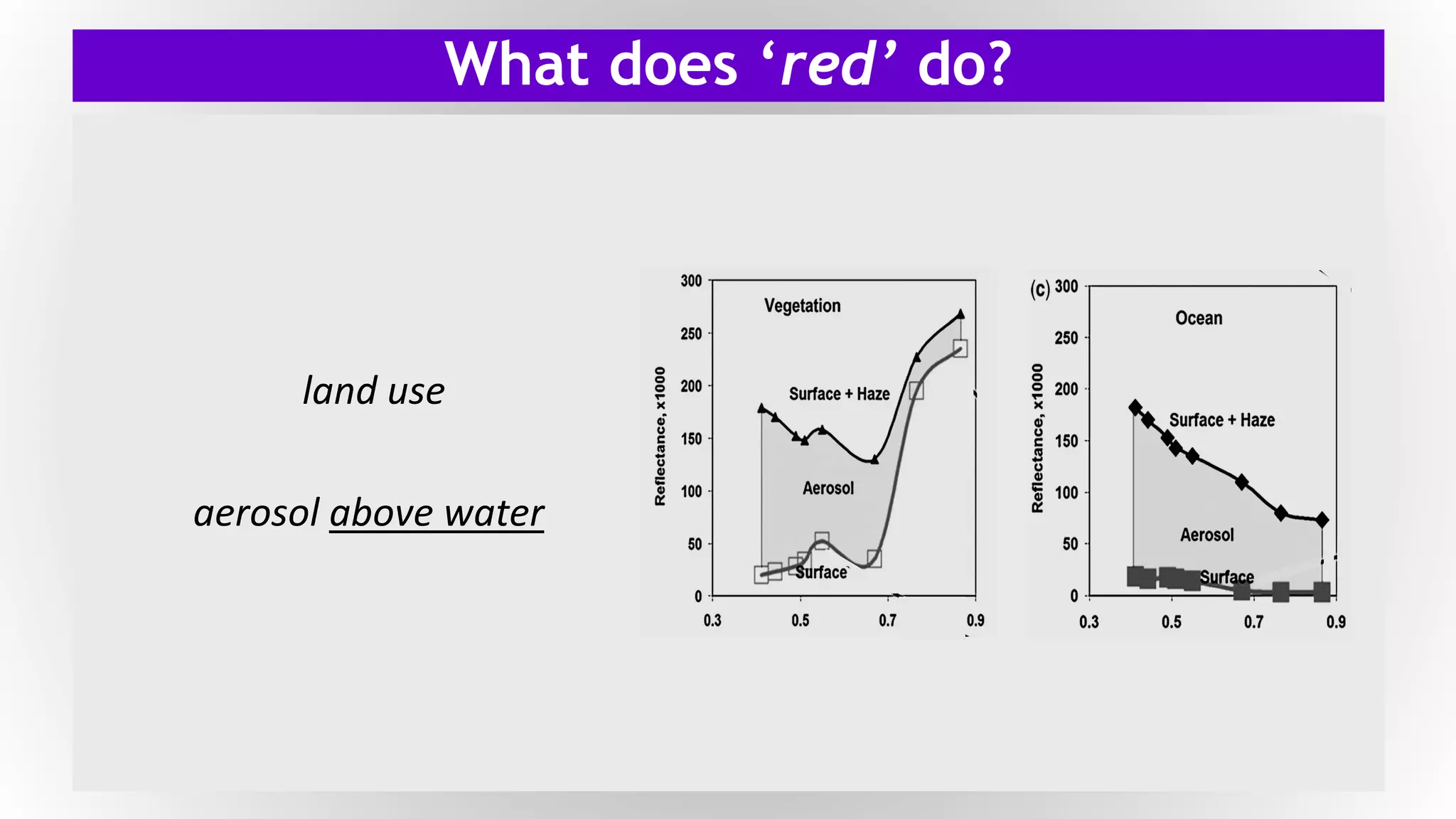
What does ‘red’ do?
land use
aerosol above water
How to get ‘water’?
subtract?
black in infrared (~865nm)
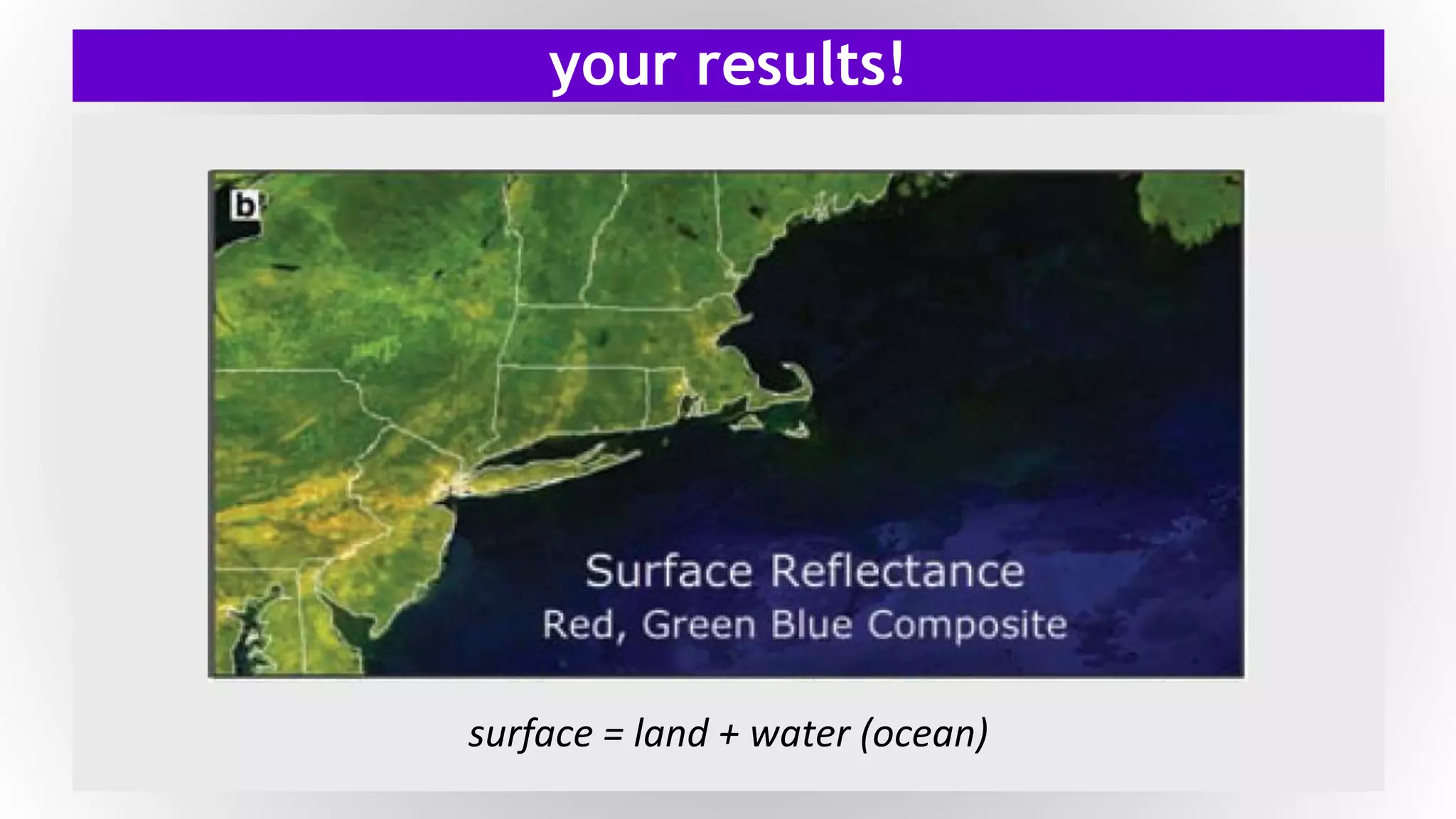
your results!
surface = land + water (ocean)
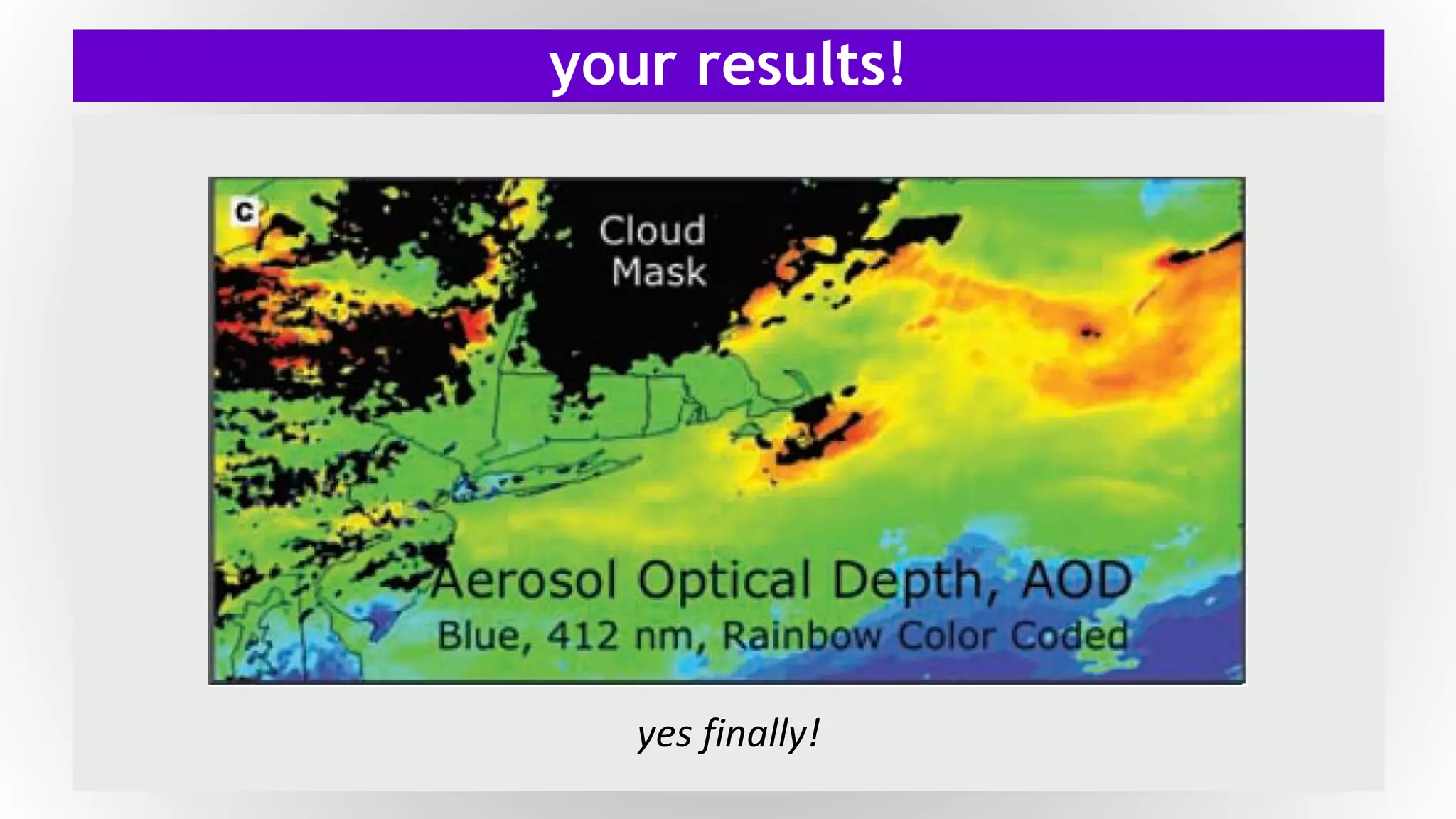
your results!
yes finally!
Summary
3
Challenges
clouds cover 60% of earth’s atmosphere
atmospheric temperature… aerosol phase change
sensing technologies (coverage and accuracy)
upgradation of obsolete satellites (600+ geosynchronous)
data interpretation techniques (aerosol techniques)
space infrastructure is very expensive
let’s summarize
remote sensing is a science, technology and art
two types of sensing: active and passive
two types of orbits: geosynchronous and polar
four characteristics: spatial, spectral, radiometric, temporal
one governing phenomenon: optical properties
challenges: surface reflectance and clouds
Sources
Satellite-based measurement of atmospheric aerosols
Rudolf B. Husar
Department of Energy, Environmental and Chemical Engineering,
Washington University, Missouri
Earth Observatory
National Aeronautics and Space Administration
Wikipedia
Wikimedia Foundation
and other sources as well…
Further Reading
Atmospheric Chemistry and Physics:
from air pollution to climate change (2006)
John H. Seinfeld - Spyros N. Pandis
Visibility: Science and Regulation (2002)
John G. Watson
Remote Sensing of Tropospheric Aerosols from Space (1999)
Michael D. King
Remote Sensing of Particulate Pollution from Space:
have we reached the promised land (2009)
Raymond M. Hoff - Sundar A. Christopher
The characterization of aerosols distributed with respect to size
and chemical composition (1970)
S.K. Friedlander
The End

Remote Sensing of Aerosols

  • 1.
    Remote Sensing of Aerosols StudentTutorial Series: Lecture-2 ENV6130 Aerosol Mechanics March 29, 2016 kalaivanan murthy
  • 2.
    Note! this is... an introductorymaterial presented in an new-age interactive fashion best viewed with the lecture video
  • 3.
  • 4.
    Two Areas remote sensing technologyto capture optical wave changes satellite - sensors aerosol technology deducing true form from remote sensing inputs optical properties
  • 5.
  • 6.
    What is RemoteSensing? Science of acquiring information about an object without having a physical contact.
  • 7.
    Terminology “Science – andthe art – of identifying, observing, and measuring an object without coming into direct contact with it.” Ms. Evelyn Pruitt US Office of Naval Research 1950’s Source: Earth Observatory, National Aeronautics and Space Administration
  • 8.
    What others say? “acquisitionof information about an object or phenomenon without making physical contact with object.. thus in contrast to site observation” “..in modern usage.. use of aerial sensor technologies to detect and classify objects on earth.. surface, atmosphere, oceans.. by means of propagated signals on earth” – Wikipedia (Feb 2016) “collecting and interpreting information about the environment and the surface.. from a distance.. primarily by sensing radiation that is naturally emitted or reflected.. by sensing signals transmitted from a device and reflected back to it.” – Environmental Systems Research Institute (Feb 2016)
  • 9.
    brief-Timeline c.1820’s camera 1840’s photographsof earth (balloons) 1960’s aerial photography..
  • 10.
  • 11.
    What kind ofinformation? Changes in spatial and temporal characteristics. spatial - space (x, y, z) temporal - time (t) optical
  • 12.
    How? Absorption and reflectionof radiation by the object. Max Planck (1858-1947)
  • 13.
    Types (source) based onlight source, passive active external source self source (sun, earth) (electromagnetic pulse) eg. Landsat, ASTER, AVHRR eg. LIDAR, RADAR, SONAR not only visible
  • 14.
    Types (orbit) based onorbit, geo-synchronous polar orbital period 24h orbital period <2h high altitude (~36000 km) low altitude (700 - 800 km) same location all time weather forecast, landuse, communication sea-surface temperature http://scijinks.jpl.nasa.gov/orbit/
  • 15.
    Characterization Resolution and Coverage spatialsmallest unit of an image, pixel spectral wavelength resolution (Δλ) radiometric magnitude of detectable radiation temporal time frequency
  • 16.
    i) spatial how muchcan it see? how clear? coverage resolution (pixel)
  • 17.
    ii) spectral how muchcan it see? how clear? bandwidth (Δλ)
  • 18.
    iii) radiometric sensitivity tomagnitude of electromagnetic energy ability to detect minute changes in incoming energy bits 8 bits 11 bits
  • 19.
    iv) temporal how continuouslycan you watch? since when? revisit period eg. MODIS (1 day, since 2000)
  • 20.
    Why remote sensing? inaccessible locations by ground transport  continuous monitoring and observation  non-destructive observation (no physical contact)  macroscale observations (national-scale and continent-scale)  observations less affected by weather catastrophes  high precision (no bias or manipulation)  energy efficient (sourced by solar energy)  versatility (one device, many applications)  longer life (no wear/tear)  less maintenance issues
  • 21.
    key terms to communicate,we need language to be specific, vocabulary 词汇
  • 22.
  • 23.
  • 24.
    key terms MODIS Moderate ResolutionImaging Spectroradiometer sensor (device) mounted on AQUA & TERRA satellites HIGH… radiometric (12 bits), multi spectral (36 bands, 0.4 – 14.4 µm) polar orbit sun-synchronous? revisit period (1 - 2 day) http://modis.gsfc.nasa.gov/about/design.php
  • 25.
    key terms MISR Multiangle ImagingSpectroradiometer sensor (device) 9 cameras x 4 spectral bands red, blue, green, near-infrared http://www-misr.jpl.nasa.gov/
  • 26.
    key terms SeaWIFS Sea-viewing WideField-of-view Sensor sensor (device) polar orbiting 8 bands global ocean bio-optic properties (marine phytoplankton) http://oceancolor.gsfc.nasa.gov/SeaWiFS/SEASTAR/SPACECRAFT.html
  • 27.
  • 28.
    key terms vector (point.. line..polygon..) raster (pixel.. value..)
  • 29.
  • 30.
    Applications  air quality road networks and urbanization  meteorology  disaster management  aerosol source regions  global transport patterns  agriculture crop yield, land use management  ocean and land surface characteristics  national security  explore terrestrial bodies  astronomy and cosmology applications
  • 31.
  • 32.
    Phytoplankton phyto - plant plankton- made to wonder ..microscopic organisms that live in watery environment
  • 33.
    Organizations founded NASA National Aeronauticsand Space Administration 1958 IKI RAN Russian Space Research Institute 1965 ISRO Indian Space Research Organization 1969 NSDAJ National Space Development Agency of Japan 1969 GAC German Aerospace Center 1969 ESA European Space Agency 1975 RSC Russian Federal Space Agency 1992 CNSA China National Space Administration 1993
  • 34.
  • 35.
  • 36.
  • 37.
  • 38.
    Characterization f (x, y,z, t, D, C, S, X) x, y = ground location z = altitude t = time D = particle diameter C = composition S = shape X = mixing
  • 39.
    Factors f (x, y,z, t, D, C, S, X) Diameter: 0.1 - 10 µm Composition: phase, constituents Shape: conical, spherical.. Mixing: internal, external
  • 40.
    Efficiency fine particle modehas greater scattering
  • 41.
    Vertical Layers based on… aerosoltype residence time mixing characteristics internal mixing
  • 42.
    distinct terms radiation emission ortransmission of energy ..in form of waves or particles electromagnetic particle (α, β, neutron) acoustic (ultrasound,sound,seismic) gravitational electromagnetic radiation radiant energy released ..by electromagnetic process radio, infrared, visible etc.
  • 43.
    EMR James Clerk Maxwell (1831-1879) wave form of electric & magnetic equations
  • 44.
    Reflectance presence of aerosolcan increase decrease reflectance
  • 45.
    How to know? decidingcriteria 𝑃 𝑅0 ..three cases < 1 P - phase function = 1 R0 - surface reflectance > 1
  • 46.
    case-(i) phase function islesser than surface reflectance 𝑃 𝑅0 < 1 addition of aerosols decrease true reflection http://earthobservatory.nasa.gov/IOTD/view.php?id=84557
  • 47.
    case-(ii) phase function isequal to surface reflectance 𝑃 𝑅0 = 1 addition of aerosols will not change apparent reflection
  • 48.
    case-(iii) phase function isgreater than surface reflectance 𝑃 𝑅0 > 1 addition of aerosols increase apparent reflection
  • 49.
    Validity the above cases notvalid for thick aerosol layer why?
  • 50.
    What do youthink? Let’s do an activity
  • 51.
    Here is yourtask! You are given a satellite image. You are asked to deduce aerosol, land, water features. qualitatively
  • 52.
    Satellite Image here isyour satellite image..
  • 53.
  • 54.
    Recollect the reflectance ..threecolor channels Blue (412 nm) Green(555 nm) Red (670 nm)
  • 55.
    What does ‘blue’do? aerosol depth
  • 56.
    What does ‘red’do? land use aerosol above water
  • 57.
    How to get‘water’? subtract? black in infrared (~865nm)
  • 58.
    your results! surface =land + water (ocean)
  • 59.
  • 60.
  • 61.
    Challenges clouds cover 60%of earth’s atmosphere atmospheric temperature… aerosol phase change sensing technologies (coverage and accuracy) upgradation of obsolete satellites (600+ geosynchronous) data interpretation techniques (aerosol techniques) space infrastructure is very expensive
  • 62.
    let’s summarize remote sensingis a science, technology and art two types of sensing: active and passive two types of orbits: geosynchronous and polar four characteristics: spatial, spectral, radiometric, temporal one governing phenomenon: optical properties challenges: surface reflectance and clouds
  • 63.
    Sources Satellite-based measurement ofatmospheric aerosols Rudolf B. Husar Department of Energy, Environmental and Chemical Engineering, Washington University, Missouri Earth Observatory National Aeronautics and Space Administration Wikipedia Wikimedia Foundation and other sources as well…
  • 64.
    Further Reading Atmospheric Chemistryand Physics: from air pollution to climate change (2006) John H. Seinfeld - Spyros N. Pandis Visibility: Science and Regulation (2002) John G. Watson Remote Sensing of Tropospheric Aerosols from Space (1999) Michael D. King Remote Sensing of Particulate Pollution from Space: have we reached the promised land (2009) Raymond M. Hoff - Sundar A. Christopher The characterization of aerosols distributed with respect to size and chemical composition (1970) S.K. Friedlander
  • 65.

Editor's Notes

  • #2 Be sure to credit the previous presenter. Bioaerosols by Mr. Ringer Remember always, the highest energy ever produced is in sun, where fusion occurs which is nothing by a bombardment of sub-atmonic particles. Technical fault can happen at any time, so we must be prepared.
  • #3 Working knowledge of remote sensing, not a researching knowledge, but this may help you to start one.
  • #4 Try to give an disclaimer at the end about the pace, technical level, acknowledgement,
  • #5 Remote Sensing has many applications. Aerosol has complex behavior.
  • #7 Site observation, tachymeter
  • #8 Source: Earth Observatory, National Aeronautics and Space Administration
  • #9 Source: Earth Observatory, National Aeronautics and Space Administration
  • #11 Tacheometer or tacheymeter
  • #12 A point of discussion: optical characteristics depends only on object. For changes in light, the device has to be calibrated.
  • #13 Try to delete his name and put it in the end. Try to incorporate scattering and extinction in this. Remember OZONE layer. know
  • #14 Tacheometer or tacheymeter http://www.geo.mtu.edu/rs4hazards/ksdurst/website/lectures/RemoteSensing.pdf ASTER Advanced Spaceborne Thermal Emission and Reflection Radiometer
  • #15 Tacheometer or tacheymeter http://www.geo.mtu.edu/rs4hazards/ksdurst/website/lectures/RemoteSensing.pdf ASTER Advanced Spaceborne Thermal Emission and Reflection Radiometer
  • #16 spatial resolution and Coverage.. spectral resolution: suppose I want a cyan. Can it separate the incident light? sensors ability to discriminate very slight differences in (reflected or emitted) energy Temporal resolution is the revisit period, and is the length of time for a satellite to complete one entire orbit cycle Unit of brightness is Lumens.
  • #17 Geostationary satellites have low spatial coverage than polar satellite. Why?
  • #18 Human eye ability is only in visible range. <lambda>min… <lambda>max
  • #19 See.. I have details, but I don’t have sufficient space to store them. In the above example, it needs 11 bits to store the accuracy of image. Same way as we humans cannot distinguish between different colors. We cannot differentiate between chestnut and brown.
  • #20 Geostationary satellite has higher temporal resolution than polar satellite. Why?
  • #22 what is the script of an image?
  • #29 Which one occupies more space?
  • #30 Tacheometer or tacheymeter
  • #31 Source: http://www.slideshare.net/amalmurali47/seminar-28925946
  • #32 http://www.slideshare.net/amalmurali47/seminar-28925946
  • #33 Source: http://earthobservatory.nasa.gov/Features/Phytoplankton/page3.php
  • #34 Any other space organizations?
  • #35 Human eye is better than camera?
  • #42 internal mixing: physical, chemical and optical properties need to be considered jointly.
  • #44 internal mixing: physical, chemical and optical properties need to be considered jointly.
  • #55 Color Filter: same as you see in the mobile.
  • #62 First you need to understand about optical properties of aerosol in ground. Only then you will be able to discern the pattern What is the concentration of ozone.. change of phase or constituents..?
  • #63 First you need to understand about optical properties of aerosol in ground. Only then you will be able to discern the pattern What is the concentration of ozone.. change of phase or constituents..?
  • #64 First you need to understand about optical properties of aerosol in ground. Only then you will be able to discern the pattern What is the concentration of ozone.. change of phase or constituents..?
  • #65 First you need to understand about optical properties of aerosol in ground. Only then you will be able to discern the pattern What is the concentration of ozone.. change of phase or constituents..?