Grunt Productions 2007
Simple AstronomicalSimple Astronomical
PrinciplesPrinciples
(Introduction - The Celestial(Introduction - The Celestial
Sphere)Sphere)
A brief by Lance GrindleyA brief by Lance Grindley
Grunt Productions 2007
CoveringCovering
 Principles of the CelestialPrinciples of the Celestial
SphereSphere
 Movement of HeavenlyMovement of Heavenly
BodiesBodies
 Simple astronomicalSimple astronomical
definitionsdefinitions
 Combined co-ordinateCombined co-ordinate
systemsystem
Grunt Productions 2007
Celestial SphereCelestial Sphere
 Viewed from Earth, the sky appearsViewed from Earth, the sky appears
as an inverted bowl.as an inverted bowl.
 The stars and other heavenlyThe stars and other heavenly
bodies appear to lie on this sphere,bodies appear to lie on this sphere,
irrespective of their actual distance.irrespective of their actual distance.
 Radius of celestial sphere is infiniteRadius of celestial sphere is infinite
so position is always described inso position is always described in
angular terms.angular terms.
Grunt Productions 2007
Relative Motion of theRelative Motion of the
Celestial SphereCelestial Sphere
 Earth rotates eastwards at one revolutionEarth rotates eastwards at one revolution
with respect to the sun every solar day.with respect to the sun every solar day.
 Heavenly bodies appear to move westwardsHeavenly bodies appear to move westwards
rising in the east and setting in the west.rising in the east and setting in the west.
 Rate of rotation and apparent movement isRate of rotation and apparent movement is
360360oo
divided by 24 hours = 15divided by 24 hours = 15oo
per hourper hour
 Angular east/west movement is measured onAngular east/west movement is measured on
the equator and calledthe equator and called “hour angle”.“hour angle”.
Grunt Productions 2007
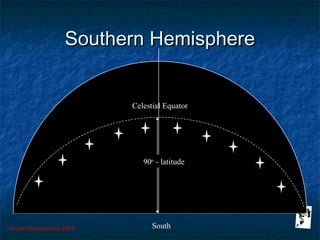
Southern HemisphereSouthern Hemisphere
South
Celestial Equator
90o
- latitude
Grunt Productions 2007
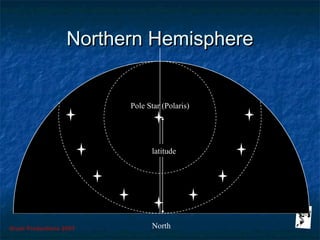
Northern HemisphereNorthern Hemisphere
North
Pole Star (Polaris)
latitude
Grunt Productions 2007
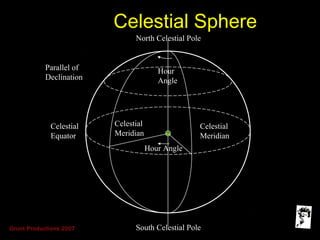
Celestial SphereCelestial Sphere
North Celestial Pole
South Celestial Pole
Celestial
Equator
Parallel of
Declination
Celestial
Meridian
Celestial
Meridian
Hour
Angle
Hour Angle
Grunt Productions 2007
Positions onPositions on
Earth/Celestial SphereEarth/Celestial Sphere
 Positions are related toPositions are related to
Equator and GreenwichEquator and Greenwich
MeridianMeridian
 Latitude and Longitude usedLatitude and Longitude used
on Earth’s surfaceon Earth’s surface
 Declination and GreenwichDeclination and Greenwich
Hour Angle (GHA) used onHour Angle (GHA) used on
Celestial SphereCelestial Sphere
Grunt Productions 2007
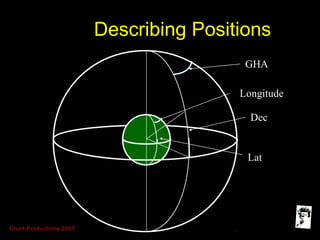
Describing PositionsDescribing Positions
GHA
Dec
Lat
Longitude
Grunt Productions 2007
Earth’s Solar OrbitEarth’s Solar Orbit
 Earth’s axis remains stationary inEarth’s axis remains stationary in
spatial terms but is notspatial terms but is not
perpendicular to the plane of theperpendicular to the plane of the
orbit.orbit.
 Inclined axis causes the position ofInclined axis causes the position of
the sun to move in relation to thethe sun to move in relation to the
equator.equator.
 Changing angle (declination)Changing angle (declination)
creates the seasons in temperatecreates the seasons in temperate
Grunt Productions 2007
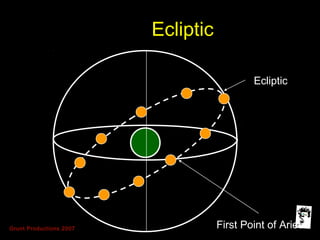
EclipticEcliptic
First Point of Aries
Ecliptic
Grunt Productions 2007
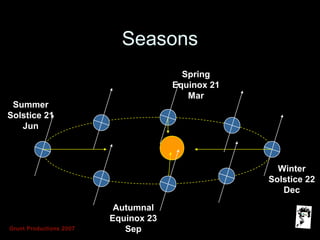
SeasonsSeasons
Winter
Solstice 22
Dec
Summer
Solstice 21
Jun
Spring
Equinox 21
Mar
Autumnal
Equinox 23
Sep
Grunt Productions 2007
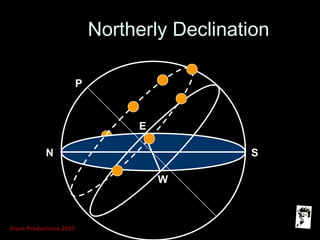
Northerly DeclinationNortherly Declination
N S
E
W
P
Grunt Productions 2007
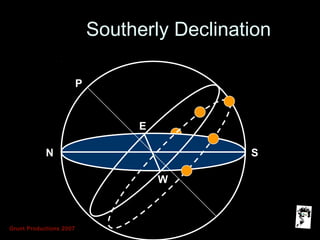
Southerly DeclinationSoutherly Declination
N S
E
W
P
Grunt Productions 2007
ConclusionsConclusions
 Concept of Celestial Sphere allows usConcept of Celestial Sphere allows us
to use spherical trigonometry toto use spherical trigonometry to
measure relative positions and solvemeasure relative positions and solve
problems.problems.
 A precise time is required to predict theA precise time is required to predict the
relative position of an astronomicalrelative position of an astronomical
body.body.
 The changing declination of the sunThe changing declination of the sun
creates the seasons and changes timescreates the seasons and changes times
of rise and set.of rise and set.

Celestial sphere lrg

  • 1.
    Grunt Productions 2007 SimpleAstronomicalSimple Astronomical PrinciplesPrinciples (Introduction - The Celestial(Introduction - The Celestial Sphere)Sphere) A brief by Lance GrindleyA brief by Lance Grindley
  • 2.
    Grunt Productions 2007 CoveringCovering Principles of the CelestialPrinciples of the Celestial SphereSphere  Movement of HeavenlyMovement of Heavenly BodiesBodies  Simple astronomicalSimple astronomical definitionsdefinitions  Combined co-ordinateCombined co-ordinate systemsystem
  • 3.
    Grunt Productions 2007 CelestialSphereCelestial Sphere  Viewed from Earth, the sky appearsViewed from Earth, the sky appears as an inverted bowl.as an inverted bowl.  The stars and other heavenlyThe stars and other heavenly bodies appear to lie on this sphere,bodies appear to lie on this sphere, irrespective of their actual distance.irrespective of their actual distance.  Radius of celestial sphere is infiniteRadius of celestial sphere is infinite so position is always described inso position is always described in angular terms.angular terms.
  • 4.
    Grunt Productions 2007 RelativeMotion of theRelative Motion of the Celestial SphereCelestial Sphere  Earth rotates eastwards at one revolutionEarth rotates eastwards at one revolution with respect to the sun every solar day.with respect to the sun every solar day.  Heavenly bodies appear to move westwardsHeavenly bodies appear to move westwards rising in the east and setting in the west.rising in the east and setting in the west.  Rate of rotation and apparent movement isRate of rotation and apparent movement is 360360oo divided by 24 hours = 15divided by 24 hours = 15oo per hourper hour  Angular east/west movement is measured onAngular east/west movement is measured on the equator and calledthe equator and called “hour angle”.“hour angle”.
  • 5.
    Grunt Productions 2007 SouthernHemisphereSouthern Hemisphere South Celestial Equator 90o - latitude
  • 6.
    Grunt Productions 2007 NorthernHemisphereNorthern Hemisphere North Pole Star (Polaris) latitude
  • 7.
    Grunt Productions 2007 CelestialSphereCelestial Sphere North Celestial Pole South Celestial Pole Celestial Equator Parallel of Declination Celestial Meridian Celestial Meridian Hour Angle Hour Angle
  • 8.
    Grunt Productions 2007 PositionsonPositions on Earth/Celestial SphereEarth/Celestial Sphere  Positions are related toPositions are related to Equator and GreenwichEquator and Greenwich MeridianMeridian  Latitude and Longitude usedLatitude and Longitude used on Earth’s surfaceon Earth’s surface  Declination and GreenwichDeclination and Greenwich Hour Angle (GHA) used onHour Angle (GHA) used on Celestial SphereCelestial Sphere
  • 9.
    Grunt Productions 2007 DescribingPositionsDescribing Positions GHA Dec Lat Longitude
  • 10.
    Grunt Productions 2007 Earth’sSolar OrbitEarth’s Solar Orbit  Earth’s axis remains stationary inEarth’s axis remains stationary in spatial terms but is notspatial terms but is not perpendicular to the plane of theperpendicular to the plane of the orbit.orbit.  Inclined axis causes the position ofInclined axis causes the position of the sun to move in relation to thethe sun to move in relation to the equator.equator.  Changing angle (declination)Changing angle (declination) creates the seasons in temperatecreates the seasons in temperate
  • 11.
  • 12.
    Grunt Productions 2007 SeasonsSeasons Winter Solstice22 Dec Summer Solstice 21 Jun Spring Equinox 21 Mar Autumnal Equinox 23 Sep
  • 13.
    Grunt Productions 2007 NortherlyDeclinationNortherly Declination N S E W P
  • 14.
    Grunt Productions 2007 SoutherlyDeclinationSoutherly Declination N S E W P
  • 15.
    Grunt Productions 2007 ConclusionsConclusions Concept of Celestial Sphere allows usConcept of Celestial Sphere allows us to use spherical trigonometry toto use spherical trigonometry to measure relative positions and solvemeasure relative positions and solve problems.problems.  A precise time is required to predict theA precise time is required to predict the relative position of an astronomicalrelative position of an astronomical body.body.  The changing declination of the sunThe changing declination of the sun creates the seasons and changes timescreates the seasons and changes times of rise and set.of rise and set.

Editor's Notes

  • #2 Welcome GPS could be considered one of the most successful navigation systems of all time. The system has revolutionised navigation both commercially and in warfare. Why should we even consider astro-navigation in this new technological age? There are some factors to consider: a. GPS is currently surprisingly easy to jam. b. The current fit is not without problems and there is little redundancy. c. Professional sense of achievement. d. Specifically required to conform to STCW.
  • #3 The primary method of calculating your position using astronomical data is the use of the NAVPAC programme produced by HMNAO. Purpose of this introduction is to enable you to understand a little more about the principles of astro-navigation and the way the programme calculates a position. An understanding of the concept of the celestial sphere will enable you to understand the simple explanation of the sight programme and hopefully will prove to be of general interest.
  • #4 The stars exist at very different distances from the earth, some a mere 5 or 6 light-years away but a number at 1000 light-years or greater distances. The celestial sphere assumes that all stars and planets (which are of course much closer) are at a similar distance, fixed on the inside of a sphere of infinite radius. The earth of course is assumed to lie at the centre of this system.
  • #5 One revolution in 24 hours is the equivalent of 15o per hour. This is referred to as “Arc to Time”. The table for calculating the equivalent time period for comparison with longitude is contained in the NA on the first of the buff coloured pages. Note that the time correction is always added for westerly longitudes and subtracted for easterly longitudes.
  • #6 If we examine the relative movement of stars, firstly by looking south from any northerly temperate latitude, the following will be observed: a. Stars rise in the east and set in the west. b. The path of very star or planet is parallel to the line of the celestial equator c. Heavenly bodies reach their maximum altitude as they pass due south (cross the observer’s meridian). d. The maximum altitude achieved by the equator is 90o - latitude so the maximum altitude of any body is dictated by latitude and its angle north or south of the celestial equator.
  • #7 Looking northwards towards the pole, the altitude of the pole (and Polaris) will be the same as the observer’s latitude. The stars which lie below the pole, plus all the stars at similar angular distances, will be circumpolar. They are visible throughout the night. The Plough or Big Dipper consists entirely of circumpolar stars.
  • #8 Although it is not necessary to look at the celestial sphere in detail, a broad understanding of some of the terms will help our understanding of the principles of astro-navigation. The celestial equator is a great circle which is perpendicular to the earth’s axis which joins the north and south celestial poles. Any great circle, or semi great circle, passing through the north and south celestial poles will be a celestial meridian. Each celestial meridian defines a plane, and the angle between any two planes, created by celestial meridians, is called an hour angle. The hour angle can be measured at the pole or along the plane of the equator.
  • #9 There is a direct correlation between position described on the surface of the earth in terms of latitude and longitude, and position within the celestial sphere, defined in terms of declination and hour angle. Declination is the direct equivalent of latitude. If the hour angle is measured from the Greenwich celestial meridian then it is termed the Greenwich Hour Angle (GHA). By convention the GHA is always measured westwards, so the angle is always increasing with time when measuring the angle to any point on the celestial sphere. If GHA is less than 180 then GHA is the direct equivalent of longitude, but if GHA is greater than 180, then it must be subtracted from 360 to give the numerical equivalent.
  • #10 The relationship between positions on the earth and those on the celestial sphere is demonstrated on the above drawing.
  • #11 Before leaving the celestial sphere, it is worth quickly looking at the earth’s solar orbit, and seeing why the sun’s declination changes slowly throughout the year. The earth’s spin axis is inclined to the plane of its orbit by an angle of 23.5. This is the sun’s maximum declination, north and south, and defines the limits of the tropics.
  • #12 The relationship between positions on the earth and those on the celestial sphere is demonstrated on the above drawing.
  • #13 Starting at the spring equinox, the declination of the sun will be zero (the sun will appear to lie on the celestial equator). The declination of the sun will slowly increase (northerly) until it reaches a maximum at the summer solstice. The process then reverses and the apparent position of the sun moves back to the autumnal equinox, the winter solstice and back to the spring equinox again. The path of the sun around the celestial sphere is called the ecliptic.
  • #14 If we look at a typical period of daylight during the summer it will be seen that: a. the sun moves more or less parallel to the equator; b. if the declination is northerly, the sun will rise to the north of east and set to the north of west; c. because the arc of the sun’s track is greater than 180°, the period of daylight will be more than 12 hours.
  • #15 If we look at a typical period of daylight during the summer it will be seen that: a. the sun moves more or less parallel to the equator; b. if the declination is northerly, the sun will rise to the north of east and set to the north of west; c. because the arc of the sun’s track is greater than 180°, the period of daylight will be more than 12 hours.
  • #16 The conclusions are shown above.