Presentation on
Equation of Time
Presented By:
Md. Nazmus Saqib Khan
ID 12075768
Year: 4th
Session: 2011-12
Department of Mathematics
University of Rajshahi-6205
Index
Some Definitions
Defining Equation of Time
Chief Causes of Equation of Time
Graphical Representation
Some applications
References
© Department of Mathematics, R.U.
Some Definitions
Apparent sun
Mean sun
Apparent solar time
Mean solar time
Transit
Hour Angle
Right Ascension
© Department of Mathematics, R.U.
Some Definitions
© Department of Mathematics, R.U.
 Apparent sun: The sun we see in
the sky is called apparent sun.
 Mean sun: The mean sun is
fictitious point which moves
uniformly along the equator with
the mean velocity of the sun along
the ecliptic.
Some Definitions
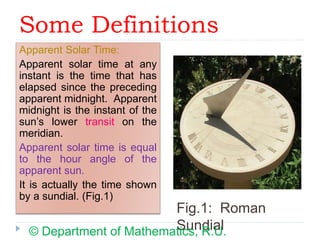
Apparent Solar Time:
Apparent solar time at any
instant is the time that has
elapsed since the preceding
apparent midnight. Apparent
midnight is the instant of the
sun’s lower transit on the
meridian.
Apparent solar time is equal
to the hour angle of the
apparent sun.
It is actually the time shown
by a sundial. (Fig.1)
Fig.1: Roman
Sundial© Department of Mathematics, R.U.
Some Definitions
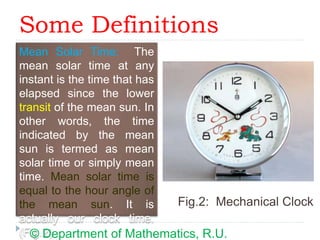
Mean Solar Time: The
mean solar time at any
instant is the time that has
elapsed since the lower
transit of the mean sun. In
other words, the time
indicated by the mean
sun is termed as mean
solar time or simply mean
time. Mean solar time is
equal to the hour angle of
the mean sun. It is
actually our clock time.
(Fig.2)
Fig.2: Mechanical Clock
© Department of Mathematics, R.U.
Some Definitions
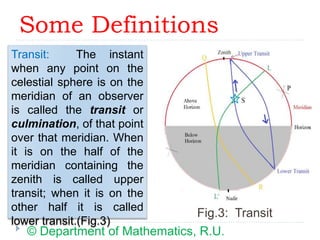
Transit: The instant
when any point on the
celestial sphere is on the
meridian of an observer
is called the transit or
culmination, of that point
over that meridian. When
it is on the half of the
meridian containing the
zenith is called upper
transit; when it is on the
other half it is called
lower transit.(Fig.3)
Fig.3: Transit
© Department of Mathematics, R.U.
Some Definitions
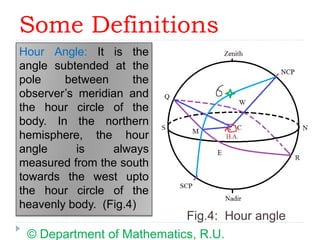
Hour Angle: It is the
angle subtended at the
pole between the
observer’s meridian and
the hour circle of the
body. In the northern
hemisphere, the hour
angle is always
measured from the south
towards the west upto
the hour circle of the
heavenly body. (Fig.4)
Fig.4: Hour angle
© Department of Mathematics, R.U.
Some Definitions
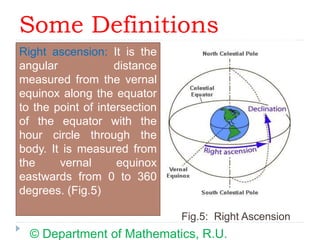
Right ascension: It is the
angular distance
measured from the vernal
equinox along the equator
to the point of intersection
of the equator with the
hour circle through the
body. It is measured from
the vernal equinox
eastwards from 0 to 360
degrees. (Fig.5)
Fig.5: Right Ascension
© Department of Mathematics, R.U.
Defining Equation of Time
Since observations made on the sun for the
purpose of determining the time can give
apparent time only, it is necessary to be able
to find at any instant the exact relation
between apparent and mean time. The
difference between the two, which varies
from -14m to +16m (nearly), is called the
equation of time. This quantity may be
found in the Nautical Almanac for each day
of the year.
© Department of Mathematics, R.U.
Defining Equation of Time
So the equation of time at any instant at a given place
is defined as the difference between the apparent
solar time and mean solar time at that instant.
Equation of time = Apparent solar time – Mean solar
time
= H.A. of apparent sun – H.A. of mean
sun
= R.A. of mean sun – R.A. of apparent
sun
Since, H.A. of a body = – R. A. of the body .
[H.A. = Hour Angle
R.A. = Right Ascension]
© Department of Mathematics, R.U.
Chief Causes of Equation of Time
The difference between the two kinds
of time is due to several causes, the
chief of which are:
I. The inequality of the earth’s angular
motion in the orbit, and
II. The fact that the apparent sun is on
the ecliptic while the mean sun is on
the equator.
© Department of Mathematics, R.U.
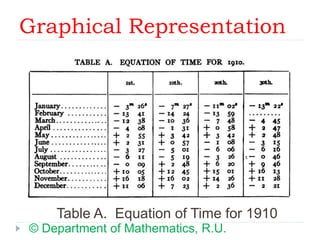
Graphical Representation
Table A. Equation of Time for 1910
© Department of Mathematics, R.U.
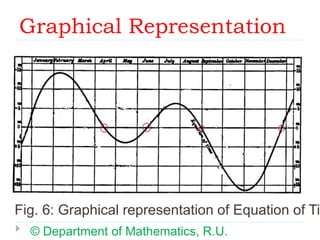
Graphical Representation
Fig. 6: Graphical representation of Equation of Tim
© Department of Mathematics, R.U.
Some applications
 The equation of time is used to correct the sundial time.
In the late 17th and 18th centuries, equation clocks were
made, which allowed the user to see or calculate
apparent solar time, as would be shown by a sundial.
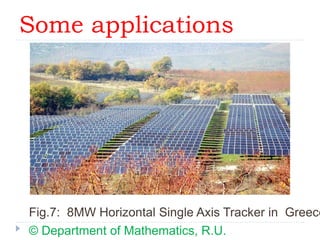
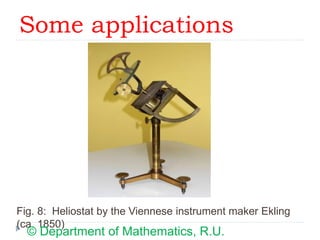
 It is also used for many applications of solar energy.
Machines such as solar trackers and heliostats have to
move in ways that are influenced by the equation of time.
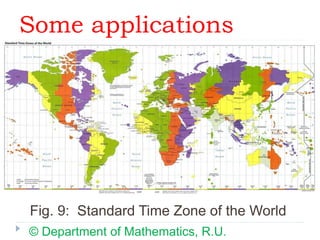
 Civil time is the local mean time for a meridian that often
passes near the center of the time zone, and may
possibly be further altered by daylight saving time. When
the apparent solar time that corresponds to a given civil
time is to be found, the difference in longitude between
the site of interest and the time zone meridian, daylight
saving time, and the equation of time must all be
considered.
© Department of Mathematics, R.U.
Some applications
Fig.7: 8MW Horizontal Single Axis Tracker in Greece
© Department of Mathematics, R.U.
Some applications
Fig. 8: Heliostat by the Viennese instrument maker Ekling
(ca. 1850)
© Department of Mathematics, R.U.
Some applications
Fig. 9: Standard Time Zone of the World
© Department of Mathematics, R.U.
References
 Spherical Astronomy by W. M. Smart
 Practical Astronomy by George L.
Hosmer
 Spherical Astronomy by Sharma
 Astronomy by K. K. De
 The Astronomical Almanac online
 Wikipedia
 Google Images
© Department of Mathematics, R.U.
END OF THIS PRESENTATION
Any Questions?
Thank You!
© Department of Mathematics, R.U.

Presentation on Equation of time

  • 1.
    Presentation on Equation ofTime Presented By: Md. Nazmus Saqib Khan ID 12075768 Year: 4th Session: 2011-12 Department of Mathematics University of Rajshahi-6205
  • 2.
    Index Some Definitions Defining Equationof Time Chief Causes of Equation of Time Graphical Representation Some applications References © Department of Mathematics, R.U.
  • 3.
    Some Definitions Apparent sun Meansun Apparent solar time Mean solar time Transit Hour Angle Right Ascension © Department of Mathematics, R.U.
  • 4.
    Some Definitions © Departmentof Mathematics, R.U.  Apparent sun: The sun we see in the sky is called apparent sun.  Mean sun: The mean sun is fictitious point which moves uniformly along the equator with the mean velocity of the sun along the ecliptic.
  • 5.
    Some Definitions Apparent SolarTime: Apparent solar time at any instant is the time that has elapsed since the preceding apparent midnight. Apparent midnight is the instant of the sun’s lower transit on the meridian. Apparent solar time is equal to the hour angle of the apparent sun. It is actually the time shown by a sundial. (Fig.1) Fig.1: Roman Sundial© Department of Mathematics, R.U.
  • 6.
    Some Definitions Mean SolarTime: The mean solar time at any instant is the time that has elapsed since the lower transit of the mean sun. In other words, the time indicated by the mean sun is termed as mean solar time or simply mean time. Mean solar time is equal to the hour angle of the mean sun. It is actually our clock time. (Fig.2) Fig.2: Mechanical Clock © Department of Mathematics, R.U.
  • 7.
    Some Definitions Transit: Theinstant when any point on the celestial sphere is on the meridian of an observer is called the transit or culmination, of that point over that meridian. When it is on the half of the meridian containing the zenith is called upper transit; when it is on the other half it is called lower transit.(Fig.3) Fig.3: Transit © Department of Mathematics, R.U.
  • 8.
    Some Definitions Hour Angle:It is the angle subtended at the pole between the observer’s meridian and the hour circle of the body. In the northern hemisphere, the hour angle is always measured from the south towards the west upto the hour circle of the heavenly body. (Fig.4) Fig.4: Hour angle © Department of Mathematics, R.U.
  • 9.
    Some Definitions Right ascension:It is the angular distance measured from the vernal equinox along the equator to the point of intersection of the equator with the hour circle through the body. It is measured from the vernal equinox eastwards from 0 to 360 degrees. (Fig.5) Fig.5: Right Ascension © Department of Mathematics, R.U.
  • 10.
    Defining Equation ofTime Since observations made on the sun for the purpose of determining the time can give apparent time only, it is necessary to be able to find at any instant the exact relation between apparent and mean time. The difference between the two, which varies from -14m to +16m (nearly), is called the equation of time. This quantity may be found in the Nautical Almanac for each day of the year. © Department of Mathematics, R.U.
  • 11.
    Defining Equation ofTime So the equation of time at any instant at a given place is defined as the difference between the apparent solar time and mean solar time at that instant. Equation of time = Apparent solar time – Mean solar time = H.A. of apparent sun – H.A. of mean sun = R.A. of mean sun – R.A. of apparent sun Since, H.A. of a body = – R. A. of the body . [H.A. = Hour Angle R.A. = Right Ascension] © Department of Mathematics, R.U.
  • 12.
    Chief Causes ofEquation of Time The difference between the two kinds of time is due to several causes, the chief of which are: I. The inequality of the earth’s angular motion in the orbit, and II. The fact that the apparent sun is on the ecliptic while the mean sun is on the equator. © Department of Mathematics, R.U.
  • 13.
    Graphical Representation Table A.Equation of Time for 1910 © Department of Mathematics, R.U.
  • 14.
    Graphical Representation Fig. 6:Graphical representation of Equation of Tim © Department of Mathematics, R.U.
  • 15.
    Some applications  Theequation of time is used to correct the sundial time. In the late 17th and 18th centuries, equation clocks were made, which allowed the user to see or calculate apparent solar time, as would be shown by a sundial.  It is also used for many applications of solar energy. Machines such as solar trackers and heliostats have to move in ways that are influenced by the equation of time.  Civil time is the local mean time for a meridian that often passes near the center of the time zone, and may possibly be further altered by daylight saving time. When the apparent solar time that corresponds to a given civil time is to be found, the difference in longitude between the site of interest and the time zone meridian, daylight saving time, and the equation of time must all be considered. © Department of Mathematics, R.U.
  • 16.
    Some applications Fig.7: 8MWHorizontal Single Axis Tracker in Greece © Department of Mathematics, R.U.
  • 17.
    Some applications Fig. 8:Heliostat by the Viennese instrument maker Ekling (ca. 1850) © Department of Mathematics, R.U.
  • 18.
    Some applications Fig. 9:Standard Time Zone of the World © Department of Mathematics, R.U.
  • 19.
    References  Spherical Astronomyby W. M. Smart  Practical Astronomy by George L. Hosmer  Spherical Astronomy by Sharma  Astronomy by K. K. De  The Astronomical Almanac online  Wikipedia  Google Images © Department of Mathematics, R.U.
  • 20.
    END OF THISPRESENTATION Any Questions? Thank You! © Department of Mathematics, R.U.