MAXILLECTOMYAND
CRANIOFACIAL RESECTION
DR.MAAMON
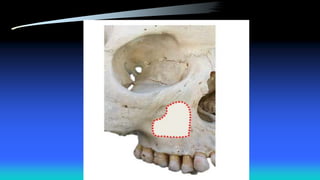
Maxillectomy
• Maxillectomy is a surgical procedure used to partially or completely remove
the maxilla bone
Indications
• Malignant tumors involving maxilla
• Benign tumors of maxilla causing extensive bone destruction (fibrous dysplasia)
• May be performed as a part of combined resection of skull base and
nasopharyngeal neoplasm
• May be needed in patients with extensive fungal /granulomatous infections
• Malignant tumors of oral cavity with extensive involvement of palate
• Not indicated in the management of tumors which are better managed by
chemoradiation (lymphoma and rhabdomyosarcoma )
Contraindication
• Distant metastases
• Gross brain invasion
• Central skull base invasion
• Bilateral optic nerve or chiasm infiltration.
• Extension through the sphenoid sinus walls
• Significant trismus
• Poor general condition of the patient
• Patient not consenting to undergo the procedure
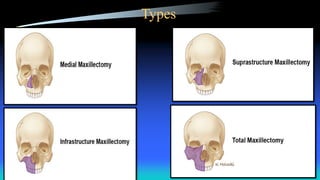
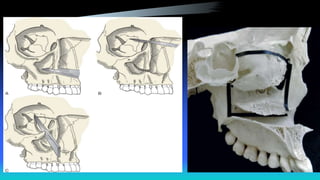
Types
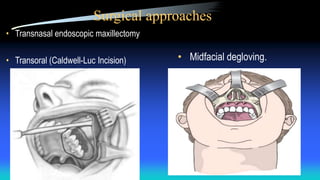
Surgical approaches
• Transnasal endoscopic maxillectomy
• Transoral (Caldwell-Luc Incision) • Midfacial degloving.
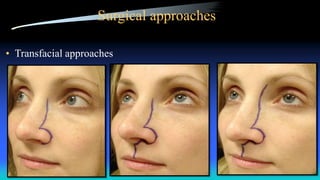
Surgical approaches
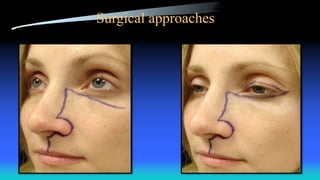
• Transfacial approaches
Surgical approaches
Preoperative evaluation
• Detailed history
• Thorough clinical head and neck examination (including nasal endoscopy and cranial
nerve examinations , ophthalmological examination )
• CT scan and MRI
• Biopsy
• Metastatic workup
Preoperative evaluation
• Ophthalmological evaluation .
• Dental evaluation
• Neurosurgical evaluation
• Plastic surgery evaluation
Preoperative evaluation
Preoperative consent includes discussing,
• The facial incisions
• Loss of sensation in the infraor-bital nerve distribution,
• Diplopia, epiphora, enophthalmos,potential injury to the optic nerve,
• CSF leak.
• Consent for harvesting graft/flap if tissue reconstruction is intended
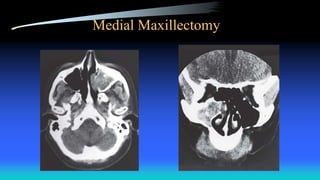
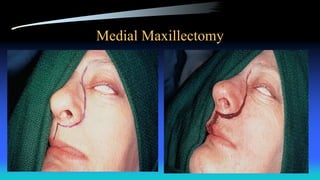
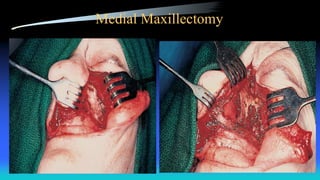
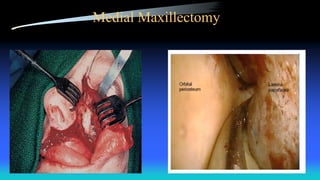
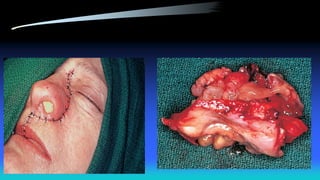
Medial Maxillectomy
Indicated for
• Low-grade malignant tumors, inverted papillomas, and other tumors of limited
extent on the lateral wall of the nasal cavity or the medial wall of the maxillary
antrum.
Medial Maxillectomy
Medial Maxillectomy
Medial Maxillectomy
Medial Maxillectomy
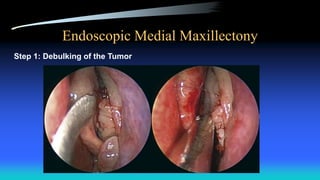
Endoscopic Medial Maxillectony
Step 1: Debulking of the Tumor
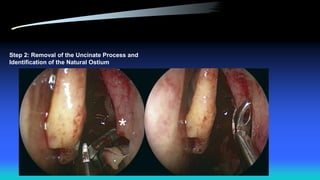
Step 2: Removal of the Uncinate Process and
Identification of the Natural Ostium
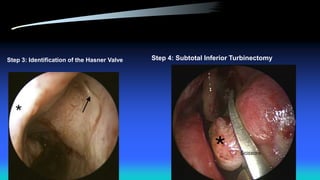
Step 3: Identification of the Hasner Valve Step 4: Subtotal Inferior Turbinectomy
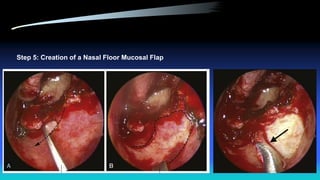
Step 5: Creation of a Nasal Floor Mucosal Flap
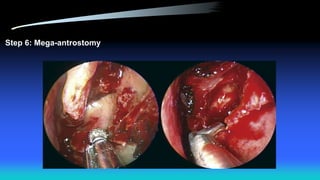
Step 6: Mega-antrostomy
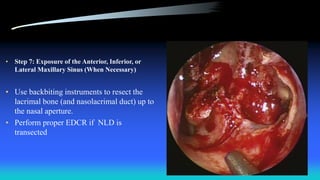
• Step 7: Exposure of the Anterior, Inferior, or
Lateral Maxillary Sinus (When Necessary)
• Use backbiting instruments to resect the
lacrimal bone (and nasolacrimal duct) up to
the nasal aperture.
• Perform proper EDCR if NLD is
transected
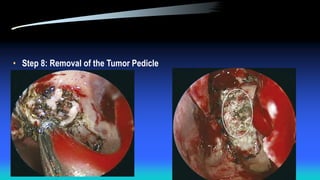
• Step 8: Removal of the Tumor Pedicle
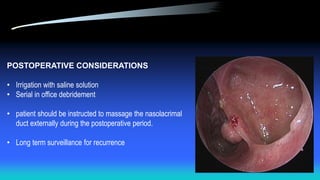
POSTOPERATIVE CONSIDERATIONS
• Irrigation with saline solution
• Serial in office debridement
• patient should be instructed to massage the nasolacrimal
duct externally during the postoperative period.
• Long term surveillance for recurrence
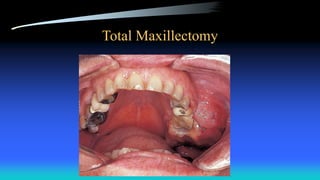
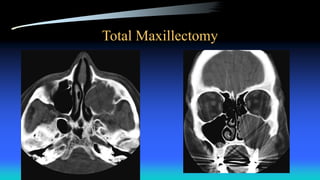
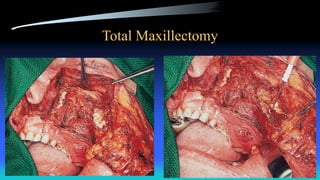
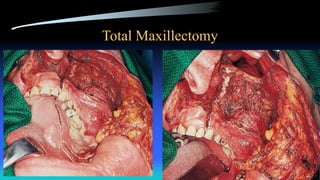
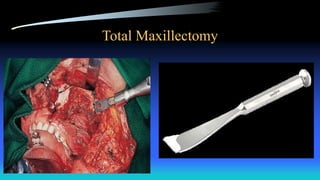
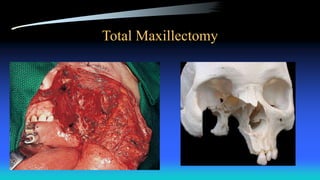
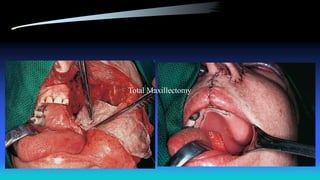
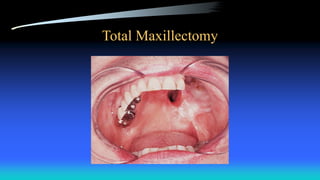
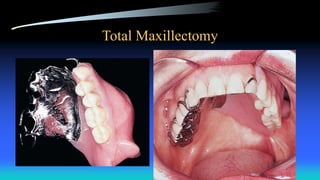
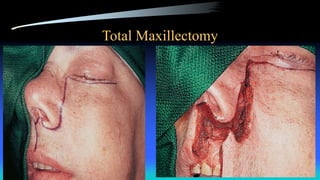
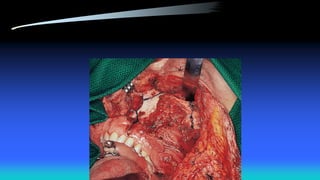
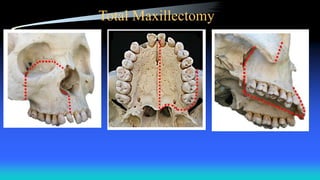
Total Maxillectomy
• Complete removal of the maxilla becomes necessary when :
• primary tumor arising from the surface lining of the maxillary sinus fills up the entire
antrum.
• Primary mesenchymal tumors arising in the maxilla such as soft tissue and bone
sarcomas also require total removal of the maxilla to encompass the entire lesion.
Total Maxillectomy
Total Maxillectomy
Total Maxillectomy
Total Maxillectomy
Total Maxillectomy
Total Maxillectomy
Total Maxillectomy
Total Maxillectomy
Total Maxillectomy
Total Maxillectomy
Total Maxillectomy
Total Maxillectomy
Total Maxillectomy with Orbital
Exenteration
• Indicated when a primary tumor of the nasal cavity or paranasal sinuses extends into
the orbit through the orbital periosteum.
• Orbital exenteration of a functioning eye with normal vision is considered only if the
possibility of a curative resection exists
• Removal of a functioning eye for a palliative operation is not recommended.
• facial moulage and clinical photographs should be obtained to facilitate subsequent
fabrication of a facial prosthesis.
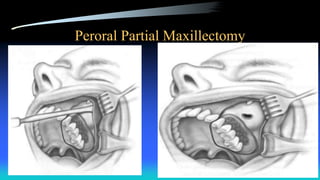
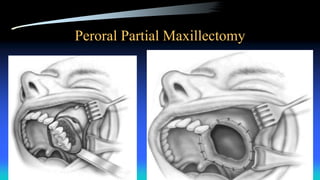
Peroral Partial Maxillectomy
• Indicated for small tumours of the hard palate and superior alveolus
• CT scans in axial and coronal planes is mandatory for accurate delineation of the
extent of the tumor before embarking on a peroral partial maxillectomy
Peroral Partial Maxillectomy
Complications:
• Intraoperative hemorrhage
• Troublesome Epiphora
• Damage to orbital structures
• . Damage to cornea
• Loss of vision
• Velopharyngeal incompetence (Nasal leak of ingested fluids)
• Cosmetic defects / scars
• Trismus due to scarring of muscles of mastication
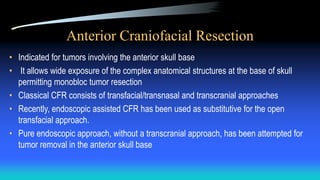
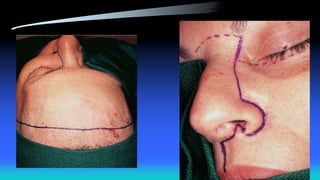
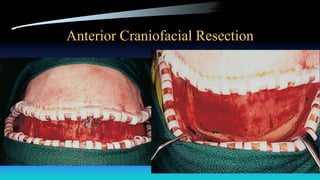
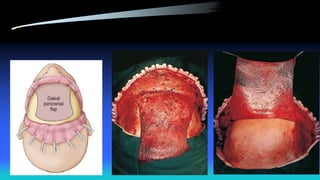
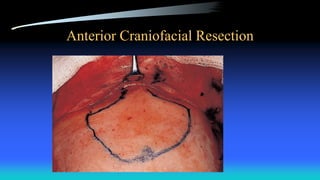
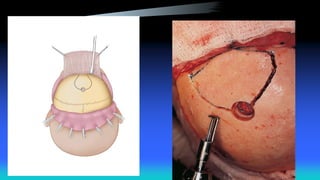
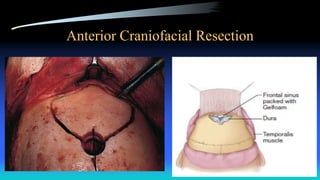
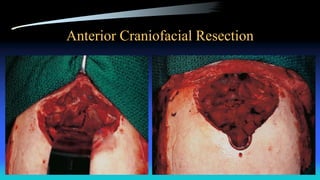
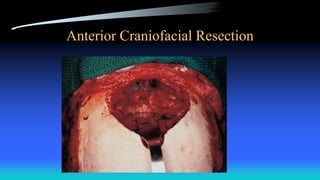
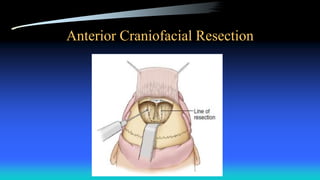
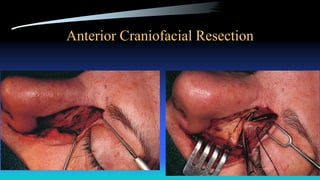
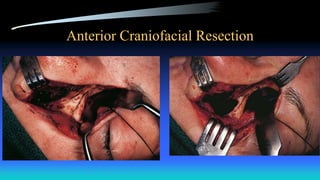
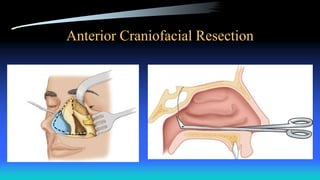
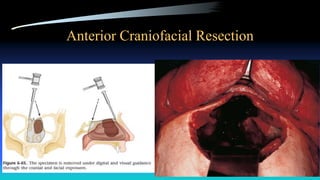
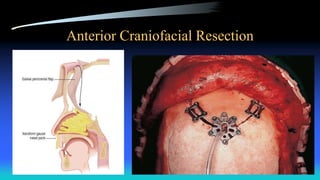
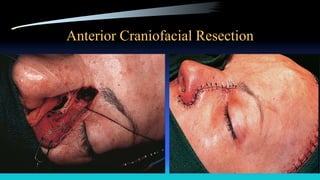
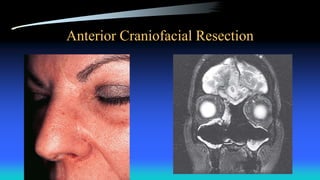
Anterior Craniofacial Resection
• Indicated for tumors involving the anterior skull base
• It allows wide exposure of the complex anatomical structures at the base of skull
permitting monobloc tumor resection
• Classical CFR consists of transfacial/transnasal and transcranial approaches
• Recently, endoscopic assisted CFR has been used as substitutive for the open
transfacial approach.
• Pure endoscopic approach, without a transcranial approach, has been attempted for
tumor removal in the anterior skull base
OPEN CFR
• Preoperative broad-spectrum antibiotics should be given because of the connection
between the sinonasal cavity and the cranial cavity.
• A lumbar puncture is performed to decompress the brain and minimize retraction
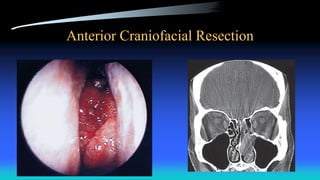
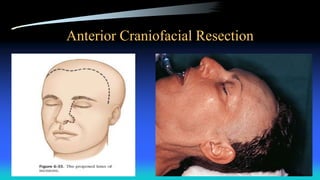
Anterior Craniofacial Resection
Endoscopic Craniofacial Resection
Reconstruction
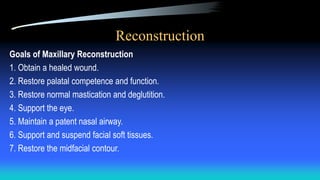
Goals of Maxillary Reconstruction
1. Obtain a healed wound.
2. Restore palatal competence and function.
3. Restore normal mastication and deglutition.
4. Support the eye.
5. Maintain a patent nasal airway.
6. Support and suspend facial soft tissues.
7. Restore the midfacial contour.
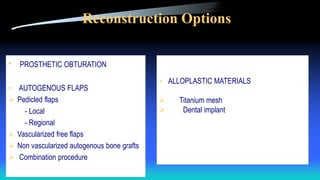
Reconstruction Options
• PROSTHETIC OBTURATION
• AUTOGENOUS FLAPS
 Pedicled flaps
- Local
- Regional
 Vascularized free flaps
 Non vascularized autogenous bone grafts
 Combination procedure
• ALLOPLASTIC MATERIALS
 Titanium mesh
 Dental implant
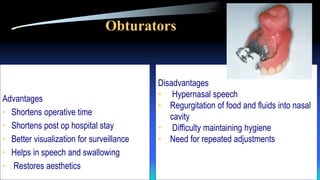
Obturators
Advantages
• Shortens operative time
• Shortens post op hospital stay
• Better visualization for surveillance
• Helps in speech and swallowing
• Restores aesthetics
Disadvantages
• Hypernasal speech
• Regurgitation of food and fluids into nasal
cavity
• Difficulty maintaining hygiene
• Need for repeated adjustments
Microvascular Free Flaps
• Indicated for large defects
• Matching to three-dimensional shape of defect
– Provide bone, palatal and nasal lining, skin, soft tissue
• Requires vascular pedicle 10-15 cm long
• Multiple different options
– Myocutaneous
– Osteomyocutaneous
– Combination with free bone grafts
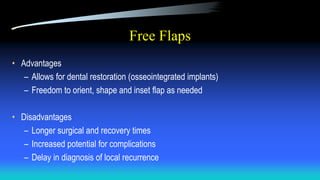
Free Flaps
• Advantages
– Allows for dental restoration (osseointegrated implants)
– Freedom to orient, shape and inset flap as needed
• Disadvantages
– Longer surgical and recovery times
– Increased potential for complications
– Delay in diagnosis of local recurrence
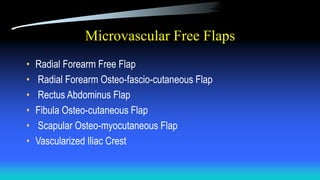
Microvascular Free Flaps
• Radial Forearm Free Flap
• Radial Forearm Osteo-fascio-cutaneous Flap
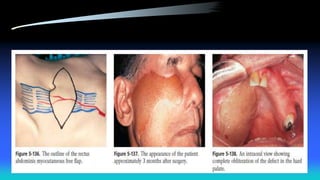
• Rectus Abdominus Flap
• Fibula Osteo-cutaneous Flap
• Scapular Osteo-myocutaneous Flap
• Vascularized Iliac Crest
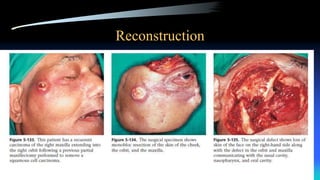
Reconstruction
Maxillectomy and craniofacial resection

Maxillectomy and craniofacial resection

Editor's Notes
  • #5 Extension through the sphenoid sinus walls often suggests involvement of the carotid arteries or penetration into the cavernous sinus, Significant trismus is suggestive of gross invasion into the pterygoid musculature
  • #7 Gingivobuccal incision Bilateral septocolumellar and intercartilaginous incisions., Transfixion incision.
  • #8 Lateral rhinotomy incision (mours incision ) Weber furgusson incisions and its modification
  • #10 CT clearly demonstrates bone abnormality; however, it may overestimate the extent of tumor MRI distinguishes tumor from surrounding soft tissue and is especially valuable in differentiating tumor from secretions resulting from sinus obstruction . MRI also demonstrates perineural spread better than CT does.
  • #11 Multidicplinary team approach
  • #14 CT scan of patient with inverted papilloma
  • #15 done under general anesthesia with orotracheal intubation INCISION is marked and infiltrated with local antiesthetic with adrenaline 1:100000 tarsorraphy or ceramic corneal shield The skin incision is deepened through the soft tissues and the musculature of the upper lip and cheek up to the anterior bony wall of the maxilla.
  • #16 As the cheek flap is elevated, the infraorbital nerve near the orbital rim is carefully preserved. Nasal cavity is entered Anterior antrostomy is done
  • #17 A silk suture is placed through the detached medial canthal ligament and left long for identification, for subsequent reapproximation to the nasal bone. Malleable retractor
  • #18 Frontoethmoidal suture Anterior and posterior ethmoid foramena Anterior antrostomy
  • #19 Osteotomies are made along the floor of the nose through the bone between the antrum and the nasal cavity (A), through the frontal-ethmoid suture below the level of the anterior ethmoid artery (B), and along the medial floor of the orbit to the posterior wall of the antrum The soft tissue attachment removed with scissors
  • #20 Nasolacrimal duct
  • #23 Endoscopic images showing reflection of the middle turbinate medially to reveal the contents of the middle meatus. Polyps and tumor can be debulked with instruments or a tissue shaver.
  • #25 Perform a subtotal inferior turbinectomy using endoscopic scissors by incising between the anterior one third and the posterior two thirds of the turbinate, just behind the Hasner valve
  • #26 Angled Beaver blade
  • #27 Use downbiting instruments and a high-speed irrigating drill to resect the medial maxillary wall down to the nasal floor
  • #28 Endoscopic image showing the mucosal flap redraped along the floor (asterisk) and into the maxillary sinus defect when the procedure is complete.
  • #29 The pedicle is resected and the surrounding bone drilled away to remove nests of tumor within the bone. B, The area of attachment (circle) has been drilled down. *
  • #32 Introral picture Odontogenic myxoma
  • #35 Skin of eye lid raised crefully Orbicularis oculi muscle The upper cheek flap is elevated approximately 1 cm lateral to the lateral canthus of the eye to provide sufficient exposure of the entire anterior and anterolateral wall of the maxilla
  • #36 Subperiosteal dissection of the orbital contents in the lower part of the orbit permits excision of the orbital plate of the maxilla, which will be the superior margin of the surgical specimen. Division of the attachment of the masseter muscle on the inferior border of the zygoma
  • #37 The palatal incision is extended posteriorly in the midline up to the junction of the hard and soft palate, at which point it turns laterally behind the maxillary tubercle up to the gingivobuccal sulcus. 2-Entry is made into the nasal cavity by opening the vestibule of the nasal cavity through the piriform recess to expose the nasal process of the maxilla.
  • #38 When Soft tissue dissection is completed Mark the osteotomy site with cautery The proposed bone cuts for total maxillectomy are marked on the patient with the use of electrocautery.
  • #39 Superomedially, the nasal process of the maxilla is divided Superolaterally, the maxilla is separated from the zygomatic arch, inferiorly the maxilla is divided through its alveolar process between the lateral incisor and canine tooth up to the midline and from there onward through the midline up to its posterior margin Inferolaterally, the maxilla is separated from the pterygoid plates through its hamulus to provide a monobloc resection.
  • #40 high-speed power saw is used Oscillating saw Curved osteotome
  • #42 A split-thickness skin graft is used to line the facial flap and cover the exposed soft tissue in the infratemporal fossa.
  • #43 An intraoral view 3 months after surgery.
  • #44 Final prosthesis
  • #47 Gingivobuccal incision with a periosteal elevator used to elevate the periosteum up to the level of the inferior orbital nerve. Antrostomy with visualization of the maxillary sinus floor and infraorbital rim.
  • #48 The hard palate is transected to the midline and into the maxillary sinus while trying to avoid the lateral nasal wall and nasal cavity Posterior osteotomy created by aiming superomedially A split-thickness skin graft is used to line the raw surfaces
  • #49 due to over packing the maxillectomy cavity compromising vascularity of optic nerve
  • #50 In 1997, Yuen et al. cranionasal resection Due to the development of the endoscope technique and instruments,
  • #52 Olfactory neurblastoma (esthisoneuroblastoma
  • #54 After the scalp hair is shaved , a bicoronal incision is made from ear tragus to ear tragus down through the subcutaneous tissue and down to the plane superficial to the galea aponeurotica
  • #55 The scalp flap is elevated in a plane superficial to the galea aponeurotica and the pericranium. The posterior scalp flap is retracted significantly to obtain a generous portion of the galea and pericranium for the pedicled flap. Raney clips.
  • #56 The proposed line of incision (U-shaped) in the pericranium for the elevation of a galeal-pericranial flap for subsequent use during repair of the skull base Complete elevation of the flap over the calvarium exposes the underlying frontal bone
  • #57 A retractor placed in the center of the field shows the exposed upper part of the nasal bones and the supraorbital ridges bilaterally.
  • #58 The proposed line of the bone cut is marked on the anterior wall of the frontal sinus and the frontal bone. A single burr hole is made in the midline and dural elevators are used to elevate the dura adjacent to the burr hole on both sides to permit introduction of the side-cutting Midas Rex saw
  • #60 The mucosa of the frontal sinus is completely curetted out,and its posterior wall is removed to cranialize the sinus. The dural sleeves have been divided and ligated.
  • #61 A retractor placed along the midline over the sagittal sinus exposes the posterior part of the cribriform plate and the planum sphenoidale. Before this anesthetist is asked to withdrow 15-20 ml csf from lumber drain
  • #62 A high-speed drill with a fine burr is used to make the bone cuts through the floor of the anterior cranial fossa. the bone cut goes through the roof of the left orbit, remaining lateral to the lamina papyracea on the left side, through the sphenoid sinus posteriorly, and through the cribriform plate, remaining medial to the lamina papyracea on the right-hand
  • #65 Bone cuts are now made through the nasal process of maxilla and through the lacrimal fossa and the anterior aspect of the lamina papyracea within the orbit on the left-hand side. The medial wall of the maxilla in its lower part is divided with an osteotome through the floor of the nasal cavity as far as back posteriorly as possible. The incision in the nasal septum
  • #67 galeal pericranial pedicled flap is swung down to cover the bony defect in the skull base The craniotomy is closed with appropriate miniplates Suction drain placed extradural space