GLOMUS
TUMORS
Dr. AJAY MANICKAM
JR – RG KAR MEDICAL
COLLEGE
THE GLOMUS TUMORS
These are chemodactomas or non-chromaffin
paragangliomas arise from glomus bodies
distributed along the parasympathetic nerve in the
skull base, thorax & neck
GLOMUS TUMOURS
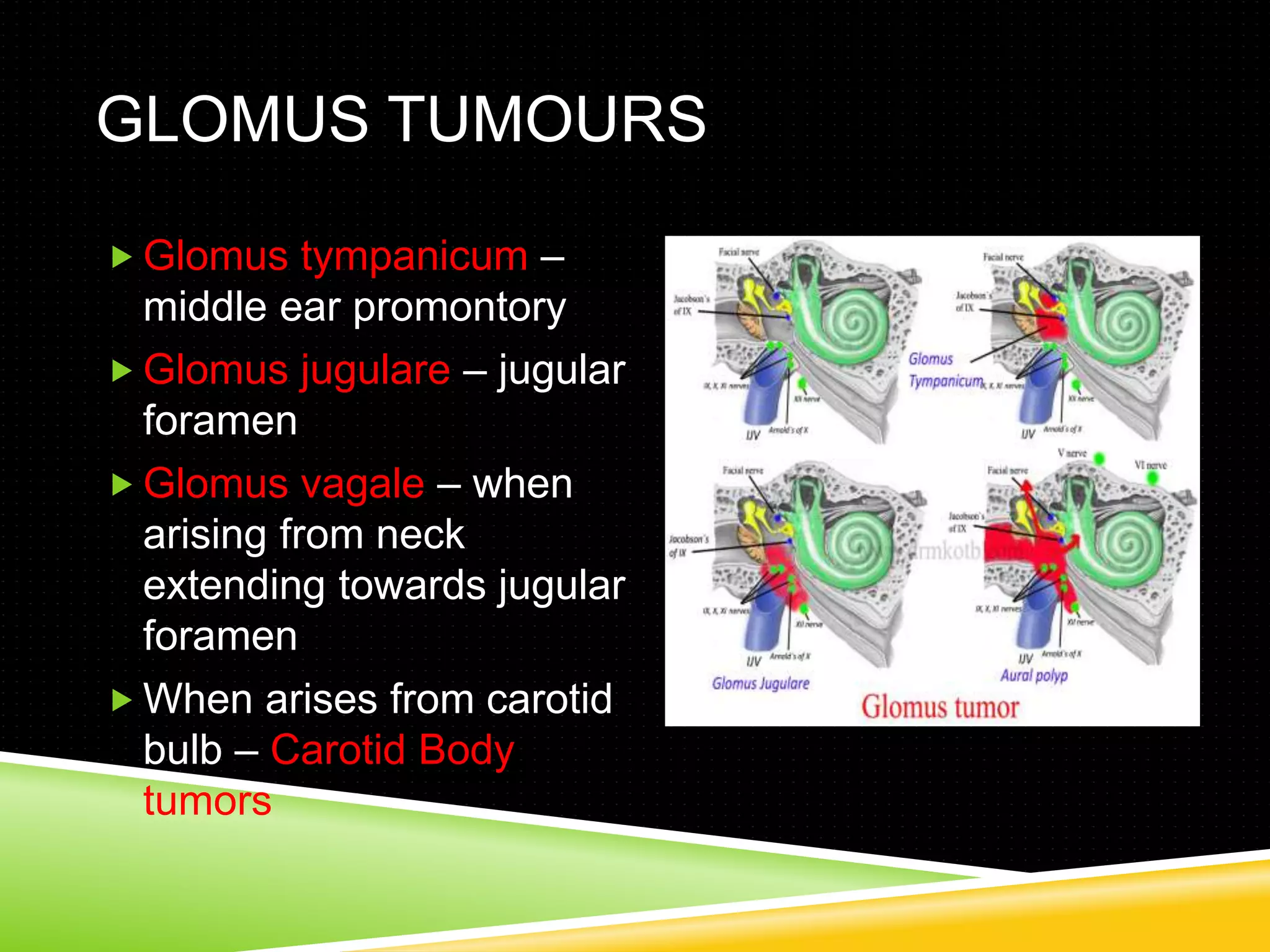
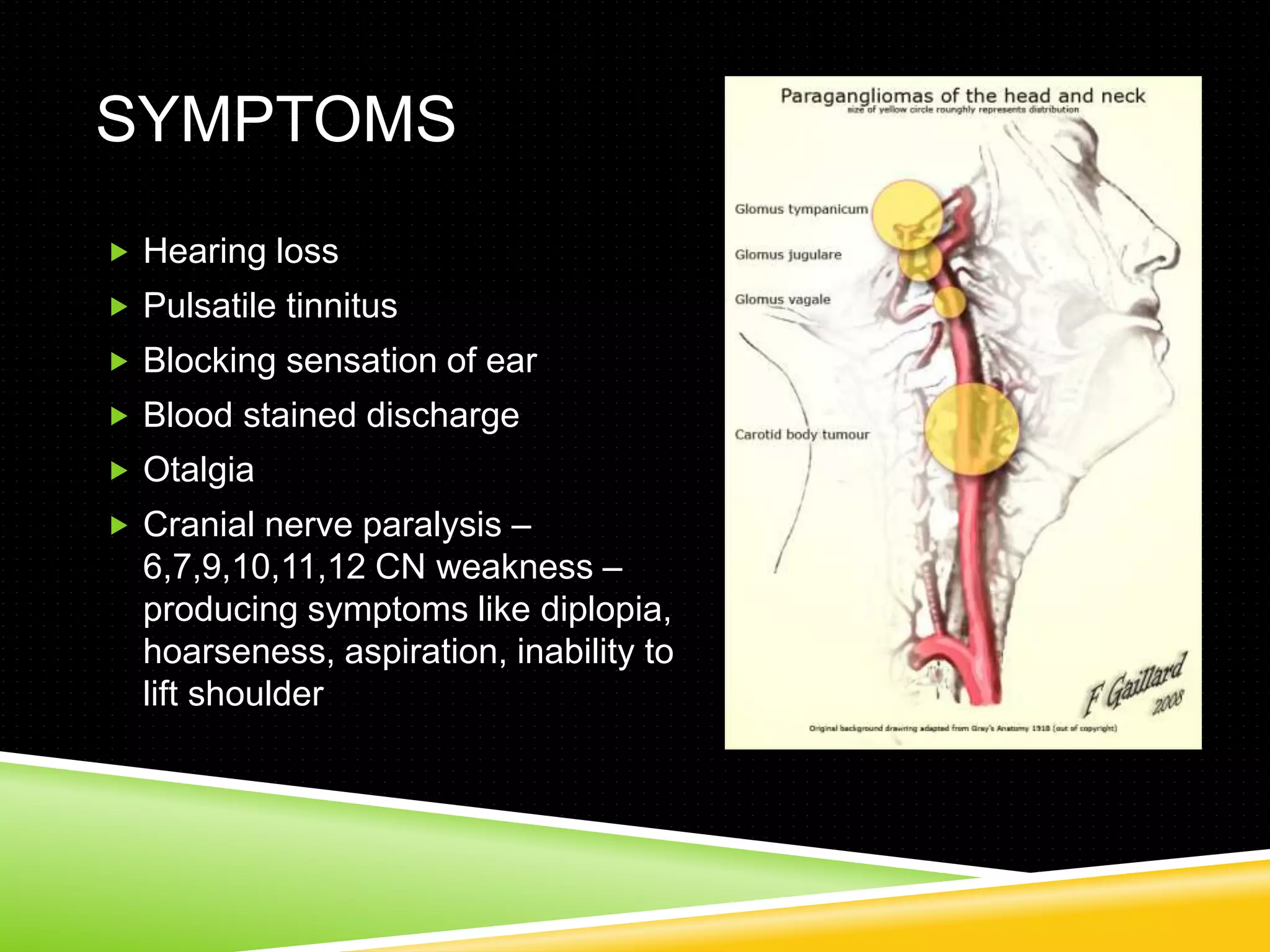
 Glomus tympanicum –
middle ear promontory
 Glomus jugulare – jugular
foramen
 Glomus vagale – when
arising from neck
extending towards jugular
foramen
 When arises from carotid
bulb – Carotid Body
tumors
PATHOGENESIS
 Hypervascular tumours arising from
glomus bodies
 Glomus bodies are found within
adventitia of the jugular bulb, course of
glossopharyngeal nerve, vagus nerve,
tympanic canaliculus, retrofacial air
cells, promontory, geniculate ganglion
 They secrete catecholamines, although
few cases hypersecretion of
noradrenaline, dopamine, serotonin
have also been described
 Few cases may go for malignant
changes and metastasis
CLINICAL FEATURES
 Incidence
 Middle aged, female
 Familial with autosomal dominant pattern but can be sporadic
also
SYMPTOMS
 Hearing loss
 Pulsatile tinnitus
 Blocking sensation of ear
 Blood stained discharge
 Otalgia
 Cranial nerve paralysis –
6,7,9,10,11,12 CN weakness –
producing symptoms like diplopia,
hoarseness, aspiration, inability to
lift shoulder
SIGNS
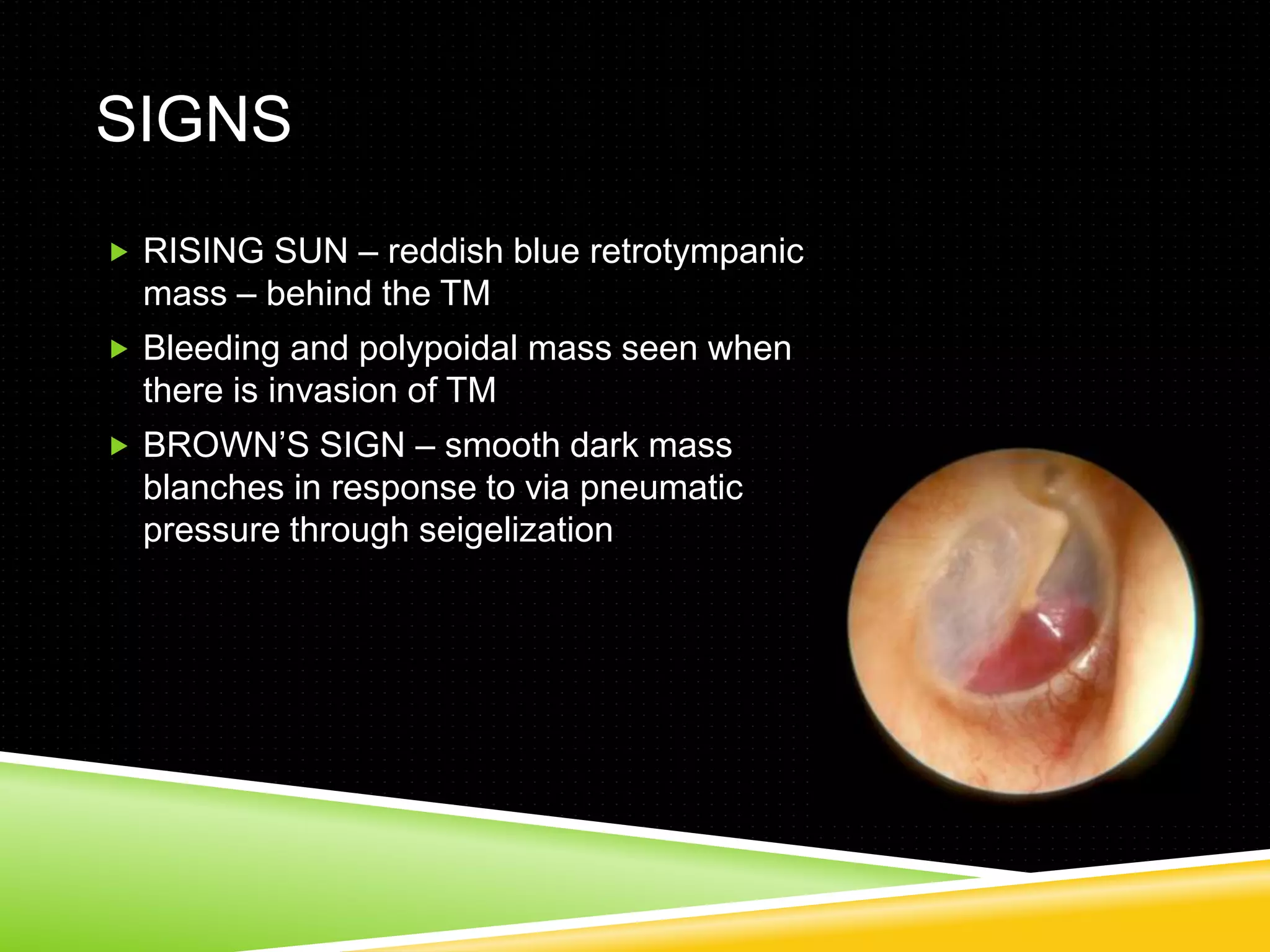
 RISING SUN – reddish blue retrotympanic
mass – behind the TM
 Bleeding and polypoidal mass seen when
there is invasion of TM
 BROWN’S SIGN – smooth dark mass
blanches in response to via pneumatic
pressure through seigelization
CLASSIFICATION - FISCH
 Type A – tumour localized in ME cavity
 Type B – tympanomastoid tumours with no destruction of bone in
infralabyrinthine compartment in the temporal bone
 Type C – tumour invading bone of the infralabyrinthine
compartment
 Type D – tumours with intracranial extension
INVESTIGATIONS
 Audiogram – initially conductive – later SNHL
 MRI with gadolinium contrast – T1 weighed
image shows salt & pepper appearance
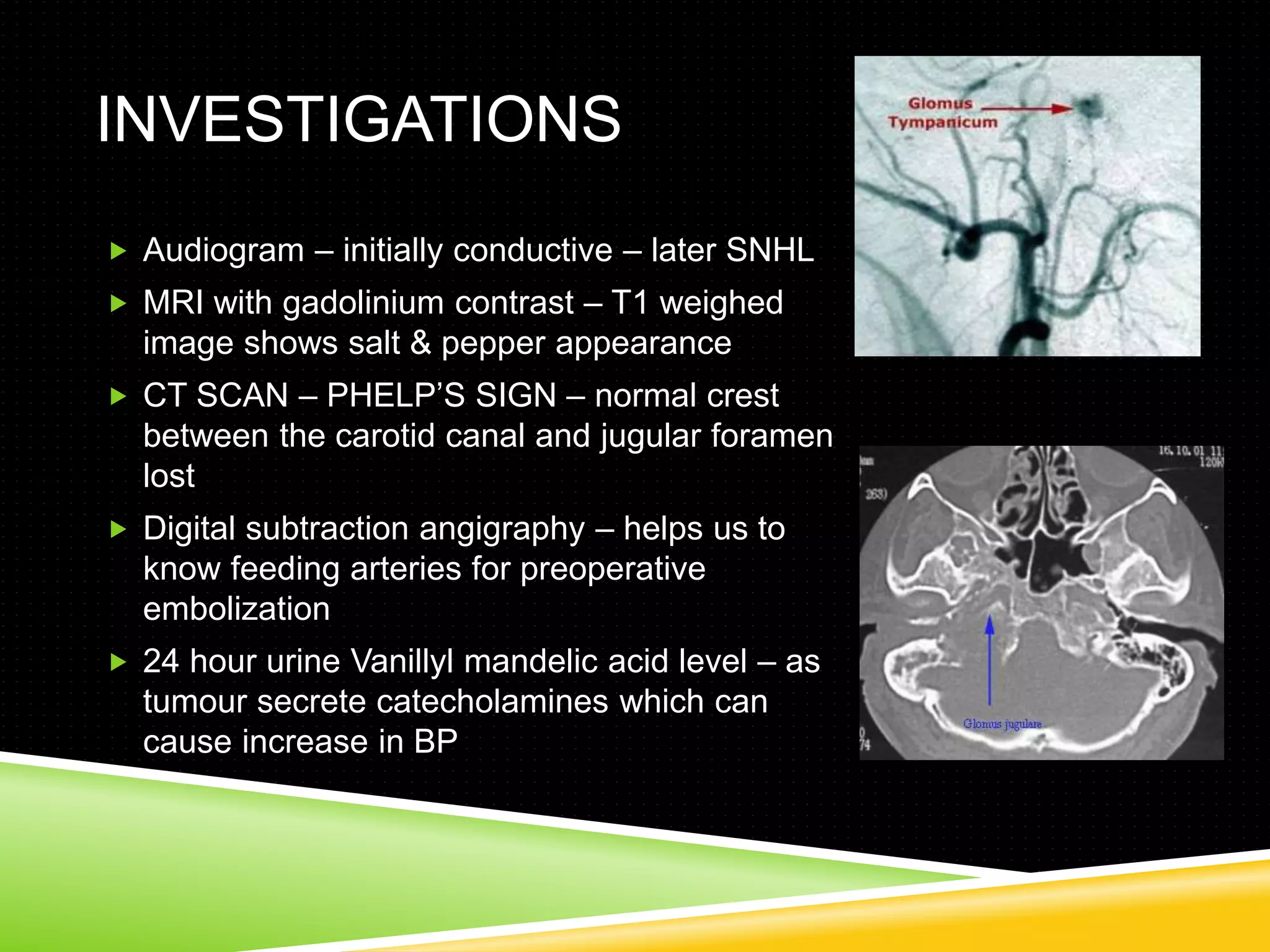
 CT SCAN – PHELP’S SIGN – normal crest
between the carotid canal and jugular foramen
lost
 Digital subtraction angigraphy – helps us to
know feeding arteries for preoperative
embolization
 24 hour urine Vanillyl mandelic acid level – as
tumour secrete catecholamines which can
cause increase in BP
TREATMENT
 Surgery
 Type A & B – Trans mastoid approach
 Type C & D – Lateral skull base approach
 Embolization – preoperative before 48 hours can reduce intra
operative bleeding
 Radiotherapy & chemotherapy for unresectable tumours
 LASER assisted excision - gives good results

Glomus tumors

  • 1.
    GLOMUS TUMORS Dr. AJAY MANICKAM JR– RG KAR MEDICAL COLLEGE
  • 2.
    THE GLOMUS TUMORS Theseare chemodactomas or non-chromaffin paragangliomas arise from glomus bodies distributed along the parasympathetic nerve in the skull base, thorax & neck
  • 3.
    GLOMUS TUMOURS  Glomustympanicum – middle ear promontory  Glomus jugulare – jugular foramen  Glomus vagale – when arising from neck extending towards jugular foramen  When arises from carotid bulb – Carotid Body tumors
  • 4.
    PATHOGENESIS  Hypervascular tumoursarising from glomus bodies  Glomus bodies are found within adventitia of the jugular bulb, course of glossopharyngeal nerve, vagus nerve, tympanic canaliculus, retrofacial air cells, promontory, geniculate ganglion  They secrete catecholamines, although few cases hypersecretion of noradrenaline, dopamine, serotonin have also been described  Few cases may go for malignant changes and metastasis
  • 5.
    CLINICAL FEATURES  Incidence Middle aged, female  Familial with autosomal dominant pattern but can be sporadic also
  • 6.
    SYMPTOMS  Hearing loss Pulsatile tinnitus  Blocking sensation of ear  Blood stained discharge  Otalgia  Cranial nerve paralysis – 6,7,9,10,11,12 CN weakness – producing symptoms like diplopia, hoarseness, aspiration, inability to lift shoulder
  • 7.
    SIGNS  RISING SUN– reddish blue retrotympanic mass – behind the TM  Bleeding and polypoidal mass seen when there is invasion of TM  BROWN’S SIGN – smooth dark mass blanches in response to via pneumatic pressure through seigelization
  • 8.
    CLASSIFICATION - FISCH Type A – tumour localized in ME cavity  Type B – tympanomastoid tumours with no destruction of bone in infralabyrinthine compartment in the temporal bone  Type C – tumour invading bone of the infralabyrinthine compartment  Type D – tumours with intracranial extension
  • 9.
    INVESTIGATIONS  Audiogram –initially conductive – later SNHL  MRI with gadolinium contrast – T1 weighed image shows salt & pepper appearance  CT SCAN – PHELP’S SIGN – normal crest between the carotid canal and jugular foramen lost  Digital subtraction angigraphy – helps us to know feeding arteries for preoperative embolization  24 hour urine Vanillyl mandelic acid level – as tumour secrete catecholamines which can cause increase in BP
  • 10.
    TREATMENT  Surgery  TypeA & B – Trans mastoid approach  Type C & D – Lateral skull base approach  Embolization – preoperative before 48 hours can reduce intra operative bleeding  Radiotherapy & chemotherapy for unresectable tumours  LASER assisted excision - gives good results