
Dr Zeeshan Ali
INTRACTABLE ASPIRATION
Definition
 Laryngeal penetration of gastric secretions below
the vocal cords
(40% have small aspirations often go
unnoticed: it’s the quantity of aspiration that
defines it)
low pH causes inflammatory response bringing
leukotriene induced damage to lung
Causes
 CNS – stroke,MS,parkinsons,head injury
 PNS – GB synd, polio,demylinating diseases
 NMJ – mysthenia gravis, lambert eaten synd
 Muscles– muscular dystrophy, polymyositis
 GIT – GERD, achlasia, pharyngeal pouch, tumour
 Mechanical – NG tubes,tracheostomy,ETT
 Misc – severe debilitation
Signs and symptoms
 No symptoms
 Coughing bouts
 Chowking during swallowing
 Dysphagia
 Regurgitation
 Dysphonia
 RECURRENT PNEUMONIA PLUS SEPSIS
Examination
 Complete head and neck exam
 Tongue movement
 Gag reflex
 Cough reflex
 IDL
Investigations
 CXR (no pattern) basal infiltrates
 Contrast swallow
 Rigid endoscopy
 Barium videoflouroscopy swallow test
 Fibreoptic endoscopic evaluation of swallowing
(FEES)
 Bronchio aveolar lavage for lipid laden
macrophages
Best contrast should be nonionic,low osmolar
having LMW
Current radiological method
 Barium and gastrograffin both poor materials as
cause chemical pneumonitis! OMNIPAQ ,DIONOSIL
are recommended
 What a radiologist should do! sequence
 Take history and examine patient
 Do Diluted barium test
 Do Barium puree in food test
 Use alternate contrast in children -Tc99 in milk
 see Change is neck positions on swallowing
 See Breath holding effect on swallowing
 Witness all on flouroscopy himself
 Or record it via videoflouroscopy
 Help swallowing pathologist suggest usefulness of
exercises
Management
 Specific surgeries
 Surgeries for persistent aspirators
 Conservative strategies
Specific surgeries
 VC medialization
 Cricopharyngeal myotomy (Heller’s)
 Nissen’s fundoplication
 Removal of tumour
 Pharyngeal pouch surgery
 TEF surgery
Persistent aspirators
 Principle
 Close or separate
 Divert
 Excise
Persistent aspirators
 Total / narrow field laryngectomy
 Endolaryngeal stents
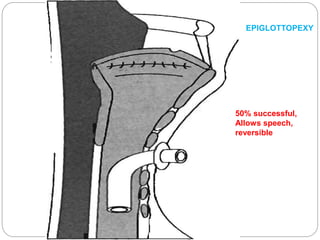
 Epiglottopexy
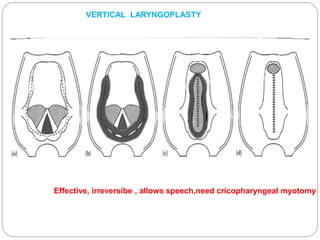
 Vertical laryngoplasty
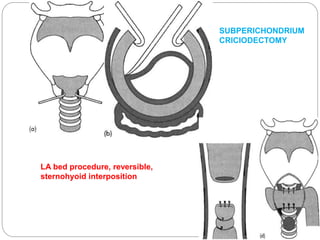
 Subperichondrium cricoidectomy
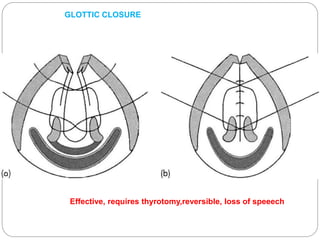
 Glottic closure
 Tracheo-oesopageal diversion
 Laryngotracheal seperation
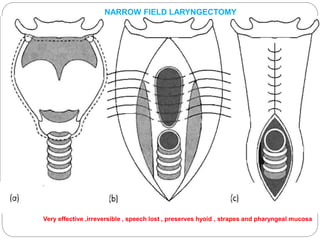
Very effective ,irreversible , speech lost , preserves hyoid , strapes and pharyngeal mucosa
NARROW FIELD LARYNGECTOMY
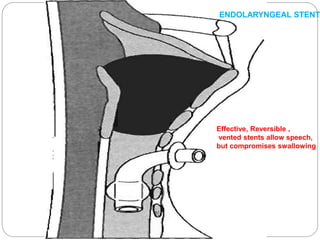
Effective, Reversible ,
vented stents allow speech,
but compromises swallowing
ENDOLARYNGEAL STENT
50% successful,
Allows speech,
reversible
EPIGLOTTOPEXY
Effective, irreversibe , allows speech,need cricopharyngeal myotomy
VERTICAL LARYNGOPLASTY
LA bed procedure, reversible,
sternohyoid interposition
SUBPERICHONDRIUM
CRICIODECTOMY
Effective, requires thyrotomy,reversible, loss of speeech
GLOTTIC CLOSURE
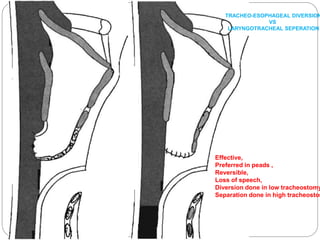
Effective,
Preferred in peads ,
Reversible,
Loss of speech,
Diversion done in low tracheostomy
Separation done in high tracheostom
TRACHEO-ESOPHAGEAL DIVERSION
VS
LARYNGOTRACHEAL SEPERATION
Conservative
 Treat lung disease
 Chest physiotherapy
 Swallow maneuvers
 NPO, Frequent suctioning, head elevation
,alternative route nutrition
 Tracheostomy (causes aspiration!! Evan blue
test)
 NG TUBE
 Gastrostomy
 Jejunostomy (best results)
Swallow maneuvres
 Reclining position at 30 degrees
 Seated position 60 degrees 2 hrs after eating
 Head rotation (opposite of what we think!! Tilting toward
paralyzed side reduces aspiration)
 Chin tuck method
 Side lying position
 Cervical excercises
 Thermal tactile stimulation
 Supraglottic swallowing
 Mandelsohn maneuvre
 Shaker exercise
 Balloon training
 Respiratory physiotherapy
ASPIRATION IN NEONATES
 Aspiration have infant reflux but not all reflux
have aspiration
 All infant have reflux but a minor event and
subsides later (physiological reflux)
 Short abdominal segment and hourly feeds is the
reason
 Preterm infant have more reflux problems
 More in formula fed infants ( causes more
bloating and lead to opening of LES earlier)
 Most reflux are asymptomatic
 Major cause of ALTE (apparent life threatening
events)
 Seen in laryngomalacia, subglottic stenosis,
laryngeal clefts and resp papillomatosis
Causes
 CP
 NM disorders
 Impaired esophageal motility and laryngeal
sensations
 Prematurity
 GERD
 Tracheostomy?
 Laryngeal clefts
 TEF
 VC palsy
 Presents as
 Apnea and bradycardia
 Chowking episodes
 ALTE
 Colicky pains , irritability and arching of back
(Sandifer synd)
 Recurrent pneumonia
 Recurrent hoarseness,croup like
symptoms,laryngitis
 Rhinosinusitis
 Otitis media
Investigations for reflux
 Trial of antireflux (diagnostic intervention)
 Barium swallow (good for structural problems)
 Radionucleotide scintigraphy(tc99 labelled milk)
 PH monitoring (gold std)
 Endoscopic findings
 Hypopharyngeal cobble stoning
 Oedema arytenoids
 Posterior commisure oedema
 Lingual tonsil hypertrophy
 Blunting carina
 Increased bronchial secretions
 Signs of oesophagitis
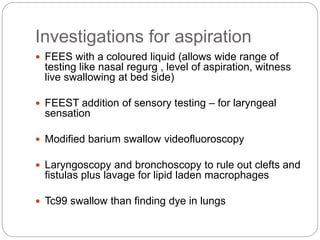
Investigations for aspiration
 FEES with a coloured liquid (allows wide range of
testing like nasal regurg , level of aspiration, witness
live swallowing at bed side)
 FEEST addition of sensory testing – for laryngeal
sensation
 Modified barium swallow videofluoroscopy
 Laryngoscopy and bronchoscopy to rule out clefts and
fistulas plus lavage for lipid laden macrophages
 Tc99 swallow than finding dye in lungs
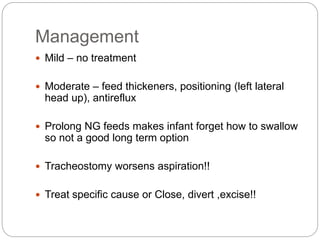
Management
 Mild – no treatment
 Moderate – feed thickeners, positioning (left lateral
head up), antireflux
 Prolong NG feeds makes infant forget how to swallow
so not a good long term option
 Tracheostomy worsens aspiration!!
 Treat specific cause or Close, divert ,excise!!
THANK YOU

Intractable aspiration

  • 1.
  • 2.
    Definition  Laryngeal penetrationof gastric secretions below the vocal cords (40% have small aspirations often go unnoticed: it’s the quantity of aspiration that defines it) low pH causes inflammatory response bringing leukotriene induced damage to lung
  • 3.
    Causes  CNS –stroke,MS,parkinsons,head injury  PNS – GB synd, polio,demylinating diseases  NMJ – mysthenia gravis, lambert eaten synd  Muscles– muscular dystrophy, polymyositis  GIT – GERD, achlasia, pharyngeal pouch, tumour  Mechanical – NG tubes,tracheostomy,ETT  Misc – severe debilitation
  • 4.
    Signs and symptoms No symptoms  Coughing bouts  Chowking during swallowing  Dysphagia  Regurgitation  Dysphonia  RECURRENT PNEUMONIA PLUS SEPSIS
  • 5.
    Examination  Complete headand neck exam  Tongue movement  Gag reflex  Cough reflex  IDL
  • 6.
    Investigations  CXR (nopattern) basal infiltrates  Contrast swallow  Rigid endoscopy  Barium videoflouroscopy swallow test  Fibreoptic endoscopic evaluation of swallowing (FEES)  Bronchio aveolar lavage for lipid laden macrophages Best contrast should be nonionic,low osmolar having LMW
  • 7.
    Current radiological method Barium and gastrograffin both poor materials as cause chemical pneumonitis! OMNIPAQ ,DIONOSIL are recommended  What a radiologist should do! sequence  Take history and examine patient  Do Diluted barium test  Do Barium puree in food test  Use alternate contrast in children -Tc99 in milk  see Change is neck positions on swallowing  See Breath holding effect on swallowing  Witness all on flouroscopy himself  Or record it via videoflouroscopy  Help swallowing pathologist suggest usefulness of exercises
  • 8.
    Management  Specific surgeries Surgeries for persistent aspirators  Conservative strategies
  • 9.
    Specific surgeries  VCmedialization  Cricopharyngeal myotomy (Heller’s)  Nissen’s fundoplication  Removal of tumour  Pharyngeal pouch surgery  TEF surgery
  • 10.
    Persistent aspirators  Principle Close or separate  Divert  Excise
  • 11.
    Persistent aspirators  Total/ narrow field laryngectomy  Endolaryngeal stents  Epiglottopexy  Vertical laryngoplasty  Subperichondrium cricoidectomy  Glottic closure  Tracheo-oesopageal diversion  Laryngotracheal seperation
  • 12.
    Very effective ,irreversible, speech lost , preserves hyoid , strapes and pharyngeal mucosa NARROW FIELD LARYNGECTOMY
  • 13.
    Effective, Reversible , ventedstents allow speech, but compromises swallowing ENDOLARYNGEAL STENT
  • 14.
  • 15.
    Effective, irreversibe ,allows speech,need cricopharyngeal myotomy VERTICAL LARYNGOPLASTY
  • 16.
    LA bed procedure,reversible, sternohyoid interposition SUBPERICHONDRIUM CRICIODECTOMY
  • 17.
    Effective, requires thyrotomy,reversible,loss of speeech GLOTTIC CLOSURE
  • 18.
    Effective, Preferred in peads, Reversible, Loss of speech, Diversion done in low tracheostomy Separation done in high tracheostom TRACHEO-ESOPHAGEAL DIVERSION VS LARYNGOTRACHEAL SEPERATION
  • 19.
    Conservative  Treat lungdisease  Chest physiotherapy  Swallow maneuvers  NPO, Frequent suctioning, head elevation ,alternative route nutrition  Tracheostomy (causes aspiration!! Evan blue test)  NG TUBE  Gastrostomy  Jejunostomy (best results)
  • 20.
    Swallow maneuvres  Recliningposition at 30 degrees  Seated position 60 degrees 2 hrs after eating  Head rotation (opposite of what we think!! Tilting toward paralyzed side reduces aspiration)  Chin tuck method  Side lying position  Cervical excercises  Thermal tactile stimulation  Supraglottic swallowing  Mandelsohn maneuvre  Shaker exercise  Balloon training  Respiratory physiotherapy
  • 21.
  • 22.
     Aspiration haveinfant reflux but not all reflux have aspiration  All infant have reflux but a minor event and subsides later (physiological reflux)  Short abdominal segment and hourly feeds is the reason  Preterm infant have more reflux problems  More in formula fed infants ( causes more bloating and lead to opening of LES earlier)  Most reflux are asymptomatic  Major cause of ALTE (apparent life threatening events)  Seen in laryngomalacia, subglottic stenosis, laryngeal clefts and resp papillomatosis
  • 23.
    Causes  CP  NMdisorders  Impaired esophageal motility and laryngeal sensations  Prematurity  GERD  Tracheostomy?  Laryngeal clefts  TEF  VC palsy
  • 24.
     Presents as Apnea and bradycardia  Chowking episodes  ALTE  Colicky pains , irritability and arching of back (Sandifer synd)  Recurrent pneumonia  Recurrent hoarseness,croup like symptoms,laryngitis  Rhinosinusitis  Otitis media
  • 25.
    Investigations for reflux Trial of antireflux (diagnostic intervention)  Barium swallow (good for structural problems)  Radionucleotide scintigraphy(tc99 labelled milk)  PH monitoring (gold std)  Endoscopic findings  Hypopharyngeal cobble stoning  Oedema arytenoids  Posterior commisure oedema  Lingual tonsil hypertrophy  Blunting carina  Increased bronchial secretions  Signs of oesophagitis
  • 26.
    Investigations for aspiration FEES with a coloured liquid (allows wide range of testing like nasal regurg , level of aspiration, witness live swallowing at bed side)  FEEST addition of sensory testing – for laryngeal sensation  Modified barium swallow videofluoroscopy  Laryngoscopy and bronchoscopy to rule out clefts and fistulas plus lavage for lipid laden macrophages  Tc99 swallow than finding dye in lungs
  • 27.
    Management  Mild –no treatment  Moderate – feed thickeners, positioning (left lateral head up), antireflux  Prolong NG feeds makes infant forget how to swallow so not a good long term option  Tracheostomy worsens aspiration!!  Treat specific cause or Close, divert ,excise!!
  • 28.