RECONSTRUCTIVE SURGERIES
Aim : Restoration of form and function
Form:
cosmetic
Restoration of contour
Expression of face
Oral competence
Functions:
Speech
Mastication
Deglutition
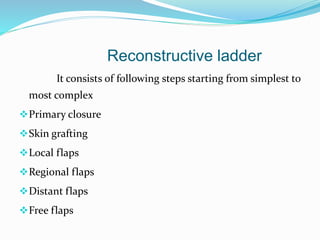
Reconstructive ladder
It consists of following steps starting from simplest to
most complex
๏ถPrimary closure
๏ถSkin grafting
๏ถLocal flaps
๏ถRegional flaps
๏ถDistant flaps
๏ถFree flaps
Patient selection and decision making
๏‚— Select the most appropriate option for the particular
defect
๏‚— Patient factors-Age,perfomance
status,comorbidities
๏‚— Patient choice and expectations
๏‚— Tissues to be replaced
๏‚— Occupation
๏‚— Patient counselling
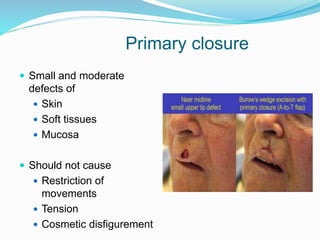
Primary closure
๏‚— Small and moderate
defects of
๏‚— Skin
๏‚— Soft tissues
๏‚— Mucosa
๏‚— Should not cause
๏‚— Restriction of
movements
๏‚— Tension
๏‚— Cosmetic disfigurement
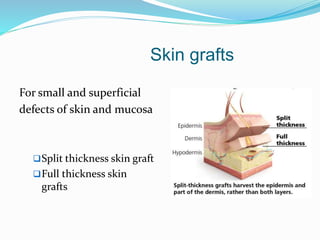
Skin grafts
For small and superficial
defects of skin and mucosa
๏ฑSplit thickness skin graft
๏ฑFull thickness skin
grafts
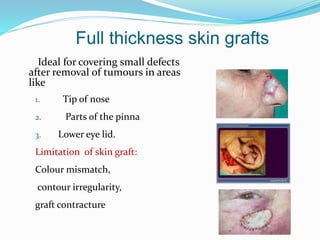
Full thickness skin grafts
Ideal for covering small defects
after removal of tumours in areas
like
1. Tip of nose
2. Parts of the pinna
3. Lower eye lid.
Limitation of skin graft:
Colour mismatch,
contour irregularity,
graft contracture
Locoregional flaps
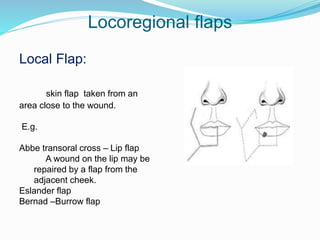
Local Flap:
skin flap taken from an
area close to the wound.
E.g.
Abbe transoral cross โ€“ Lip flap
A wound on the lip may be
repaired by a flap from the
adjacent cheek.
Eslander flap
Bernad โ€“Burrow flap
Local Flaps features:
๏‚ง Rich Vascularity
๏‚ง Lot of local flaps available
๏‚ง Long and thin local flaps can be planned
๏‚ง Good colour and texture match
๏‚ง Good healing of donor site
๏‚ง Less morbidity
๏‚ง Same incision & field
๏‚ง Little expertise
๏‚ง Time saving
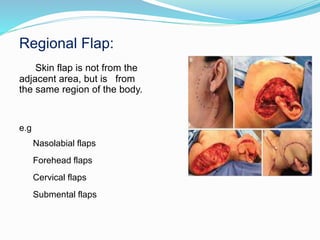
Regional Flap:
Skin flap is not from the
adjacent area, but is from
the same region of the body.
e.g
Nasolabial flaps
Forehead flaps
Cervical flaps
Submental flaps
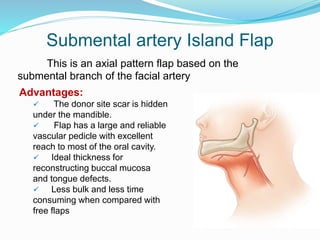
Submental artery Island Flap
This is an axial pattern flap based on the
submental branch of the facial artery
Advantages:
๏ƒผ The donor site scar is hidden
under the mandible.
๏ƒผ Flap has a large and reliable
vascular pedicle with excellent
reach to most of the oral cavity.
๏ƒผ Ideal thickness for
reconstructing buccal mucosa
and tongue defects.
๏ƒผ Less bulk and less time
consuming when compared with
free flaps
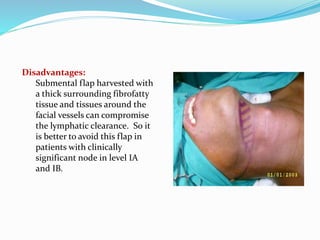
Disadvantages:
Submental flap harvested with
a thick surrounding fibrofatty
tissue and tissues around the
facial vessels can compromise
the lymphatic clearance. So it
is better to avoid this flap in
patients with clinically
significant node in level IA
and IB.
DELTOPECTORAL FLAP
It served as the premier flap for
reconstructing complex head and
neck defects LIKE oral
cavity&cheek
Advantages
๏ƒผ Technical simplicity
๏ƒผ Predictable vascular supply
๏ƒผ The DP flap also provides a
valuable salvage option
The deltopectoral flap is based on
perforators from the internal mammary
artery, usually perforators passing
through the second and third intercostal
spaces.
Myocutaneous Flaps
โ€ข Commonest reconstructive option for major head
and neck defects
๏‚ง Pectoralis major flaps
๏‚ง Sternomastoid flaps
๏‚ง Trapezius myocutaneous flaps
๏‚ง Latissimuss dorsi flaps
Pectoralis major myocutaneous flap
The most frequently used
myocutaneous flap
The workhorse of the head
and neck surgeon
The blood supply to
pectoralis major flap is consistent
and so very reliable.
The donor defect can be
closed primarily in majority of
cases.
Main uses of Pectoralis major
Myocutaneous flap
o For reconstruction of major intra oral
lining defects
o For reconstructing outside skin defects
of cheek or full thickness defects of oral
cavity.
o For covering major neck skin defects
following extended radical neck dissection
and in post irradiated patients.
o For protecting the exposed carotid vessels following neck
dissection to prevent carotid blow out.
o For augmenting the pharyngeal closure following
laryngopharyngectomy when there is tension in pharyngeal closure
especially in salvage set up.
o For reconstructing circumferential pharyngeal and cervical
oesophageal defects.
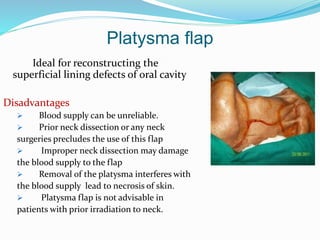
Platysma flap
Ideal for reconstructing the
superficial lining defects of oral cavity
Disadvantages
๏ƒ˜ Blood supply can be unreliable.
๏ƒ˜ Prior neck dissection or any neck
surgeries precludes the use of this flap
๏ƒ˜ Improper neck dissection may damage
the blood supply to the flap
๏ƒ˜ Removal of the platysma interferes with
the blood supply lead to necrosis of skin.
๏ƒ˜ Platysma flap is not advisable in
patients with prior irradiation to neck.
Sternomastoid flap
Advantages
๏ถ The skin is hairless and thin
๏ถ An ideal reconstructive option for medium sized cheek
defects.
๏ถ It does not produce excessive bulk in the face or mouth
Disadvantages
๏ถ Improper neck dissection is likely to cause damage to
the vascular pedicle.
๏ถ A previous neck surgery or concurrent
lymphadenectomy preclude the use of this flap
Trapezius Myocutaneous Flap
It is used for
reconstructing defects of
head and neck region
and upper back.
Its location makes it
the flap of choice for
defects of the occipital,
parotid and cervical
spine regions.
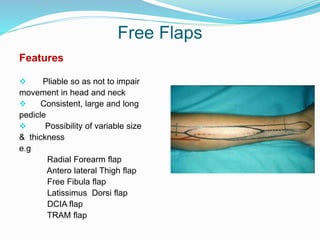
Free Flaps
Features
๏ถ Pliable so as not to impair
movement in head and neck
๏ถ Consistent, large and long
pedicle
๏ถ Possibility of variable size
& thickness
e.g
Radial Forearm flap
Antero lateral Thigh flap
Free Fibula flap
Latissimus Dorsi flap
DCIA flap
TRAM flap
MANDIBULAR RECONSTRUCTION
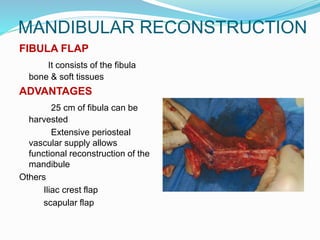
FIBULA FLAP
It consists of the fibula
bone & soft tissues
ADVANTAGES
25 cm of fibula can be
harvested
Extensive periosteal
vascular supply allows
functional reconstruction of the
mandibule
Others
Iliac crest flap
scapular flap
CONCLUSION
Reconstructive surgery is an essential part of head and
neck cancer surgery
This improves the form and function of survivors and the
quality of life.
Various options are available for head and neck
reconstructions and has to select the appropriate one
Thank you
THANK YOU

Reconstruction in head and neck surgeries

  • 2.
    RECONSTRUCTIVE SURGERIES Aim :Restoration of form and function Form: cosmetic Restoration of contour Expression of face Oral competence Functions: Speech Mastication Deglutition
  • 3.
    Reconstructive ladder It consistsof following steps starting from simplest to most complex ๏ถPrimary closure ๏ถSkin grafting ๏ถLocal flaps ๏ถRegional flaps ๏ถDistant flaps ๏ถFree flaps
  • 4.
    Patient selection anddecision making ๏‚— Select the most appropriate option for the particular defect ๏‚— Patient factors-Age,perfomance status,comorbidities ๏‚— Patient choice and expectations ๏‚— Tissues to be replaced ๏‚— Occupation ๏‚— Patient counselling
  • 5.
    Primary closure ๏‚— Smalland moderate defects of ๏‚— Skin ๏‚— Soft tissues ๏‚— Mucosa ๏‚— Should not cause ๏‚— Restriction of movements ๏‚— Tension ๏‚— Cosmetic disfigurement
  • 6.
    Skin grafts For smalland superficial defects of skin and mucosa ๏ฑSplit thickness skin graft ๏ฑFull thickness skin grafts
  • 7.
    Full thickness skingrafts Ideal for covering small defects after removal of tumours in areas like 1. Tip of nose 2. Parts of the pinna 3. Lower eye lid. Limitation of skin graft: Colour mismatch, contour irregularity, graft contracture
  • 8.
    Locoregional flaps Local Flap: skinflap taken from an area close to the wound. E.g. Abbe transoral cross โ€“ Lip flap A wound on the lip may be repaired by a flap from the adjacent cheek. Eslander flap Bernad โ€“Burrow flap
  • 9.
    Local Flaps features: ๏‚งRich Vascularity ๏‚ง Lot of local flaps available ๏‚ง Long and thin local flaps can be planned ๏‚ง Good colour and texture match ๏‚ง Good healing of donor site ๏‚ง Less morbidity ๏‚ง Same incision & field ๏‚ง Little expertise ๏‚ง Time saving
  • 10.
    Regional Flap: Skin flapis not from the adjacent area, but is from the same region of the body. e.g Nasolabial flaps Forehead flaps Cervical flaps Submental flaps
  • 11.
    Submental artery IslandFlap This is an axial pattern flap based on the submental branch of the facial artery Advantages: ๏ƒผ The donor site scar is hidden under the mandible. ๏ƒผ Flap has a large and reliable vascular pedicle with excellent reach to most of the oral cavity. ๏ƒผ Ideal thickness for reconstructing buccal mucosa and tongue defects. ๏ƒผ Less bulk and less time consuming when compared with free flaps
  • 12.
    Disadvantages: Submental flap harvestedwith a thick surrounding fibrofatty tissue and tissues around the facial vessels can compromise the lymphatic clearance. So it is better to avoid this flap in patients with clinically significant node in level IA and IB.
  • 13.
    DELTOPECTORAL FLAP It servedas the premier flap for reconstructing complex head and neck defects LIKE oral cavity&cheek Advantages ๏ƒผ Technical simplicity ๏ƒผ Predictable vascular supply ๏ƒผ The DP flap also provides a valuable salvage option The deltopectoral flap is based on perforators from the internal mammary artery, usually perforators passing through the second and third intercostal spaces.
  • 14.
    Myocutaneous Flaps โ€ข Commonestreconstructive option for major head and neck defects ๏‚ง Pectoralis major flaps ๏‚ง Sternomastoid flaps ๏‚ง Trapezius myocutaneous flaps ๏‚ง Latissimuss dorsi flaps
  • 15.
    Pectoralis major myocutaneousflap The most frequently used myocutaneous flap The workhorse of the head and neck surgeon The blood supply to pectoralis major flap is consistent and so very reliable. The donor defect can be closed primarily in majority of cases.
  • 16.
    Main uses ofPectoralis major Myocutaneous flap o For reconstruction of major intra oral lining defects o For reconstructing outside skin defects of cheek or full thickness defects of oral cavity. o For covering major neck skin defects following extended radical neck dissection and in post irradiated patients.
  • 17.
    o For protectingthe exposed carotid vessels following neck dissection to prevent carotid blow out. o For augmenting the pharyngeal closure following laryngopharyngectomy when there is tension in pharyngeal closure especially in salvage set up. o For reconstructing circumferential pharyngeal and cervical oesophageal defects.
  • 18.
    Platysma flap Ideal forreconstructing the superficial lining defects of oral cavity Disadvantages ๏ƒ˜ Blood supply can be unreliable. ๏ƒ˜ Prior neck dissection or any neck surgeries precludes the use of this flap ๏ƒ˜ Improper neck dissection may damage the blood supply to the flap ๏ƒ˜ Removal of the platysma interferes with the blood supply lead to necrosis of skin. ๏ƒ˜ Platysma flap is not advisable in patients with prior irradiation to neck.
  • 19.
    Sternomastoid flap Advantages ๏ถ Theskin is hairless and thin ๏ถ An ideal reconstructive option for medium sized cheek defects. ๏ถ It does not produce excessive bulk in the face or mouth Disadvantages ๏ถ Improper neck dissection is likely to cause damage to the vascular pedicle. ๏ถ A previous neck surgery or concurrent lymphadenectomy preclude the use of this flap
  • 20.
    Trapezius Myocutaneous Flap Itis used for reconstructing defects of head and neck region and upper back. Its location makes it the flap of choice for defects of the occipital, parotid and cervical spine regions.
  • 21.
    Free Flaps Features ๏ถ Pliableso as not to impair movement in head and neck ๏ถ Consistent, large and long pedicle ๏ถ Possibility of variable size & thickness e.g Radial Forearm flap Antero lateral Thigh flap Free Fibula flap Latissimus Dorsi flap DCIA flap TRAM flap
  • 22.
    MANDIBULAR RECONSTRUCTION FIBULA FLAP Itconsists of the fibula bone & soft tissues ADVANTAGES 25 cm of fibula can be harvested Extensive periosteal vascular supply allows functional reconstruction of the mandibule Others Iliac crest flap scapular flap
  • 23.
    CONCLUSION Reconstructive surgery isan essential part of head and neck cancer surgery This improves the form and function of survivors and the quality of life. Various options are available for head and neck reconstructions and has to select the appropriate one
  • 24.