Transnasal endoscopic
Sphenopalatine artery ligation
(TESPAL)
Prepared by
Annampalli yuvasree-
13
Sites of epistaxis
• Little’s area
• Above the level of middle turbinate
• Below the level of middle turbinate –here the
bleeding is from the
branches of sphenopalatine artery
It maybe Hidden ,lying lateral to middle or inferior
turbinate
• Posterior part of nasal cavity
• Nasopharynx
TYPES OF EPISTAXIS
• Anterior –Mostly from littles area
• Posterior-mostley from posterosuperior part of nasal
cavity,often
often difficult to localize the Bleeding point
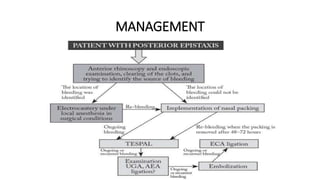
MANAGEMENT
TESPAL
• The procedure was first reported
by budrovich and Saetti in 1992
INDICATIONS
• Treatment of epistaxis refractory to nasal packing
• Control of arterial bleeding encountered during nasal
or sinus surgery
• Arterial control for vascular tumor resection
Example-JNA
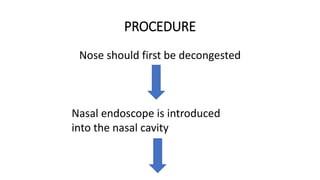
PROCEDURE
Nose should first be decongested
Nasal endoscope is introduced
into the nasal cavity
An incision ranging between 10-20mm
Is made vertically about 5mm anterior to the
Attachment of the middle turbinate
Mucosal flap is gently retracted posteriorly
till the crista ethmoidalis visualised
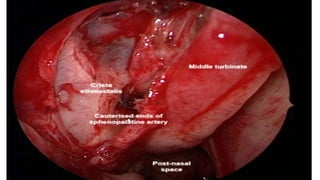
The sphenopalatine artery is
Cauterized
Following successful ligation/cauterisation the area is
explored posteriorly for 2-3mm to ensure that no more
vessels remain uncauterized
COMPLICATIONS
1. Palatal numbness
2. Sinusitis
3. Decreased lacrimation
4. Septal perforation
5. Inferior turbinate necrosis
Thank you

Tespal surgery

  • 1.
    Transnasal endoscopic Sphenopalatine arteryligation (TESPAL) Prepared by Annampalli yuvasree- 13
  • 3.
    Sites of epistaxis •Little’s area • Above the level of middle turbinate • Below the level of middle turbinate –here the bleeding is from the branches of sphenopalatine artery It maybe Hidden ,lying lateral to middle or inferior turbinate • Posterior part of nasal cavity • Nasopharynx
  • 4.
    TYPES OF EPISTAXIS •Anterior –Mostly from littles area • Posterior-mostley from posterosuperior part of nasal cavity,often often difficult to localize the Bleeding point
  • 5.
  • 6.
    TESPAL • The procedurewas first reported by budrovich and Saetti in 1992
  • 7.
    INDICATIONS • Treatment ofepistaxis refractory to nasal packing • Control of arterial bleeding encountered during nasal or sinus surgery • Arterial control for vascular tumor resection Example-JNA
  • 8.
    PROCEDURE Nose should firstbe decongested Nasal endoscope is introduced into the nasal cavity
  • 9.
    An incision rangingbetween 10-20mm Is made vertically about 5mm anterior to the Attachment of the middle turbinate Mucosal flap is gently retracted posteriorly till the crista ethmoidalis visualised
  • 11.
    The sphenopalatine arteryis Cauterized Following successful ligation/cauterisation the area is explored posteriorly for 2-3mm to ensure that no more vessels remain uncauterized
  • 13.
    COMPLICATIONS 1. Palatal numbness 2.Sinusitis 3. Decreased lacrimation 4. Septal perforation 5. Inferior turbinate necrosis
  • 14.