PHYSICS
1.4 Diffraction of Waves
Prepared by:
Qhaiyum
Budi
Nadzri
Aimran
Abdullah Azam
Definition of Diffraction
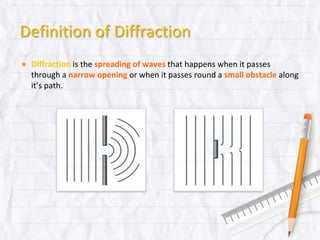
Diffraction is the spreading of waves that happens when it passes
through a narrow opening or when it passes round a small obstacle along
it’s path.
Characteristics of Diffraction
When diffraction occurs:
i. Wave direction changes.
ii. Wave velocity, ν, changes.
iii. Wavelength, λ, is unchanged.
iv. Frequency, ƒ, is unchanged.
v. Speed unchanged.
The amplitude, а, of the diffracted wave is
smaller compared to that of the incident wave, as
the wave energy is spread out over a larger
surface.
Diffraction of Water Waves
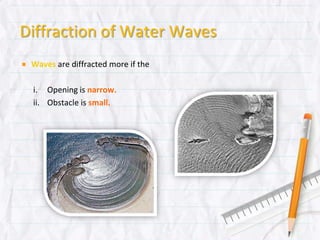
Waves are diffracted more if the
i. Opening is narrow.
ii. Obstacle is small.
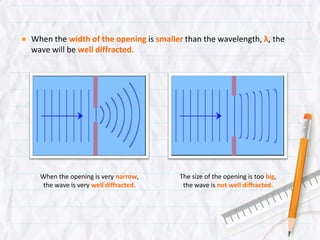
When the width of the opening is smaller than the wavelength, λ,
the wave will be well diffracted.
When the opening is very
narrow, the wave is very well
diffracted.
The size of the opening is too
big, the wave is not well
diffracted.
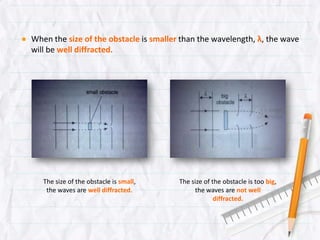
When the size of the obstacle is smaller than the wavelength, λ,
the wave will be well diffracted.
The size of the obstacle is small,
the waves are well diffracted.
The size of the obstacle is too big,
the waves are not well
diffracted.
Diffraction of Light Waves
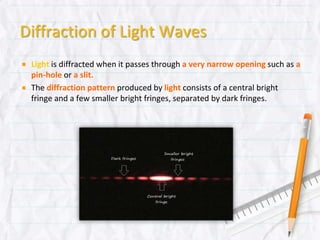
Light is diffracted when it passes through a very narrow opening such as
a pin-hole or a slit.
The diffraction pattern produced by light consists of a central bright fringe
and a few smaller bright fringes, separated by dark fringes.
Diffraction of Sound Waves
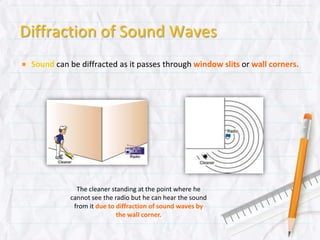
Sound can be diffracted as it passes through window slits or wall
corners.
The cleaner standing at the point where he
cannot see the radio but he can hear the
sound from it due to diffraction of sound
waves by the wall corner.
Applications in Everyday Life
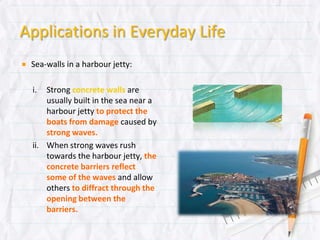
Sea-walls in a harbour jetty:
i. Strong concrete walls are usually
built in the sea near a harbour jetty
to protect the boats from damage
caused by strong waves.
ii. When strong waves rush towards the
harbour jetty, the concrete barriers
reflect some of the waves and
allow others to diffract through the
opening between the barriers.
That’s All
From Us
Thank You
For Listening XD !
◢◤

Phycis Form 5: Chapter 1.4 Diffraction of Waves

  • 1.
    PHYSICS 1.4 Diffraction ofWaves Prepared by: Qhaiyum Budi Nadzri Aimran Abdullah Azam
  • 2.
    Definition of Diffraction Diffractionis the spreading of waves that happens when it passes through a narrow opening or when it passes round a small obstacle along it’s path.
  • 3.
    Characteristics of Diffraction Whendiffraction occurs: i. Wave direction changes. ii. Wave velocity, ν, changes. iii. Wavelength, λ, is unchanged. iv. Frequency, ƒ, is unchanged. v. Speed unchanged. The amplitude, а, of the diffracted wave is smaller compared to that of the incident wave, as the wave energy is spread out over a larger surface.
  • 4.
    Diffraction of WaterWaves Waves are diffracted more if the i. Opening is narrow. ii. Obstacle is small.
  • 5.
    When the widthof the opening is smaller than the wavelength, λ, the wave will be well diffracted. When the opening is very narrow, the wave is very well diffracted. The size of the opening is too big, the wave is not well diffracted.
  • 6.
    When the sizeof the obstacle is smaller than the wavelength, λ, the wave will be well diffracted. The size of the obstacle is small, the waves are well diffracted. The size of the obstacle is too big, the waves are not well diffracted.
  • 7.
    Diffraction of LightWaves Light is diffracted when it passes through a very narrow opening such as a pin-hole or a slit. The diffraction pattern produced by light consists of a central bright fringe and a few smaller bright fringes, separated by dark fringes.
  • 8.
    Diffraction of SoundWaves Sound can be diffracted as it passes through window slits or wall corners. The cleaner standing at the point where he cannot see the radio but he can hear the sound from it due to diffraction of sound waves by the wall corner.
  • 9.
    Applications in EverydayLife Sea-walls in a harbour jetty: i. Strong concrete walls are usually built in the sea near a harbour jetty to protect the boats from damage caused by strong waves. ii. When strong waves rush towards the harbour jetty, the concrete barriers reflect some of the waves and allow others to diffract through the opening between the barriers.
  • 10.
    That’s All From Us ThankYou For Listening XD ! ◢◤