 Motion
 Virtual Motion
 Relative motion
 Point of
reference
 Distance
 Displacement
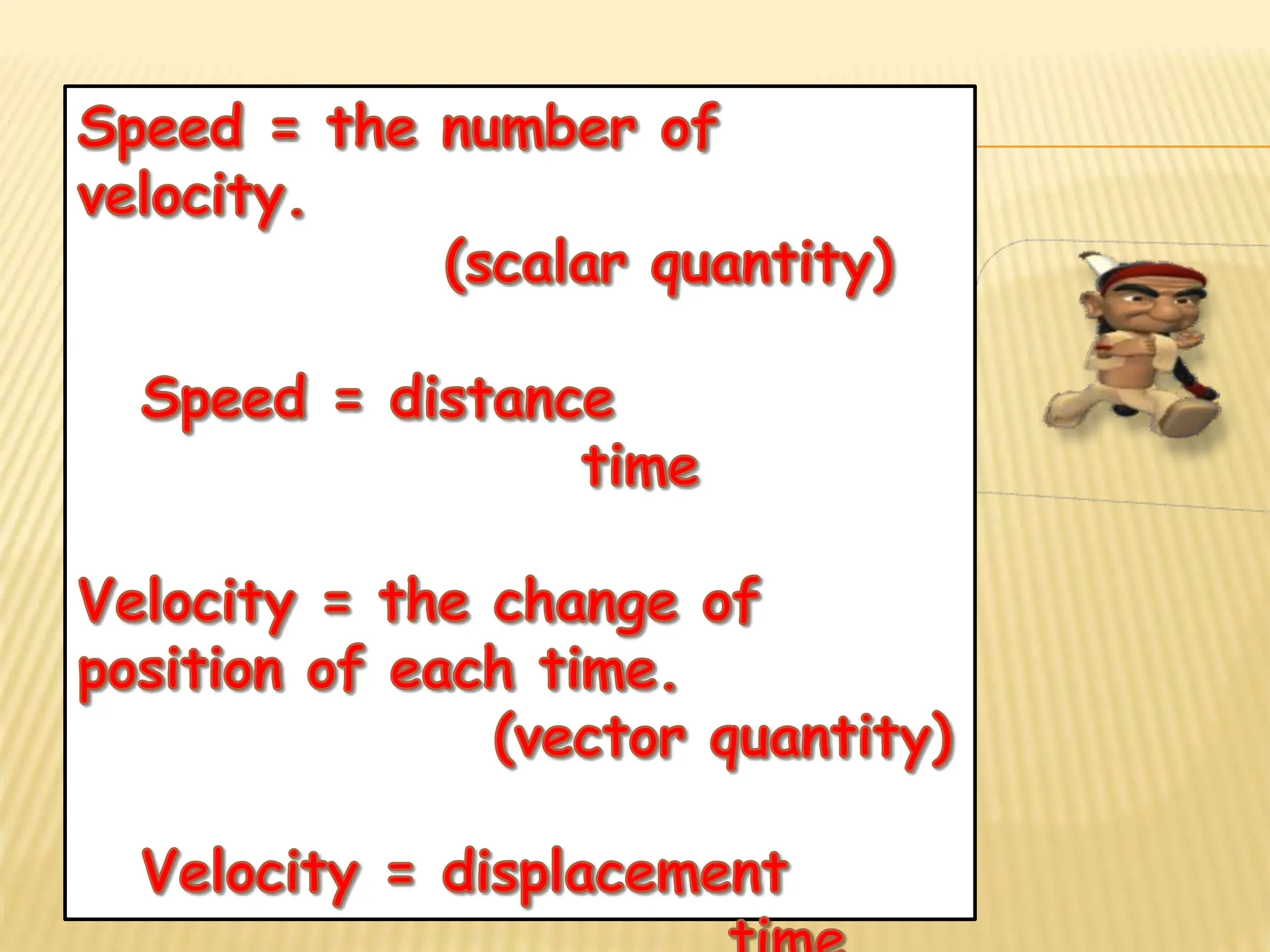
 Speed
 Velocity
 Acceleration
 Deceleration
 Uniform motion
 Uniformly
acceleration
motion
Science Words
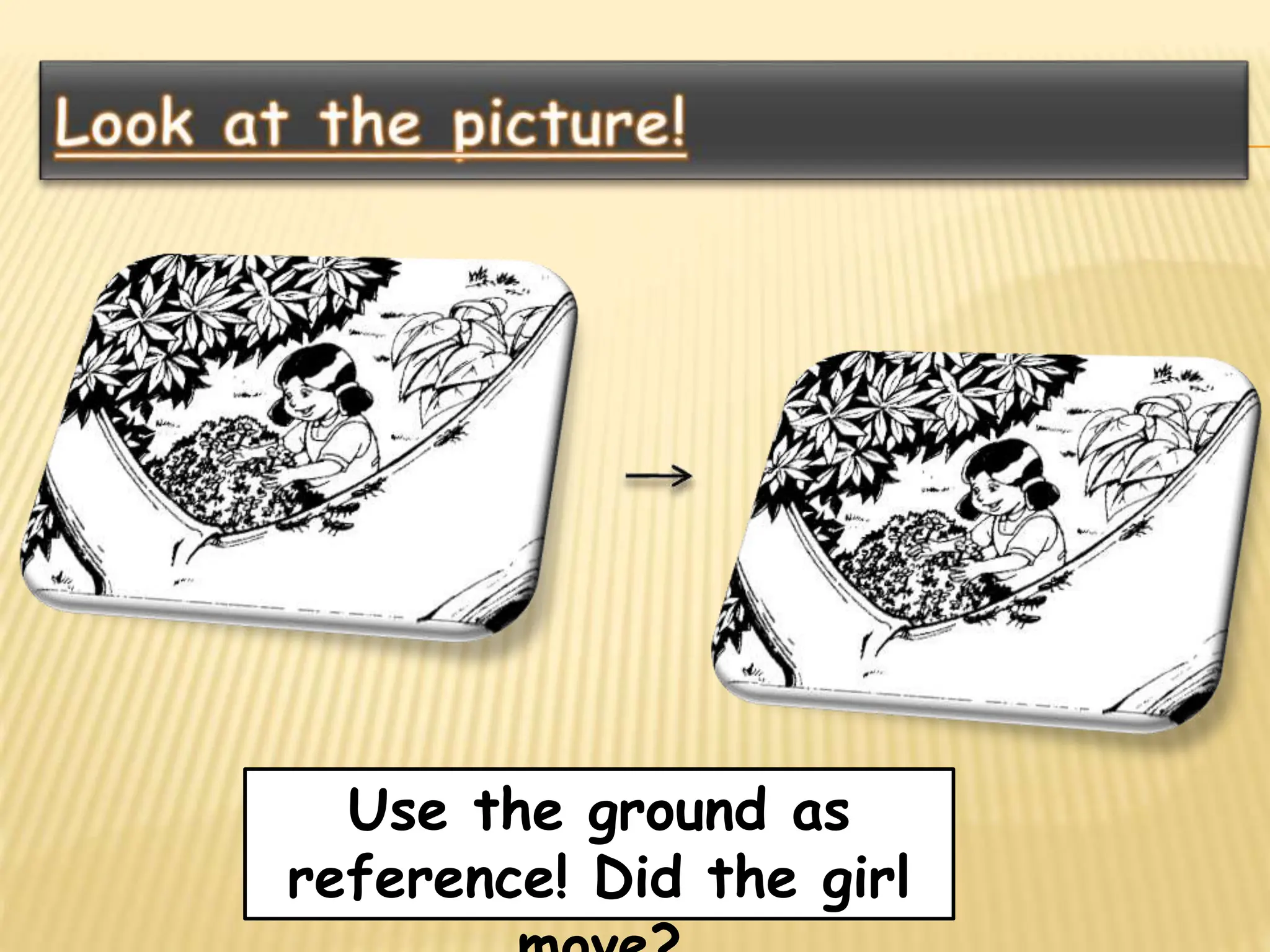
Use the ground as
reference! Did the girl
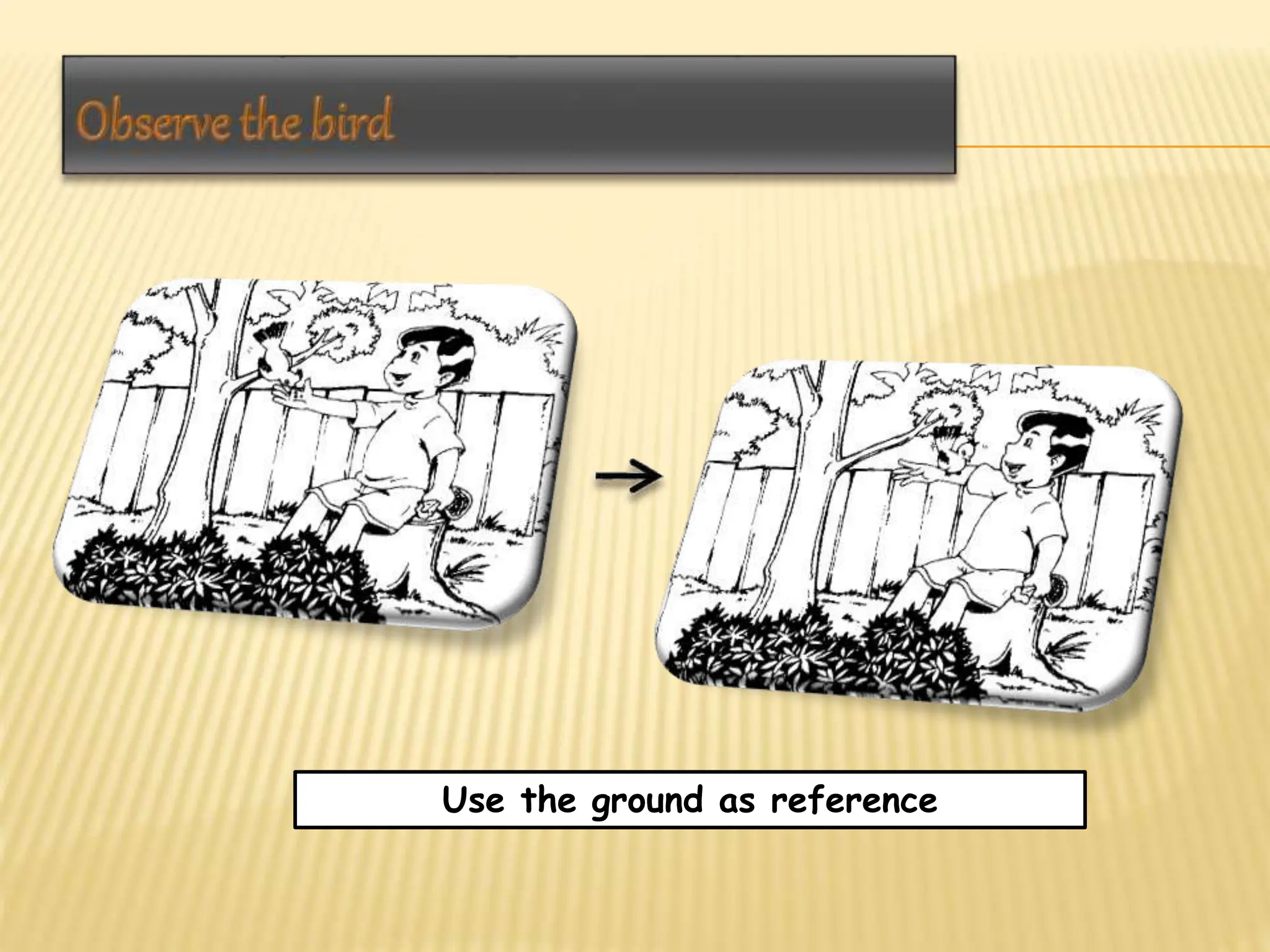
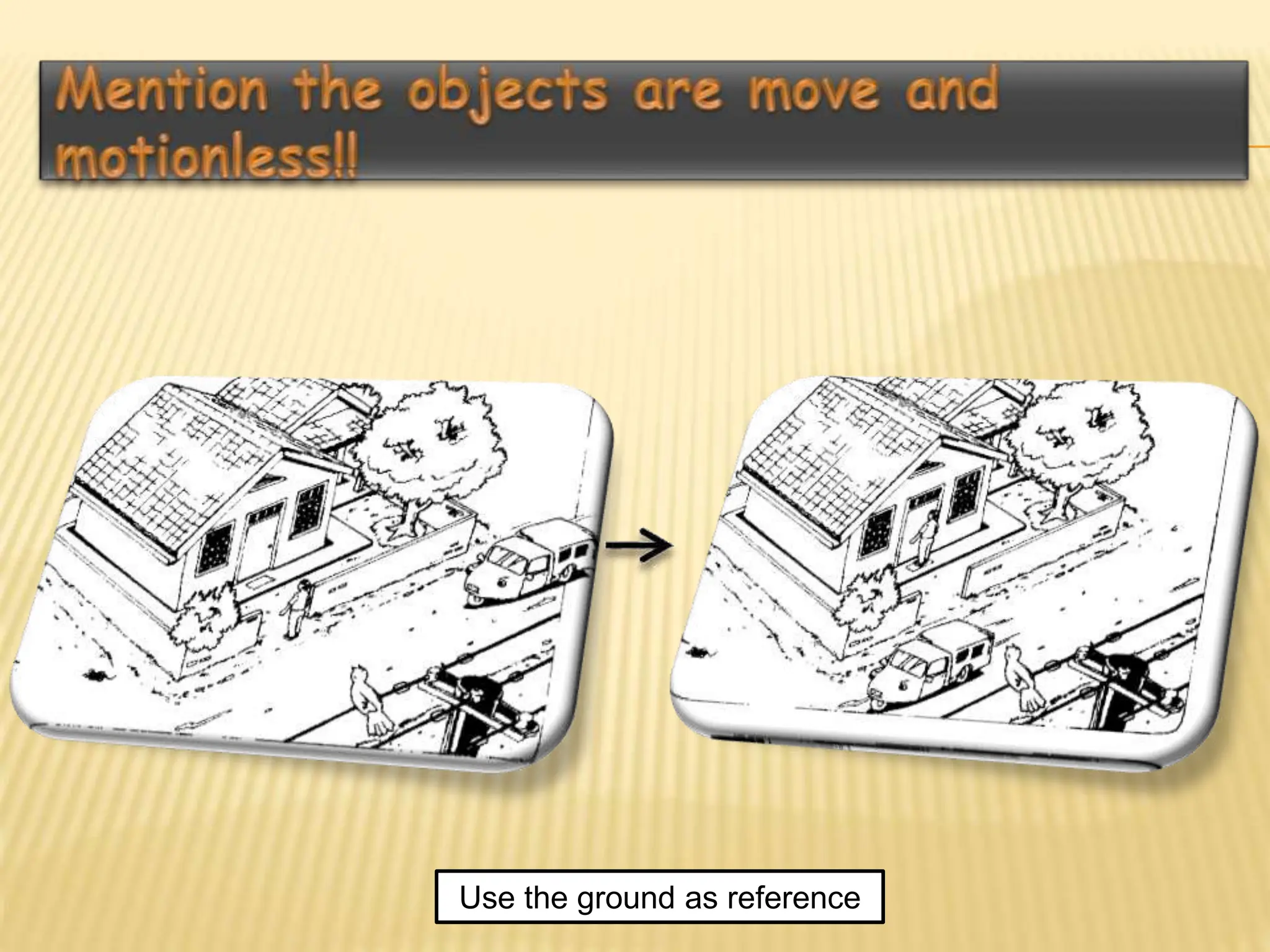
Use the ground as reference
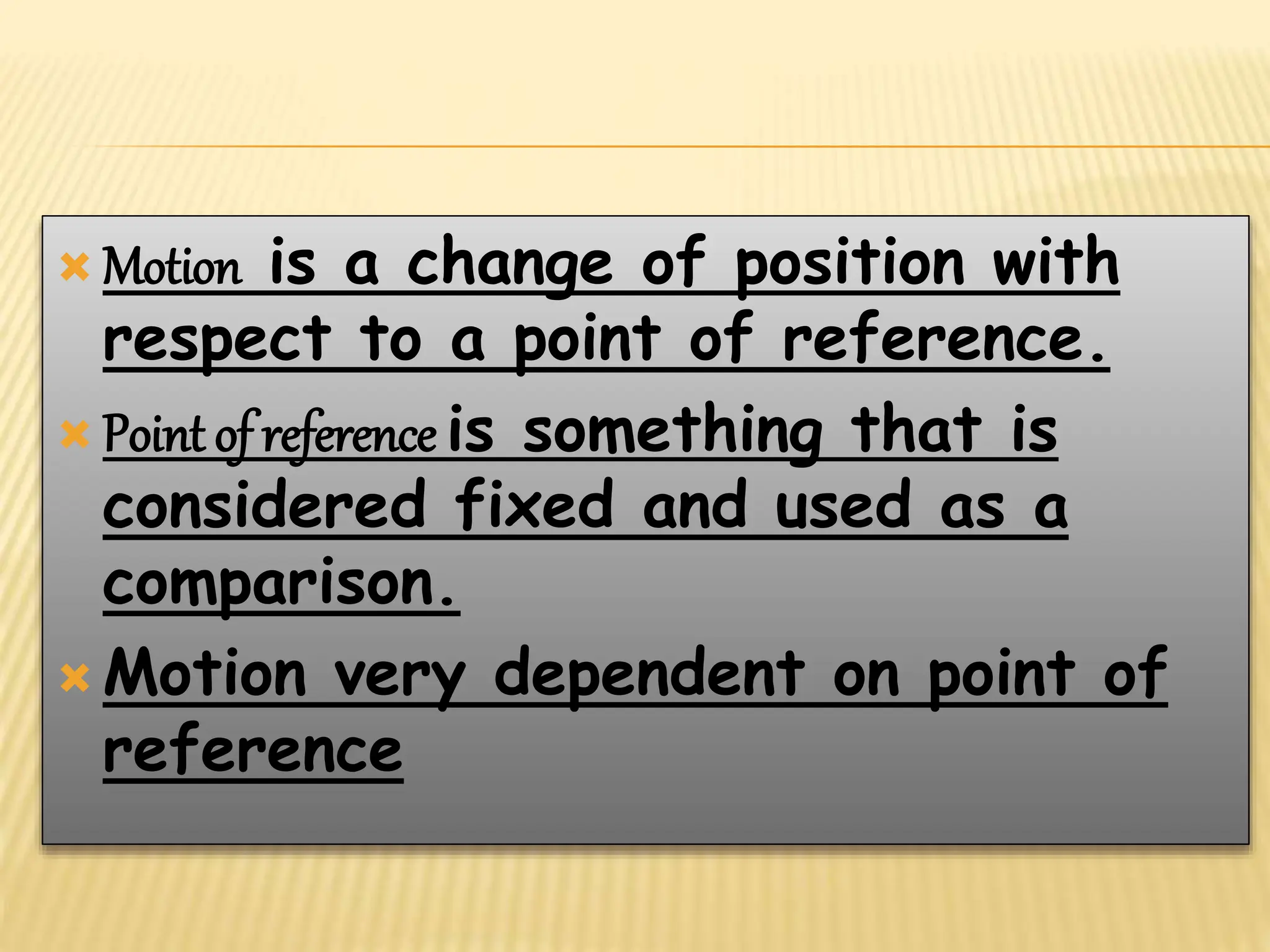
 Motion is a change of position with
respect to a point of reference.
 Point of reference is something that is
considered fixed and used as a
comparison.
 Motion very dependent on point of
reference
.....
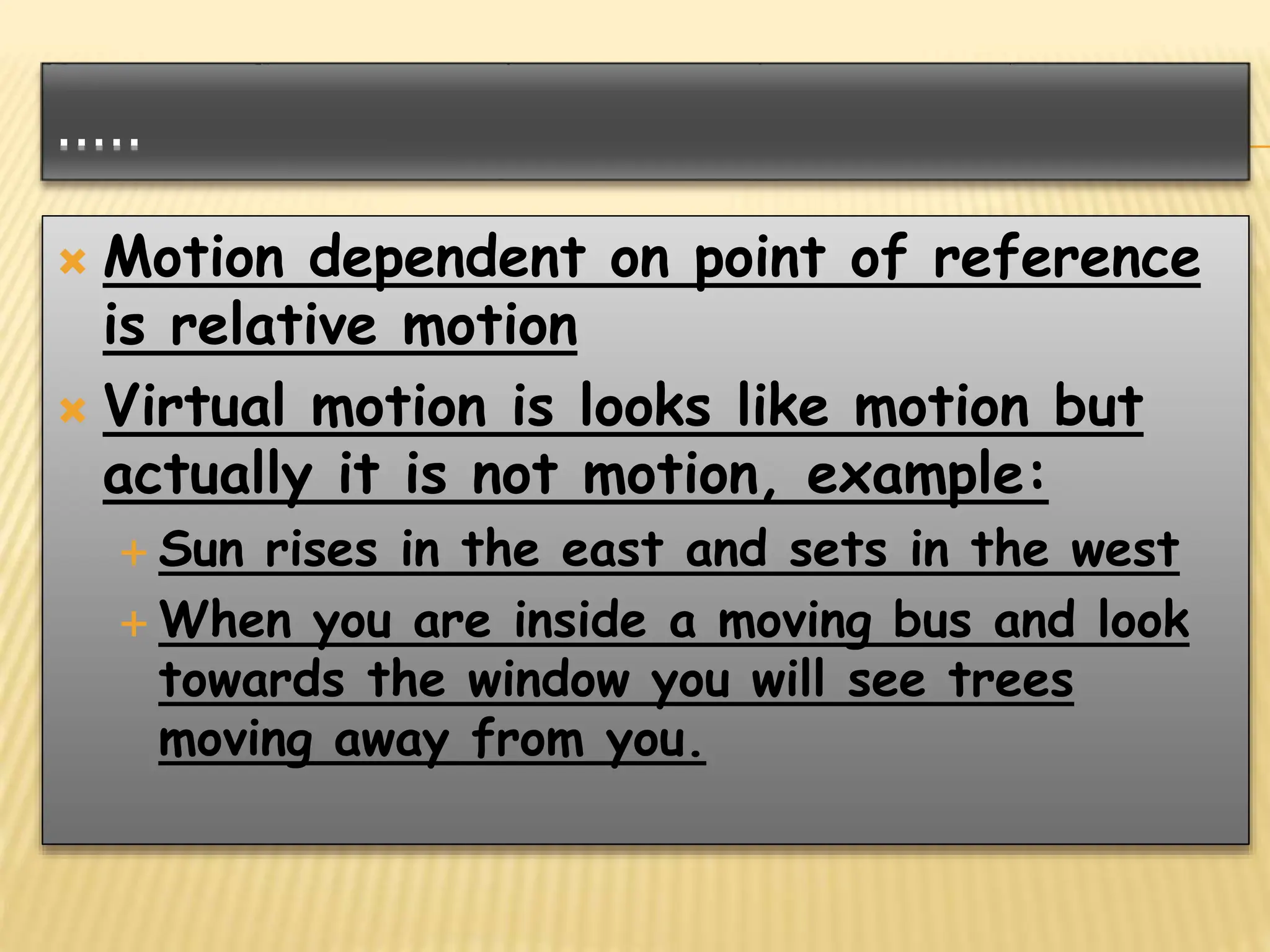
 Motion dependent on point of reference
is relative motion
 Virtual motion is looks like motion but
actually it is not motion, example:
 Sun rises in the east and sets in the west
 When you are inside a moving bus and look
towards the window you will see trees
moving away from you.
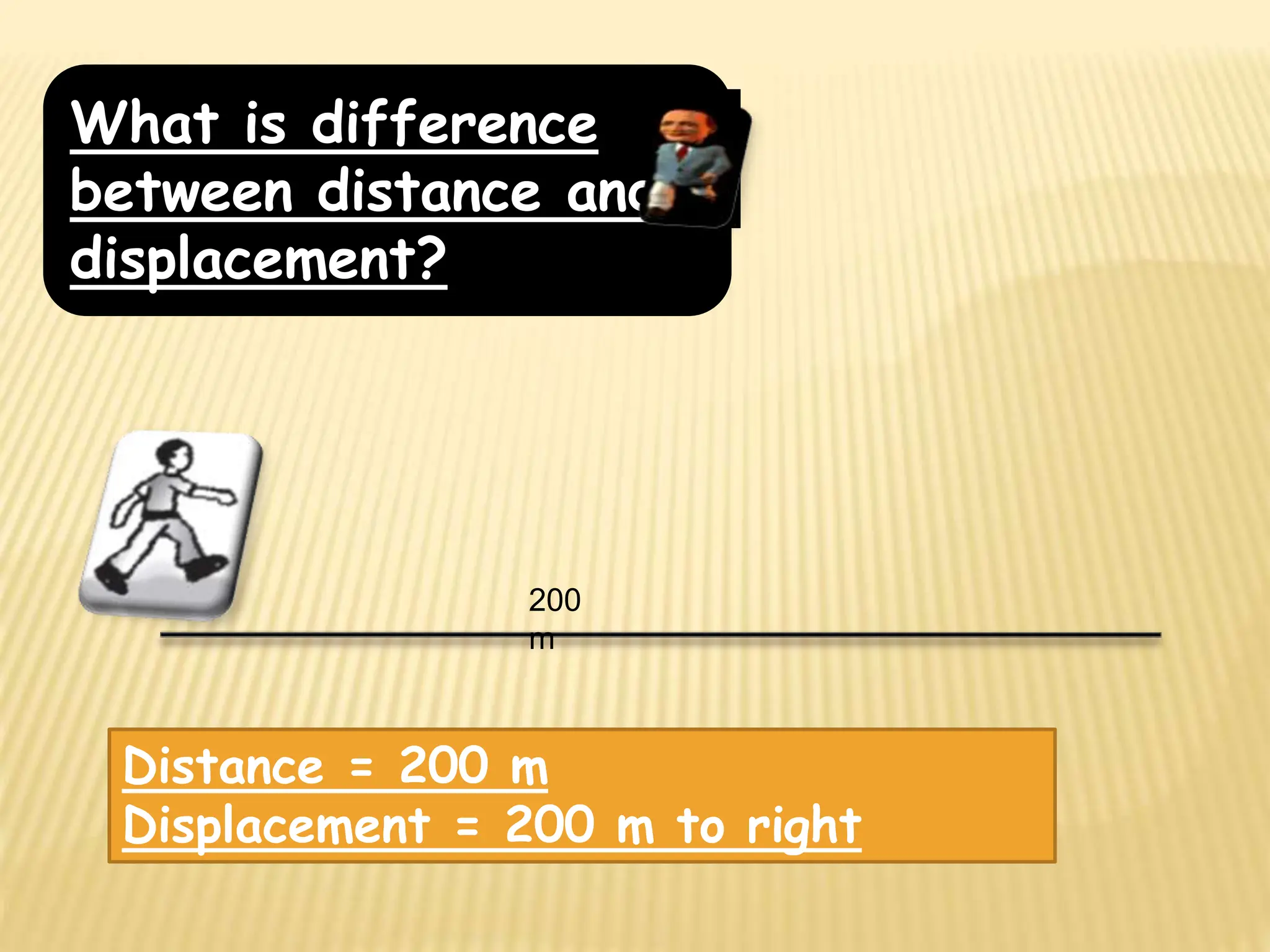
Distance = 200 m
Displacement = 200 m to right
200
m
What is difference
between distance and
displacement?
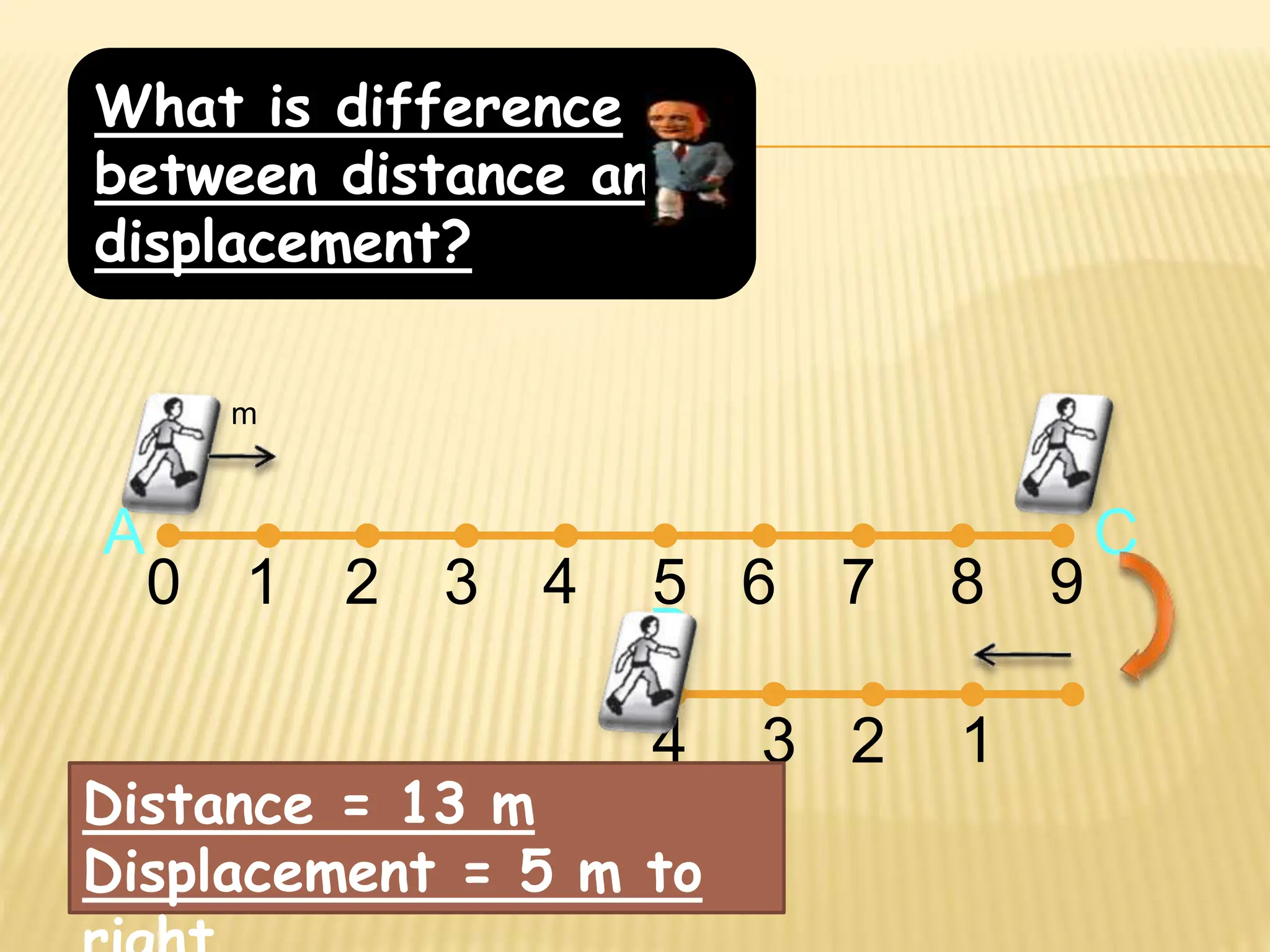
0 1 2 3 4 5 6 7 8 9
A C
B
2 1
3
4
Distance = 13 m
Displacement = 5 m to
m
What is difference
between distance and
displacement?
 Distance is length of all lines passed through
by an object
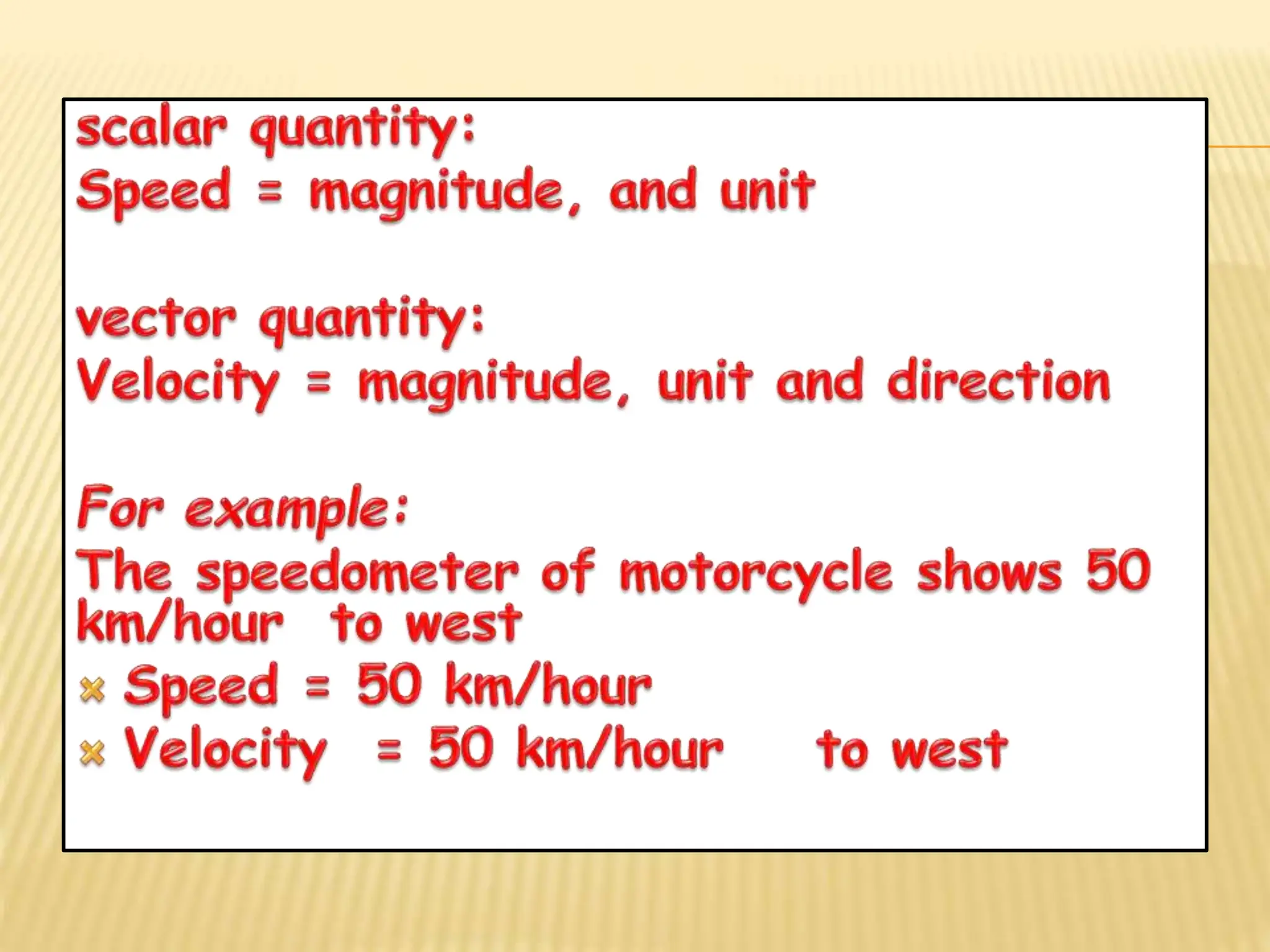
scalar quantity -> have: magnitude and unit
 Diplacement is position change of an object
from the initial point
Vector quantity -> have: magnitude, unit, and
direction
In solving for the displacement,
get the SUM of the magnitude of
the same directions. Then,
subtract the magnitude of
opposite directions and follow the
direction of the bigger
magnitude
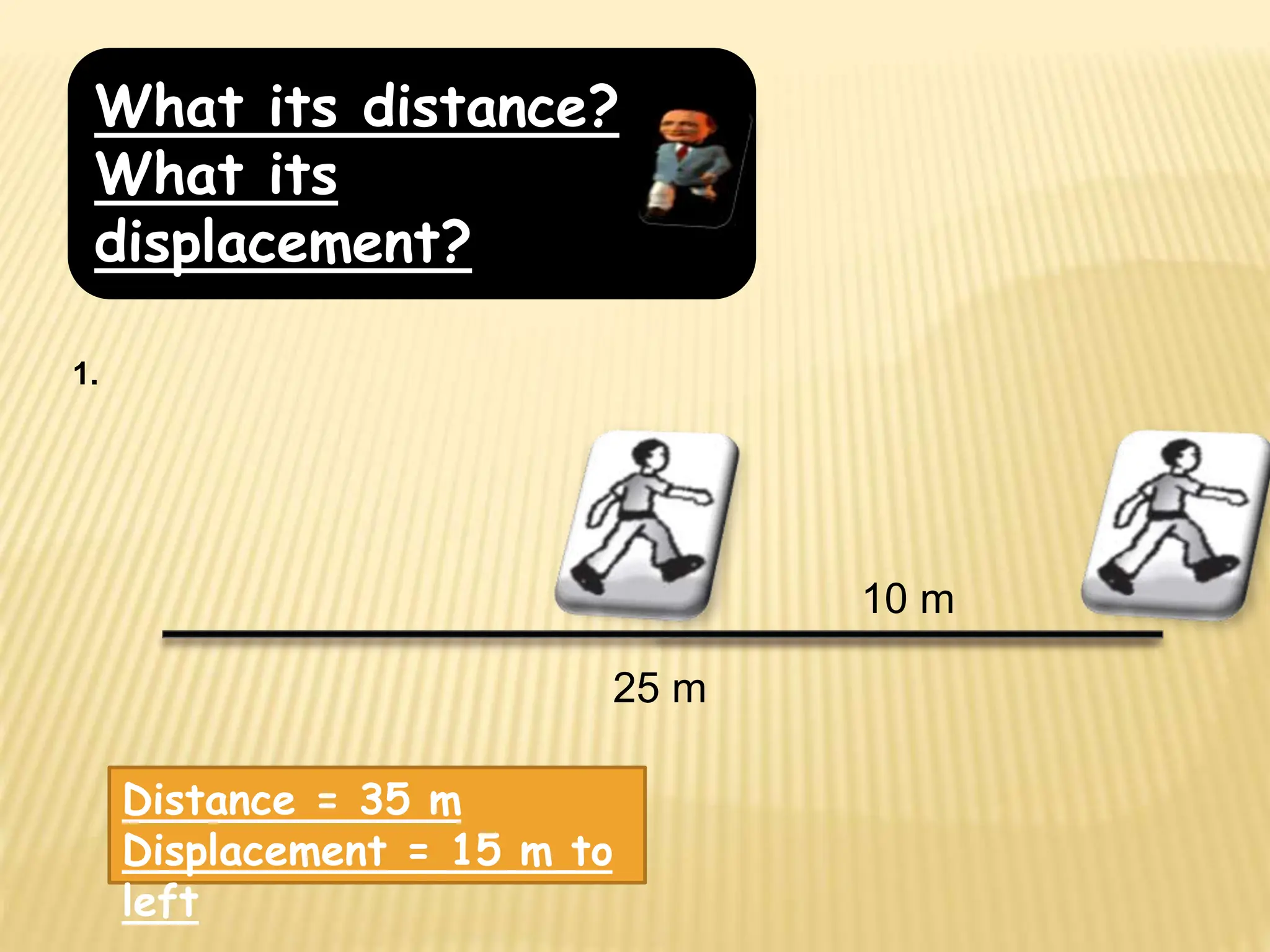
Distance = 35 m
Displacement = 15 m to
left
What its distance?
What its
displacement?
10 m
25 m
1.
Speed and Velocity
0 4
Time (second)
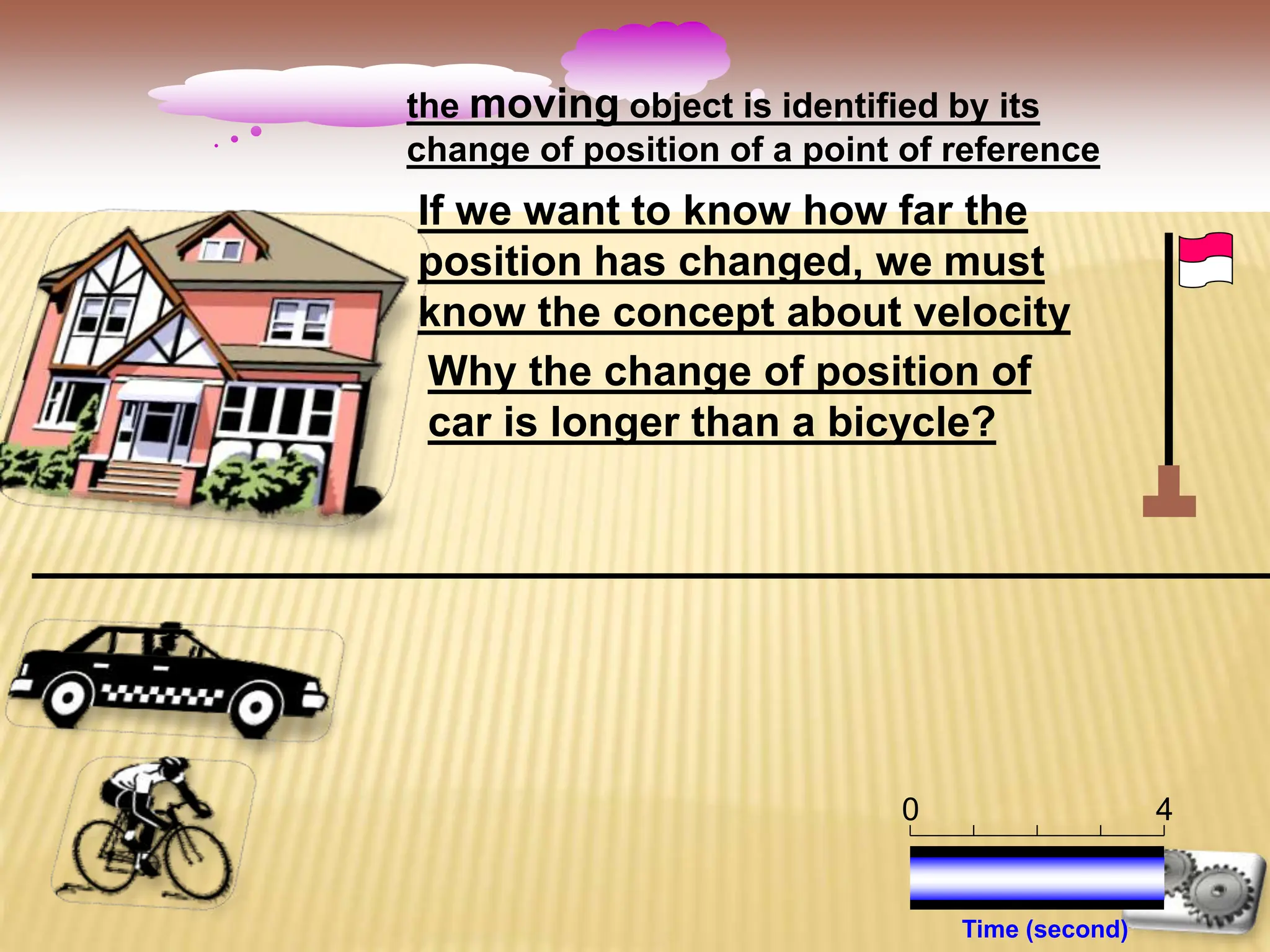
the moving object is identified by its
change of position of a point of reference
If we want to know how far the
position has changed, we must
know the concept about velocity
Why the change of position of
car is longer than a bicycle?
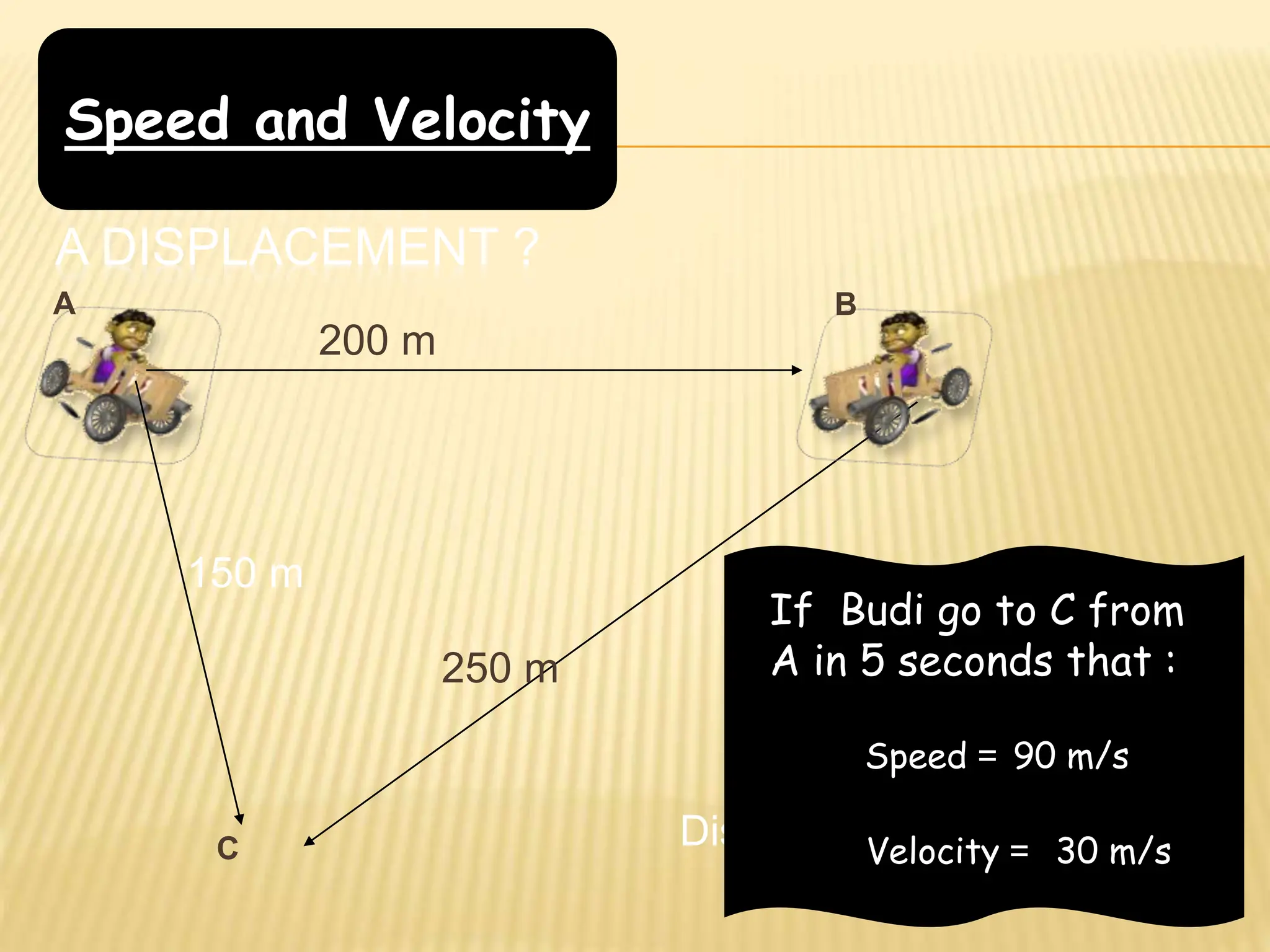
WHAT DIFFERENCE
BETWEEN A
DISTANCE AND
A DISPLACEMENT ?
200 m
250 m
150 m
Distance =
Displacement =
A B
C
450 m
150 m
Speed and Velocity
If Budi go to C from
A in 5 seconds that :
Speed =
Velocity =
90 m/s
30 m/s
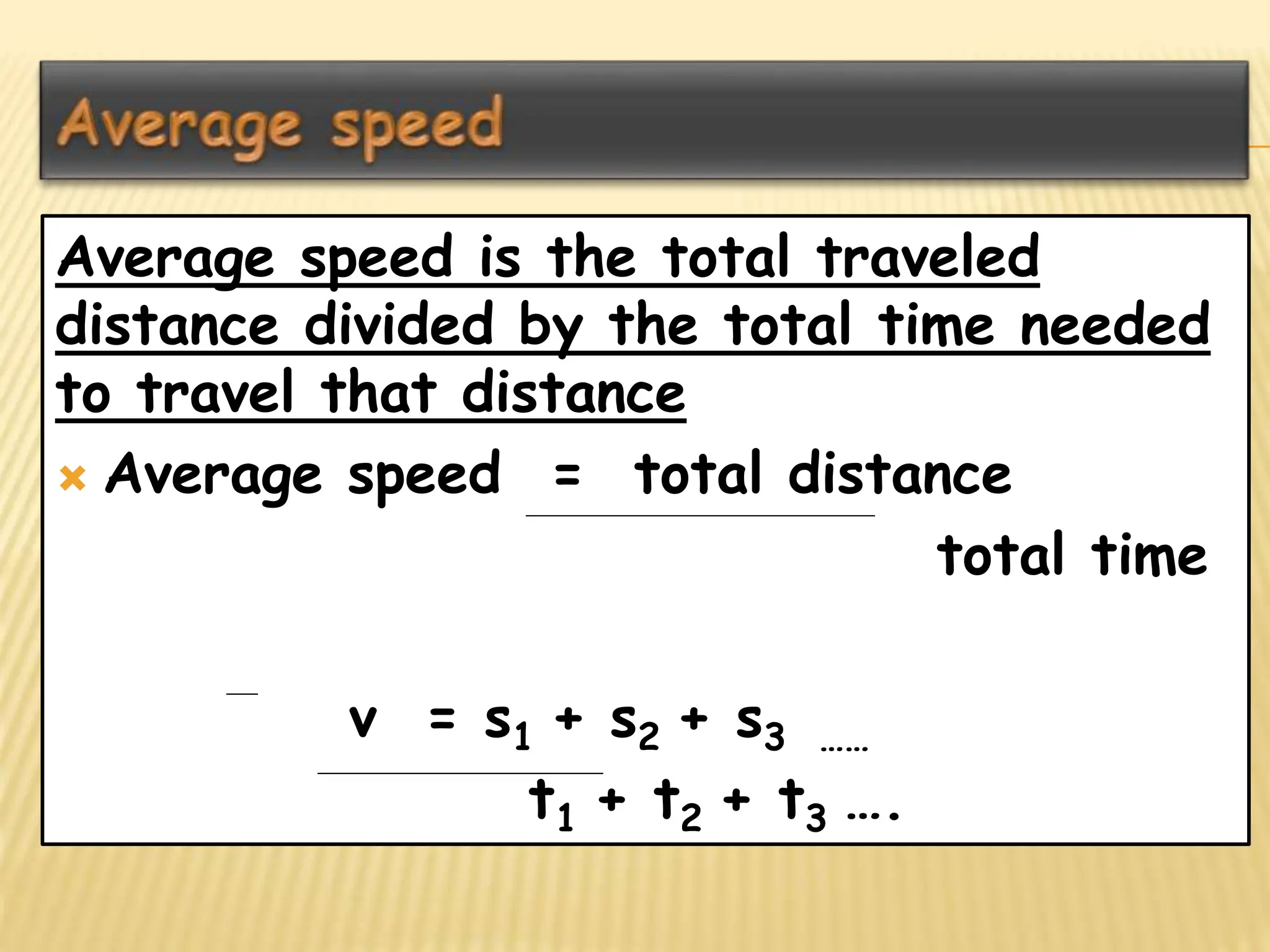
Average speed is the total traveled
distance divided by the total time needed
to travel that distance
 Average speed = total distance
total time
v = s1 + s2 + s3 ……
t1 + t2 + t3 ….
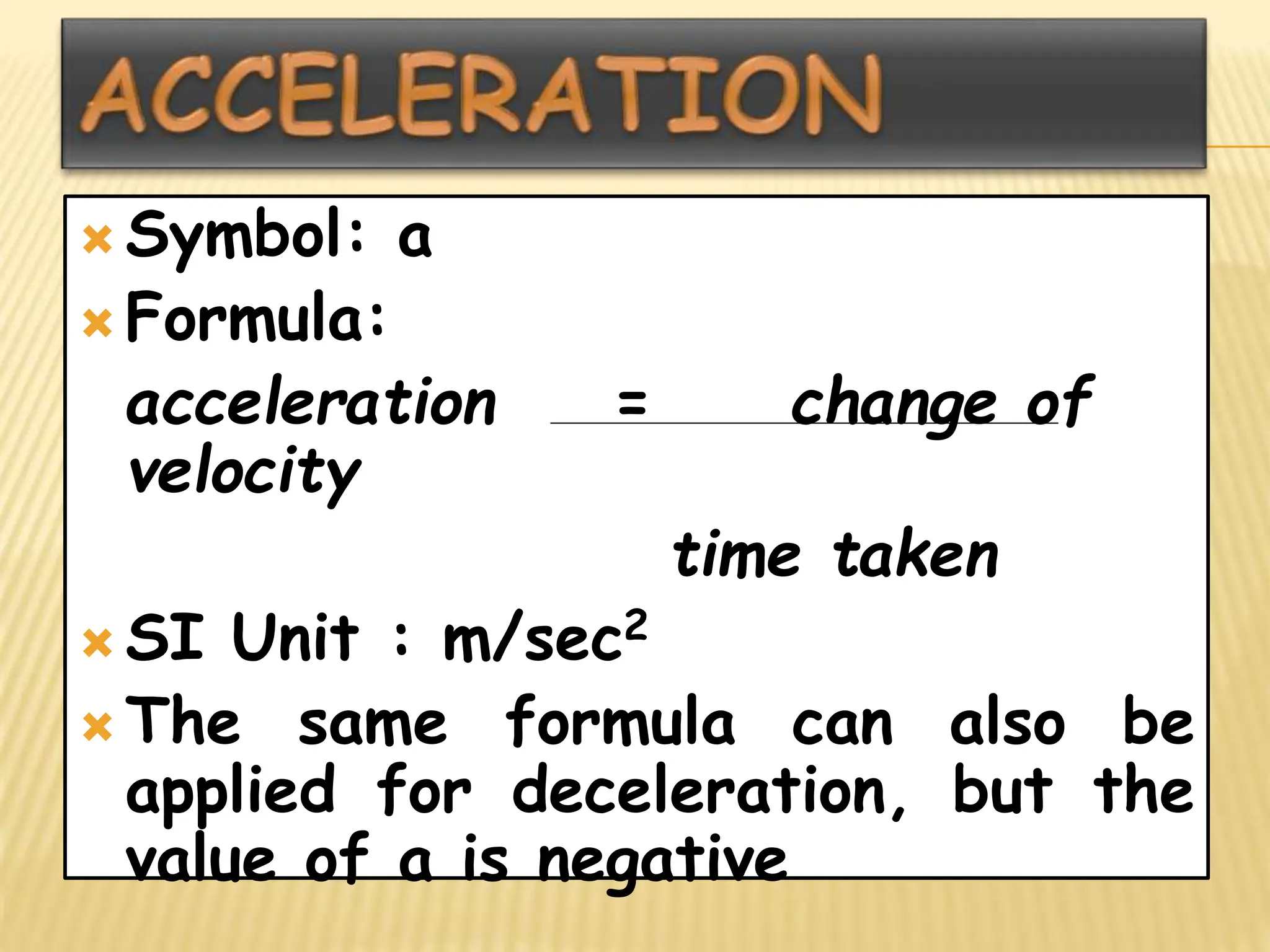
 Symbol: a
 Formula:
acceleration = change of
velocity
time taken
 SI Unit : m/sec2
 The same formula can also be
applied for deceleration, but the
value of a is negative
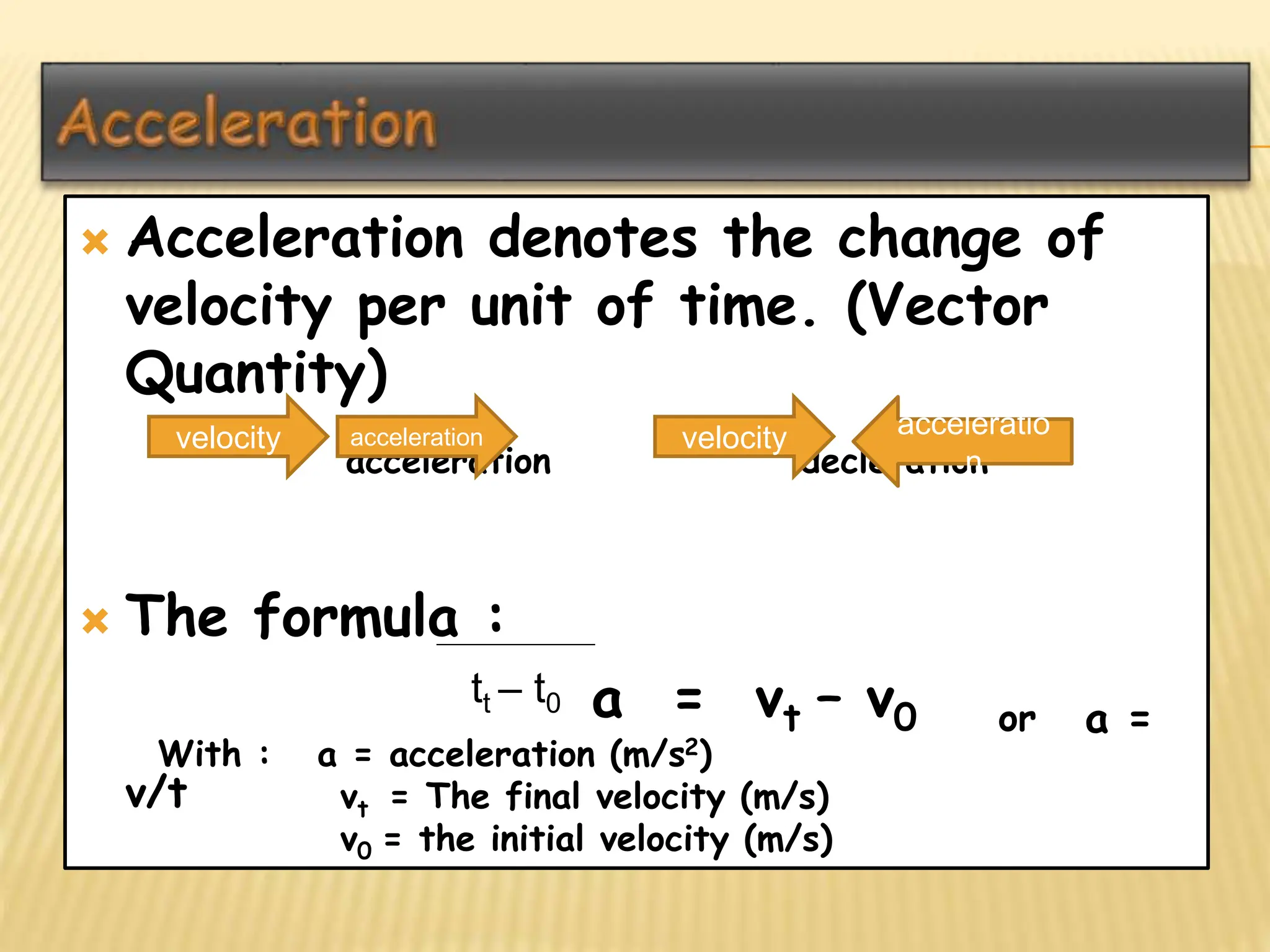
 Acceleration denotes the change of
velocity per unit of time. (Vector
Quantity)
acceleration decleration
 The formula :
a = vt – v0 or a =
v/t
tt – t0
With : a = acceleration (m/s2)
vt = The final velocity (m/s)
v0 = the initial velocity (m/s)
velocity acceleration velocity acceleratio
n
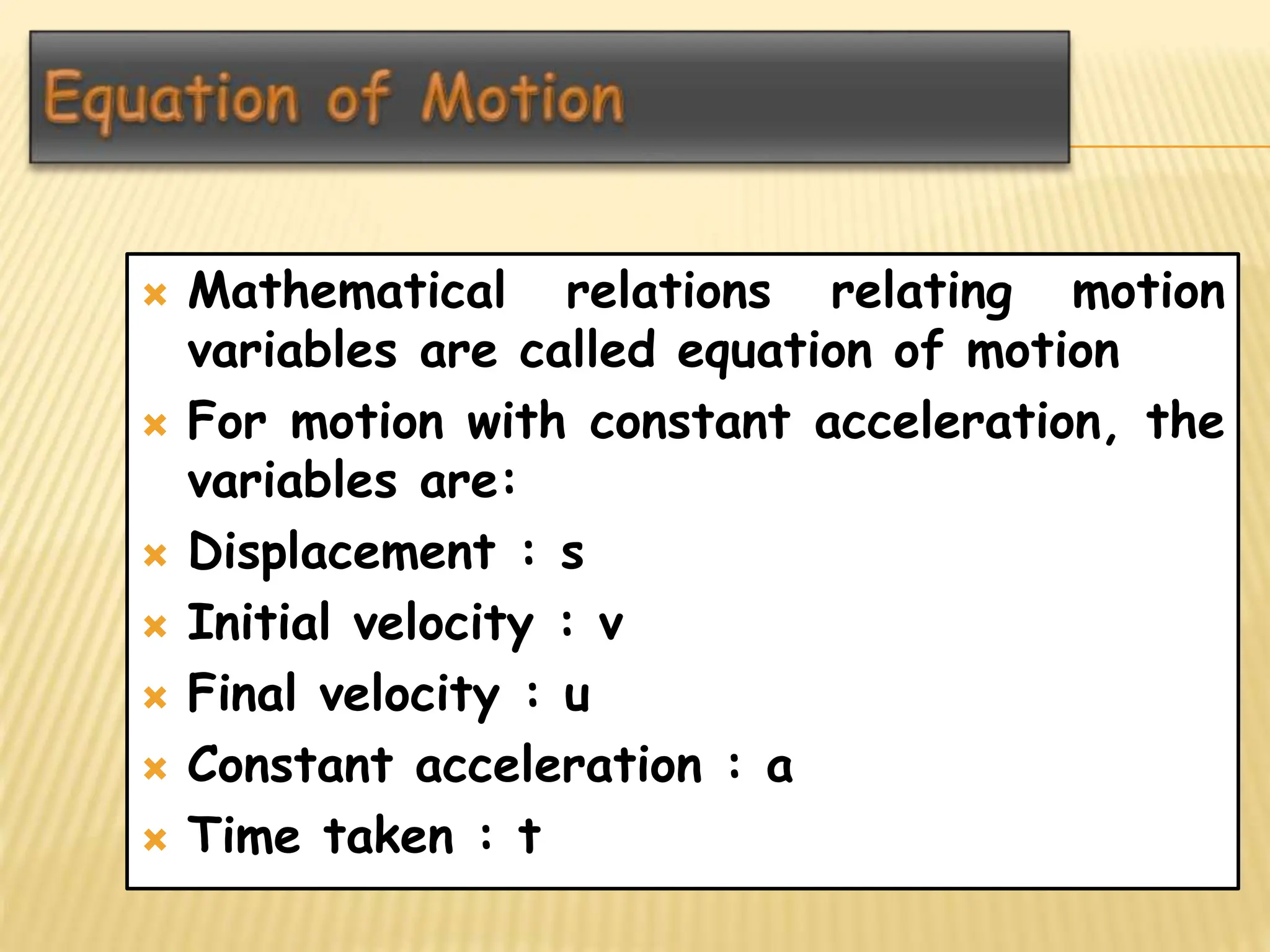
 Mathematical relations relating motion
variables are called equation of motion
 For motion with constant acceleration, the
variables are:
 Displacement : s
 Initial velocity : v
 Final velocity : u
 Constant acceleration : a
 Time taken : t
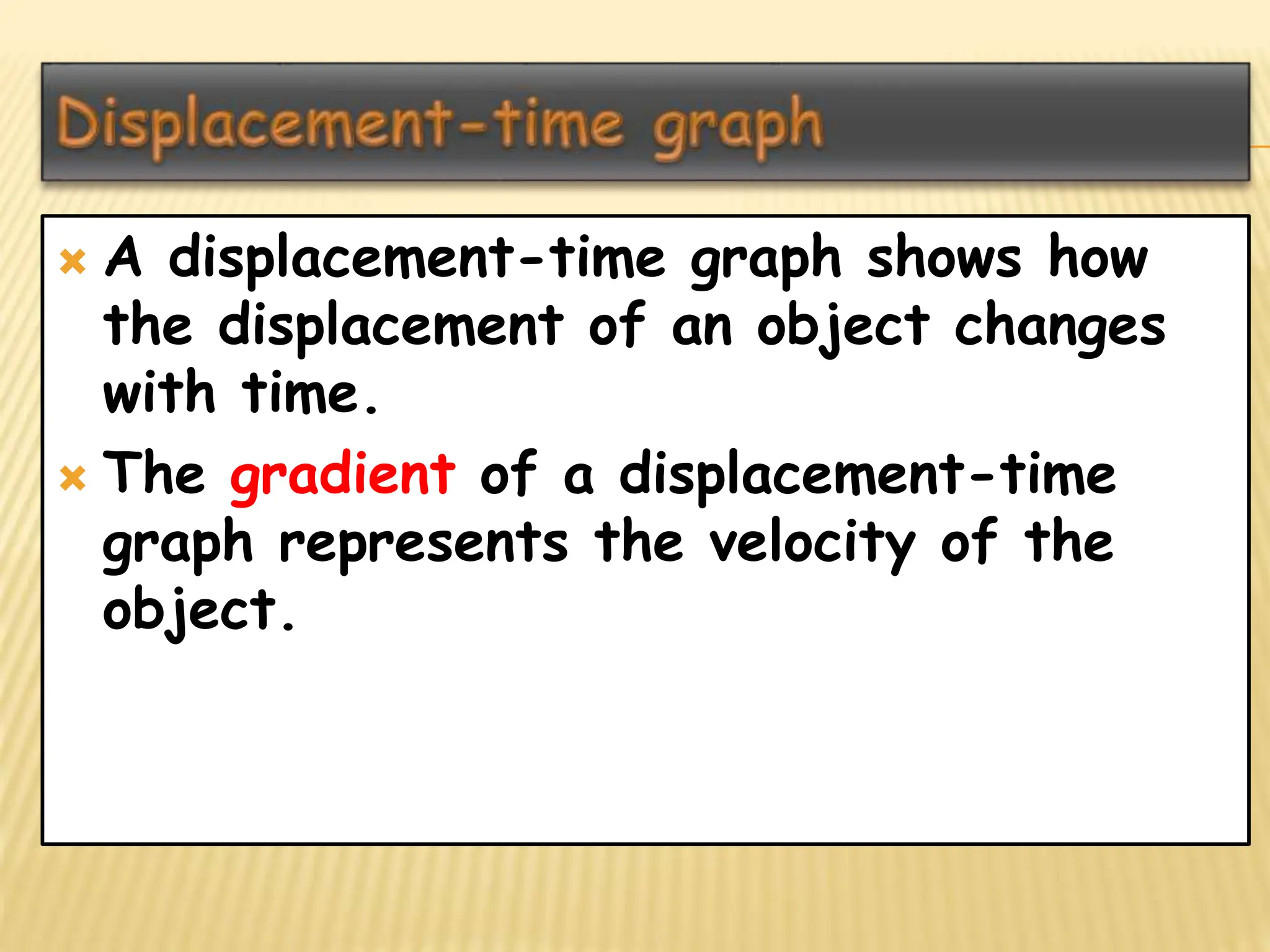
 A displacement-time graph shows how
the displacement of an object changes
with time.
 The gradient of a displacement-time
graph represents the velocity of the
object.
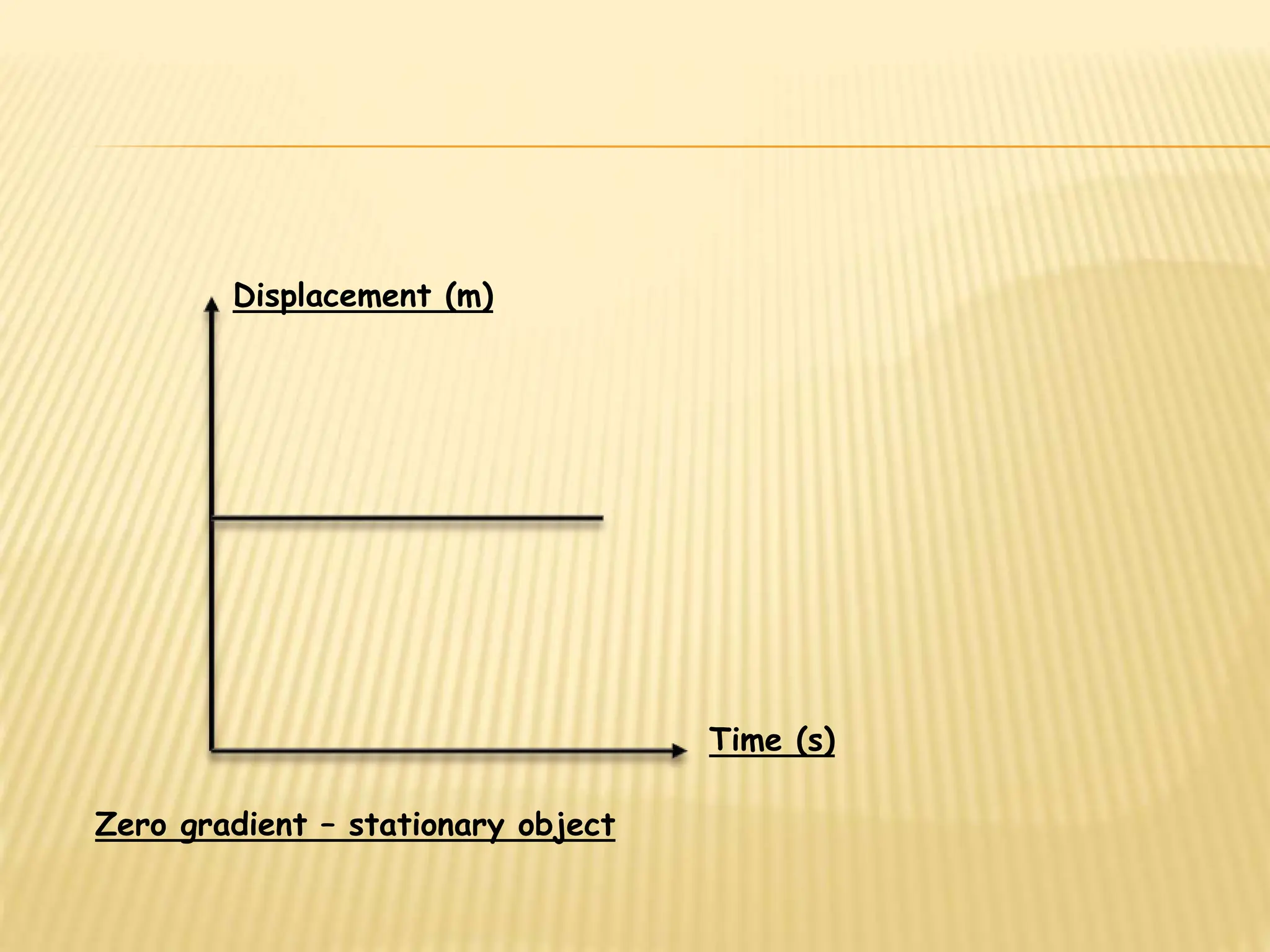
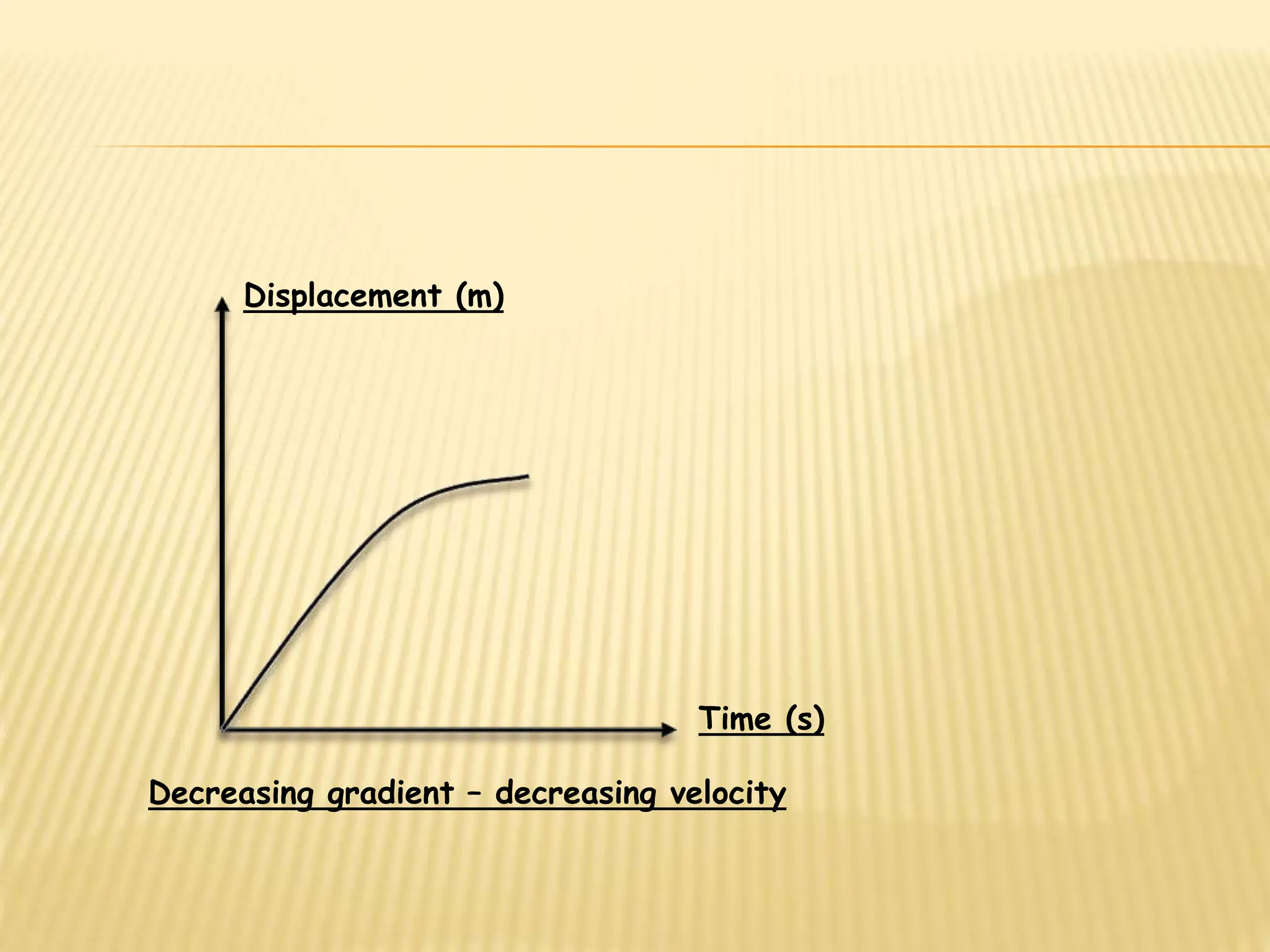
Displacement (m)
Time (s)
Zero gradient – stationary object
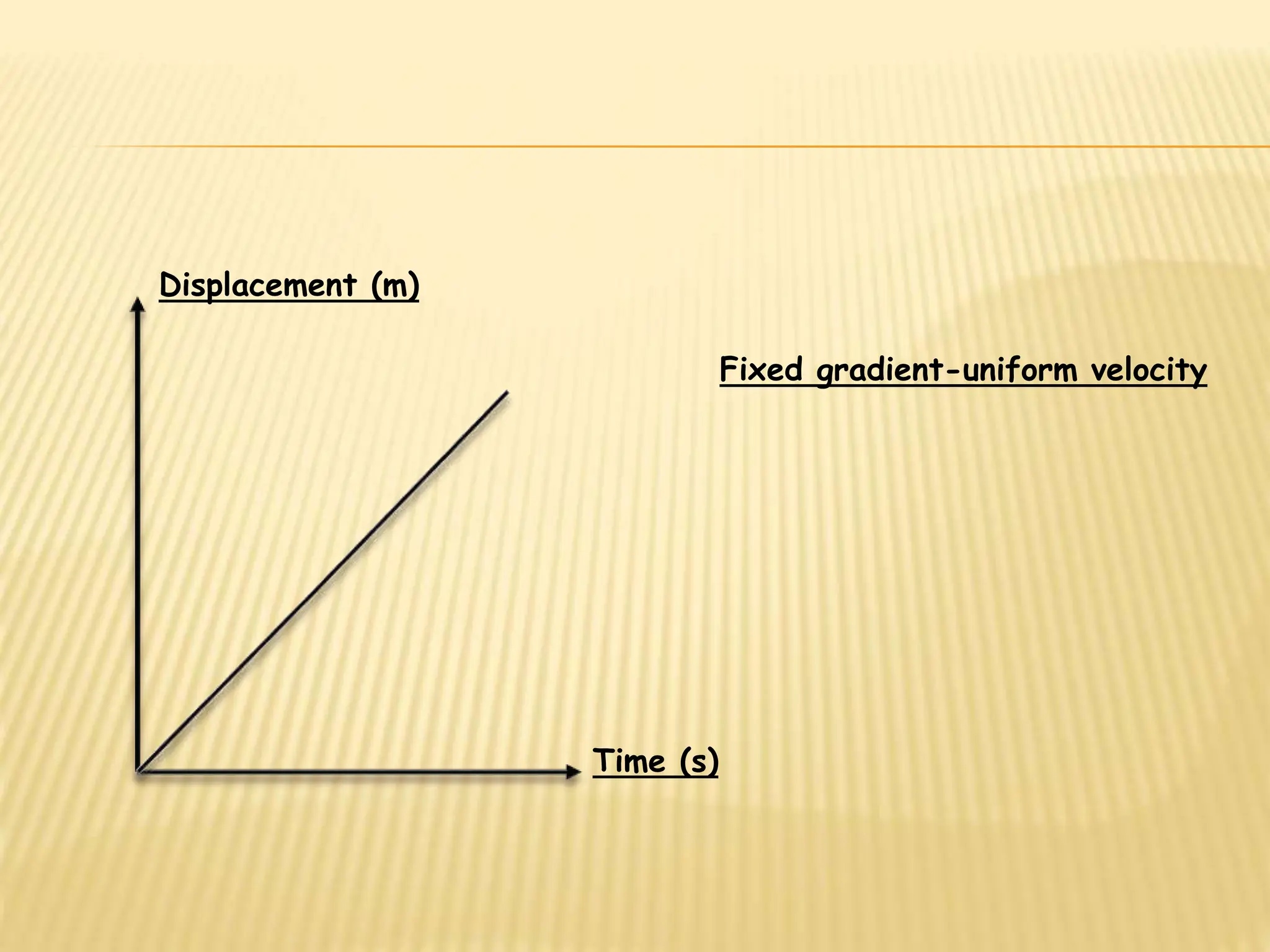
Displacement (m)
Time (s)
Fixed gradient-uniform velocity
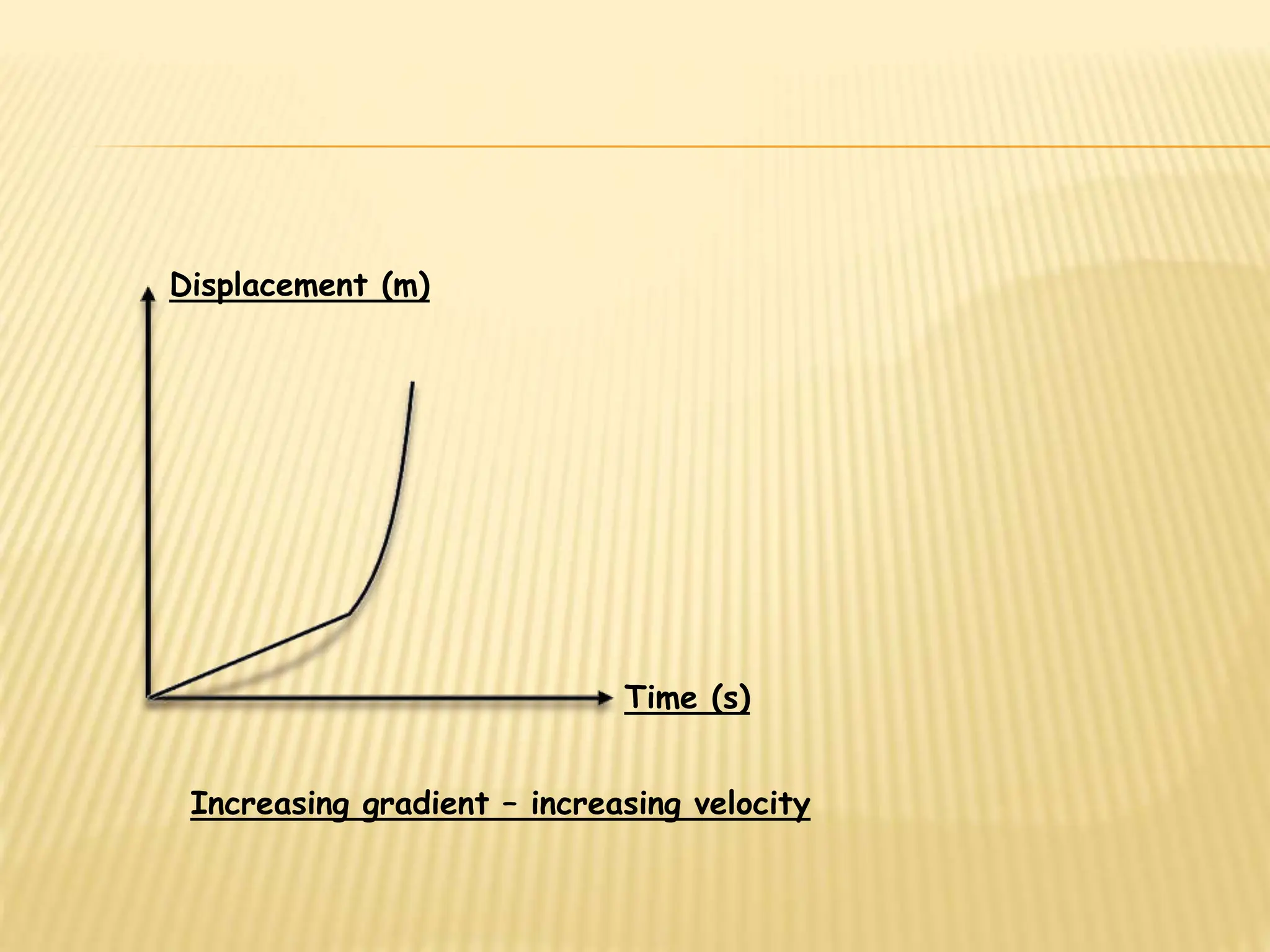
Displacement (m)
Time (s)
Increasing gradient – increasing velocity
Displacement (m)
Time (s)
Decreasing gradient – decreasing velocity
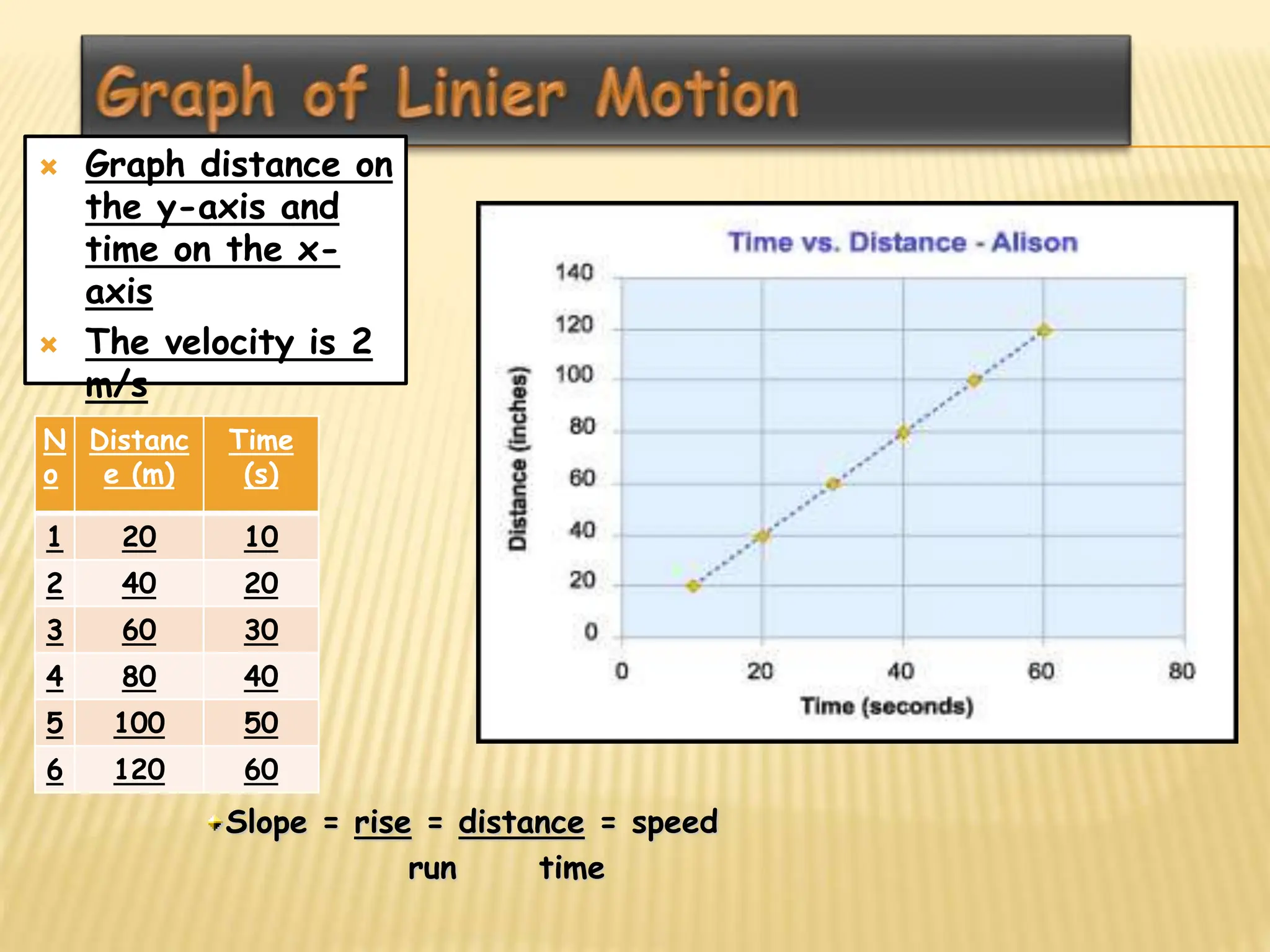
 Graph distance on
the y-axis and
time on the x-
axis
 The velocity is 2
m/s
Slope = rise = distance = speed
run time
N
o
Distanc
e (m)
Time
(s)
1 20 10
2 40 20
3 60 30
4 80 40
5 100 50
6 120 60
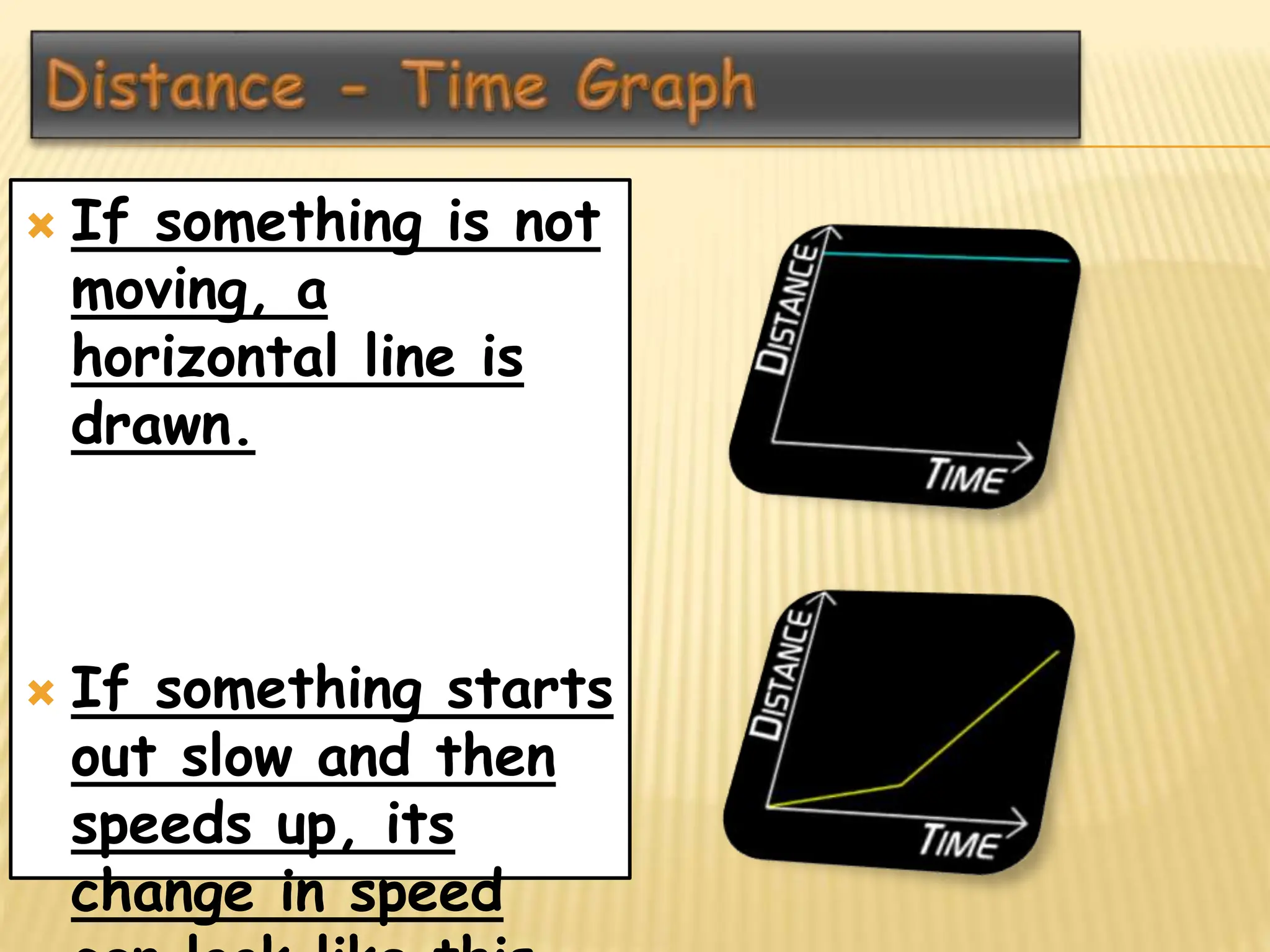
 If something is not
moving, a
horizontal line is
drawn.
 If something starts
out slow and then
speeds up, its
change in speed
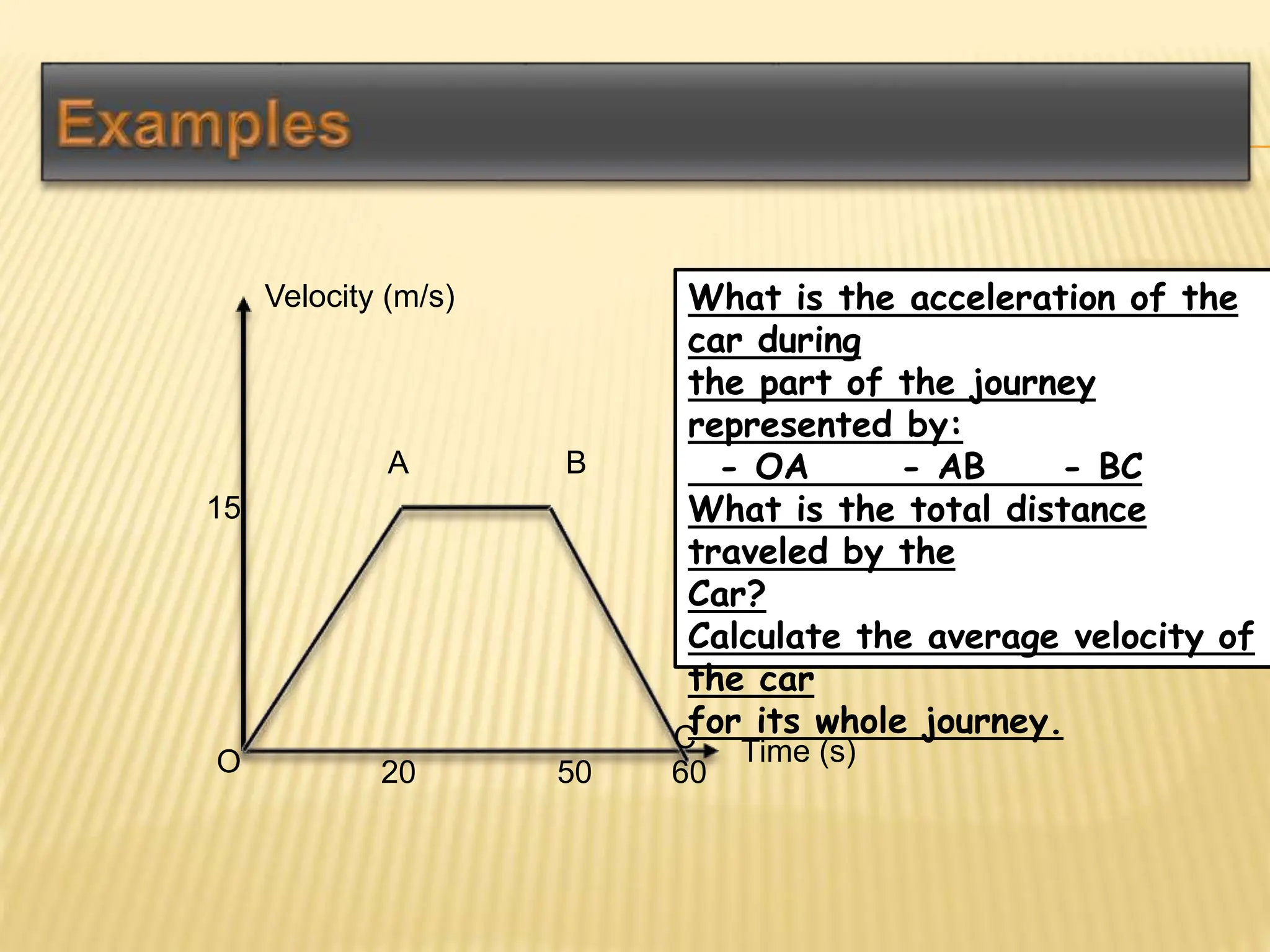
 A velocity-time graph shows how the
velocity of an object changes with time.

 The gradient of a velocity-time graph
represents the acceleration of the
object.
 The area under a velocity-time graph
represents the distance traveled by the
object.
Velocity (m/s)
Time (s)
A B
C
15
20 50 60
O
What is the acceleration of the
car during
the part of the journey
represented by:
- OA - AB - BC
What is the total distance
traveled by the
Car?
Calculate the average velocity of
the car
for its whole journey.
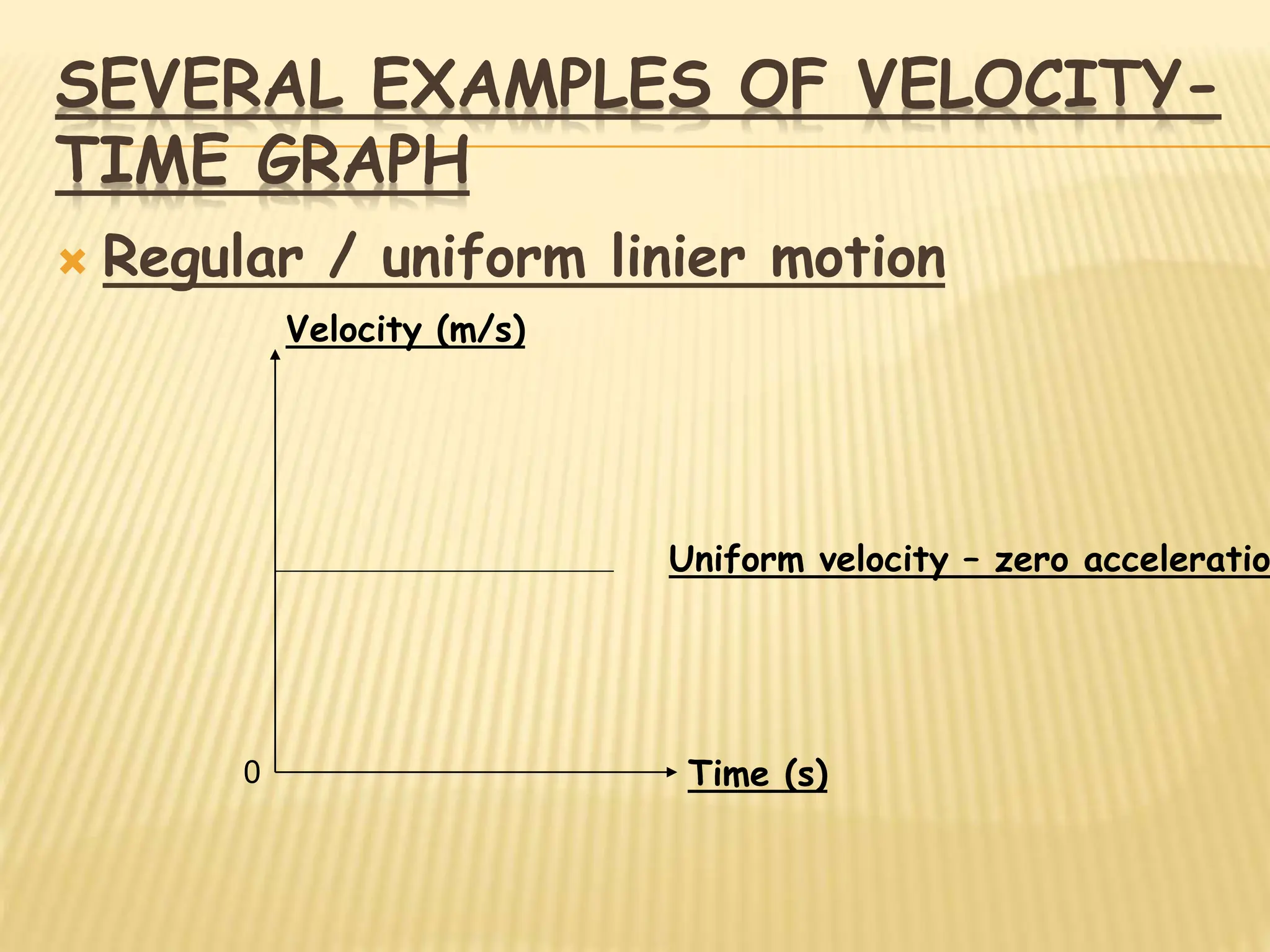
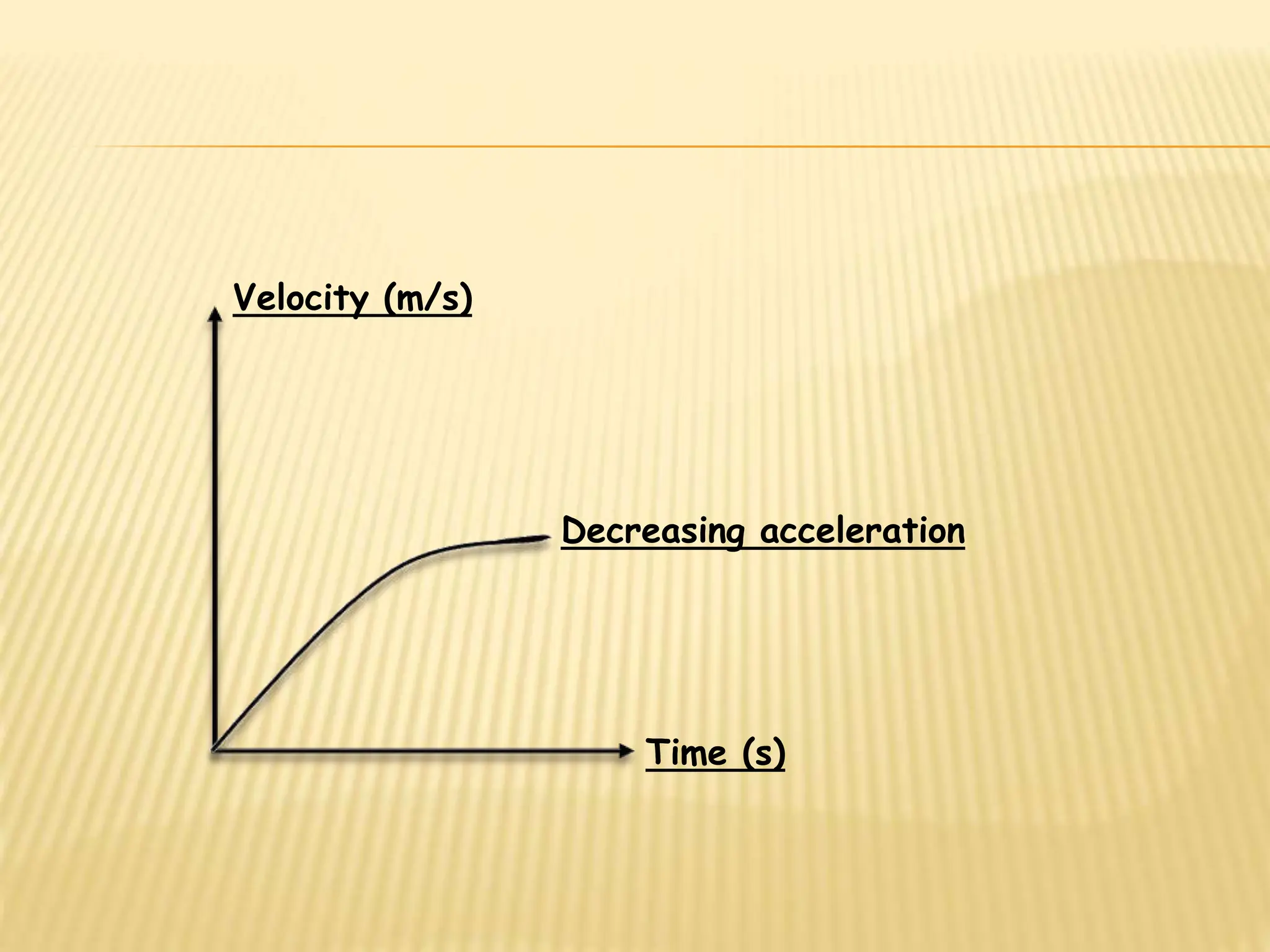
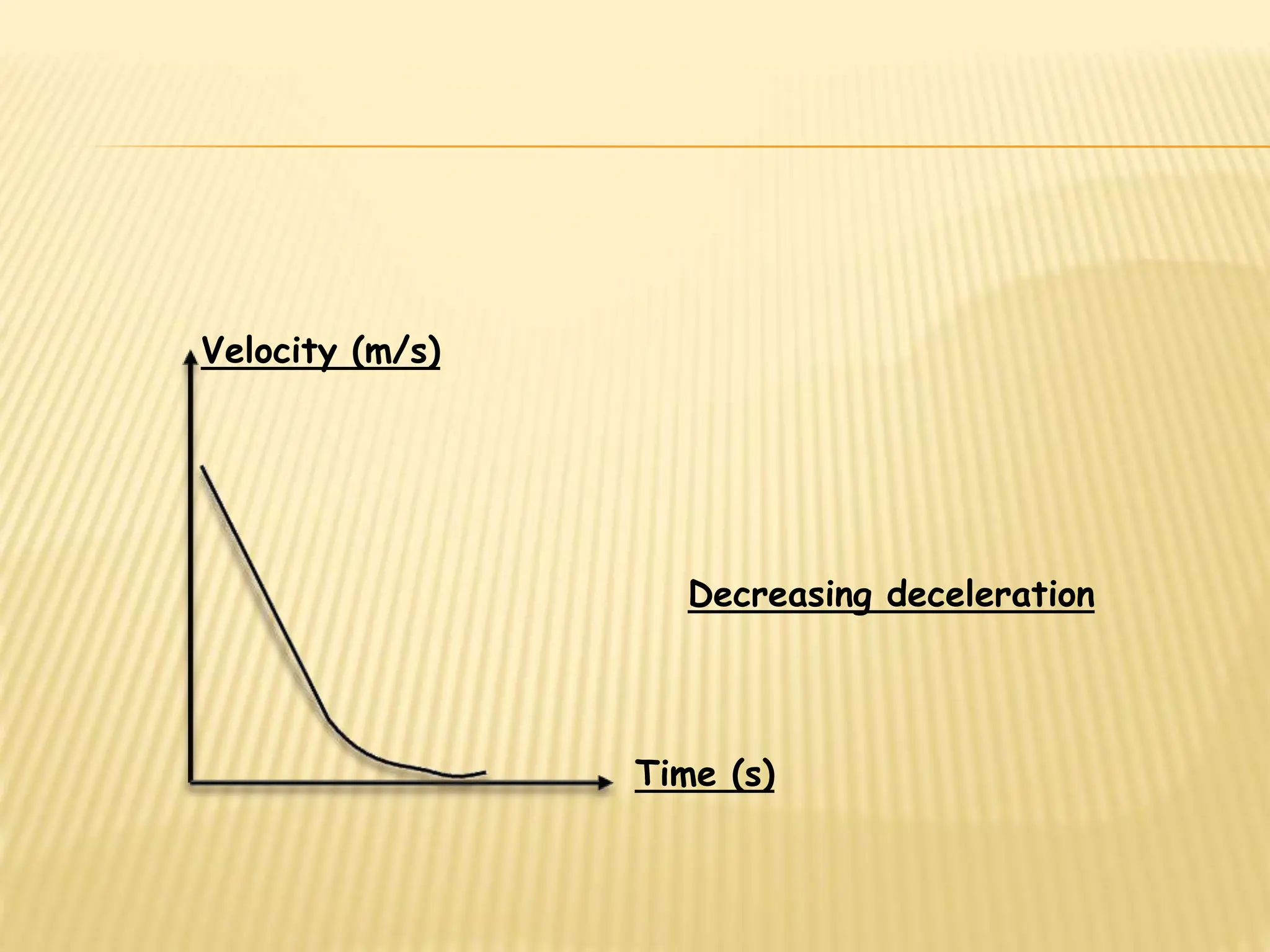
SEVERAL EXAMPLES OF VELOCITY-
TIME GRAPH
 Regular / uniform linier motion
Velocity (m/s)
0 Time (s)
Uniform velocity – zero acceleratio
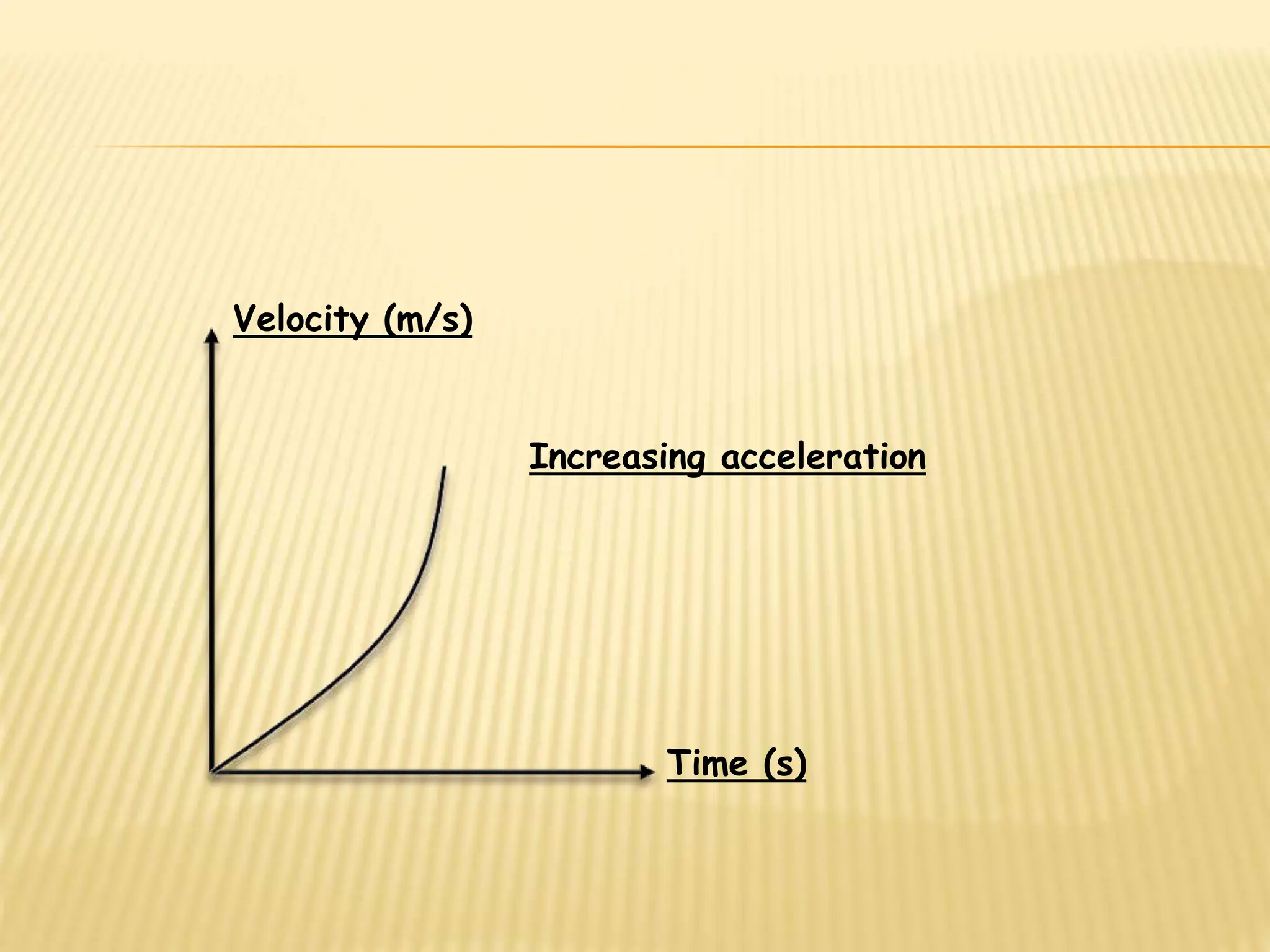
Velocity (m/s)
Time (s)
Increasing acceleration
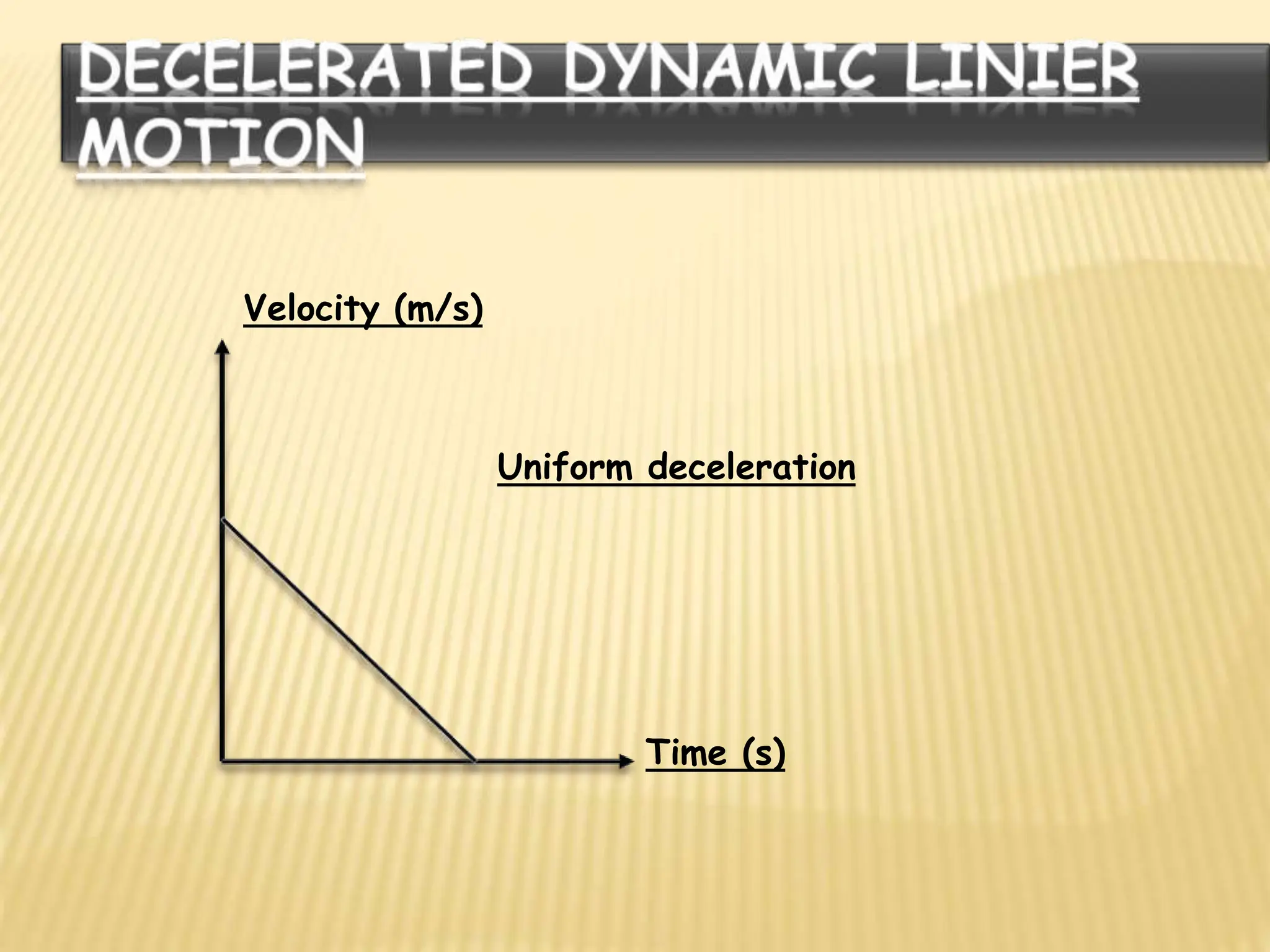
Velocity (m/s)
Time (s)
Uniform deceleration
Velocity (m/s)
Time (s)
Decreasing acceleration
Decreasing deceleration
Velocity (m/s)
Time (s)
motion, distance displacement speed and velocity

motion, distance displacement speed and velocity

  • 2.
     Motion  VirtualMotion  Relative motion  Point of reference  Distance  Displacement  Speed  Velocity  Acceleration  Deceleration  Uniform motion  Uniformly acceleration motion Science Words
  • 3.
    Use the groundas reference! Did the girl
  • 4.
    Use the groundas reference
  • 5.
    Use the groundas reference
  • 6.
     Motion isa change of position with respect to a point of reference.  Point of reference is something that is considered fixed and used as a comparison.  Motion very dependent on point of reference
  • 7.
    .....  Motion dependenton point of reference is relative motion  Virtual motion is looks like motion but actually it is not motion, example:  Sun rises in the east and sets in the west  When you are inside a moving bus and look towards the window you will see trees moving away from you.
  • 8.
    Distance = 200m Displacement = 200 m to right 200 m What is difference between distance and displacement?
  • 9.
    0 1 23 4 5 6 7 8 9 A C B 2 1 3 4 Distance = 13 m Displacement = 5 m to m What is difference between distance and displacement?
  • 10.
     Distance islength of all lines passed through by an object scalar quantity -> have: magnitude and unit  Diplacement is position change of an object from the initial point Vector quantity -> have: magnitude, unit, and direction
  • 11.
    In solving forthe displacement, get the SUM of the magnitude of the same directions. Then, subtract the magnitude of opposite directions and follow the direction of the bigger magnitude
  • 12.
    Distance = 35m Displacement = 15 m to left What its distance? What its displacement? 10 m 25 m 1.
  • 13.
  • 14.
    0 4 Time (second) themoving object is identified by its change of position of a point of reference If we want to know how far the position has changed, we must know the concept about velocity Why the change of position of car is longer than a bicycle?
  • 17.
    WHAT DIFFERENCE BETWEEN A DISTANCEAND A DISPLACEMENT ? 200 m 250 m 150 m Distance = Displacement = A B C 450 m 150 m Speed and Velocity If Budi go to C from A in 5 seconds that : Speed = Velocity = 90 m/s 30 m/s
  • 18.
    Average speed isthe total traveled distance divided by the total time needed to travel that distance  Average speed = total distance total time v = s1 + s2 + s3 …… t1 + t2 + t3 ….
  • 19.
     Symbol: a Formula: acceleration = change of velocity time taken  SI Unit : m/sec2  The same formula can also be applied for deceleration, but the value of a is negative
  • 20.
     Acceleration denotesthe change of velocity per unit of time. (Vector Quantity) acceleration decleration  The formula : a = vt – v0 or a = v/t tt – t0 With : a = acceleration (m/s2) vt = The final velocity (m/s) v0 = the initial velocity (m/s) velocity acceleration velocity acceleratio n
  • 21.
     Mathematical relationsrelating motion variables are called equation of motion  For motion with constant acceleration, the variables are:  Displacement : s  Initial velocity : v  Final velocity : u  Constant acceleration : a  Time taken : t
  • 22.
     A displacement-timegraph shows how the displacement of an object changes with time.  The gradient of a displacement-time graph represents the velocity of the object.
  • 23.
    Displacement (m) Time (s) Zerogradient – stationary object
  • 24.
    Displacement (m) Time (s) Fixedgradient-uniform velocity
  • 25.
    Displacement (m) Time (s) Increasinggradient – increasing velocity
  • 26.
    Displacement (m) Time (s) Decreasinggradient – decreasing velocity
  • 27.
     Graph distanceon the y-axis and time on the x- axis  The velocity is 2 m/s Slope = rise = distance = speed run time N o Distanc e (m) Time (s) 1 20 10 2 40 20 3 60 30 4 80 40 5 100 50 6 120 60
  • 28.
     If somethingis not moving, a horizontal line is drawn.  If something starts out slow and then speeds up, its change in speed
  • 29.
     A velocity-timegraph shows how the velocity of an object changes with time.  The gradient of a velocity-time graph represents the acceleration of the object.  The area under a velocity-time graph represents the distance traveled by the object.
  • 30.
    Velocity (m/s) Time (s) AB C 15 20 50 60 O What is the acceleration of the car during the part of the journey represented by: - OA - AB - BC What is the total distance traveled by the Car? Calculate the average velocity of the car for its whole journey.
  • 31.
    SEVERAL EXAMPLES OFVELOCITY- TIME GRAPH  Regular / uniform linier motion Velocity (m/s) 0 Time (s) Uniform velocity – zero acceleratio
  • 32.
  • 33.
  • 34.
  • 35.