Wave Optics
Prepared by
Sandhya Velayudhan
PGT Physics, JNV Kozhikode
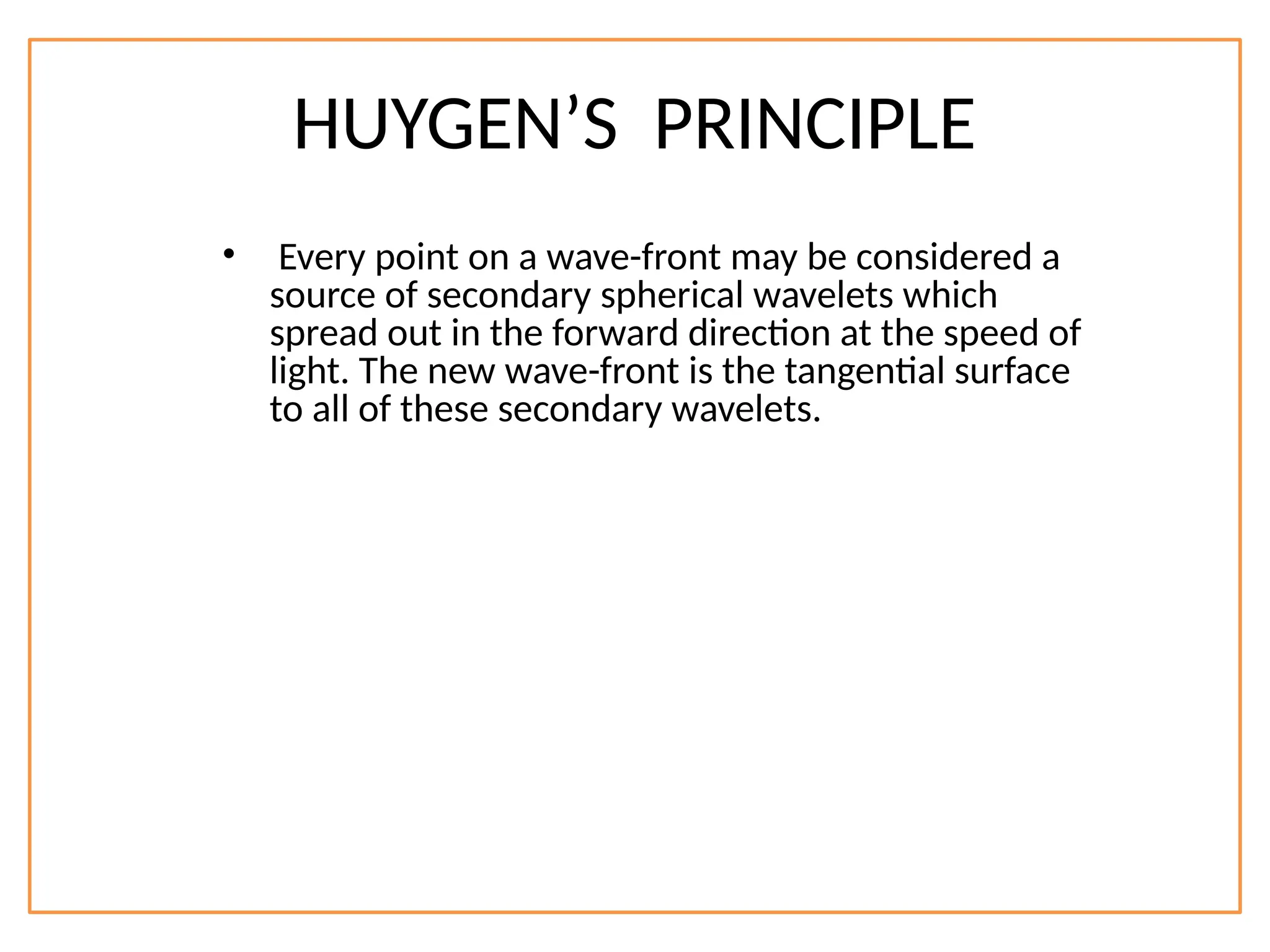
HUYGEN’S PRINCIPLE
• Every point on a wave-front may be considered a
source of secondary spherical wavelets which
spread out in the forward direction at the speed of
light. The new wave-front is the tangential surface
to all of these secondary wavelets.
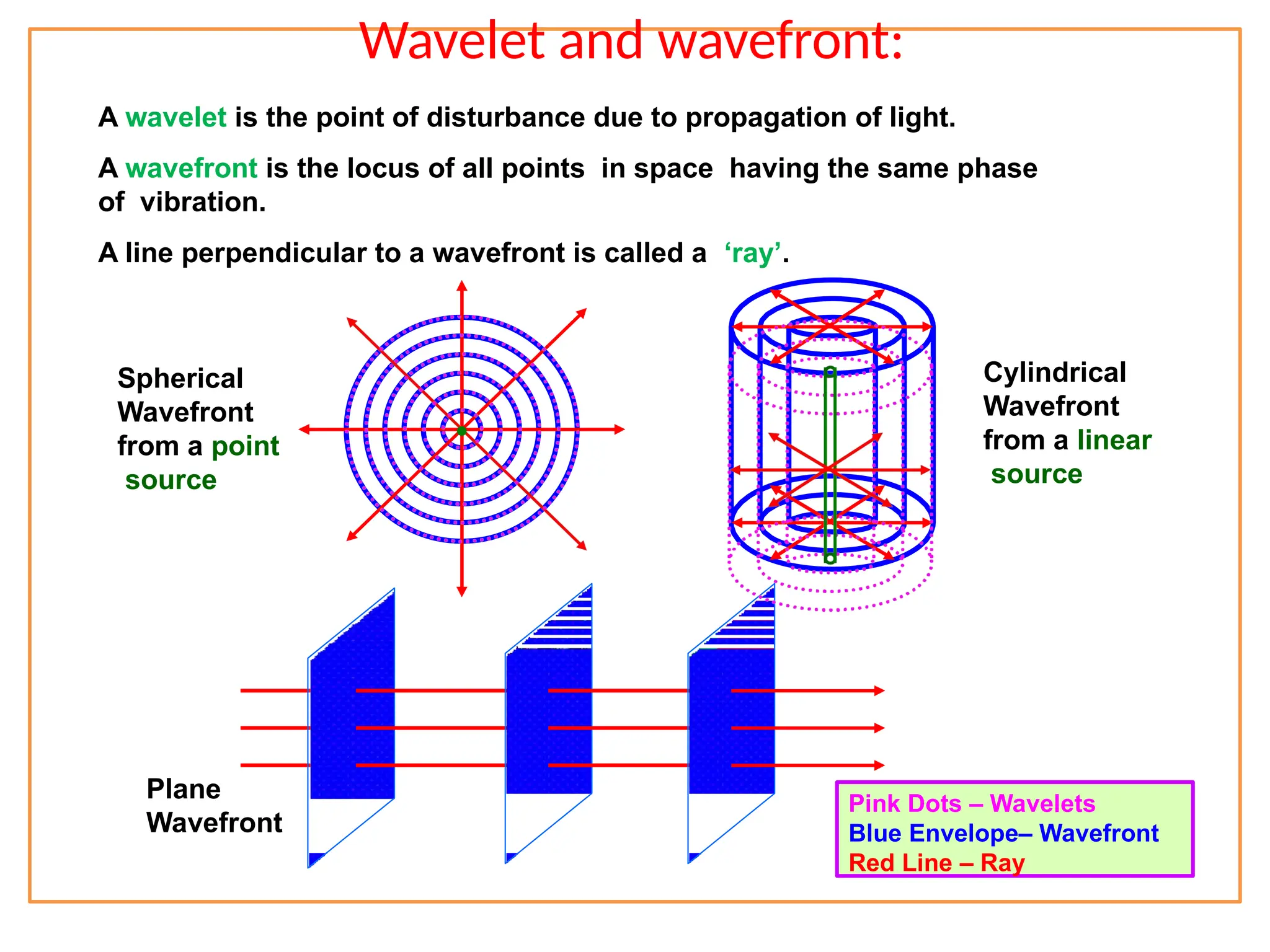
Wavelet and wavefront:
A wavelet is the point of disturbance due to propagation of light.
A wavefront is the locus of all points in space having the same phase
of vibration.
A line perpendicular to a wavefront is called a ‘ray’.
Spherical
Wavefront
from a point
source
Cylindrical
Wavefront
from a linear
source
Plane
Wavefront
Pink Dots – Wavelets
Blue Envelope– Wavefront
Red Line – Ray
•
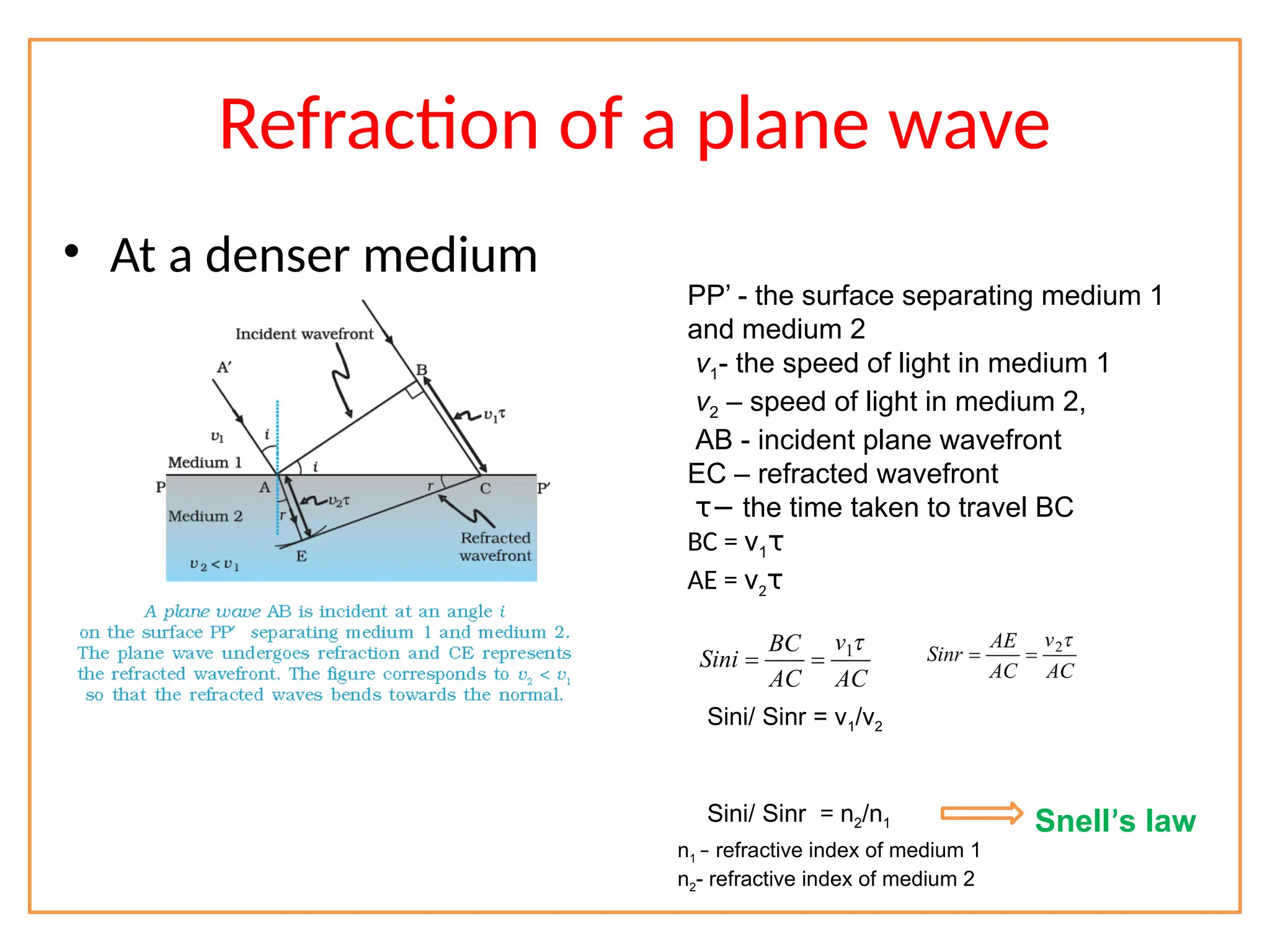
Refraction of a plane wave
• At a denser medium
PP’ - the surface separating medium 1
and medium 2
v1- the speed of light in medium 1
v2 – speed of light in medium 2,
AB - incident plane wavefront
EC – refracted wavefront
τ− the time taken to travel BC
BC = v1τ
AE = v2τ
Sini/ Sinr = v1/v2
Sini/ Sinr = n2/n1 Snell’s law
n1 – refractive index of medium 1
n2- refractive index of medium 2
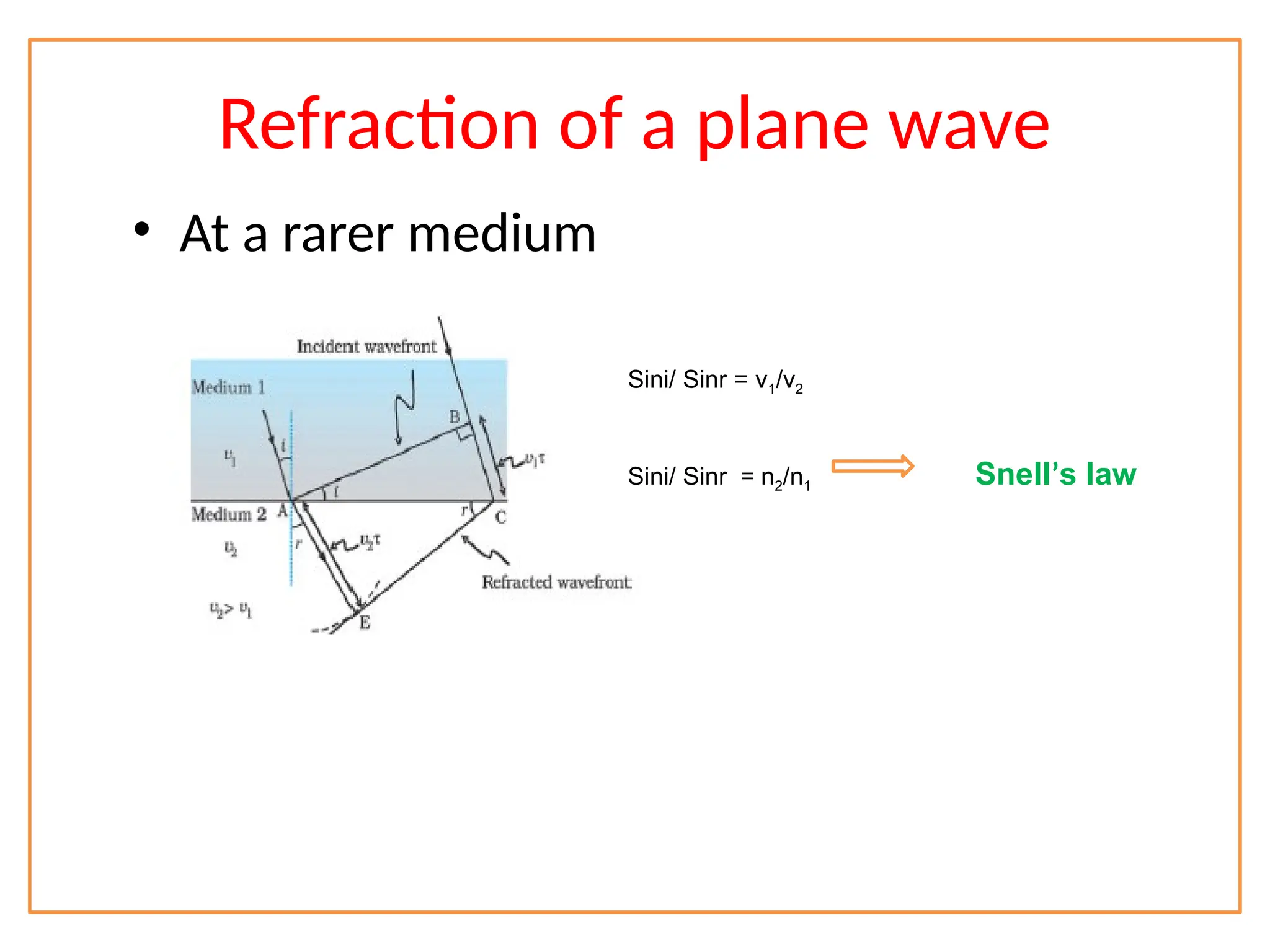
• At a rarer medium
Refraction of a plane wave
Sini/ Sinr = v1/v2
Sini/ Sinr = n2/n1 Snell’s law
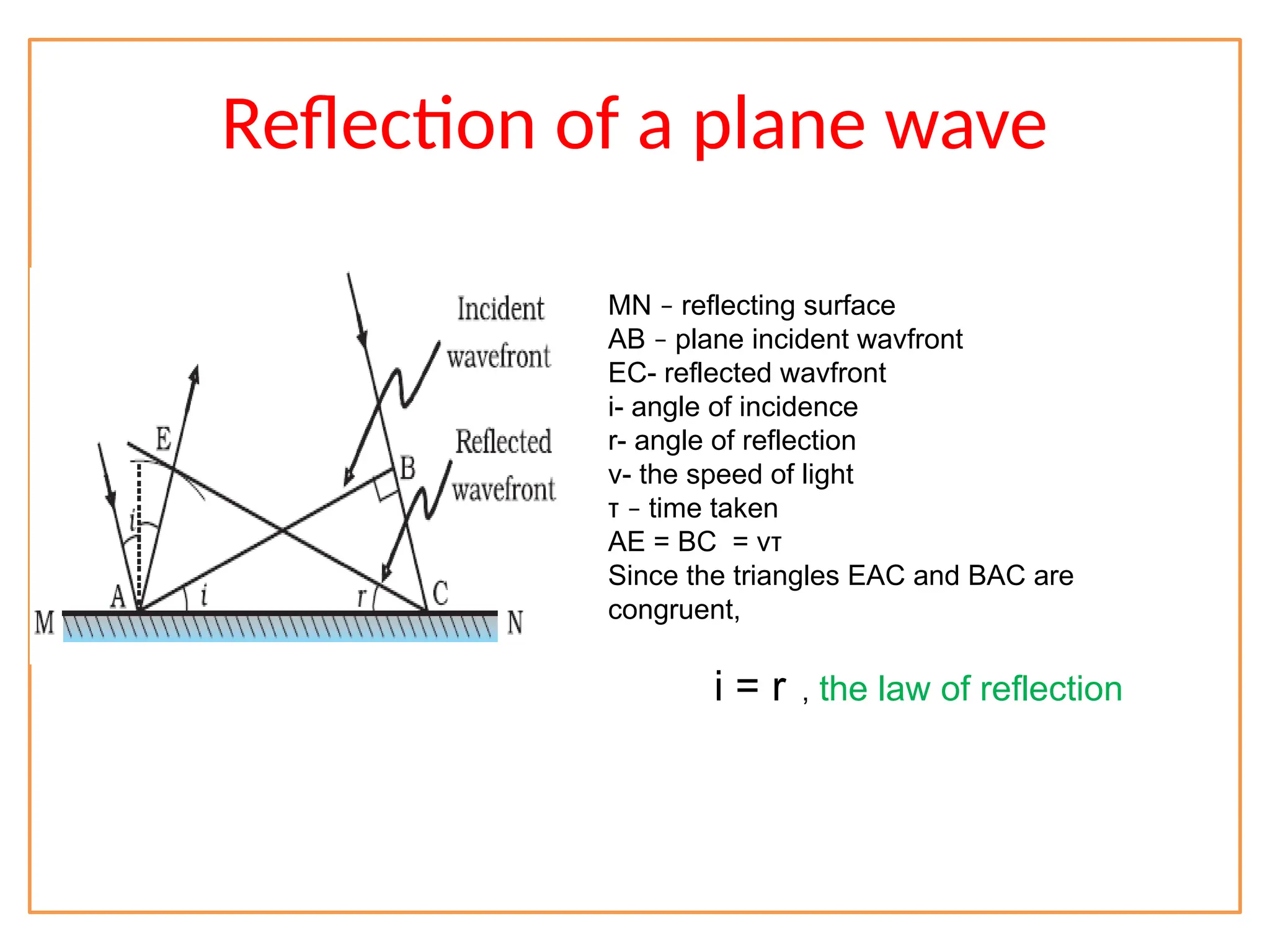
Reflection of a plane wave
MN – reflecting surface
AB – plane incident wavfront
EC- reflected wavfront
i- angle of incidence
r- angle of reflection
v- the speed of light
τ – time taken
AE = BC = vτ
Since the triangles EAC and BAC are
congruent,
i = r , the law of reflection
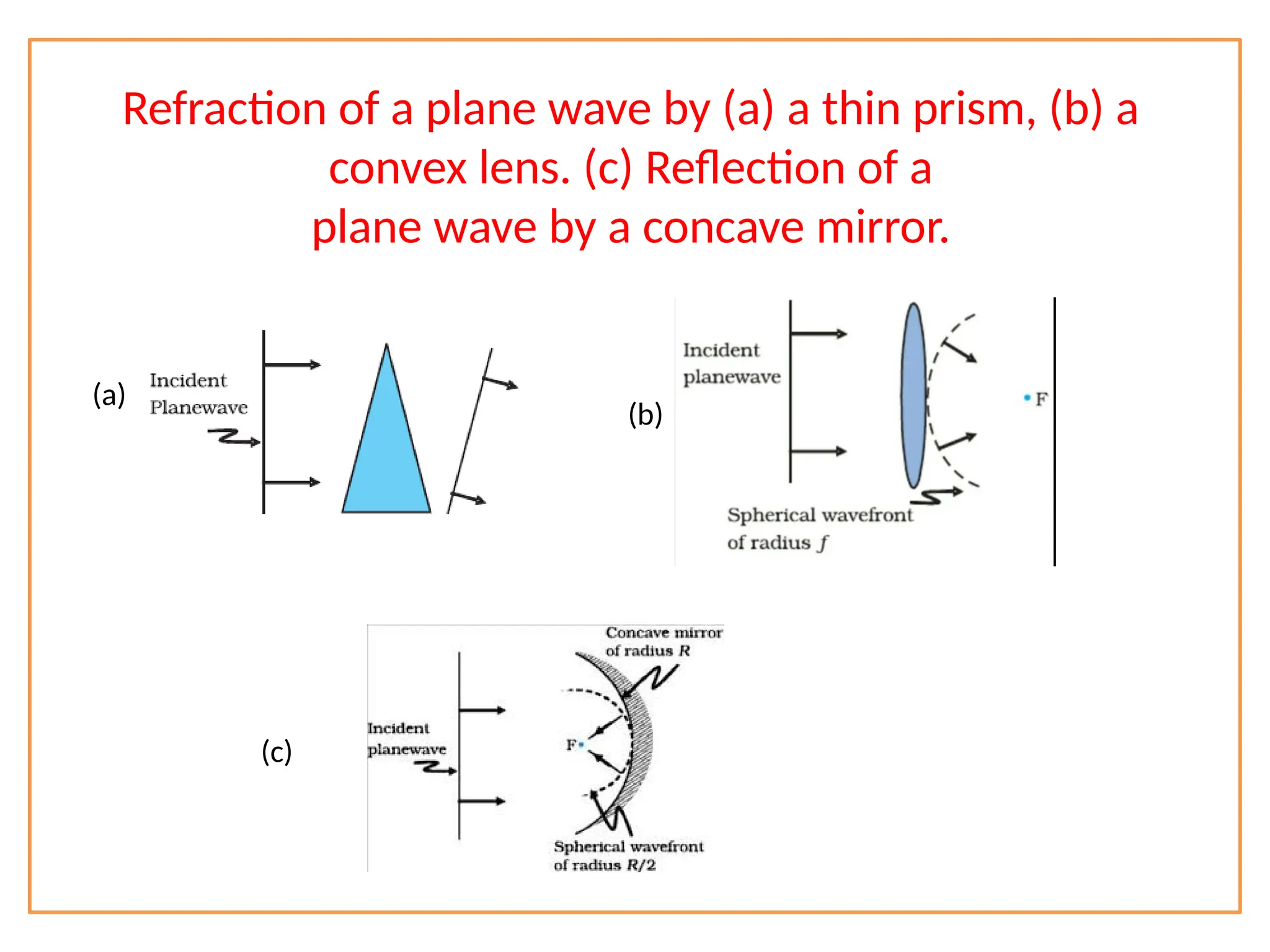
Refraction of a plane wave by (a) a thin prism, (b) a
convex lens. (c) Reflection of a
plane wave by a concave mirror.
(a)
(b)
(c)
Interference
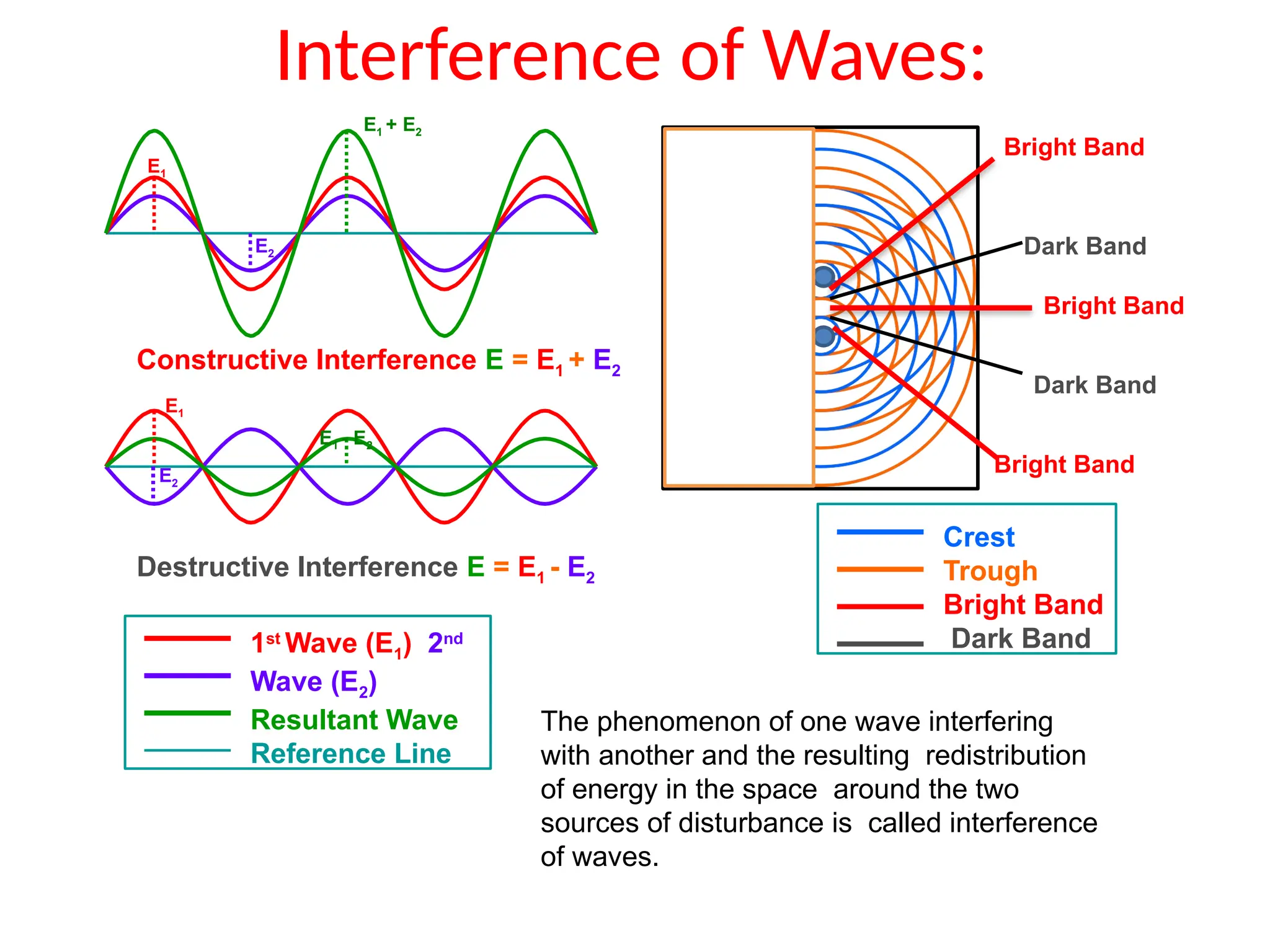
The phenomenon of one wave interfering with
another and the resulting redistribution of energy in
the space around the two sources of disturbance is
called interference of waves.
Coherent Sources
The sources emitting light waves of same
frequency or wavelength having either a zero
or constant phase difference are said to be
coherent
Interference of Waves:
Destructive Interference E = E1 - E2
Crest
Trough
Bright Band
Dark Band
1st
Wave (E1) 2nd
Wave (E2)
Resultant Wave
Reference Line
E2
E2
The phenomenon of one wave interfering
with another and the resulting redistribution
of energy in the space around the two
sources of disturbance is called interference
of waves.
E1 + E2
E1
Constructive Interference E = E1 + E2
E1
E1 - E2
Bright Band
Dark Band
Dark Band
Bright Band
Bright Band
S2
S1
Condition for Constructive and destructive
Interference
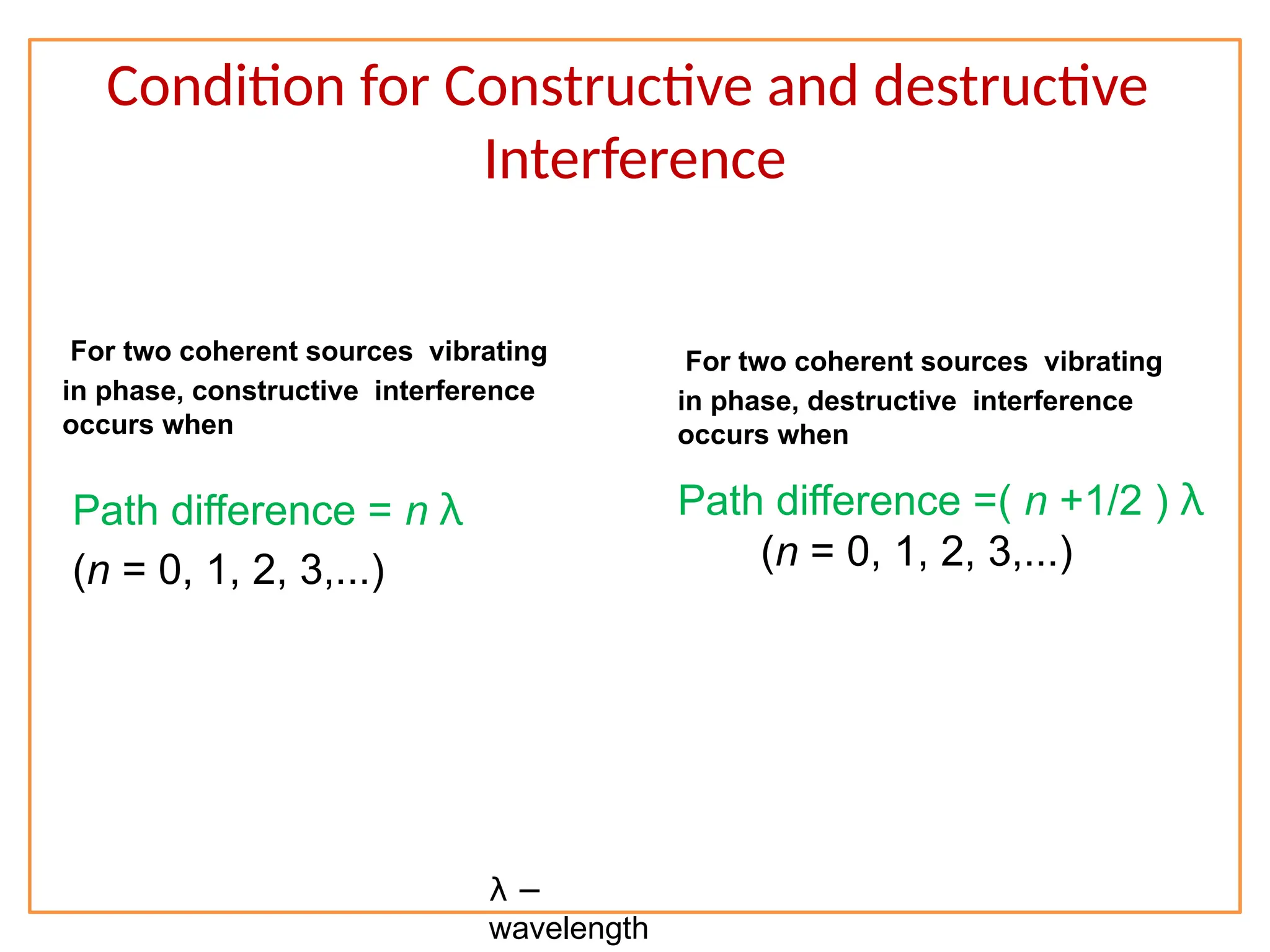
For two coherent sources vibrating
in phase, constructive interference
occurs when
Path difference = n λ
(n = 0, 1, 2, 3,...)
For two coherent sources vibrating
in phase, destructive interference
occurs when
Path difference =( n +1/2 ) λ
(n = 0, 1, 2, 3,...)
λ −
wavelength
Intensity in interference
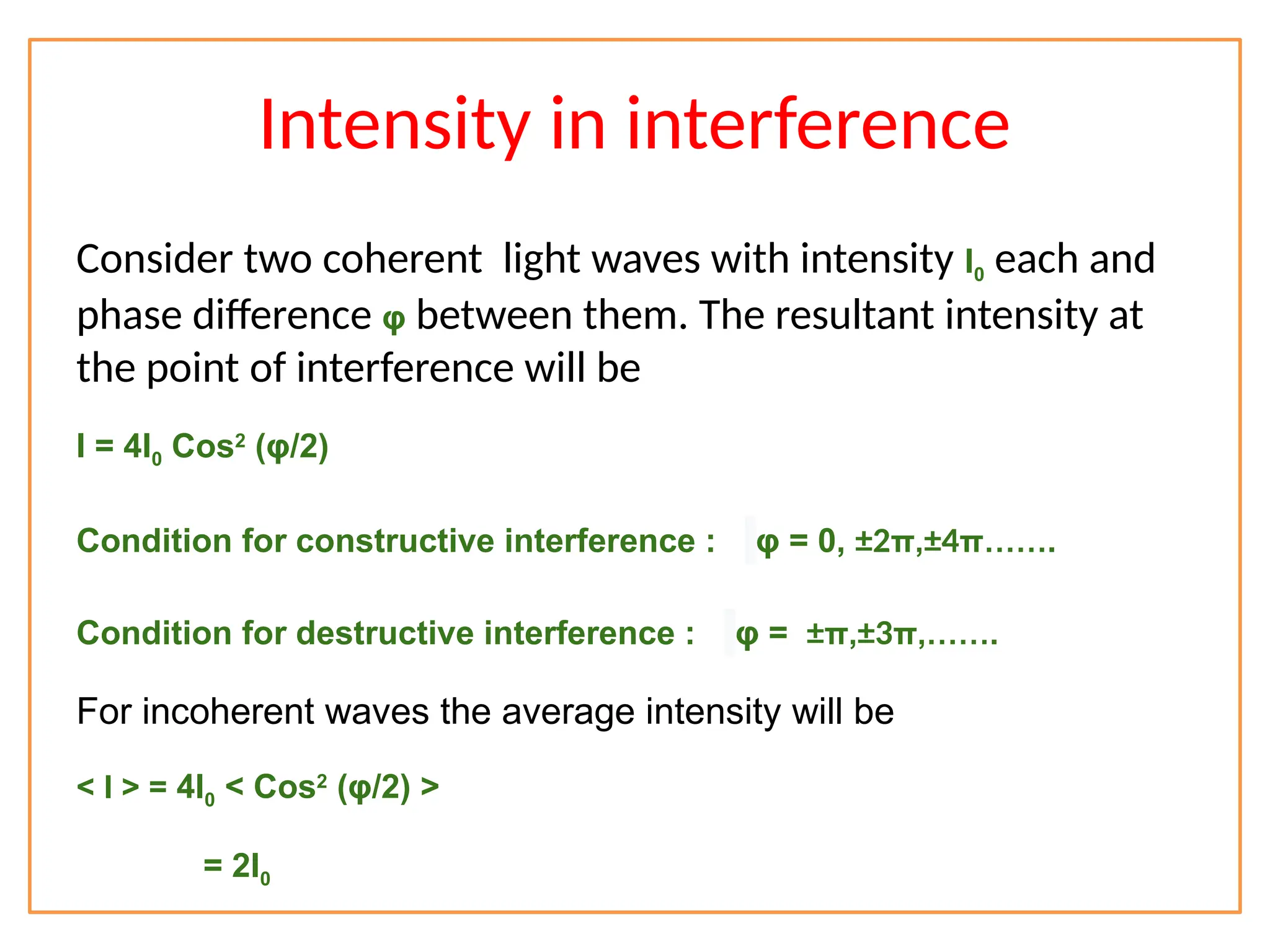
Consider two coherent light waves with intensity I0 each and
phase difference φ between them. The resultant intensity at
the point of interference will be
I = 4I0 Cos2
(φ/2)
Condition for constructive interference : φ = 0, ±2π,±4π…….
Condition for destructive interference : φ = ±π,±3π,…….
For incoherent waves the average intensity will be
< I > = 4I0 < Cos2
(φ/2) >
= 2I0
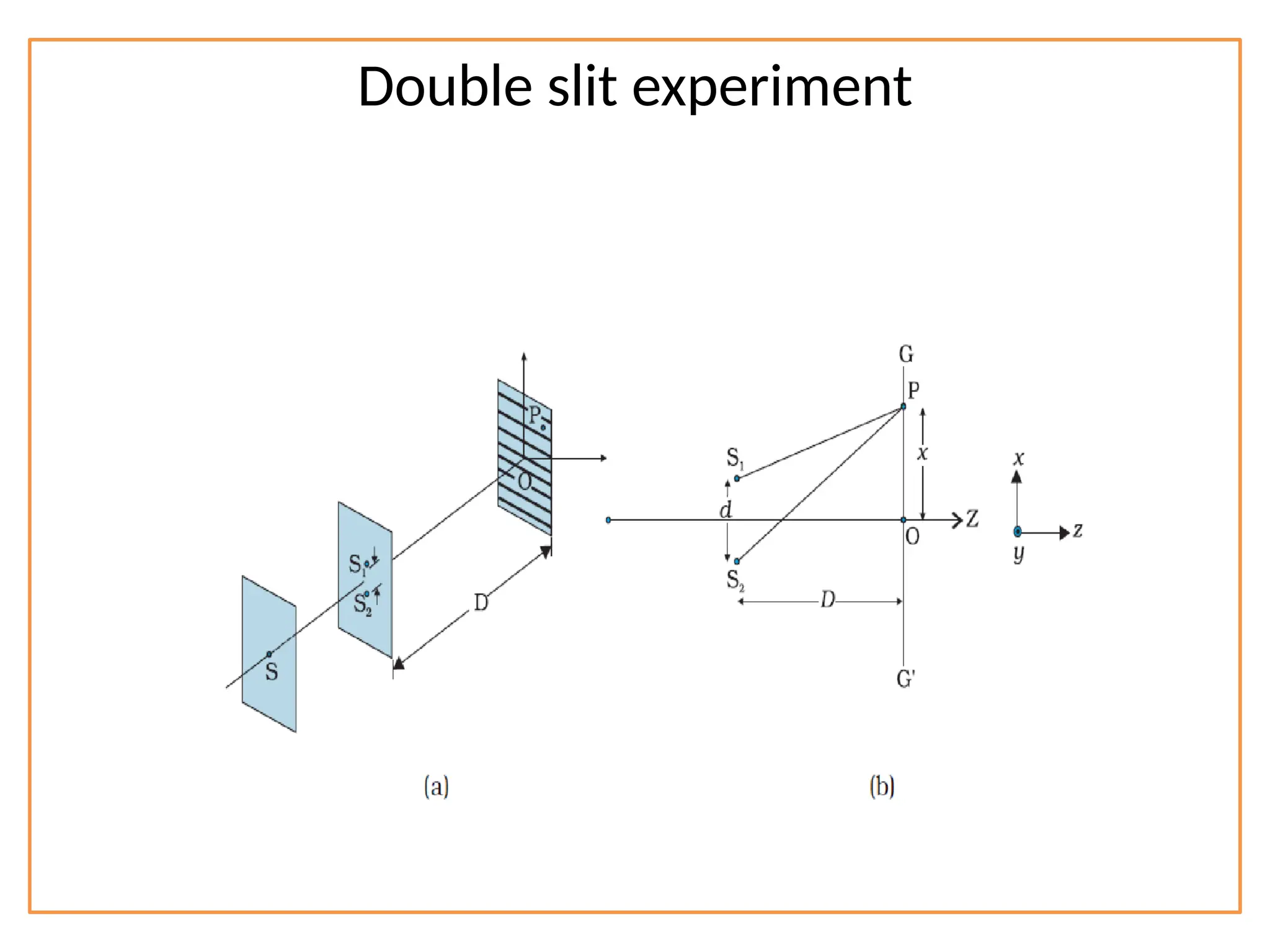
Double slit experiment
Path difference
The waves from S1 and S2 reach the point P with
Path difference ∆ = S2P – S1P
S2P2
– S1P2
= [D2
+ {x + (d/2)}2
] - [D2
+ {x - (d/2)}2
]
(S2P – S1P) (S2P + S1P) = 2 x d
∆ = x d / D
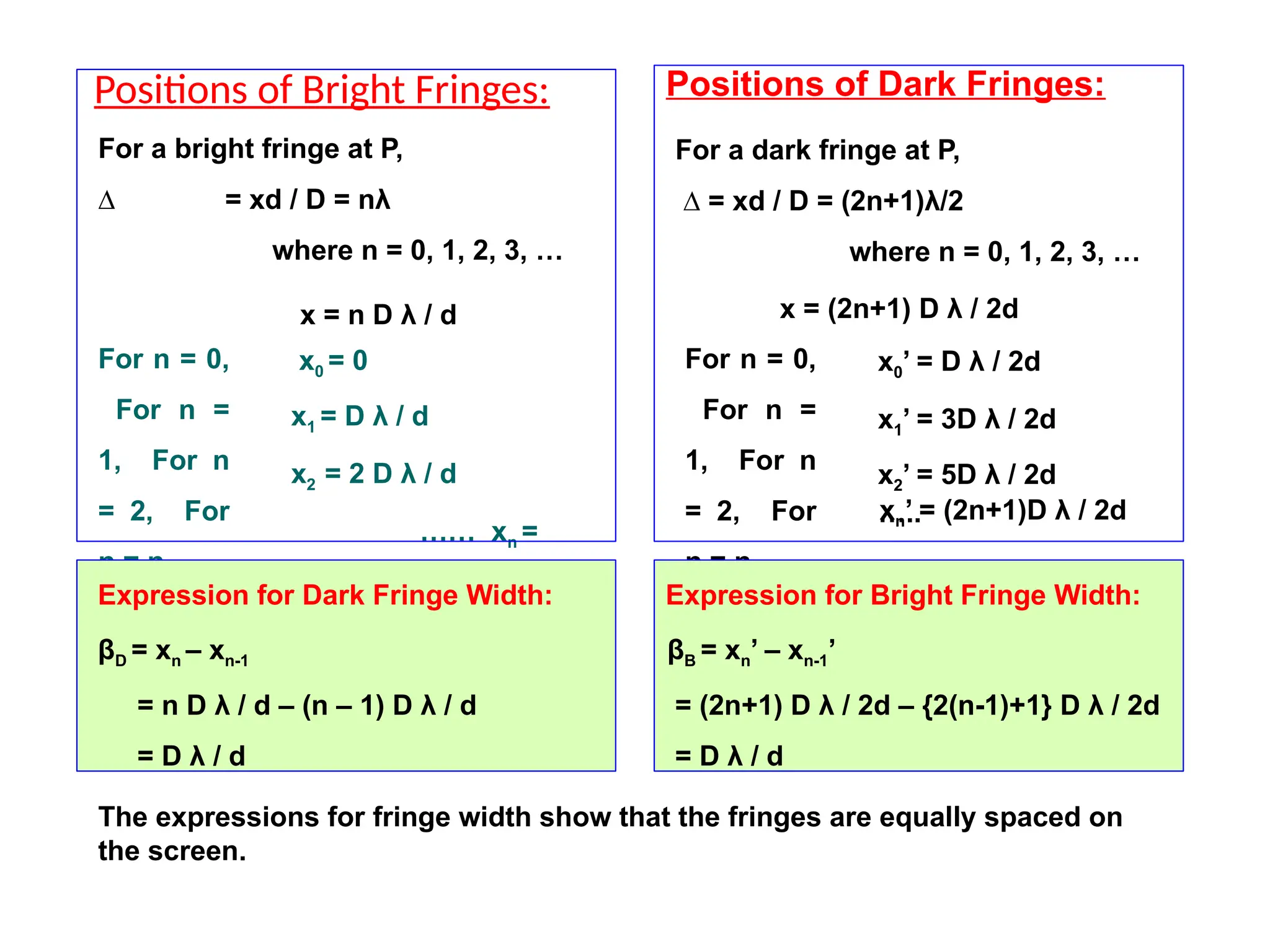
Positions of Bright Fringes:
For a bright fringe at P,
∆ = xd / D = nλ
where n = 0, 1, 2, 3, …
For n = 0,
For n =
1, For n
= 2, For
n = n,
x = n D λ / d
x0 = 0
x1 = D λ / d
x2 = 2 D λ / d
…… xn =
n D λ / d
x0’ = D λ / 2d
x1’ = 3D λ / 2d
x2’ = 5D λ / 2d
…..
For n = 0,
For n =
1, For n
= 2, For
n = n,
xn’ = (2n+1)D λ / 2d
Positions of Dark Fringes:
For a dark fringe at P,
∆ = xd / D = (2n+1)λ/2
where n = 0, 1, 2, 3, …
x = (2n+1) D λ / 2d
Expression for Dark Fringe Width:
βD = xn – xn-1
= n D λ / d – (n – 1) D λ / d
= D λ / d
Expression for Bright Fringe Width:
βB = xn’ – xn-1’
= (2n+1) D λ / 2d – {2(n-1)+1} D λ / 2d
= D λ / d
The expressions for fringe width show that the fringes are equally spaced on
the screen.
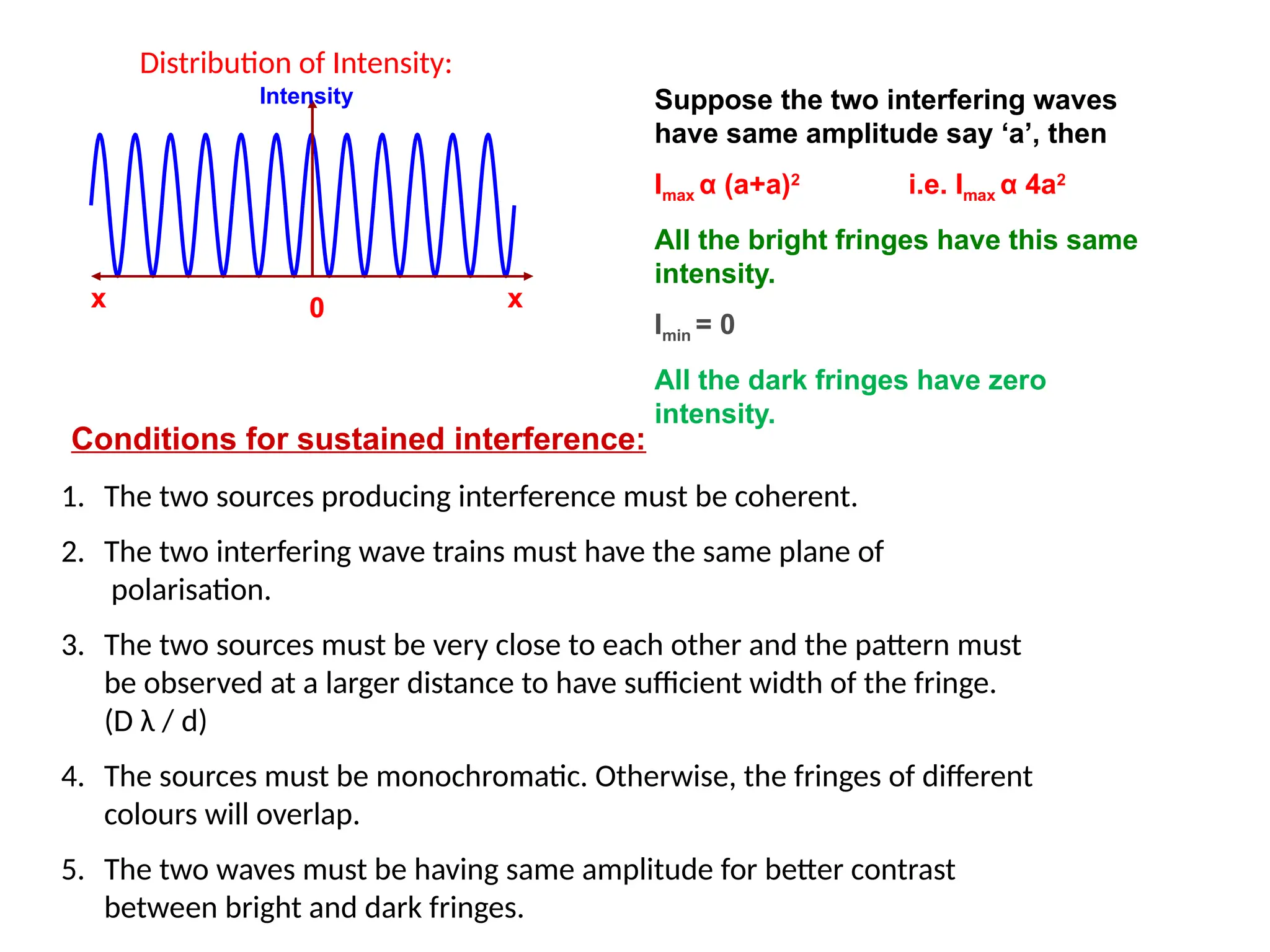
Distribution of Intensity:
Intensity
0 x
x
Suppose the two interfering waves
have same amplitude say ‘a’, then
Imax α (a+a)2
i.e. Imax α 4a2
All the bright fringes have this same
intensity.
Imin = 0
All the dark fringes have zero
intensity.
Conditions for sustained interference:
1. The two sources producing interference must be coherent.
2. The two interfering wave trains must have the same plane of
polarisation.
3. The two sources must be very close to each other and the pattern must
be observed at a larger distance to have sufficient width of the fringe.
(D λ / d)
4. The sources must be monochromatic. Otherwise, the fringes of different
colours will overlap.
5. The two waves must be having same amplitude for better contrast
between bright and dark fringes.
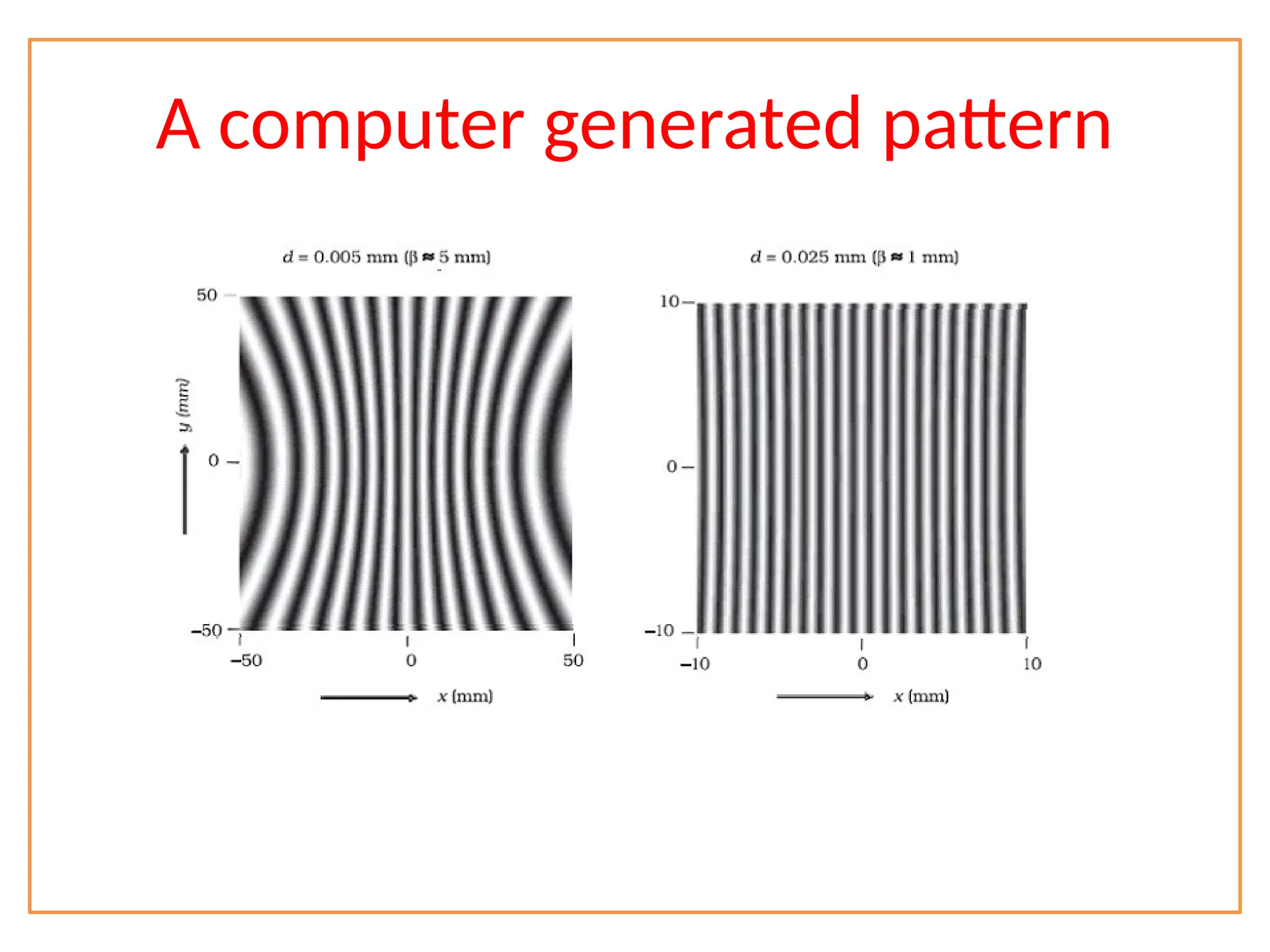
A computer generated pattern
Some Examples of Interference
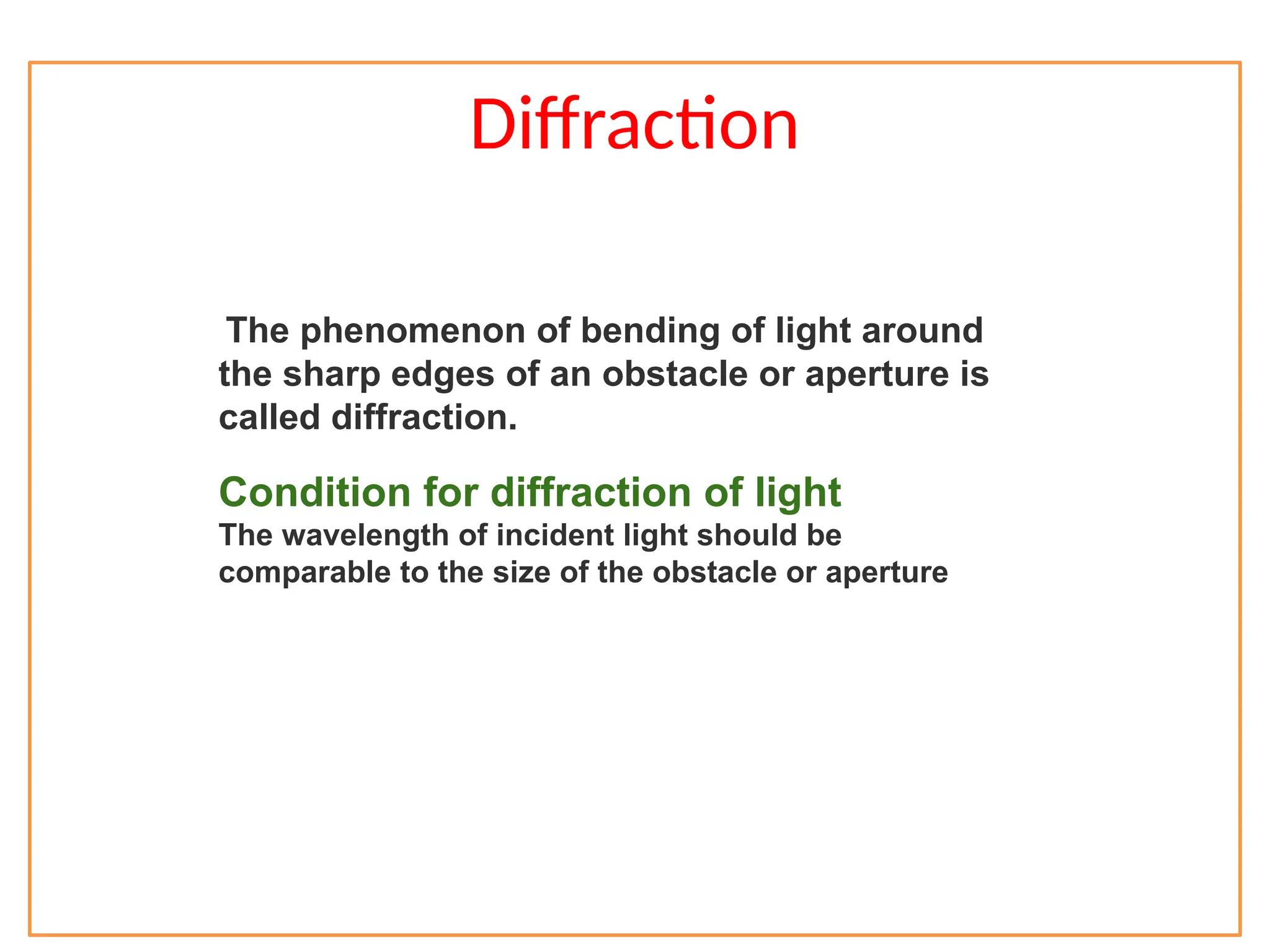
One of the best examples of interference is
demonstrated by the light reflected from a film
of oil floating on water. Another example is the
thin film of a soap bubble, which reflects a
spectrum of beautiful colors when illuminated
by natural or artificial light sources.
Diffraction
The phenomenon of bending of light around
the sharp edges of an obstacle or aperture is
called diffraction.
Condition for diffraction of light
The wavelength of incident light should be
comparable to the size of the obstacle or aperture
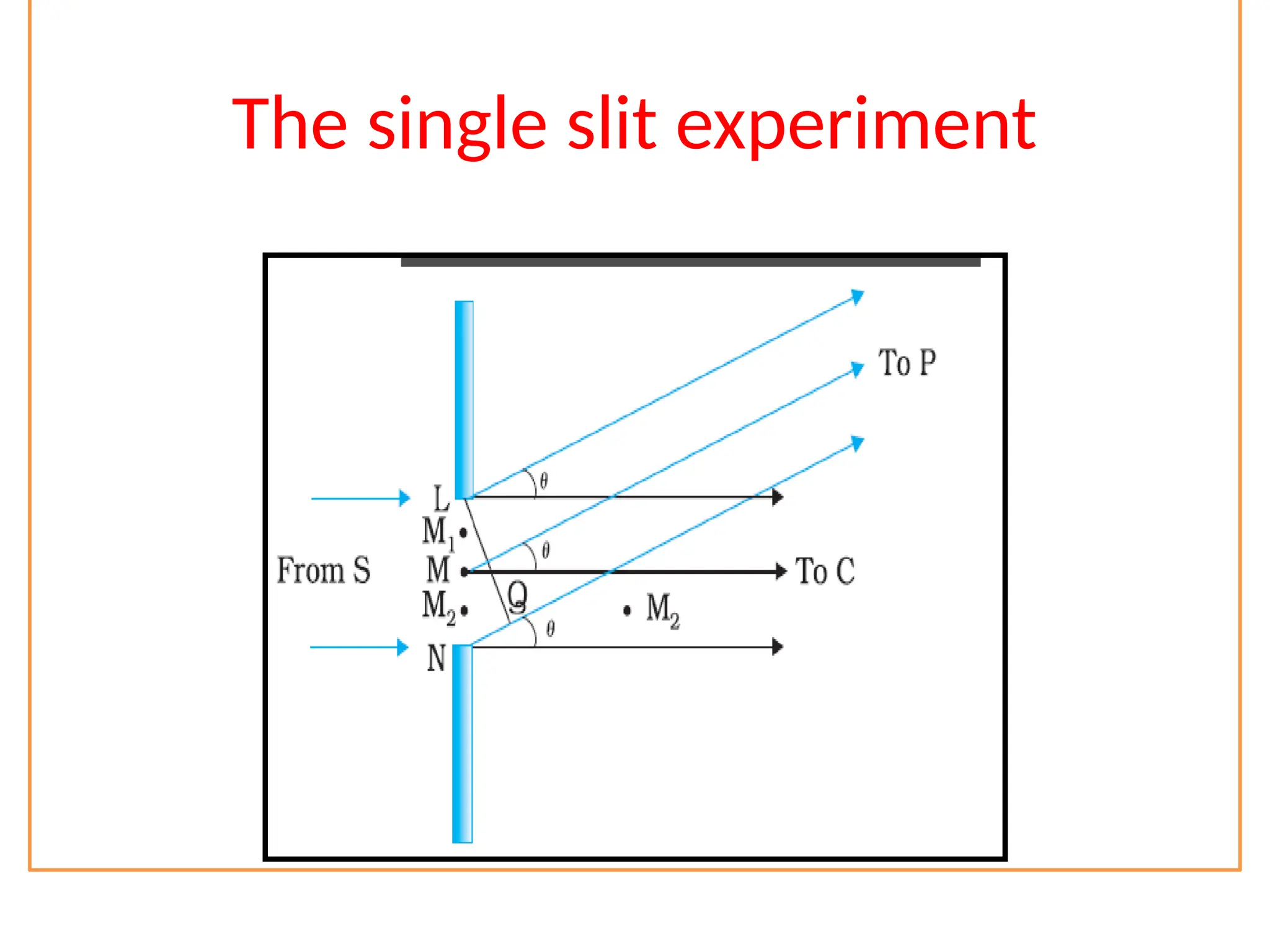
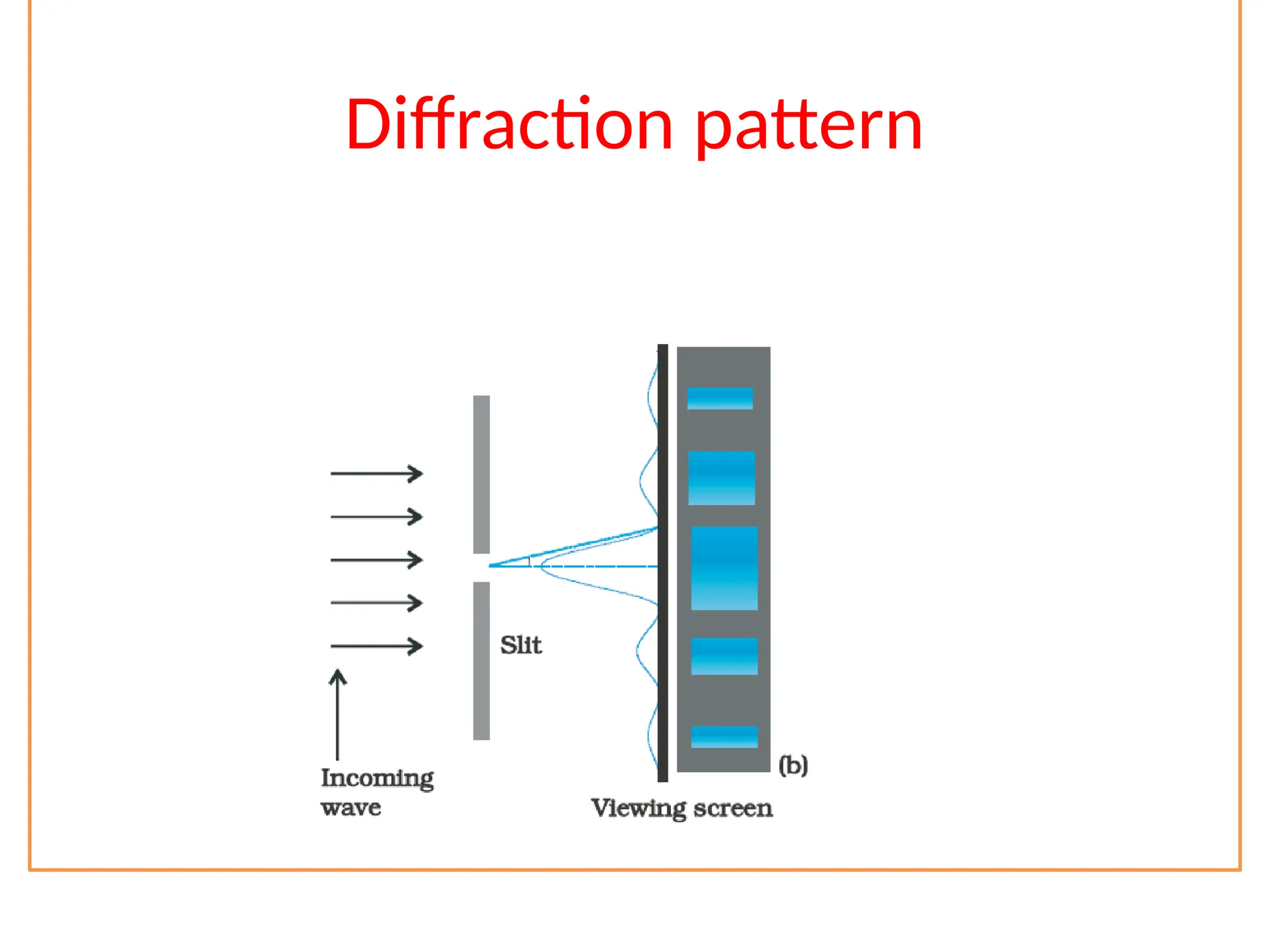
The single slit experiment
Theory:
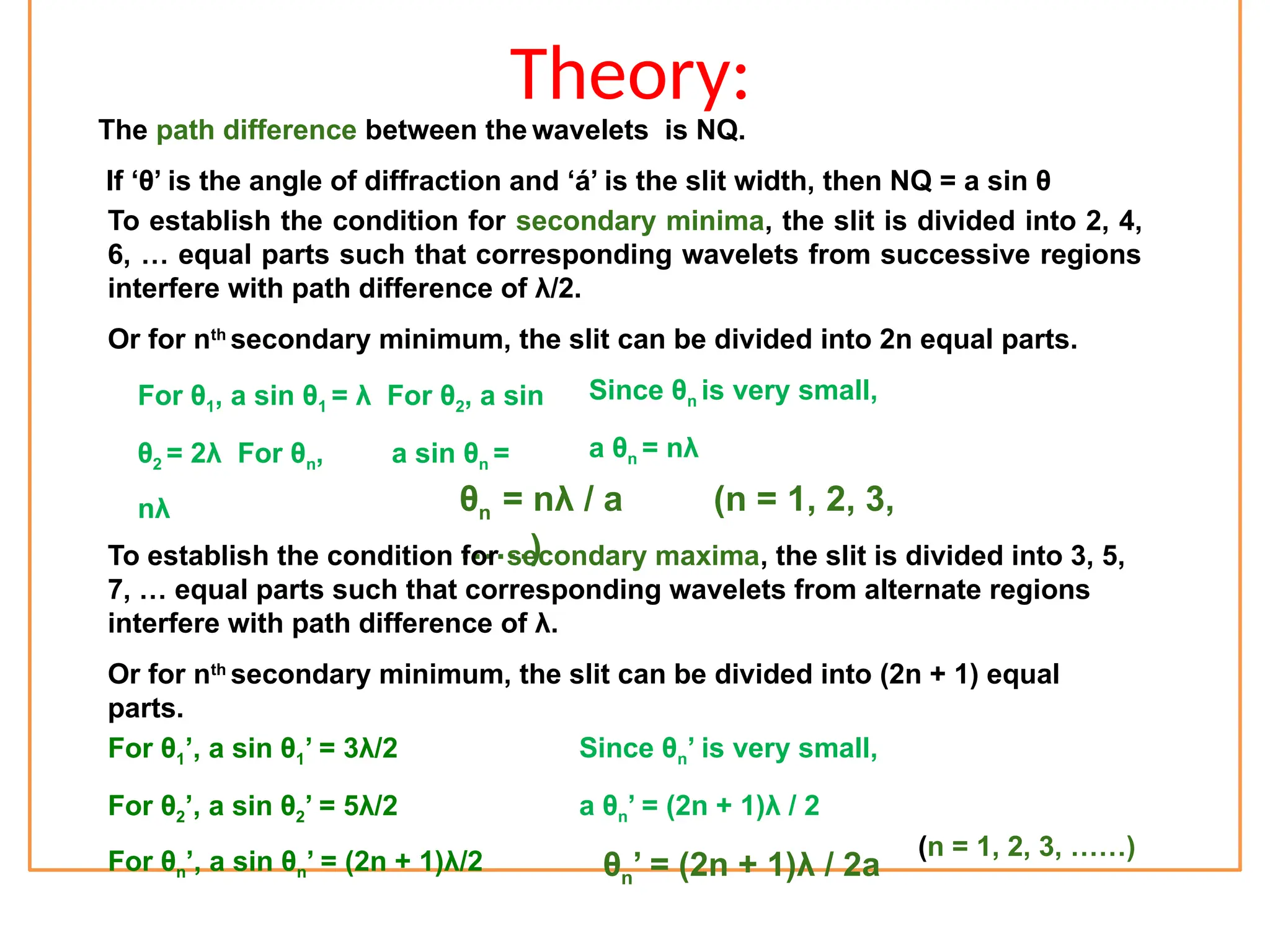
The path difference between the wavelets is NQ.
If ‘θ’ is the angle of diffraction and ‘á’ is the slit width, then NQ = a sin θ
To establish the condition for secondary minima, the slit is divided into 2, 4,
6, … equal parts such that corresponding wavelets from successive regions
interfere with path difference of λ/2.
Or for nth
secondary minimum, the slit can be divided into 2n equal parts.
For θ1, a sin θ1 = λ For θ2, a sin
θ2 = 2λ For θn, a sin θn =
nλ
Since θn is very small,
a θn = nλ
θn = nλ / a (n = 1, 2, 3,
……)
To establish the condition for secondary maxima, the slit is divided into 3, 5,
7, … equal parts such that corresponding wavelets from alternate regions
interfere with path difference of λ.
Or for nth
secondary minimum, the slit can be divided into (2n + 1) equal
parts.
For θ1’, a sin θ1’ = 3λ/2
For θ2’, a sin θ2’ = 5λ/2
For θn’, a sin θn’ = (2n + 1)λ/2
Since θn’ is very small,
a θn’ = (2n + 1)λ / 2
θn’ = (2n + 1)λ / 2a
(n = 1, 2, 3, ……)
Diffraction pattern
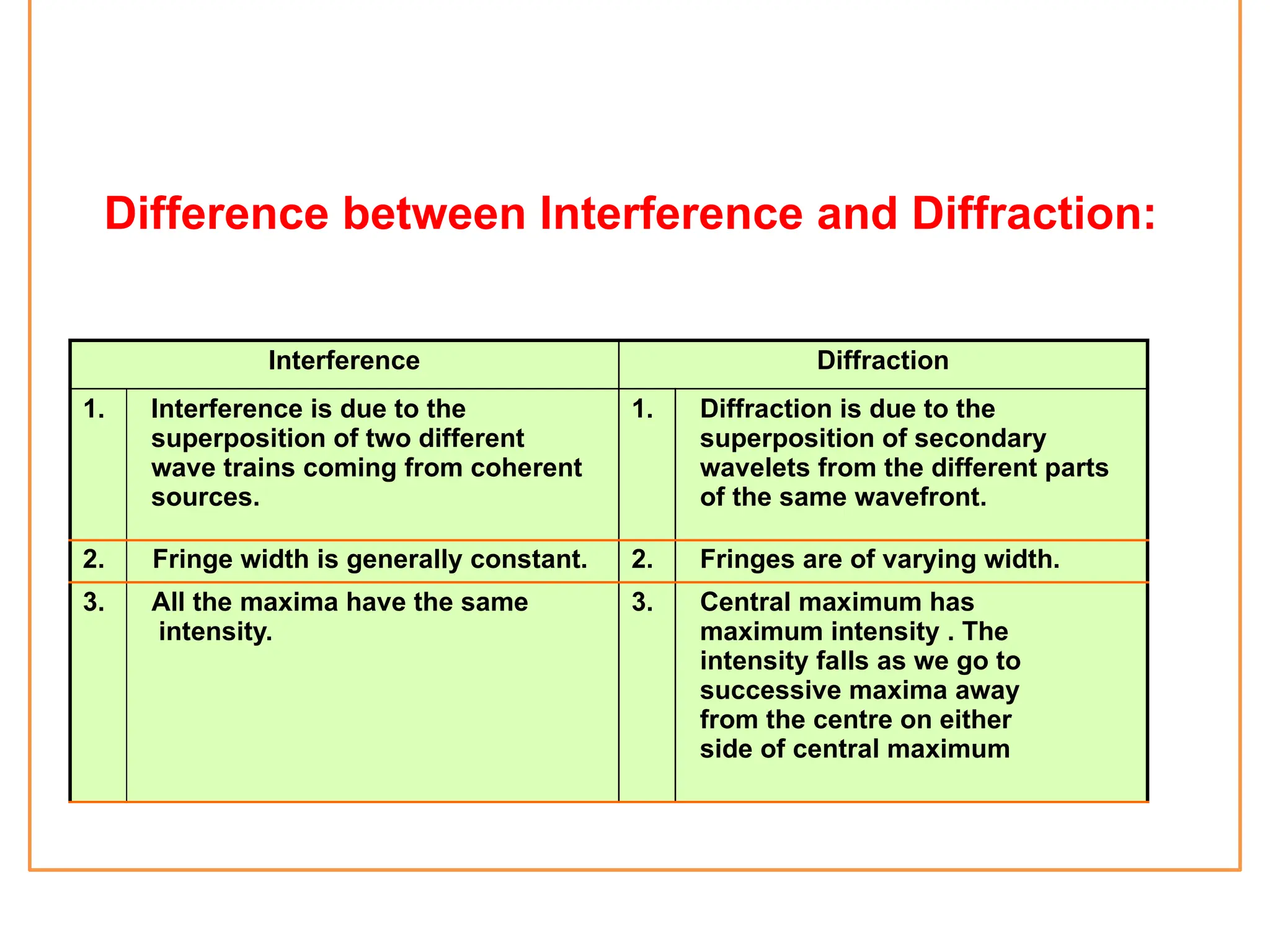
Difference between Interference and Diffraction:
Interference Diffraction
1. Interference is due to the
superposition of two different
wave trains coming from coherent
sources.
1. Diffraction is due to the
superposition of secondary
wavelets from the different parts
of the same wavefront.
2. Fringe width is generally constant. 2. Fringes are of varying width.
3. All the maxima have the same
intensity.
3. Central maximum has
maximum intensity . The
intensity falls as we go to
successive maxima away
from the centre on either
side of central maximum
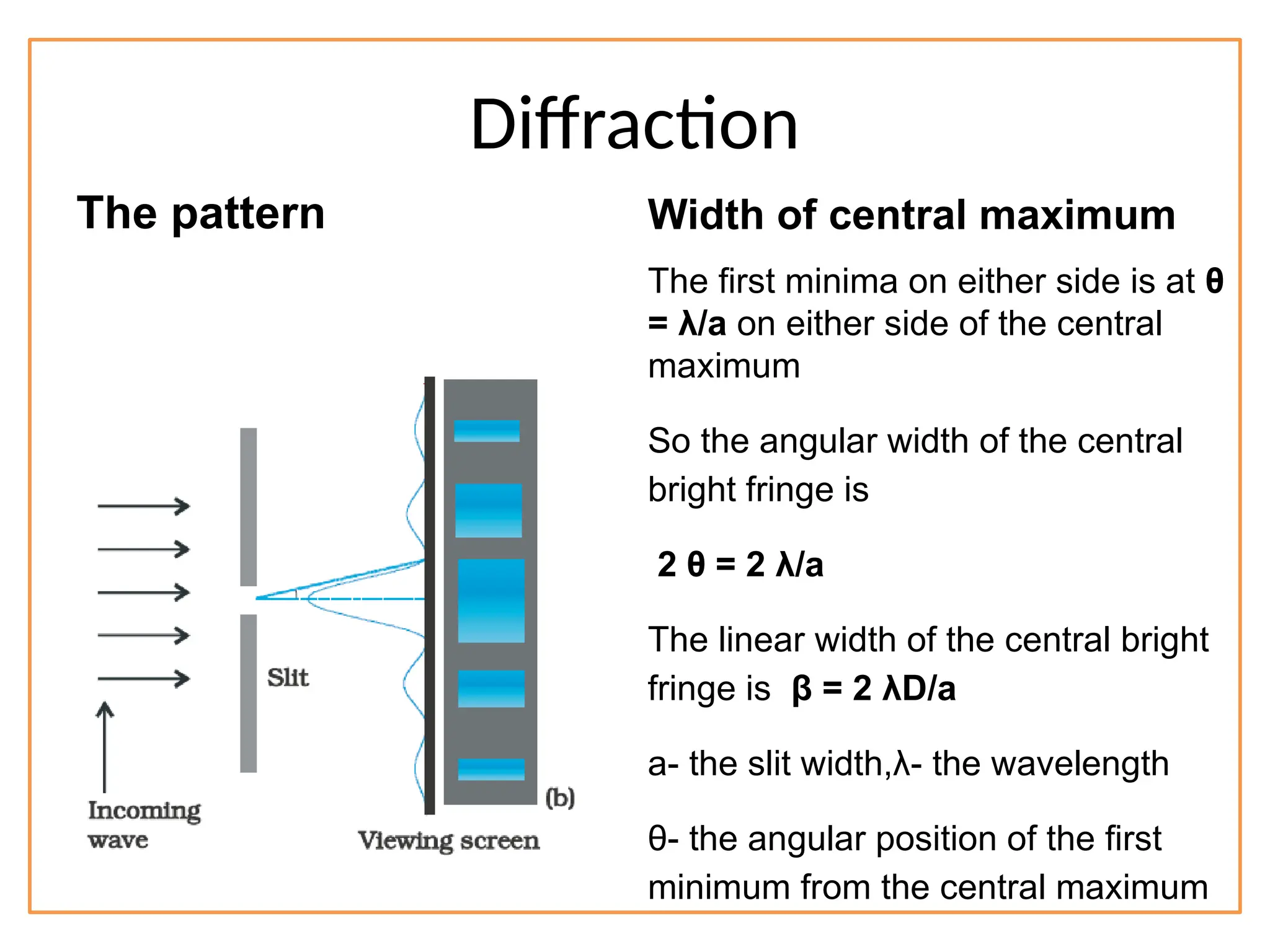
Diffraction
The pattern Width of central maximum
The first minima on either side is at θ
= λ/a on either side of the central
maximum
So the angular width of the central
bright fringe is
2 θ = 2 λ/a
The linear width of the central bright
fringe is β = 2 λD/a
a- the slit width,λ- the wavelength
θ- the angular position of the first
minimum from the central maximum
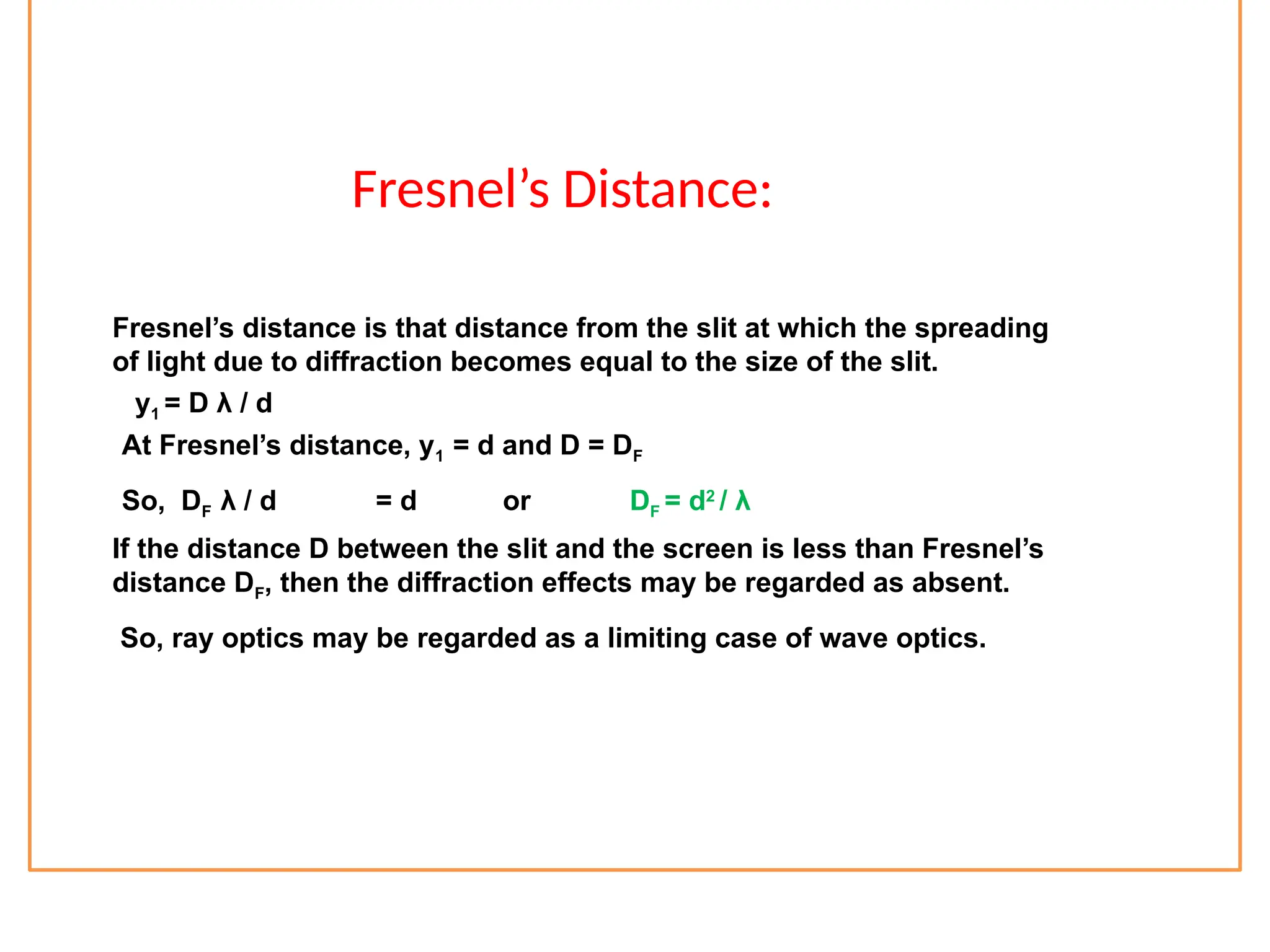
Fresnel’s Distance:
Fresnel’s distance is that distance from the slit at which the spreading
of light due to diffraction becomes equal to the size of the slit.
y1 = D λ / d
At Fresnel’s distance, y1 = d and D = DF
So, DF λ / d = d or DF = d2
/ λ
If the distance D between the slit and the screen is less than Fresnel’s
distance DF, then the diffraction effects may be regarded as absent.
So, ray optics may be regarded as a limiting case of wave optics.
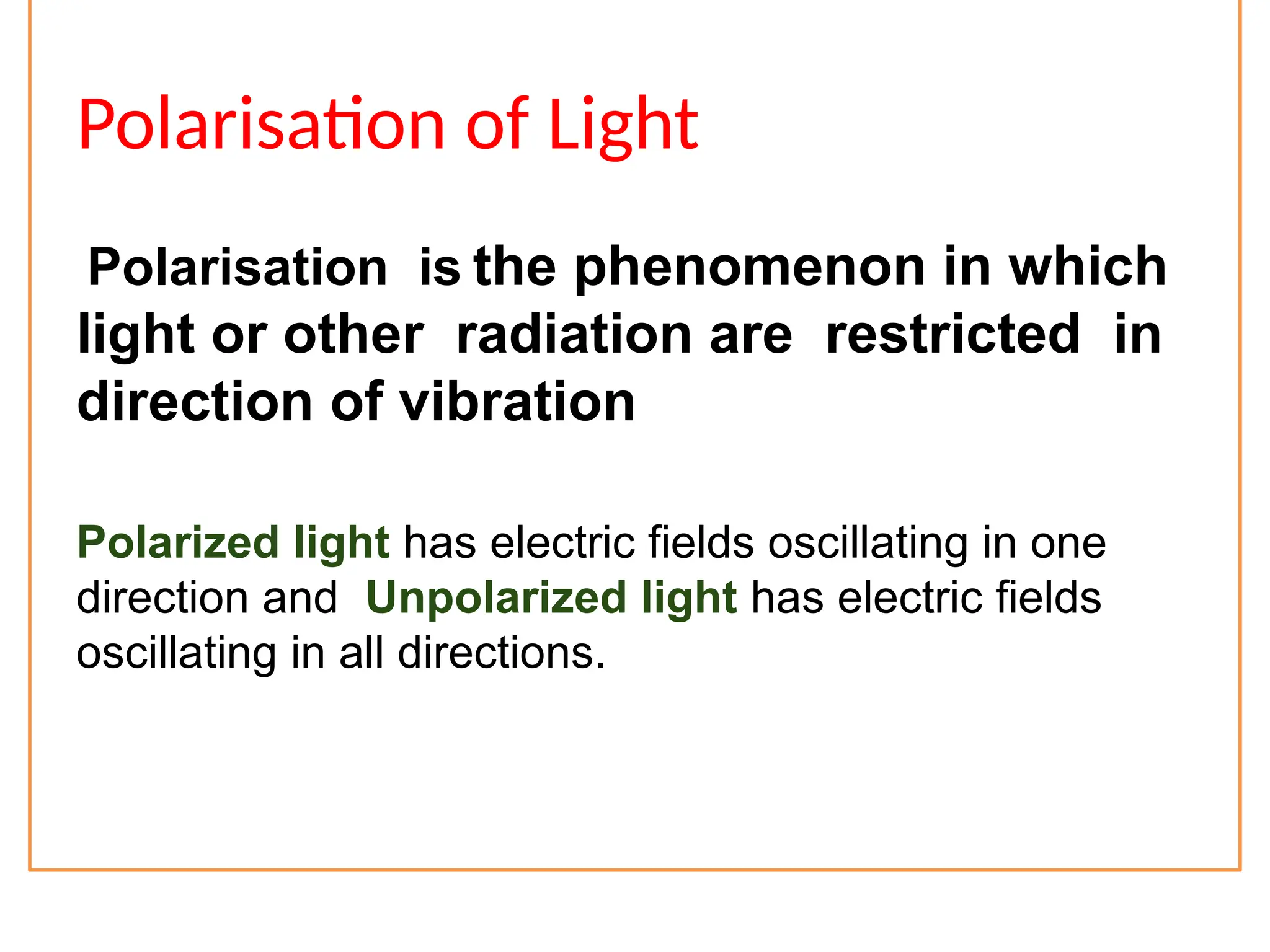
Polarisation of Light
Polarisation is the phenomenon in which
light or other radiation are restricted in
direction of vibration
Polarized light has electric fields oscillating in one
direction and Unpolarized light has electric fields
oscillating in all directions.
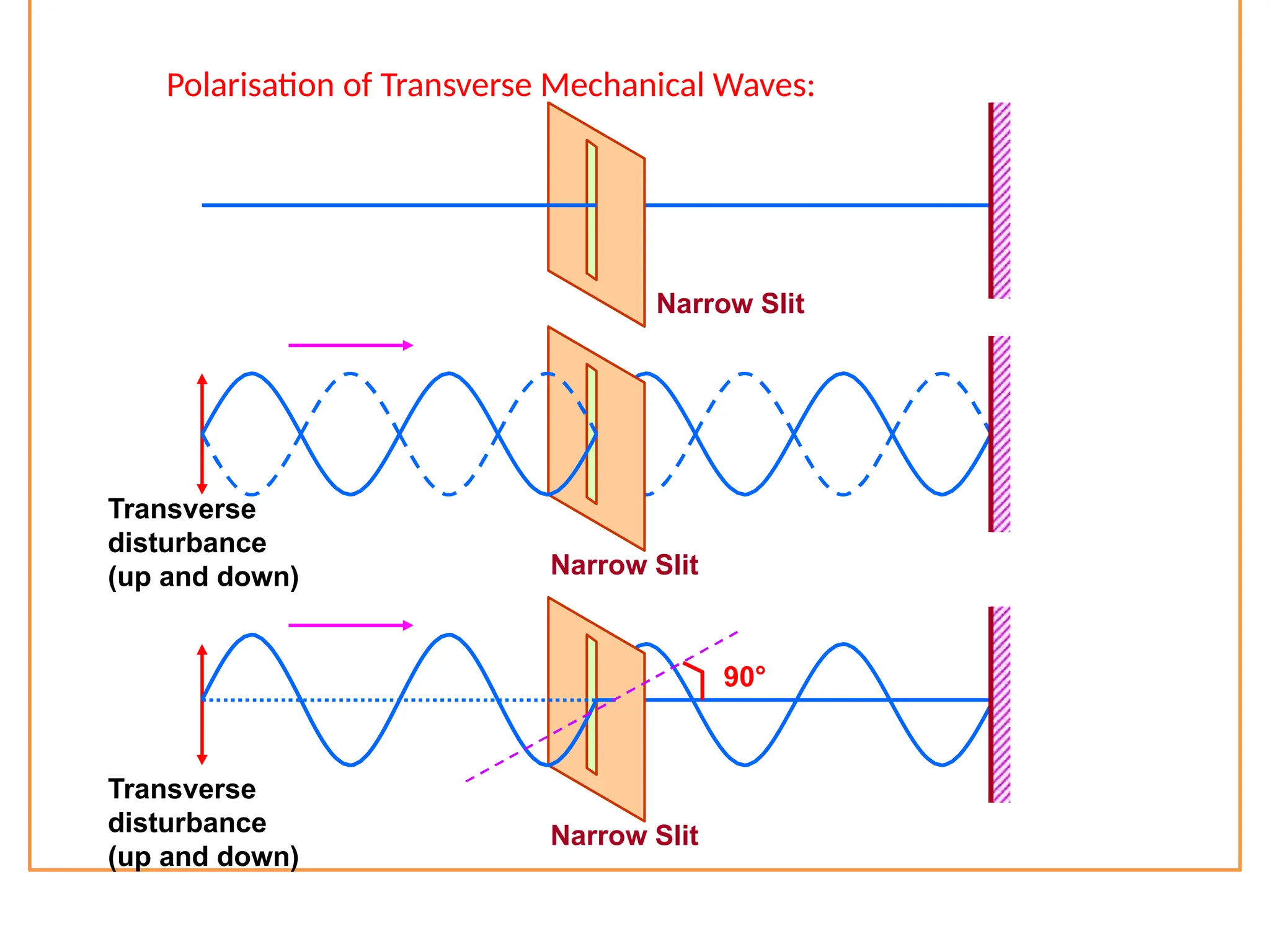
Polarisation of Transverse Mechanical Waves:
Transverse
disturbance
(up and down) Narrow Slit
Transverse
disturbance
(up and down)
Narrow Slit
Narrow Slit
90°
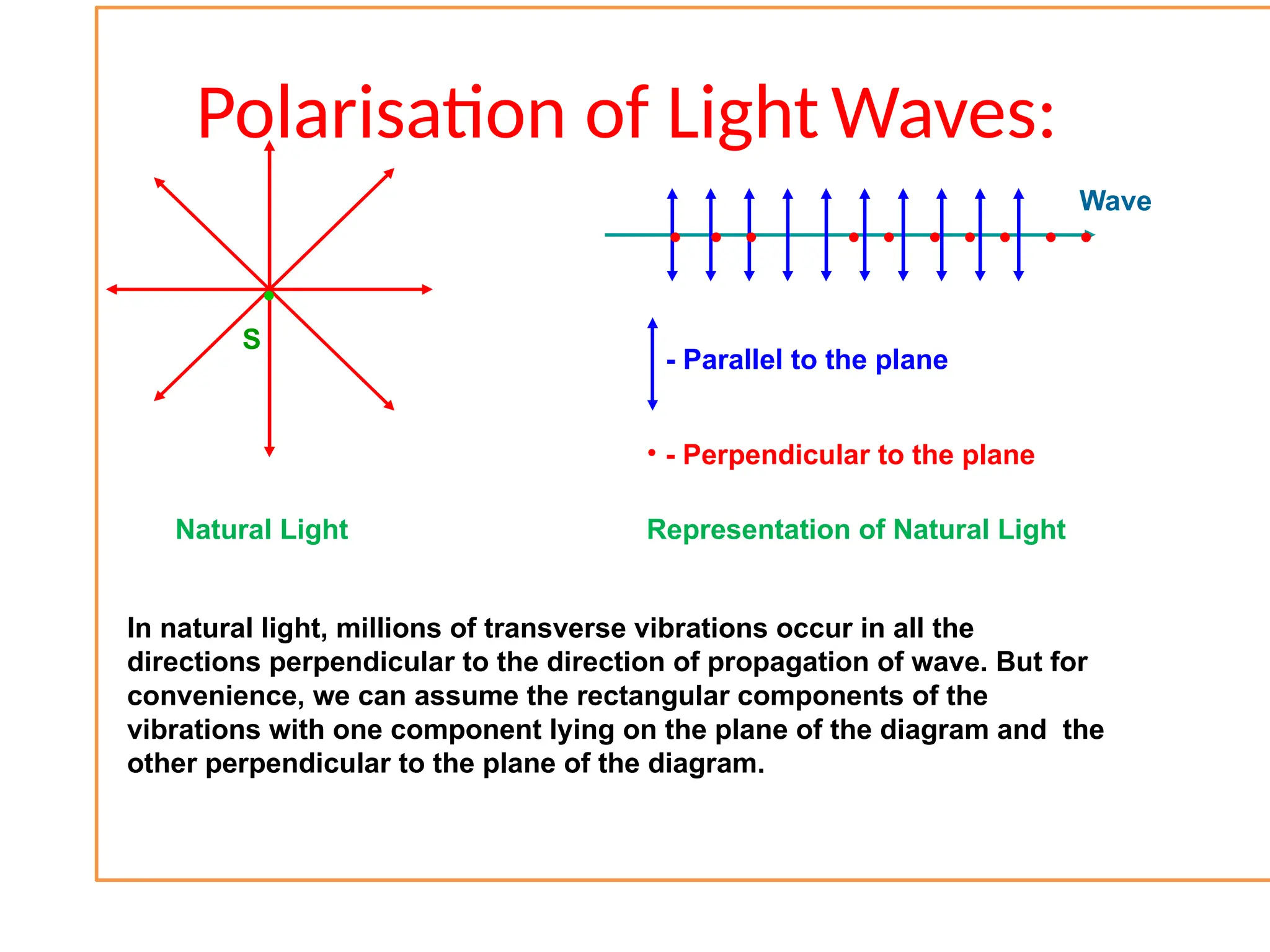
Polarisation of LightWaves:
•
S
Natural Light Representation of Natural Light
In natural light, millions of transverse vibrations occur in all the
directions perpendicular to the direction of propagation of wave. But for
convenience, we can assume the rectangular components of the
vibrations with one component lying on the plane of the diagram and the
other perpendicular to the plane of the diagram.
• • • • • • • • • •
Wave
- Parallel to the plane
• - Perpendicular to the plane
•
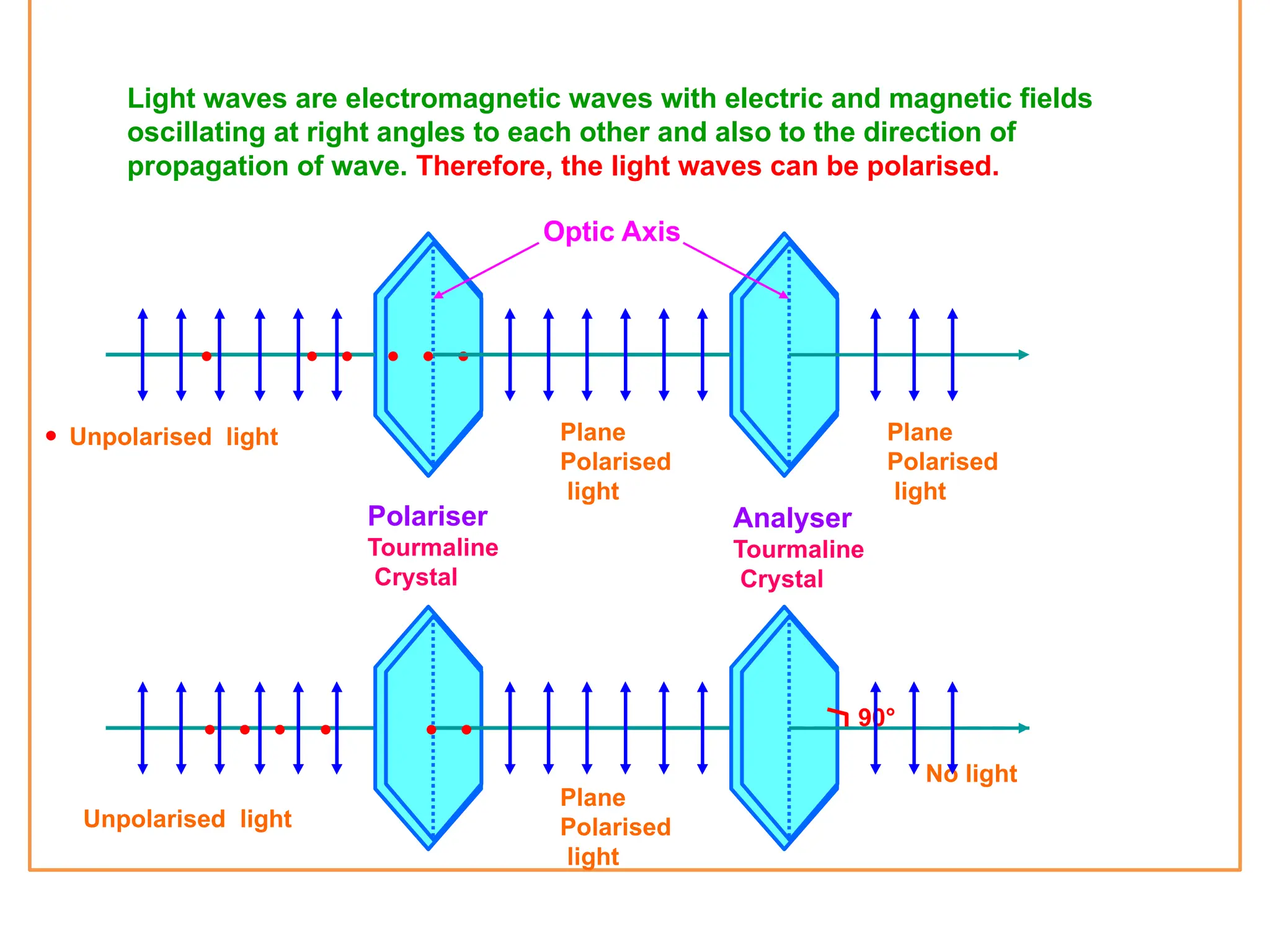
Polariser
Tourmaline
Crystal
Analyser
Tourmaline
Crystal
• • • • • •
Unpolarised light Plane
Polarised
light
Plane
Polarised
light
Light waves are electromagnetic waves with electric and magnetic fields
oscillating at right angles to each other and also to the direction of
propagation of wave. Therefore, the light waves can be polarised.
Optic Axis
90°
• • • • • •
Unpolarised light
Plane
Polarised
light
No light
• • • • • •
Unpolarised
light
Polariser
Plane
Polarised
light
Analyser
90°
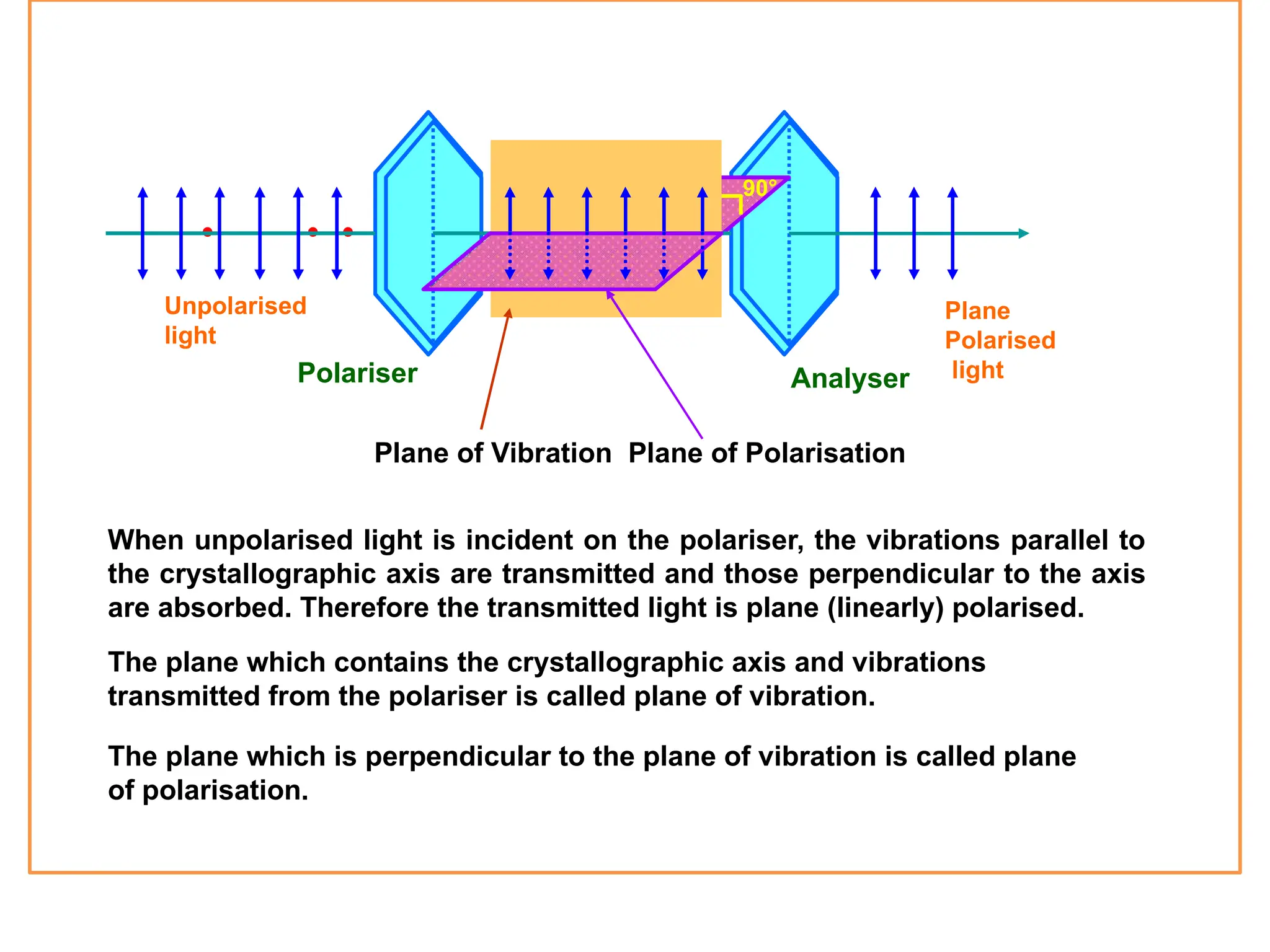
Plane of Vibration Plane of Polarisation
When unpolarised light is incident on the polariser, the vibrations parallel to
the crystallographic axis are transmitted and those perpendicular to the axis
are absorbed. Therefore the transmitted light is plane (linearly) polarised.
The plane which contains the crystallographic axis and vibrations
transmitted from the polariser is called plane of vibration.
The plane which is perpendicular to the plane of vibration is called plane
of polarisation.
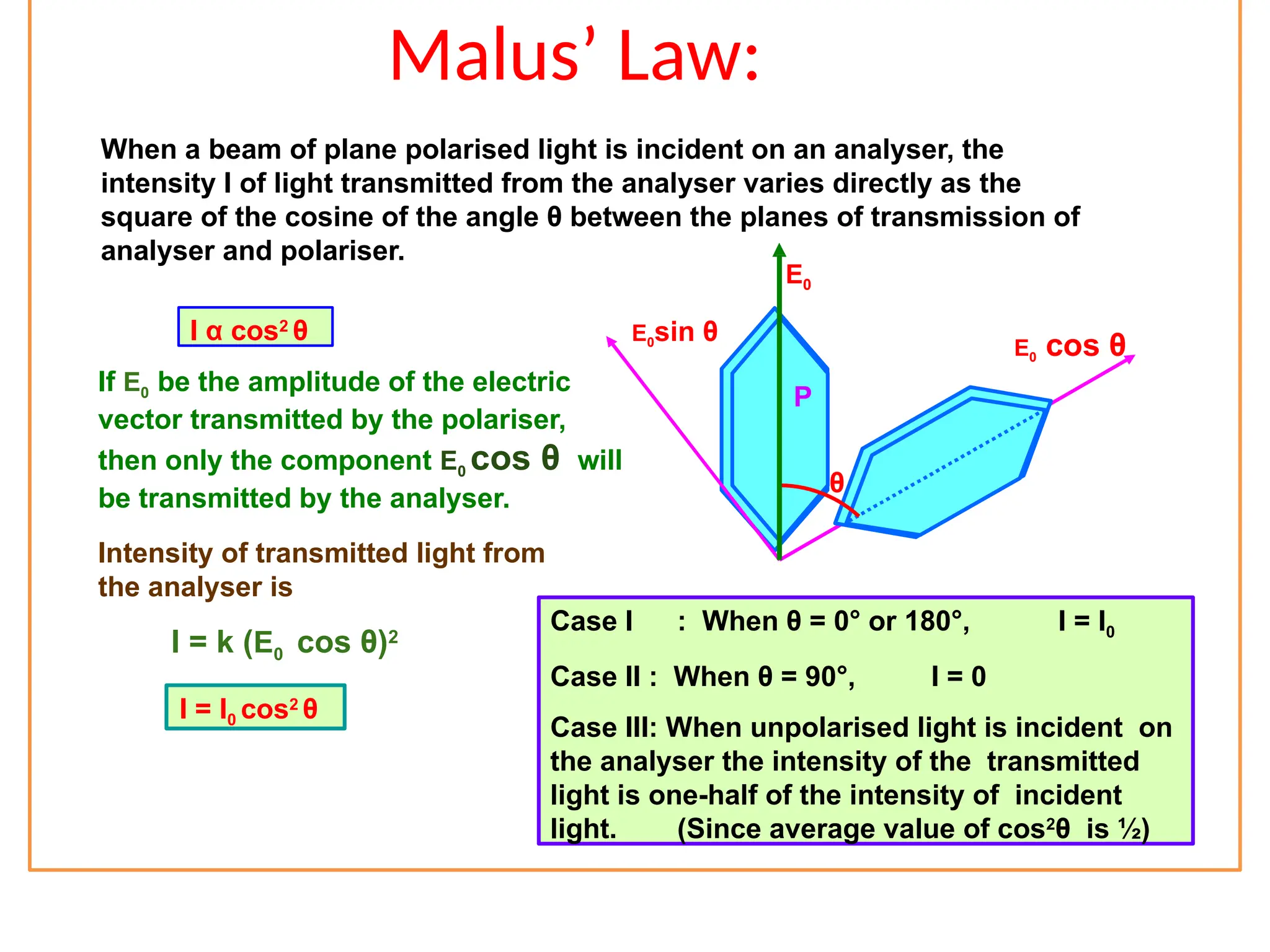
Malus’ Law:
When a beam of plane polarised light is incident on an analyser, the
intensity I of light transmitted from the analyser varies directly as the
square of the cosine of the angle θ between the planes of transmission of
analyser and polariser.
I α cos2
θ
A
If E0 be the amplitude of the electric
vector transmitted by the polariser,
then only the component E0 cos θ will
be transmitted by the analyser.
Intensity of transmitted light from
the analyser is
I = k (E0 cos θ)2
I = I0 cos2
θ
Case I : When θ = 0° or 180°, I = I0
Case II : When θ = 90°, I = 0
Case III: When unpolarised light is incident on
the analyser the intensity of the transmitted
light is one-half of the intensity of incident
light. (Since average value of cos2
θ is ½)
E0 cos θ
P
θ
E0sin θ
E0
Polarisation by Reflection and Brewster’s Law:
r
μ
90°
a
b
θB
r b
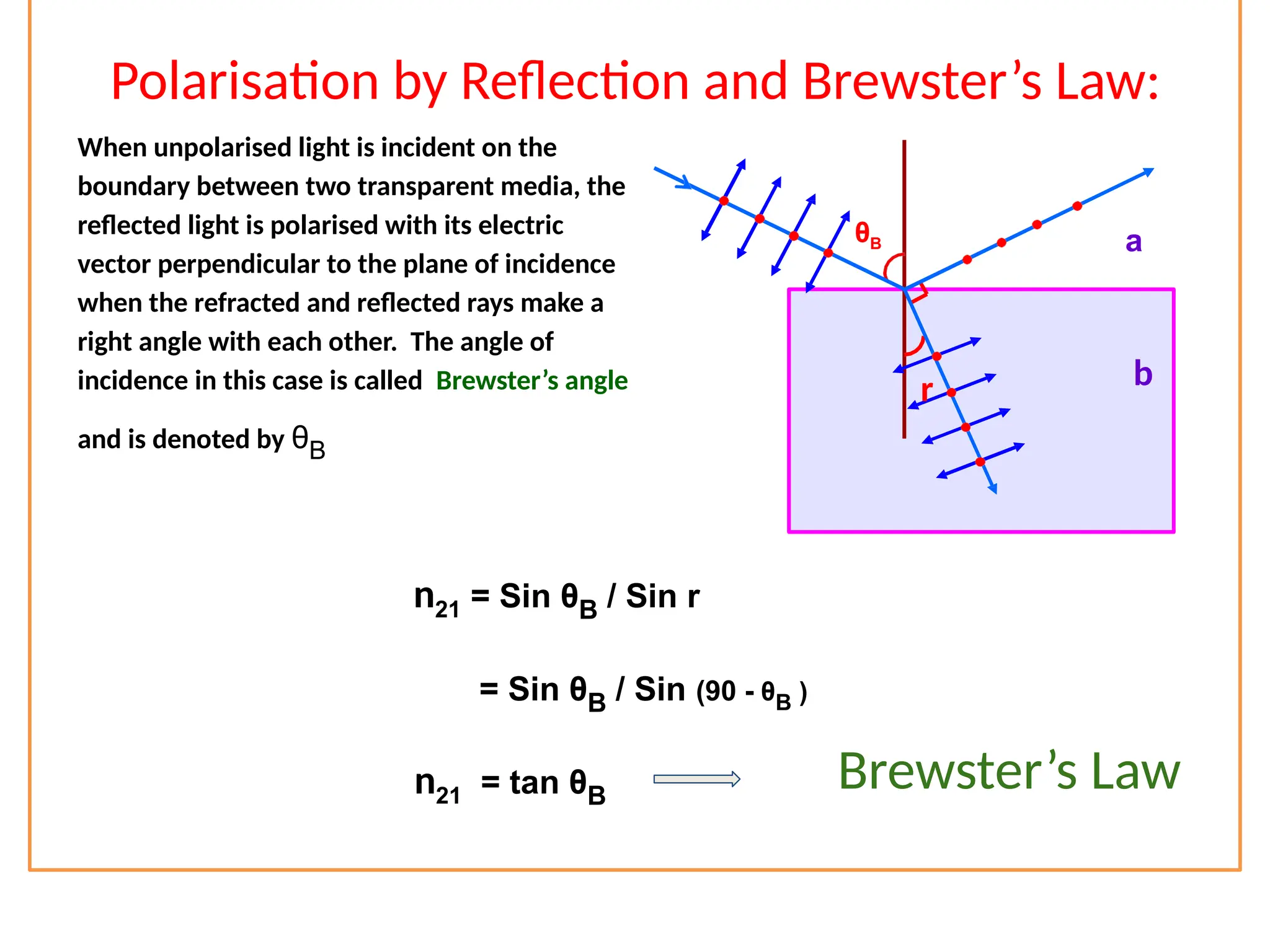
n21 = Sin θB / Sin r
= Sin θB / Sin (90 - θB )
n21 = tan θB
When unpolarised light is incident on the
boundary between two transparent media, the
reflected light is polarised with its electric
vector perpendicular to the plane of incidence
when the refracted and reflected rays make a
right angle with each other. The angle of
incidence in this case is called Brewster’s angle
and is denoted by θB
Brewster’s Law
Polaroids:
H – Polaroid is prepared by taking a sheet of polyvinyl alcohol (long chain
polymer molecules) and subjecting to a large strain. The molecules are
oriented parallel to the strain and the material becomes doubly refracting.
When strained with iodine, the material behaves like a dichroic crystal.
K – Polaroid is prepared by heating a stretched polyvinyl alcohol film in the
presence of HCl (an active dehydrating catalyst). When the film
becomes slightly darkened, it behaves like a strong dichroic crystal.
Uses of Polaroids:
1) Polaroid Sun Glasses
2) Polaroid Filters
3) For Laboratory Purpose
4) In Head-light of Automobiles
5) In Three – Dimensional Motion Pictures
6) In Window Panes
7) In Wind Shield in Automobiles

Wave Optics class XII SCIENCE PROJECT FILE

  • 1.
    Wave Optics Prepared by SandhyaVelayudhan PGT Physics, JNV Kozhikode
  • 2.
    HUYGEN’S PRINCIPLE • Everypoint on a wave-front may be considered a source of secondary spherical wavelets which spread out in the forward direction at the speed of light. The new wave-front is the tangential surface to all of these secondary wavelets.
  • 3.
    Wavelet and wavefront: Awavelet is the point of disturbance due to propagation of light. A wavefront is the locus of all points in space having the same phase of vibration. A line perpendicular to a wavefront is called a ‘ray’. Spherical Wavefront from a point source Cylindrical Wavefront from a linear source Plane Wavefront Pink Dots – Wavelets Blue Envelope– Wavefront Red Line – Ray •
  • 4.
    Refraction of aplane wave • At a denser medium PP’ - the surface separating medium 1 and medium 2 v1- the speed of light in medium 1 v2 – speed of light in medium 2, AB - incident plane wavefront EC – refracted wavefront τ− the time taken to travel BC BC = v1τ AE = v2τ Sini/ Sinr = v1/v2 Sini/ Sinr = n2/n1 Snell’s law n1 – refractive index of medium 1 n2- refractive index of medium 2
  • 5.
    • At ararer medium Refraction of a plane wave Sini/ Sinr = v1/v2 Sini/ Sinr = n2/n1 Snell’s law
  • 6.
    Reflection of aplane wave MN – reflecting surface AB – plane incident wavfront EC- reflected wavfront i- angle of incidence r- angle of reflection v- the speed of light τ – time taken AE = BC = vτ Since the triangles EAC and BAC are congruent, i = r , the law of reflection
  • 7.
    Refraction of aplane wave by (a) a thin prism, (b) a convex lens. (c) Reflection of a plane wave by a concave mirror. (a) (b) (c)
  • 8.
    Interference The phenomenon ofone wave interfering with another and the resulting redistribution of energy in the space around the two sources of disturbance is called interference of waves.
  • 9.
    Coherent Sources The sourcesemitting light waves of same frequency or wavelength having either a zero or constant phase difference are said to be coherent
  • 10.
    Interference of Waves: DestructiveInterference E = E1 - E2 Crest Trough Bright Band Dark Band 1st Wave (E1) 2nd Wave (E2) Resultant Wave Reference Line E2 E2 The phenomenon of one wave interfering with another and the resulting redistribution of energy in the space around the two sources of disturbance is called interference of waves. E1 + E2 E1 Constructive Interference E = E1 + E2 E1 E1 - E2 Bright Band Dark Band Dark Band Bright Band Bright Band S2 S1
  • 11.
    Condition for Constructiveand destructive Interference For two coherent sources vibrating in phase, constructive interference occurs when Path difference = n λ (n = 0, 1, 2, 3,...) For two coherent sources vibrating in phase, destructive interference occurs when Path difference =( n +1/2 ) λ (n = 0, 1, 2, 3,...) λ − wavelength
  • 12.
    Intensity in interference Considertwo coherent light waves with intensity I0 each and phase difference φ between them. The resultant intensity at the point of interference will be I = 4I0 Cos2 (φ/2) Condition for constructive interference : φ = 0, ±2π,±4π……. Condition for destructive interference : φ = ±π,±3π,……. For incoherent waves the average intensity will be < I > = 4I0 < Cos2 (φ/2) > = 2I0
  • 13.
  • 14.
    Path difference The wavesfrom S1 and S2 reach the point P with Path difference ∆ = S2P – S1P S2P2 – S1P2 = [D2 + {x + (d/2)}2 ] - [D2 + {x - (d/2)}2 ] (S2P – S1P) (S2P + S1P) = 2 x d ∆ = x d / D
  • 15.
    Positions of BrightFringes: For a bright fringe at P, ∆ = xd / D = nλ where n = 0, 1, 2, 3, … For n = 0, For n = 1, For n = 2, For n = n, x = n D λ / d x0 = 0 x1 = D λ / d x2 = 2 D λ / d …… xn = n D λ / d x0’ = D λ / 2d x1’ = 3D λ / 2d x2’ = 5D λ / 2d ….. For n = 0, For n = 1, For n = 2, For n = n, xn’ = (2n+1)D λ / 2d Positions of Dark Fringes: For a dark fringe at P, ∆ = xd / D = (2n+1)λ/2 where n = 0, 1, 2, 3, … x = (2n+1) D λ / 2d Expression for Dark Fringe Width: βD = xn – xn-1 = n D λ / d – (n – 1) D λ / d = D λ / d Expression for Bright Fringe Width: βB = xn’ – xn-1’ = (2n+1) D λ / 2d – {2(n-1)+1} D λ / 2d = D λ / d The expressions for fringe width show that the fringes are equally spaced on the screen.
  • 16.
    Distribution of Intensity: Intensity 0x x Suppose the two interfering waves have same amplitude say ‘a’, then Imax α (a+a)2 i.e. Imax α 4a2 All the bright fringes have this same intensity. Imin = 0 All the dark fringes have zero intensity. Conditions for sustained interference: 1. The two sources producing interference must be coherent. 2. The two interfering wave trains must have the same plane of polarisation. 3. The two sources must be very close to each other and the pattern must be observed at a larger distance to have sufficient width of the fringe. (D λ / d) 4. The sources must be monochromatic. Otherwise, the fringes of different colours will overlap. 5. The two waves must be having same amplitude for better contrast between bright and dark fringes.
  • 17.
  • 18.
    Some Examples ofInterference One of the best examples of interference is demonstrated by the light reflected from a film of oil floating on water. Another example is the thin film of a soap bubble, which reflects a spectrum of beautiful colors when illuminated by natural or artificial light sources.
  • 19.
    Diffraction The phenomenon ofbending of light around the sharp edges of an obstacle or aperture is called diffraction. Condition for diffraction of light The wavelength of incident light should be comparable to the size of the obstacle or aperture
  • 20.
    The single slitexperiment
  • 21.
    Theory: The path differencebetween the wavelets is NQ. If ‘θ’ is the angle of diffraction and ‘á’ is the slit width, then NQ = a sin θ To establish the condition for secondary minima, the slit is divided into 2, 4, 6, … equal parts such that corresponding wavelets from successive regions interfere with path difference of λ/2. Or for nth secondary minimum, the slit can be divided into 2n equal parts. For θ1, a sin θ1 = λ For θ2, a sin θ2 = 2λ For θn, a sin θn = nλ Since θn is very small, a θn = nλ θn = nλ / a (n = 1, 2, 3, ……) To establish the condition for secondary maxima, the slit is divided into 3, 5, 7, … equal parts such that corresponding wavelets from alternate regions interfere with path difference of λ. Or for nth secondary minimum, the slit can be divided into (2n + 1) equal parts. For θ1’, a sin θ1’ = 3λ/2 For θ2’, a sin θ2’ = 5λ/2 For θn’, a sin θn’ = (2n + 1)λ/2 Since θn’ is very small, a θn’ = (2n + 1)λ / 2 θn’ = (2n + 1)λ / 2a (n = 1, 2, 3, ……)
  • 22.
  • 23.
    Difference between Interferenceand Diffraction: Interference Diffraction 1. Interference is due to the superposition of two different wave trains coming from coherent sources. 1. Diffraction is due to the superposition of secondary wavelets from the different parts of the same wavefront. 2. Fringe width is generally constant. 2. Fringes are of varying width. 3. All the maxima have the same intensity. 3. Central maximum has maximum intensity . The intensity falls as we go to successive maxima away from the centre on either side of central maximum
  • 24.
    Diffraction The pattern Widthof central maximum The first minima on either side is at θ = λ/a on either side of the central maximum So the angular width of the central bright fringe is 2 θ = 2 λ/a The linear width of the central bright fringe is β = 2 λD/a a- the slit width,λ- the wavelength θ- the angular position of the first minimum from the central maximum
  • 25.
    Fresnel’s Distance: Fresnel’s distanceis that distance from the slit at which the spreading of light due to diffraction becomes equal to the size of the slit. y1 = D λ / d At Fresnel’s distance, y1 = d and D = DF So, DF λ / d = d or DF = d2 / λ If the distance D between the slit and the screen is less than Fresnel’s distance DF, then the diffraction effects may be regarded as absent. So, ray optics may be regarded as a limiting case of wave optics.
  • 26.
    Polarisation of Light Polarisationis the phenomenon in which light or other radiation are restricted in direction of vibration Polarized light has electric fields oscillating in one direction and Unpolarized light has electric fields oscillating in all directions.
  • 27.
    Polarisation of TransverseMechanical Waves: Transverse disturbance (up and down) Narrow Slit Transverse disturbance (up and down) Narrow Slit Narrow Slit 90°
  • 28.
    Polarisation of LightWaves: • S NaturalLight Representation of Natural Light In natural light, millions of transverse vibrations occur in all the directions perpendicular to the direction of propagation of wave. But for convenience, we can assume the rectangular components of the vibrations with one component lying on the plane of the diagram and the other perpendicular to the plane of the diagram. • • • • • • • • • • Wave - Parallel to the plane • - Perpendicular to the plane
  • 29.
    • Polariser Tourmaline Crystal Analyser Tourmaline Crystal • • •• • • Unpolarised light Plane Polarised light Plane Polarised light Light waves are electromagnetic waves with electric and magnetic fields oscillating at right angles to each other and also to the direction of propagation of wave. Therefore, the light waves can be polarised. Optic Axis 90° • • • • • • Unpolarised light Plane Polarised light No light
  • 30.
    • • •• • • Unpolarised light Polariser Plane Polarised light Analyser 90° Plane of Vibration Plane of Polarisation When unpolarised light is incident on the polariser, the vibrations parallel to the crystallographic axis are transmitted and those perpendicular to the axis are absorbed. Therefore the transmitted light is plane (linearly) polarised. The plane which contains the crystallographic axis and vibrations transmitted from the polariser is called plane of vibration. The plane which is perpendicular to the plane of vibration is called plane of polarisation.
  • 31.
    Malus’ Law: When abeam of plane polarised light is incident on an analyser, the intensity I of light transmitted from the analyser varies directly as the square of the cosine of the angle θ between the planes of transmission of analyser and polariser. I α cos2 θ A If E0 be the amplitude of the electric vector transmitted by the polariser, then only the component E0 cos θ will be transmitted by the analyser. Intensity of transmitted light from the analyser is I = k (E0 cos θ)2 I = I0 cos2 θ Case I : When θ = 0° or 180°, I = I0 Case II : When θ = 90°, I = 0 Case III: When unpolarised light is incident on the analyser the intensity of the transmitted light is one-half of the intensity of incident light. (Since average value of cos2 θ is ½) E0 cos θ P θ E0sin θ E0
  • 32.
    Polarisation by Reflectionand Brewster’s Law: r μ 90° a b θB r b n21 = Sin θB / Sin r = Sin θB / Sin (90 - θB ) n21 = tan θB When unpolarised light is incident on the boundary between two transparent media, the reflected light is polarised with its electric vector perpendicular to the plane of incidence when the refracted and reflected rays make a right angle with each other. The angle of incidence in this case is called Brewster’s angle and is denoted by θB Brewster’s Law
  • 33.
    Polaroids: H – Polaroidis prepared by taking a sheet of polyvinyl alcohol (long chain polymer molecules) and subjecting to a large strain. The molecules are oriented parallel to the strain and the material becomes doubly refracting. When strained with iodine, the material behaves like a dichroic crystal. K – Polaroid is prepared by heating a stretched polyvinyl alcohol film in the presence of HCl (an active dehydrating catalyst). When the film becomes slightly darkened, it behaves like a strong dichroic crystal. Uses of Polaroids: 1) Polaroid Sun Glasses 2) Polaroid Filters 3) For Laboratory Purpose 4) In Head-light of Automobiles 5) In Three – Dimensional Motion Pictures 6) In Window Panes 7) In Wind Shield in Automobiles