Waves and Optics Nisha Issac (: &  Ethan Munguia
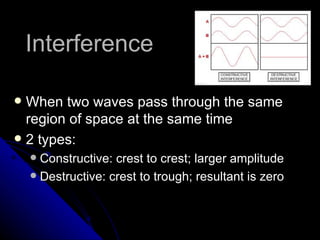
Interference When two waves pass through the same region of space at the same time 2 types:  Constructive: crest to crest; larger amplitude Destructive: crest to trough; resultant is zero
Diffraction Refers to the ability of waves to bend around obstacles  Amount of diffraction depends on the wavelength of the waves and the size of the obstacle.
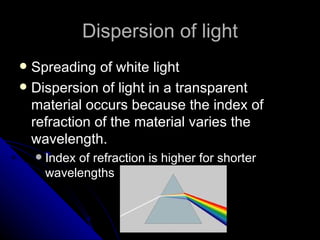
Dispersion of light Spreading of white light Dispersion of light in a transparent material occurs because the index of refraction of the material varies the wavelength. Index of refraction is higher for shorter wavelengths
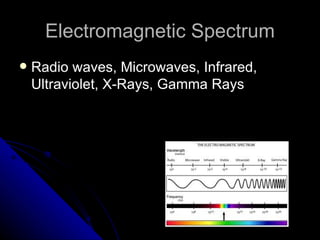
Electromagnetic Spectrum Radio waves, Microwaves, Infrared, Ultraviolet, X-Rays, Gamma Rays
Reflection “ Bouncing” off of a wave of a surface; exact angle Angle of incidence Angle of reflection
Refraction Change in direction of a wave when it passes into a new substance Reason it changes direction or bends is because each different substance has its own effect on speed of light. Index of refraction
Mirrors Reflective surfaces Convex and Concave  Has a focal point, where all the light directed at that mirror converges or diverges and the distance between the mirror and that point is the focal length.
Lenses Has a focal point  Radius of curvature of a lens is exactly twice the focal length.
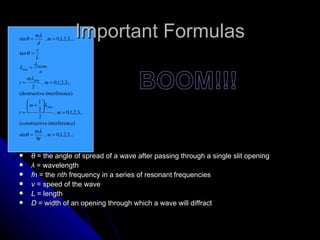
Important Formulas θ  = the angle of spread of a wave after passing through a single slit opening λ  = wavelength fn  = the  nth  frequency in a series of resonant frequencies v  = speed of the wave L  = length  D  = width of an opening through which a wave will diffract

Waves and Optics

  • 1.
    Waves and OpticsNisha Issac (: & Ethan Munguia
  • 2.
    Interference When twowaves pass through the same region of space at the same time 2 types: Constructive: crest to crest; larger amplitude Destructive: crest to trough; resultant is zero
  • 3.
    Diffraction Refers tothe ability of waves to bend around obstacles Amount of diffraction depends on the wavelength of the waves and the size of the obstacle.
  • 4.
    Dispersion of lightSpreading of white light Dispersion of light in a transparent material occurs because the index of refraction of the material varies the wavelength. Index of refraction is higher for shorter wavelengths
  • 5.
    Electromagnetic Spectrum Radiowaves, Microwaves, Infrared, Ultraviolet, X-Rays, Gamma Rays
  • 6.
    Reflection “ Bouncing”off of a wave of a surface; exact angle Angle of incidence Angle of reflection
  • 7.
    Refraction Change indirection of a wave when it passes into a new substance Reason it changes direction or bends is because each different substance has its own effect on speed of light. Index of refraction
  • 8.
    Mirrors Reflective surfacesConvex and Concave Has a focal point, where all the light directed at that mirror converges or diverges and the distance between the mirror and that point is the focal length.
  • 9.
    Lenses Has afocal point Radius of curvature of a lens is exactly twice the focal length.
  • 10.
    Important Formulas θ = the angle of spread of a wave after passing through a single slit opening λ = wavelength fn = the nth frequency in a series of resonant frequencies v = speed of the wave L = length D = width of an opening through which a wave will diffract