Globalisation and the
Increase in Migration
starter
• What do you think I mean by the following
terms:
• Migration
• Identity
• Sovereignty
• How do you think the concepts of
migration impacts on a countries identity?
Learning Objectives
• Definition of migration
• Understand the types of migrants
• Assess the reasons for migration
• 2 Case studies highlighting views on
migration
• IMF defines Globalisation as
“The growing economic interdependence of
countries worldwide…”
• This can also apply to people and not just
goods and services
• It is globalisation that has created
opportunities for people to migrate as well
as incentives and pressures that help to
explain the movement of people
• A migrant is defines as “Someone who
moves their permanent residence from
one country to another for at least a year”.
Types of migrant
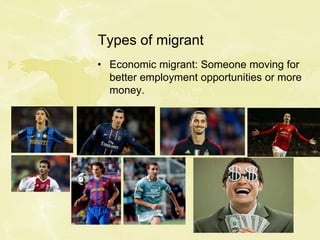
• Economic migrant: Someone moving for
better employment opportunities or more
money.
Refugee
• People who leave their home because
they have suffered or fear they will suffer
persecution due to their:
• Race
• Religion
• Nationality
• Political Opinions
• They seek asylum in other countries and
can be granted Asylum seeker status
Irregular migrant
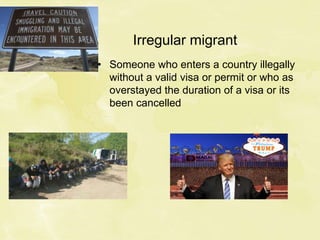
• Someone who enters a country illegally
without a valid visa or permit or who as
overstayed the duration of a visa or its
been cancelled
Changes
• Globalisation has changed the economic
system creating push and pull factors
required to drive migration
• The two trends:
– Rural to urban migration within emerging
economies and developing countries
– International migration between interconnected
countries.
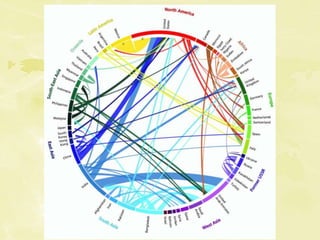
Biggest movements
• Have generally always occurred within
emerging economies such as rural to
urban migration in China
• Largest reginal movement = SE Asia to
the Middle East (Oil and construction)
• Between countries = Mexico to USA
• Circulation of people = Sub-Saharan
countries
• Biggest issues = the press telling us it is
only an EU issue.
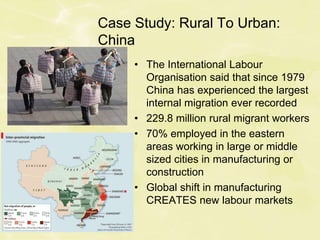
Case Study: Rural To Urban:
China
• The International Labour
Organisation said that since 1979
China has experienced the largest
internal migration ever recorded
• 229.8 million rural migrant workers
• 70% employed in the eastern
areas working in large or middle
sized cities in manufacturing or
construction
• Global shift in manufacturing
CREATES new labour markets
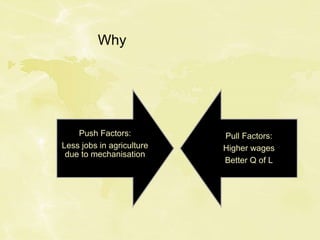
Why
Push Factors:
Less jobs in agriculture
due to mechanisation
Pull Factors:
Higher wages
Better Q of L
Issues
• All Chinese births are registered by the Hukou system
• Rural citizens do not have an urban Hukou and
therefore can’t easily relocate to cities
• Creating a floating pop’n
• Often denied access to:
– Health care
– Housing
– Education
• Despite this the pull factors often are too great
estimated by 2025 a further 250 million will leave their
rural homes taking china’s urban pop’n to over 1 billion
Same issues in different countries
• The same problems with rural to urban
migration exist across the globe as the
wage differential grows.
• The DRC (Democratic Republic of Congo)
suffer the same issues due to massive
rural poverty, conflict and lack of food
• The DRC rural to urban migration is
overwhelming driven by push factors
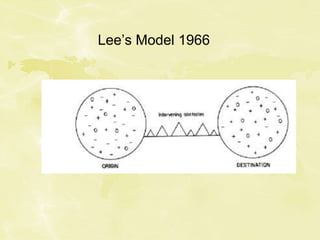
Lee’s Model 1966
• Does not isolate push/pull factors
• Looks at attributes for each place
• Decisions based on personal factors
reliant on
1. Age
2. Gender
3. Marital Status
4. Education
5. Socio-economic class
• Some are positive factors some are
seen as negative others as neutral all
this influences personal decision making
process
For instance
• Where would you want to live in the world?
• What would cause you to leave?
• Why wouldn’t you leave?
• Many of these factors depend on the individual
and can rely on a vast array of factors but
each person makes internalised choices
• One person’s push factor could be another's
pull factor.
• E.g.
• Hate Manchester v Love Manchester
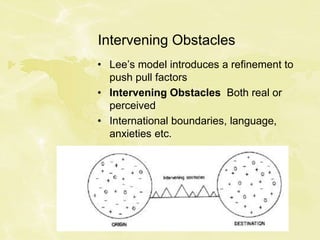
Intervening Obstacles
• Lee’s model introduces a refinement to
push pull factors
• Intervening Obstacles Both real or
perceived
• International boundaries, language,
anxieties etc.
International Migration
• Around 3-4% of global pop’n live outside their country of
birth
• This varies greatly between countries due to:
– Migration policies
– Levels of engagement in global economy
– Internal economic growth
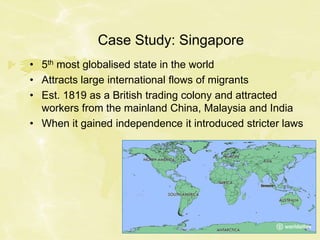
Case Study: Singapore
• 5th most globalised state in the world
• Attracts large international flows of migrants
• Est. 1819 as a British trading colony and attracted
workers from the mainland China, Malaysia and India
• When it gained independence it introduced stricter laws
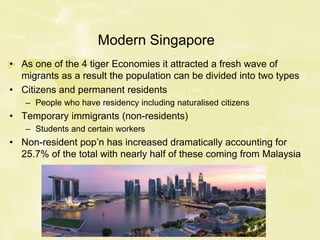
Modern Singapore
• As one of the 4 tiger Economies it attracted a fresh wave of
migrants as a result the population can be divided into two types
• Citizens and permanent residents
– People who have residency including naturalised citizens
• Temporary immigrants (non-residents)
– Students and certain workers
• Non-resident pop’n has increased dramatically accounting for
25.7% of the total with nearly half of these coming from Malaysia
Issues
• Most of non-residents are low-skilled working in construction, services
or manufacturing
• Some in bars and tourist spots
• Termination of employment means termination of visa and non-
residents must leave within 7 days
• They are screened for HIV/AIDS
• Can’t marry residents
• Females found to be pregnant are forced home without exception
• Skilled labour from the west have less restrictive visas and can apply
for residency after 2yrs.
• Singaporeans often seek work aboard and nearly 200,00 live
overseas
• Many are highly skilled and students sponsored by the Govt are
forced to return after completion.
Questions
• Explain why migration rates differ between
countries (6)
• Explain why migration policies can be
seen as counter-productive (6)

Lesson 1 globalisation and the increase in migration

  • 1.
  • 2.
    starter • What doyou think I mean by the following terms: • Migration • Identity • Sovereignty • How do you think the concepts of migration impacts on a countries identity?
  • 3.
    Learning Objectives • Definitionof migration • Understand the types of migrants • Assess the reasons for migration • 2 Case studies highlighting views on migration
  • 4.
    • IMF definesGlobalisation as “The growing economic interdependence of countries worldwide…” • This can also apply to people and not just goods and services • It is globalisation that has created opportunities for people to migrate as well as incentives and pressures that help to explain the movement of people • A migrant is defines as “Someone who moves their permanent residence from one country to another for at least a year”.
  • 5.
    Types of migrant •Economic migrant: Someone moving for better employment opportunities or more money.
  • 6.
    Refugee • People wholeave their home because they have suffered or fear they will suffer persecution due to their: • Race • Religion • Nationality • Political Opinions • They seek asylum in other countries and can be granted Asylum seeker status
  • 7.
    Irregular migrant • Someonewho enters a country illegally without a valid visa or permit or who as overstayed the duration of a visa or its been cancelled
  • 8.
    Changes • Globalisation haschanged the economic system creating push and pull factors required to drive migration • The two trends: – Rural to urban migration within emerging economies and developing countries – International migration between interconnected countries.
  • 10.
    Biggest movements • Havegenerally always occurred within emerging economies such as rural to urban migration in China • Largest reginal movement = SE Asia to the Middle East (Oil and construction) • Between countries = Mexico to USA • Circulation of people = Sub-Saharan countries • Biggest issues = the press telling us it is only an EU issue.
  • 11.
    Case Study: RuralTo Urban: China • The International Labour Organisation said that since 1979 China has experienced the largest internal migration ever recorded • 229.8 million rural migrant workers • 70% employed in the eastern areas working in large or middle sized cities in manufacturing or construction • Global shift in manufacturing CREATES new labour markets
  • 12.
    Why Push Factors: Less jobsin agriculture due to mechanisation Pull Factors: Higher wages Better Q of L
  • 13.
    Issues • All Chinesebirths are registered by the Hukou system • Rural citizens do not have an urban Hukou and therefore can’t easily relocate to cities • Creating a floating pop’n • Often denied access to: – Health care – Housing – Education • Despite this the pull factors often are too great estimated by 2025 a further 250 million will leave their rural homes taking china’s urban pop’n to over 1 billion
  • 14.
    Same issues indifferent countries • The same problems with rural to urban migration exist across the globe as the wage differential grows. • The DRC (Democratic Republic of Congo) suffer the same issues due to massive rural poverty, conflict and lack of food • The DRC rural to urban migration is overwhelming driven by push factors
  • 15.
  • 16.
    • Does notisolate push/pull factors • Looks at attributes for each place • Decisions based on personal factors reliant on 1. Age 2. Gender 3. Marital Status 4. Education 5. Socio-economic class • Some are positive factors some are seen as negative others as neutral all this influences personal decision making process
  • 17.
    For instance • Wherewould you want to live in the world? • What would cause you to leave? • Why wouldn’t you leave? • Many of these factors depend on the individual and can rely on a vast array of factors but each person makes internalised choices • One person’s push factor could be another's pull factor. • E.g. • Hate Manchester v Love Manchester
  • 18.
    Intervening Obstacles • Lee’smodel introduces a refinement to push pull factors • Intervening Obstacles Both real or perceived • International boundaries, language, anxieties etc.
  • 19.
    International Migration • Around3-4% of global pop’n live outside their country of birth • This varies greatly between countries due to: – Migration policies – Levels of engagement in global economy – Internal economic growth
  • 20.
    Case Study: Singapore •5th most globalised state in the world • Attracts large international flows of migrants • Est. 1819 as a British trading colony and attracted workers from the mainland China, Malaysia and India • When it gained independence it introduced stricter laws
  • 21.
    Modern Singapore • Asone of the 4 tiger Economies it attracted a fresh wave of migrants as a result the population can be divided into two types • Citizens and permanent residents – People who have residency including naturalised citizens • Temporary immigrants (non-residents) – Students and certain workers • Non-resident pop’n has increased dramatically accounting for 25.7% of the total with nearly half of these coming from Malaysia
  • 22.
    Issues • Most ofnon-residents are low-skilled working in construction, services or manufacturing • Some in bars and tourist spots • Termination of employment means termination of visa and non- residents must leave within 7 days • They are screened for HIV/AIDS • Can’t marry residents • Females found to be pregnant are forced home without exception • Skilled labour from the west have less restrictive visas and can apply for residency after 2yrs. • Singaporeans often seek work aboard and nearly 200,00 live overseas • Many are highly skilled and students sponsored by the Govt are forced to return after completion.
  • 23.
    Questions • Explain whymigration rates differ between countries (6) • Explain why migration policies can be seen as counter-productive (6)