Nationalism Today
Have a go…
• Evaluate the effects that contested borders
can have on some nations. (20)
Starter
• What is meant by the term nationalism
• Why is nationalism and a growing issue of
identity interlinked?
Learning Objectives:
• Define what Nationalism means
• Appreciate that the growing nationalism of
today is built on historical roots
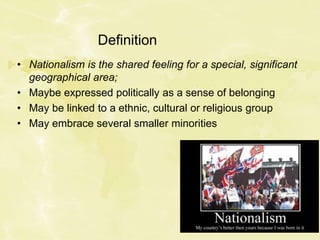
Definition
• Nationalism is the shared feeling for a special, significant
geographical area;
• Maybe expressed politically as a sense of belonging
• May be linked to a ethnic, cultural or religious group
• May embrace several smaller minorities
19th Century Europe
• Saw a rise in nationalism based on the
industrial revolution and the increased
wealth of nations
• Friedrich Hegel (1770-1831) said it was
the cement that bound countries as
religion and old wealth was on the decline.
• Countries like Germany, Italy and
Romania formed by linking regional states
with a common national identity
Empire Building
• During this time some countries sort global
empires and nationalism was a large part
of this including Britain, Spain, France and
Holland.
• It became extreme when Germany in the
early twentieth century expanded into
parts of eastern Europe believing the
Germans needed more living space
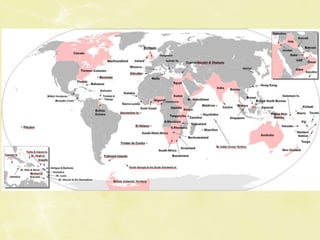
Independence Movement post
1945
• By the end of WW2 European Nationalism
had spread and through the education of
the colonial elites
• Self-determination a by-product of the
liberal nationalistic ideals helped to
threaten imperial powers
• At first there was a resistance to
independence but the man power the war
and the cost became too great to continue
USA and USSR
• The dominance of these two nations post
WW2
• The USA were against colonies as it saw
itself as the leader of the free world
• Plus it felt it impacted trade
• USSR also were against it as it felt it
oppressive
• Plus it could have more influence on them.
Independence Movement
• Came in two types
• Non-Violent protest
– India
• Violent revolutions
– Angola against Portugal (1964-71)
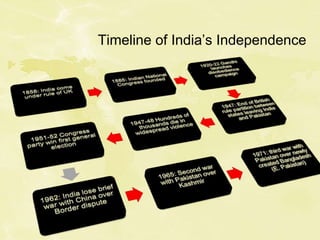
Timeline of India’s Independence
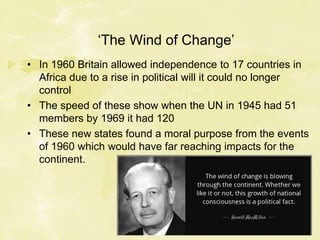
‘The Wind of Change’
• In 1960 Britain allowed independence to 17 countries in
Africa due to a rise in political will it could no longer
control
• The speed of these show when the UN in 1945 had 51
members by 1969 it had 120
• These new states found a moral purpose from the events
of 1960 which would have far reaching impacts for the
continent.
Post-Colonial Conflict
• Has had a massive impact on the region
West Africa alone has seen 7 conflicts due
to post-colonial change:
– Nigeria (1967-70)
– Liberia (1989 & 1999)
– Sierra Leone (1991-2002)
– Guinea Bissau (1998-99)
– Ivory Coast (2002-07 & 2010-11)
Why would nations fight when
they have their independence
• Chose a Nation and find out:
• Ethnicity split
• GDP per capita
• Wealth of resources
• Other issues
– Nigeria
– Liberia
– Sierra Leone
– Guinea Bissau
– Ivory Coast

Lesson 5 nationalism today

  • 1.
  • 2.
    Have a go… •Evaluate the effects that contested borders can have on some nations. (20)
  • 3.
    Starter • What ismeant by the term nationalism • Why is nationalism and a growing issue of identity interlinked?
  • 4.
    Learning Objectives: • Definewhat Nationalism means • Appreciate that the growing nationalism of today is built on historical roots
  • 5.
    Definition • Nationalism isthe shared feeling for a special, significant geographical area; • Maybe expressed politically as a sense of belonging • May be linked to a ethnic, cultural or religious group • May embrace several smaller minorities
  • 6.
    19th Century Europe •Saw a rise in nationalism based on the industrial revolution and the increased wealth of nations • Friedrich Hegel (1770-1831) said it was the cement that bound countries as religion and old wealth was on the decline. • Countries like Germany, Italy and Romania formed by linking regional states with a common national identity
  • 7.
    Empire Building • Duringthis time some countries sort global empires and nationalism was a large part of this including Britain, Spain, France and Holland. • It became extreme when Germany in the early twentieth century expanded into parts of eastern Europe believing the Germans needed more living space
  • 8.
    Independence Movement post 1945 •By the end of WW2 European Nationalism had spread and through the education of the colonial elites • Self-determination a by-product of the liberal nationalistic ideals helped to threaten imperial powers • At first there was a resistance to independence but the man power the war and the cost became too great to continue
  • 10.
    USA and USSR •The dominance of these two nations post WW2 • The USA were against colonies as it saw itself as the leader of the free world • Plus it felt it impacted trade • USSR also were against it as it felt it oppressive • Plus it could have more influence on them.
  • 11.
    Independence Movement • Camein two types • Non-Violent protest – India • Violent revolutions – Angola against Portugal (1964-71)
  • 12.
  • 13.
    ‘The Wind ofChange’ • In 1960 Britain allowed independence to 17 countries in Africa due to a rise in political will it could no longer control • The speed of these show when the UN in 1945 had 51 members by 1969 it had 120 • These new states found a moral purpose from the events of 1960 which would have far reaching impacts for the continent.
  • 14.
    Post-Colonial Conflict • Hashad a massive impact on the region West Africa alone has seen 7 conflicts due to post-colonial change: – Nigeria (1967-70) – Liberia (1989 & 1999) – Sierra Leone (1991-2002) – Guinea Bissau (1998-99) – Ivory Coast (2002-07 & 2010-11)
  • 15.
    Why would nationsfight when they have their independence • Chose a Nation and find out: • Ethnicity split • GDP per capita • Wealth of resources • Other issues – Nigeria – Liberia – Sierra Leone – Guinea Bissau – Ivory Coast