
Svalbard – A Case Study
Lower Sixth
General Facts
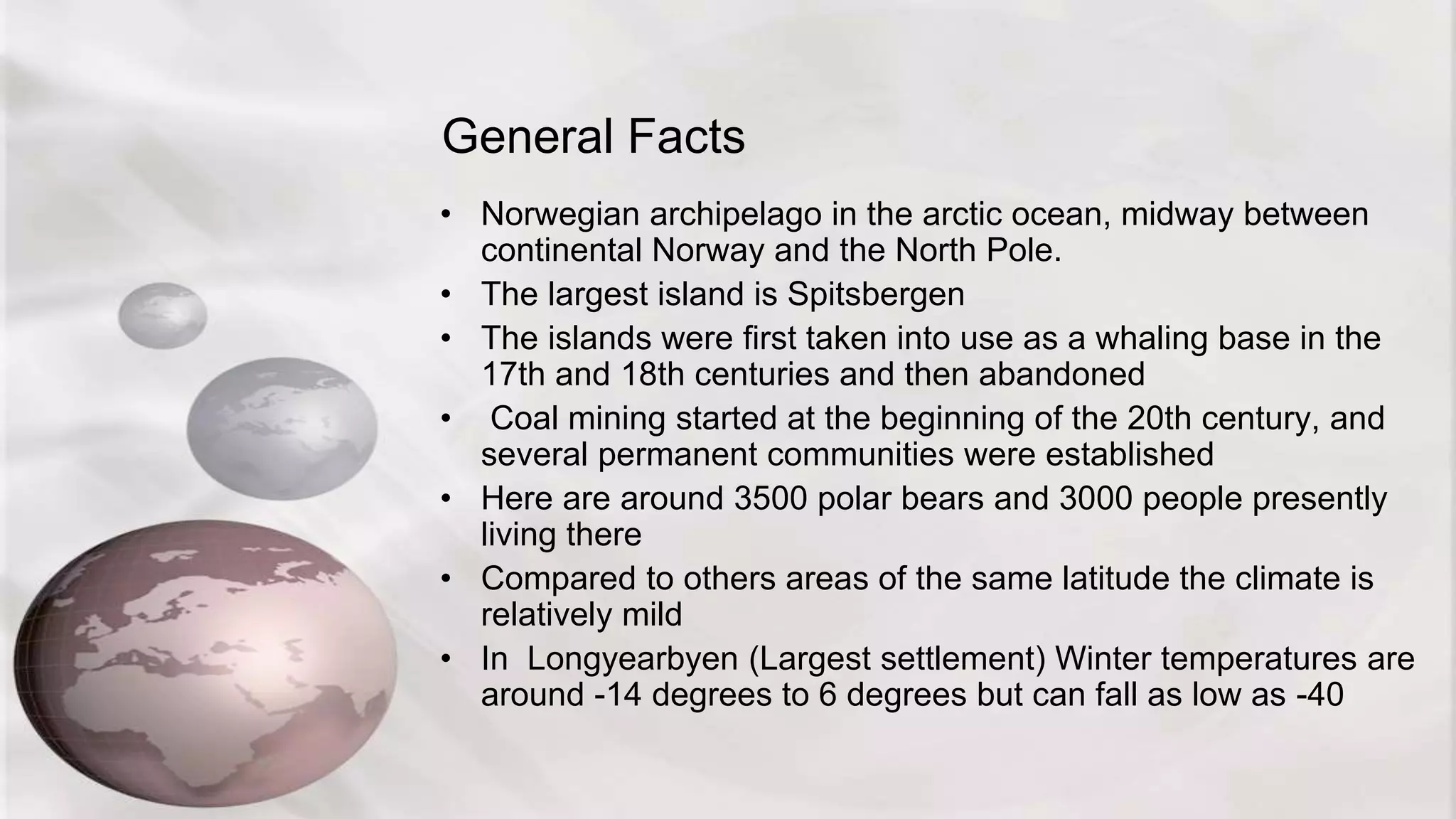
• Norwegian archipelago in the arctic ocean, midway between
continental Norway and the North Pole.
• The largest island is Spitsbergen
• The islands were first taken into use as a whaling base in the
17th and 18th centuries and then abandoned
• Coal mining started at the beginning of the 20th century, and
several permanent communities were established
• Here are around 3500 polar bears and 3000 people presently
living there
• Compared to others areas of the same latitude the climate is
relatively mild
• In Longyearbyen (Largest settlement) Winter temperatures are
around -14 degrees to 6 degrees but can fall as low as -40
Ice cover
• 60% of Svalbard is covered by ice
• It has over 2000 glaciers
• Nordaustlandet has the largest glacier and the 3rd largest
in the world
• Most of the rest is bare rock (Scree, moraines, rock and
fluvial deposits) only 10% is vegetated
• Permafrost exists almost everywhere
• It has the largest wilderness area in Europe (Untouched in
places but also fragile)
• Fortitude (The TV series was filmed here)
Threats to
Svalbard
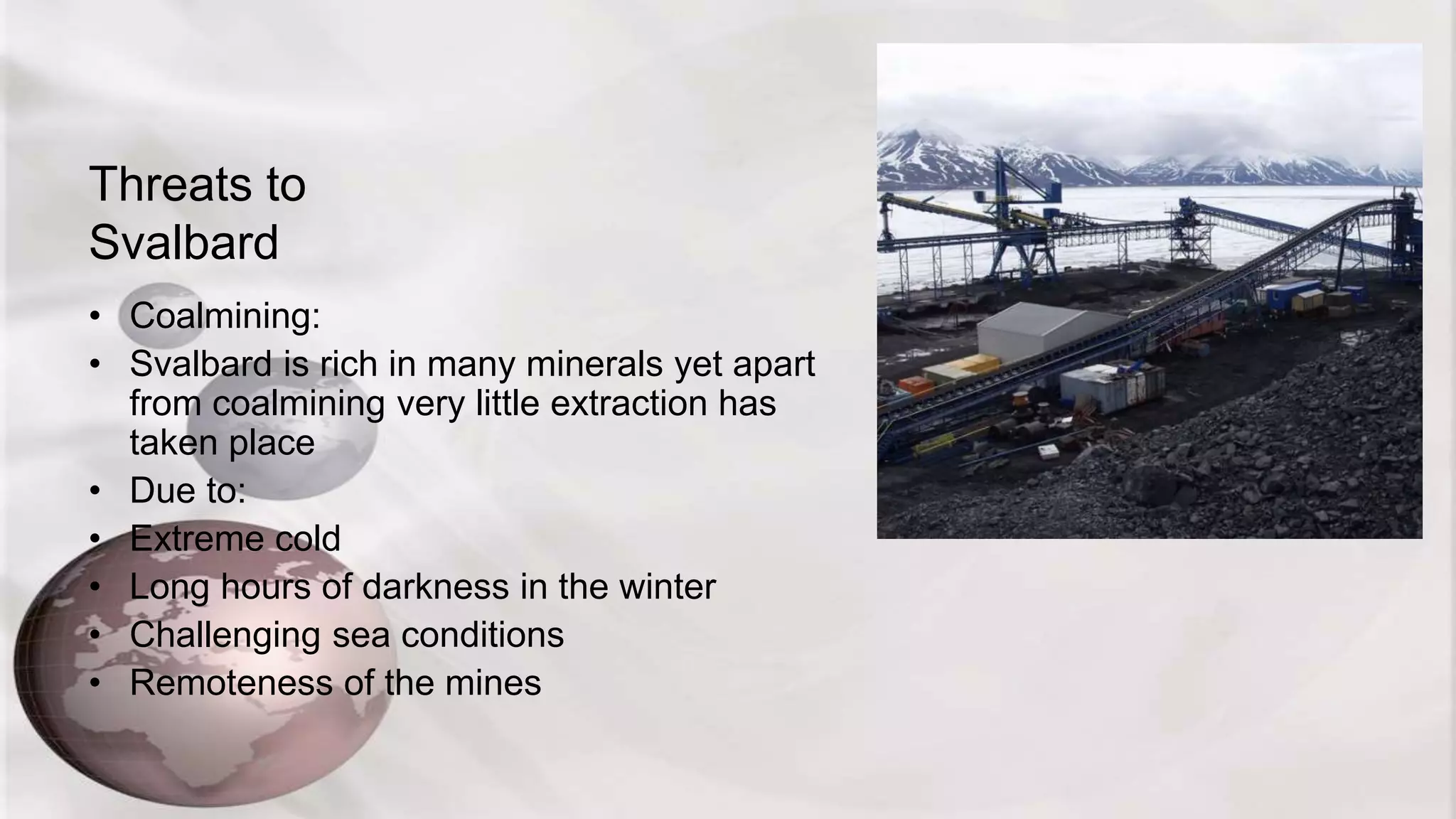
• Coalmining:
• Svalbard is rich in many minerals yet apart
from coalmining very little extraction has
taken place
• Due to:
• Extreme cold
• Long hours of darkness in the winter
• Challenging sea conditions
• Remoteness of the mines
Coalmining
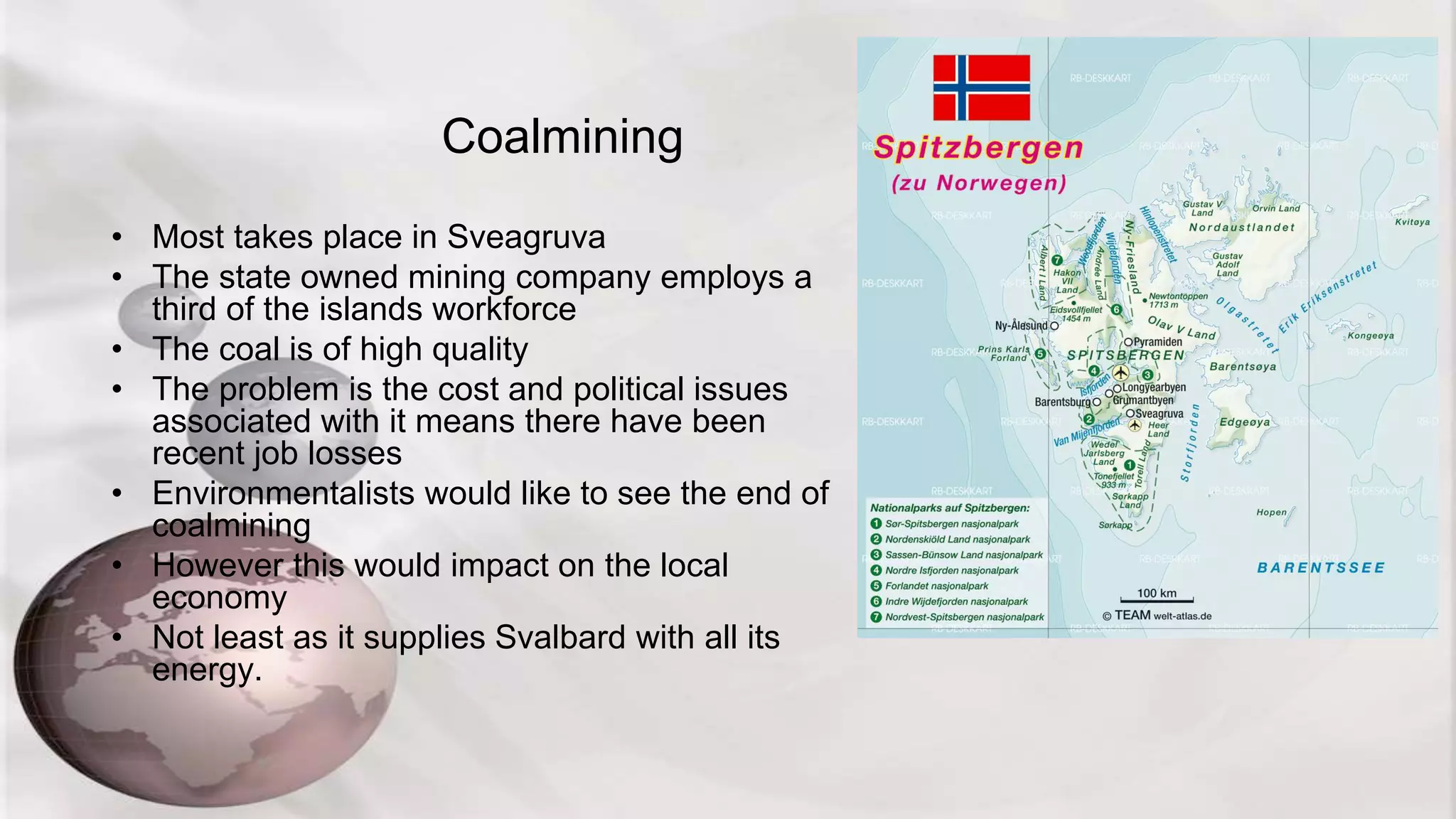
• Most takes place in Sveagruva
• The state owned mining company employs a
third of the islands workforce
• The coal is of high quality
• The problem is the cost and political issues
associated with it means there have been
recent job losses
• Environmentalists would like to see the end of
coalmining
• However this would impact on the local
economy
• Not least as it supplies Svalbard with all its
energy.
Polar Scientific Research
• Has a long history of research
• Covering:
– Marine
– Geology
– Meteorology
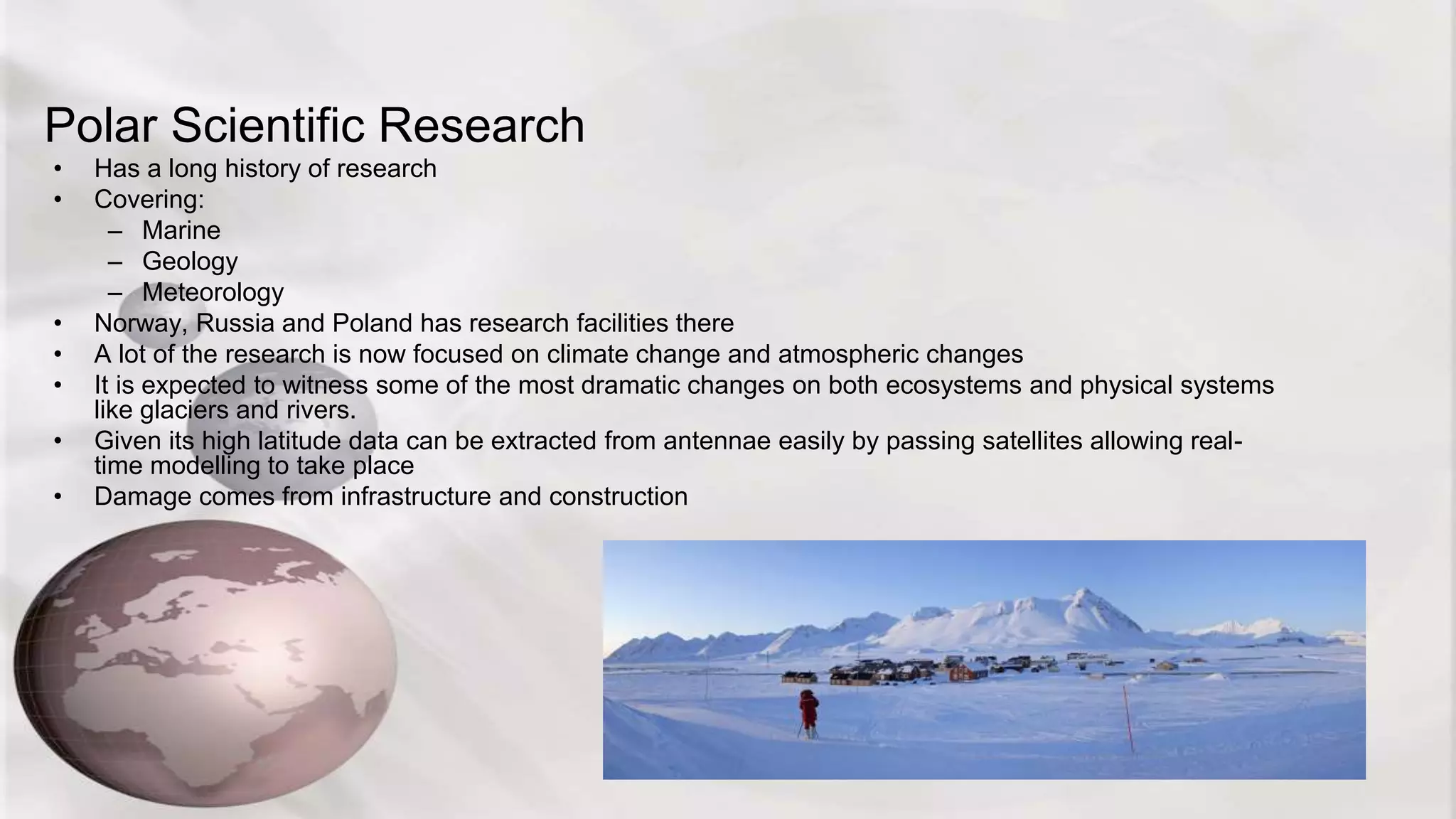
• Norway, Russia and Poland has research facilities there
• A lot of the research is now focused on climate change and atmospheric changes
• It is expected to witness some of the most dramatic changes on both ecosystems and physical systems
like glaciers and rivers.
• Given its high latitude data can be extracted from antennae easily by passing satellites allowing real-
time modelling to take place
• Damage comes from infrastructure and construction
Tourism
• Tourism has been a fairly large income for the area and
most tourists arrive by ship
• Svalbard's first airport opened in 1975 in Longyearbyen
• In 2013 70,000 people visited 30,000 on cruise ships
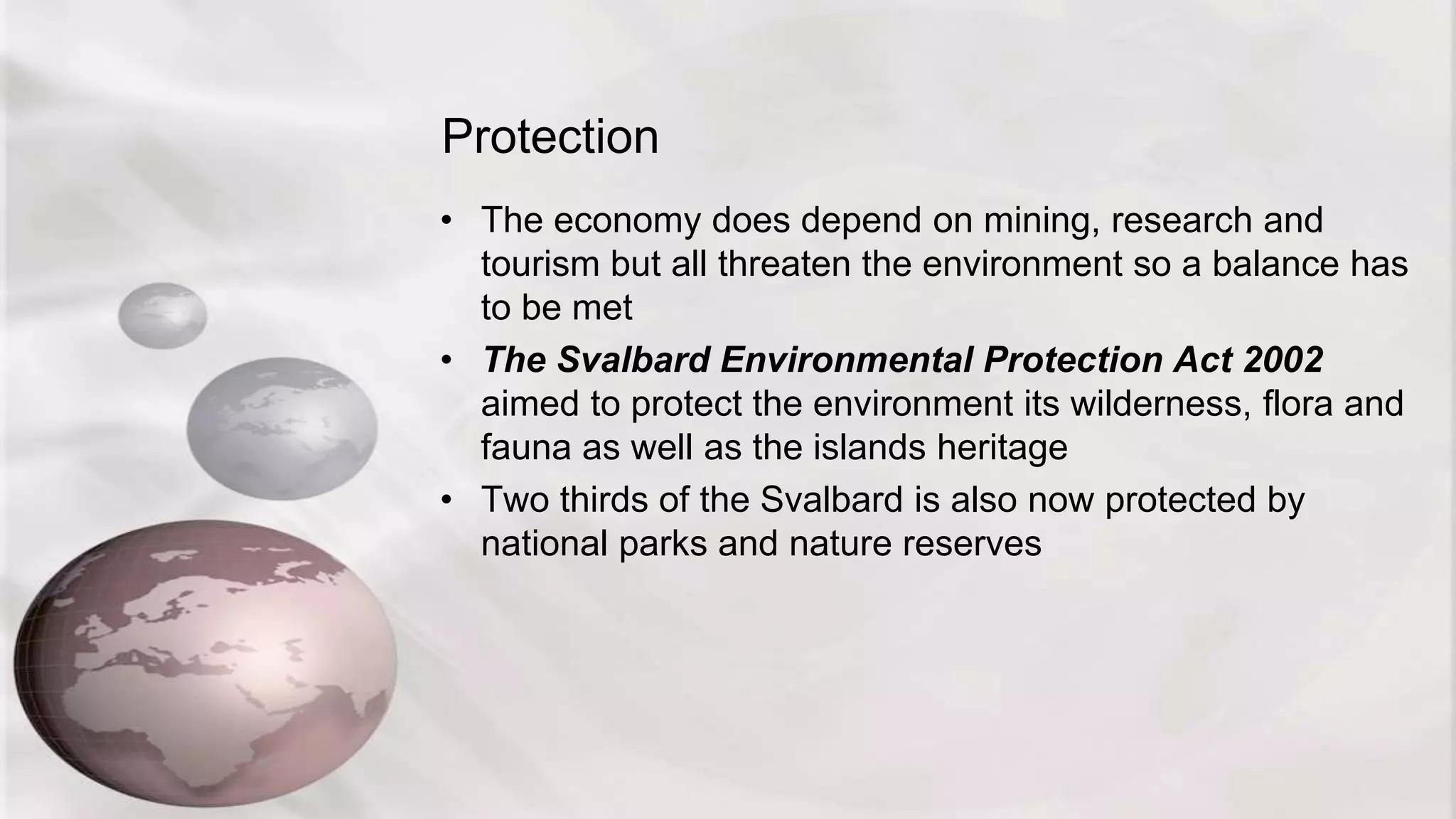
• Most come to explore the natural beauty of the region
– Glaciers
– Fjords
– Wildlife (Polar bears, seals, walrus)
– Or to study the history
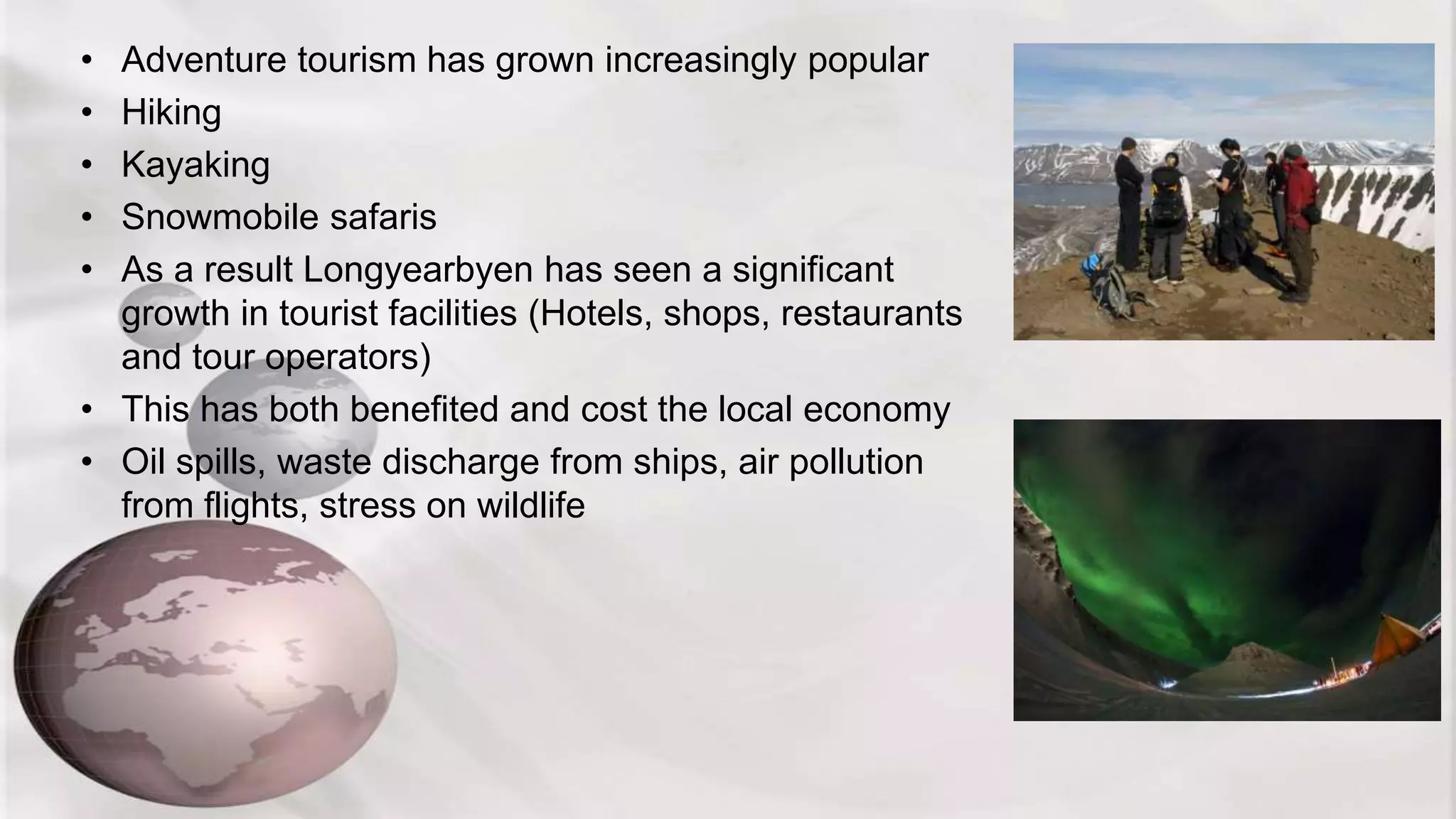
• Adventure tourism has grown increasingly popular
• Hiking
• Kayaking
• Snowmobile safaris
• As a result Longyearbyen has seen a significant
growth in tourist facilities (Hotels, shops, restaurants
and tour operators)
• This has both benefited and cost the local economy
• Oil spills, waste discharge from ships, air pollution
from flights, stress on wildlife
Protection
• The economy does depend on mining, research and
tourism but all threaten the environment so a balance has
to be met
• The Svalbard Environmental Protection Act 2002
aimed to protect the environment its wilderness, flora and
fauna as well as the islands heritage
• Two thirds of the Svalbard is also now protected by
national parks and nature reserves
Threats to Svalbard
Coalmining
1. Dirty
2. Environmentalists
want it to end
3. Provides a third of
all jobs
4. High quality coal
5. Provides all of
Svalbard's energy
Polar Research
1. Benefits global
research
2. Looks at climate
change and
atmospheric
changes
3. Real time
modelling
4. Impacts of
infrastructure
5. Impacts from
construction
Tourism
1. 70,000 people a year
30,000 on cruise
ships
2. Oil spills and waste
3. Air pollution from
flights
4. Need for more
facilities
5. Adventure tourism
stresses the wildlife
and ecosystems

Lesson 15 svalbard a case study

  • 1.
    Svalbard – ACase Study Lower Sixth
  • 4.
    General Facts • Norwegianarchipelago in the arctic ocean, midway between continental Norway and the North Pole. • The largest island is Spitsbergen • The islands were first taken into use as a whaling base in the 17th and 18th centuries and then abandoned • Coal mining started at the beginning of the 20th century, and several permanent communities were established • Here are around 3500 polar bears and 3000 people presently living there • Compared to others areas of the same latitude the climate is relatively mild • In Longyearbyen (Largest settlement) Winter temperatures are around -14 degrees to 6 degrees but can fall as low as -40
  • 5.
    Ice cover • 60%of Svalbard is covered by ice • It has over 2000 glaciers • Nordaustlandet has the largest glacier and the 3rd largest in the world • Most of the rest is bare rock (Scree, moraines, rock and fluvial deposits) only 10% is vegetated • Permafrost exists almost everywhere • It has the largest wilderness area in Europe (Untouched in places but also fragile) • Fortitude (The TV series was filmed here)
  • 6.
    Threats to Svalbard • Coalmining: •Svalbard is rich in many minerals yet apart from coalmining very little extraction has taken place • Due to: • Extreme cold • Long hours of darkness in the winter • Challenging sea conditions • Remoteness of the mines
  • 7.
    Coalmining • Most takesplace in Sveagruva • The state owned mining company employs a third of the islands workforce • The coal is of high quality • The problem is the cost and political issues associated with it means there have been recent job losses • Environmentalists would like to see the end of coalmining • However this would impact on the local economy • Not least as it supplies Svalbard with all its energy.
  • 8.
    Polar Scientific Research •Has a long history of research • Covering: – Marine – Geology – Meteorology • Norway, Russia and Poland has research facilities there • A lot of the research is now focused on climate change and atmospheric changes • It is expected to witness some of the most dramatic changes on both ecosystems and physical systems like glaciers and rivers. • Given its high latitude data can be extracted from antennae easily by passing satellites allowing real- time modelling to take place • Damage comes from infrastructure and construction
  • 9.
    Tourism • Tourism hasbeen a fairly large income for the area and most tourists arrive by ship • Svalbard's first airport opened in 1975 in Longyearbyen • In 2013 70,000 people visited 30,000 on cruise ships • Most come to explore the natural beauty of the region – Glaciers – Fjords – Wildlife (Polar bears, seals, walrus) – Or to study the history
  • 10.
    • Adventure tourismhas grown increasingly popular • Hiking • Kayaking • Snowmobile safaris • As a result Longyearbyen has seen a significant growth in tourist facilities (Hotels, shops, restaurants and tour operators) • This has both benefited and cost the local economy • Oil spills, waste discharge from ships, air pollution from flights, stress on wildlife
  • 11.
    Protection • The economydoes depend on mining, research and tourism but all threaten the environment so a balance has to be met • The Svalbard Environmental Protection Act 2002 aimed to protect the environment its wilderness, flora and fauna as well as the islands heritage • Two thirds of the Svalbard is also now protected by national parks and nature reserves
  • 12.
    Threats to Svalbard Coalmining 1.Dirty 2. Environmentalists want it to end 3. Provides a third of all jobs 4. High quality coal 5. Provides all of Svalbard's energy Polar Research 1. Benefits global research 2. Looks at climate change and atmospheric changes 3. Real time modelling 4. Impacts of infrastructure 5. Impacts from construction Tourism 1. 70,000 people a year 30,000 on cruise ships 2. Oil spills and waste 3. Air pollution from flights 4. Need for more facilities 5. Adventure tourism stresses the wildlife and ecosystems