The Global Organisations
Starter
• Describe the reasons for the growth in tax
havens
• Explain what is meant by a nation state
• Why might a new nation state fail?
Learning Objectives:
• Understand the importance of global
organisations
• Assess how effective IGOs are in
international disputes
• Understand the term rogue state and the
options available to IGOs
The IGOs
• There are many important IGOs that do
necessary work around the work
• As we have already seen some are better
than others
• They are often seen as preserving the rich
or tools of these powers
• They do however do a lot of good around
the world in other ways.
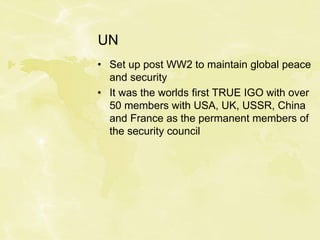
UN
• Set up post WW2 to maintain global peace
and security
• It was the worlds first TRUE IGO with over
50 members with USA, UK, USSR, China
and France as the permanent members of
the security council
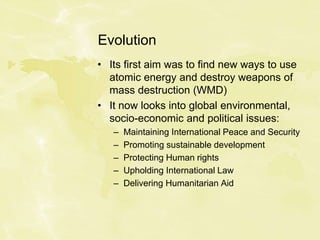
Evolution
• Its first aim was to find new ways to use
atomic energy and destroy weapons of
mass destruction (WMD)
• It now looks into global environmental,
socio-economic and political issues:
– Maintaining International Peace and Security
– Promoting sustainable development
– Protecting Human rights
– Upholding International Law
– Delivering Humanitarian Aid
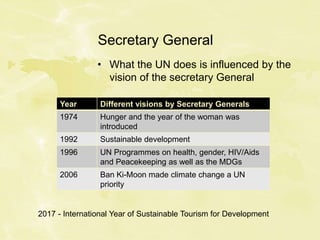
Secretary General
• What the UN does is influenced by the
vision of the secretary General
Year Different visions by Secretary Generals
1974 Hunger and the year of the woman was
introduced
1992 Sustainable development
1996 UN Programmes on health, gender, HIV/Aids
and Peacekeeping as well as the MDGs
2006 Ban Ki-Moon made climate change a UN
priority
2017 - International Year of Sustainable Tourism for Development
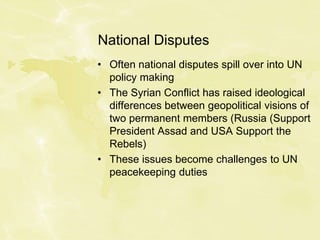
National Disputes
• Often national disputes spill over into UN
policy making
• The Syrian Conflict has raised ideological
differences between geopolitical visions of
two permanent members (Russia (Support
President Assad and USA Support the
Rebels)
• These issues become challenges to UN
peacekeeping duties
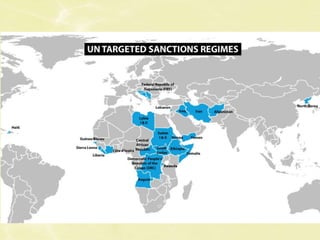
Sanctions
• Have been away that the UN Security
Council respond to threats.
• These mostly involve economic sanctions
against countries where human suffering is
prevalent
• Direct Military sanctions to protect people
from conflict or persecution
The types of Sanctions
• Arms Embargos
– Ban weapons and military supplies
• Trade Embargos
– Banning specific import items or purchase of exports from
the country
• Restrictions on Loans
– for development project
• Freezing Assets
– Bank Accounts of specific people or businesses
• Travel restrictions
– For specific people or politicians
Economic and Arms Sanctions
Impacts
• Economic sanctions are usually imposed by a
particular country against another for cutting off
business and trade relations like export and import of
items as well as financial loans.
• These sanctions represent an effective foreign policy
method when a country differs with another nation’s:
– Government,
– Environmental pollution,
– Human rights violations.
• benefits of economic sanctions
– Enables change of policies
– Highlights important issues
• These have been applied to the Ivory Coast and
Liberia in 2015 due to suspected war crimes
• But the two most recent high profile sanctions have
been against Iran and Bosnia
Case Study: Iran (Economic
Sanctions)
• There has been suspicion by some that
they are a ‘Rogue State’
• They were attempting to build Nuclear
weapons
• This led to economic sanctions and
financial restrictions being imposed
• Iran is the 4th largest oil exporting country
• Iran’s GDP fell by 5%
• The sanctions had a substantial effect on
the Iranian nuclear program by making it
harder to acquire specialised materials
and equipment needed
Discussion
• Do Sanctions work?
Social Impacts
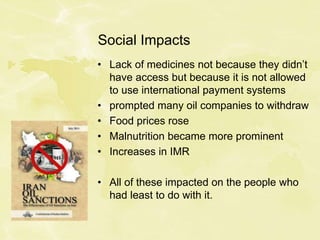
• Lack of medicines not because they didn’t
have access but because it is not allowed
to use international payment systems
• prompted many oil companies to withdraw
• Food prices rose
• Malnutrition became more prominent
• Increases in IMR
• All of these impacted on the people who
had least to do with it.
Accord
• Iran signed an Accord in 2016 with the UN This meant
that the sanctions were lifted because the country had
dismantled its Nuclear programme:
– Release of Iran’s frozen funds abroad, estimated at $29 billion,
representing approximately one third of Iran's foreign held
reserves
– The removal of sanctions against exports of Iranian oil.
– Allow foreign firms to invest in Iran’s oil and gas, cars, hotels
and other sectors.
– Allow Iran to trade with the rest of the world and use the global
banking system
Lesson 8   the global organisations

Lesson 8 the global organisations

  • 1.
  • 2.
    Starter • Describe thereasons for the growth in tax havens • Explain what is meant by a nation state • Why might a new nation state fail?
  • 3.
    Learning Objectives: • Understandthe importance of global organisations • Assess how effective IGOs are in international disputes • Understand the term rogue state and the options available to IGOs
  • 4.
    The IGOs • Thereare many important IGOs that do necessary work around the work • As we have already seen some are better than others • They are often seen as preserving the rich or tools of these powers • They do however do a lot of good around the world in other ways.
  • 5.
    UN • Set uppost WW2 to maintain global peace and security • It was the worlds first TRUE IGO with over 50 members with USA, UK, USSR, China and France as the permanent members of the security council
  • 6.
    Evolution • Its firstaim was to find new ways to use atomic energy and destroy weapons of mass destruction (WMD) • It now looks into global environmental, socio-economic and political issues: – Maintaining International Peace and Security – Promoting sustainable development – Protecting Human rights – Upholding International Law – Delivering Humanitarian Aid
  • 7.
    Secretary General • Whatthe UN does is influenced by the vision of the secretary General Year Different visions by Secretary Generals 1974 Hunger and the year of the woman was introduced 1992 Sustainable development 1996 UN Programmes on health, gender, HIV/Aids and Peacekeeping as well as the MDGs 2006 Ban Ki-Moon made climate change a UN priority 2017 - International Year of Sustainable Tourism for Development
  • 8.
    National Disputes • Oftennational disputes spill over into UN policy making • The Syrian Conflict has raised ideological differences between geopolitical visions of two permanent members (Russia (Support President Assad and USA Support the Rebels) • These issues become challenges to UN peacekeeping duties
  • 9.
    Sanctions • Have beenaway that the UN Security Council respond to threats. • These mostly involve economic sanctions against countries where human suffering is prevalent • Direct Military sanctions to protect people from conflict or persecution
  • 11.
    The types ofSanctions • Arms Embargos – Ban weapons and military supplies • Trade Embargos – Banning specific import items or purchase of exports from the country • Restrictions on Loans – for development project • Freezing Assets – Bank Accounts of specific people or businesses • Travel restrictions – For specific people or politicians
  • 12.
    Economic and ArmsSanctions Impacts • Economic sanctions are usually imposed by a particular country against another for cutting off business and trade relations like export and import of items as well as financial loans. • These sanctions represent an effective foreign policy method when a country differs with another nation’s: – Government, – Environmental pollution, – Human rights violations. • benefits of economic sanctions – Enables change of policies – Highlights important issues • These have been applied to the Ivory Coast and Liberia in 2015 due to suspected war crimes • But the two most recent high profile sanctions have been against Iran and Bosnia
  • 13.
    Case Study: Iran(Economic Sanctions) • There has been suspicion by some that they are a ‘Rogue State’ • They were attempting to build Nuclear weapons • This led to economic sanctions and financial restrictions being imposed • Iran is the 4th largest oil exporting country • Iran’s GDP fell by 5% • The sanctions had a substantial effect on the Iranian nuclear program by making it harder to acquire specialised materials and equipment needed
  • 14.
  • 15.
    Social Impacts • Lackof medicines not because they didn’t have access but because it is not allowed to use international payment systems • prompted many oil companies to withdraw • Food prices rose • Malnutrition became more prominent • Increases in IMR • All of these impacted on the people who had least to do with it.
  • 16.
    Accord • Iran signedan Accord in 2016 with the UN This meant that the sanctions were lifted because the country had dismantled its Nuclear programme: – Release of Iran’s frozen funds abroad, estimated at $29 billion, representing approximately one third of Iran's foreign held reserves – The removal of sanctions against exports of Iranian oil. – Allow foreign firms to invest in Iran’s oil and gas, cars, hotels and other sectors. – Allow Iran to trade with the rest of the world and use the global banking system