Md. Yousuf Gazi, Lecturer, Department of Geology, University of Dhaka (yousuf.geo@du.ac.bd)
Md. Yousuf Gazi
Lecturer
Department of Geology
University of Dhaka
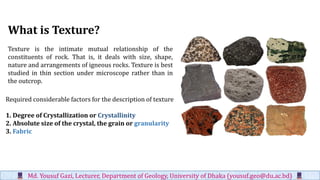
What is Texture?
Texture is the intimate mutual relationship of the
constituents of rock. That is, it deals with size, shape,
nature and arrangements of igneous rocks. Texture is best
studied in thin section under microscope rather than in
the outcrop.
Required considerable factors for the description of texture
1. Degree of Crystallization or Crystallinity
2. Absolute size of the crystal, the grain or granularity
3. Fabric
Md. Yousuf Gazi, Lecturer, Department of Geology, University of Dhaka (yousuf.geo@du.ac.bd)
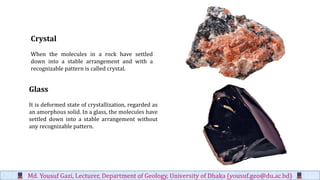
Crystal
When the molecules in a rock have settled
down into a stable arrangement and with a
recognizable pattern is called crystal.
Md. Yousuf Gazi, Lecturer, Department of Geology, University of Dhaka (yousuf.geo@du.ac.bd)
Glass
It is deformed state of crystallization, regarded as
an amorphous solid. In a glass, the molecules have
settled down into a stable arrangement without
any recognizable pattern.
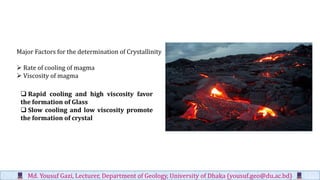
Major Factors for the determination of Crystallinity
 Rate of cooling of magma
 Viscosity of magma
 Rapid cooling and high viscosity favor
the formation of Glass
 Slow cooling and low viscosity promote
the formation of crystal
Md. Yousuf Gazi, Lecturer, Department of Geology, University of Dhaka (yousuf.geo@du.ac.bd)
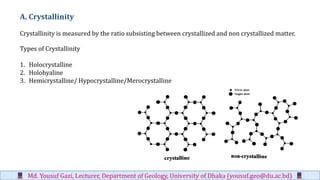
A. Crystallinity
Crystallinity is measured by the ratio subsisting between crystallized and non crystallized matter.
Types of Crystallinity
1. Holocrystalline
2. Holohyaline
3. Hemicrystalline/ Hypocrystalline/Merocrystalline
Md. Yousuf Gazi, Lecturer, Department of Geology, University of Dhaka (yousuf.geo@du.ac.bd)
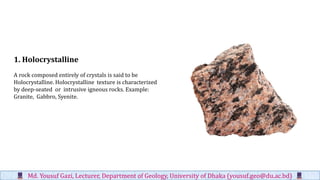
1. Holocrystalline
A rock composed entirely of crystals is said to be
Holocrystalline. Holocrystalline texture is characterized
by deep-seated or intrusive igneous rocks. Example:
Granite, Gabbro, Syenite.
Md. Yousuf Gazi, Lecturer, Department of Geology, University of Dhaka (yousuf.geo@du.ac.bd)
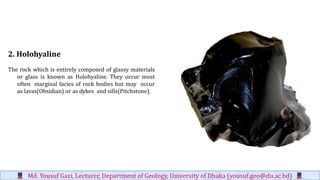
2. Holohyaline
The rock which is entirely composed of glassy materials
or glass is known as Holohyaline. They occur most
often marginal facies of rock bodies but may occur
as lavas(Obsidian) or as dykes and sills(Pitchstone).
Md. Yousuf Gazi, Lecturer, Department of Geology, University of Dhaka (yousuf.geo@du.ac.bd)
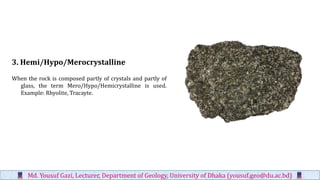
3. Hemi/Hypo/Merocrystalline
When the rock is composed partly of crystals and partly of
glass, the term Mero/Hypo/Hemicrystalline is used.
Example: Rhyolite, Tracayte.
Md. Yousuf Gazi, Lecturer, Department of Geology, University of Dhaka (yousuf.geo@du.ac.bd)
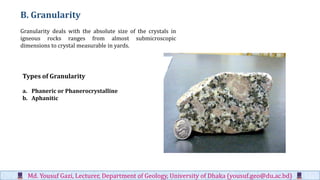
B. Granularity
Granularity deals with the absolute size of the crystals in
igneous rocks ranges from almost submicroscopic
dimensions to crystal measurable in yards.
Md. Yousuf Gazi, Lecturer, Department of Geology, University of Dhaka (yousuf.geo@du.ac.bd)
Types of Granularity
a. Phaneric or Phanerocrystalline
b. Aphanitic
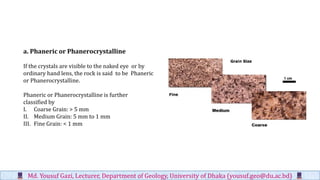
a. Phaneric or Phanerocrystalline
If the crystals are visible to the naked eye or by
ordinary hand lens, the rock is said to be Phaneric
or Phanerocrystalline.
Phaneric or Phanerocrystalline is further
classified by
I. Coarse Grain: > 5 mm
II. Medium Grain: 5 mm to 1 mm
III. Fine Grain: < 1 mm
Md. Yousuf Gazi, Lecturer, Department of Geology, University of Dhaka (yousuf.geo@du.ac.bd)
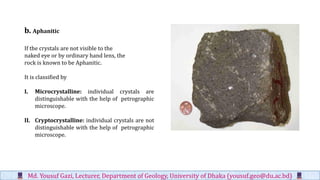
b. Aphanitic
If the crystals are not visible to the
naked eye or by ordinary hand lens, the
rock is known to be Aphanitic.
It is classified by
I. Microcrystalline: individual crystals are
distinguishable with the help of petrographic
microscope.
II. Cryptocrystalline: individual crystals are not
distinguishable with the help of petrographic
microscope.
Md. Yousuf Gazi, Lecturer, Department of Geology, University of Dhaka (yousuf.geo@du.ac.bd)
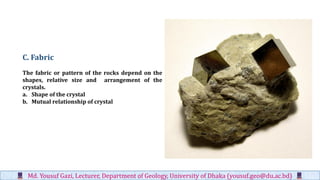
C. Fabric
The fabric or pattern of the rocks depend on the
shapes, relative size and arrangement of the
crystals.
a. Shape of the crystal
b. Mutual relationship of crystal
Md. Yousuf Gazi, Lecturer, Department of Geology, University of Dhaka (yousuf.geo@du.ac.bd)
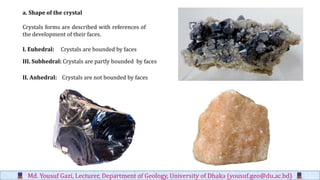
III. Subhedral: Crystals are partly bounded by faces
a. Shape of the crystal
Crystals forms are described with references of
the development of their faces.
I. Euhedral: Crystals are bounded by faces
II. Anhedral: Crystals are not bounded by faces
Md. Yousuf Gazi, Lecturer, Department of Geology, University of Dhaka (yousuf.geo@du.ac.bd)
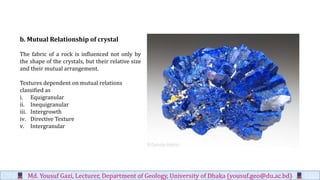
b. Mutual Relationship of crystal
The fabric of a rock is influenced not only by
the shape of the crystals, but their relative size
and their mutual arrangement.
Textures dependent on mutual relations
classified as
i. Equigranular
ii. Inequigranular
iii. Intergrowth
iv. Directive Texture
v. Intergranular
Md. Yousuf Gazi, Lecturer, Department of Geology, University of Dhaka (yousuf.geo@du.ac.bd)
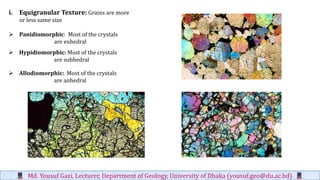
i. Equigranular Texture: Grains are more
or less same size
 Panidiomorphic: Most of the crystals
are euhedral
 Allodiomorphic: Most of the crystals
are anhedral
 Hypidiomorphic: Most of the crystals
are subhedral
Md. Yousuf Gazi, Lecturer, Department of Geology, University of Dhaka (yousuf.geo@du.ac.bd)
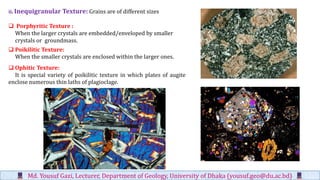
ii. Inequigranular Texture: Grains are of different sizes
 Porphyritic Texture :
When the larger crystals are embedded/enveloped by smaller
crystals or groundmass.
 Ophitic Texture:
It is special variety of poikilitic texture in which plates of augite
enclose numerous thin laths of plagioclage.
 Poikilitic Texture:
When the smaller crystals are enclosed within the larger ones.
Md. Yousuf Gazi, Lecturer, Department of Geology, University of Dhaka (yousuf.geo@du.ac.bd)
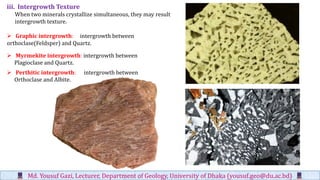
iii. Intergrowth Texture
When two minerals crystallize simultaneous, they may result
intergrowth texture.
 Graphic intergrowth: intergrowth between
orthoclase(Feldsper) and Quartz.
Md. Yousuf Gazi, Lecturer, Department of Geology, University of Dhaka (yousuf.geo@du.ac.bd)
 Perthitic intergrowth: intergrowth between
Orthoclase and Albite.
 Myrmekite intergrowth: intergrowth between
Plagioclase and Quartz.
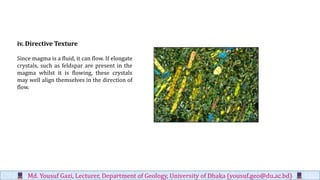
iv. Directive Texture
Since magma is a fluid, it can flow. If elongate
crystals, such as feldspar are present in the
magma whilst it is flowing, these crystals
may well align themselves in the direction of
flow.
Md. Yousuf Gazi, Lecturer, Department of Geology, University of Dhaka (yousuf.geo@du.ac.bd)
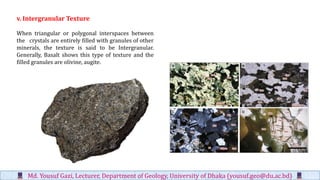
v. Intergranular Texture
When triangular or polygonal interspaces between
the crystals are entirely filled with granules of other
minerals, the texture is said to be Intergranular.
Generally, Basalt shows this type of texture and the
filled granules are olivine, augite.
Md. Yousuf Gazi, Lecturer, Department of Geology, University of Dhaka (yousuf.geo@du.ac.bd)

Textures of igneous rocks

  • 1.
    Md. Yousuf Gazi,Lecturer, Department of Geology, University of Dhaka (yousuf.geo@du.ac.bd) Md. Yousuf Gazi Lecturer Department of Geology University of Dhaka
  • 2.
    What is Texture? Textureis the intimate mutual relationship of the constituents of rock. That is, it deals with size, shape, nature and arrangements of igneous rocks. Texture is best studied in thin section under microscope rather than in the outcrop. Required considerable factors for the description of texture 1. Degree of Crystallization or Crystallinity 2. Absolute size of the crystal, the grain or granularity 3. Fabric Md. Yousuf Gazi, Lecturer, Department of Geology, University of Dhaka (yousuf.geo@du.ac.bd)
  • 3.
    Crystal When the moleculesin a rock have settled down into a stable arrangement and with a recognizable pattern is called crystal. Md. Yousuf Gazi, Lecturer, Department of Geology, University of Dhaka (yousuf.geo@du.ac.bd) Glass It is deformed state of crystallization, regarded as an amorphous solid. In a glass, the molecules have settled down into a stable arrangement without any recognizable pattern.
  • 4.
    Major Factors forthe determination of Crystallinity  Rate of cooling of magma  Viscosity of magma  Rapid cooling and high viscosity favor the formation of Glass  Slow cooling and low viscosity promote the formation of crystal Md. Yousuf Gazi, Lecturer, Department of Geology, University of Dhaka (yousuf.geo@du.ac.bd)
  • 5.
    A. Crystallinity Crystallinity ismeasured by the ratio subsisting between crystallized and non crystallized matter. Types of Crystallinity 1. Holocrystalline 2. Holohyaline 3. Hemicrystalline/ Hypocrystalline/Merocrystalline Md. Yousuf Gazi, Lecturer, Department of Geology, University of Dhaka (yousuf.geo@du.ac.bd)
  • 6.
    1. Holocrystalline A rockcomposed entirely of crystals is said to be Holocrystalline. Holocrystalline texture is characterized by deep-seated or intrusive igneous rocks. Example: Granite, Gabbro, Syenite. Md. Yousuf Gazi, Lecturer, Department of Geology, University of Dhaka (yousuf.geo@du.ac.bd)
  • 7.
    2. Holohyaline The rockwhich is entirely composed of glassy materials or glass is known as Holohyaline. They occur most often marginal facies of rock bodies but may occur as lavas(Obsidian) or as dykes and sills(Pitchstone). Md. Yousuf Gazi, Lecturer, Department of Geology, University of Dhaka (yousuf.geo@du.ac.bd)
  • 8.
    3. Hemi/Hypo/Merocrystalline When therock is composed partly of crystals and partly of glass, the term Mero/Hypo/Hemicrystalline is used. Example: Rhyolite, Tracayte. Md. Yousuf Gazi, Lecturer, Department of Geology, University of Dhaka (yousuf.geo@du.ac.bd)
  • 9.
    B. Granularity Granularity dealswith the absolute size of the crystals in igneous rocks ranges from almost submicroscopic dimensions to crystal measurable in yards. Md. Yousuf Gazi, Lecturer, Department of Geology, University of Dhaka (yousuf.geo@du.ac.bd) Types of Granularity a. Phaneric or Phanerocrystalline b. Aphanitic
  • 10.
    a. Phaneric orPhanerocrystalline If the crystals are visible to the naked eye or by ordinary hand lens, the rock is said to be Phaneric or Phanerocrystalline. Phaneric or Phanerocrystalline is further classified by I. Coarse Grain: > 5 mm II. Medium Grain: 5 mm to 1 mm III. Fine Grain: < 1 mm Md. Yousuf Gazi, Lecturer, Department of Geology, University of Dhaka (yousuf.geo@du.ac.bd)
  • 11.
    b. Aphanitic If thecrystals are not visible to the naked eye or by ordinary hand lens, the rock is known to be Aphanitic. It is classified by I. Microcrystalline: individual crystals are distinguishable with the help of petrographic microscope. II. Cryptocrystalline: individual crystals are not distinguishable with the help of petrographic microscope. Md. Yousuf Gazi, Lecturer, Department of Geology, University of Dhaka (yousuf.geo@du.ac.bd)
  • 12.
    C. Fabric The fabricor pattern of the rocks depend on the shapes, relative size and arrangement of the crystals. a. Shape of the crystal b. Mutual relationship of crystal Md. Yousuf Gazi, Lecturer, Department of Geology, University of Dhaka (yousuf.geo@du.ac.bd)
  • 13.
    III. Subhedral: Crystalsare partly bounded by faces a. Shape of the crystal Crystals forms are described with references of the development of their faces. I. Euhedral: Crystals are bounded by faces II. Anhedral: Crystals are not bounded by faces Md. Yousuf Gazi, Lecturer, Department of Geology, University of Dhaka (yousuf.geo@du.ac.bd)
  • 14.
    b. Mutual Relationshipof crystal The fabric of a rock is influenced not only by the shape of the crystals, but their relative size and their mutual arrangement. Textures dependent on mutual relations classified as i. Equigranular ii. Inequigranular iii. Intergrowth iv. Directive Texture v. Intergranular Md. Yousuf Gazi, Lecturer, Department of Geology, University of Dhaka (yousuf.geo@du.ac.bd)
  • 15.
    i. Equigranular Texture:Grains are more or less same size  Panidiomorphic: Most of the crystals are euhedral  Allodiomorphic: Most of the crystals are anhedral  Hypidiomorphic: Most of the crystals are subhedral Md. Yousuf Gazi, Lecturer, Department of Geology, University of Dhaka (yousuf.geo@du.ac.bd)
  • 16.
    ii. Inequigranular Texture:Grains are of different sizes  Porphyritic Texture : When the larger crystals are embedded/enveloped by smaller crystals or groundmass.  Ophitic Texture: It is special variety of poikilitic texture in which plates of augite enclose numerous thin laths of plagioclage.  Poikilitic Texture: When the smaller crystals are enclosed within the larger ones. Md. Yousuf Gazi, Lecturer, Department of Geology, University of Dhaka (yousuf.geo@du.ac.bd)
  • 17.
    iii. Intergrowth Texture Whentwo minerals crystallize simultaneous, they may result intergrowth texture.  Graphic intergrowth: intergrowth between orthoclase(Feldsper) and Quartz. Md. Yousuf Gazi, Lecturer, Department of Geology, University of Dhaka (yousuf.geo@du.ac.bd)  Perthitic intergrowth: intergrowth between Orthoclase and Albite.  Myrmekite intergrowth: intergrowth between Plagioclase and Quartz.
  • 18.
    iv. Directive Texture Sincemagma is a fluid, it can flow. If elongate crystals, such as feldspar are present in the magma whilst it is flowing, these crystals may well align themselves in the direction of flow. Md. Yousuf Gazi, Lecturer, Department of Geology, University of Dhaka (yousuf.geo@du.ac.bd)
  • 19.
    v. Intergranular Texture Whentriangular or polygonal interspaces between the crystals are entirely filled with granules of other minerals, the texture is said to be Intergranular. Generally, Basalt shows this type of texture and the filled granules are olivine, augite. Md. Yousuf Gazi, Lecturer, Department of Geology, University of Dhaka (yousuf.geo@du.ac.bd)
  • 20.
    Md. Yousuf Gazi,Lecturer, Department of Geology, University of Dhaka (yousuf.geo@du.ac.bd)