National Identity
Starter
• Why do we need IGOs to help protect our
environment
• Why do some countries persistently ignore
environmental rules and regulations
Learning Objectives
• Understand the concept of Nationalism
• Consider the different aspects of our
National Identity
• Appreciate that some countries are more
nationalistic than others
• Assess the reasons why national identity is
often hard to understand
What is our National Identity
• After conflict often countries base
themselves on democracy, freedom,
respect and liberty
• This is often a way of reducing nationalism
• The EU and UN are based on these
• We try to weak nationalism through
internationalism and IGOs
• However Nationalism remains a powerful
force
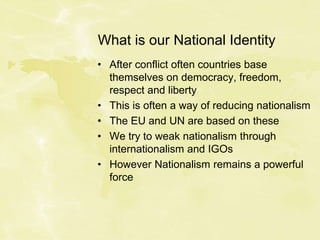
• The Balkans shows how powerful
nationalism can be
• Nationalism can be reinforced through
– Education
– Sport
– Politics
• Where loyalty to a particular group can be
reinforced
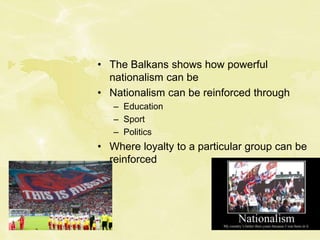
Public Events
• These often present an
opportunity for
nationalism to be seen.
• Extremism can be seen
via the National Front or
the BNP
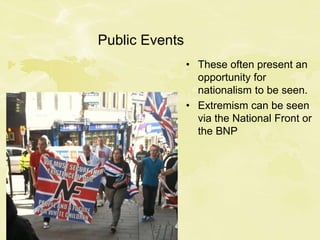
• A desire to show national pride such as
sporting events or the opening of the
Olympic games
Loyalty
• Nationalism inspires loyalty and devotion
• Its often associated with slogans or
symbols
– Flags
– Anthems
– Currency
– Passports
• Identity and Loyalty are often tied to legal
systems and methods of governance
• We concentrate our loyalty by often
criticising another system.
• Football teams is a prime example of this
National Identity and
Multinationalism
• Thanks to globalisation we are now
interconnected
• Emerging countries are developing deeper
connections with the developed world
• This results in migration
• This creates multinationalism with many
ethnic groups
• Questions of national identity therefore
become more complex
• In the UK people see themselves as
English, Scottish or Welsh before they see
themselves as British
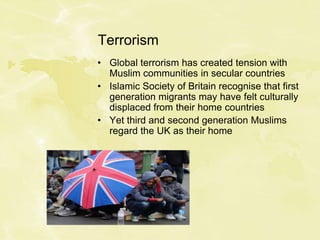
Terrorism
• Global terrorism has created tension with
Muslim communities in secular countries
• Islamic Society of Britain recognise that first
generation migrants may have felt culturally
displaced from their home countries
• Yet third and second generation Muslims
regard the UK as their home
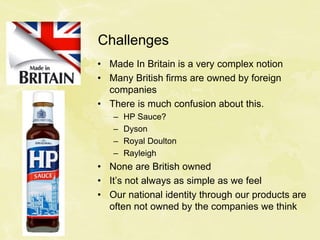
Challenges
• Made In Britain is a very complex notion
• Many British firms are owned by foreign
companies
• There is much confusion about this.
– HP Sauce?
– Dyson
– Royal Doulton
– Rayleigh
• None are British owned
• It’s not always as simple as we feel
• Our national identity through our products are
often not owned by the companies we think
Loss of Heritage
• House of Fraser
• Sarsons vinegar
• Branston Pickle
• Walker Crisps
• Weetabix
• Jaguar
• Manchester United
• Tetley
• Smirnoff
• Newcastle Brown Ale
• Scottish Power
• Thames Water
• O2
• Heathrow Airport
• Boots UK
• Cadbury
• Terry's Chocolate Orange
• Rolls Royce
Westernisation
• The world’s largest 500 companies
generate $31.2 trillion in revenue and $1.7
trillion in profit and employ 65 million
worldwide
• British GDP = $2.86 trillion
• This is equal to the whole output of Italy in
profits per year.
• They come from 36 countries but the
majority are based in the USA, Europe, SE
Asia
• All project their influence globally through
ownership of foreign companies
TNCs
• Those in the western world have much greater
connections than elsewhere
• They promote the capitalist model
• Brand-orientated consumerism has lead to
unethical exploitation in the worlds poorest
countries (Remember the UNs first ideas that were
voted down?)
– Entitled to regulate and control activities of MNC
operating within their territory
– Free to nationalise or expropriate foreign property on
conditions favourable to them
– Free to set up associations of primary commodities
producers similar to OPEC others should respect this
right and not challenge it
– Able to benefit from stable and equitable prices for raw
materials, tariffs and transfer of technology and
Economic assistance should be free from conditions.
• This never happened….
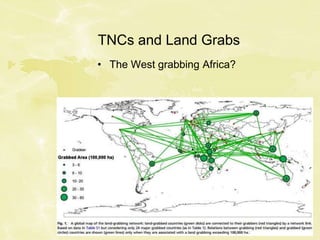
TNCs and Land Grabs
• The West grabbing Africa?

Lesson 12 national identity

  • 1.
  • 3.
    Starter • Why dowe need IGOs to help protect our environment • Why do some countries persistently ignore environmental rules and regulations
  • 4.
    Learning Objectives • Understandthe concept of Nationalism • Consider the different aspects of our National Identity • Appreciate that some countries are more nationalistic than others • Assess the reasons why national identity is often hard to understand
  • 5.
    What is ourNational Identity • After conflict often countries base themselves on democracy, freedom, respect and liberty • This is often a way of reducing nationalism • The EU and UN are based on these • We try to weak nationalism through internationalism and IGOs • However Nationalism remains a powerful force
  • 6.
    • The Balkansshows how powerful nationalism can be • Nationalism can be reinforced through – Education – Sport – Politics • Where loyalty to a particular group can be reinforced
  • 7.
    Public Events • Theseoften present an opportunity for nationalism to be seen. • Extremism can be seen via the National Front or the BNP
  • 8.
    • A desireto show national pride such as sporting events or the opening of the Olympic games
  • 9.
    Loyalty • Nationalism inspiresloyalty and devotion • Its often associated with slogans or symbols – Flags – Anthems – Currency – Passports • Identity and Loyalty are often tied to legal systems and methods of governance • We concentrate our loyalty by often criticising another system. • Football teams is a prime example of this
  • 10.
    National Identity and Multinationalism •Thanks to globalisation we are now interconnected • Emerging countries are developing deeper connections with the developed world • This results in migration • This creates multinationalism with many ethnic groups • Questions of national identity therefore become more complex • In the UK people see themselves as English, Scottish or Welsh before they see themselves as British
  • 11.
    Terrorism • Global terrorismhas created tension with Muslim communities in secular countries • Islamic Society of Britain recognise that first generation migrants may have felt culturally displaced from their home countries • Yet third and second generation Muslims regard the UK as their home
  • 12.
    Challenges • Made InBritain is a very complex notion • Many British firms are owned by foreign companies • There is much confusion about this. – HP Sauce? – Dyson – Royal Doulton – Rayleigh • None are British owned • It’s not always as simple as we feel • Our national identity through our products are often not owned by the companies we think
  • 13.
    Loss of Heritage •House of Fraser • Sarsons vinegar • Branston Pickle • Walker Crisps • Weetabix • Jaguar • Manchester United • Tetley • Smirnoff • Newcastle Brown Ale • Scottish Power • Thames Water • O2 • Heathrow Airport • Boots UK • Cadbury • Terry's Chocolate Orange • Rolls Royce
  • 14.
    Westernisation • The world’slargest 500 companies generate $31.2 trillion in revenue and $1.7 trillion in profit and employ 65 million worldwide • British GDP = $2.86 trillion • This is equal to the whole output of Italy in profits per year. • They come from 36 countries but the majority are based in the USA, Europe, SE Asia • All project their influence globally through ownership of foreign companies
  • 15.
    TNCs • Those inthe western world have much greater connections than elsewhere • They promote the capitalist model • Brand-orientated consumerism has lead to unethical exploitation in the worlds poorest countries (Remember the UNs first ideas that were voted down?) – Entitled to regulate and control activities of MNC operating within their territory – Free to nationalise or expropriate foreign property on conditions favourable to them – Free to set up associations of primary commodities producers similar to OPEC others should respect this right and not challenge it – Able to benefit from stable and equitable prices for raw materials, tariffs and transfer of technology and Economic assistance should be free from conditions. • This never happened….
  • 16.
    TNCs and LandGrabs • The West grabbing Africa?