Nation States
Starter
• Define
• Identity and sovereignty
• Explain why some countries have more
restrictive policies on migration than others
Learning Objectives
• Define a nation state
• Consider the issues that face countries
due to ethnic diversity
• Consider the implications of colonial
history on modern day conflict
Definition
• A political entity that has sovereignty over
its territory (Clear boundaries)
• Authority to govern without outside
interference
• Recognition by other countries
• Historically states take many forms
– Self governing cities
– Kingdoms
– Empires
• Its derived from a shared history of
ethnicity and each vary in their
composition and heritage
Examples
• Japan is the worlds largest nation state
with 127 million people
• There is little cultural or ethnic diversity.
• The UK formed in 1707 is fragmented in
that the laws differ in each nation it isn’t
uniform
• Singapore
• Iceland
Origins
• National borders are often determined by the
physical geography.
• These are easy to differentiate e.g. the Pyrenees
between France and Spain
• They may however also be due to historical events
such as that between N. Ireland and the Republic
• Many are the result of colonial history drawn by
foreign powers
• These took no account of social geographies for
example USA and Canada.
• These can create difficulties and lead to ethnic
tension
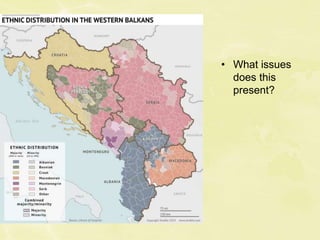
• What issues
does this
present?
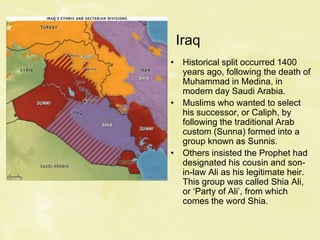
Iraq
• Historical split occurred 1400
years ago, following the death of
Muhammad in Medina, in
modern day Saudi Arabia.
• Muslims who wanted to select
his successor, or Caliph, by
following the traditional Arab
custom (Sunna) formed into a
group known as Sunnis.
• Others insisted the Prophet had
designated his cousin and son-
in-law Ali as his legitimate heir.
This group was called Shia Ali,
or ‘Party of Ali’, from which
comes the word Shia.
• A majority of Iraqi Arabs are Shias, but
Sunnis ran the show when Saddam
Hussein, himself Sunni, ruled Iraq.
• Saddam spread a false belief, still
surprisingly persistent in the country today,
that Sunnis were the real majority in Iraq.
• Thus, Sunnis felt, and still feel, entitled to
larger shares of political power than might
perhaps be warranted by their size
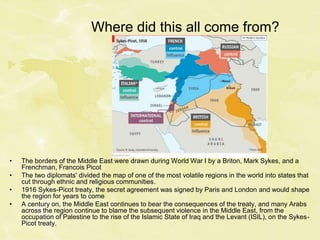
Where did this all come from?
• The borders of the Middle East were drawn during World War I by a Briton, Mark Sykes, and a
Frenchman, Francois Picot
• The two diplomats' divided the map of one of the most volatile regions in the world into states that
cut through ethnic and religious communities.
• 1916 Sykes-Picot treaty, the secret agreement was signed by Paris and London and would shape
the region for years to come
• A century on, the Middle East continues to bear the consequences of the treaty, and many Arabs
across the region continue to blame the subsequent violence in the Middle East, from the
occupation of Palestine to the rise of the Islamic State of Iraq and the Levant (ISIL), on the Sykes-
Picot treaty.
Contested Borders and Conflict
• Contested borders exist all over the world
fuelled by:
– Desire to unite culturally
– Gain access to resources
– Absorb other territories
• Any threat can cause instability made
worse if a superpower takes an interest.
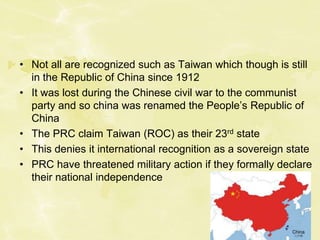
• Not all are recognized such as Taiwan which though is still
in the Republic of China since 1912
• It was lost during the Chinese civil war to the communist
party and so china was renamed the People’s Republic of
China
• The PRC claim Taiwan (ROC) as their 23rd state
• This denies it international recognition as a sovereign state
• PRC have threatened military action if they formally declare
their national independence
Consider the issues of the
Ukraine
• The area has been contested for a long
time
• Many empires have ruled the lands and
divided as they have seen fit
– Lithuania
– Poland
– Ottoman Empire
– Austria-Hungary
– Russian Empire
• The Crimea became contested as these
areas have a mix of cultures some identify
with Russia and some don’t
Ukraine Govt
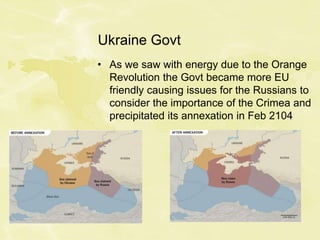
• As we saw with energy due to the Orange
Revolution the Govt became more EU
friendly causing issues for the Russians to
consider the importance of the Crimea and
precipitated its annexation in Feb 2104
Have a go…
• Evaluate the effects that contested borders
can have on some nations. (20)

Lesson 4 nation states

  • 1.
  • 2.
    Starter • Define • Identityand sovereignty • Explain why some countries have more restrictive policies on migration than others
  • 3.
    Learning Objectives • Definea nation state • Consider the issues that face countries due to ethnic diversity • Consider the implications of colonial history on modern day conflict
  • 4.
    Definition • A politicalentity that has sovereignty over its territory (Clear boundaries) • Authority to govern without outside interference • Recognition by other countries • Historically states take many forms – Self governing cities – Kingdoms – Empires • Its derived from a shared history of ethnicity and each vary in their composition and heritage
  • 5.
    Examples • Japan isthe worlds largest nation state with 127 million people • There is little cultural or ethnic diversity. • The UK formed in 1707 is fragmented in that the laws differ in each nation it isn’t uniform • Singapore • Iceland
  • 6.
    Origins • National bordersare often determined by the physical geography. • These are easy to differentiate e.g. the Pyrenees between France and Spain • They may however also be due to historical events such as that between N. Ireland and the Republic • Many are the result of colonial history drawn by foreign powers • These took no account of social geographies for example USA and Canada. • These can create difficulties and lead to ethnic tension
  • 7.
  • 8.
    Iraq • Historical splitoccurred 1400 years ago, following the death of Muhammad in Medina, in modern day Saudi Arabia. • Muslims who wanted to select his successor, or Caliph, by following the traditional Arab custom (Sunna) formed into a group known as Sunnis. • Others insisted the Prophet had designated his cousin and son- in-law Ali as his legitimate heir. This group was called Shia Ali, or ‘Party of Ali’, from which comes the word Shia.
  • 9.
    • A majorityof Iraqi Arabs are Shias, but Sunnis ran the show when Saddam Hussein, himself Sunni, ruled Iraq. • Saddam spread a false belief, still surprisingly persistent in the country today, that Sunnis were the real majority in Iraq. • Thus, Sunnis felt, and still feel, entitled to larger shares of political power than might perhaps be warranted by their size
  • 10.
    Where did thisall come from? • The borders of the Middle East were drawn during World War I by a Briton, Mark Sykes, and a Frenchman, Francois Picot • The two diplomats' divided the map of one of the most volatile regions in the world into states that cut through ethnic and religious communities. • 1916 Sykes-Picot treaty, the secret agreement was signed by Paris and London and would shape the region for years to come • A century on, the Middle East continues to bear the consequences of the treaty, and many Arabs across the region continue to blame the subsequent violence in the Middle East, from the occupation of Palestine to the rise of the Islamic State of Iraq and the Levant (ISIL), on the Sykes- Picot treaty.
  • 11.
    Contested Borders andConflict • Contested borders exist all over the world fuelled by: – Desire to unite culturally – Gain access to resources – Absorb other territories • Any threat can cause instability made worse if a superpower takes an interest.
  • 12.
    • Not allare recognized such as Taiwan which though is still in the Republic of China since 1912 • It was lost during the Chinese civil war to the communist party and so china was renamed the People’s Republic of China • The PRC claim Taiwan (ROC) as their 23rd state • This denies it international recognition as a sovereign state • PRC have threatened military action if they formally declare their national independence
  • 13.
    Consider the issuesof the Ukraine • The area has been contested for a long time • Many empires have ruled the lands and divided as they have seen fit – Lithuania – Poland – Ottoman Empire – Austria-Hungary – Russian Empire • The Crimea became contested as these areas have a mix of cultures some identify with Russia and some don’t
  • 14.
    Ukraine Govt • Aswe saw with energy due to the Orange Revolution the Govt became more EU friendly causing issues for the Russians to consider the importance of the Crimea and precipitated its annexation in Feb 2104
  • 15.
    Have a go… •Evaluate the effects that contested borders can have on some nations. (20)