Contents
 Glaciers
 Glacial Theory
 Important terms regarding Glaciers
 Anatomy of Glaciers
 Glacier Budget
 Types of Glaciers
 Erosional work of Glaciers
 Depositional work of Glaciers
 References
Glaciers
 A thick ice mass that originates on land from the
accumulation, compaction, & recrystallization of snow.
 Agents of erosion – acquire, transport and deposit
sediment
 Occupy ~10% of land area
 “Interrupts” hydrologic cycle by “locking up” water
Gravity and Slope are primary force of motion
Entire ice sheet moves 5 to 50 m/yr
Fastest movement within the center
Friction Slows down the sides
Glacial Theory
1. 1829 - Swiss engineer named J. Venetz first proposed that
glaciers had once been more extensive than at present. His
observations inspired Jean de Charpentier to begin a field study
of active glaciers.
2. 1837 - de Charpentier presented his results to the Swiss
naturalist, Louis Agassiz (considered to be the "Father of
Glaciation"), who developed the first comprehensive theory of
Glaciation.
Important Terms Regarding Glaciers
 Ablation zone: The area of a glacier where mass is lost through
melting or evaporation at a greater rate than snow and ice
accumulate.
 Accumulation zone: The area of a glacier where mass is
increased through snowfall at a greater rate than snow and ice
is lost through ablation.
 Basal sliding: The sliding of a glacier over the ground on a layer
of water.
 Firn: The granular ice formed by the recrystallization of snow;
also known as “Névé”.
 Glacial surge: The rapid forward movement of a glacier.
 Snow line: The elevation above which snow can form and remain
all year.
 Terminus: The leading edge of a glacier; also known as the
glacier snout.
 Till: A random mixture of finely crushed rock, sand, pebbles, and
boulders deposited by a glacier.
 Glacial Trough: Glacier flown constantly widens its
rock channel, when the ice is finally swept away
because of melting a deep steeped walled feature
appears which is known as “Glacial Trough”
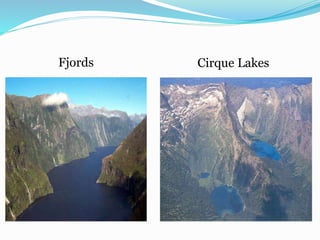
 Fiord: When floor of a trough open to the sea lies
below the level sea level, the water enters as the ice
front retreats making a deep narrow “Estuary”
know as “Fiord”
 Glaciation: The period during which the continental
ice sheet grows and spread outward over vast areas
is known as “Glaciation”
 Shelves: Presences of great plates of floating
Glaciers is known as “Shelves”
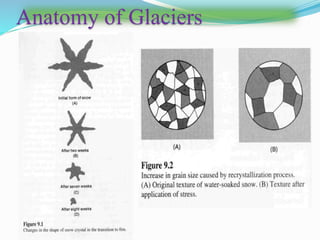
Anatomy of Glaciers
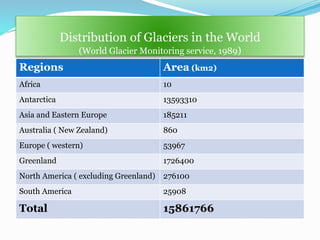
Distribution of Glaciers in the World
(World Glacier Monitoring service, 1989)
Regions Area (km2)
Africa 10
Antarctica 13593310
Asia and Eastern Europe 185211
Australia ( New Zealand) 860
Europe ( western) 53967
Greenland 1726400
North America ( excluding Greenland) 276100
South America 25908
Total 15861766
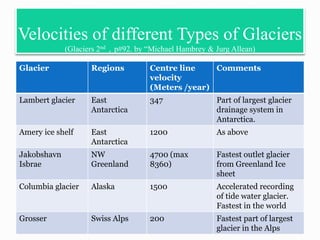
Velocities of different Types of Glaciers
(Glaciers 2nd , p#92. by “Michael Hambrey & Jurg Allean)
Glacier Regions Centre line
velocity
(Meters /year)
Comments
Lambert glacier East
Antarctica
347 Part of largest glacier
drainage system in
Antarctica.
Amery ice shelf East
Antarctica
1200 As above
Jakobshavn
Isbrae
NW
Greenland
4700 (max
8360)
Fastest outlet glacier
from Greenland Ice
sheet
Columbia glacier Alaska 1500 Accelerated recording
of tide water glacier.
Fastest in the world
Grosser Swiss Alps 200 Fastest part of largest
glacier in the Alps
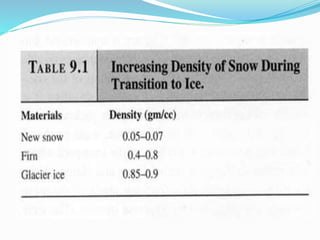
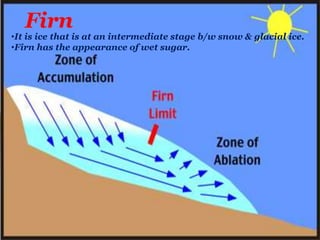
Firn
•It is ice that is at an intermediate stage b/w snow & glacial ice.
•Firn has the appearance of wet sugar.
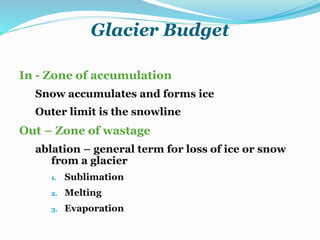
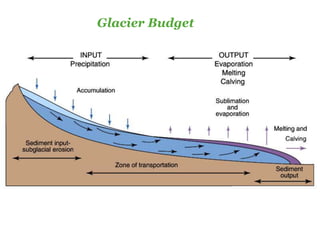
Glacier Budget
In - Zone of accumulation
Snow accumulates and forms ice
Outer limit is the snowline
Out – Zone of wastage
ablation – general term for loss of ice or snow
from a glacier
1. Sublimation
2. Melting
3. Evaporation
Glacier Budget
Types of Glacier
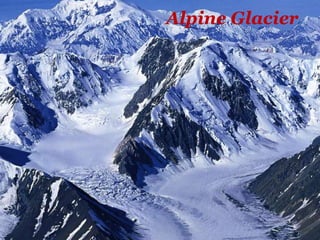
1. Valley (Alpine)
 Found in mountainous areas
 Smaller than ice sheets
 Lengths greater than widths
 Only cover a small region
 Transform V-shaped valleys into U -shaped
valleys
Alpine Glacier
Types of Glacier
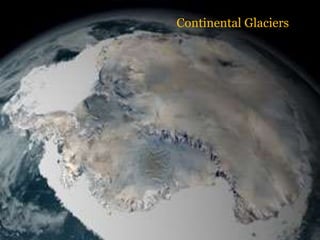
2. Ice sheets (Continental Glacier)
 Large scale – cover 10% of Earth’s land
 Found in polar regions
 Greenland – 1.7 million km2
 Antarctica – 1.4 million km2
Continental Glaciers
Erosional work of Glaciers
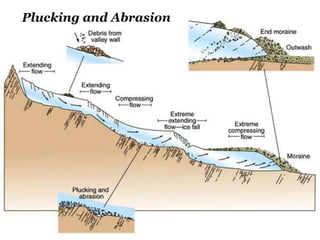
Plucking – loosen and lift blocks of rock
Abrasion – sediment in ice acts as giant “sandpaper”
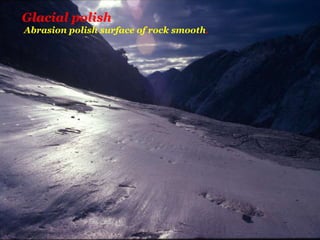
 Abrasion polish surface of rock smooth. This geomorphic
feature is known as “Glacial Polish”.
 Glacial melt water can have a light, cloudy appearance,
and is called “Glacial Milk”.
 Creates Rock flour – very fine-grained material
 Creates Striations – grooves scratched in bedrock
that indicate direction of ice movement
Plucking and Abrasion
Erosional Work of Glaciers
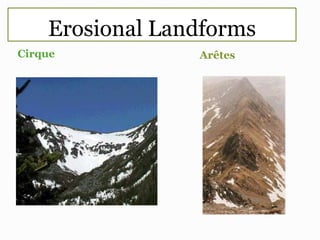
 Cirque
 Arête
 Col
 Horn
 Crevasse
 Striations
 Glacial Polish
 Cirque Glacier
 Tarn Lakes
Cirque Arêtes
Erosional Landforms
Cirque Arêtes
A scooped-out,
amphitheater shaped basin
at the head of an alpine
glacier.
A sharp saw tooth or
serrated ridge that divides
two cirque basins.
Knife-edge in French
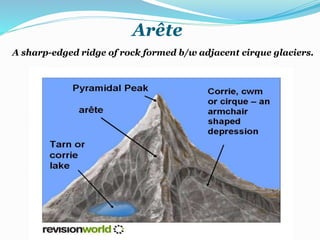
Arête
A sharp-edged ridge of rock formed b/w adjacent cirque glaciers.
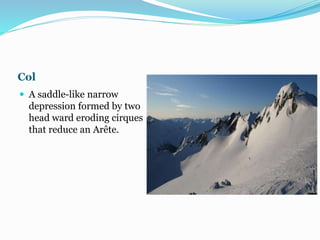
Col
 A saddle-like narrow
depression formed by two
head ward eroding cirques
that reduce an Arête.
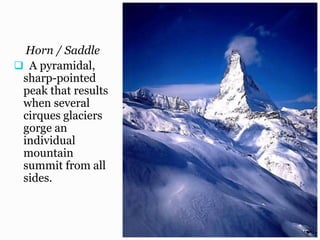
Horn / Saddle
 A pyramidal,
sharp-pointed
peak that results
when several
cirques glaciers
gorge an
individual
mountain
summit from all
sides.
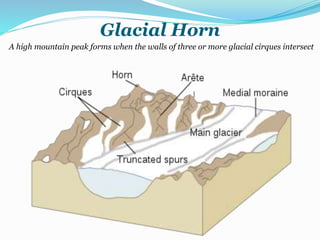
Glacial Horn
A high mountain peak forms when the walls of three or more glacial cirques intersect
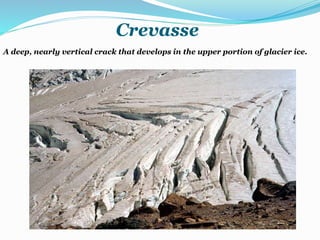
Crevasse
A deep, nearly vertical crack that develops in the upper portion of glacier ice.
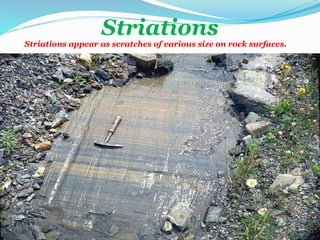
Striations
Striations appear as scratches of various size on rock surfaces.
Glacial polish
Abrasion polish surface of rock smooth.
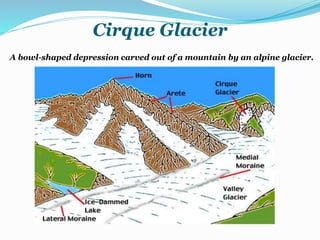
Cirque Glacier
A bowl-shaped depression carved out of a mountain by an alpine glacier.
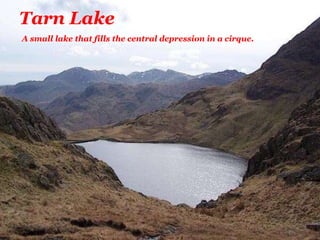
Tarn Lake
A small lake that fills the central depression in a cirque.
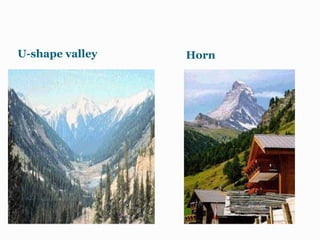
U-shape valley Horn
Fjords Cirque Lakes
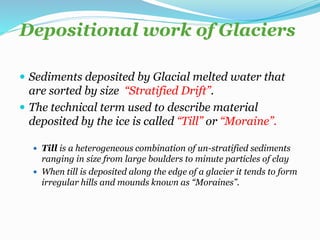
Depositional work of Glaciers
 Sediments deposited by Glacial melted water that
are sorted by size “Stratified Drift”.
 The technical term used to describe material
deposited by the ice is called “Till” or “Moraine”.
 Till is a heterogeneous combination of un-stratified sediments
ranging in size from large boulders to minute particles of clay
 When till is deposited along the edge of a glacier it tends to form
irregular hills and mounds known as “Moraines”.
Depositional Work of Glaciers
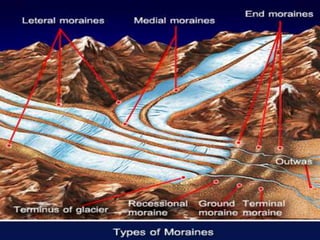
 Terminal Moraine
 Medial Moraine
 Lateral Moraine
 Recessional Moraines
 Erratic
 Esker
 Kame
 Drumlins
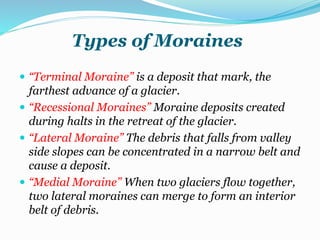
Types of Moraines
 “Terminal Moraine” is a deposit that mark, the
farthest advance of a glacier.
 “Recessional Moraines” Moraine deposits created
during halts in the retreat of the glacier.
 “Lateral Moraine” The debris that falls from valley
side slopes can be concentrated in a narrow belt and
cause a deposit.
 “Medial Moraine” When two glaciers flow together,
two lateral moraines can merge to form an interior
belt of debris.
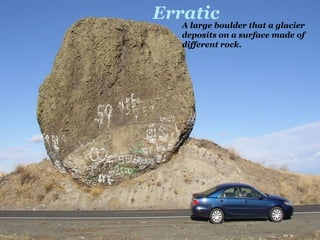
Erratic
A large boulder that a glacier
deposits on a surface made of
different rock.
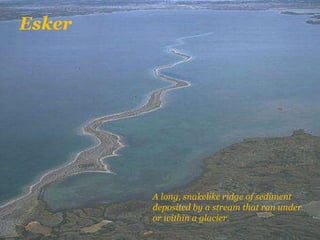
Esker
A long, snakelike ridge of sediment
deposited by a stream that ran under
or within a glacier.
A steep-sided, conical mound or
hill formed of glacial drift that is
created when sediment is
washed into a depression on the
top surface of a glacier and then
deposited on the ground below
when the glacier melts away.
Kame
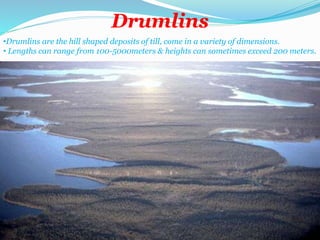
Drumlins
•Drumlins are the hill shaped deposits of till, come in a variety of dimensions.
• Lengths can range from 100-5000meters & heights can sometimes exceed 200 meters.
References
 http://nsidc.org/glaciers/questions/what.html
 http://www4.uwsp.edu/geo/faculty/lemke/geol370/lecture_notes/09_glacial_erosion_landfor
ms.html
 http://www.uvm.edu/whale/GlaciersWhatAre.html
 http://geography.about.com/od/geographyintern/a/glaciers.htm
 http://www.cliffsnotes.com/study_guide/Types-of-Glaciers.topicArticleId-9605,articleId-
9518.html
 http://www.angelfire.com/alt/bfeldman_geology115/Geology-pg3.htm
 http://www.physicalgeography.net/fundamentals/10af.html
 http://www.geography-site.co.uk/pages/physical/glaciers/deposit.html
 http://www.scienceclarified.com/landforms/Faults-to-Mountains/Glacial-Landforms-and-
Features.html#b

Glaciers and its types

  • 2.
    Contents  Glaciers  GlacialTheory  Important terms regarding Glaciers  Anatomy of Glaciers  Glacier Budget  Types of Glaciers  Erosional work of Glaciers  Depositional work of Glaciers  References
  • 3.
    Glaciers  A thickice mass that originates on land from the accumulation, compaction, & recrystallization of snow.  Agents of erosion – acquire, transport and deposit sediment  Occupy ~10% of land area  “Interrupts” hydrologic cycle by “locking up” water Gravity and Slope are primary force of motion Entire ice sheet moves 5 to 50 m/yr Fastest movement within the center Friction Slows down the sides
  • 4.
    Glacial Theory 1. 1829- Swiss engineer named J. Venetz first proposed that glaciers had once been more extensive than at present. His observations inspired Jean de Charpentier to begin a field study of active glaciers. 2. 1837 - de Charpentier presented his results to the Swiss naturalist, Louis Agassiz (considered to be the "Father of Glaciation"), who developed the first comprehensive theory of Glaciation.
  • 5.
    Important Terms RegardingGlaciers  Ablation zone: The area of a glacier where mass is lost through melting or evaporation at a greater rate than snow and ice accumulate.  Accumulation zone: The area of a glacier where mass is increased through snowfall at a greater rate than snow and ice is lost through ablation.  Basal sliding: The sliding of a glacier over the ground on a layer of water.  Firn: The granular ice formed by the recrystallization of snow; also known as “Névé”.  Glacial surge: The rapid forward movement of a glacier.  Snow line: The elevation above which snow can form and remain all year.  Terminus: The leading edge of a glacier; also known as the glacier snout.  Till: A random mixture of finely crushed rock, sand, pebbles, and boulders deposited by a glacier.
  • 6.
     Glacial Trough:Glacier flown constantly widens its rock channel, when the ice is finally swept away because of melting a deep steeped walled feature appears which is known as “Glacial Trough”  Fiord: When floor of a trough open to the sea lies below the level sea level, the water enters as the ice front retreats making a deep narrow “Estuary” know as “Fiord”  Glaciation: The period during which the continental ice sheet grows and spread outward over vast areas is known as “Glaciation”  Shelves: Presences of great plates of floating Glaciers is known as “Shelves”
  • 7.
  • 9.
    Distribution of Glaciersin the World (World Glacier Monitoring service, 1989) Regions Area (km2) Africa 10 Antarctica 13593310 Asia and Eastern Europe 185211 Australia ( New Zealand) 860 Europe ( western) 53967 Greenland 1726400 North America ( excluding Greenland) 276100 South America 25908 Total 15861766
  • 10.
    Velocities of differentTypes of Glaciers (Glaciers 2nd , p#92. by “Michael Hambrey & Jurg Allean) Glacier Regions Centre line velocity (Meters /year) Comments Lambert glacier East Antarctica 347 Part of largest glacier drainage system in Antarctica. Amery ice shelf East Antarctica 1200 As above Jakobshavn Isbrae NW Greenland 4700 (max 8360) Fastest outlet glacier from Greenland Ice sheet Columbia glacier Alaska 1500 Accelerated recording of tide water glacier. Fastest in the world Grosser Swiss Alps 200 Fastest part of largest glacier in the Alps
  • 11.
    Firn •It is icethat is at an intermediate stage b/w snow & glacial ice. •Firn has the appearance of wet sugar.
  • 12.
    Glacier Budget In -Zone of accumulation Snow accumulates and forms ice Outer limit is the snowline Out – Zone of wastage ablation – general term for loss of ice or snow from a glacier 1. Sublimation 2. Melting 3. Evaporation
  • 13.
  • 14.
    Types of Glacier 1.Valley (Alpine)  Found in mountainous areas  Smaller than ice sheets  Lengths greater than widths  Only cover a small region  Transform V-shaped valleys into U -shaped valleys
  • 15.
  • 16.
    Types of Glacier 2.Ice sheets (Continental Glacier)  Large scale – cover 10% of Earth’s land  Found in polar regions  Greenland – 1.7 million km2  Antarctica – 1.4 million km2
  • 17.
  • 18.
    Erosional work ofGlaciers Plucking – loosen and lift blocks of rock Abrasion – sediment in ice acts as giant “sandpaper”  Abrasion polish surface of rock smooth. This geomorphic feature is known as “Glacial Polish”.  Glacial melt water can have a light, cloudy appearance, and is called “Glacial Milk”.  Creates Rock flour – very fine-grained material  Creates Striations – grooves scratched in bedrock that indicate direction of ice movement
  • 19.
  • 20.
    Erosional Work ofGlaciers  Cirque  Arête  Col  Horn  Crevasse  Striations  Glacial Polish  Cirque Glacier  Tarn Lakes
  • 21.
  • 22.
    Cirque Arêtes A scooped-out, amphitheatershaped basin at the head of an alpine glacier. A sharp saw tooth or serrated ridge that divides two cirque basins. Knife-edge in French
  • 23.
    Arête A sharp-edged ridgeof rock formed b/w adjacent cirque glaciers.
  • 24.
    Col  A saddle-likenarrow depression formed by two head ward eroding cirques that reduce an Arête.
  • 25.
    Horn / Saddle A pyramidal, sharp-pointed peak that results when several cirques glaciers gorge an individual mountain summit from all sides.
  • 26.
    Glacial Horn A highmountain peak forms when the walls of three or more glacial cirques intersect
  • 27.
    Crevasse A deep, nearlyvertical crack that develops in the upper portion of glacier ice.
  • 28.
    Striations Striations appear asscratches of various size on rock surfaces.
  • 29.
    Glacial polish Abrasion polishsurface of rock smooth.
  • 30.
    Cirque Glacier A bowl-shapeddepression carved out of a mountain by an alpine glacier.
  • 31.
    Tarn Lake A smalllake that fills the central depression in a cirque.
  • 32.
  • 33.
  • 34.
    Depositional work ofGlaciers  Sediments deposited by Glacial melted water that are sorted by size “Stratified Drift”.  The technical term used to describe material deposited by the ice is called “Till” or “Moraine”.  Till is a heterogeneous combination of un-stratified sediments ranging in size from large boulders to minute particles of clay  When till is deposited along the edge of a glacier it tends to form irregular hills and mounds known as “Moraines”.
  • 35.
    Depositional Work ofGlaciers  Terminal Moraine  Medial Moraine  Lateral Moraine  Recessional Moraines  Erratic  Esker  Kame  Drumlins
  • 36.
    Types of Moraines “Terminal Moraine” is a deposit that mark, the farthest advance of a glacier.  “Recessional Moraines” Moraine deposits created during halts in the retreat of the glacier.  “Lateral Moraine” The debris that falls from valley side slopes can be concentrated in a narrow belt and cause a deposit.  “Medial Moraine” When two glaciers flow together, two lateral moraines can merge to form an interior belt of debris.
  • 38.
    Erratic A large boulderthat a glacier deposits on a surface made of different rock.
  • 39.
    Esker A long, snakelikeridge of sediment deposited by a stream that ran under or within a glacier.
  • 40.
    A steep-sided, conicalmound or hill formed of glacial drift that is created when sediment is washed into a depression on the top surface of a glacier and then deposited on the ground below when the glacier melts away. Kame
  • 41.
    Drumlins •Drumlins are thehill shaped deposits of till, come in a variety of dimensions. • Lengths can range from 100-5000meters & heights can sometimes exceed 200 meters.
  • 42.
    References  http://nsidc.org/glaciers/questions/what.html  http://www4.uwsp.edu/geo/faculty/lemke/geol370/lecture_notes/09_glacial_erosion_landfor ms.html http://www.uvm.edu/whale/GlaciersWhatAre.html  http://geography.about.com/od/geographyintern/a/glaciers.htm  http://www.cliffsnotes.com/study_guide/Types-of-Glaciers.topicArticleId-9605,articleId- 9518.html  http://www.angelfire.com/alt/bfeldman_geology115/Geology-pg3.htm  http://www.physicalgeography.net/fundamentals/10af.html  http://www.geography-site.co.uk/pages/physical/glaciers/deposit.html  http://www.scienceclarified.com/landforms/Faults-to-Mountains/Glacial-Landforms-and- Features.html#b