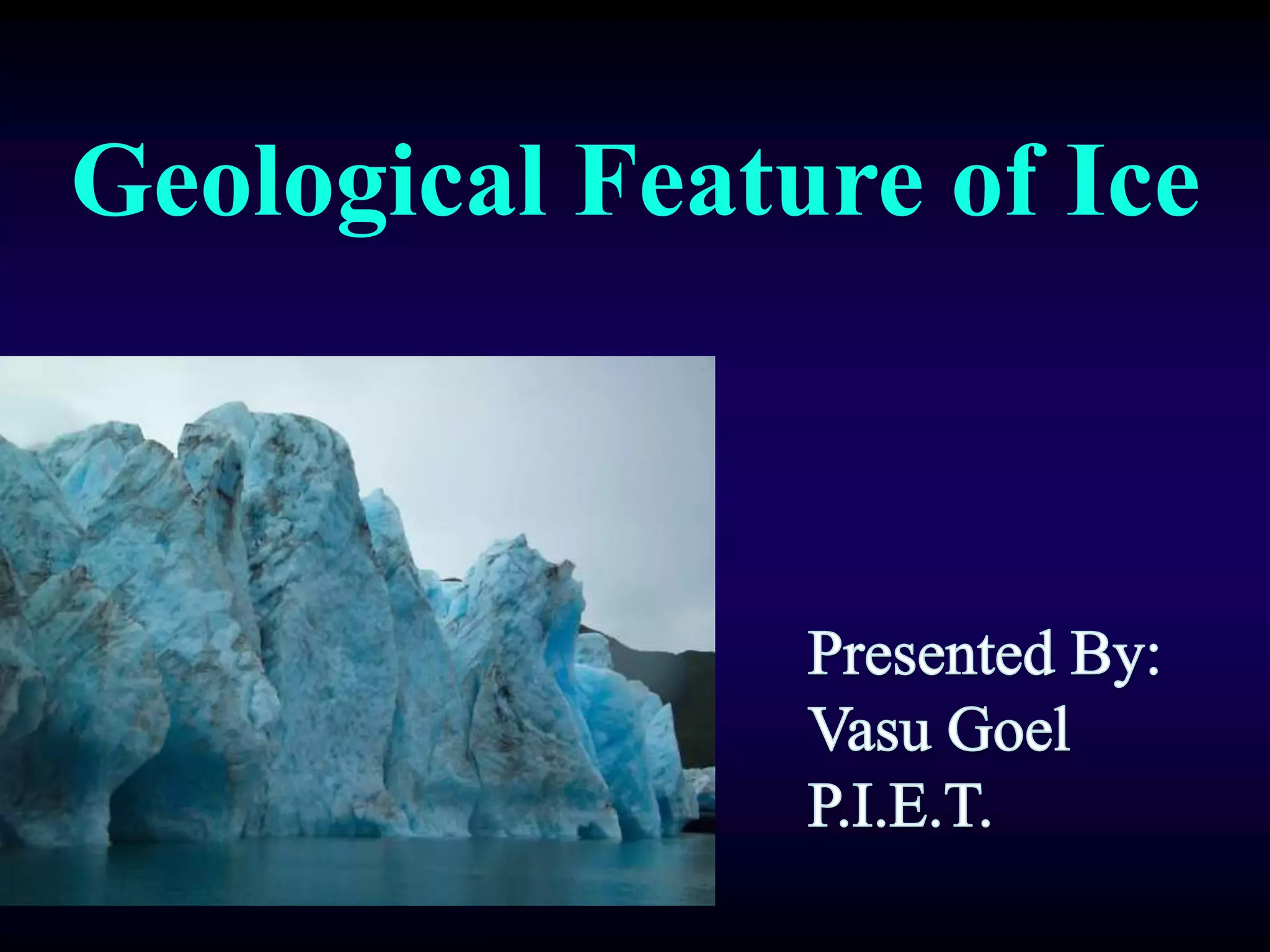
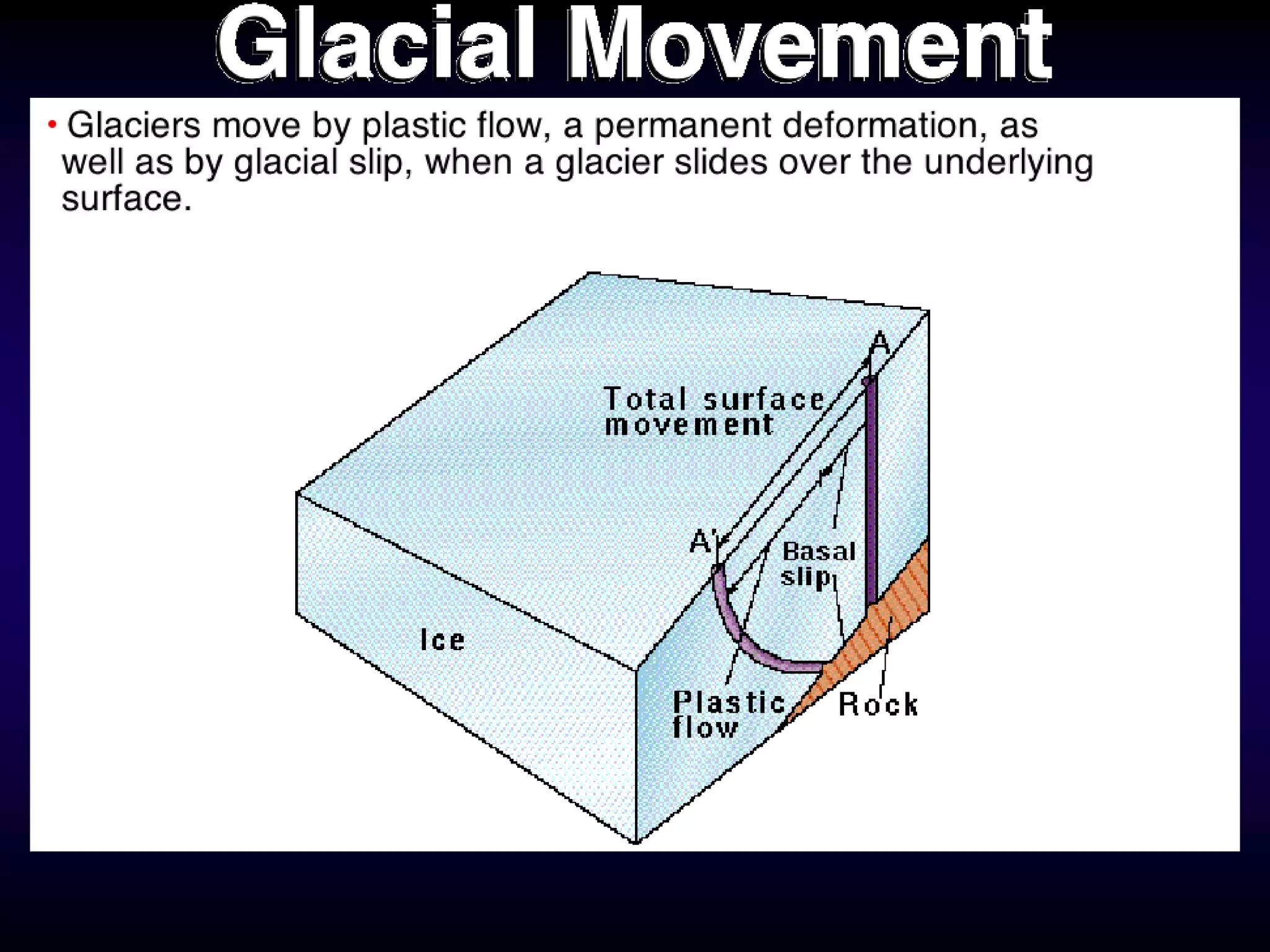
Geological Feature of Ice
• Glacier
> a mass of ice composed of recrystallized
compacted snow thatflows under its own
weight on land.
• Presently glaciers cover of the
Earth's surface.
• Glaciers occur in Greenland and
Antarctica and in higher mountain
ranges.
• Glacier
> a mass of ice composed of recrystallized
compacted snow thatflows under its own
weight on land.
• Presently glaciers cover of the
Earth's surface.
• Glaciers occur in Greenland and
Antarctica and in higher mountain
ranges.
11//
1010
Glaciers and GlaciationGlaciers and Glaciation
Glaciers-
Important in understanding global scale climate change
Related to all 5 of the Earth’s systems
Exosphere- changes in the amount of sunlight cause
glaciations
Hydrosphere- glacial ice is frozen water, part of the
hydrosphere
Geosphere- Glacial ice flows over and modifies land
Atmosphere- alteration of global atmospheric patterns
contributes to glacial ice formation
Biosphere- ice displaces animals and plants
• Glacial times represent significant time
periods in Earth's history
• Represent major climatic departures
from the modern on a Global Scale
• Cyclic in Nature
• Man's Influence???
• Glacial Ice contains records of
atmospheric changes
• Glacial times represent significant time
periods in Earth's history
• Represent major climatic departures
from the modern on a Global Scale
• Cyclic in Nature
• Man's Influence???
• Glacial Ice contains records of past
atmospheric changes
Importance
Proterozoic, Pennsylvanian, Pleistocene
• Snowflakes are melted & deformed by the pressure of
overlying snow, becoming granular snow, then firn, and
finally interlocking crystals of glacial ice.
Origin of ice
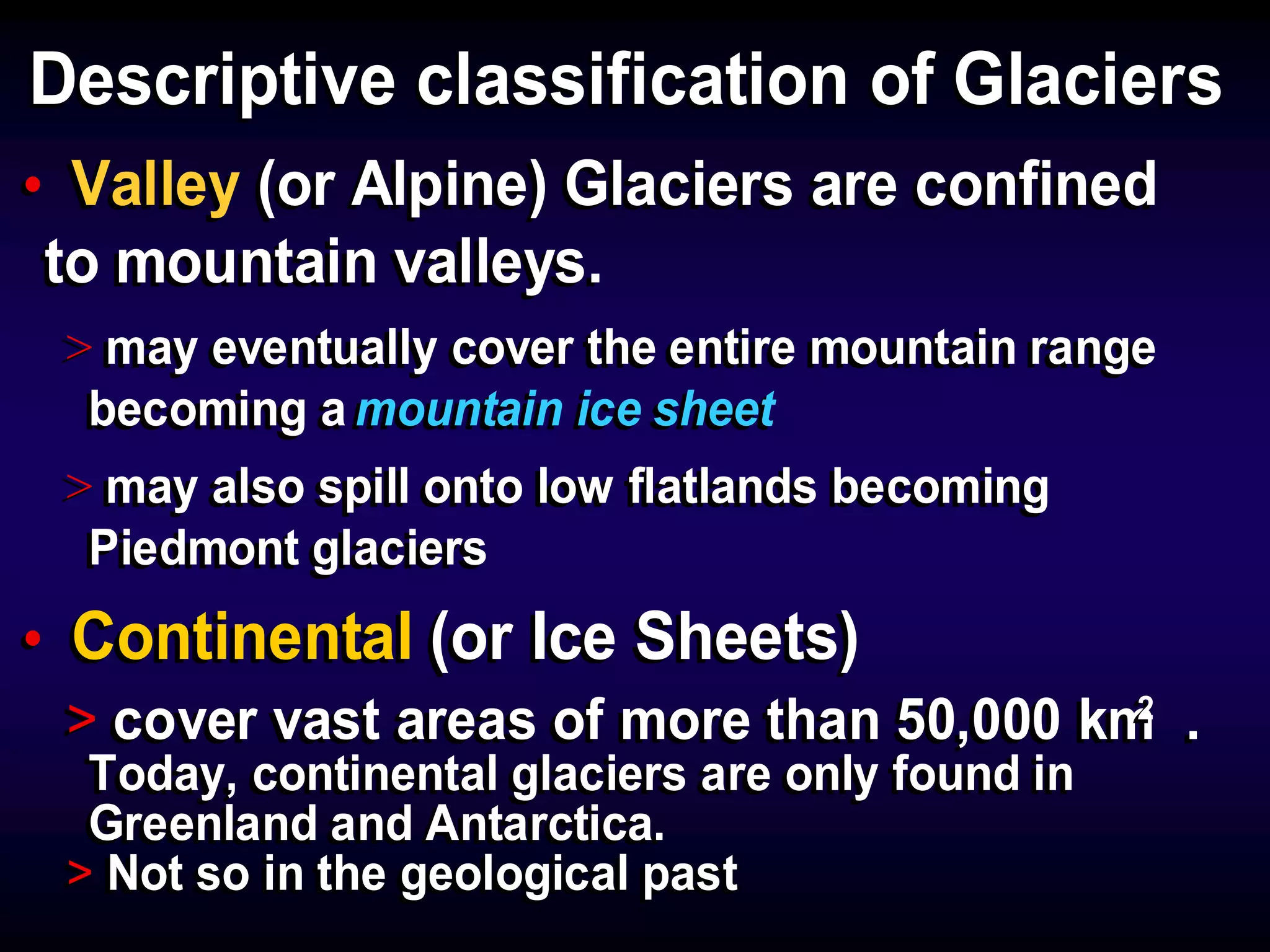
Descriptive classification of GlaciersDescriptive classification of Glaciers
• Valley (or Alpine) Glaciers are confined
to mountain valleys.
> may eventually cover the entire mountain range
becoming a mountain ice sheet
> may also spill onto low flatlands becoming
Piedmont glaciers
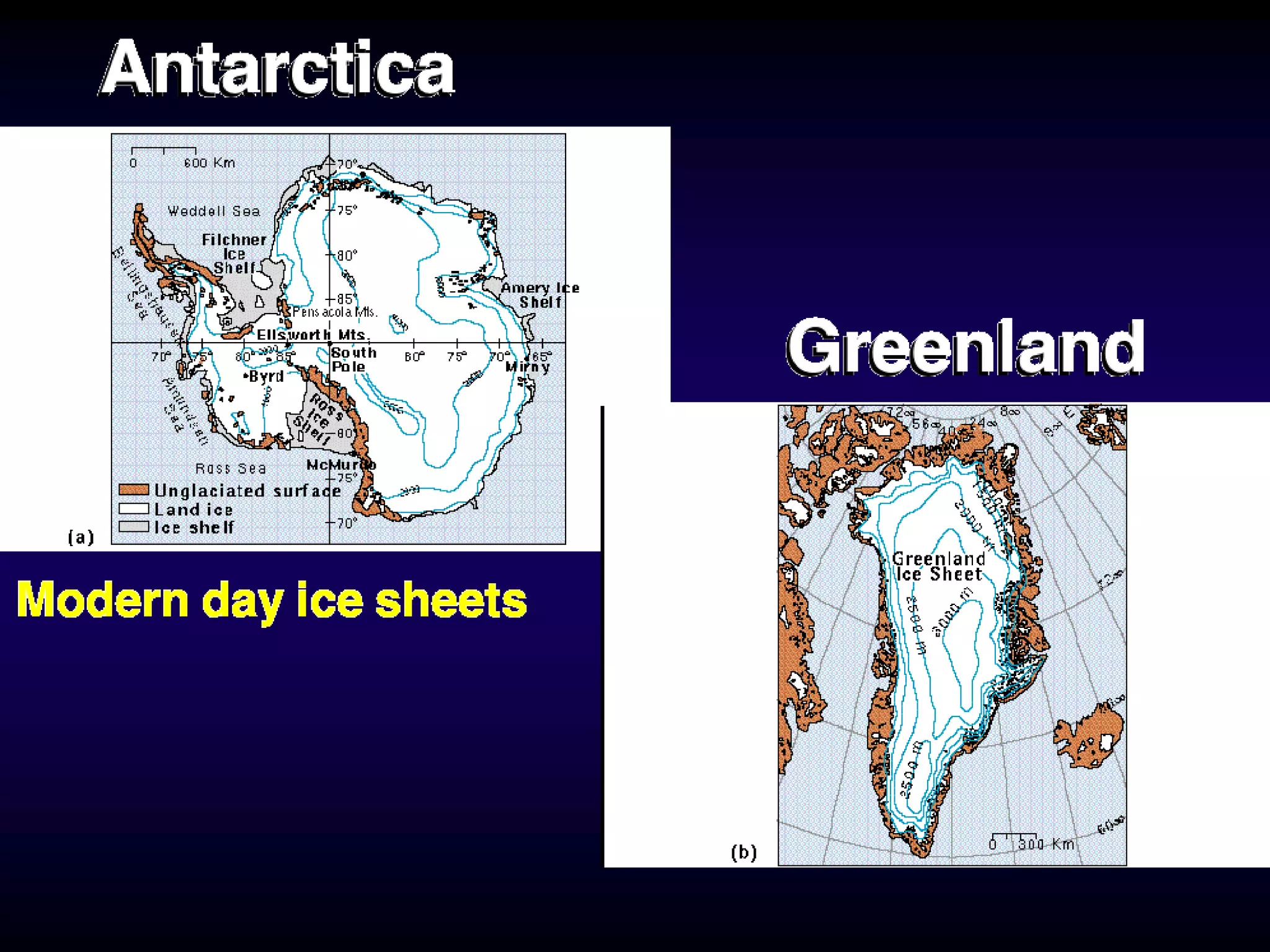
• Continental (or Ice Sheets)
> cover vast areas of more than 50,000 km .
Today, continental glaciers are only found in
Greenland and Antarctica.
> Not so in the geological past
• Valley (or Alpine) Glaciers are confined
to mountain valleys.
> may eventually cover the entire mountain range
becoming a mountain ice sheet
> may also spill onto low flatlands becoming
Piedmont glaciers
• Continental (or Ice Sheets)
> cover vast areas of more than 50,000 km .
Today, continental glaciers are only found in
Greenland and Antarctica.
> Not so in the geological past
22
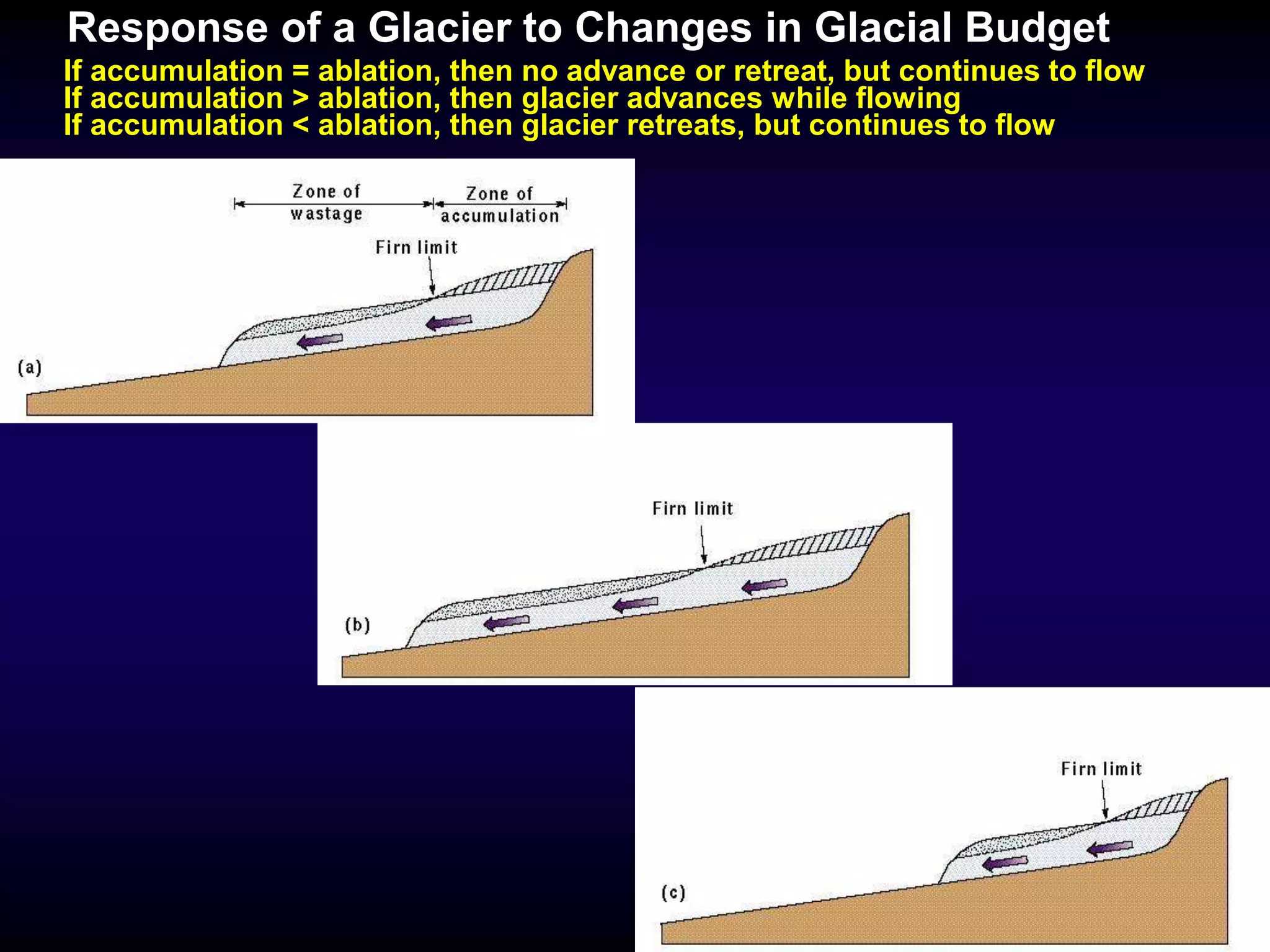
Response of a Glacier to Changes in Glacial Budget
If accumulation = ablation, then no advance or retreat, but continues to flow
If accumulation > ablation, then glacier advances while flowing
If accumulation < ablation, then glacier retreats, but continues to flow
Effects of GlaciersEffects of Glaciers
• Fills in the low spots
> valleys and basins get filled in w/ sediment
• Knocks down the high spots
> mountains and hills get eroded
• Reroutes the drainages
> valley filling may block streams, causing
new paths to be taken
• Deposits accumulate in specific
places related to flow and meltwater
characteristics
• Fills in the low spots
> valleys and basins get filled in w/ sediment
• Knocks down the high spots
> mountains and hills get eroded
• Reroutes the drainages
> valley filling may block streams, causing
new paths to be taken
• Deposits accumulate in specific
places related to flow and meltwater
characteristics
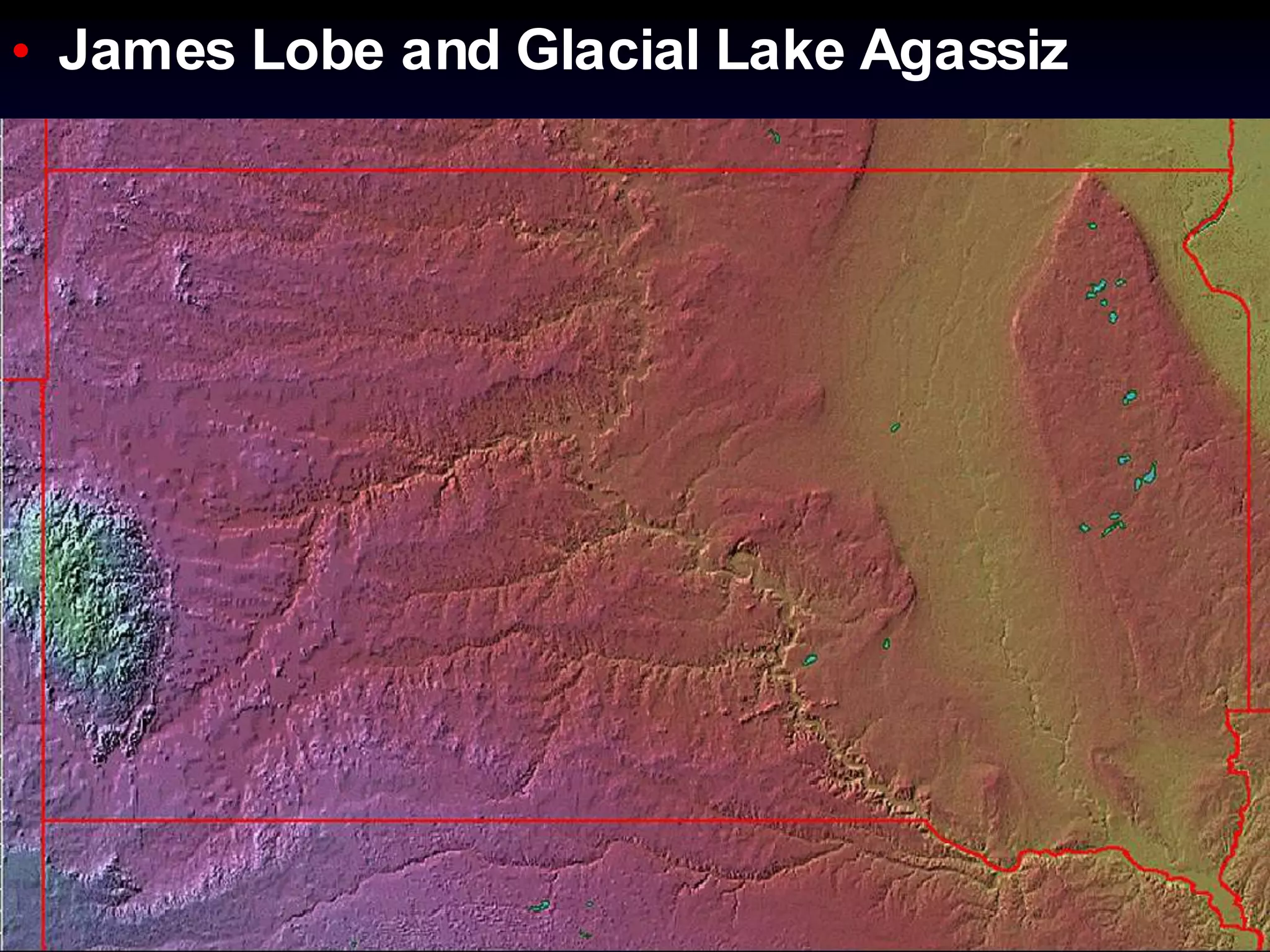
• James Lobe and Glacial Lake Agassiz
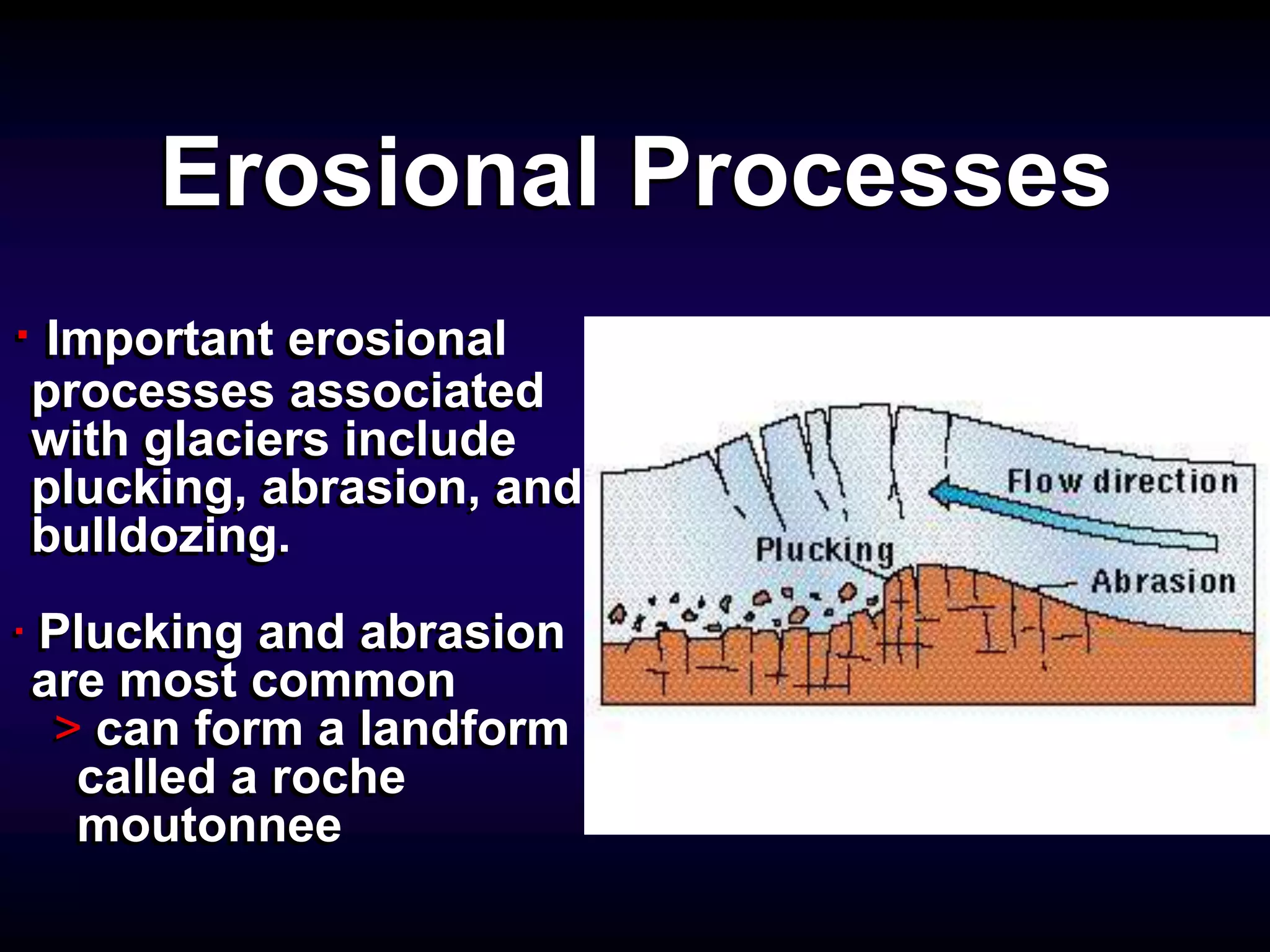
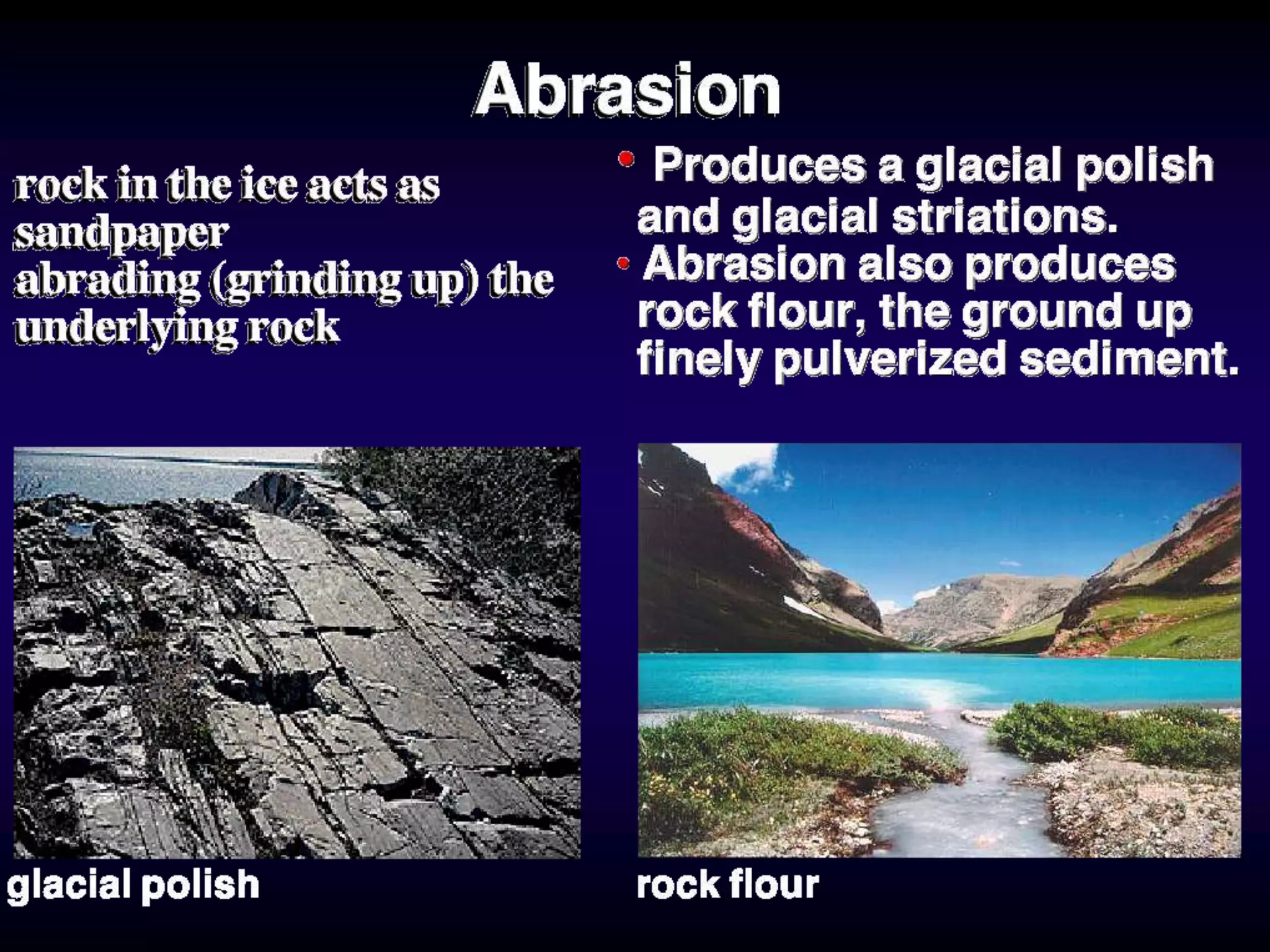
Erosional ProcessesErosional Processes
・Important erosional
processes associated
with glaciers include
plucking, abrasion, and
bulldozing.
・ Plucking and abrasion
are most common
> can form a landform
called a roche
moutonnee
・Important erosional
processes associated
with glaciers include
plucking, abrasion, and
bulldozing.
・ Plucking and abrasion
are most common
> can form a landform
called a roche
moutonnee
Erosional features
Roche Moutonnée
Erosional features
•Hanging Valley
•Horn
•Arete
•Cirque
•U-shaped trough
•Col
•Truncated Spurs
Glacial DepositsGlacial Deposits
• glacial drift- A general term
refering to sediment formed by any
glacial action.
• Till (Diamicton) poorly sorted,
unlayered material directly
deposited by a glacier;
• Stratified drift (Outwash) sorted,
layered sediment usually
deposited by meltwater streams.
• Glacial drift- A general term
referring to sediment formed by
Any glacial action.
• Till (Diamicton)- poorly sorted,
unlayered material directly
deposited by a glacier; ice contact
• Stratified drift (Outwash)- sorted,
layered sediment usually
deposited by meltwater streams.
Proglacial or ice contact
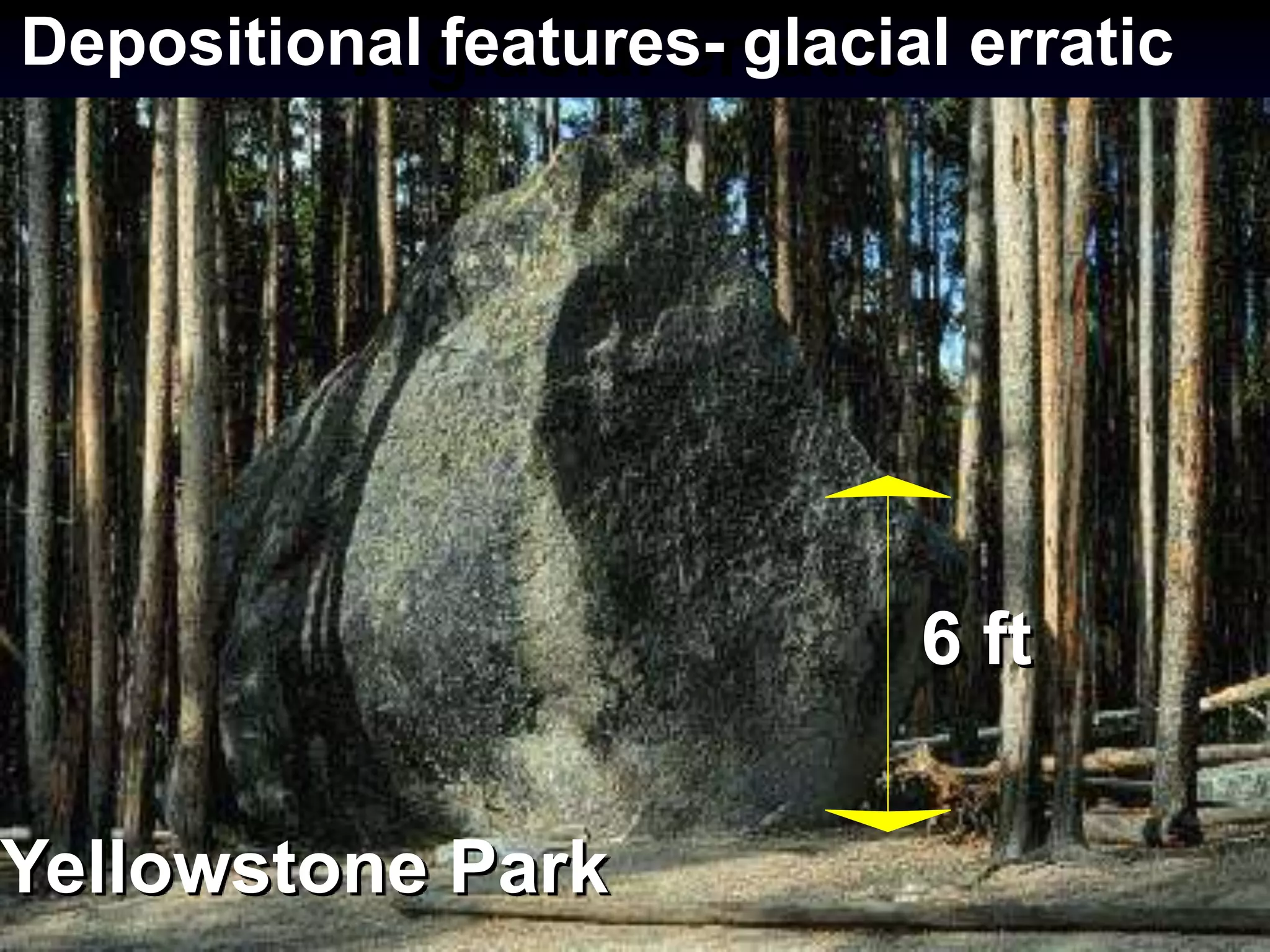
A glacial erraticDepositional features- glacial erratic
6 ft
Yellowstone Park
Sediments-
Glacial Till exposed in Iowa
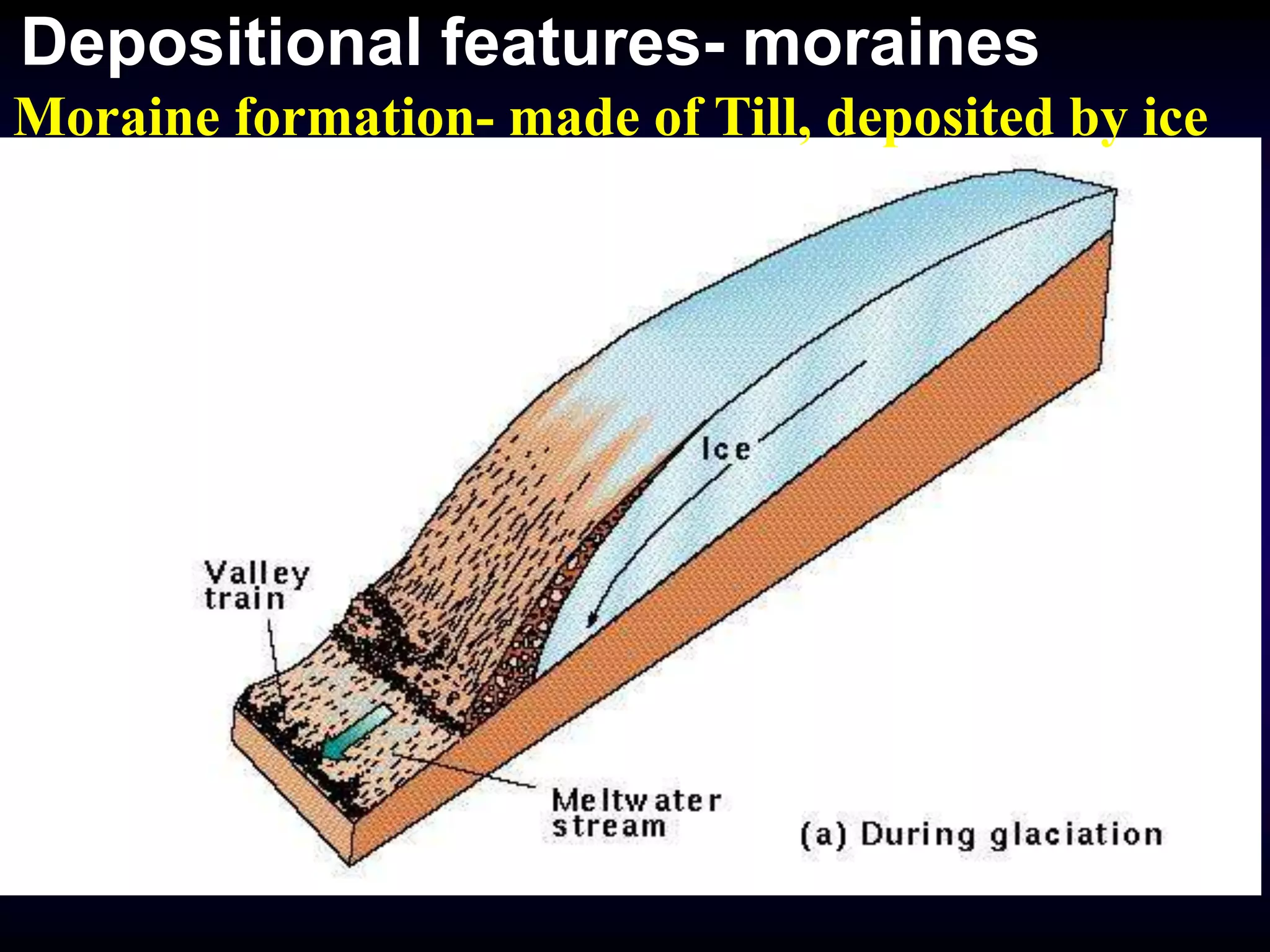
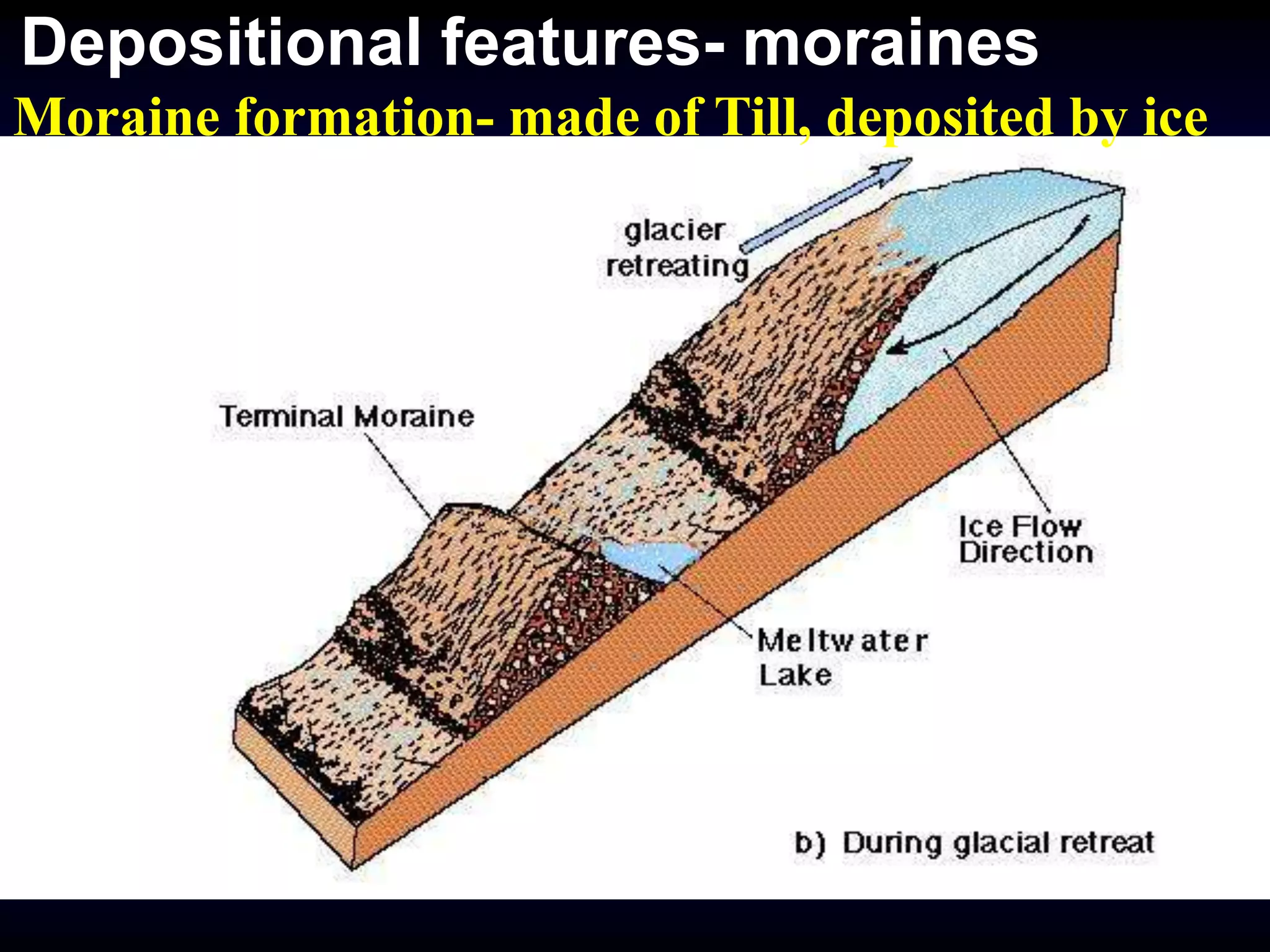
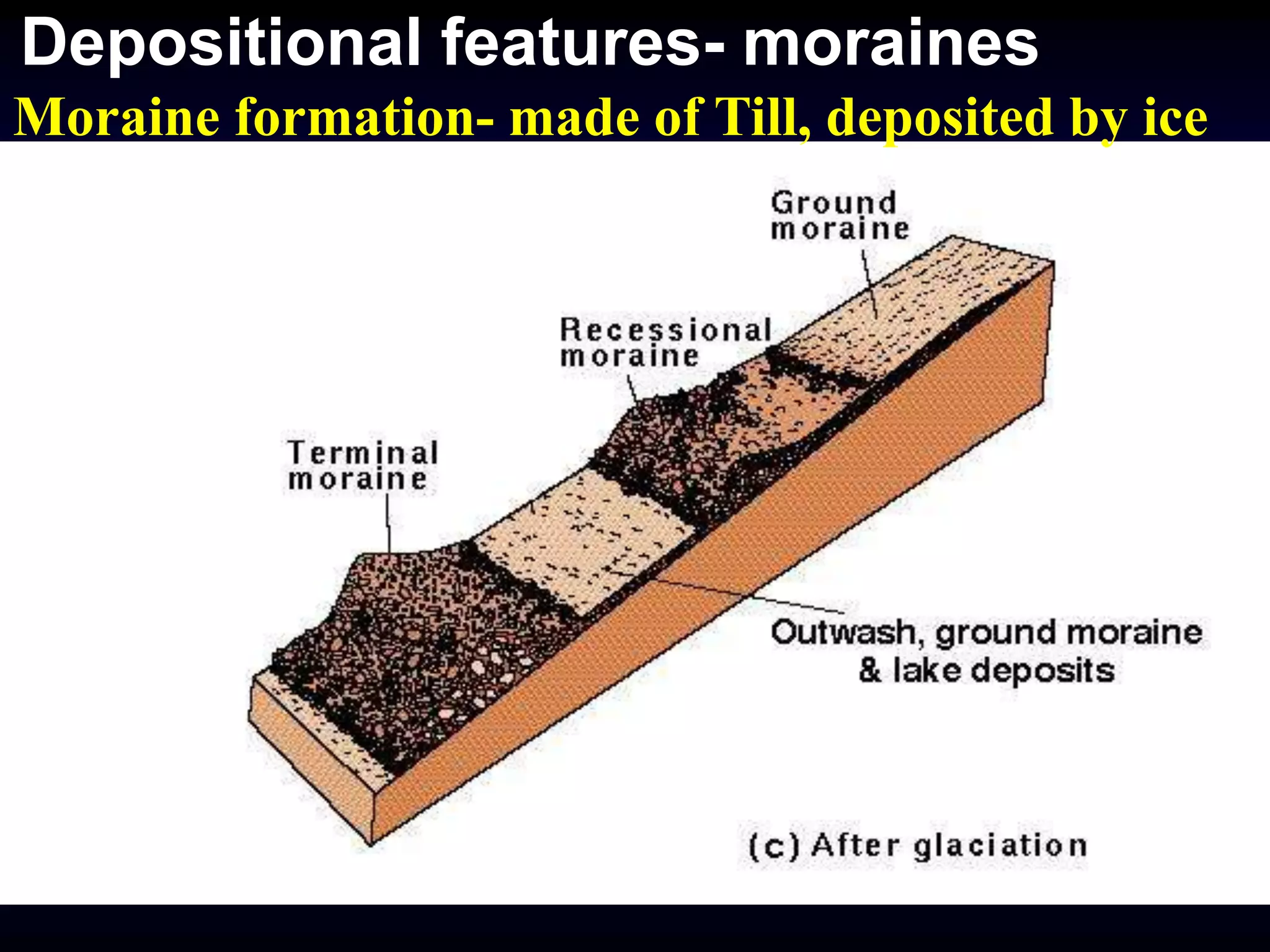
Moraine formation- made of Till, deposited by ice
Depositional features- moraines
Moraine formation- made of Till, deposited by ice
Depositional features- moraines
Moraine formation- made of Till, deposited by ice
Depositional features- moraines
・ Lateral and Medial
Moraines are sediment
eroded from the valley
sides and deposited by
a glacier. They often
appear as dark stripes
in a glacier.
・ Lateral and Medial
Moraines are sediment
eroded from the valley
sides and deposited by
a glacier. They often
appear as dark stripes
in a glacier.
Lateral
moraines
Lateral
moraines
Medial
moraines
Medial
moraines
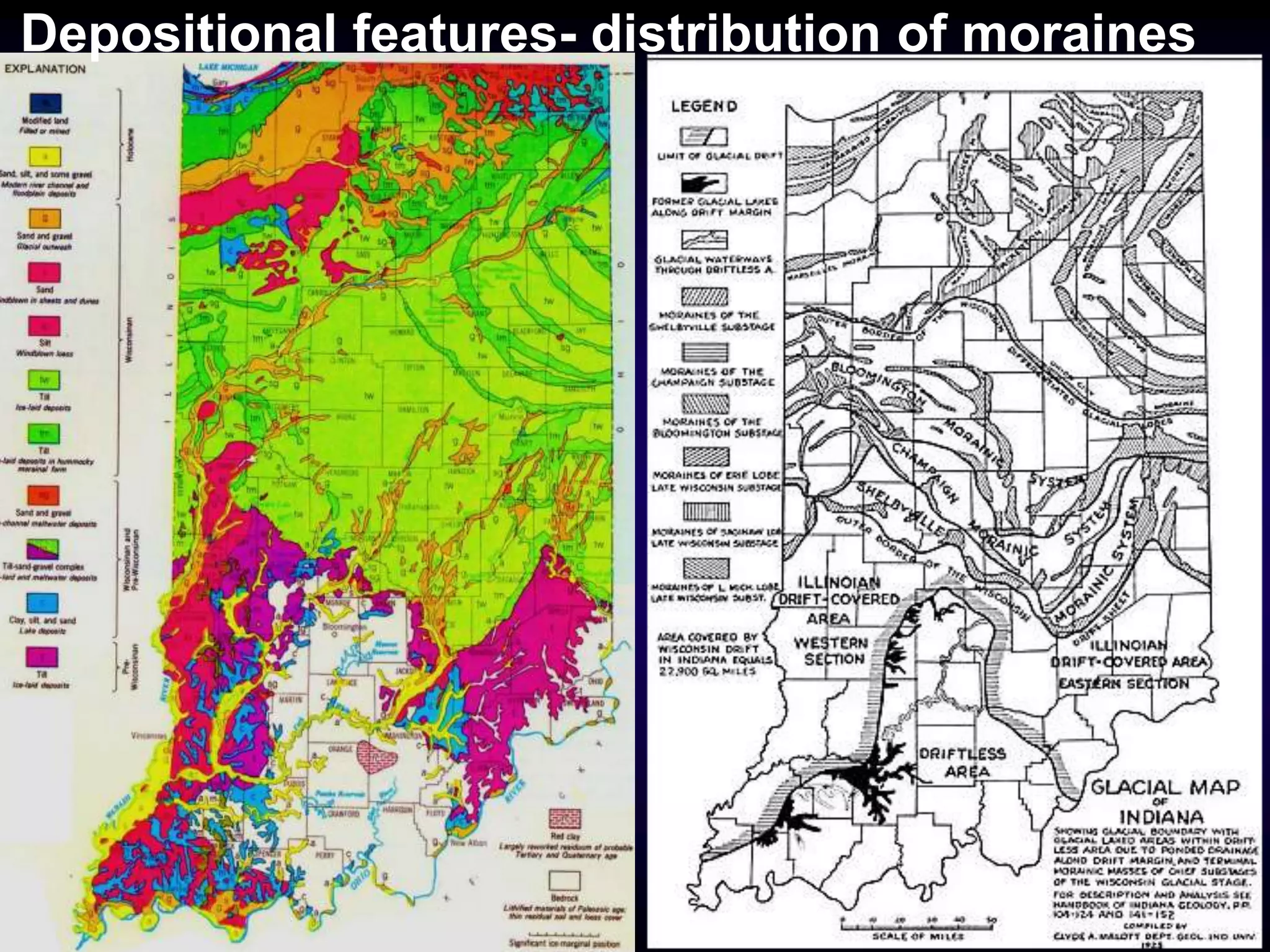
Depositional features- distribution of moraines
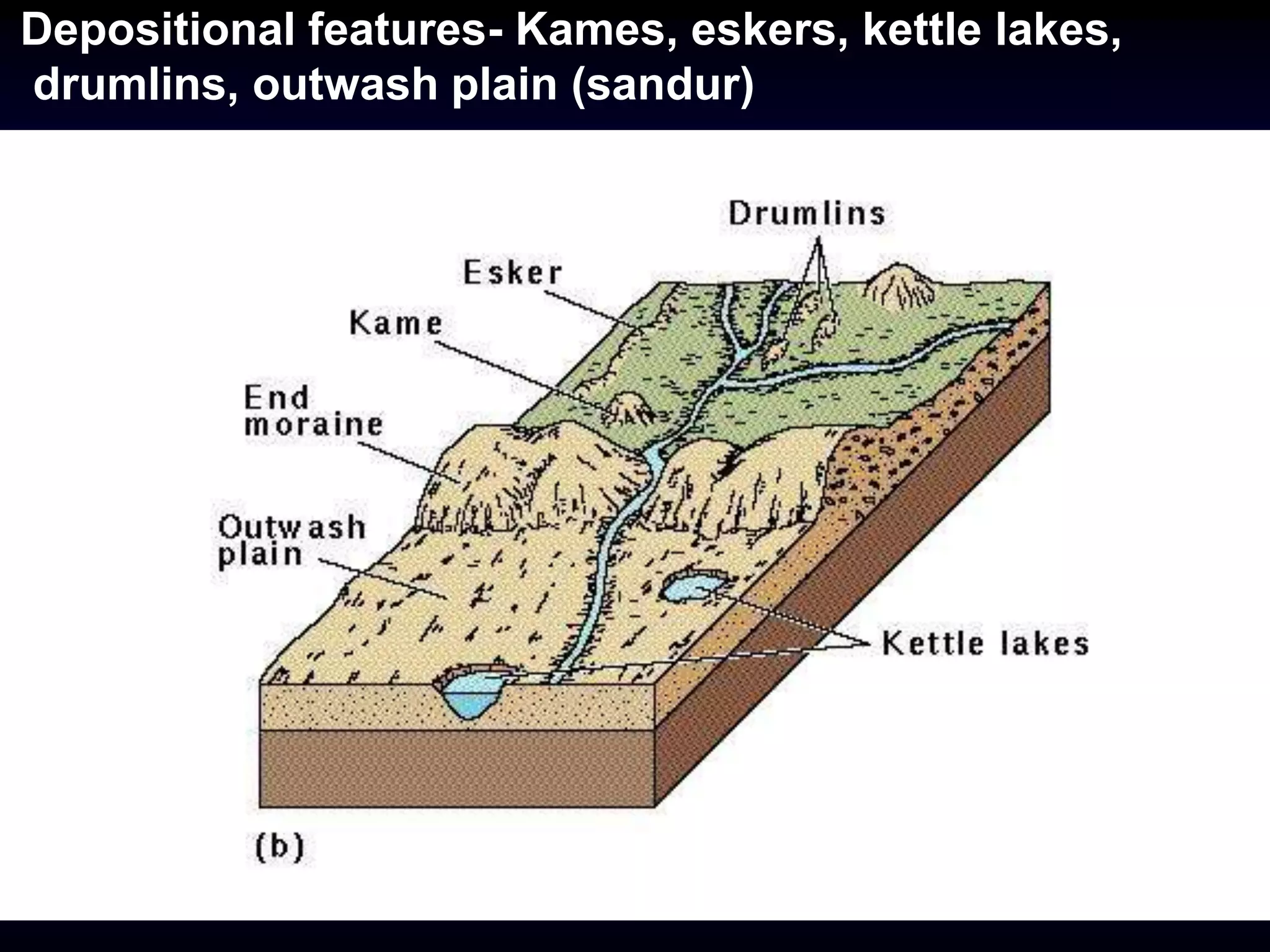
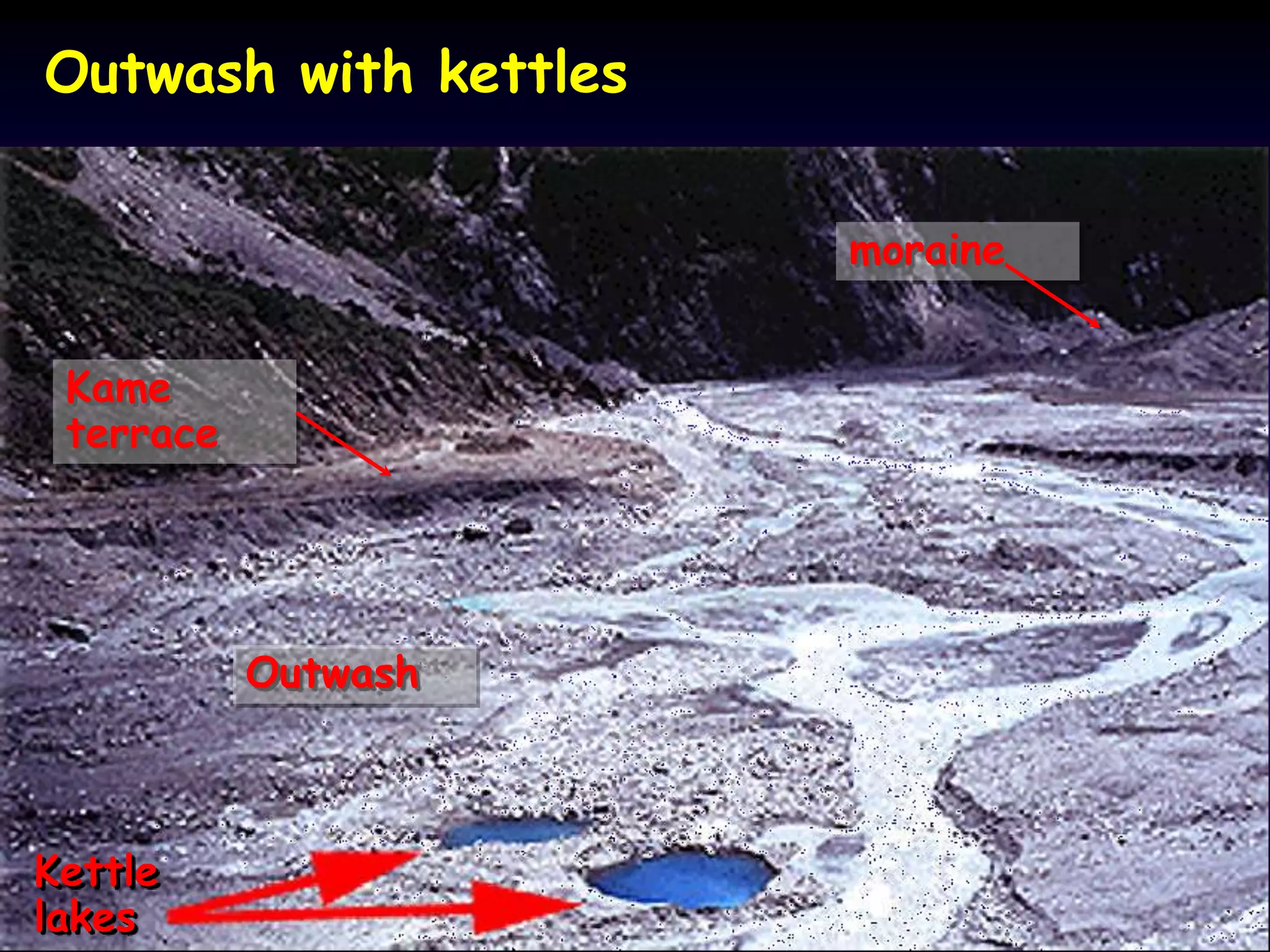
Depositional features- Kames, eskers, kettle lakes,
drumlins, outwash plain (sandur)
Depositional features- Kames, eskers, kettle lakes,
drumlins, outwash plain (sandur)
Outwash with kettles
Kettle
lakes
Outwash
moraine
Kame
terrace
Outwash Plain
with eskers and a
braided stream
Pleistocene GlaciationPleistocene Glaciations
• The Pleistocene "ice age" began
~1.96 million years ago
• Several glacial and interglacial
episodes.
> Glacial - a period of ice advance, generally
interpreted as a globally cool period.
> Interglacial - a period of ice retreat, generally
interpreted as a globally warm period.
• The Pleistocene "ice age" began
~1.96 million years ago
• Several glacial and interglacial
Episodes have occurred.
> Glacial - a period of ice advance, generally
interpreted as a globally cool period.
> Interglacial - a period of ice retreat, generally
interpreted as a globally warm period.
We are in an interglacial period right now
Milankovitch Orbital Theory
• Proposed to account for the cyclical
nature of Glaciations.
• Astronomer & Mathematician Milutin
Milankovich attributed the glaciation to
variation in three parameters of the
Earth's orbit.
• Proposed to account for the cyclical
nature of Glaciations.
• Astronomer & Mathematician Milutin
Milankovitch attributed the glaciation to
variation in three parameters of the
Earth's orbit.
eccentricity
precession
Obliquity- not shown
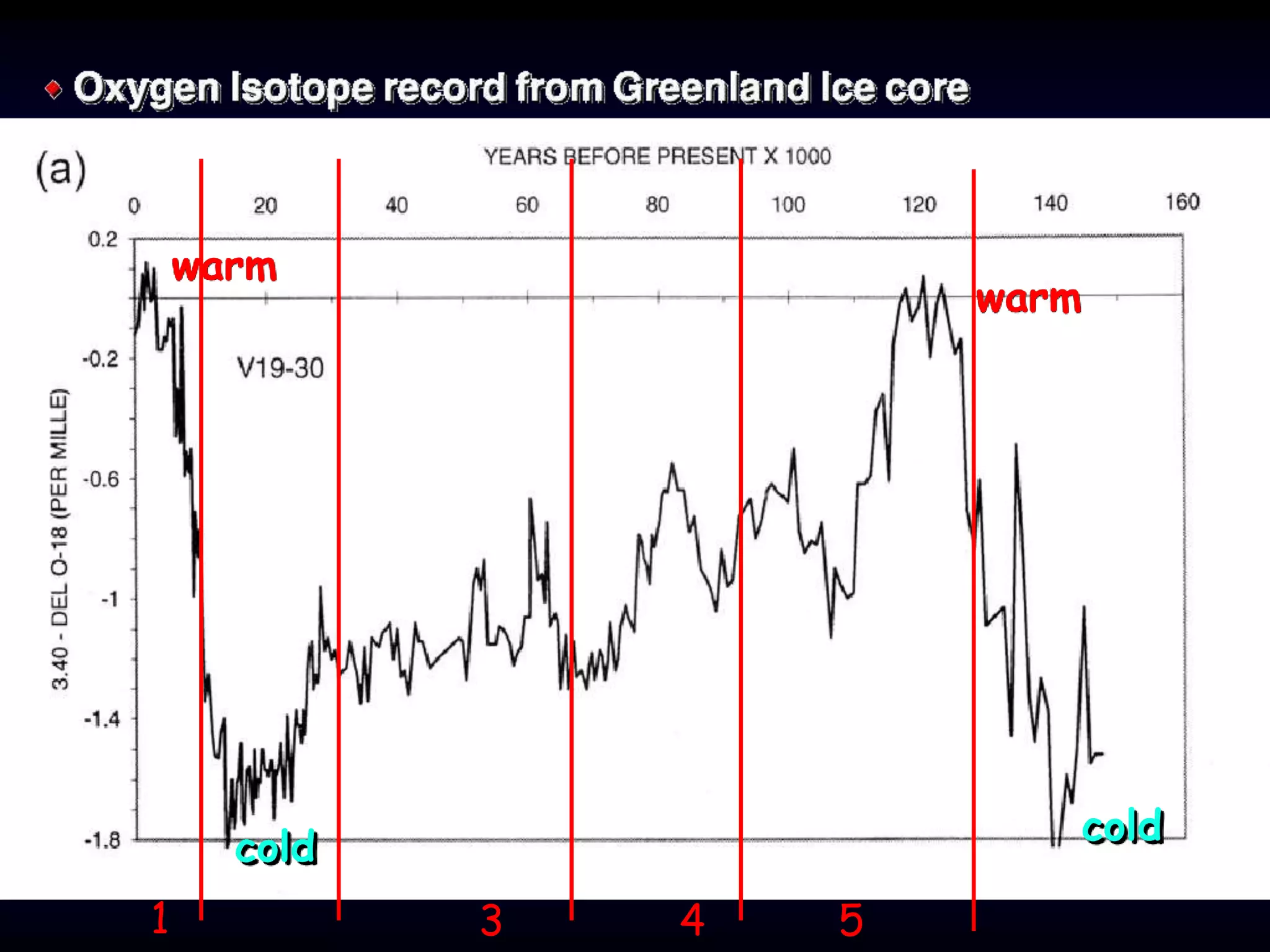
warm
warm
cold
cold
1 3 54
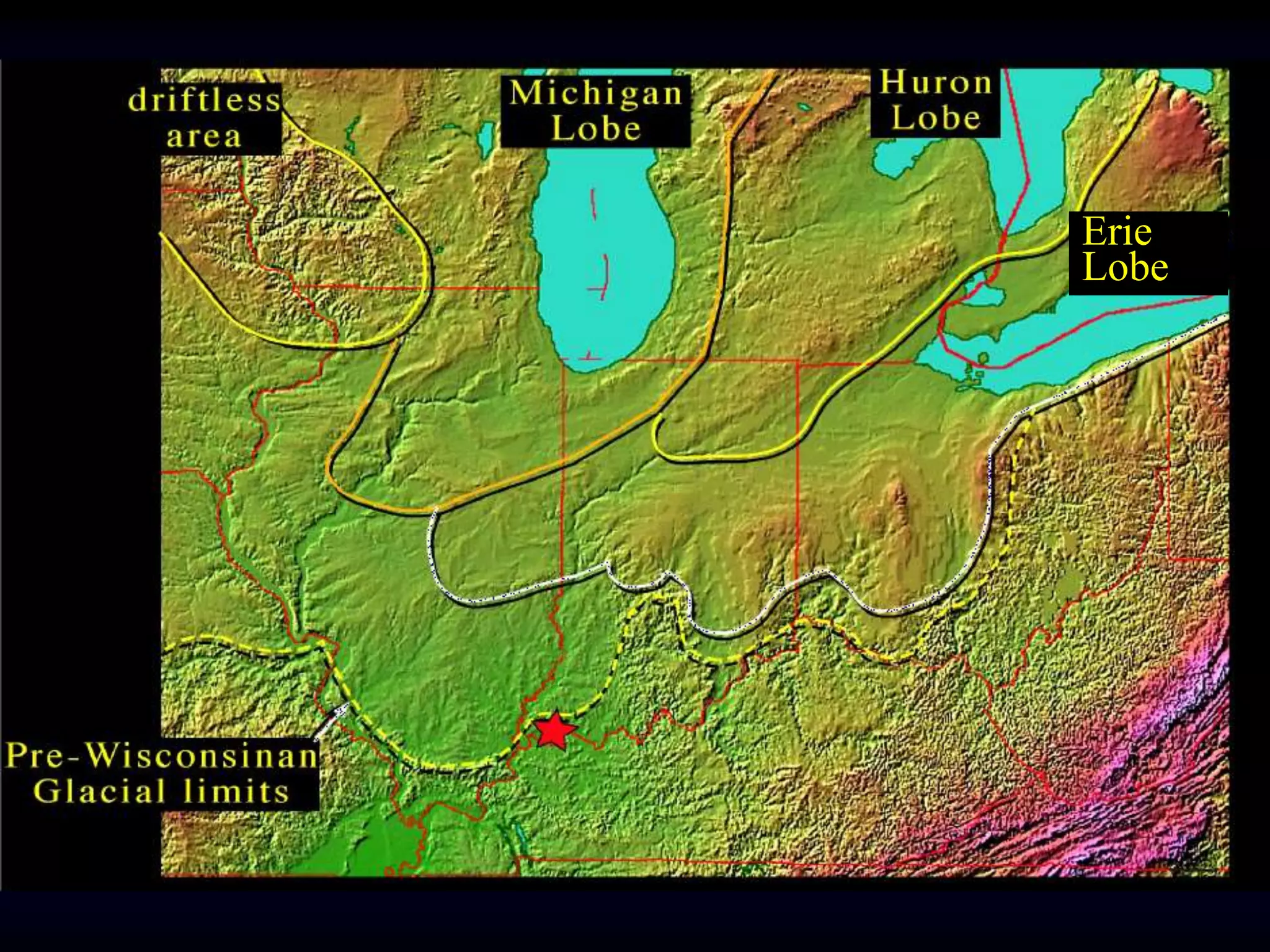
Erie
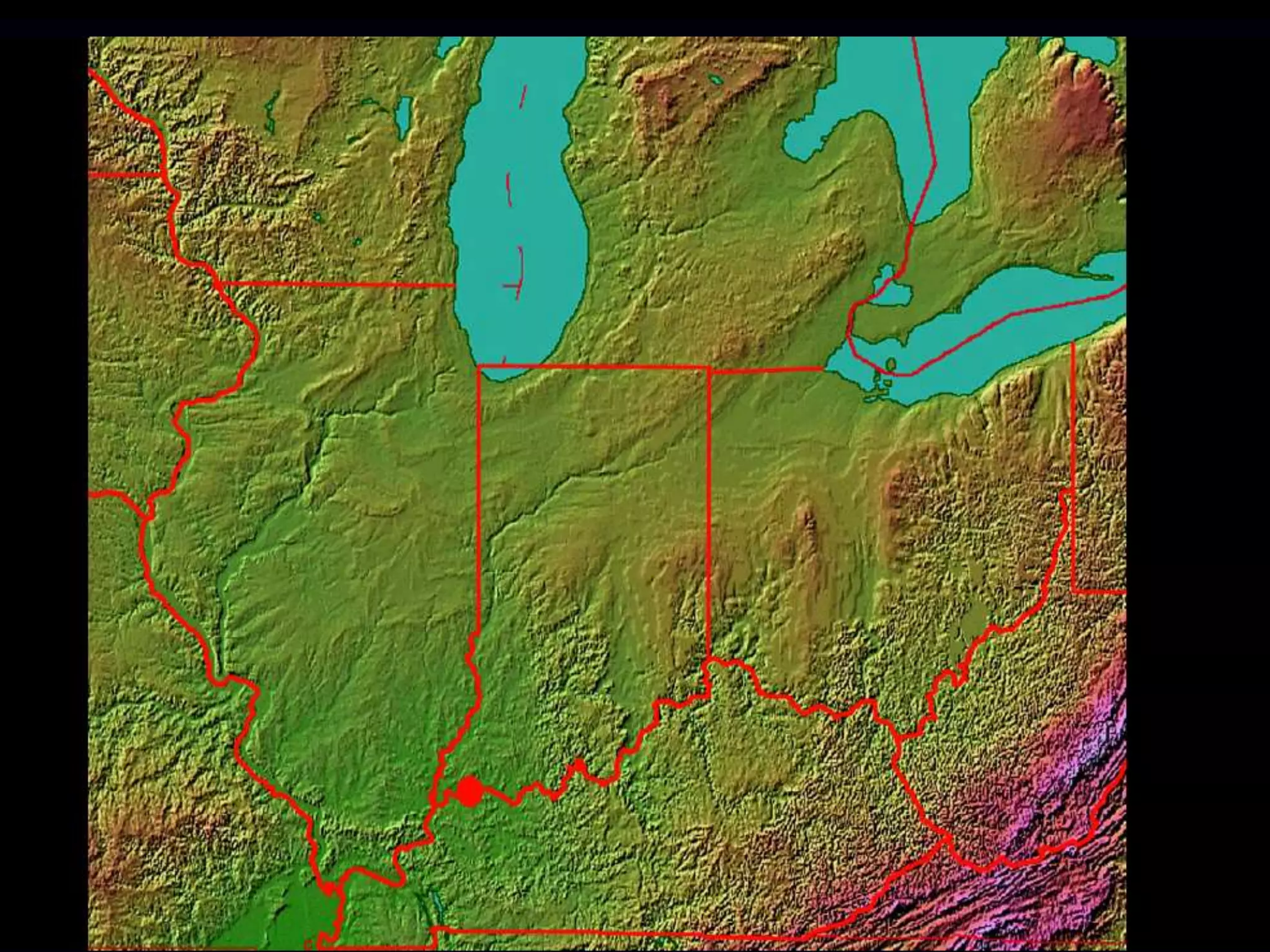
Lobe

Geological features of ice

  • 1.
  • 2.
    • Glacier > amass of ice composed of recrystallized compacted snow thatflows under its own weight on land. • Presently glaciers cover of the Earth's surface. • Glaciers occur in Greenland and Antarctica and in higher mountain ranges. • Glacier > a mass of ice composed of recrystallized compacted snow thatflows under its own weight on land. • Presently glaciers cover of the Earth's surface. • Glaciers occur in Greenland and Antarctica and in higher mountain ranges. 11// 1010 Glaciers and GlaciationGlaciers and Glaciation
  • 3.
    Glaciers- Important in understandingglobal scale climate change Related to all 5 of the Earth’s systems Exosphere- changes in the amount of sunlight cause glaciations Hydrosphere- glacial ice is frozen water, part of the hydrosphere Geosphere- Glacial ice flows over and modifies land Atmosphere- alteration of global atmospheric patterns contributes to glacial ice formation Biosphere- ice displaces animals and plants
  • 4.
    • Glacial timesrepresent significant time periods in Earth's history • Represent major climatic departures from the modern on a Global Scale • Cyclic in Nature • Man's Influence??? • Glacial Ice contains records of atmospheric changes • Glacial times represent significant time periods in Earth's history • Represent major climatic departures from the modern on a Global Scale • Cyclic in Nature • Man's Influence??? • Glacial Ice contains records of past atmospheric changes Importance Proterozoic, Pennsylvanian, Pleistocene
  • 5.
    • Snowflakes aremelted & deformed by the pressure of overlying snow, becoming granular snow, then firn, and finally interlocking crystals of glacial ice. Origin of ice
  • 7.
    Descriptive classification ofGlaciersDescriptive classification of Glaciers • Valley (or Alpine) Glaciers are confined to mountain valleys. > may eventually cover the entire mountain range becoming a mountain ice sheet > may also spill onto low flatlands becoming Piedmont glaciers • Continental (or Ice Sheets) > cover vast areas of more than 50,000 km . Today, continental glaciers are only found in Greenland and Antarctica. > Not so in the geological past • Valley (or Alpine) Glaciers are confined to mountain valleys. > may eventually cover the entire mountain range becoming a mountain ice sheet > may also spill onto low flatlands becoming Piedmont glaciers • Continental (or Ice Sheets) > cover vast areas of more than 50,000 km . Today, continental glaciers are only found in Greenland and Antarctica. > Not so in the geological past 22
  • 9.
    Response of aGlacier to Changes in Glacial Budget If accumulation = ablation, then no advance or retreat, but continues to flow If accumulation > ablation, then glacier advances while flowing If accumulation < ablation, then glacier retreats, but continues to flow
  • 10.
    Effects of GlaciersEffectsof Glaciers • Fills in the low spots > valleys and basins get filled in w/ sediment • Knocks down the high spots > mountains and hills get eroded • Reroutes the drainages > valley filling may block streams, causing new paths to be taken • Deposits accumulate in specific places related to flow and meltwater characteristics • Fills in the low spots > valleys and basins get filled in w/ sediment • Knocks down the high spots > mountains and hills get eroded • Reroutes the drainages > valley filling may block streams, causing new paths to be taken • Deposits accumulate in specific places related to flow and meltwater characteristics
  • 11.
    • James Lobeand Glacial Lake Agassiz
  • 13.
    Erosional ProcessesErosional Processes ・Importanterosional processes associated with glaciers include plucking, abrasion, and bulldozing. ・ Plucking and abrasion are most common > can form a landform called a roche moutonnee ・Important erosional processes associated with glaciers include plucking, abrasion, and bulldozing. ・ Plucking and abrasion are most common > can form a landform called a roche moutonnee
  • 14.
  • 16.
  • 17.
    Glacial DepositsGlacial Deposits •glacial drift- A general term refering to sediment formed by any glacial action. • Till (Diamicton) poorly sorted, unlayered material directly deposited by a glacier; • Stratified drift (Outwash) sorted, layered sediment usually deposited by meltwater streams. • Glacial drift- A general term referring to sediment formed by Any glacial action. • Till (Diamicton)- poorly sorted, unlayered material directly deposited by a glacier; ice contact • Stratified drift (Outwash)- sorted, layered sediment usually deposited by meltwater streams. Proglacial or ice contact
  • 18.
    A glacial erraticDepositionalfeatures- glacial erratic 6 ft Yellowstone Park
  • 19.
  • 20.
    Moraine formation- madeof Till, deposited by ice Depositional features- moraines
  • 21.
    Moraine formation- madeof Till, deposited by ice Depositional features- moraines
  • 22.
    Moraine formation- madeof Till, deposited by ice Depositional features- moraines
  • 23.
    ・ Lateral andMedial Moraines are sediment eroded from the valley sides and deposited by a glacier. They often appear as dark stripes in a glacier. ・ Lateral and Medial Moraines are sediment eroded from the valley sides and deposited by a glacier. They often appear as dark stripes in a glacier. Lateral moraines Lateral moraines Medial moraines Medial moraines
  • 24.
  • 25.
    Depositional features- Kames,eskers, kettle lakes, drumlins, outwash plain (sandur)
  • 26.
    Depositional features- Kames,eskers, kettle lakes, drumlins, outwash plain (sandur)
  • 27.
  • 28.
    Outwash Plain with eskersand a braided stream
  • 29.
    Pleistocene GlaciationPleistocene Glaciations •The Pleistocene "ice age" began ~1.96 million years ago • Several glacial and interglacial episodes. > Glacial - a period of ice advance, generally interpreted as a globally cool period. > Interglacial - a period of ice retreat, generally interpreted as a globally warm period. • The Pleistocene "ice age" began ~1.96 million years ago • Several glacial and interglacial Episodes have occurred. > Glacial - a period of ice advance, generally interpreted as a globally cool period. > Interglacial - a period of ice retreat, generally interpreted as a globally warm period. We are in an interglacial period right now
  • 30.
    Milankovitch Orbital Theory •Proposed to account for the cyclical nature of Glaciations. • Astronomer & Mathematician Milutin Milankovich attributed the glaciation to variation in three parameters of the Earth's orbit. • Proposed to account for the cyclical nature of Glaciations. • Astronomer & Mathematician Milutin Milankovitch attributed the glaciation to variation in three parameters of the Earth's orbit.
  • 31.
  • 32.
  • 33.