Glacial Futures
Lower Sixth
So what about the future?
• There are many problems that are
affecting glacial areas:
• Climate change
• Economic demands
• Tourism
• Ecosystem damage
Climate Change
• This is a context hazard in the sense that
it is going to impact upon everyone
• There will be far reaching consequences
• Modelling has been found to be difficult
and therefore the impacts are seen as
difficult to measure on environmental and
socio-economic grounds
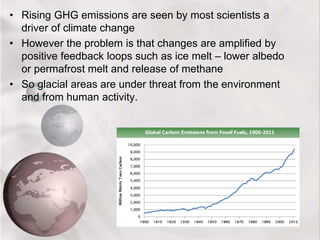
• Rising GHG emissions are seen by most scientists a
driver of climate change
• However the problem is that changes are amplified by
positive feedback loops such as ice melt – lower albedo
or permafrost melt and release of methane
• So glacial areas are under threat from the environment
and from human activity.
Polar Ice sheet Melt
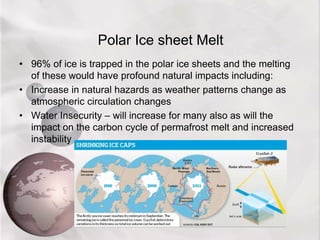
• 96% of ice is trapped in the polar ice sheets and the melting
of these would have profound natural impacts including:
• Increase in natural hazards as weather patterns change as
atmospheric circulation changes
• Water Insecurity – will increase for many also as will the
impact on the carbon cycle of permafrost melt and increased
instability
Impacts
• Active landscapes are likely to suffer
more dramatic impacts than relict
landscapes whilst relict landscapes
will be more exposed to the impacts
of temperature changes than lowland
areas
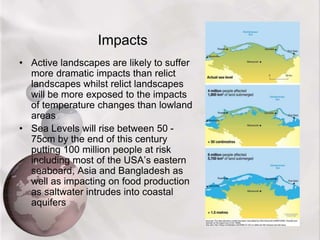
• Sea Levels will rise between 50 -
75cm by the end of this century
putting 100 million people at risk
including most of the USA’s eastern
seaboard, Asia and Bangladesh as
well as impacting on food production
as saltwater intrudes into coastal
aquifers
Wildlife
• Polar bears will have no pack ice to feed
off
• Complex changes to our food webs will
occur in polar regions
• Loss of krill will impact on the entire
Antarctic food web
• Animals may be able to migrate and
survive as they extend their migration
patterns
Ocean Circulation
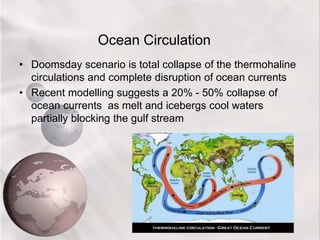
• Doomsday scenario is total collapse of the thermohaline
circulations and complete disruption of ocean currents
• Recent modelling suggests a 20% - 50% collapse of
ocean currents as melt and icebergs cool waters
partially blocking the gulf stream
People
• Diseases and pests will spread pole wards
• Impacting on biodiversity
• If a tipping point is reached (The point at
which climate change can not be reversed
and increases in rate) there may be no
turning back:
– Seen as 2 degree rise
– 450ppm
– Melting of Greenland ice cap
2 Strategies
• Mitigating against the impacts
• Adapting to the impacts at all scales
• Most scientists agree that if we mitigate
against the GHGs then there will still be a
lag time where adaptation will be
necessary
• Countries have been slow to react to
climate change whilst people are slow to
acknowledge the issues
• Only by global cooperation is there any
hope in solving the issues ahead
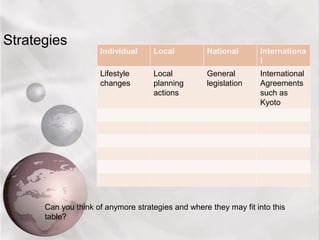
Strategies
Individual Local National Internationa
l
Lifestyle
changes
Local
planning
actions
General
legislation
International
Agreements
such as
Kyoto
Can you think of anymore strategies and where they may fit into this
table?
The final question remains
• Will the present ice- covered areas
become relict areas as we go into a
interstadial?
• Could the situation change and the earth
swing into a new stadial?
• Could we through feedback mechanisms
be pushed back into an ice age and the
glaciers return to their natural extent?

Lesson 16 futures for glacial environments

  • 1.
  • 2.
    So what aboutthe future? • There are many problems that are affecting glacial areas: • Climate change • Economic demands • Tourism • Ecosystem damage
  • 3.
    Climate Change • Thisis a context hazard in the sense that it is going to impact upon everyone • There will be far reaching consequences • Modelling has been found to be difficult and therefore the impacts are seen as difficult to measure on environmental and socio-economic grounds
  • 4.
    • Rising GHGemissions are seen by most scientists a driver of climate change • However the problem is that changes are amplified by positive feedback loops such as ice melt – lower albedo or permafrost melt and release of methane • So glacial areas are under threat from the environment and from human activity.
  • 5.
    Polar Ice sheetMelt • 96% of ice is trapped in the polar ice sheets and the melting of these would have profound natural impacts including: • Increase in natural hazards as weather patterns change as atmospheric circulation changes • Water Insecurity – will increase for many also as will the impact on the carbon cycle of permafrost melt and increased instability
  • 6.
    Impacts • Active landscapesare likely to suffer more dramatic impacts than relict landscapes whilst relict landscapes will be more exposed to the impacts of temperature changes than lowland areas • Sea Levels will rise between 50 - 75cm by the end of this century putting 100 million people at risk including most of the USA’s eastern seaboard, Asia and Bangladesh as well as impacting on food production as saltwater intrudes into coastal aquifers
  • 7.
    Wildlife • Polar bearswill have no pack ice to feed off • Complex changes to our food webs will occur in polar regions • Loss of krill will impact on the entire Antarctic food web • Animals may be able to migrate and survive as they extend their migration patterns
  • 8.
    Ocean Circulation • Doomsdayscenario is total collapse of the thermohaline circulations and complete disruption of ocean currents • Recent modelling suggests a 20% - 50% collapse of ocean currents as melt and icebergs cool waters partially blocking the gulf stream
  • 9.
    People • Diseases andpests will spread pole wards • Impacting on biodiversity • If a tipping point is reached (The point at which climate change can not be reversed and increases in rate) there may be no turning back: – Seen as 2 degree rise – 450ppm – Melting of Greenland ice cap
  • 10.
    2 Strategies • Mitigatingagainst the impacts • Adapting to the impacts at all scales • Most scientists agree that if we mitigate against the GHGs then there will still be a lag time where adaptation will be necessary • Countries have been slow to react to climate change whilst people are slow to acknowledge the issues • Only by global cooperation is there any hope in solving the issues ahead
  • 11.
    Strategies Individual Local NationalInternationa l Lifestyle changes Local planning actions General legislation International Agreements such as Kyoto Can you think of anymore strategies and where they may fit into this table?
  • 12.
    The final questionremains • Will the present ice- covered areas become relict areas as we go into a interstadial? • Could the situation change and the earth swing into a new stadial? • Could we through feedback mechanisms be pushed back into an ice age and the glaciers return to their natural extent?