Gondwana system
BY:
THOMAS CHINNAPPAN .A ,
M.SC.APPLIED GEOLOGY,
PERIYAR UNIVERSITY,
SALEM.
Gondwana
• The term "Gondwana" was coined by H.B. Medlicott in1872.
• It was derived from the kingdom of the Gonds, a great and ancient tribe who still inhabit in the
Central Provinces (Madhya Pradesh).
• The term supergroup may be use for several associated groups or for associated groups and
formations with significant lithological properties in common.
• LITHOLOGY
• The Gondwana superGroup is made up of 6 to 7 km thick succession of mainly fluviatile and
lacustrine deposits.
• However, a glacial deposit occurs at the base and the intercalations of the fossiliferous marine
beds occur both in the lower and upper parts of the succession.
• The chief rock types are sandstones shales, clays,
• conglomerates and coal seams. In addition to these rocks the upper
Gondwana succession contain about 600 meter thick lavaflows of basalt
TOPOGRAPHY
• The rocks of Gondwana are found occupying basin shaped depressions
in the older formation and such depressions sometimes, though not
always, nor even generally correspond to the existing river valleys.
• The Gondwana beds were originally deposited on an uneven surface.
SEDIMENTATION AND PALEOCLIMATES
• Beginning of the Gondwana sedimentation is characterised by the deposition of
glacial sediments.
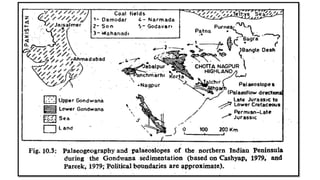
• The most prominent centre of glaciation was located in the south-west of the
present Godavari Valley from where the glaciers moved in northerly and
northwesterly directions.
• In the Damodar Valley region, the highlands were located in the north and north
west resulting in a southerly glacial advance.
• Records from the east coast of India suggest that the ice moved from an upland
that existed in the east of the present eastern shore-line of India.
• With the retreat of the glaciers at the close of glacial epoch, the irre gular topography of
the Indian Peninsula was filled in by swamps rich in vegetative matter.
• The conditions were favourable for the deposition of coaliferous sediments.
• The Gondwana basins of the Damodar Valley region show a centripetal dispersal pattern
of sediments deposited by the streams flowing in from the surrounding uplands.
• The basins of the Godavari Valley region, however, show a longitudinal dispersal pattern
of sediments.
• After the deposition of the coal bearing sediments, the Gondwana basins were effected
by a variable condition of deposition.
• A thick sequence of ironstone shales were deposited in the eastern and the southern
Gond wana basins.
• The shales were deposited in closed basins under reducing environments favourable
for the precipitation of iron carbonates.
• The sedimentation in the Satpura basins of Central India took place in an oxidising
environment giving rise to the deposition of variegated clays and ferrugenous (iron
oxides) sandstones.
• The coal forming conditions were again ushered in during the deposition of the Upper
Permian rocks. The younger coaliferous sediments were laid in almost all the
Gondwana basins.
• The Raniganj basin of the Damodar Valley region, however, shows the maximum
development coaliferous beds which contain several superior quality coal measures.
• The deposition of the superior quality coal-seams has been attributed to repeated
forma tion of extensive back swamps which were deep and yet received less inflow of
fresh water.
• The deposition of the superior quality coal-seams has been attributed to repeated
forma tion of extensive back swamps which were deep and yet received less inflow
of fresh water.
• Triassic Gondwana is characterised by cyclic alternations of arkosic sandstones and
red shales .
• whereas the Jurassic and Lower Cretaceous Gondwana formations consist of quartz-
arenite, pebble-sandstone and red siltstone association.
• The Triassic sedimentation took place in streams bearing a moderate to high channel
sinuosity characteristic of gentle slopes.
• On the other hand, the younger sediments were deposited by mainly a network of
braided streams characteristic of steeper palaeoslopes.
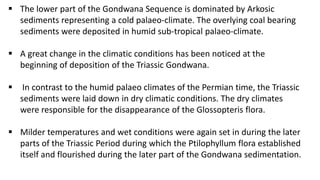
 The lower part of the Gondwana Sequence is dominated by Arkosic
sediments representing a cold palaeo-climate. The overlying coal bearing
sediments were deposited in humid sub-tropical palaeo-climate.
 A great change in the climatic conditions has been noticed at the
beginning of deposition of the Triassic Gondwana.
 In contrast to the humid palaeo climates of the Permian time, the Triassic
sediments were laid down in dry climatic conditions. The dry climates
were responsible for the disappearance of the Glossopteris flora.
 Milder temperatures and wet conditions were again set in during the later
parts of the Triassic Period during which the Ptilophyllum flora established
itself and flourished during the later part of the Gondwana sedimentation.
Stratigraphic Classifications
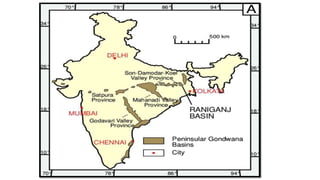
• A major part of the Gondwana sediments are confined to the three tracts,
which include Koel- Damodar, Son Mahanadi and Pranhita - Godavari basins.
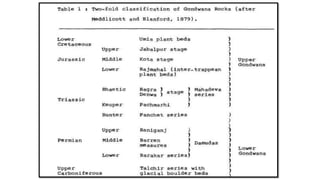
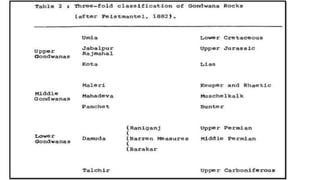
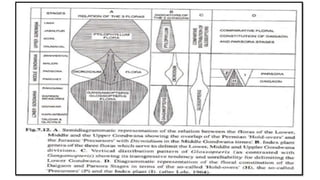
• The Gondwana Supergroup is divided into two major divisions based on their
lithological and palaeontological evidences.
• (i) Two-fold classification by W.T. Blanford, divided into lower and upper
Gondwanas, characterised by the Glossopteris and Ptilophyllum.
• (ii) Three-fold classification by Hughes, who identified a mixed flora called
Dicroidium in between theGlossopteris and Ptilophyllum floras.
FLORA AND FAUNA
FLORA : are the plants found in a particular area
FAUNA : are the animals found in particular area
EG:
The flora of pachmarhi consists of sal, teak,wild mango ,
jamun, silver,
Ferns ect.
The fauna of pachmarhi consists of wild
dog,cheetal,wolf,leopard, blue bull, barking deer ect.
LOWER GONDWANA SEQUENCE
TALCHIR FORMATION
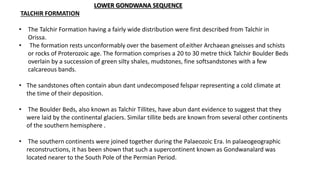
• The Talchir Formation having a fairly wide distribution were first described from Talchir in
Orissa.
• The formation rests unconformably over the basement of.either Archaean gneisses and schists
or rocks of Proterozoic age. The formation comprises a 20 to 30 metre thick Talchir Boulder Beds
overlain by a succession of green silty shales, mudstones, fine softsandstones with a few
calcareous bands.
• The sandstones often contain abun dant undecomposed felspar representing a cold climate at
the time of their deposition.
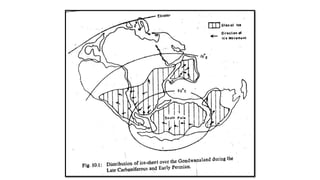
• The Boulder Beds, also known as Talchir Tillites, have abun dant evidence to suggest that they
were laid by the continental glaciers. Similar tillite beds are known from several other continents
of the southern hemisphere .
• The southern continents were joined together during the Palaeozoic Era. In palaeogeographic
reconstructions, it has been shown that such a supercontinent known as Gondwanalard was
located nearer to the South Pole of the Permian Period.
MARINE BED INTERACTION
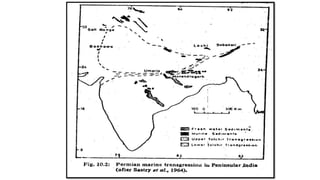
• Marine beds in association with typical Lower Gondwana rocks are known to occur at Umaria in Madhya
Pradesh (Reed, 1928) and at Manendragarh (Ghosh, 1554) about 150 kilometres southeast of Umaria.
• The Umaria Marine Bed exposed at Narsahra Railway cutting comprises a single three metre thick bed of
shelly limestone containing fossil shells of Productus, Spiriferina, Reticularia and others.
• The limestone bed occurs in the Karharbari Formation which was earlier regarded as the upper part of
the Talchir Formation. The fossil assemblage is suggestive of Lower Permian age for the limestone bed.
• The faunal assemblage is also sugges tive of a warmer climate which appears to be in conformity with
the view that the Talchir succession witnessed glacial conditions at the beginning and warmer climate
during the later parts of its deposition.
• The marine beds of Manendragarh occur in several patches attaining a thickness of up to 5 metres. The
marine rocks occur in the basal parts of the Talchir succession. The fauna include Protoretepora, Spirifer,
Avicula pecten, Eurydesma, Hyperammina, Glomospira.
BAP AND BADHAURA FORMATIONS
• Nearly a century ago, Oldham (1886) while traversing around Bap some 150 km northeast of Jaisalmer,
noticed glacial boulder beds resting over Vindhyans.
• These boulder beds were correlated with Talchir Boulder Beds as they are also associated with glacio-
fluvial conglomerate, sandstones and varved clays. The succession, ranging in thickness from 50 m to 160
m has been named as Bap Formation.
• The formation has yielded a rich and well preserved invertebrate fauna that include the characteristic
fossil Eurydesma .
• The Badhaura Formation consisting of about 350 km thick succession of alternating sandstone and clay
beds, rests conformably over the Bap Formation. The Badhaura Formation has yielded rich invertebrate
faunal assemblage that includes Paraconularia sp., Lingula sp., Neospirifer sp., Aulosteges sp., crinoid
stems and fossil wood.
• The fauna is correlated with the fauna of Conularia beds of Salt Range of Lower Permian age.
DAMUDA GROUP
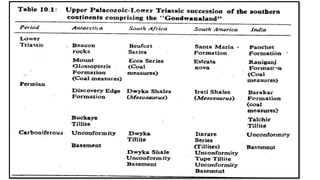
• The Talchir Formation is succeeded by the Damuda Group comprising the coal measures and
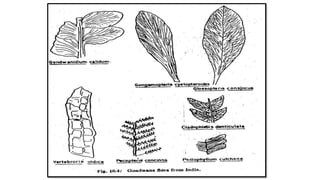
carbonaceous sediments with impressions of Glos sopteris and other associated flora.
• The group takes its name from the Damodar (earlier spelt as Damuda) river draining the southern slopes
of Rajmahal hills and eastern Ranchi Plateau. The Damuda Group consists of over 2000 metre thick
cyclic succession of conglomerates, grits, sand stones and black shales in cyclic order.
• The shale beds are coaliferous. Coal seams are commonly less than 5 metres thick and laterally
discontinuous. In some basins, the coal seams often attaining a thickness of about 40 metres are,
however, laterally continuous for fairly long distances.
• The thicker coal seams are the most productive accounting for almost entire total production of coal
from the Peninsula. The total thickness of all coal seams of Damuda Group adds up to about 5% of the
total thickness of the rock succession.
• The Damuda Group has been subdivided in the Damodar Valley type area into three formations, viz..
Barakar, Kulti (Barren Measures) and Raniganj Formations. Karharbari is a basal member of the Barakar
Formation but, at places, it attains the status of a formation.
Karharbari Formation
• The sandstones of the formation contain angular to subangular fragments of quartz and
felspar which are in contrast to particularly well rounded sediments of the overlying
Barakar Formation.
• The Gondwanidium-Buriadia megafloral assemblage of this formation has much
similarity with the Noeggerathiopsis-Paranocladus megafloral as semblage of the Talchir
Formation.
• However, the reported occurrence of a slight unconformity at the base of the Karharbari
Formation has led to separate it from the Talchir Formation and to include it with the
Damuda succession.
Barakar Formation
• The formation resting conformably over the Karharbari Formation comprises a 1700 m thick cyclic
succession of conglomerates, grits, sandstones, shales and coal seams.
• The formation derives its name from a river in the Raniganj coal field in Bihar. The peb bles cf
conglomerate consist of largely quartzites and granites derived from the Precambrian Basement.
• The sandstones are coarse, light in colour, often current bedded and highly felspathic.
• Unlike the Talchir sandstones, the felspars of Barakar sandstones are usually kaolinised. The china-
clay deposits of the formation are often of economic significance.
• The thickness of the formation is highly variable being maximum in Raniganj area.
• The thickness is reduced to less than 100 metres in the Godawari graben. The floral assemblage of
the formation contains abundant Glossopteris along
Kulti Formation
• The formation also known as Barren Measures, succeeds conformably the Barakar Formation.
• The formation is devoid of workable coal seams although streaks of carbonaceous matter are reported
from about 500 metre thick succession of sandstones with intercalations of clay beds.
• In the coal fields of eastern India, this formation is represent ed by 300 to 400 metre thick succession
of predominantly red brown shales known as Ironstone Shale Formation. The formation contains a few
deposits of sideritic iron ores.
• In Narmada Valley, the Kulti Formation is referred to as Motur Formation comprising white sandstones
with intercalations of red, yellow and carbonaceous shales.
• The Motur Formation of Godavary Valley Graben has a much reduced thickness measuring about less
than 100 metres. The Kulti and Motur formations have yielded scanty mega-flora.
Raniganj Formation
• The formation overlying the Kulti Formation consists of about 1000 m thick cyclic succession of
sandstones, shales and coal seams. The sandstones are finer grained than those of the Barakar Formation.
• The coal seams of economic significance comprising a part of the Raniganj Formation occur only in the
Raniganj coal field. The Rani ganj coal contains a higher content of volatiles but some of them are superior
quality coal.
• The flora! assemblage of the Raniganj Formation is characterised by the acme of the Glossopteris flora.
The Raniganj Forma tion has been correlated with Kamthi Formation of the Godavari Graben.
• The Kamthi Formation named after the type area near Nagpur comprises over 500 metre thick succession
of red and grey argillaceous sandstones and conglomerates with interstratified shales.
• The micaceous fine sandstone and shale sequence of Chindwara district (Narmada Valley Graben) is
known as Bilori Formation which has also been correlated with the Rani
Lower Gondwana of Eastern Himalaya
• Rock successions that have been correlated with the Lower Gondwanas of the Peninsula are exposed in
the Darjeeling district (West Bengal), the Rangit Valley (Sikkim) and the Siang district (Arenachal Pradesh).
• Patches of the Lower Gondwana elements are known from the Lesser Himalaya of Nepal (Kumar and
Gupta, 1981). The succession of Darjeeling and Sikkim Himalayas comprises a basal Rangi: Pebble Slate
Formation.
• The Damuda Group of the Eastern Himalaya rests conformably over the Rangit Pebble Slate in the Rangit
window zone of Sikkim. Elsewhere, the contact is often tectonised leading to reversal in stratigraphy.The
arenaceous and carbonaceous succession of the Damuda Group has been classified into three formations
in Arunachal Pradesh.
• The older Khelong Formation in Kameng district comprises interbedded pyritous and carbo naceous shale,
siltstones, marl, calcareous sandstone and felspathic wacke.
• The succession contains abundant floral record which includes Glossopteris indica, G. communis var.
stenoncura, G. damudica, Gangamopteris cyclo pteroides, Vertebraria indica, Phyllotheca, Schizoneura,
Rilu formation
• In Subansiri and Siang districts, the Khelong Formation is represented by Rilu Formation comprising
pyritous and calcareous siltstones and sandstones with rich faunal assemblage.
• The assemblage indicating a Late Asselian to Lower Sakmarian age is characterised by Linoproductid bra
chiopods such as Steponoviella, Linoproductus etc., together with Cyretella, tetropod Paraconularia and
goniatitic ammonites
Bhareli Formation
• overlying the Khelong Formation in Kameng district, is a typical fluvial sequence of coarse arenaceous and
coal bearing rock strata.
• The floral assemblage is characterised by the predominance of Glossopteris indicating an Upper Permian
age..
UPPER GONDWANA SEQUENCE
• The close of the Lower Gondwana sedimentation in the Satpura Hilis is marked by a phase of tectonic
deformation producing gentle folds and faults (Crookshank, 1936), In this region, the Upper Gondwana
Sequence rests unconformably over the Lower Gondwana rocks.
• In other Gondwana basins, the sedimentation seems to have been continuous with a gradual passage
from the Lower to the Upper Gondwana sequences.
• The floral record, however, shows a rapid change with the elimination of the Glos sopteris flora du.ing the
Permian-Triassic transition.
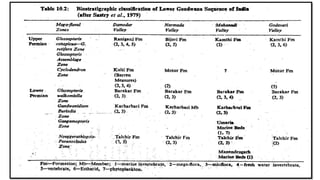
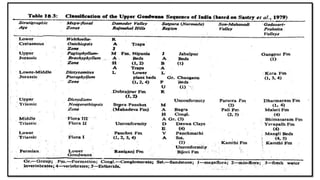
• The floral assemblage of the Upper Gondwana Sequence consists of a Lepidopteris-Dicrodium flora
characterising the lower part of sequence and a Ptilophyllum flora characteristic of the upper part of the
sequence.
• Sastry et al. (1979) have distinguished seven mega-floral zones (TabR in the Upper Gondwana Sequence.
DAMODAR VALLEY BASIN
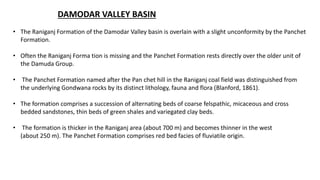
• The Raniganj Formation of the Damodar Valley basin is overlain with a slight unconformity by the Panchet
Formation.
• Often the Raniganj Forma tion is missing and the Panchet Formation rests directly over the older unit of
the Damuda Group.
• The Panchet Formation named after the Pan chet hill in the Raniganj coal field was distinguished from
the underlying Gondwana rocks by its distinct lithology, fauna and flora (Blanford, 1861).
• The formation comprises a succession of alternating beds of coarse felspathic, micaceous and cross
bedded sandstones, thin beds of green shales and variegated clay beds.
• The formation is thicker in the Raniganj area (about 700 m) and becomes thinner in the west
(about 250 m). The Panchet Formation comprises red bed facies of fluviatile origin.
SATPORA BASIN
• The Kamthi Formation of the Lower Gondwana is unconformably over lain by a thick succession of
continental red beds which were grouped into Mahadeva Group named after the Mahadeva Hills near
Panchmarhi (Oldliam, 1856).
• The a oup is generally divided into Panchmarhi Sand stone, Denwa Clays and Bagra Conglomerate. The three
for mations generally lying one over the other often grade laterally into one another.
• The Panchmarhi Sandstone consists of about 750 m thick coarse, white and cross-bedded sanstones with
characteristic ferruginous partings.
• The overlying Denwa Clay is interstratified with discontinuous and subordi nate bands of white sandstones.
• Locally the sandstones are conglomeratic. Eastwara, the Denwa Clay grade upwards into the Bagra
Conglomerate which attainc a maximum thickness of about 250 m.
• The succession is thickest in the type area with an average thickness of 1600 m gradually thinning east- and
west-wards.
RAJMAHAL HILLS
• The Barakar Formation is unconformably overlain oy a 150 m thick suc cession of sandstones and
conglomerate known as Dubrajpur Formation after a village in Rajmahal hills of Bihar.
• The Dubrajpur Formation has been assigned a Late Triassic age indicating a break in deposition from Late
Permian to Middle Triassic.
Dubrajpur Formation
• Dubrajpur Formation is conformably overlain by trap fiews with intercalated grits and carbonaceous
shales named as Rajmahal Formation . The Rajmahal Traps are plateau basalts characterised by the
absence or rare occurrence of olivine.
• The traps are predominantly composed of fine grained to coarsely crystalline dolerite with irregularly
distributed phenocrysts or aggregates of felspar and pigeonite.
• The ground. mass comprises labrodorite, pigeonite, augite, magnetite and glass. Some flows are
vescicular, the cavities filled with calcite, chalcedony and analcite.
MAHANADI - SON VALLEY BASIN
• The Kamthi Formation of the Mandla Plateau in Madhya Pradesh rang ing in age from Late Permian
to Early Triassic is conformably overlain by about 1500 m thick succession of cross bedded,
immature, felspathic sandstones and arkoses with abundant amount of brick red shales and
siltstones.
• The succession earlier referred to as Pali Beds (Hughes, 1881) and Tiki Beds (Fox, 1931) has been
named as Pali Formation. In the Son Valley, the forination rests over the Damuda coal measures.
• Robinson (1967) included the Pali Formation as a part of the Lower Gondwana as the Formation has
yielid Glossopteris communis, G. indica and Vertebra ria indica constituting the typical Glossopteris
flora of the Lower Gond wana.
Pranhita-Godawari Basin
• A fairly continuous succession of Middle and Upper Gondwana rocks is exposed in the Pranhita
Godawari Basin.
• The succession conformably resting over the Lower Gondwana Sequence (Kamthi Formation) has been
subdivided into six formations .
• The "Maleri Stage" of King (1881) conformably overlying the Kamthi Formation has been subdivided into
three litho-units.
• The lowermost Yerrapalli Formation comprising soft red and green clays contains a dis tinct vertebrate
faunal assemblage that includes fishes, amphibians, reptiles, cynodonts, proterosuchians and
pseudosuchians.
• The fossil assemblage indicates a Middle Triassic age for the formation. The Middle unit of the "Maleri
Stage" named as Bhimasarani Sandstone (Sengupta, 1970) is com posed of poorly sorted cross bedded
coarse sandstones with intercalations of red clay beds.
Maleri Formation
• The Maleri Formation comprising the uppermost unit of the "Maleri Stage" consists of bright red clay
beds intercalated with minor sandstone.
• The formation has yielded the characteristic "Maleri fauna" which include frag of conifer-wood, dipnoian
fish, amphibians.
Dharmaram Formation
• The Dharmaram Formation conformably overlying the Maleri Forma tion comprises alternation of pale
coloured sandstones and red clay beds .
• The sandstones are cross bedded and in places contain abundant lime pellets and clay galls.
• The formation has yielded platosaurid, codontosaurid, prosauropods and archosaurs of Upper Norian to
Rhaeticage.
• The Dharmaram Formation has been correlated with the Parsora Formation of the Mahanadi-Son Valley
Basin.
Kota Formation
• The Kota Formation named after the village Kota near the confluence of the Pranhita and the Godavari
rivers comprises grey white and occa sionally ferruginous gritty and pebbly sandstones with the basal
beds and lenses of clay.
• A few beds of fossiliferous limestones have been reported from the upper part of the succession. The
Kota Formation rests over the Dharmaram Formation with a slight unconformity inferred on the basis
of the faunal records of the two formations.
• The faunal assemblage of the Kota Formation indicating an Early to Middle Jurassic age consists of
Coicus (Estheria), insects (Blattoidea, Coleoptera and Hemiptera), fishes, reptiles, crocodilea and
dinosaurs. The sauropods, typical of Kota Formation, have not been reported from the underlying
formation.
• Jurassic fresh water ostrocodes have also been reported from the formation. The floral assemblage
which incindes Equisetites, Sphenopteris, Hansmanica, Coniopteris, Otozamites, Pagiophyllum,
Arancorites and Elatocladus also indicate a Lower Jurassic age for the formation.
Gangapur Formation
• The Gangapur Formation named by Kutty (1969) after Gangapur in Adilabad district of Andhra Pradesh
consists of a sequence of mudatones, siltstones, sandstones and conglomerates.
• The Chikiala Sandstone exposed along the eastern niargin of the Basin has been correlated with the
Ganga pur Formation.
• The Gangapur Formation resting unconformably over the Kota Formation has yielded a rich assemblage
of mega-flora having mixed characters of the eastern Rajmahal flora and the Jabalpur flora of the west.
• A rich assemblage of spores and pollens resembling that of the Nipania Plant Beds of the Rajmahal
Formation has been reported from the carbo naceous shales of the Gangpur succession.
• A Late Jurassic to Lower Creta ceous age has been assigned to the formation on the basis of floral
evidence.
Economic significance
• Coal - The Barakar and Raniganj Formation of the Damuda Group constitute the most important coal
bearing rock formations.
• All of the Gondwana coal is of bituminous variety.Iron Ore. About 760m thick ferruginous shales, known
as the "Iron stones shales".
• These shales form a diposit of sideritic iron ore which contains about 40-50% iron.Clay. The clays of
various types are found in abundance in the Gondwana rocks.
• These clays are used for making refractory bricks, pottery and china ware. Stone Buildings.
• The Gondwana sandstones is generally ofinferior quality. However, some of it is being used asbuilding
stone.
• Most of the gondwana cole is found in the Damuda series.
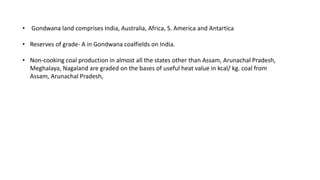
• Gondwana land comprises India, Australia, Africa, S. America and Antartica
• Reserves of grade- A in Gondwana coalfields on India.
• Non-cooking coal production in almost all the states other than Assam, Arunachal Pradesh,
Meghalaya, Nagaland are graded on the bases of useful heat value in kcal/ kg. coal from
Assam, Arunachal Pradesh,
THANK YOU

Gondwana stratigraphy

  • 1.
    Gondwana system BY: THOMAS CHINNAPPAN.A , M.SC.APPLIED GEOLOGY, PERIYAR UNIVERSITY, SALEM.
  • 2.
    Gondwana • The term"Gondwana" was coined by H.B. Medlicott in1872. • It was derived from the kingdom of the Gonds, a great and ancient tribe who still inhabit in the Central Provinces (Madhya Pradesh). • The term supergroup may be use for several associated groups or for associated groups and formations with significant lithological properties in common. • LITHOLOGY • The Gondwana superGroup is made up of 6 to 7 km thick succession of mainly fluviatile and lacustrine deposits. • However, a glacial deposit occurs at the base and the intercalations of the fossiliferous marine beds occur both in the lower and upper parts of the succession.
  • 3.
    • The chiefrock types are sandstones shales, clays, • conglomerates and coal seams. In addition to these rocks the upper Gondwana succession contain about 600 meter thick lavaflows of basalt TOPOGRAPHY • The rocks of Gondwana are found occupying basin shaped depressions in the older formation and such depressions sometimes, though not always, nor even generally correspond to the existing river valleys. • The Gondwana beds were originally deposited on an uneven surface.
  • 5.
    SEDIMENTATION AND PALEOCLIMATES •Beginning of the Gondwana sedimentation is characterised by the deposition of glacial sediments. • The most prominent centre of glaciation was located in the south-west of the present Godavari Valley from where the glaciers moved in northerly and northwesterly directions. • In the Damodar Valley region, the highlands were located in the north and north west resulting in a southerly glacial advance. • Records from the east coast of India suggest that the ice moved from an upland that existed in the east of the present eastern shore-line of India.
  • 6.
    • With theretreat of the glaciers at the close of glacial epoch, the irre gular topography of the Indian Peninsula was filled in by swamps rich in vegetative matter. • The conditions were favourable for the deposition of coaliferous sediments. • The Gondwana basins of the Damodar Valley region show a centripetal dispersal pattern of sediments deposited by the streams flowing in from the surrounding uplands. • The basins of the Godavari Valley region, however, show a longitudinal dispersal pattern of sediments. • After the deposition of the coal bearing sediments, the Gondwana basins were effected by a variable condition of deposition. • A thick sequence of ironstone shales were deposited in the eastern and the southern Gond wana basins.
  • 7.
    • The shaleswere deposited in closed basins under reducing environments favourable for the precipitation of iron carbonates. • The sedimentation in the Satpura basins of Central India took place in an oxidising environment giving rise to the deposition of variegated clays and ferrugenous (iron oxides) sandstones. • The coal forming conditions were again ushered in during the deposition of the Upper Permian rocks. The younger coaliferous sediments were laid in almost all the Gondwana basins. • The Raniganj basin of the Damodar Valley region, however, shows the maximum development coaliferous beds which contain several superior quality coal measures. • The deposition of the superior quality coal-seams has been attributed to repeated forma tion of extensive back swamps which were deep and yet received less inflow of fresh water.
  • 8.
    • The depositionof the superior quality coal-seams has been attributed to repeated forma tion of extensive back swamps which were deep and yet received less inflow of fresh water. • Triassic Gondwana is characterised by cyclic alternations of arkosic sandstones and red shales . • whereas the Jurassic and Lower Cretaceous Gondwana formations consist of quartz- arenite, pebble-sandstone and red siltstone association. • The Triassic sedimentation took place in streams bearing a moderate to high channel sinuosity characteristic of gentle slopes. • On the other hand, the younger sediments were deposited by mainly a network of braided streams characteristic of steeper palaeoslopes.
  • 9.
     The lowerpart of the Gondwana Sequence is dominated by Arkosic sediments representing a cold palaeo-climate. The overlying coal bearing sediments were deposited in humid sub-tropical palaeo-climate.  A great change in the climatic conditions has been noticed at the beginning of deposition of the Triassic Gondwana.  In contrast to the humid palaeo climates of the Permian time, the Triassic sediments were laid down in dry climatic conditions. The dry climates were responsible for the disappearance of the Glossopteris flora.  Milder temperatures and wet conditions were again set in during the later parts of the Triassic Period during which the Ptilophyllum flora established itself and flourished during the later part of the Gondwana sedimentation.
  • 10.
    Stratigraphic Classifications • Amajor part of the Gondwana sediments are confined to the three tracts, which include Koel- Damodar, Son Mahanadi and Pranhita - Godavari basins. • The Gondwana Supergroup is divided into two major divisions based on their lithological and palaeontological evidences. • (i) Two-fold classification by W.T. Blanford, divided into lower and upper Gondwanas, characterised by the Glossopteris and Ptilophyllum. • (ii) Three-fold classification by Hughes, who identified a mixed flora called Dicroidium in between theGlossopteris and Ptilophyllum floras.
  • 14.
    FLORA AND FAUNA FLORA: are the plants found in a particular area FAUNA : are the animals found in particular area EG: The flora of pachmarhi consists of sal, teak,wild mango , jamun, silver, Ferns ect. The fauna of pachmarhi consists of wild dog,cheetal,wolf,leopard, blue bull, barking deer ect.
  • 17.
    LOWER GONDWANA SEQUENCE TALCHIRFORMATION • The Talchir Formation having a fairly wide distribution were first described from Talchir in Orissa. • The formation rests unconformably over the basement of.either Archaean gneisses and schists or rocks of Proterozoic age. The formation comprises a 20 to 30 metre thick Talchir Boulder Beds overlain by a succession of green silty shales, mudstones, fine softsandstones with a few calcareous bands. • The sandstones often contain abun dant undecomposed felspar representing a cold climate at the time of their deposition. • The Boulder Beds, also known as Talchir Tillites, have abun dant evidence to suggest that they were laid by the continental glaciers. Similar tillite beds are known from several other continents of the southern hemisphere . • The southern continents were joined together during the Palaeozoic Era. In palaeogeographic reconstructions, it has been shown that such a supercontinent known as Gondwanalard was located nearer to the South Pole of the Permian Period.
  • 20.
    MARINE BED INTERACTION •Marine beds in association with typical Lower Gondwana rocks are known to occur at Umaria in Madhya Pradesh (Reed, 1928) and at Manendragarh (Ghosh, 1554) about 150 kilometres southeast of Umaria. • The Umaria Marine Bed exposed at Narsahra Railway cutting comprises a single three metre thick bed of shelly limestone containing fossil shells of Productus, Spiriferina, Reticularia and others. • The limestone bed occurs in the Karharbari Formation which was earlier regarded as the upper part of the Talchir Formation. The fossil assemblage is suggestive of Lower Permian age for the limestone bed. • The faunal assemblage is also sugges tive of a warmer climate which appears to be in conformity with the view that the Talchir succession witnessed glacial conditions at the beginning and warmer climate during the later parts of its deposition. • The marine beds of Manendragarh occur in several patches attaining a thickness of up to 5 metres. The marine rocks occur in the basal parts of the Talchir succession. The fauna include Protoretepora, Spirifer, Avicula pecten, Eurydesma, Hyperammina, Glomospira.
  • 22.
    BAP AND BADHAURAFORMATIONS • Nearly a century ago, Oldham (1886) while traversing around Bap some 150 km northeast of Jaisalmer, noticed glacial boulder beds resting over Vindhyans. • These boulder beds were correlated with Talchir Boulder Beds as they are also associated with glacio- fluvial conglomerate, sandstones and varved clays. The succession, ranging in thickness from 50 m to 160 m has been named as Bap Formation. • The formation has yielded a rich and well preserved invertebrate fauna that include the characteristic fossil Eurydesma . • The Badhaura Formation consisting of about 350 km thick succession of alternating sandstone and clay beds, rests conformably over the Bap Formation. The Badhaura Formation has yielded rich invertebrate faunal assemblage that includes Paraconularia sp., Lingula sp., Neospirifer sp., Aulosteges sp., crinoid stems and fossil wood. • The fauna is correlated with the fauna of Conularia beds of Salt Range of Lower Permian age.
  • 23.
    DAMUDA GROUP • TheTalchir Formation is succeeded by the Damuda Group comprising the coal measures and carbonaceous sediments with impressions of Glos sopteris and other associated flora. • The group takes its name from the Damodar (earlier spelt as Damuda) river draining the southern slopes of Rajmahal hills and eastern Ranchi Plateau. The Damuda Group consists of over 2000 metre thick cyclic succession of conglomerates, grits, sand stones and black shales in cyclic order. • The shale beds are coaliferous. Coal seams are commonly less than 5 metres thick and laterally discontinuous. In some basins, the coal seams often attaining a thickness of about 40 metres are, however, laterally continuous for fairly long distances. • The thicker coal seams are the most productive accounting for almost entire total production of coal from the Peninsula. The total thickness of all coal seams of Damuda Group adds up to about 5% of the total thickness of the rock succession. • The Damuda Group has been subdivided in the Damodar Valley type area into three formations, viz.. Barakar, Kulti (Barren Measures) and Raniganj Formations. Karharbari is a basal member of the Barakar Formation but, at places, it attains the status of a formation.
  • 25.
    Karharbari Formation • Thesandstones of the formation contain angular to subangular fragments of quartz and felspar which are in contrast to particularly well rounded sediments of the overlying Barakar Formation. • The Gondwanidium-Buriadia megafloral assemblage of this formation has much similarity with the Noeggerathiopsis-Paranocladus megafloral as semblage of the Talchir Formation. • However, the reported occurrence of a slight unconformity at the base of the Karharbari Formation has led to separate it from the Talchir Formation and to include it with the Damuda succession.
  • 26.
    Barakar Formation • Theformation resting conformably over the Karharbari Formation comprises a 1700 m thick cyclic succession of conglomerates, grits, sandstones, shales and coal seams. • The formation derives its name from a river in the Raniganj coal field in Bihar. The peb bles cf conglomerate consist of largely quartzites and granites derived from the Precambrian Basement. • The sandstones are coarse, light in colour, often current bedded and highly felspathic. • Unlike the Talchir sandstones, the felspars of Barakar sandstones are usually kaolinised. The china- clay deposits of the formation are often of economic significance. • The thickness of the formation is highly variable being maximum in Raniganj area. • The thickness is reduced to less than 100 metres in the Godawari graben. The floral assemblage of the formation contains abundant Glossopteris along
  • 27.
    Kulti Formation • Theformation also known as Barren Measures, succeeds conformably the Barakar Formation. • The formation is devoid of workable coal seams although streaks of carbonaceous matter are reported from about 500 metre thick succession of sandstones with intercalations of clay beds. • In the coal fields of eastern India, this formation is represent ed by 300 to 400 metre thick succession of predominantly red brown shales known as Ironstone Shale Formation. The formation contains a few deposits of sideritic iron ores. • In Narmada Valley, the Kulti Formation is referred to as Motur Formation comprising white sandstones with intercalations of red, yellow and carbonaceous shales. • The Motur Formation of Godavary Valley Graben has a much reduced thickness measuring about less than 100 metres. The Kulti and Motur formations have yielded scanty mega-flora.
  • 28.
    Raniganj Formation • Theformation overlying the Kulti Formation consists of about 1000 m thick cyclic succession of sandstones, shales and coal seams. The sandstones are finer grained than those of the Barakar Formation. • The coal seams of economic significance comprising a part of the Raniganj Formation occur only in the Raniganj coal field. The Rani ganj coal contains a higher content of volatiles but some of them are superior quality coal. • The flora! assemblage of the Raniganj Formation is characterised by the acme of the Glossopteris flora. The Raniganj Forma tion has been correlated with Kamthi Formation of the Godavari Graben. • The Kamthi Formation named after the type area near Nagpur comprises over 500 metre thick succession of red and grey argillaceous sandstones and conglomerates with interstratified shales. • The micaceous fine sandstone and shale sequence of Chindwara district (Narmada Valley Graben) is known as Bilori Formation which has also been correlated with the Rani
  • 29.
    Lower Gondwana ofEastern Himalaya • Rock successions that have been correlated with the Lower Gondwanas of the Peninsula are exposed in the Darjeeling district (West Bengal), the Rangit Valley (Sikkim) and the Siang district (Arenachal Pradesh). • Patches of the Lower Gondwana elements are known from the Lesser Himalaya of Nepal (Kumar and Gupta, 1981). The succession of Darjeeling and Sikkim Himalayas comprises a basal Rangi: Pebble Slate Formation. • The Damuda Group of the Eastern Himalaya rests conformably over the Rangit Pebble Slate in the Rangit window zone of Sikkim. Elsewhere, the contact is often tectonised leading to reversal in stratigraphy.The arenaceous and carbonaceous succession of the Damuda Group has been classified into three formations in Arunachal Pradesh. • The older Khelong Formation in Kameng district comprises interbedded pyritous and carbo naceous shale, siltstones, marl, calcareous sandstone and felspathic wacke. • The succession contains abundant floral record which includes Glossopteris indica, G. communis var. stenoncura, G. damudica, Gangamopteris cyclo pteroides, Vertebraria indica, Phyllotheca, Schizoneura,
  • 30.
    Rilu formation • InSubansiri and Siang districts, the Khelong Formation is represented by Rilu Formation comprising pyritous and calcareous siltstones and sandstones with rich faunal assemblage. • The assemblage indicating a Late Asselian to Lower Sakmarian age is characterised by Linoproductid bra chiopods such as Steponoviella, Linoproductus etc., together with Cyretella, tetropod Paraconularia and goniatitic ammonites Bhareli Formation • overlying the Khelong Formation in Kameng district, is a typical fluvial sequence of coarse arenaceous and coal bearing rock strata. • The floral assemblage is characterised by the predominance of Glossopteris indicating an Upper Permian age..
  • 31.
    UPPER GONDWANA SEQUENCE •The close of the Lower Gondwana sedimentation in the Satpura Hilis is marked by a phase of tectonic deformation producing gentle folds and faults (Crookshank, 1936), In this region, the Upper Gondwana Sequence rests unconformably over the Lower Gondwana rocks. • In other Gondwana basins, the sedimentation seems to have been continuous with a gradual passage from the Lower to the Upper Gondwana sequences. • The floral record, however, shows a rapid change with the elimination of the Glos sopteris flora du.ing the Permian-Triassic transition. • The floral assemblage of the Upper Gondwana Sequence consists of a Lepidopteris-Dicrodium flora characterising the lower part of sequence and a Ptilophyllum flora characteristic of the upper part of the sequence. • Sastry et al. (1979) have distinguished seven mega-floral zones (TabR in the Upper Gondwana Sequence.
  • 34.
    DAMODAR VALLEY BASIN •The Raniganj Formation of the Damodar Valley basin is overlain with a slight unconformity by the Panchet Formation. • Often the Raniganj Forma tion is missing and the Panchet Formation rests directly over the older unit of the Damuda Group. • The Panchet Formation named after the Pan chet hill in the Raniganj coal field was distinguished from the underlying Gondwana rocks by its distinct lithology, fauna and flora (Blanford, 1861). • The formation comprises a succession of alternating beds of coarse felspathic, micaceous and cross bedded sandstones, thin beds of green shales and variegated clay beds. • The formation is thicker in the Raniganj area (about 700 m) and becomes thinner in the west (about 250 m). The Panchet Formation comprises red bed facies of fluviatile origin.
  • 36.
    SATPORA BASIN • TheKamthi Formation of the Lower Gondwana is unconformably over lain by a thick succession of continental red beds which were grouped into Mahadeva Group named after the Mahadeva Hills near Panchmarhi (Oldliam, 1856). • The a oup is generally divided into Panchmarhi Sand stone, Denwa Clays and Bagra Conglomerate. The three for mations generally lying one over the other often grade laterally into one another. • The Panchmarhi Sandstone consists of about 750 m thick coarse, white and cross-bedded sanstones with characteristic ferruginous partings. • The overlying Denwa Clay is interstratified with discontinuous and subordi nate bands of white sandstones. • Locally the sandstones are conglomeratic. Eastwara, the Denwa Clay grade upwards into the Bagra Conglomerate which attainc a maximum thickness of about 250 m. • The succession is thickest in the type area with an average thickness of 1600 m gradually thinning east- and west-wards.
  • 37.
    RAJMAHAL HILLS • TheBarakar Formation is unconformably overlain oy a 150 m thick suc cession of sandstones and conglomerate known as Dubrajpur Formation after a village in Rajmahal hills of Bihar. • The Dubrajpur Formation has been assigned a Late Triassic age indicating a break in deposition from Late Permian to Middle Triassic. Dubrajpur Formation • Dubrajpur Formation is conformably overlain by trap fiews with intercalated grits and carbonaceous shales named as Rajmahal Formation . The Rajmahal Traps are plateau basalts characterised by the absence or rare occurrence of olivine. • The traps are predominantly composed of fine grained to coarsely crystalline dolerite with irregularly distributed phenocrysts or aggregates of felspar and pigeonite. • The ground. mass comprises labrodorite, pigeonite, augite, magnetite and glass. Some flows are vescicular, the cavities filled with calcite, chalcedony and analcite.
  • 38.
    MAHANADI - SONVALLEY BASIN • The Kamthi Formation of the Mandla Plateau in Madhya Pradesh rang ing in age from Late Permian to Early Triassic is conformably overlain by about 1500 m thick succession of cross bedded, immature, felspathic sandstones and arkoses with abundant amount of brick red shales and siltstones. • The succession earlier referred to as Pali Beds (Hughes, 1881) and Tiki Beds (Fox, 1931) has been named as Pali Formation. In the Son Valley, the forination rests over the Damuda coal measures. • Robinson (1967) included the Pali Formation as a part of the Lower Gondwana as the Formation has yielid Glossopteris communis, G. indica and Vertebra ria indica constituting the typical Glossopteris flora of the Lower Gond wana.
  • 39.
    Pranhita-Godawari Basin • Afairly continuous succession of Middle and Upper Gondwana rocks is exposed in the Pranhita Godawari Basin. • The succession conformably resting over the Lower Gondwana Sequence (Kamthi Formation) has been subdivided into six formations . • The "Maleri Stage" of King (1881) conformably overlying the Kamthi Formation has been subdivided into three litho-units. • The lowermost Yerrapalli Formation comprising soft red and green clays contains a dis tinct vertebrate faunal assemblage that includes fishes, amphibians, reptiles, cynodonts, proterosuchians and pseudosuchians. • The fossil assemblage indicates a Middle Triassic age for the formation. The Middle unit of the "Maleri Stage" named as Bhimasarani Sandstone (Sengupta, 1970) is com posed of poorly sorted cross bedded coarse sandstones with intercalations of red clay beds.
  • 40.
    Maleri Formation • TheMaleri Formation comprising the uppermost unit of the "Maleri Stage" consists of bright red clay beds intercalated with minor sandstone. • The formation has yielded the characteristic "Maleri fauna" which include frag of conifer-wood, dipnoian fish, amphibians. Dharmaram Formation • The Dharmaram Formation conformably overlying the Maleri Forma tion comprises alternation of pale coloured sandstones and red clay beds . • The sandstones are cross bedded and in places contain abundant lime pellets and clay galls. • The formation has yielded platosaurid, codontosaurid, prosauropods and archosaurs of Upper Norian to Rhaeticage. • The Dharmaram Formation has been correlated with the Parsora Formation of the Mahanadi-Son Valley Basin.
  • 41.
    Kota Formation • TheKota Formation named after the village Kota near the confluence of the Pranhita and the Godavari rivers comprises grey white and occa sionally ferruginous gritty and pebbly sandstones with the basal beds and lenses of clay. • A few beds of fossiliferous limestones have been reported from the upper part of the succession. The Kota Formation rests over the Dharmaram Formation with a slight unconformity inferred on the basis of the faunal records of the two formations. • The faunal assemblage of the Kota Formation indicating an Early to Middle Jurassic age consists of Coicus (Estheria), insects (Blattoidea, Coleoptera and Hemiptera), fishes, reptiles, crocodilea and dinosaurs. The sauropods, typical of Kota Formation, have not been reported from the underlying formation. • Jurassic fresh water ostrocodes have also been reported from the formation. The floral assemblage which incindes Equisetites, Sphenopteris, Hansmanica, Coniopteris, Otozamites, Pagiophyllum, Arancorites and Elatocladus also indicate a Lower Jurassic age for the formation.
  • 42.
    Gangapur Formation • TheGangapur Formation named by Kutty (1969) after Gangapur in Adilabad district of Andhra Pradesh consists of a sequence of mudatones, siltstones, sandstones and conglomerates. • The Chikiala Sandstone exposed along the eastern niargin of the Basin has been correlated with the Ganga pur Formation. • The Gangapur Formation resting unconformably over the Kota Formation has yielded a rich assemblage of mega-flora having mixed characters of the eastern Rajmahal flora and the Jabalpur flora of the west. • A rich assemblage of spores and pollens resembling that of the Nipania Plant Beds of the Rajmahal Formation has been reported from the carbo naceous shales of the Gangpur succession. • A Late Jurassic to Lower Creta ceous age has been assigned to the formation on the basis of floral evidence.
  • 43.
    Economic significance • Coal- The Barakar and Raniganj Formation of the Damuda Group constitute the most important coal bearing rock formations. • All of the Gondwana coal is of bituminous variety.Iron Ore. About 760m thick ferruginous shales, known as the "Iron stones shales". • These shales form a diposit of sideritic iron ore which contains about 40-50% iron.Clay. The clays of various types are found in abundance in the Gondwana rocks. • These clays are used for making refractory bricks, pottery and china ware. Stone Buildings. • The Gondwana sandstones is generally ofinferior quality. However, some of it is being used asbuilding stone. • Most of the gondwana cole is found in the Damuda series.
  • 44.
    • Gondwana landcomprises India, Australia, Africa, S. America and Antartica • Reserves of grade- A in Gondwana coalfields on India. • Non-cooking coal production in almost all the states other than Assam, Arunachal Pradesh, Meghalaya, Nagaland are graded on the bases of useful heat value in kcal/ kg. coal from Assam, Arunachal Pradesh,
  • 45.