Topic of the Seminar
CONCORDANT PLUTONS
Presented By :
ANUP UPADHYAYA,
3rd Sem., M.Sc., Applied Geology.
CONTENTS
 INTRODUCTION
 TYPES OF INTRUSIVE BODIES
 DISCORDANT
 CONCORDANT
1. SILLS
a) SINGLE SILL
b) COMPOSITE SILL
c) MULTIPLE SILL
d) DIFFERENTIATED SILL
2. LACCOLITHS
3. LOPOLITHS
4. PHACOLITHS
5. BYSMALITH
 CONCLUSIONS
 REFERENCES
INTRODUCTION
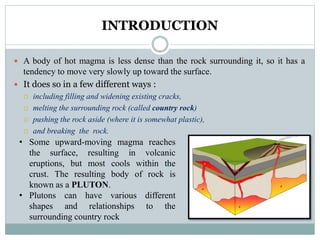
 A body of hot magma is less dense than the rock surrounding it, so it has a
tendency to move very slowly up toward the surface.
 It does so in a few different ways :
 including filling and widening existing cracks,
 melting the surrounding rock (called country rock)
 pushing the rock aside (where it is somewhat plastic),
 and breaking the rock.
• Some upward-moving magma reaches
the surface, resulting in volcanic
eruptions, but most cools within the
crust. The resulting body of rock is
known as a PLUTON.
• Plutons can have various different
shapes and relationships to the
surrounding country rock
TYPES OF INTRUSIVE BODIES
 There are two types of intrusive bodies
1. DISCORDANT
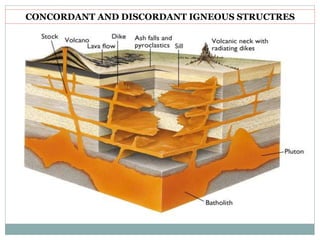
 A discordant igneous rock body cuts
across the pre-exiting rock bed.
 A dike is an example of discordant rock bodies.
2. CONCORDANT
 A concordant igneous rock body runs
parallel to the pre-existing bedrock.
 Laccoliths and sills are examples of concordant
igneous rock bodies.
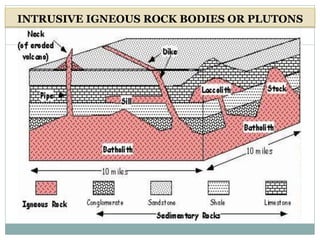
INTRUSIVE IGNEOUS ROCK BODIES OR PLUTONS
 Sills are relatively thin tabular sheetlike body that
penetrates parallel to the bedding planes.
 Laterally it may extends for 100s of kms and upto 10
kms in width.
 Lateral extend mainly depends on the hydrostatic force,
temperature, degree of fluidity or viscosity, weight of
overlying sediment column.
 Since basic magma are more fluid then acidic magma-
mostly sills are made up of gabbros and dolerites.
SILLS
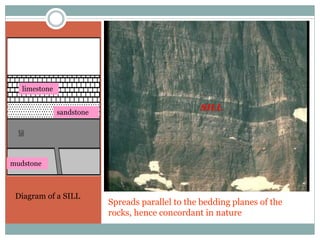
Spreads parallel to the bedding planes of the
rocks, hence concordant in nature
limestone
sandstone
mudstone
Diagram of a SILL
SILL
TYPES OF SILLS
1. SINGLE SILL
 A simple sill is the product of a single intrusion.
2. MULTIPLE SILL
 A multiple sill is formed by two or more intrusions.
3. COMPOSITE SILL
 A composite sill is composed of more than one rock type
positioned between older layers of rock during more than
one intrusive episode.
4. DIFFERENTIATED SILL
 Exceptionally Large
 Sheet like injections of magma
 Segregation of minerals formed at various stages of
crystallization into separate layers or zones
CONCORDANT AND DISCORDANT IGNEOUS STRUCTRES
LACCOLITHS
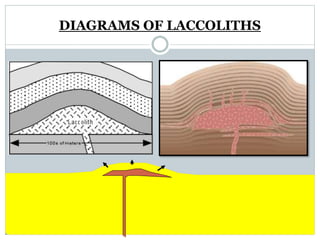
 Laccoliths are concordant mushroom-shaped
bodies with
 a flat floor and
 a domed roof.
 A laccolith is sufficiently viscous (and silicic) to
limit magma flow along the horizontal plane and
shallow enough to physically lift the roof rocks.
 It causes folding of the overlying rock layers.
 Examples include :
 Gothic Mountain is a place where the flat floor of the laccolith is exposed.
 The Sleeping Ute Mountain of Utah.
DIAGRAMS OF LACCOLITHS
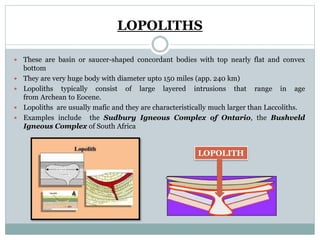
LOPOLITHS
 These are basin or saucer-shaped concordant bodies with top nearly flat and convex
bottom
 They are very huge body with diameter upto 150 miles (app. 240 km)
 Lopoliths typically consist of large layered intrusions that range in age
from Archean to Eocene.
 Lopoliths are usually mafic and they are characteristically much larger than Laccoliths.
 Examples include the Sudbury Igneous Complex of Ontario, the Bushveld
Igneous Complex of South Africa
LOPOLITH
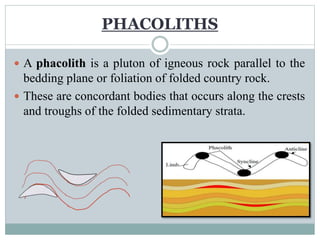
PHACOLITHS
 A phacolith is a pluton of igneous rock parallel to the
bedding plane or foliation of folded country rock.
 These are concordant bodies that occurs along the crests
and troughs of the folded sedimentary strata.
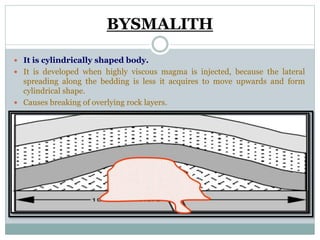
BYSMALITH
 It is cylindrically shaped body.
 It is developed when highly viscous magma is injected, because the lateral
spreading along the bedding is less it acquires to move upwards and form
cylindrical shape.
 Causes breaking of overlying rock layers.
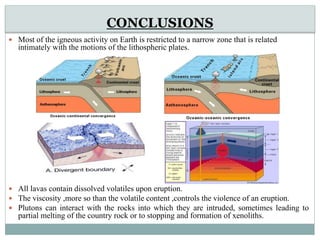
CONCLUSIONS
 Most of the igneous activity on Earth is restricted to a narrow zone that is related
intimately with the motions of the lithospheric plates.
 All lavas contain dissolved volatiles upon eruption.
 The viscosity ,more so than the volatile content ,controls the violence of an eruption.
 Plutons can interact with the rocks into which they are intruded, sometimes leading to
partial melting of the country rock or to stopping and formation of xenoliths.
REFERENCES
Books Referred :
 Igneous and Metamorphic Petrology (Pearson) ; 2013 by J.D.Winter.
 Principles of igneous and metamorphic petrology (Freeman) ; 1990 by Anthony R
Philpotts.
 Igneous and Metamorphic Petrology (Wiley-Blackwell); 1982 by Myron G. Best.
Online Sources :
• https://www.slideshare.net/Sekhar9581/forms-of-igneous-rocks
• https://www.quora.com/What-is-the-difference-between-dykes-and-sills
• https://www.quora.com/What-are-%E2%80%9Concordant-
bodies%E2%80%9D

Concordant Plutonic Bodies

  • 1.
    Topic of theSeminar CONCORDANT PLUTONS Presented By : ANUP UPADHYAYA, 3rd Sem., M.Sc., Applied Geology.
  • 2.
    CONTENTS  INTRODUCTION  TYPESOF INTRUSIVE BODIES  DISCORDANT  CONCORDANT 1. SILLS a) SINGLE SILL b) COMPOSITE SILL c) MULTIPLE SILL d) DIFFERENTIATED SILL 2. LACCOLITHS 3. LOPOLITHS 4. PHACOLITHS 5. BYSMALITH  CONCLUSIONS  REFERENCES
  • 3.
    INTRODUCTION  A bodyof hot magma is less dense than the rock surrounding it, so it has a tendency to move very slowly up toward the surface.  It does so in a few different ways :  including filling and widening existing cracks,  melting the surrounding rock (called country rock)  pushing the rock aside (where it is somewhat plastic),  and breaking the rock. • Some upward-moving magma reaches the surface, resulting in volcanic eruptions, but most cools within the crust. The resulting body of rock is known as a PLUTON. • Plutons can have various different shapes and relationships to the surrounding country rock
  • 4.
    TYPES OF INTRUSIVEBODIES  There are two types of intrusive bodies 1. DISCORDANT  A discordant igneous rock body cuts across the pre-exiting rock bed.  A dike is an example of discordant rock bodies. 2. CONCORDANT  A concordant igneous rock body runs parallel to the pre-existing bedrock.  Laccoliths and sills are examples of concordant igneous rock bodies.
  • 5.
    INTRUSIVE IGNEOUS ROCKBODIES OR PLUTONS
  • 6.
     Sills arerelatively thin tabular sheetlike body that penetrates parallel to the bedding planes.  Laterally it may extends for 100s of kms and upto 10 kms in width.  Lateral extend mainly depends on the hydrostatic force, temperature, degree of fluidity or viscosity, weight of overlying sediment column.  Since basic magma are more fluid then acidic magma- mostly sills are made up of gabbros and dolerites. SILLS
  • 7.
    Spreads parallel tothe bedding planes of the rocks, hence concordant in nature limestone sandstone mudstone Diagram of a SILL SILL
  • 8.
    TYPES OF SILLS 1.SINGLE SILL  A simple sill is the product of a single intrusion. 2. MULTIPLE SILL  A multiple sill is formed by two or more intrusions. 3. COMPOSITE SILL  A composite sill is composed of more than one rock type positioned between older layers of rock during more than one intrusive episode. 4. DIFFERENTIATED SILL  Exceptionally Large  Sheet like injections of magma  Segregation of minerals formed at various stages of crystallization into separate layers or zones
  • 9.
    CONCORDANT AND DISCORDANTIGNEOUS STRUCTRES
  • 10.
    LACCOLITHS  Laccoliths areconcordant mushroom-shaped bodies with  a flat floor and  a domed roof.  A laccolith is sufficiently viscous (and silicic) to limit magma flow along the horizontal plane and shallow enough to physically lift the roof rocks.  It causes folding of the overlying rock layers.  Examples include :  Gothic Mountain is a place where the flat floor of the laccolith is exposed.  The Sleeping Ute Mountain of Utah.
  • 11.
  • 12.
    LOPOLITHS  These arebasin or saucer-shaped concordant bodies with top nearly flat and convex bottom  They are very huge body with diameter upto 150 miles (app. 240 km)  Lopoliths typically consist of large layered intrusions that range in age from Archean to Eocene.  Lopoliths are usually mafic and they are characteristically much larger than Laccoliths.  Examples include the Sudbury Igneous Complex of Ontario, the Bushveld Igneous Complex of South Africa LOPOLITH
  • 13.
    PHACOLITHS  A phacolithis a pluton of igneous rock parallel to the bedding plane or foliation of folded country rock.  These are concordant bodies that occurs along the crests and troughs of the folded sedimentary strata.
  • 14.
    BYSMALITH  It iscylindrically shaped body.  It is developed when highly viscous magma is injected, because the lateral spreading along the bedding is less it acquires to move upwards and form cylindrical shape.  Causes breaking of overlying rock layers.
  • 15.
    CONCLUSIONS  Most ofthe igneous activity on Earth is restricted to a narrow zone that is related intimately with the motions of the lithospheric plates.  All lavas contain dissolved volatiles upon eruption.  The viscosity ,more so than the volatile content ,controls the violence of an eruption.  Plutons can interact with the rocks into which they are intruded, sometimes leading to partial melting of the country rock or to stopping and formation of xenoliths.
  • 16.
    REFERENCES Books Referred : Igneous and Metamorphic Petrology (Pearson) ; 2013 by J.D.Winter.  Principles of igneous and metamorphic petrology (Freeman) ; 1990 by Anthony R Philpotts.  Igneous and Metamorphic Petrology (Wiley-Blackwell); 1982 by Myron G. Best. Online Sources : • https://www.slideshare.net/Sekhar9581/forms-of-igneous-rocks • https://www.quora.com/What-is-the-difference-between-dykes-and-sills • https://www.quora.com/What-are-%E2%80%9Concordant- bodies%E2%80%9D