Sec on 1.4
                    Calcula ng Limits
                      V63.0121.001: Calculus I
                    Professor Ma hew Leingang
                            New York University


                          February 2, 2011

    Announcements
       First wri en HW due today
.
Announcements

   First wri en HW due
   today
   Get-to-know-you survey
   and photo deadline is
   February 11
Objectives
   Know basic limits like lim x = a
                          x→a
   and lim c = c.
       x→a
   Use the limit laws to compute
   elementary limits.
   Use algebra to simplify limits.
   Understand and state the
   Squeeze Theorem.
   Use the Squeeze Theorem to
   demonstrate a limit.
Limit


.
Yoda on teaching course concepts
     You must unlearn
     what you have
     learned.
 In other words, we are
 building up concepts and
 allowing ourselves only to
 speak in terms of what we
 personally have produced.
Outline
 Recall: The concept of limit

 Basic Limits

 Limit Laws
    The direct subs tu on property

 Limits with Algebra
    Two more limit theorems

 Two important trigonometric limits
Heuristic Definition of a Limit
 Defini on
 We write
                               lim f(x) = L
                               x→a
 and say

             “the limit of f(x), as x approaches a, equals L”

 if we can make the values of f(x) arbitrarily close to L (as close to L
 as we like) by taking x to be sufficiently close to a (on either side of
 a) but not equal to a.
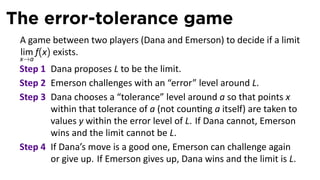
The error-tolerance game
 A game between two players (Dana and Emerson) to decide if a limit
 lim f(x) exists.
 x→a
 Step 1 Dana proposes L to be the limit.
 Step 2 Emerson challenges with an “error” level around L.
 Step 3 Dana chooses a “tolerance” level around a so that points x
        within that tolerance of a (not coun ng a itself) are taken to
        values y within the error level of L. If Dana cannot, Emerson
        wins and the limit cannot be L.
 Step 4 If Dana’s move is a good one, Emerson can challenge again
        or give up. If Emerson gives up, Dana wins and the limit is L.
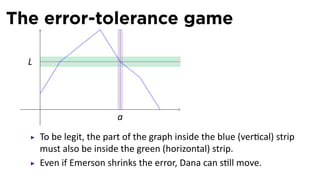
The error-tolerance game

  L


      .
                          a
      To be legit, the part of the graph inside the blue (ver cal) strip
      must also be inside the green (horizontal) strip.
      Even if Emerson shrinks the error, Dana can s ll move.
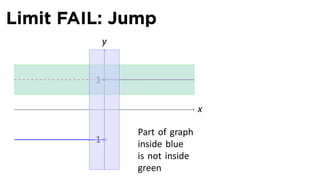
Limit FAIL: Jump
             y


         1

             .                   x

                 Part of graph
        −1       inside blue
                 is not inside
                 green
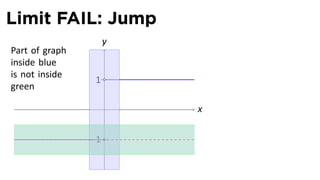
Limit FAIL: Jump
                     y
Part of graph
inside blue
is not inside
                 1
green

                     .   x


                −1
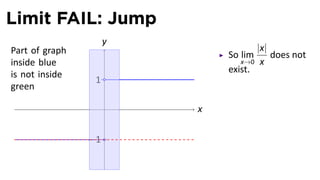
Limit FAIL: Jump
                     y
Part of graph                       |x|
                             So lim     does not
inside blue                     x→0 x
is not inside                exist.
                 1
green

                     .   x


                −1
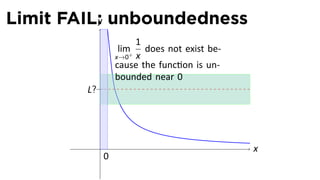
Limit FAIL: unboundedness
          y

                         1
                     lim+   does not exist be-
                     x→0 x
                     cause the func on is un-
                     bounded near 0
        L?


             .                                   x
                 0
Limit EPIC FAIL                              (π )
 Here is a graph of the func on f(x) = sin          :
                                              x
                                     y
                                 1

                                     .                   x


                               −1

 For every y in [−1, 1], there are infinitely many points x arbitrarily
 close to zero where f(x) = y. So lim f(x) cannot exist.
                                     x→0
Outline
 Recall: The concept of limit

 Basic Limits

 Limit Laws
    The direct subs tu on property

 Limits with Algebra
    Two more limit theorems

 Two important trigonometric limits
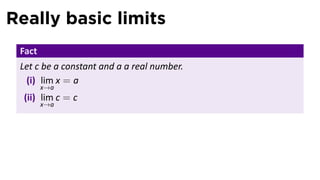
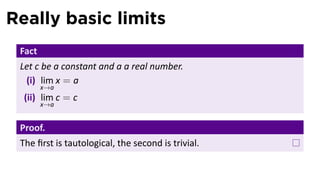
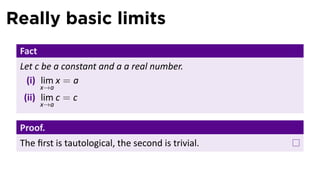
Really basic limits
 Fact
 Let c be a constant and a a real number.
  (i) lim x = a
        x→a
  (ii) lim c = c
        x→a
Really basic limits
 Fact
 Let c be a constant and a a real number.
  (i) lim x = a
        x→a
  (ii) lim c = c
        x→a


 Proof.
 The first is tautological, the second is trivial.
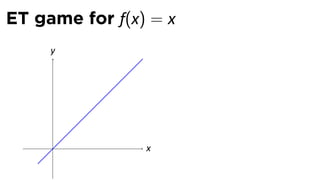
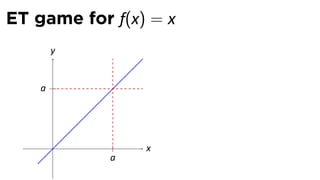
ET game for f(x) = x
     y


     .          x
ET game for f(x) = x
     y


     .          x
ET game for f(x) = x
        y


    a


        .       x
            a
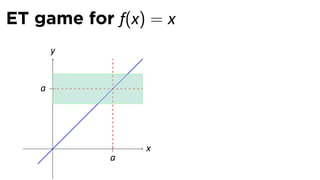
ET game for f(x) = x
        y


    a


        .       x
            a
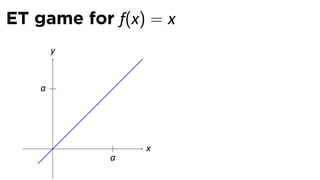
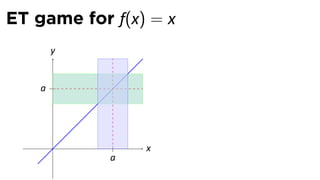
ET game for f(x) = x
        y


    a


        .       x
            a
ET game for f(x) = x
        y


    a


        .       x
            a
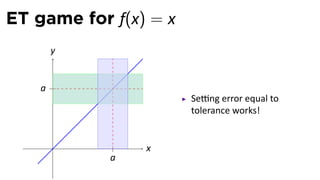
ET game for f(x) = x
        y


    a
                       Se ng error equal to
                       tolerance works!


        .       x
            a
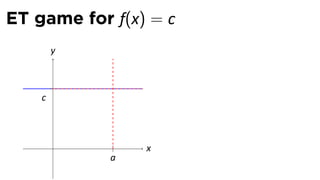
ET game for f(x) = c


     .
ET game for f(x) = c
     y


     .          x
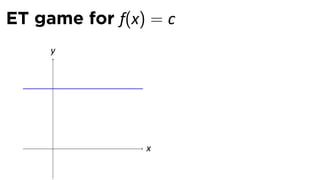
ET game for f(x) = c
     y


     .          x
ET game for f(x) = c
        y


    c


        .       x
            a
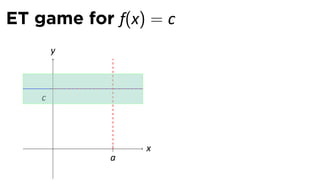
ET game for f(x) = c
        y


    c


        .       x
            a
ET game for f(x) = c
        y


    c


        .       x
            a
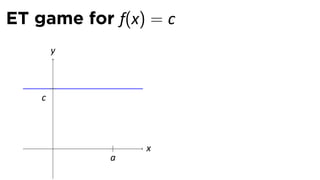
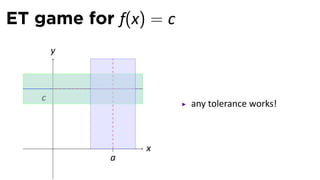
ET game for f(x) = c
        y


    c
                       any tolerance works!


        .       x
            a
Really basic limits
 Fact
 Let c be a constant and a a real number.
  (i) lim x = a
        x→a
  (ii) lim c = c
        x→a


 Proof.
 The first is tautological, the second is trivial.
Outline
 Recall: The concept of limit

 Basic Limits

 Limit Laws
    The direct subs tu on property

 Limits with Algebra
    Two more limit theorems

 Two important trigonometric limits
Limits and arithmetic
 Fact
 Suppose lim f(x) = L and lim g(x) = M and c is a constant. Then
              x→a         x→a
  1. lim [f(x) + g(x)] = L + M
        x→a
Limits and arithmetic
 Fact
 Suppose lim f(x) = L and lim g(x) = M and c is a constant. Then
              x→a         x→a
  1. lim [f(x) + g(x)] = L + M (errors add)
        x→a
Limits and arithmetic
 Fact
 Suppose lim f(x) = L and lim g(x) = M and c is a constant. Then
              x→a         x→a
  1. lim [f(x) + g(x)] = L + M (errors add)
        x→a
  2. lim [f(x) − g(x)] = L − M
        x→a
Limits and arithmetic
 Fact
 Suppose lim f(x) = L and lim g(x) = M and c is a constant. Then
              x→a         x→a
  1. lim [f(x) + g(x)] = L + M (errors add)
        x→a
  2. lim [f(x) − g(x)] = L − M
        x→a
  3. lim [cf(x)] = cL
        x→a
Limits and arithmetic
 Fact
 Suppose lim f(x) = L and lim g(x) = M and c is a constant. Then
              x→a          x→a
  1. lim [f(x) + g(x)] = L + M (errors add)
        x→a
  2. lim [f(x) − g(x)] = L − M
        x→a
  3. lim [cf(x)] = cL (error scales)
        x→a
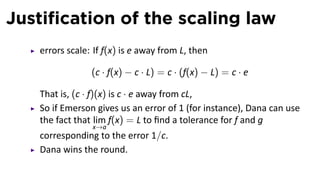
Justification of the scaling law
   errors scale: If f(x) is e away from L, then

                (c · f(x) − c · L) = c · (f(x) − L) = c · e

   That is, (c · f)(x) is c · e away from cL,
   So if Emerson gives us an error of 1 (for instance), Dana can use
   the fact that lim f(x) = L to find a tolerance for f and g
                x→a
   corresponding to the error 1/c.
   Dana wins the round.
Limits and arithmetic
 Fact
 Suppose lim f(x) = L and lim g(x) = M and c is a constant. Then
              x→a          x→a
  1. lim [f(x) + g(x)] = L + M (errors add)
        x→a
  2. lim [f(x) − g(x)] = L − M (combina on of adding and scaling)
        x→a
  3. lim [cf(x)] = cL (error scales)
        x→a
Limits and arithmetic
 Fact
 Suppose lim f(x) = L and lim g(x) = M and c is a constant. Then
              x→a          x→a
  1. lim [f(x) + g(x)] = L + M (errors add)
        x→a
  2. lim [f(x) − g(x)] = L − M (combina on of adding and scaling)
        x→a
  3. lim [cf(x)] = cL (error scales)
        x→a
  4. lim [f(x)g(x)] = L · M
        x→a
Limits and arithmetic
 Fact
 Suppose lim f(x) = L and lim g(x) = M and c is a constant. Then
              x→a          x→a
  1. lim [f(x) + g(x)] = L + M (errors add)
        x→a
  2. lim [f(x) − g(x)] = L − M (combina on of adding and scaling)
        x→a
  3. lim [cf(x)] = cL (error scales)
        x→a
  4. lim [f(x)g(x)] = L · M (more complicated, but doable)
        x→a
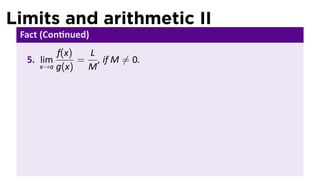
Limits and arithmetic II
 Fact (Con nued)
         f(x)  L
  5. lim      = , if M ̸= 0.
     x→a g(x)  M
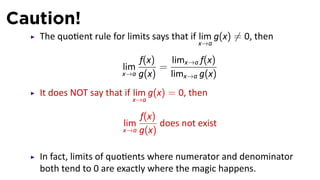
Caution!
   The quo ent rule for limits says that if lim g(x) ̸= 0, then
                                           x→a

                            f(x)   limx→a f(x)
                        lim      =
                        x→a g(x)   limx→a g(x)
   It does NOT say that if lim g(x) = 0, then
                          x→a

                            f(x)
                        lim      does not exist
                        x→a g(x)


   In fact, limits of quo ents where numerator and denominator
   both tend to 0 are exactly where the magic happens.
Limits and arithmetic II
 Fact (Con nued)
          f(x)   L
  5. lim       = , if M ̸= 0.
     x→a g(x)    M
                  [        ]n
               n
  6. lim [f(x)] = lim f(x)
     x→a           x→a
Limits and arithmetic II
 Fact (Con nued)
          f(x)   L
  5. lim       = , if M ̸= 0.
     x→a g(x)    M
                  [       ]n
               n
  6. lim [f(x)] = lim f(x) (follows from 4 repeatedly)
     x→a           x→a
Limits and arithmetic II
 Fact (Con nued)
          f(x)   L
  5. lim       = , if M ̸= 0.
     x→a g(x)    M
                  [       ]n
               n
  6. lim [f(x)] = lim f(x) (follows from 4 repeatedly)
     x→a             x→a
           n     n
  7. lim x = a
     x→a
Limits and arithmetic II
 Fact (Con nued)
          f(x)   L
  5. lim       = , if M ̸= 0.
     x→a g(x)    M
                  [       ]n
               n
  6. lim [f(x)] = lim f(x) (follows from 4 repeatedly)
     x→a             x→a
           n   n
  7. lim x = a
     x→a
         √    √
  8. lim n x = n a
     x→a
Limits and arithmetic II
 Fact (Con nued)
          f(x)   L
  5. lim       = , if M ̸= 0.
     x→a g(x)    M
                  [       ]n
               n
  6. lim [f(x)] = lim f(x) (follows from 4 repeatedly)
     x→a           x→a
           n   n
  7. lim x = a (follows from 6)
     x→a
         √    √
  8. lim n x = n a
     x→a
Limits and arithmetic II
 Fact (Con nued)
          f(x)   L
  5. lim       = , if M ̸= 0.
     x→a g(x)    M
                  [       ]n
               n
  6. lim [f(x)] = lim f(x) (follows from 4 repeatedly)
     x→a            x→a
           n   n
  7. lim x = a (follows from 6)
     x→a
         √    √
  8. lim n x = n a
     x→a
         √        √
          n
  9. lim f(x) = n lim f(x) (If n is even, we must addi onally
     x→a             x→a
     assume that lim f(x) > 0)
                   x→a
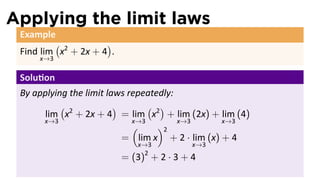
Applying the limit laws
 Example
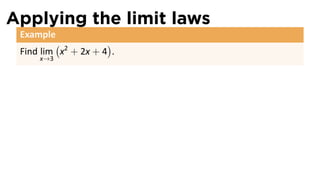
         (           )
 Find lim x2 + 2x + 4 .
     x→3
Applying the limit laws
 Example
         (           )
 Find lim x2 + 2x + 4 .
     x→3

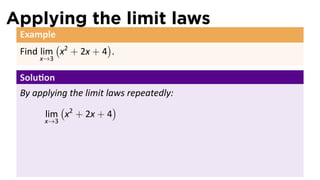
 Solu on
 By applying the limit laws repeatedly:
           (             )
       lim x2 + 2x + 4
       x→3
Applying the limit laws
 Example
         (           )
 Find lim x2 + 2x + 4 .
     x→3

 Solu on
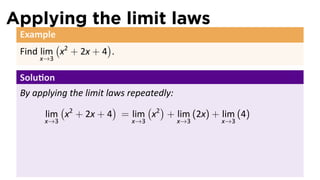
 By applying the limit laws repeatedly:
           (             )      ( )
       lim x2 + 2x + 4 = lim x2 + lim (2x) + lim (4)
      x→3                 x→3      x→3       x→3
Applying the limit laws
 Example
         (           )
 Find lim x2 + 2x + 4 .
     x→3

 Solu on
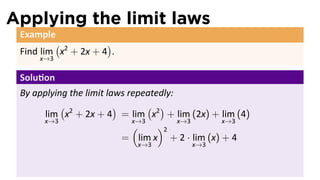
 By applying the limit laws repeatedly:
           (             )       ( )
       lim x2 + 2x + 4 = lim x2 + lim (2x) + lim (4)
      x→3                    x→3        x→3      x→3
                             (     )2
                           = lim x + 2 · lim (x) + 4
                           x→3         x→3
Applying the limit laws
 Example
         (           )
 Find lim x2 + 2x + 4 .
     x→3

 Solu on
 By applying the limit laws repeatedly:
           (             )       ( )
       lim x2 + 2x + 4 = lim x2 + lim (2x) + lim (4)
      x→3                    x→3        x→3      x→3
                             (     )2
                           = lim x + 2 · lim (x) + 4
                             x→3          x→3
                               2
                          = (3) + 2 · 3 + 4
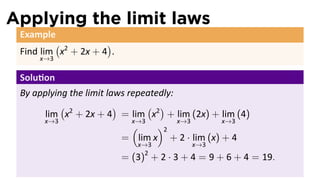
Applying the limit laws
 Example
         (           )
 Find lim x2 + 2x + 4 .
     x→3

 Solu on
 By applying the limit laws repeatedly:
           (             )       ( )
       lim x2 + 2x + 4 = lim x2 + lim (2x) + lim (4)
      x→3                    x→3        x→3      x→3
                             (     )2
                           = lim x + 2 · lim (x) + 4
                             x→3          x→3
                               2
                          = (3) + 2 · 3 + 4 = 9 + 6 + 4 = 19.
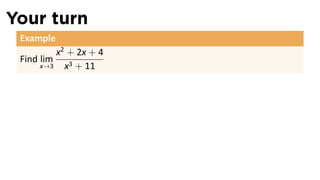
Your turn
 Example
          x2 + 2x + 4
 Find lim
      x→3   x3 + 11
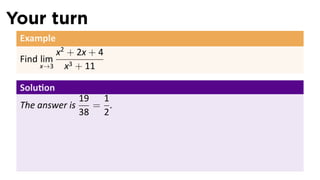
Your turn
 Example
          x2 + 2x + 4
 Find lim
      x→3   x3 + 11

 Solu on
                 19 1
 The answer is     = .
                 38 2
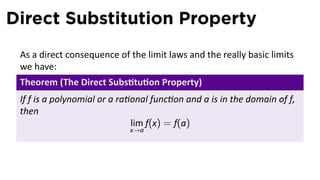
Direct Substitution Property
 As a direct consequence of the limit laws and the really basic limits
 we have:
 Theorem (The Direct Subs tu on Property)
 If f is a polynomial or a ra onal func on and a is in the domain of f,
 then
                              lim f(x) = f(a)
                            x→a
Outline
 Recall: The concept of limit

 Basic Limits

 Limit Laws
    The direct subs tu on property

 Limits with Algebra
    Two more limit theorems

 Two important trigonometric limits
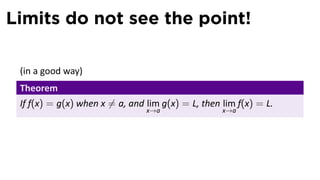
Limits do not see the point!

 (in a good way)
 Theorem
 If f(x) = g(x) when x ̸= a, and lim g(x) = L, then lim f(x) = L.
                                x→a                 x→a
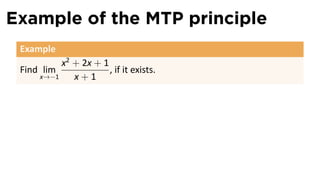
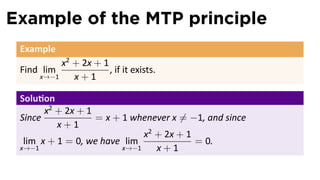
Example of the MTP principle
 Example
          x2 + 2x + 1
 Find lim             , if it exists.
     x→−1    x+1
Example of the MTP principle
 Example
          x2 + 2x + 1
 Find lim             , if it exists.
     x→−1    x+1

 Solu on
       x2 + 2x + 1
 Since             = x + 1 whenever x ̸= −1, and since
          x+1
                              x2 + 2x + 1
  lim x + 1 = 0, we have lim              = 0.
 x→−1                    x→−1    x+1
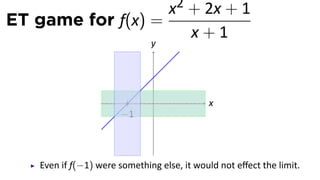
x2 + 2x + 1
ET game for f(x) =
                      x+1
                               y


                               .             x
                       −1


    Even if f(−1) were something else, it would not effect the limit.
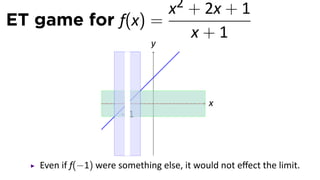
x2 + 2x + 1
ET game for f(x) =
                      x+1
                               y


                               .             x
                       −1


    Even if f(−1) were something else, it would not effect the limit.
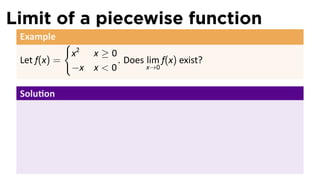
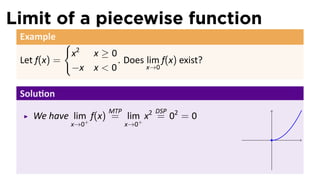
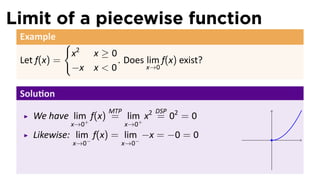
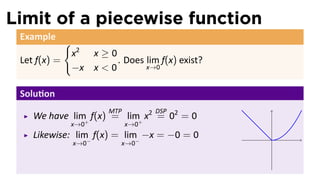
Limit of a piecewise function
 Example
              {
                  x2 x ≥ 0
 Let f(x) =                . Does lim f(x) exist?
                  −x x < 0        x→0


 Solu on


                                                    .
Limit of a piecewise function
 Example
              {
                  x2 x ≥ 0
 Let f(x) =                . Does lim f(x) exist?
                  −x x < 0        x→0


 Solu on
                          MTP         DSP
    We have lim+ f(x) = lim+ x2 = 02 = 0
              x→0               x→0
                                                    .
Limit of a piecewise function
 Example
              {
                  x2 x ≥ 0
 Let f(x) =                . Does lim f(x) exist?
                  −x x < 0        x→0


 Solu on
                          MTP         DSP
    We have lim+ f(x) = lim+ x2 = 02 = 0
              x→0               x→0
                                                    .
Limit of a piecewise function
 Example
              {
                  x2 x ≥ 0
 Let f(x) =                . Does lim f(x) exist?
                  −x x < 0        x→0


 Solu on
                          MTP         DSP
    We have lim+ f(x) = lim+ x2 = 02 = 0
              x→0               x→0
                                                    .
Limit of a piecewise function
 Example
              {
                  x2 x ≥ 0
 Let f(x) =                . Does lim f(x) exist?
                  −x x < 0        x→0


 Solu on
                          MTP         DSP
    We have lim+ f(x) = lim+ x2 = 02 = 0
              x→0               x→0
    Likewise: lim− f(x) = lim− −x = −0 = 0          .
                  x→0        x→0
Limit of a piecewise function
 Example
              {
                  x2 x ≥ 0
 Let f(x) =                . Does lim f(x) exist?
                  −x x < 0        x→0


 Solu on
                          MTP         DSP
    We have lim+ f(x) = lim+ x2 = 02 = 0
              x→0               x→0
    Likewise: lim− f(x) = lim− −x = −0 = 0          .
                  x→0        x→0
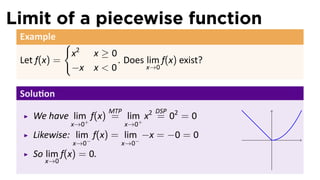
Limit of a piecewise function
 Example
              {
                  x2 x ≥ 0
 Let f(x) =                . Does lim f(x) exist?
                  −x x < 0        x→0


 Solu on
                          MTP         DSP
    We have lim+ f(x) = lim+ x2 = 02 = 0
              x→0               x→0
    Likewise: lim− f(x) = lim− −x = −0 = 0          .
                  x→0        x→0
    So lim f(x) = 0.
       x→0
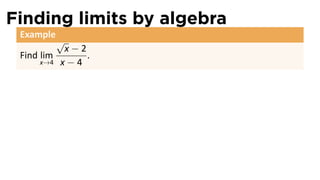
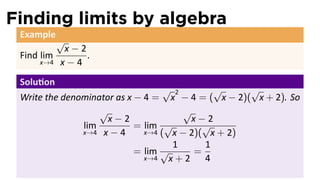
Finding limits by algebra
 Example
            √
             x−2
 Find lim        .
     x→4    x−4
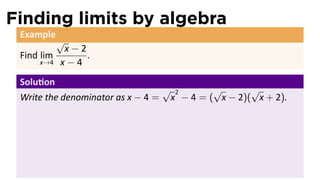
Finding limits by algebra
 Example
            √
             x−2
 Find lim        .
     x→4    x−4
 Solu on
                                    √    2       √       √
 Write the denominator as x − 4 =       x − 4 = ( x − 2)( x + 2).
Finding limits by algebra
 Example
            √
             x−2
 Find lim        .
     x→4    x−4
 Solu on
                                   √ 2       √     √
 Write the denominator as x − 4 = x − 4 = ( x − 2)( x + 2). So
                   √                   √
                     x−2                 x−2
               lim          = lim √        √
               x→4 x − 4      x→4 ( x − 2)( x + 2)
                                     1     1
                            = lim √      =
                              x→4   x+2 4
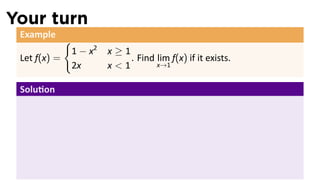
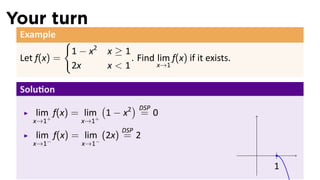
Your turn
 Example
              {
                  1 − x2   x≥1
 Let f(x) =                    . Find lim f(x) if it exists.
                  2x       x<1        x→1


 Solu on
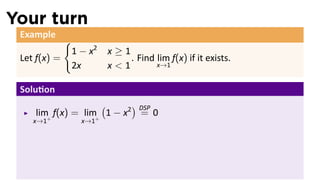
Your turn
 Example
              {
                  1 − x2   x≥1
 Let f(x) =                    . Find lim f(x) if it exists.
                  2x       x<1        x→1


 Solu on
                    (      ) DSP
    lim+ f(x) = lim+ 1 − x2 = 0
    x→1             x→1
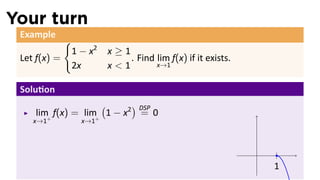
Your turn
 Example
              {
                  1 − x2   x≥1
 Let f(x) =                    . Find lim f(x) if it exists.
                  2x       x<1        x→1


 Solu on
                    (      ) DSP
    lim+ f(x) = lim+ 1 − x2 = 0
    x→1             x→1


                                                               .
                                                                   1
Your turn
 Example
              {
                  1 − x2   x≥1
 Let f(x) =                    . Find lim f(x) if it exists.
                  2x       x<1        x→1


 Solu on
                    (      ) DSP
    lim+ f(x) = lim+ 1 − x2 = 0
    x→1             x→1
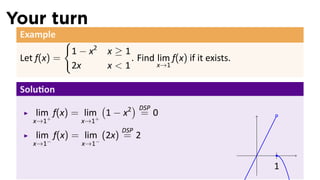
                              DSP
    lim− f(x) = lim− (2x) = 2
    x→1             x→1
                                                               .
                                                                   1
Your turn
 Example
              {
                  1 − x2   x≥1
 Let f(x) =                    . Find lim f(x) if it exists.
                  2x       x<1        x→1


 Solu on
                    (      ) DSP
    lim+ f(x) = lim+ 1 − x2 = 0
    x→1             x→1
                              DSP
    lim− f(x) = lim− (2x) = 2
    x→1             x→1
                                                               .
                                                                   1
Your turn
 Example
              {
                  1 − x2   x≥1
 Let f(x) =                    . Find lim f(x) if it exists.
                  2x       x<1        x→1


 Solu on
                    (      ) DSP
    lim+ f(x) = lim+ 1 − x2 = 0
    x→1             x→1
                              DSP
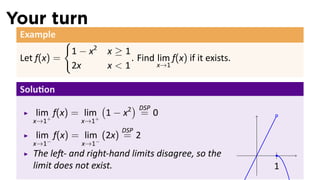
    lim− f(x) = lim− (2x) = 2
    x→1             x→1
    The le - and right-hand limits disagree, so the            .
    limit does not exist.                                          1
A message from
the Mathematical Grammar Police

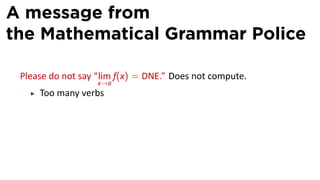
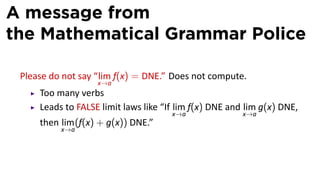
 Please do not say “lim f(x) = DNE.” Does not compute.
                   x→a
A message from
the Mathematical Grammar Police

 Please do not say “lim f(x) = DNE.” Does not compute.
                   x→a
     Too many verbs
A message from
the Mathematical Grammar Police

 Please do not say “lim f(x) = DNE.” Does not compute.
                   x→a
     Too many verbs
     Leads to FALSE limit laws like “If lim f(x) DNE and lim g(x) DNE,
                                      x→a               x→a
     then lim (f(x) + g(x)) DNE.”
          x→a
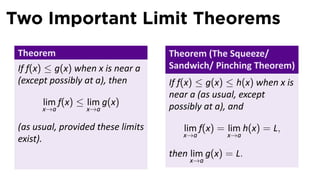
Two Important Limit Theorems
 Theorem                            Theorem (The Squeeze/
 If f(x) ≤ g(x) when x is near a    Sandwich/ Pinching Theorem)
 (except possibly at a), then       If f(x) ≤ g(x) ≤ h(x) when x is
                                    near a (as usual, except
       lim f(x) ≤ lim g(x)          possibly at a), and
       x→a        x→a

 (as usual, provided these limits      lim f(x) = lim h(x) = L,
                                       x→a        x→a
 exist).
                                    then lim g(x) = L.
                                         x→a
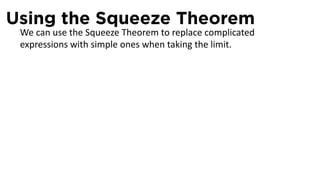
Using the Squeeze Theorem
 We can use the Squeeze Theorem to replace complicated
 expressions with simple ones when taking the limit.
Using the Squeeze Theorem
 We can use the Squeeze Theorem to replace complicated
 expressions with simple ones when taking the limit.
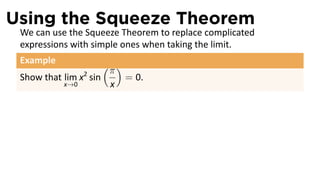
 Example
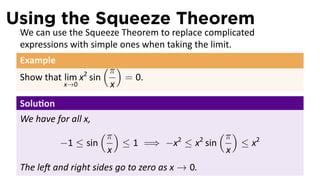
                       (π )
                 2
 Show that lim x sin          = 0.
           x→0          x
Using the Squeeze Theorem
 We can use the Squeeze Theorem to replace complicated
 expressions with simple ones when taking the limit.
 Example
                       (π )
                  2
 Show that lim x sin          = 0.
            x→0         x
 Solu on
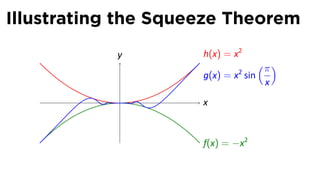
 We have for all x,
                      (π )                         (π )
           −1 ≤ sin           ≤ 1 =⇒ −x ≤ x sin
                                       2       2
                                                          ≤ x2
                       x                            x
 The le and right sides go to zero as x → 0.
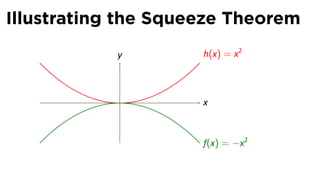
Illustrating the Squeeze Theorem
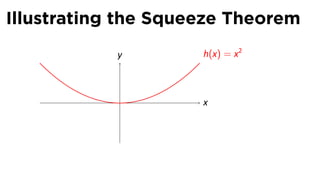
            y        h(x) = x2


            .        x
Illustrating the Squeeze Theorem
            y        h(x) = x2


            .        x


                     f(x) = −x2
Illustrating the Squeeze Theorem
            y        h(x) = x2
                                    (π )
                             2
                     g(x) = x sin
                                     x
            .        x


                     f(x) = −x2
Outline
 Recall: The concept of limit

 Basic Limits

 Limit Laws
    The direct subs tu on property

 Limits with Algebra
    Two more limit theorems

 Two important trigonometric limits
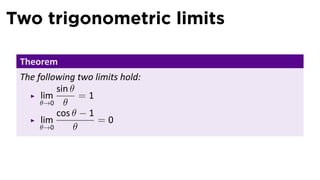
Two trigonometric limits

 Theorem
 The following two limits hold:
          sin θ
      lim        =1
      θ→0 θ
          cos θ − 1
      lim           =0
      θ→0      θ
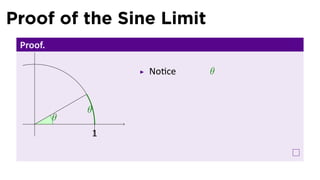
Proof of the Sine Limit
 Proof.

                      No ce   θ


              θ
    .     θ
                  1
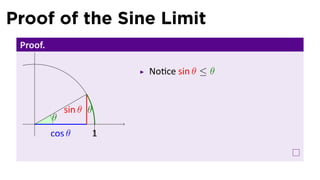
Proof of the Sine Limit
 Proof.

                            No ce sin θ ≤ θ


              sin θ θ
    .     θ
          cos θ         1
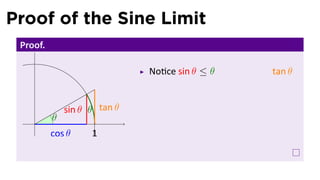
Proof of the Sine Limit
 Proof.

                              No ce sin θ ≤ θ   tan θ


              sin θ θ tan θ
    .     θ
          cos θ     1
Proof of the Sine Limit
 Proof.
                                                        θ
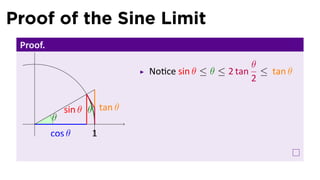
                              No ce sin θ ≤ θ ≤ 2 tan     ≤ tan θ
                                                        2


              sin θ θ tan θ
    .     θ
          cos θ     1
Proof of the Sine Limit
 Proof.
                                                         θ
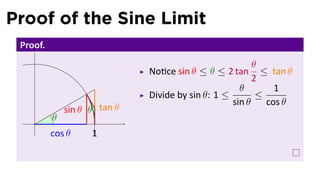
                              No ce sin θ ≤ θ ≤ 2 tan      ≤ tan θ
                                                         2
                                                     θ        1
                              Divide by sin θ: 1 ≤        ≤
                                                   sin θ    cos θ
              sin θ θ tan θ
    .     θ
          cos θ     1
Proof of the Sine Limit
 Proof.
                                                         θ
                              No ce sin θ ≤ θ ≤ 2 tan      ≤ tan θ
                                                         2
                                                     θ        1
                              Divide by sin θ: 1 ≤        ≤
                                                   sin θ    cos θ
              sin θ θ tan θ                          sin θ
    .     θ                   Take reciprocals: 1 ≥        ≥ cos θ
                                                       θ
          cos θ     1
Proof of the Sine Limit
 Proof.
                                                           θ
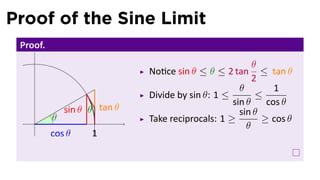
                                No ce sin θ ≤ θ ≤ 2 tan      ≤ tan θ
                                                           2
                                                       θ        1
                                Divide by sin θ: 1 ≤        ≤
                                                     sin θ    cos θ
              sin θ θ tan θ                            sin θ
    .     θ                     Take reciprocals: 1 ≥        ≥ cos θ
                                                         θ
        cos θ     1
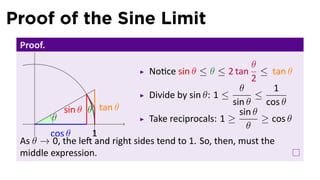
 As θ → 0, the le and right sides tend to 1. So, then, must the
 middle expression.
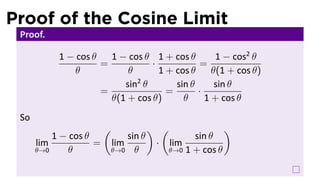
Proof of the Cosine Limit
 Proof.

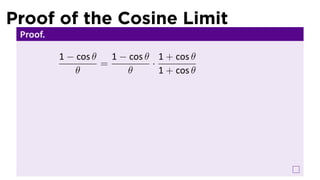
          1 − cos θ   1 − cos θ 1 + cos θ
                    =          ·
              θ           θ      1 + cos θ
Proof of the Cosine Limit
 Proof.

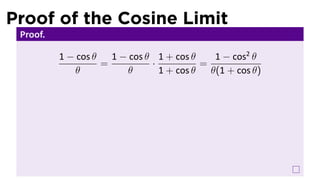
          1 − cos θ   1 − cos θ 1 + cos θ     1 − cos2 θ
                    =          ·           =
              θ           θ      1 + cos θ   θ(1 + cos θ)
Proof of the Cosine Limit
 Proof.

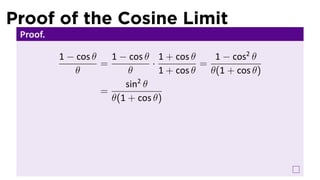
          1 − cos θ   1 − cos θ 1 + cos θ      1 − cos2 θ
                    =           ·           =
              θ           θ       1 + cos θ   θ(1 + cos θ)
                            2
                         sin θ
                    =
                      θ(1 + cos θ)
Proof of the Cosine Limit
 Proof.

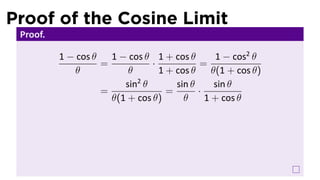
          1 − cos θ   1 − cos θ 1 + cos θ        1 − cos2 θ
                    =           ·            =
              θ           θ       1 + cos θ     θ(1 + cos θ)
                            2
                         sin θ        sin θ      sin θ
                    =               =       ·
                      θ(1 + cos θ)      θ     1 + cos θ
Proof of the Cosine Limit
 Proof.

           1 − cos θ   1 − cos θ 1 + cos θ        1 − cos2 θ
                     =           ·            =
               θ           θ       1 + cos θ     θ(1 + cos θ)
                             2
                          sin θ        sin θ      sin θ
                     =               =       ·
                       θ(1 + cos θ)      θ     1 + cos θ
 So
                        (           ) (                )
          1 − cos θ         sin θ            sin θ
      lim           =   lim          · lim
      θ→0     θ         θ→0 θ          θ→0 1 + cos θ
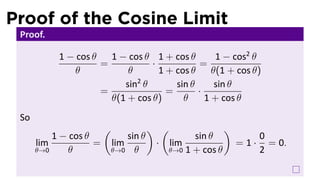
Proof of the Cosine Limit
 Proof.

           1 − cos θ   1 − cos θ 1 + cos θ        1 − cos2 θ
                     =           ·            =
               θ           θ       1 + cos θ     θ(1 + cos θ)
                             2
                          sin θ        sin θ      sin θ
                     =               =       ·
                       θ(1 + cos θ)      θ     1 + cos θ
 So
                        (           ) (                )
          1 − cos θ         sin θ            sin θ               0
      lim           =   lim          · lim                 =1·     = 0.
      θ→0     θ         θ→0 θ          θ→0 1 + cos θ             2
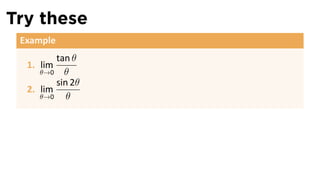
Try these
 Example
         tan θ
  1. lim
     θ→0 θ
         sin 2θ
  2. lim
     θ→0    θ
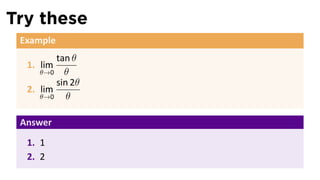
Try these
 Example
         tan θ
  1. lim
     θ→0 θ
         sin 2θ
  2. lim
     θ→0    θ

 Answer
  1. 1
  2. 2
Solutions
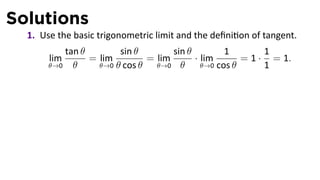
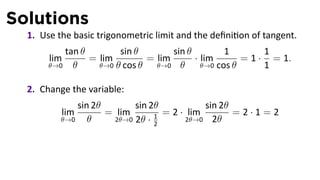
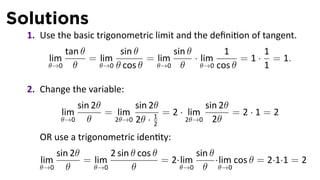
  1. Use the basic trigonometric limit and the defini on of tangent.
          tan θ        sin θ        sin θ         1        1
       lim      = lim         = lim       · lim       = 1 · = 1.
       θ→0 θ      θ→0 θ cos θ   θ→0 θ       θ→0 cos θ      1
Solutions
  1. Use the basic trigonometric limit and the defini on of tangent.
          tan θ        sin θ        sin θ         1        1
       lim      = lim         = lim       · lim       = 1 · = 1.
       θ→0 θ      θ→0 θ cos θ   θ→0 θ       θ→0 cos θ      1

  2. Change the variable:
              sin 2θ        sin 2θ           sin 2θ
          lim        = lim         = 2 · lim        =2·1=2
          θ→0    θ     2θ→0 2θ · 1      2θ→0 2θ
                                 2
Solutions
  1. Use the basic trigonometric limit and the defini on of tangent.
          tan θ        sin θ        sin θ         1        1
       lim      = lim         = lim       · lim       = 1 · = 1.
       θ→0 θ      θ→0 θ cos θ   θ→0 θ       θ→0 cos θ      1

  2. Change the variable:
               sin 2θ        sin 2θ           sin 2θ
           lim        = lim         = 2 · lim        =2·1=2
           θ→0    θ     2θ→0 2θ · 1      2θ→0 2θ
                                  2

     OR use a trigonometric iden ty:
         sin 2θ       2 sin θ cos θ         sin θ
     lim        = lim               = 2·lim       ·lim cos θ = 2·1·1 = 2
     θ→0    θ     θ→0       θ           θ→0 θ      θ→0
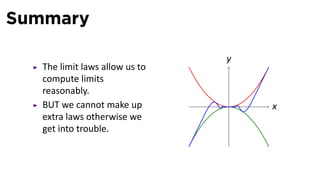
Summary

                                y
   The limit laws allow us to
   compute limits
   reasonably.
   BUT we cannot make up        .   x
   extra laws otherwise we
   get into trouble.

Lesson 4: Calculating Limits (slides)

  • 1.
    Sec on 1.4 Calcula ng Limits V63.0121.001: Calculus I Professor Ma hew Leingang New York University February 2, 2011 Announcements First wri en HW due today .
  • 2.
    Announcements First wri en HW due today Get-to-know-you survey and photo deadline is February 11
  • 3.
    Objectives Know basic limits like lim x = a x→a and lim c = c. x→a Use the limit laws to compute elementary limits. Use algebra to simplify limits. Understand and state the Squeeze Theorem. Use the Squeeze Theorem to demonstrate a limit.
  • 4.
  • 5.
    Yoda on teachingcourse concepts You must unlearn what you have learned. In other words, we are building up concepts and allowing ourselves only to speak in terms of what we personally have produced.
  • 6.
    Outline Recall: Theconcept of limit Basic Limits Limit Laws The direct subs tu on property Limits with Algebra Two more limit theorems Two important trigonometric limits
  • 7.
    Heuristic Definition ofa Limit Defini on We write lim f(x) = L x→a and say “the limit of f(x), as x approaches a, equals L” if we can make the values of f(x) arbitrarily close to L (as close to L as we like) by taking x to be sufficiently close to a (on either side of a) but not equal to a.
  • 8.
    The error-tolerance game A game between two players (Dana and Emerson) to decide if a limit lim f(x) exists. x→a Step 1 Dana proposes L to be the limit. Step 2 Emerson challenges with an “error” level around L. Step 3 Dana chooses a “tolerance” level around a so that points x within that tolerance of a (not coun ng a itself) are taken to values y within the error level of L. If Dana cannot, Emerson wins and the limit cannot be L. Step 4 If Dana’s move is a good one, Emerson can challenge again or give up. If Emerson gives up, Dana wins and the limit is L.
  • 9.
    The error-tolerance game L . a To be legit, the part of the graph inside the blue (ver cal) strip must also be inside the green (horizontal) strip. Even if Emerson shrinks the error, Dana can s ll move.
  • 10.
    Limit FAIL: Jump y 1 . x Part of graph −1 inside blue is not inside green
  • 11.
    Limit FAIL: Jump y Part of graph inside blue is not inside 1 green . x −1
  • 12.
    Limit FAIL: Jump y Part of graph |x| So lim does not inside blue x→0 x is not inside exist. 1 green . x −1
  • 13.
    Limit FAIL: unboundedness y 1 lim+ does not exist be- x→0 x cause the func on is un- bounded near 0 L? . x 0
  • 14.
    Limit EPIC FAIL (π ) Here is a graph of the func on f(x) = sin : x y 1 . x −1 For every y in [−1, 1], there are infinitely many points x arbitrarily close to zero where f(x) = y. So lim f(x) cannot exist. x→0
  • 15.
    Outline Recall: Theconcept of limit Basic Limits Limit Laws The direct subs tu on property Limits with Algebra Two more limit theorems Two important trigonometric limits
  • 16.
    Really basic limits Fact Let c be a constant and a a real number. (i) lim x = a x→a (ii) lim c = c x→a
  • 17.
    Really basic limits Fact Let c be a constant and a a real number. (i) lim x = a x→a (ii) lim c = c x→a Proof. The first is tautological, the second is trivial.
  • 18.
    ET game forf(x) = x y . x
  • 19.
    ET game forf(x) = x y . x
  • 20.
    ET game forf(x) = x y a . x a
  • 21.
    ET game forf(x) = x y a . x a
  • 22.
    ET game forf(x) = x y a . x a
  • 23.
    ET game forf(x) = x y a . x a
  • 24.
    ET game forf(x) = x y a Se ng error equal to tolerance works! . x a
  • 25.
    ET game forf(x) = c .
  • 26.
    ET game forf(x) = c y . x
  • 27.
    ET game forf(x) = c y . x
  • 28.
    ET game forf(x) = c y c . x a
  • 29.
    ET game forf(x) = c y c . x a
  • 30.
    ET game forf(x) = c y c . x a
  • 31.
    ET game forf(x) = c y c any tolerance works! . x a
  • 32.
    Really basic limits Fact Let c be a constant and a a real number. (i) lim x = a x→a (ii) lim c = c x→a Proof. The first is tautological, the second is trivial.
  • 33.
    Outline Recall: Theconcept of limit Basic Limits Limit Laws The direct subs tu on property Limits with Algebra Two more limit theorems Two important trigonometric limits
  • 34.
    Limits and arithmetic Fact Suppose lim f(x) = L and lim g(x) = M and c is a constant. Then x→a x→a 1. lim [f(x) + g(x)] = L + M x→a
  • 35.
    Limits and arithmetic Fact Suppose lim f(x) = L and lim g(x) = M and c is a constant. Then x→a x→a 1. lim [f(x) + g(x)] = L + M (errors add) x→a
  • 36.
    Limits and arithmetic Fact Suppose lim f(x) = L and lim g(x) = M and c is a constant. Then x→a x→a 1. lim [f(x) + g(x)] = L + M (errors add) x→a 2. lim [f(x) − g(x)] = L − M x→a
  • 37.
    Limits and arithmetic Fact Suppose lim f(x) = L and lim g(x) = M and c is a constant. Then x→a x→a 1. lim [f(x) + g(x)] = L + M (errors add) x→a 2. lim [f(x) − g(x)] = L − M x→a 3. lim [cf(x)] = cL x→a
  • 38.
    Limits and arithmetic Fact Suppose lim f(x) = L and lim g(x) = M and c is a constant. Then x→a x→a 1. lim [f(x) + g(x)] = L + M (errors add) x→a 2. lim [f(x) − g(x)] = L − M x→a 3. lim [cf(x)] = cL (error scales) x→a
  • 39.
    Justification of thescaling law errors scale: If f(x) is e away from L, then (c · f(x) − c · L) = c · (f(x) − L) = c · e That is, (c · f)(x) is c · e away from cL, So if Emerson gives us an error of 1 (for instance), Dana can use the fact that lim f(x) = L to find a tolerance for f and g x→a corresponding to the error 1/c. Dana wins the round.
  • 40.
    Limits and arithmetic Fact Suppose lim f(x) = L and lim g(x) = M and c is a constant. Then x→a x→a 1. lim [f(x) + g(x)] = L + M (errors add) x→a 2. lim [f(x) − g(x)] = L − M (combina on of adding and scaling) x→a 3. lim [cf(x)] = cL (error scales) x→a
  • 41.
    Limits and arithmetic Fact Suppose lim f(x) = L and lim g(x) = M and c is a constant. Then x→a x→a 1. lim [f(x) + g(x)] = L + M (errors add) x→a 2. lim [f(x) − g(x)] = L − M (combina on of adding and scaling) x→a 3. lim [cf(x)] = cL (error scales) x→a 4. lim [f(x)g(x)] = L · M x→a
  • 42.
    Limits and arithmetic Fact Suppose lim f(x) = L and lim g(x) = M and c is a constant. Then x→a x→a 1. lim [f(x) + g(x)] = L + M (errors add) x→a 2. lim [f(x) − g(x)] = L − M (combina on of adding and scaling) x→a 3. lim [cf(x)] = cL (error scales) x→a 4. lim [f(x)g(x)] = L · M (more complicated, but doable) x→a
  • 43.
    Limits and arithmeticII Fact (Con nued) f(x) L 5. lim = , if M ̸= 0. x→a g(x) M
  • 44.
    Caution! The quo ent rule for limits says that if lim g(x) ̸= 0, then x→a f(x) limx→a f(x) lim = x→a g(x) limx→a g(x) It does NOT say that if lim g(x) = 0, then x→a f(x) lim does not exist x→a g(x) In fact, limits of quo ents where numerator and denominator both tend to 0 are exactly where the magic happens.
  • 45.
    Limits and arithmeticII Fact (Con nued) f(x) L 5. lim = , if M ̸= 0. x→a g(x) M [ ]n n 6. lim [f(x)] = lim f(x) x→a x→a
  • 46.
    Limits and arithmeticII Fact (Con nued) f(x) L 5. lim = , if M ̸= 0. x→a g(x) M [ ]n n 6. lim [f(x)] = lim f(x) (follows from 4 repeatedly) x→a x→a
  • 47.
    Limits and arithmeticII Fact (Con nued) f(x) L 5. lim = , if M ̸= 0. x→a g(x) M [ ]n n 6. lim [f(x)] = lim f(x) (follows from 4 repeatedly) x→a x→a n n 7. lim x = a x→a
  • 48.
    Limits and arithmeticII Fact (Con nued) f(x) L 5. lim = , if M ̸= 0. x→a g(x) M [ ]n n 6. lim [f(x)] = lim f(x) (follows from 4 repeatedly) x→a x→a n n 7. lim x = a x→a √ √ 8. lim n x = n a x→a
  • 49.
    Limits and arithmeticII Fact (Con nued) f(x) L 5. lim = , if M ̸= 0. x→a g(x) M [ ]n n 6. lim [f(x)] = lim f(x) (follows from 4 repeatedly) x→a x→a n n 7. lim x = a (follows from 6) x→a √ √ 8. lim n x = n a x→a
  • 50.
    Limits and arithmeticII Fact (Con nued) f(x) L 5. lim = , if M ̸= 0. x→a g(x) M [ ]n n 6. lim [f(x)] = lim f(x) (follows from 4 repeatedly) x→a x→a n n 7. lim x = a (follows from 6) x→a √ √ 8. lim n x = n a x→a √ √ n 9. lim f(x) = n lim f(x) (If n is even, we must addi onally x→a x→a assume that lim f(x) > 0) x→a
  • 51.
    Applying the limitlaws Example ( ) Find lim x2 + 2x + 4 . x→3
  • 52.
    Applying the limitlaws Example ( ) Find lim x2 + 2x + 4 . x→3 Solu on By applying the limit laws repeatedly: ( ) lim x2 + 2x + 4 x→3
  • 53.
    Applying the limitlaws Example ( ) Find lim x2 + 2x + 4 . x→3 Solu on By applying the limit laws repeatedly: ( ) ( ) lim x2 + 2x + 4 = lim x2 + lim (2x) + lim (4) x→3 x→3 x→3 x→3
  • 54.
    Applying the limitlaws Example ( ) Find lim x2 + 2x + 4 . x→3 Solu on By applying the limit laws repeatedly: ( ) ( ) lim x2 + 2x + 4 = lim x2 + lim (2x) + lim (4) x→3 x→3 x→3 x→3 ( )2 = lim x + 2 · lim (x) + 4 x→3 x→3
  • 55.
    Applying the limitlaws Example ( ) Find lim x2 + 2x + 4 . x→3 Solu on By applying the limit laws repeatedly: ( ) ( ) lim x2 + 2x + 4 = lim x2 + lim (2x) + lim (4) x→3 x→3 x→3 x→3 ( )2 = lim x + 2 · lim (x) + 4 x→3 x→3 2 = (3) + 2 · 3 + 4
  • 56.
    Applying the limitlaws Example ( ) Find lim x2 + 2x + 4 . x→3 Solu on By applying the limit laws repeatedly: ( ) ( ) lim x2 + 2x + 4 = lim x2 + lim (2x) + lim (4) x→3 x→3 x→3 x→3 ( )2 = lim x + 2 · lim (x) + 4 x→3 x→3 2 = (3) + 2 · 3 + 4 = 9 + 6 + 4 = 19.
  • 57.
    Your turn Example x2 + 2x + 4 Find lim x→3 x3 + 11
  • 58.
    Your turn Example x2 + 2x + 4 Find lim x→3 x3 + 11 Solu on 19 1 The answer is = . 38 2
  • 59.
    Direct Substitution Property As a direct consequence of the limit laws and the really basic limits we have: Theorem (The Direct Subs tu on Property) If f is a polynomial or a ra onal func on and a is in the domain of f, then lim f(x) = f(a) x→a
  • 60.
    Outline Recall: Theconcept of limit Basic Limits Limit Laws The direct subs tu on property Limits with Algebra Two more limit theorems Two important trigonometric limits
  • 61.
    Limits do notsee the point! (in a good way) Theorem If f(x) = g(x) when x ̸= a, and lim g(x) = L, then lim f(x) = L. x→a x→a
  • 62.
    Example of theMTP principle Example x2 + 2x + 1 Find lim , if it exists. x→−1 x+1
  • 63.
    Example of theMTP principle Example x2 + 2x + 1 Find lim , if it exists. x→−1 x+1 Solu on x2 + 2x + 1 Since = x + 1 whenever x ̸= −1, and since x+1 x2 + 2x + 1 lim x + 1 = 0, we have lim = 0. x→−1 x→−1 x+1
  • 64.
    x2 + 2x+ 1 ET game for f(x) = x+1 y . x −1 Even if f(−1) were something else, it would not effect the limit.
  • 65.
    x2 + 2x+ 1 ET game for f(x) = x+1 y . x −1 Even if f(−1) were something else, it would not effect the limit.
  • 66.
    Limit of apiecewise function Example { x2 x ≥ 0 Let f(x) = . Does lim f(x) exist? −x x < 0 x→0 Solu on .
  • 67.
    Limit of apiecewise function Example { x2 x ≥ 0 Let f(x) = . Does lim f(x) exist? −x x < 0 x→0 Solu on MTP DSP We have lim+ f(x) = lim+ x2 = 02 = 0 x→0 x→0 .
  • 68.
    Limit of apiecewise function Example { x2 x ≥ 0 Let f(x) = . Does lim f(x) exist? −x x < 0 x→0 Solu on MTP DSP We have lim+ f(x) = lim+ x2 = 02 = 0 x→0 x→0 .
  • 69.
    Limit of apiecewise function Example { x2 x ≥ 0 Let f(x) = . Does lim f(x) exist? −x x < 0 x→0 Solu on MTP DSP We have lim+ f(x) = lim+ x2 = 02 = 0 x→0 x→0 .
  • 70.
    Limit of apiecewise function Example { x2 x ≥ 0 Let f(x) = . Does lim f(x) exist? −x x < 0 x→0 Solu on MTP DSP We have lim+ f(x) = lim+ x2 = 02 = 0 x→0 x→0 Likewise: lim− f(x) = lim− −x = −0 = 0 . x→0 x→0
  • 71.
    Limit of apiecewise function Example { x2 x ≥ 0 Let f(x) = . Does lim f(x) exist? −x x < 0 x→0 Solu on MTP DSP We have lim+ f(x) = lim+ x2 = 02 = 0 x→0 x→0 Likewise: lim− f(x) = lim− −x = −0 = 0 . x→0 x→0
  • 72.
    Limit of apiecewise function Example { x2 x ≥ 0 Let f(x) = . Does lim f(x) exist? −x x < 0 x→0 Solu on MTP DSP We have lim+ f(x) = lim+ x2 = 02 = 0 x→0 x→0 Likewise: lim− f(x) = lim− −x = −0 = 0 . x→0 x→0 So lim f(x) = 0. x→0
  • 73.
    Finding limits byalgebra Example √ x−2 Find lim . x→4 x−4
  • 74.
    Finding limits byalgebra Example √ x−2 Find lim . x→4 x−4 Solu on √ 2 √ √ Write the denominator as x − 4 = x − 4 = ( x − 2)( x + 2).
  • 75.
    Finding limits byalgebra Example √ x−2 Find lim . x→4 x−4 Solu on √ 2 √ √ Write the denominator as x − 4 = x − 4 = ( x − 2)( x + 2). So √ √ x−2 x−2 lim = lim √ √ x→4 x − 4 x→4 ( x − 2)( x + 2) 1 1 = lim √ = x→4 x+2 4
  • 76.
    Your turn Example { 1 − x2 x≥1 Let f(x) = . Find lim f(x) if it exists. 2x x<1 x→1 Solu on
  • 77.
    Your turn Example { 1 − x2 x≥1 Let f(x) = . Find lim f(x) if it exists. 2x x<1 x→1 Solu on ( ) DSP lim+ f(x) = lim+ 1 − x2 = 0 x→1 x→1
  • 78.
    Your turn Example { 1 − x2 x≥1 Let f(x) = . Find lim f(x) if it exists. 2x x<1 x→1 Solu on ( ) DSP lim+ f(x) = lim+ 1 − x2 = 0 x→1 x→1 . 1
  • 79.
    Your turn Example { 1 − x2 x≥1 Let f(x) = . Find lim f(x) if it exists. 2x x<1 x→1 Solu on ( ) DSP lim+ f(x) = lim+ 1 − x2 = 0 x→1 x→1 DSP lim− f(x) = lim− (2x) = 2 x→1 x→1 . 1
  • 80.
    Your turn Example { 1 − x2 x≥1 Let f(x) = . Find lim f(x) if it exists. 2x x<1 x→1 Solu on ( ) DSP lim+ f(x) = lim+ 1 − x2 = 0 x→1 x→1 DSP lim− f(x) = lim− (2x) = 2 x→1 x→1 . 1
  • 81.
    Your turn Example { 1 − x2 x≥1 Let f(x) = . Find lim f(x) if it exists. 2x x<1 x→1 Solu on ( ) DSP lim+ f(x) = lim+ 1 − x2 = 0 x→1 x→1 DSP lim− f(x) = lim− (2x) = 2 x→1 x→1 The le - and right-hand limits disagree, so the . limit does not exist. 1
  • 82.
    A message from theMathematical Grammar Police Please do not say “lim f(x) = DNE.” Does not compute. x→a
  • 83.
    A message from theMathematical Grammar Police Please do not say “lim f(x) = DNE.” Does not compute. x→a Too many verbs
  • 84.
    A message from theMathematical Grammar Police Please do not say “lim f(x) = DNE.” Does not compute. x→a Too many verbs Leads to FALSE limit laws like “If lim f(x) DNE and lim g(x) DNE, x→a x→a then lim (f(x) + g(x)) DNE.” x→a
  • 85.
    Two Important LimitTheorems Theorem Theorem (The Squeeze/ If f(x) ≤ g(x) when x is near a Sandwich/ Pinching Theorem) (except possibly at a), then If f(x) ≤ g(x) ≤ h(x) when x is near a (as usual, except lim f(x) ≤ lim g(x) possibly at a), and x→a x→a (as usual, provided these limits lim f(x) = lim h(x) = L, x→a x→a exist). then lim g(x) = L. x→a
  • 86.
    Using the SqueezeTheorem We can use the Squeeze Theorem to replace complicated expressions with simple ones when taking the limit.
  • 87.
    Using the SqueezeTheorem We can use the Squeeze Theorem to replace complicated expressions with simple ones when taking the limit. Example (π ) 2 Show that lim x sin = 0. x→0 x
  • 88.
    Using the SqueezeTheorem We can use the Squeeze Theorem to replace complicated expressions with simple ones when taking the limit. Example (π ) 2 Show that lim x sin = 0. x→0 x Solu on We have for all x, (π ) (π ) −1 ≤ sin ≤ 1 =⇒ −x ≤ x sin 2 2 ≤ x2 x x The le and right sides go to zero as x → 0.
  • 89.
    Illustrating the SqueezeTheorem y h(x) = x2 . x
  • 90.
    Illustrating the SqueezeTheorem y h(x) = x2 . x f(x) = −x2
  • 91.
    Illustrating the SqueezeTheorem y h(x) = x2 (π ) 2 g(x) = x sin x . x f(x) = −x2
  • 92.
    Outline Recall: Theconcept of limit Basic Limits Limit Laws The direct subs tu on property Limits with Algebra Two more limit theorems Two important trigonometric limits
  • 93.
    Two trigonometric limits Theorem The following two limits hold: sin θ lim =1 θ→0 θ cos θ − 1 lim =0 θ→0 θ
  • 94.
    Proof of theSine Limit Proof. No ce θ θ . θ 1
  • 95.
    Proof of theSine Limit Proof. No ce sin θ ≤ θ sin θ θ . θ cos θ 1
  • 96.
    Proof of theSine Limit Proof. No ce sin θ ≤ θ tan θ sin θ θ tan θ . θ cos θ 1
  • 97.
    Proof of theSine Limit Proof. θ No ce sin θ ≤ θ ≤ 2 tan ≤ tan θ 2 sin θ θ tan θ . θ cos θ 1
  • 98.
    Proof of theSine Limit Proof. θ No ce sin θ ≤ θ ≤ 2 tan ≤ tan θ 2 θ 1 Divide by sin θ: 1 ≤ ≤ sin θ cos θ sin θ θ tan θ . θ cos θ 1
  • 99.
    Proof of theSine Limit Proof. θ No ce sin θ ≤ θ ≤ 2 tan ≤ tan θ 2 θ 1 Divide by sin θ: 1 ≤ ≤ sin θ cos θ sin θ θ tan θ sin θ . θ Take reciprocals: 1 ≥ ≥ cos θ θ cos θ 1
  • 100.
    Proof of theSine Limit Proof. θ No ce sin θ ≤ θ ≤ 2 tan ≤ tan θ 2 θ 1 Divide by sin θ: 1 ≤ ≤ sin θ cos θ sin θ θ tan θ sin θ . θ Take reciprocals: 1 ≥ ≥ cos θ θ cos θ 1 As θ → 0, the le and right sides tend to 1. So, then, must the middle expression.
  • 101.
    Proof of theCosine Limit Proof. 1 − cos θ 1 − cos θ 1 + cos θ = · θ θ 1 + cos θ
  • 102.
    Proof of theCosine Limit Proof. 1 − cos θ 1 − cos θ 1 + cos θ 1 − cos2 θ = · = θ θ 1 + cos θ θ(1 + cos θ)
  • 103.
    Proof of theCosine Limit Proof. 1 − cos θ 1 − cos θ 1 + cos θ 1 − cos2 θ = · = θ θ 1 + cos θ θ(1 + cos θ) 2 sin θ = θ(1 + cos θ)
  • 104.
    Proof of theCosine Limit Proof. 1 − cos θ 1 − cos θ 1 + cos θ 1 − cos2 θ = · = θ θ 1 + cos θ θ(1 + cos θ) 2 sin θ sin θ sin θ = = · θ(1 + cos θ) θ 1 + cos θ
  • 105.
    Proof of theCosine Limit Proof. 1 − cos θ 1 − cos θ 1 + cos θ 1 − cos2 θ = · = θ θ 1 + cos θ θ(1 + cos θ) 2 sin θ sin θ sin θ = = · θ(1 + cos θ) θ 1 + cos θ So ( ) ( ) 1 − cos θ sin θ sin θ lim = lim · lim θ→0 θ θ→0 θ θ→0 1 + cos θ
  • 106.
    Proof of theCosine Limit Proof. 1 − cos θ 1 − cos θ 1 + cos θ 1 − cos2 θ = · = θ θ 1 + cos θ θ(1 + cos θ) 2 sin θ sin θ sin θ = = · θ(1 + cos θ) θ 1 + cos θ So ( ) ( ) 1 − cos θ sin θ sin θ 0 lim = lim · lim =1· = 0. θ→0 θ θ→0 θ θ→0 1 + cos θ 2
  • 107.
    Try these Example tan θ 1. lim θ→0 θ sin 2θ 2. lim θ→0 θ
  • 108.
    Try these Example tan θ 1. lim θ→0 θ sin 2θ 2. lim θ→0 θ Answer 1. 1 2. 2
  • 109.
    Solutions 1.Use the basic trigonometric limit and the defini on of tangent. tan θ sin θ sin θ 1 1 lim = lim = lim · lim = 1 · = 1. θ→0 θ θ→0 θ cos θ θ→0 θ θ→0 cos θ 1
  • 110.
    Solutions 1.Use the basic trigonometric limit and the defini on of tangent. tan θ sin θ sin θ 1 1 lim = lim = lim · lim = 1 · = 1. θ→0 θ θ→0 θ cos θ θ→0 θ θ→0 cos θ 1 2. Change the variable: sin 2θ sin 2θ sin 2θ lim = lim = 2 · lim =2·1=2 θ→0 θ 2θ→0 2θ · 1 2θ→0 2θ 2
  • 111.
    Solutions 1.Use the basic trigonometric limit and the defini on of tangent. tan θ sin θ sin θ 1 1 lim = lim = lim · lim = 1 · = 1. θ→0 θ θ→0 θ cos θ θ→0 θ θ→0 cos θ 1 2. Change the variable: sin 2θ sin 2θ sin 2θ lim = lim = 2 · lim =2·1=2 θ→0 θ 2θ→0 2θ · 1 2θ→0 2θ 2 OR use a trigonometric iden ty: sin 2θ 2 sin θ cos θ sin θ lim = lim = 2·lim ·lim cos θ = 2·1·1 = 2 θ→0 θ θ→0 θ θ→0 θ θ→0
  • 112.
    Summary y The limit laws allow us to compute limits reasonably. BUT we cannot make up . x extra laws otherwise we get into trouble.