1.1 The Limit
Of a Function,
One-sided limits
And theorems on limits
Prepared by:
Asst. Prof. Enrico M. Yambao, M.Sc.
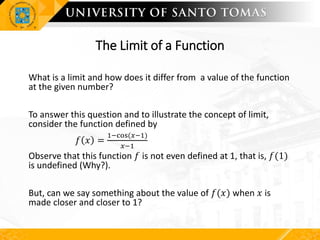
The Limit of a Function
What is a limit and how does it differ from a value of the function
at the given number?
To answer this question and to illustrate the concept of limit,
consider the function defined by
𝑓 𝑥 =
1−cos(𝑥−1)
𝑥−1
Observe that this function 𝑓 is not even defined at 1, that is, 𝑓(1)
is undefined (Why?).
But, can we say something about the value of 𝑓(𝑥) when 𝑥 is
made closer and closer to 1?
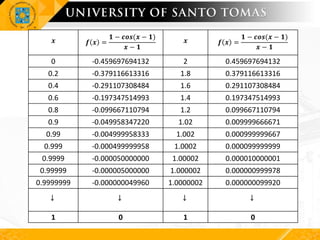
𝒙 𝒇 𝒙 =
𝟏 − 𝒄𝒐𝒔(𝒙 − 𝟏)
𝒙 − 𝟏
𝒙 𝒇 𝒙 =
𝟏 − 𝒄𝒐𝒔(𝒙 − 𝟏)
𝒙 − 𝟏
0 -0.459697694132 2 0.459697694132
0.2 -0.379116613316 1.8 0.379116613316
0.4 -0.291107308484 1.6 0.291107308484
0.6 -0.197347514993 1.4 0.197347514993
0.8 -0.099667110794 1.2 0.099667110794
0.9 -0.049958347220 1.02 0.009999666671
0.99 -0.004999958333 1.002 0.000999999667
0.999 -0.000499999958 1.0002 0.000099999999
0.9999 -0.000050000000 1.00002 0.000010000001
0.99999 -0.000005000000 1.000002 0.000000999978
0.9999999 -0.000000049960 1.0000002 0.000000099920
↓ ↓ ↓ ↓
1 0 1 0
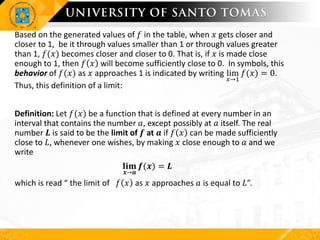
Based on the generated values of 𝑓 in the table, when 𝑥 gets closer and
closer to 1, be it through values smaller than 1 or through values greater
than 1, 𝑓(𝑥) becomes closer and closer to 0. That is, if 𝑥 is made close
enough to 1, then 𝑓 𝑥 will become sufficiently close to 0. In symbols, this
behavior of 𝑓(𝑥) as 𝑥 approaches 1 is indicated by writing lim
𝑥→1
𝑓(𝑥) = 0.
Thus, this definition of a limit:
Definition: Let 𝑓(𝑥) be a function that is defined at every number in an
interval that contains the number 𝑎, except possibly at 𝑎 itself. The real
number 𝑳 is said to be the limit of 𝒇 at 𝒂 if 𝑓 𝑥 can be made sufficiently
close to 𝐿, whenever one wishes, by making 𝑥 close enough to 𝑎 and we
write
𝐥𝐢𝐦
𝒙→𝒂
𝒇(𝒙) = 𝑳
which is read “ the limit of 𝑓 𝑥 as 𝑥 approaches 𝑎 is equal to 𝐿”.
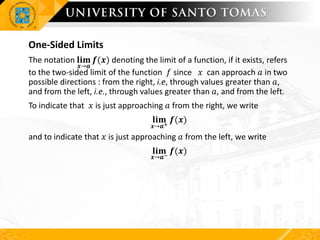
One-Sided Limits
The notation 𝐥𝐢𝐦
𝒙→𝒂
𝒇(𝒙) denoting the limit of a function, if it exists, refers
to the two-sided limit of the function 𝑓 since 𝑥 can approach 𝑎 in two
possible directions : from the right, i.e, through values greater than 𝑎,
and from the left, i.e., through values greater than 𝑎, and from the left.
To indicate that 𝑥 is just approaching 𝑎 from the right, we write
𝐥𝐢𝐦
𝒙→𝒂+
𝒇(𝒙)
and to indicate that 𝑥 is just approaching 𝑎 from the left, we write
𝐥𝐢𝐦
𝒙→𝒂−
𝒇(𝒙)
Theorems on Limits
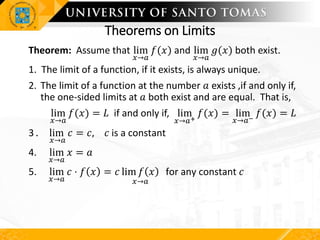
Theorem: Assume that lim
𝑥→𝑎
𝑓(𝑥) and lim
𝑥→𝑎
𝑔(𝑥) both exist.
1. The limit of a function, if it exists, is always unique.
2. The limit of a function at the number 𝑎 exists ,if and only if,
the one-sided limits at 𝑎 both exist and are equal. That is,
lim
𝑥→𝑎
𝑓(𝑥) = 𝐿 if and only if, lim
𝑥→𝑎+
𝑓(𝑥) = lim
𝑥→𝑎−
𝑓(𝑥) = 𝐿
3 . lim
𝑥→𝑎
𝑐 = 𝑐, 𝑐 is a constant
4. lim
𝑥→𝑎
𝑥 = 𝑎
5. lim
𝑥→𝑎
𝑐 ⋅ 𝑓 𝑥 = 𝑐 lim 𝑓 𝑥
𝑥→𝑎
for any constant 𝑐
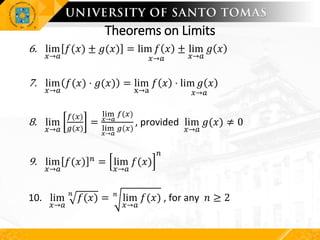
Theorems on Limits
6. lim
𝑥→𝑎
𝑓(𝑥) ± 𝑔(𝑥) = lim 𝑓 𝑥
𝑥→𝑎
± lim
𝑥→𝑎
𝑔 𝑥
7. lim
𝑥→𝑎
𝑓(𝑥) ⋅ 𝑔(𝑥) = lim
x→a
𝑓 𝑥 ⋅ lim 𝑔 𝑥
𝑥→𝑎
8. lim
𝑥→𝑎
𝑓(𝑥)
𝑔(𝑥)
=
lim
𝑥→𝑎
𝑓(𝑥)
lim
𝑥→𝑎
𝑔(𝑥)
, provided lim
𝑥→𝑎
𝑔(𝑥) ≠ 0
9. lim
𝑥→𝑎
𝑓(𝑥) 𝑛 = lim
𝑥→𝑎
𝑓(𝑥)
𝑛
10. lim
𝑥→𝑎
𝑛
𝑓(𝑥) = 𝑛
lim
𝑥→𝑎
𝑓(𝑥) , for any 𝑛 ≥ 2
Evaluation of Limits
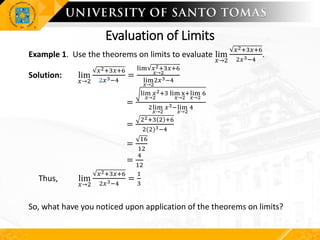
Example 1. Use the theorems on limits to evaluate lim
𝑥→2
𝑥2+3𝑥+6
2𝑥3−4
.
Solution: lim
𝑥→2
𝑥2+3𝑥+6
2𝑥3−4
=
lim 𝑥2+3𝑥+6
𝑥→2
lim
𝑥→2
2𝑥3−4
=
lim 𝑥2
𝑥→2
+3 lim x+
𝑥→2
lim
𝑥→2
6
2lim
𝑥→2
𝑥3−lim
𝑥→2
4
=
22+3 2 +6
2(2)3−4
=
16
12
=
4
12
Thus, lim
𝑥→2
𝑥2+3𝑥+6
2𝑥3−4
=
1
3
So, what have you noticed upon application of the theorems on limits?
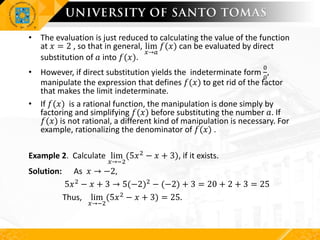
• The evaluation is just reduced to calculating the value of the function
at 𝑥 = 2 , so that in general, lim
𝑥→𝑎
𝑓(𝑥) can be evaluated by direct
substitution of 𝑎 into 𝑓(𝑥).
• However, if direct substitution yields the indeterminate form
0
0
,
manipulate the expression that defines 𝑓(𝑥) to get rid of the factor
that makes the limit indeterminate.
• If 𝑓(𝑥) is a rational function, the manipulation is done simply by
factoring and simplifying 𝑓(𝑥) before substituting the number 𝑎. If
𝑓(𝑥) is not rational, a different kind of manipulation is necessary. For
example, rationalizing the denominator of 𝑓(𝑥) .
Example 2. Calculate lim
𝑥→−2
(5𝑥2 − 𝑥 + 3), if it exists.
Solution: As 𝑥 → −2,
5𝑥2 − 𝑥 + 3 → 5(−2)2 − (−2) + 3 = 20 + 2 + 3 = 25
Thus, lim
𝑥→−2
(5𝑥2 − 𝑥 + 3) = 25.
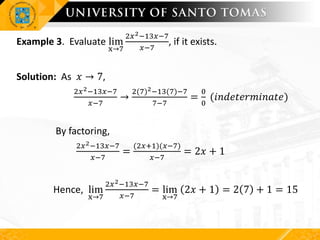
Example 3. Evaluate lim
x→7
2𝑥2−13𝑥−7
𝑥−7
, if it exists.
Solution: As 𝑥 → 7,
2𝑥2−13𝑥−7
𝑥−7
→
2(7)2−13(7)−7
7−7
=
0
0
(𝑖𝑛𝑑𝑒𝑡𝑒𝑟𝑚𝑖𝑛𝑎𝑡𝑒)
By factoring,
2𝑥2−13𝑥−7
𝑥−7
=
(2𝑥+1)(𝑥−7)
𝑥−7
= 2𝑥 + 1
Hence, lim
x→7
2𝑥2−13𝑥−7
𝑥−7
= lim
x→7
2𝑥 + 1 = 2 7 + 1 = 15
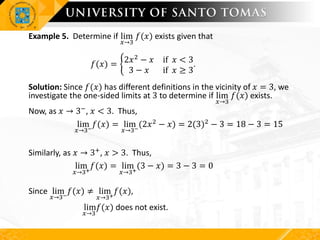
Example 5. Determine if lim
𝑥→3
𝑓(𝑥) exists given that
𝑓(𝑥) = ቊ2𝑥2
− 𝑥 if 𝑥 < 3
3 − 𝑥 if 𝑥 ≥ 3
.
Solution: Since 𝑓(𝑥) has different definitions in the vicinity of 𝑥 = 3, we
investigate the one-sided limits at 3 to determine if lim
𝑥→3
𝑓(𝑥) exists.
Now, as 𝑥 → 3−, 𝑥 < 3. Thus,
lim
𝑥→3−
𝑓(𝑥) = lim
𝑥→3−
(2𝑥2 − 𝑥) = 2(3)2 − 3 = 18 − 3 = 15
Similarly, as 𝑥 → 3+, 𝑥 > 3. Thus,
lim
𝑥→3+
𝑓(𝑥) = lim
𝑥→3+
(3 − 𝑥) = 3 − 3 = 0
Since lim
𝑥→3−
𝑓(𝑥) ≠ lim
𝑥→3+
𝑓(𝑥),
lim
𝑥→3
𝑓(𝑥) does not exist.
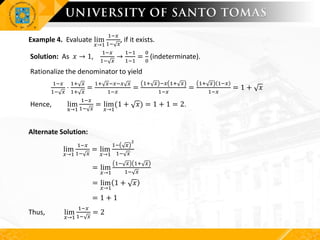
Example 4. Evaluate lim
𝑥→1
1−𝑥
1− 𝑥
, if it exists.
Solution: As 𝑥 → 1,
1−𝑥
1− 𝑥
→
1−1
1−1
=
0
0
(indeterminate).
Rationalize the denominator to yield
1−𝑥
1− 𝑥
⋅
1+ 𝑥
1+ 𝑥
=
1+ 𝑥−𝑥−𝑥 𝑥
1−𝑥
=
1+ 𝑥 −𝑥 1+ 𝑥
1−𝑥
=
1+ 𝑥 1−𝑥
1−𝑥
= 1 + 𝑥
Hence, lim
x→1
1−𝑥
1− 𝑥
= lim
𝑥→1
(1 + 𝑥) = 1 + 1 = 2.
Alternate Solution:
lim
𝑥→1
1−𝑥
1− 𝑥
= lim
𝑥→1
1− 𝑥
2
1− 𝑥
= lim
𝑥→1
1− 𝑥 1+ 𝑥
1− 𝑥
= lim
𝑥→1
1 + 𝑥
= 1 + 1
Thus, lim
𝑥→1
1−𝑥
1− 𝑥
= 2
Exercises: Use the theorems on limits to evaluate each of the following, if it exists.
1. lim
𝑥→−1
2𝑥3
− 4𝑥2
+ 5𝑥 − 10 7. lim
𝑥→5
𝑥2+1
2𝑥+2−2
2. lim
𝑥→3
9𝑥2−16
𝑥2−4
8. lim
𝑥→2
𝑥−2
𝑥+2
3. lim
𝑥→−1/2
4𝑥2+4𝑥+1
2𝑥2−𝑥−1
9. lim
𝑥→−3
𝑥3+27
𝑥2−9
4. lim
𝑥→2
𝑥−2
𝑥2−3𝑥+2
10. lim
𝑥→2
6−𝑥−𝑥
𝑥2−4
5. lim
𝑥→1
𝑥3+1
𝑥+1
11. lim
𝑥→2
𝑓(𝑥) if 𝑓 𝑥 = ቊ
2𝑥, 𝑥 ≤ 2
3𝑥 − 2, 𝑥 > 2
6. lim
𝑥→5
𝑥2+5− 30
𝑥−5
12. lim
𝑥→1
𝑓(𝑥) if 𝑓 𝑥 = ൝
𝑥2
+ 2, 𝑥 < 1
4𝑥 + 5, 𝑥 > 1

The Limit of a Function , maths, calculas

  • 1.
    1.1 The Limit Ofa Function, One-sided limits And theorems on limits Prepared by: Asst. Prof. Enrico M. Yambao, M.Sc.
  • 2.
    The Limit ofa Function What is a limit and how does it differ from a value of the function at the given number? To answer this question and to illustrate the concept of limit, consider the function defined by 𝑓 𝑥 = 1−cos(𝑥−1) 𝑥−1 Observe that this function 𝑓 is not even defined at 1, that is, 𝑓(1) is undefined (Why?). But, can we say something about the value of 𝑓(𝑥) when 𝑥 is made closer and closer to 1?
  • 3.
    𝒙 𝒇 𝒙= 𝟏 − 𝒄𝒐𝒔(𝒙 − 𝟏) 𝒙 − 𝟏 𝒙 𝒇 𝒙 = 𝟏 − 𝒄𝒐𝒔(𝒙 − 𝟏) 𝒙 − 𝟏 0 -0.459697694132 2 0.459697694132 0.2 -0.379116613316 1.8 0.379116613316 0.4 -0.291107308484 1.6 0.291107308484 0.6 -0.197347514993 1.4 0.197347514993 0.8 -0.099667110794 1.2 0.099667110794 0.9 -0.049958347220 1.02 0.009999666671 0.99 -0.004999958333 1.002 0.000999999667 0.999 -0.000499999958 1.0002 0.000099999999 0.9999 -0.000050000000 1.00002 0.000010000001 0.99999 -0.000005000000 1.000002 0.000000999978 0.9999999 -0.000000049960 1.0000002 0.000000099920 ↓ ↓ ↓ ↓ 1 0 1 0
  • 4.
    Based on thegenerated values of 𝑓 in the table, when 𝑥 gets closer and closer to 1, be it through values smaller than 1 or through values greater than 1, 𝑓(𝑥) becomes closer and closer to 0. That is, if 𝑥 is made close enough to 1, then 𝑓 𝑥 will become sufficiently close to 0. In symbols, this behavior of 𝑓(𝑥) as 𝑥 approaches 1 is indicated by writing lim 𝑥→1 𝑓(𝑥) = 0. Thus, this definition of a limit: Definition: Let 𝑓(𝑥) be a function that is defined at every number in an interval that contains the number 𝑎, except possibly at 𝑎 itself. The real number 𝑳 is said to be the limit of 𝒇 at 𝒂 if 𝑓 𝑥 can be made sufficiently close to 𝐿, whenever one wishes, by making 𝑥 close enough to 𝑎 and we write 𝐥𝐢𝐦 𝒙→𝒂 𝒇(𝒙) = 𝑳 which is read “ the limit of 𝑓 𝑥 as 𝑥 approaches 𝑎 is equal to 𝐿”.
  • 5.
    One-Sided Limits The notation𝐥𝐢𝐦 𝒙→𝒂 𝒇(𝒙) denoting the limit of a function, if it exists, refers to the two-sided limit of the function 𝑓 since 𝑥 can approach 𝑎 in two possible directions : from the right, i.e, through values greater than 𝑎, and from the left, i.e., through values greater than 𝑎, and from the left. To indicate that 𝑥 is just approaching 𝑎 from the right, we write 𝐥𝐢𝐦 𝒙→𝒂+ 𝒇(𝒙) and to indicate that 𝑥 is just approaching 𝑎 from the left, we write 𝐥𝐢𝐦 𝒙→𝒂− 𝒇(𝒙)
  • 6.
    Theorems on Limits Theorem:Assume that lim 𝑥→𝑎 𝑓(𝑥) and lim 𝑥→𝑎 𝑔(𝑥) both exist. 1. The limit of a function, if it exists, is always unique. 2. The limit of a function at the number 𝑎 exists ,if and only if, the one-sided limits at 𝑎 both exist and are equal. That is, lim 𝑥→𝑎 𝑓(𝑥) = 𝐿 if and only if, lim 𝑥→𝑎+ 𝑓(𝑥) = lim 𝑥→𝑎− 𝑓(𝑥) = 𝐿 3 . lim 𝑥→𝑎 𝑐 = 𝑐, 𝑐 is a constant 4. lim 𝑥→𝑎 𝑥 = 𝑎 5. lim 𝑥→𝑎 𝑐 ⋅ 𝑓 𝑥 = 𝑐 lim 𝑓 𝑥 𝑥→𝑎 for any constant 𝑐
  • 7.
    Theorems on Limits 6.lim 𝑥→𝑎 𝑓(𝑥) ± 𝑔(𝑥) = lim 𝑓 𝑥 𝑥→𝑎 ± lim 𝑥→𝑎 𝑔 𝑥 7. lim 𝑥→𝑎 𝑓(𝑥) ⋅ 𝑔(𝑥) = lim x→a 𝑓 𝑥 ⋅ lim 𝑔 𝑥 𝑥→𝑎 8. lim 𝑥→𝑎 𝑓(𝑥) 𝑔(𝑥) = lim 𝑥→𝑎 𝑓(𝑥) lim 𝑥→𝑎 𝑔(𝑥) , provided lim 𝑥→𝑎 𝑔(𝑥) ≠ 0 9. lim 𝑥→𝑎 𝑓(𝑥) 𝑛 = lim 𝑥→𝑎 𝑓(𝑥) 𝑛 10. lim 𝑥→𝑎 𝑛 𝑓(𝑥) = 𝑛 lim 𝑥→𝑎 𝑓(𝑥) , for any 𝑛 ≥ 2
  • 8.
    Evaluation of Limits Example1. Use the theorems on limits to evaluate lim 𝑥→2 𝑥2+3𝑥+6 2𝑥3−4 . Solution: lim 𝑥→2 𝑥2+3𝑥+6 2𝑥3−4 = lim 𝑥2+3𝑥+6 𝑥→2 lim 𝑥→2 2𝑥3−4 = lim 𝑥2 𝑥→2 +3 lim x+ 𝑥→2 lim 𝑥→2 6 2lim 𝑥→2 𝑥3−lim 𝑥→2 4 = 22+3 2 +6 2(2)3−4 = 16 12 = 4 12 Thus, lim 𝑥→2 𝑥2+3𝑥+6 2𝑥3−4 = 1 3 So, what have you noticed upon application of the theorems on limits?
  • 9.
    • The evaluationis just reduced to calculating the value of the function at 𝑥 = 2 , so that in general, lim 𝑥→𝑎 𝑓(𝑥) can be evaluated by direct substitution of 𝑎 into 𝑓(𝑥). • However, if direct substitution yields the indeterminate form 0 0 , manipulate the expression that defines 𝑓(𝑥) to get rid of the factor that makes the limit indeterminate. • If 𝑓(𝑥) is a rational function, the manipulation is done simply by factoring and simplifying 𝑓(𝑥) before substituting the number 𝑎. If 𝑓(𝑥) is not rational, a different kind of manipulation is necessary. For example, rationalizing the denominator of 𝑓(𝑥) . Example 2. Calculate lim 𝑥→−2 (5𝑥2 − 𝑥 + 3), if it exists. Solution: As 𝑥 → −2, 5𝑥2 − 𝑥 + 3 → 5(−2)2 − (−2) + 3 = 20 + 2 + 3 = 25 Thus, lim 𝑥→−2 (5𝑥2 − 𝑥 + 3) = 25.
  • 10.
    Example 3. Evaluatelim x→7 2𝑥2−13𝑥−7 𝑥−7 , if it exists. Solution: As 𝑥 → 7, 2𝑥2−13𝑥−7 𝑥−7 → 2(7)2−13(7)−7 7−7 = 0 0 (𝑖𝑛𝑑𝑒𝑡𝑒𝑟𝑚𝑖𝑛𝑎𝑡𝑒) By factoring, 2𝑥2−13𝑥−7 𝑥−7 = (2𝑥+1)(𝑥−7) 𝑥−7 = 2𝑥 + 1 Hence, lim x→7 2𝑥2−13𝑥−7 𝑥−7 = lim x→7 2𝑥 + 1 = 2 7 + 1 = 15
  • 11.
    Example 5. Determineif lim 𝑥→3 𝑓(𝑥) exists given that 𝑓(𝑥) = ቊ2𝑥2 − 𝑥 if 𝑥 < 3 3 − 𝑥 if 𝑥 ≥ 3 . Solution: Since 𝑓(𝑥) has different definitions in the vicinity of 𝑥 = 3, we investigate the one-sided limits at 3 to determine if lim 𝑥→3 𝑓(𝑥) exists. Now, as 𝑥 → 3−, 𝑥 < 3. Thus, lim 𝑥→3− 𝑓(𝑥) = lim 𝑥→3− (2𝑥2 − 𝑥) = 2(3)2 − 3 = 18 − 3 = 15 Similarly, as 𝑥 → 3+, 𝑥 > 3. Thus, lim 𝑥→3+ 𝑓(𝑥) = lim 𝑥→3+ (3 − 𝑥) = 3 − 3 = 0 Since lim 𝑥→3− 𝑓(𝑥) ≠ lim 𝑥→3+ 𝑓(𝑥), lim 𝑥→3 𝑓(𝑥) does not exist.
  • 12.
    Example 4. Evaluatelim 𝑥→1 1−𝑥 1− 𝑥 , if it exists. Solution: As 𝑥 → 1, 1−𝑥 1− 𝑥 → 1−1 1−1 = 0 0 (indeterminate). Rationalize the denominator to yield 1−𝑥 1− 𝑥 ⋅ 1+ 𝑥 1+ 𝑥 = 1+ 𝑥−𝑥−𝑥 𝑥 1−𝑥 = 1+ 𝑥 −𝑥 1+ 𝑥 1−𝑥 = 1+ 𝑥 1−𝑥 1−𝑥 = 1 + 𝑥 Hence, lim x→1 1−𝑥 1− 𝑥 = lim 𝑥→1 (1 + 𝑥) = 1 + 1 = 2. Alternate Solution: lim 𝑥→1 1−𝑥 1− 𝑥 = lim 𝑥→1 1− 𝑥 2 1− 𝑥 = lim 𝑥→1 1− 𝑥 1+ 𝑥 1− 𝑥 = lim 𝑥→1 1 + 𝑥 = 1 + 1 Thus, lim 𝑥→1 1−𝑥 1− 𝑥 = 2
  • 13.
    Exercises: Use thetheorems on limits to evaluate each of the following, if it exists. 1. lim 𝑥→−1 2𝑥3 − 4𝑥2 + 5𝑥 − 10 7. lim 𝑥→5 𝑥2+1 2𝑥+2−2 2. lim 𝑥→3 9𝑥2−16 𝑥2−4 8. lim 𝑥→2 𝑥−2 𝑥+2 3. lim 𝑥→−1/2 4𝑥2+4𝑥+1 2𝑥2−𝑥−1 9. lim 𝑥→−3 𝑥3+27 𝑥2−9 4. lim 𝑥→2 𝑥−2 𝑥2−3𝑥+2 10. lim 𝑥→2 6−𝑥−𝑥 𝑥2−4 5. lim 𝑥→1 𝑥3+1 𝑥+1 11. lim 𝑥→2 𝑓(𝑥) if 𝑓 𝑥 = ቊ 2𝑥, 𝑥 ≤ 2 3𝑥 − 2, 𝑥 > 2 6. lim 𝑥→5 𝑥2+5− 30 𝑥−5 12. lim 𝑥→1 𝑓(𝑥) if 𝑓 𝑥 = ൝ 𝑥2 + 2, 𝑥 < 1 4𝑥 + 5, 𝑥 > 1