Section	3.7
  Indeterminate	Forms	and	L’Hôpital’s
                 Rule

                 V63.0121.027, Calculus	I


                    November	3, 2009


Announcements
   Quiz	next	week	in	section

                                       .    .   .   .   .   .
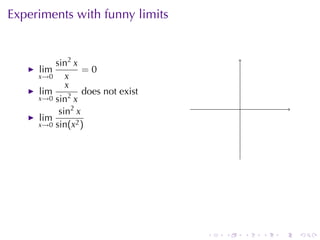
Experiments	with	funny	limits


         sin2 x
     lim
     x→0   x


                                        .


                                .   .       .   .   .   .
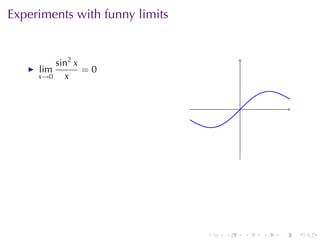
Experiments	with	funny	limits


         sin2 x
     lim        =0
     x→0   x


                                        .


                                .   .       .   .   .   .
Experiments	with	funny	limits


         sin2 x
     lim        =0
     x→0   x
           x
     lim
     x→0 sin2 x
                                        .


                                .   .       .   .   .   .
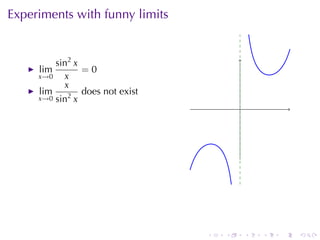
Experiments	with	funny	limits


         sin2 x
     lim        =0
     x→0   x
           x
     lim        does	not	exist
     x→0 sin2 x
                                         .


                                 .   .       .   .   .   .
Experiments	with	funny	limits


         sin2 x
     lim         =0
     x→0    x
            x
     lim         does	not	exist
     x→0 sin2 x
          sin2 x                          .
     lim
     x→0 sin(x2 )


                                  .   .       .   .   .   .
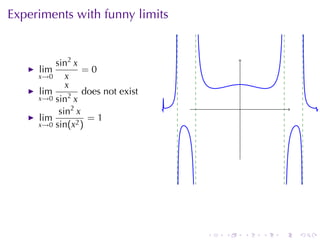
Experiments	with	funny	limits


         sin2 x
     lim         =0
     x→0    x
            x
     lim         does	not	exist
     x→0 sin2 x
          sin2 x                          .
     lim          =1
     x→0 sin(x2 )


                                  .   .       .   .   .   .
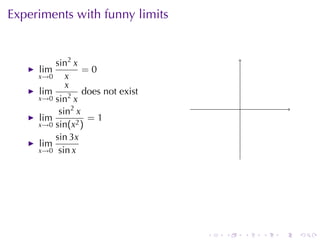
Experiments	with	funny	limits


         sin2 x
     lim         =0
     x→0    x
            x
     lim         does	not	exist
     x→0 sin2 x
          sin2 x                          .
     lim          =1
     x→0 sin(x2 )
         sin 3x
     lim
     x→0 sin x


                                  .   .       .   .   .   .
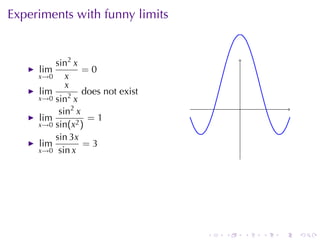
Experiments	with	funny	limits


         sin2 x
     lim         =0
     x→0    x
            x
     lim         does	not	exist
     x→0 sin2 x
          sin2 x                          .
     lim          =1
     x→0 sin(x2 )
         sin 3x
     lim         =3
     x→0 sin x


                                  .   .       .   .   .   .
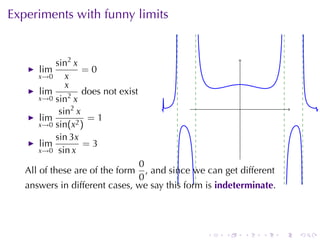
Experiments	with	funny	limits


          sin2 x
      lim         =0
      x→0    x
             x
      lim         does	not	exist
      x→0 sin2 x
           sin2 x                                       .
      lim          =1
      x→0 sin(x2 )
          sin 3x
      lim         =3
      x→0 sin x

                               0
   All	of	these	are	of	the	form  , and	since	we	can	get	different
                               0
   answers	in	different	cases, we	say	this	form	is indeterminate.


                                                .   .       .   .   .   .
Outline

  Indeterminate	Forms

  L’Hôpital’s	Rule

  Relative	Rates	of	Growth

  Other	Indeterminate	Limits
     Indeterminate	Products
     Indeterminate	Differences
     Indeterminate	Powers

  Summary


                                 .   .   .   .   .   .
Recall


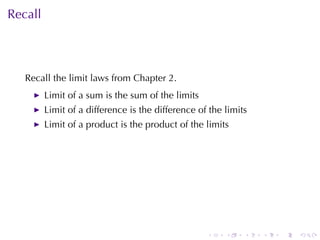
   Recall	the	limit	laws	from	Chapter	2.
         Limit	of	a	sum	is	the	sum	of	the	limits


                                                   .   .   .   .   .   .
Recall


   Recall	the	limit	laws	from	Chapter	2.
         Limit	of	a	sum	is	the	sum	of	the	limits
         Limit	of	a	difference	is	the	difference	of	the	limits


                                                   .    .    .   .   .   .
Recall


   Recall	the	limit	laws	from	Chapter	2.
         Limit	of	a	sum	is	the	sum	of	the	limits
         Limit	of	a	difference	is	the	difference	of	the	limits
         Limit	of	a	product	is	the	product	of	the	limits


                                                   .    .    .   .   .   .
Recall


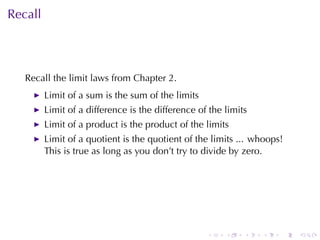
   Recall	the	limit	laws	from	Chapter	2.
         Limit	of	a	sum	is	the	sum	of	the	limits
         Limit	of	a	difference	is	the	difference	of	the	limits
         Limit	of	a	product	is	the	product	of	the	limits
         Limit	of	a	quotient	is	the	quotient	of	the	limits	... whoops!
         This	is	true	as	long	as	you	don’t	try	to	divide	by	zero.


                                                   .    .    .   .   .   .
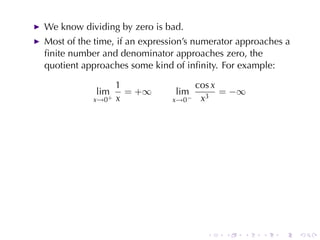
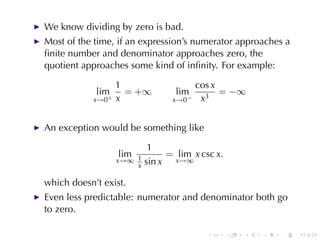
We	know	dividing	by	zero	is	bad.
Most	of	the	time, if	an	expression’s	numerator	approaches	a
finite	number	and	denominator	approaches	zero, the
quotient	approaches	some	kind	of	infinity. For	example:

                  1                  cos x
            lim     = +∞       lim         = −∞
           x→0+   x           x→0−    x3


                                       .   .    .   .   .     .
We	know	dividing	by	zero	is	bad.
Most	of	the	time, if	an	expression’s	numerator	approaches	a
finite	number	and	denominator	approaches	zero, the
quotient	approaches	some	kind	of	infinity. For	example:

                   1                    cos x
            lim      = +∞         lim         = −∞
            x→0+   x             x→0−    x3


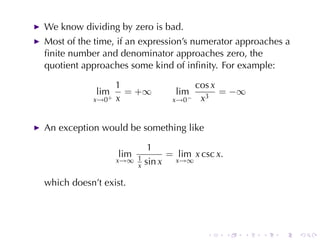
An	exception	would	be	something	like

                            1
                   lim          = lim x csc x.
                   x→∞ 1   sin x x→∞
                       x

which	doesn’t	exist.


                                          .      .   .   .   .   .
We	know	dividing	by	zero	is	bad.
Most	of	the	time, if	an	expression’s	numerator	approaches	a
finite	number	and	denominator	approaches	zero, the
quotient	approaches	some	kind	of	infinity. For	example:

                   1                    cos x
            lim      = +∞         lim         = −∞
            x→0+   x             x→0−    x3


An	exception	would	be	something	like

                            1
                   lim          = lim x csc x.
                   x→∞ 1   sin x x→∞
                       x

which	doesn’t	exist.
Even	less	predictable: numerator	and	denominator	both	go
to	zero.

                                          .      .   .   .   .   .
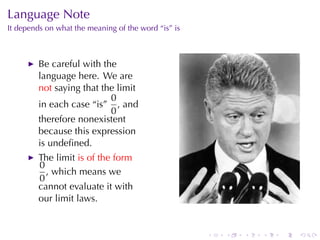
Language	Note
It	depends	on	what	the	meaning	of	the	word	“is”	is


        Be	careful	with	the
        language	here. We	are
        not saying	that	the	limit
                          0
        in	each	case	“is” , and
                          0
        therefore	nonexistent
        because	this	expression
        is	undefined.
        The	limit is	of	the	form
        0
          , which	means	we
        0
        cannot	evaluate	it	with
        our	limit	laws.


                                                     .   .   .   .   .   .
Indeterminate	forms	are	like	Tug	Of	War


   Which	side	wins	depends	on	which	side	is	stronger.

                                             .   .      .   .   .   .
Outline

  Indeterminate	Forms

  L’Hôpital’s	Rule

  Relative	Rates	of	Growth

  Other	Indeterminate	Limits
     Indeterminate	Products
     Indeterminate	Differences
     Indeterminate	Powers

  Summary


                                 .   .   .   .   .   .
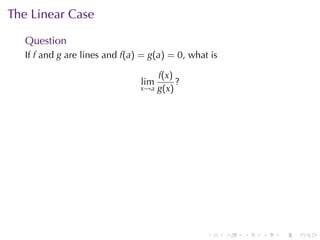
The	Linear	Case

   Question
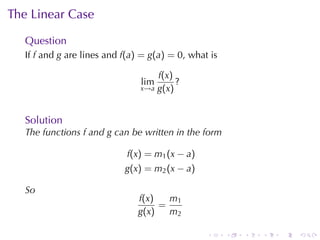
   If f and g are	lines	and f(a) = g(a) = 0, what	is

                                      f(x)
                                lim        ?
                                x→a   g(x)


                                                 .     .   .   .   .   .
The	Linear	Case

   Question
   If f and g are	lines	and f(a) = g(a) = 0, what	is

                                      f(x)
                                lim        ?
                                x→a   g(x)


   Solution
   The	functions f and g can	be	written	in	the	form

                             f(x) = m1 (x − a)
                            g(x) = m2 (x − a)

   So
                               f (x )   m1
                                      =
                               g (x )   m2

                                                 .     .   .   .   .   .
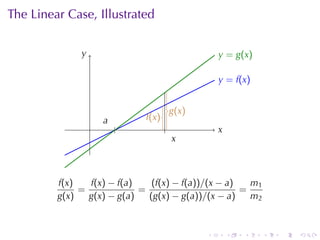
The	Linear	Case, Illustrated


              y
              .                                      y
                                                     . = g(x)

                                                     y
                                                     . = f(x)


                                         g
                                         . (x)
                      a
                      .       f
                              .(x)
                  .       .          .               x
                                                     .
                                         x
                                         .


         f(x)   f(x) − f(a)    (f(x) − f(a))/(x − a)   m1
              =             =                        =
         g(x)   g(x) − g(a)   (g(x) − g(a))/(x − a)    m2


                                                 .       .   .   .   .   .
What	then?


     But	what	if	the	functions	aren’t	linear?


                                                .   .   .   .   .   .
What	then?


     But	what	if	the	functions	aren’t	linear?
     Can	we	approximate	a	function	near	a	point	with	a	linear
     function?


                                                .   .   .   .   .   .
What	then?


     But	what	if	the	functions	aren’t	linear?
     Can	we	approximate	a	function	near	a	point	with	a	linear
     function?
     What	would	be	the	slope	of	that	linear	function?


                                                .   .   .   .   .   .
What	then?


     But	what	if	the	functions	aren’t	linear?
     Can	we	approximate	a	function	near	a	point	with	a	linear
     function?
     What	would	be	the	slope	of	that	linear	function? The
     derivative!


                                                .   .   .   .   .   .
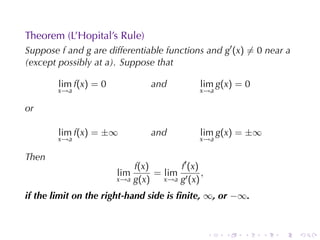
Theorem	(L’Hopital’s	Rule)
Suppose f and g are	differentiable	functions	and g′ (x) ̸= 0 near a
(except	possibly	at a). Suppose	that

        lim f(x) = 0           and          lim g(x) = 0
        x→a                                 x→a

or

        lim f(x) = ±∞          and          lim g(x) = ±∞
        x→a                                 x→a

Then
                           f(x)       f′ (x)
                       lim      = lim ′ ,
                       x→a g(x)   x→a g (x)

if	the	limit	on	the	right-hand	side	is	finite, ∞, or −∞.


                                               .   .   .    .   .     .
Meet	the	Mathematician: L’Hôpital


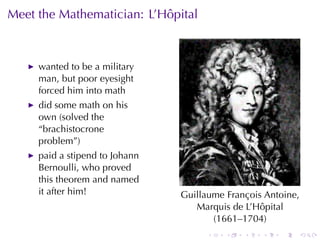
     wanted	to	be	a	military
     man, but	poor	eyesight
     forced	him	into	math
     did	some	math	on	his
     own	(solved	the
     “brachistocrone
     problem”)
     paid	a	stipend	to	Johann
     Bernoulli, who	proved
     this	theorem	and	named
     it	after	him!              Guillaume	François	Antoine,
                                   Marquis	de	L’Hôpital
                                       (1661–1704)
                                      .   .   .   .   .       .
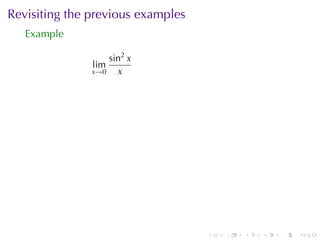
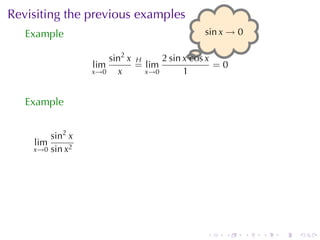
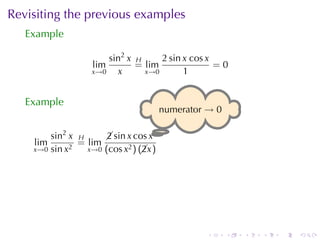
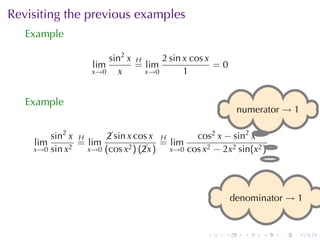
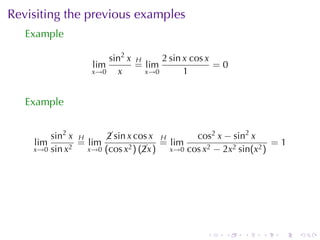
Revisiting	the	previous	examples
   Example

                   sin2 x
               lim
               x→0   x


                                   .   .   .   .   .   .
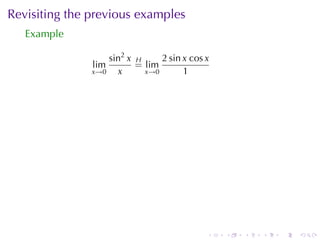
Revisiting	the	previous	examples
   Example

                   sin2 x H     2 sin x cos x
               lim        = lim
               x→0   x      x→0       1


                                            .   .   .   .   .   .
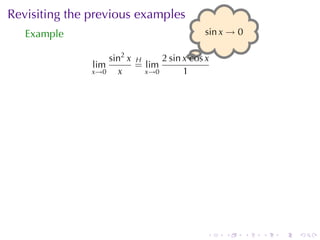
Revisiting	the	previous	examples
   Example                                  . in x → 0
                                            s

                   sin2 x H     2 sin x.cos x
               lim        = lim
               x→0   x      x→0       1


                                            .    .       .   .   .   .
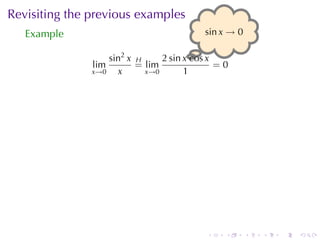
Revisiting	the	previous	examples
   Example                                . in x → 0
                                          s

                   sin2 x H     2 sin x.cos x
               lim        = lim               =0
               x→0   x      x→0       1


                                          .    .       .   .   .   .
Revisiting	the	previous	examples
   Example                                  . in x → 0
                                            s

                     sin2 x H     2 sin x.cos x
                 lim        = lim               =0
                 x→0   x      x→0       1


   Example


        sin2 x
    lim
    x→0 sin x2


                                            .    .       .   .   .   .
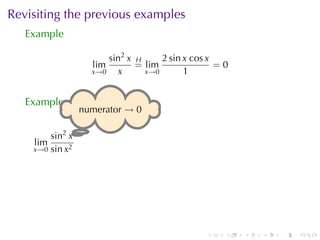
Revisiting	the	previous	examples
   Example

                        sin2 x H     2 sin x cos x
                     lim       = lim               =0
                    x→0   x      x→0       1


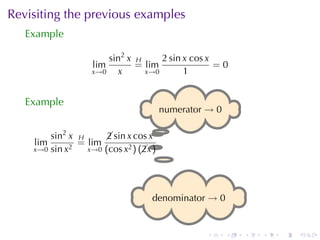
   Example
                  . umerator → 0
                  n

        sin2 x.
    lim
    x→0 sin x2


                                               .    .   .   .   .   .
Revisiting	the	previous	examples
   Example

                         sin2 x H     2 sin x cos x
                      lim       = lim               =0
                     x→0   x      x→0       1


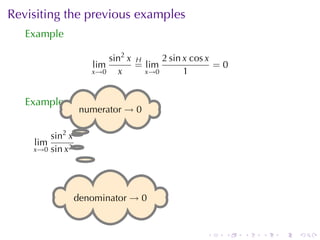
   Example
                   . umerator → 0
                   n

        sin2 x.
    lim        .
    x→0 sin x2


               . enominator → 0
               d


                                                .    .   .   .   .   .
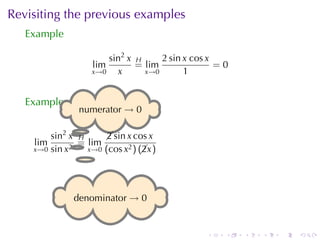
Revisiting	the	previous	examples
   Example

                        sin2 x H     2 sin x cos x
                    lim        = lim               =0
                    x→0   x      x→0       1


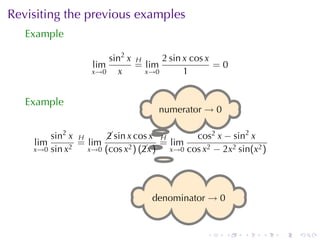
   Example
                . umerator → 0
                n

        sin2 x. H       sin x cos x
                        2
    lim       2.
                 = lim
    x→0 sin x      x→0 (cos x2 ) (x )
                                  2


               . enominator → 0
               d


                                               .    .   .   .   .   .
Revisiting	the	previous	examples
   Example

                       sin2 x H     2 sin x cos x
                   lim        = lim               =0
                   x→0   x      x→0       1


   Example
                                       . umerator → 0
                                       n

        sin2 x H                   .
                      sin x cos x
                      2
    lim        = lim
    x→0 sin x2   x→0 (cos x2 ) (x )
                                2


                                                 .      .   .   .   .   .
Revisiting	the	previous	examples
   Example

                       sin2 x H     2 sin x cos x
                   lim        = lim               =0
                   x→0   x      x→0       1


   Example
                                        . umerator → 0
                                        n

        sin2 x H                    .
                      sin x cos x
                      2
    lim        = lim               .)
    x→0 sin x2   x→0 (cos x2 ) (x
                                2


                                   . enominator → 0
                                   d


                                                  .      .   .   .   .   .
Revisiting	the	previous	examples
   Example

                       sin2 x H     2 sin x cos x
                   lim        = lim               =0
                   x→0   x      x→0       1


   Example
                                    . umerator → 0
                                    n

        sin2 x H                    .         cos2 x − sin2 x
                      sin x cos x H
                      2
    lim        = lim                    lim
                                   .) = x→0 cos x2 − 2x2 sin(x2 )
    x→0 sin x2   x→0 (cos x2 ) (x
                                2


                                   . enominator → 0
                                   d


                                                 .    .    .    .   .   .
Revisiting	the	previous	examples
   Example

                       sin2 x H     2 sin x cos x
                   lim        = lim               =0
                   x→0   x      x→0       1


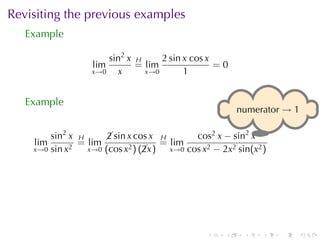
   Example
                                                         . umerator → 1
                                                         n

        sin2 x H      sin x cos x H
                      2                      cos2 x − sin2 x.
    lim        = lim                 = lim
    x→0 sin x2   x→0 (cos x2 ) (x )
                                2      x→0 cos x2 − 2x2 sin(x2 )


                                                .    .    .    .   .      .
Revisiting	the	previous	examples
   Example

                       sin2 x H     2 sin x cos x
                   lim        = lim               =0
                   x→0   x      x→0       1


   Example
                                                           . umerator → 1
                                                           n

        sin2 x H      sin x cos x H
                      2                      cos2 x − sin2 x.
    lim        = lim                 = lim                       .
    x→0 sin x2   x→0 (cos x2 ) (x )
                                2      x→0 cos x2 − 2x2 sin(x2 )


                                                          . enominator → 1
                                                          d


                                                 .    .      .   .   .      .
Revisiting	the	previous	examples
   Example

                      sin2 x H     2 sin x cos x
                  lim        = lim               =0
                  x→0   x      x→0       1


   Example


        sin2 x H      sin x cos x H
                      2                      cos2 x − sin2 x
    lim        = lim                 = lim                       =1
    x→0 sin x2   x→0 (cos x2 ) (x )
                                2      x→0 cos x2 − 2x2 sin(x2 )


                                               .   .    .    .   .    .
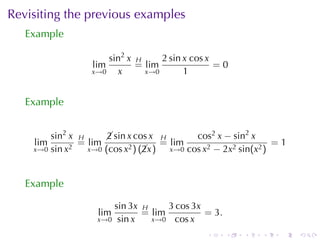
Revisiting	the	previous	examples
   Example

                      sin2 x H     2 sin x cos x
                  lim        = lim               =0
                  x→0   x      x→0       1


   Example


        sin2 x H      sin x cos x H
                      2                      cos2 x − sin2 x
    lim        = lim                 = lim                       =1
    x→0 sin x2   x→0 (cos x2 ) (x )
                                2      x→0 cos x2 − 2x2 sin(x2 )


   Example

                          sin 3x H     3 cos 3x
                    lim          = lim          = 3.
                   x→0     sin x   x→0 cos x

                                                .      .   .   .   .   .
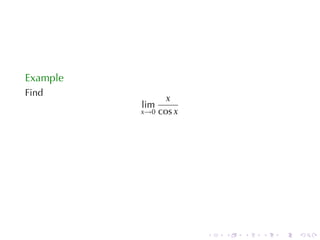
Example
Find
                x
          lim
          x→0 cos x


                      .   .   .   .   .   .
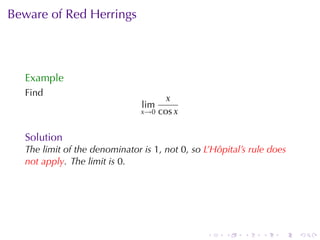
Beware	of	Red	Herrings


  Example
  Find
                                     x
                               lim
                               x→0 cos x


  Solution
  The	limit	of	the	denominator	is 1, not 0, so L’Hôpital’s	rule	does
  not	apply. The	limit	is 0.


                                                .   .    .    .   .    .
Outline

  Indeterminate	Forms

  L’Hôpital’s	Rule

  Relative	Rates	of	Growth

  Other	Indeterminate	Limits
     Indeterminate	Products
     Indeterminate	Differences
     Indeterminate	Powers

  Summary


                                 .   .   .   .   .   .
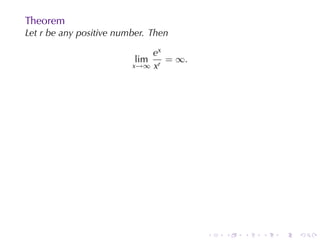
Theorem
Let r be	any	positive	number. Then

                             ex
                          lim   = ∞.
                         x→∞ xr


                                       .   .   .   .   .   .
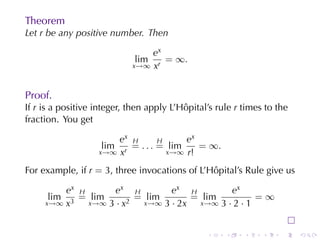
Theorem
Let r be	any	positive	number. Then

                                ex
                             lim   = ∞.
                            x→∞ xr


Proof.
If r is	a	positive	integer, then	apply	L’Hôpital’s	rule r times	to	the
fraction. You	get

                       ex H       H     ex
                    lim   = . . . = lim    = ∞.
                   x→∞ xr           x→∞ r!

For	example, if r = 3, three	invocations	of	L’Hôpital’s	Rule	give	us

         ex H      ex H          ex H          ex
      lim   = lim        = lim        = lim           =∞
     x→∞ x3   x→∞ 3 · x2   x→∞ 3 · 2x   x→∞ 3 · 2 · 1


                                                .    .    .    .    .    .
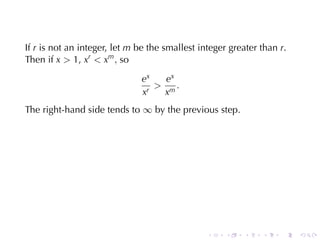
If r is	not	an	integer, let m be	the	smallest	integer	greater	than r.
Then	if x  1, xr  xm , so

                              ex   ex
                                  m.
                              xr  x
The	right-hand	side	tends	to ∞ by	the	previous	step.


                                                .    .   .    .    .    .
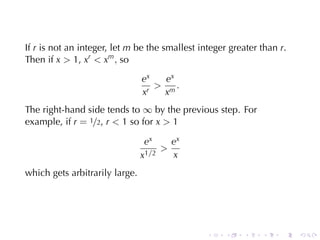
If r is	not	an	integer, let m be	the	smallest	integer	greater	than r.
Then	if x  1, xr  xm , so

                                ex   ex
                                    m.
                                xr  x
The	right-hand	side	tends	to ∞ by	the	previous	step. For
example, if r = 1/2, r  1 so	for x  1

                                 ex    ex
                                     
                                x1/2   x
which	gets	arbitrarily	large.


                                                .    .   .    .    .    .
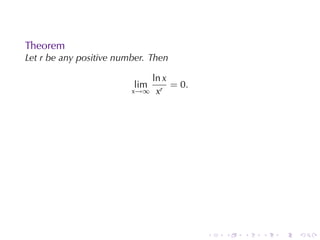
Theorem
Let r be	any	positive	number. Then

                            ln x
                         lim     = 0.
                         x→∞ xr


                                        .   .   .   .   .   .
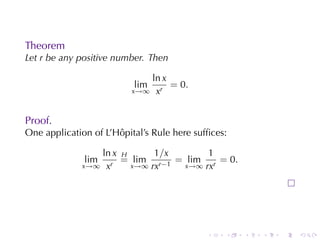
Theorem
Let r be	any	positive	number. Then

                            ln x
                          lim    = 0.
                         x→∞ xr


Proof.
One	application	of	L’Hôpital’s	Rule	here	suffices:

                    ln x H      1 /x      1
              lim        = lim r−1 = lim r = 0.
             x→∞     xr    x→∞ rx    x→∞ rx


                                            .   .   .   .   .   .
Outline

  Indeterminate	Forms

  L’Hôpital’s	Rule

  Relative	Rates	of	Growth

  Other	Indeterminate	Limits
     Indeterminate	Products
     Indeterminate	Differences
     Indeterminate	Powers

  Summary


                                 .   .   .   .   .   .
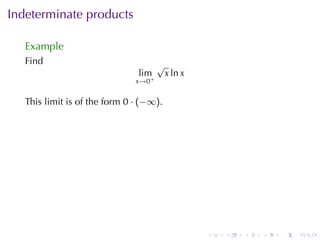
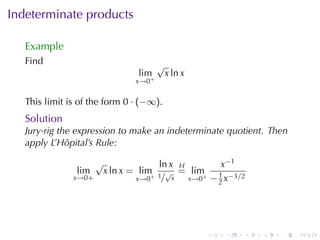
Indeterminate	products

   Example
   Find                               √
                               lim        x ln x
                               x→0+


   This	limit	is	of	the	form 0 · (−∞).


                                                   .   .   .   .   .   .
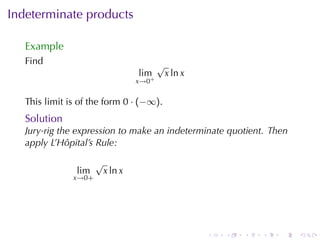
Indeterminate	products

   Example
   Find                                   √
                                   lim        x ln x
                                   x→0+


   This	limit	is	of	the	form 0 · (−∞).
   Solution
   Jury-rig	the	expression	to	make	an	indeterminate	quotient. Then
   apply	L’Hôpital’s	Rule:

                      √
                lim       x ln x
               x→0+


                                                       .   .   .   .   .   .
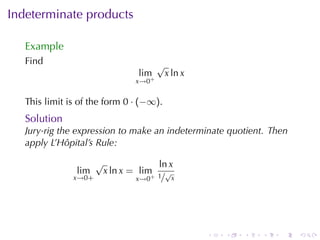
Indeterminate	products

   Example
   Find                                  √
                                  lim        x ln x
                                 x→0+


   This	limit	is	of	the	form 0 · (−∞).
   Solution
   Jury-rig	the	expression	to	make	an	indeterminate	quotient. Then
   apply	L’Hôpital’s	Rule:

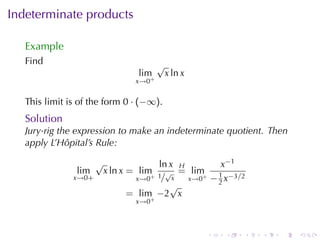
                      √                  ln x
                lim       x ln x = lim
               x→0+               x→0+   1/√x


                                                      .   .   .   .   .   .
Indeterminate	products

   Example
   Find                                  √
                                  lim        x ln x
                                 x→0+


   This	limit	is	of	the	form 0 · (−∞).
   Solution
   Jury-rig	the	expression	to	make	an	indeterminate	quotient. Then
   apply	L’Hôpital’s	Rule:

                      √                  ln x H         x−1
                lim       x ln x = lim     √ = lim     1
               x→0+               x→0+   1/ x   x→0+ − 2 x−3/2


                                                      .   .   .   .   .   .
Indeterminate	products

   Example
   Find                                  √
                                  lim        x ln x
                                 x→0+


   This	limit	is	of	the	form 0 · (−∞).
   Solution
   Jury-rig	the	expression	to	make	an	indeterminate	quotient. Then
   apply	L’Hôpital’s	Rule:

                      √              ln x H         x−1
                lim       x ln x = lim √ = lim     1
               x→0+             x→0+ 1/ x   x→0+ − 2 x−3/2
                                        √
                               = lim −2 x
                                  x→0+


                                                      .   .   .   .   .   .
Indeterminate	products

   Example
   Find                                  √
                                  lim        x ln x
                                 x→0+


   This	limit	is	of	the	form 0 · (−∞).
   Solution
   Jury-rig	the	expression	to	make	an	indeterminate	quotient. Then
   apply	L’Hôpital’s	Rule:

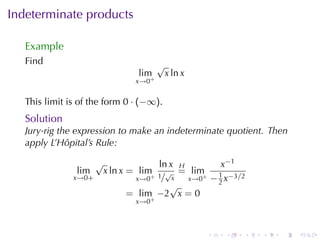
                      √              ln x H         x−1
                lim       x ln x = lim √ = lim     1
               x→0+             x→0+ 1/ x   x→0+ − 2 x−3/2
                                        √
                               = lim −2 x = 0
                                  x→0+


                                                      .   .   .   .   .   .
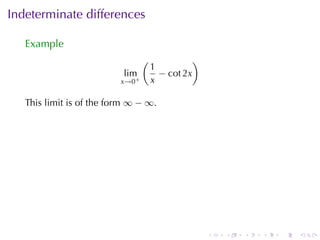
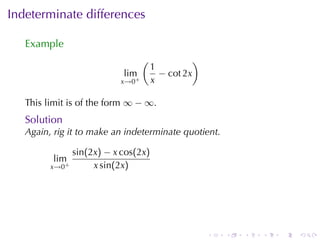
Indeterminate	differences

   Example
                                 (                )
                                     1
                           lim         − cot 2x
                          x→0+       x

   This	limit	is	of	the	form ∞ − ∞.


                                                      .   .   .   .   .   .
Indeterminate	differences

   Example
                                  (                )
                                      1
                            lim         − cot 2x
                           x→0+       x

   This	limit	is	of	the	form ∞ − ∞.
   Solution
   Again, rig	it	to	make	an	indeterminate	quotient.

                sin(2x) − x cos(2x)
         lim
         x→0+        x sin(2x)


                                                       .   .   .   .   .   .
Indeterminate	differences

   Example
                                  (                )
                                      1
                            lim         − cot 2x
                           x→0+       x

   This	limit	is	of	the	form ∞ − ∞.
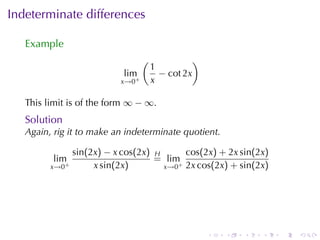
   Solution
   Again, rig	it	to	make	an	indeterminate	quotient.

                sin(2x) − x cos(2x) H      cos(2x) + 2x sin(2x)
         lim                        = lim+
         x→0+        x sin(2x)        x→0 2x cos(2x) + sin(2x)


                                                       .   .   .   .   .   .
Indeterminate	differences

   Example
                                  (                )
                                      1
                            lim         − cot 2x
                           x→0+       x

   This	limit	is	of	the	form ∞ − ∞.
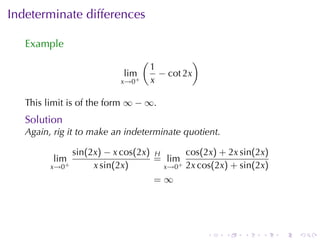
   Solution
   Again, rig	it	to	make	an	indeterminate	quotient.

                sin(2x) − x cos(2x) H      cos(2x) + 2x sin(2x)
         lim                        = lim+
         x→0+        x sin(2x)        x→0 2x cos(2x) + sin(2x)
                                    =∞


                                                       .   .   .   .   .   .
Indeterminate	differences

   Example
                                  (                )
                                      1
                            lim         − cot 2x
                           x→0+       x

   This	limit	is	of	the	form ∞ − ∞.
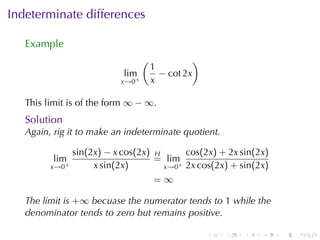
   Solution
   Again, rig	it	to	make	an	indeterminate	quotient.

                sin(2x) − x cos(2x) H      cos(2x) + 2x sin(2x)
         lim                        = lim+
         x→0+        x sin(2x)        x→0 2x cos(2x) + sin(2x)
                                    =∞

   The	limit	is +∞ becuase	the	numerator	tends	to 1 while	the
   denominator	tends	to	zero	but	remains	positive.

                                                       .   .   .   .   .   .
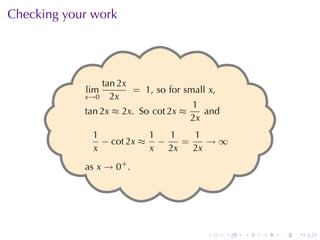
Checking	your	work


            .
                 tan 2x
            lim         = 1, so for small x,
            x→0 2x
                                      1
            tan 2x ≈ 2x. So cot 2x ≈     and
                              .      2x
              1           1  1    1
                − cot 2x ≈ −    =    →∞
              x           x  2x   2x
            as x → 0+ .


                                         .     .   .   .   .   .
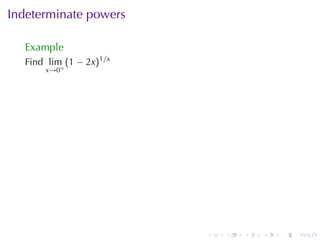
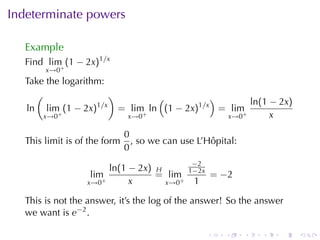
Indeterminate	powers

  Example
  Find lim (1 − 2x)1/x
      x→0+


                         .   .   .   .   .   .
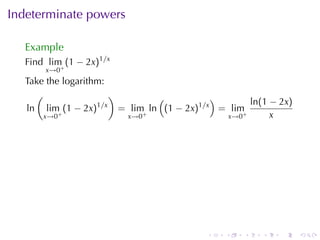
Indeterminate	powers

  Example
  Find lim (1 − 2x)1/x
      x→0+
  Take	the	logarithm:
    (                  )          (           )
                   1/x                                ln(1 − 2x)
  ln lim (1 − 2x)        = lim+ ln (1 − 2x)1/x = lim+
      x→0 +               x→0                   x→0        x


                                            .   .   .    .   .     .
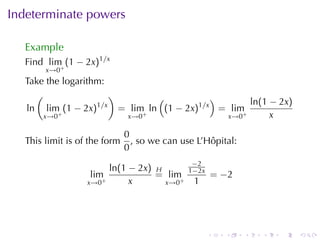
Indeterminate	powers

  Example
  Find lim (1 − 2x)1/x
       x→0+
  Take	the	logarithm:
    (                  )          (           )
                   1/x                                ln(1 − 2x)
  ln lim (1 − 2x)        = lim+ ln (1 − 2x)1/x = lim+
      x→0 +               x→0                   x→0        x

                              0
  This	limit	is	of	the	form     , so	we	can	use	L’Hôpital:
                              0
                                              −2
                         ln(1 − 2x) H        1−2x
                   lim              = lim+              = −2
                  x→0+        x       x→0      1


                                                    .     .    .   .   .   .
Indeterminate	powers

  Example
  Find lim (1 − 2x)1/x
       x→0+
  Take	the	logarithm:
    (                  )          (           )
                   1/x                                ln(1 − 2x)
  ln lim (1 − 2x)        = lim+ ln (1 − 2x)1/x = lim+
      x→0 +               x→0                   x→0        x

                              0
  This	limit	is	of	the	form     , so	we	can	use	L’Hôpital:
                              0
                                              −2
                         ln(1 − 2x) H        1−2x
                   lim              = lim+              = −2
                  x→0+        x       x→0      1

  This	is	not	the	answer, it’s	the	log	of	the	answer! So	the	answer
  we	want	is e−2 .

                                                    .     .    .   .   .   .
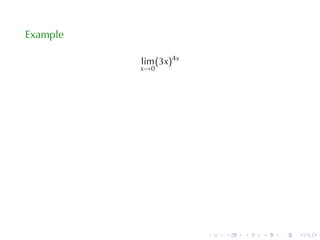
Example

          lim (3x)4x
          x→0


                       .   .   .   .   .   .
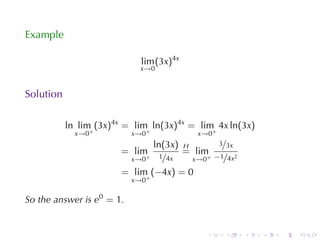
Example

                             lim (3x)4x
                            x→0


Solution

           ln lim (3x)4x = lim ln(3x)4x = lim 4x ln(3x)
             x→0+          x→0+           x→0+
                               ln(3x) H          3/3x
                        = lim+        = lim+
                         x→0     1/4x   x→0     −1/4x2

                        = lim (−4x) = 0
                           x→0+

So	the	answer	is e0 = 1.


                                            .     .      .   .   .   .
Outline

  Indeterminate	Forms

  L’Hôpital’s	Rule

  Relative	Rates	of	Growth

  Other	Indeterminate	Limits
     Indeterminate	Products
     Indeterminate	Differences
     Indeterminate	Powers

  Summary


                                 .   .   .   .   .   .
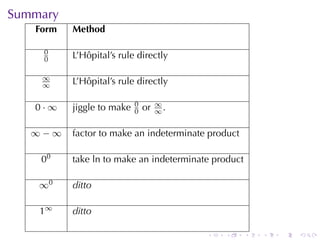
Summary
   Form   Method

     0
     0    L’Hôpital’s	rule	directly

    ∞
    ∞     L’Hôpital’s	rule	directly

                           0        ∞
   0·∞    jiggle	to	make   0   or   ∞.


   ∞−∞    factor	to	make	an	indeterminate	product

    00    take ln to	make	an	indeterminate	product

    ∞0    ditto

    1∞    ditto

                                         .   .       .   .   .   .
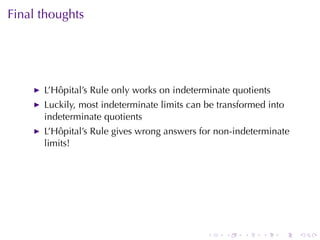
Final	thoughts


      L’Hôpital’s	Rule	only	works	on	indeterminate	quotients
      Luckily, most	indeterminate	limits	can	be	transformed	into
      indeterminate	quotients
      L’Hôpital’s	Rule	gives	wrong	answers	for	non-indeterminate
      limits!


                                             .   .    .   .    .   .

Lesson 18: Indeterminate Forms and L'Hôpital's Rule

  • 1.
    Section 3.7 Indeterminate Forms and L’Hôpital’s Rule V63.0121.027, Calculus I November 3, 2009 Announcements Quiz next week in section . . . . . .
  • 2.
    Experiments with funny limits sin2 x lim x→0 x . . . . . . .
  • 3.
    Experiments with funny limits sin2 x lim =0 x→0 x . . . . . . .
  • 4.
    Experiments with funny limits sin2 x lim =0 x→0 x x lim x→0 sin2 x . . . . . . .
  • 5.
    Experiments with funny limits sin2 x lim =0 x→0 x x lim does not exist x→0 sin2 x . . . . . . .
  • 6.
    Experiments with funny limits sin2 x lim =0 x→0 x x lim does not exist x→0 sin2 x sin2 x . lim x→0 sin(x2 ) . . . . . .
  • 7.
    Experiments with funny limits sin2 x lim =0 x→0 x x lim does not exist x→0 sin2 x sin2 x . lim =1 x→0 sin(x2 ) . . . . . .
  • 8.
    Experiments with funny limits sin2 x lim =0 x→0 x x lim does not exist x→0 sin2 x sin2 x . lim =1 x→0 sin(x2 ) sin 3x lim x→0 sin x . . . . . .
  • 9.
    Experiments with funny limits sin2 x lim =0 x→0 x x lim does not exist x→0 sin2 x sin2 x . lim =1 x→0 sin(x2 ) sin 3x lim =3 x→0 sin x . . . . . .
  • 10.
    Experiments with funny limits sin2 x lim =0 x→0 x x lim does not exist x→0 sin2 x sin2 x . lim =1 x→0 sin(x2 ) sin 3x lim =3 x→0 sin x 0 All of these are of the form , and since we can get different 0 answers in different cases, we say this form is indeterminate. . . . . . .
  • 11.
    Outline Indeterminate Forms L’Hôpital’s Rule Relative Rates of Growth Other Indeterminate Limits Indeterminate Products Indeterminate Differences Indeterminate Powers Summary . . . . . .
  • 12.
    Recall Recall the limit laws from Chapter 2. Limit of a sum is the sum of the limits . . . . . .
  • 13.
    Recall Recall the limit laws from Chapter 2. Limit of a sum is the sum of the limits Limit of a difference is the difference of the limits . . . . . .
  • 14.
    Recall Recall the limit laws from Chapter 2. Limit of a sum is the sum of the limits Limit of a difference is the difference of the limits Limit of a product is the product of the limits . . . . . .
  • 15.
    Recall Recall the limit laws from Chapter 2. Limit of a sum is the sum of the limits Limit of a difference is the difference of the limits Limit of a product is the product of the limits Limit of a quotient is the quotient of the limits ... whoops! This is true as long as you don’t try to divide by zero. . . . . . .
  • 16.
  • 17.
    We know dividing by zero is bad. Most of the time, if an expression’s numerator approaches a finite number and denominator approaches zero, the quotient approaches some kind of infinity.For example: 1 cos x lim = +∞ lim = −∞ x→0+ x x→0− x3 An exception would be something like 1 lim = lim x csc x. x→∞ 1 sin x x→∞ x which doesn’t exist. . . . . . .
  • 18.
    We know dividing by zero is bad. Most of the time, if an expression’s numerator approaches a finite number and denominator approaches zero, the quotient approaches some kind of infinity.For example: 1 cos x lim = +∞ lim = −∞ x→0+ x x→0− x3 An exception would be something like 1 lim = lim x csc x. x→∞ 1 sin x x→∞ x which doesn’t exist. Even less predictable: numerator and denominator both go to zero. . . . . . .
  • 19.
    Language Note It depends on what the meaning of the word “is” is Be careful with the language here. We are not saying that the limit 0 in each case “is” , and 0 therefore nonexistent because this expression is undefined. The limit is of the form 0 , which means we 0 cannot evaluate it with our limit laws. . . . . . .
  • 20.
    Indeterminate forms are like Tug Of War Which side wins depends on which side is stronger. . . . . . .
  • 21.
    Outline Indeterminate Forms L’Hôpital’s Rule Relative Rates of Growth Other Indeterminate Limits Indeterminate Products Indeterminate Differences Indeterminate Powers Summary . . . . . .
  • 22.
    The Linear Case Question If f and g are lines and f(a) = g(a) = 0, what is f(x) lim ? x→a g(x) . . . . . .
  • 23.
    The Linear Case Question If f and g are lines and f(a) = g(a) = 0, what is f(x) lim ? x→a g(x) Solution The functions f and g can be written in the form f(x) = m1 (x − a) g(x) = m2 (x − a) So f (x ) m1 = g (x ) m2 . . . . . .
  • 24.
    The Linear Case, Illustrated y . y . = g(x) y . = f(x) g . (x) a . f .(x) . . . x . x . f(x) f(x) − f(a) (f(x) − f(a))/(x − a) m1 = = = g(x) g(x) − g(a) (g(x) − g(a))/(x − a) m2 . . . . . .
  • 25.
    What then? But what if the functions aren’t linear? . . . . . .
  • 26.
    What then? But what if the functions aren’t linear? Can we approximate a function near a point with a linear function? . . . . . .
  • 27.
    What then? But what if the functions aren’t linear? Can we approximate a function near a point with a linear function? What would be the slope of that linear function? . . . . . .
  • 28.
    What then? But what if the functions aren’t linear? Can we approximate a function near a point with a linear function? What would be the slope of that linear function? The derivative! . . . . . .
  • 29.
    Theorem (L’Hopital’s Rule) Suppose f andg are differentiable functions and g′ (x) ̸= 0 near a (except possibly at a). Suppose that lim f(x) = 0 and lim g(x) = 0 x→a x→a or lim f(x) = ±∞ and lim g(x) = ±∞ x→a x→a Then f(x) f′ (x) lim = lim ′ , x→a g(x) x→a g (x) if the limit on the right-hand side is finite, ∞, or −∞. . . . . . .
  • 30.
    Meet the Mathematician: L’Hôpital wanted to be a military man, but poor eyesight forced him into math did some math on his own (solved the “brachistocrone problem”) paid a stipend to Johann Bernoulli, who proved this theorem and named it after him! Guillaume François Antoine, Marquis de L’Hôpital (1661–1704) . . . . . .
  • 31.
    Revisiting the previous examples Example sin2 x lim x→0 x . . . . . .
  • 32.
    Revisiting the previous examples Example sin2 x H 2 sin x cos x lim = lim x→0 x x→0 1 . . . . . .
  • 33.
    Revisiting the previous examples Example . in x → 0 s sin2 x H 2 sin x.cos x lim = lim x→0 x x→0 1 . . . . . .
  • 34.
    Revisiting the previous examples Example . in x → 0 s sin2 x H 2 sin x.cos x lim = lim =0 x→0 x x→0 1 . . . . . .
  • 35.
    Revisiting the previous examples Example . in x → 0 s sin2 x H 2 sin x.cos x lim = lim =0 x→0 x x→0 1 Example sin2 x lim x→0 sin x2 . . . . . .
  • 36.
    Revisiting the previous examples Example sin2 x H 2 sin x cos x lim = lim =0 x→0 x x→0 1 Example . umerator → 0 n sin2 x. lim x→0 sin x2 . . . . . .
  • 37.
    Revisiting the previous examples Example sin2 x H 2 sin x cos x lim = lim =0 x→0 x x→0 1 Example . umerator → 0 n sin2 x. lim . x→0 sin x2 . enominator → 0 d . . . . . .
  • 38.
    Revisiting the previous examples Example sin2 x H 2 sin x cos x lim = lim =0 x→0 x x→0 1 Example . umerator → 0 n sin2 x. H sin x cos x 2 lim 2. = lim x→0 sin x x→0 (cos x2 ) (x ) 2 . enominator → 0 d . . . . . .
  • 39.
    Revisiting the previous examples Example sin2 x H 2 sin x cos x lim = lim =0 x→0 x x→0 1 Example . umerator → 0 n sin2 x H . sin x cos x 2 lim = lim x→0 sin x2 x→0 (cos x2 ) (x ) 2 . . . . . .
  • 40.
    Revisiting the previous examples Example sin2 x H 2 sin x cos x lim = lim =0 x→0 x x→0 1 Example . umerator → 0 n sin2 x H . sin x cos x 2 lim = lim .) x→0 sin x2 x→0 (cos x2 ) (x 2 . enominator → 0 d . . . . . .
  • 41.
    Revisiting the previous examples Example sin2 x H 2 sin x cos x lim = lim =0 x→0 x x→0 1 Example . umerator → 0 n sin2 x H . cos2 x − sin2 x sin x cos x H 2 lim = lim lim .) = x→0 cos x2 − 2x2 sin(x2 ) x→0 sin x2 x→0 (cos x2 ) (x 2 . enominator → 0 d . . . . . .
  • 42.
    Revisiting the previous examples Example sin2 x H 2 sin x cos x lim = lim =0 x→0 x x→0 1 Example . umerator → 1 n sin2 x H sin x cos x H 2 cos2 x − sin2 x. lim = lim = lim x→0 sin x2 x→0 (cos x2 ) (x ) 2 x→0 cos x2 − 2x2 sin(x2 ) . . . . . .
  • 43.
    Revisiting the previous examples Example sin2 x H 2 sin x cos x lim = lim =0 x→0 x x→0 1 Example . umerator → 1 n sin2 x H sin x cos x H 2 cos2 x − sin2 x. lim = lim = lim . x→0 sin x2 x→0 (cos x2 ) (x ) 2 x→0 cos x2 − 2x2 sin(x2 ) . enominator → 1 d . . . . . .
  • 44.
    Revisiting the previous examples Example sin2 x H 2 sin x cos x lim = lim =0 x→0 x x→0 1 Example sin2 x H sin x cos x H 2 cos2 x − sin2 x lim = lim = lim =1 x→0 sin x2 x→0 (cos x2 ) (x ) 2 x→0 cos x2 − 2x2 sin(x2 ) . . . . . .
  • 45.
    Revisiting the previous examples Example sin2 x H 2 sin x cos x lim = lim =0 x→0 x x→0 1 Example sin2 x H sin x cos x H 2 cos2 x − sin2 x lim = lim = lim =1 x→0 sin x2 x→0 (cos x2 ) (x ) 2 x→0 cos x2 − 2x2 sin(x2 ) Example sin 3x H 3 cos 3x lim = lim = 3. x→0 sin x x→0 cos x . . . . . .
  • 46.
    Example Find x lim x→0 cos x . . . . . .
  • 47.
    Beware of Red Herrings Example Find x lim x→0 cos x Solution The limit of the denominator is 1, not 0, so L’Hôpital’s rule does not apply. The limit is 0. . . . . . .
  • 48.
    Outline Indeterminate Forms L’Hôpital’s Rule Relative Rates of Growth Other Indeterminate Limits Indeterminate Products Indeterminate Differences Indeterminate Powers Summary . . . . . .
  • 49.
    Theorem Let r be any positive number.Then ex lim = ∞. x→∞ xr . . . . . .
  • 50.
    Theorem Let r be any positive number.Then ex lim = ∞. x→∞ xr Proof. If r is a positive integer, then apply L’Hôpital’s rule r times to the fraction. You get ex H H ex lim = . . . = lim = ∞. x→∞ xr x→∞ r! For example, if r = 3, three invocations of L’Hôpital’s Rule give us ex H ex H ex H ex lim = lim = lim = lim =∞ x→∞ x3 x→∞ 3 · x2 x→∞ 3 · 2x x→∞ 3 · 2 · 1 . . . . . .
  • 51.
    If r is not an integer,let m be the smallest integer greater than r. Then if x 1, xr xm , so ex ex m. xr x The right-hand side tends to ∞ by the previous step. . . . . . .
  • 52.
    If r is not an integer,let m be the smallest integer greater than r. Then if x 1, xr xm , so ex ex m. xr x The right-hand side tends to ∞ by the previous step. For example, if r = 1/2, r 1 so for x 1 ex ex x1/2 x which gets arbitrarily large. . . . . . .
  • 53.
    Theorem Let r be any positive number.Then ln x lim = 0. x→∞ xr . . . . . .
  • 54.
    Theorem Let r be any positive number.Then ln x lim = 0. x→∞ xr Proof. One application of L’Hôpital’s Rule here suffices: ln x H 1 /x 1 lim = lim r−1 = lim r = 0. x→∞ xr x→∞ rx x→∞ rx . . . . . .
  • 55.
    Outline Indeterminate Forms L’Hôpital’s Rule Relative Rates of Growth Other Indeterminate Limits Indeterminate Products Indeterminate Differences Indeterminate Powers Summary . . . . . .
  • 56.
    Indeterminate products Example Find √ lim x ln x x→0+ This limit is of the form 0 · (−∞). . . . . . .
  • 57.
    Indeterminate products Example Find √ lim x ln x x→0+ This limit is of the form 0 · (−∞). Solution Jury-rig the expression to make an indeterminate quotient. Then apply L’Hôpital’s Rule: √ lim x ln x x→0+ . . . . . .
  • 58.
    Indeterminate products Example Find √ lim x ln x x→0+ This limit is of the form 0 · (−∞). Solution Jury-rig the expression to make an indeterminate quotient. Then apply L’Hôpital’s Rule: √ ln x lim x ln x = lim x→0+ x→0+ 1/√x . . . . . .
  • 59.
    Indeterminate products Example Find √ lim x ln x x→0+ This limit is of the form 0 · (−∞). Solution Jury-rig the expression to make an indeterminate quotient. Then apply L’Hôpital’s Rule: √ ln x H x−1 lim x ln x = lim √ = lim 1 x→0+ x→0+ 1/ x x→0+ − 2 x−3/2 . . . . . .
  • 60.
    Indeterminate products Example Find √ lim x ln x x→0+ This limit is of the form 0 · (−∞). Solution Jury-rig the expression to make an indeterminate quotient. Then apply L’Hôpital’s Rule: √ ln x H x−1 lim x ln x = lim √ = lim 1 x→0+ x→0+ 1/ x x→0+ − 2 x−3/2 √ = lim −2 x x→0+ . . . . . .
  • 61.
    Indeterminate products Example Find √ lim x ln x x→0+ This limit is of the form 0 · (−∞). Solution Jury-rig the expression to make an indeterminate quotient. Then apply L’Hôpital’s Rule: √ ln x H x−1 lim x ln x = lim √ = lim 1 x→0+ x→0+ 1/ x x→0+ − 2 x−3/2 √ = lim −2 x = 0 x→0+ . . . . . .
  • 62.
    Indeterminate differences Example ( ) 1 lim − cot 2x x→0+ x This limit is of the form ∞ − ∞. . . . . . .
  • 63.
    Indeterminate differences Example ( ) 1 lim − cot 2x x→0+ x This limit is of the form ∞ − ∞. Solution Again, rig it to make an indeterminate quotient. sin(2x) − x cos(2x) lim x→0+ x sin(2x) . . . . . .
  • 64.
    Indeterminate differences Example ( ) 1 lim − cot 2x x→0+ x This limit is of the form ∞ − ∞. Solution Again, rig it to make an indeterminate quotient. sin(2x) − x cos(2x) H cos(2x) + 2x sin(2x) lim = lim+ x→0+ x sin(2x) x→0 2x cos(2x) + sin(2x) . . . . . .
  • 65.
    Indeterminate differences Example ( ) 1 lim − cot 2x x→0+ x This limit is of the form ∞ − ∞. Solution Again, rig it to make an indeterminate quotient. sin(2x) − x cos(2x) H cos(2x) + 2x sin(2x) lim = lim+ x→0+ x sin(2x) x→0 2x cos(2x) + sin(2x) =∞ . . . . . .
  • 66.
    Indeterminate differences Example ( ) 1 lim − cot 2x x→0+ x This limit is of the form ∞ − ∞. Solution Again, rig it to make an indeterminate quotient. sin(2x) − x cos(2x) H cos(2x) + 2x sin(2x) lim = lim+ x→0+ x sin(2x) x→0 2x cos(2x) + sin(2x) =∞ The limit is +∞ becuase the numerator tends to 1 while the denominator tends to zero but remains positive. . . . . . .
  • 67.
    Checking your work . tan 2x lim = 1, so for small x, x→0 2x 1 tan 2x ≈ 2x. So cot 2x ≈ and . 2x 1 1 1 1 − cot 2x ≈ − = →∞ x x 2x 2x as x → 0+ . . . . . . .
  • 68.
    Indeterminate powers Example Find lim (1 − 2x)1/x x→0+ . . . . . .
  • 69.
    Indeterminate powers Example Find lim (1 − 2x)1/x x→0+ Take the logarithm: ( ) ( ) 1/x ln(1 − 2x) ln lim (1 − 2x) = lim+ ln (1 − 2x)1/x = lim+ x→0 + x→0 x→0 x . . . . . .
  • 70.
    Indeterminate powers Example Find lim (1 − 2x)1/x x→0+ Take the logarithm: ( ) ( ) 1/x ln(1 − 2x) ln lim (1 − 2x) = lim+ ln (1 − 2x)1/x = lim+ x→0 + x→0 x→0 x 0 This limit is of the form , so we can use L’Hôpital: 0 −2 ln(1 − 2x) H 1−2x lim = lim+ = −2 x→0+ x x→0 1 . . . . . .
  • 71.
    Indeterminate powers Example Find lim (1 − 2x)1/x x→0+ Take the logarithm: ( ) ( ) 1/x ln(1 − 2x) ln lim (1 − 2x) = lim+ ln (1 − 2x)1/x = lim+ x→0 + x→0 x→0 x 0 This limit is of the form , so we can use L’Hôpital: 0 −2 ln(1 − 2x) H 1−2x lim = lim+ = −2 x→0+ x x→0 1 This is not the answer, it’s the log of the answer! So the answer we want is e−2 . . . . . . .
  • 72.
    Example lim (3x)4x x→0 . . . . . .
  • 73.
    Example lim (3x)4x x→0 Solution ln lim (3x)4x = lim ln(3x)4x = lim 4x ln(3x) x→0+ x→0+ x→0+ ln(3x) H 3/3x = lim+ = lim+ x→0 1/4x x→0 −1/4x2 = lim (−4x) = 0 x→0+ So the answer is e0 = 1. . . . . . .
  • 74.
    Outline Indeterminate Forms L’Hôpital’s Rule Relative Rates of Growth Other Indeterminate Limits Indeterminate Products Indeterminate Differences Indeterminate Powers Summary . . . . . .
  • 75.
    Summary Form Method 0 0 L’Hôpital’s rule directly ∞ ∞ L’Hôpital’s rule directly 0 ∞ 0·∞ jiggle to make 0 or ∞. ∞−∞ factor to make an indeterminate product 00 take ln to make an indeterminate product ∞0 ditto 1∞ ditto . . . . . .
  • 76.
    Final thoughts L’Hôpital’s Rule only works on indeterminate quotients Luckily, most indeterminate limits can be transformed into indeterminate quotients L’Hôpital’s Rule gives wrong answers for non-indeterminate limits! . . . . . .