Lesson number :1 Subject: BIOLOGY Date: 5/12/20
Topic: NUTRITION IN MAN Time: 40 min
Class: 8TH
Instructional objectives
Students will be able to
Knowledge :
1.Students will be able to identify organs of digestive system
and glands /juices produced in it
Understanding
2. Will be able to understand the digestion process .
3.Describe the function of each organ present in digestive
system
Skill :
4.Draw a neat labelled diagram of human digestive system
Application :
5.Students will be able to apply their knowledge in daily life
Teaching points
• Digestive system
• Organs and functions of digestive system
Teaching aids
• Model of digestive system .
• http://goo.gl/images/Cs8xZy
• Flash cards of mouth ,oesophagus ,liver ,stomach .
Reference books
• Biology text book 8th
state book
• 2nd
PUC biology text book .
Previous knowledge Teacher’s activity Students activity
Students would have seen the pictures of
mouth ,oesophagus ,liver ,stomach .
Teacher greets the students
Teacher shows the flashcards of mouth
,oesophagus ,liver stomach and ask the
students to identify
So what are these organs meant for
What system do they form
What is nutrition
Student greets the student.
Students observe and answer
Mouth
Stomach
Liver
Oesophagus
Digestion
Digestive system
The process of taking in food and utilize
food for various life activities
Statement of aim: In today’s class we are going to learn nutrition in man
Content Teaching points Teacher’s activity Students activity Evaluation
Human digestive system includes
alimentary canal and digestive glands .
The alimentary canal includes the
mouth ,pharynx ,oesopagous ,stomach
,small intestine ,large intestine and anus
The food subjected to mechanical
breakdown in mouth .the food is
chewed with the help of teeth and
tongue ,saliva is released in mouth
which makes the food into a soft paste
called bolus .the salivary amylase
present in saliva converts starch into
maltose
Bolus is swallowed into the stomach
via pharynx and oesophagus
The movement of bolus through the
oesophagus to the stomach is by
rythemic contraction and relaxation of
the muscle is called peristalsis
Alimentary
canal
Mouth
Oesophagus
Teacher asks the students ,weather the
humans are herbivores, carnivores or
omnivores .why humans eat cooked food
.what happens to the food consumed ?
Teacher asks the students ,what are the
different constituents of food consumed
by humans .
Teacher starts to explain that these
constituents of food should be simplified
for the easy absorption of body hence the
humans has a digestive system to
simplify or to digest the food it includes
alimentary canal and digestive glands .
The alimentary canal includes the mouth
,pharynx ,oesophagus ,stomach ,small
intestine ,large intestine and anus. shows
the model http://goo.gl/images/Cs8xZy
The digestion process starts from mouth
,its fully a mechanical breakdown of food
Students listen
And answer
humans are
omnivorous ,they
eat cooked food
for easy digestion
Students answer
Carbohydrates
,proteins and fats
Listen
Students listens
What does the
digestive
system
consists of
A: alimentary
canal and
digestive
glands
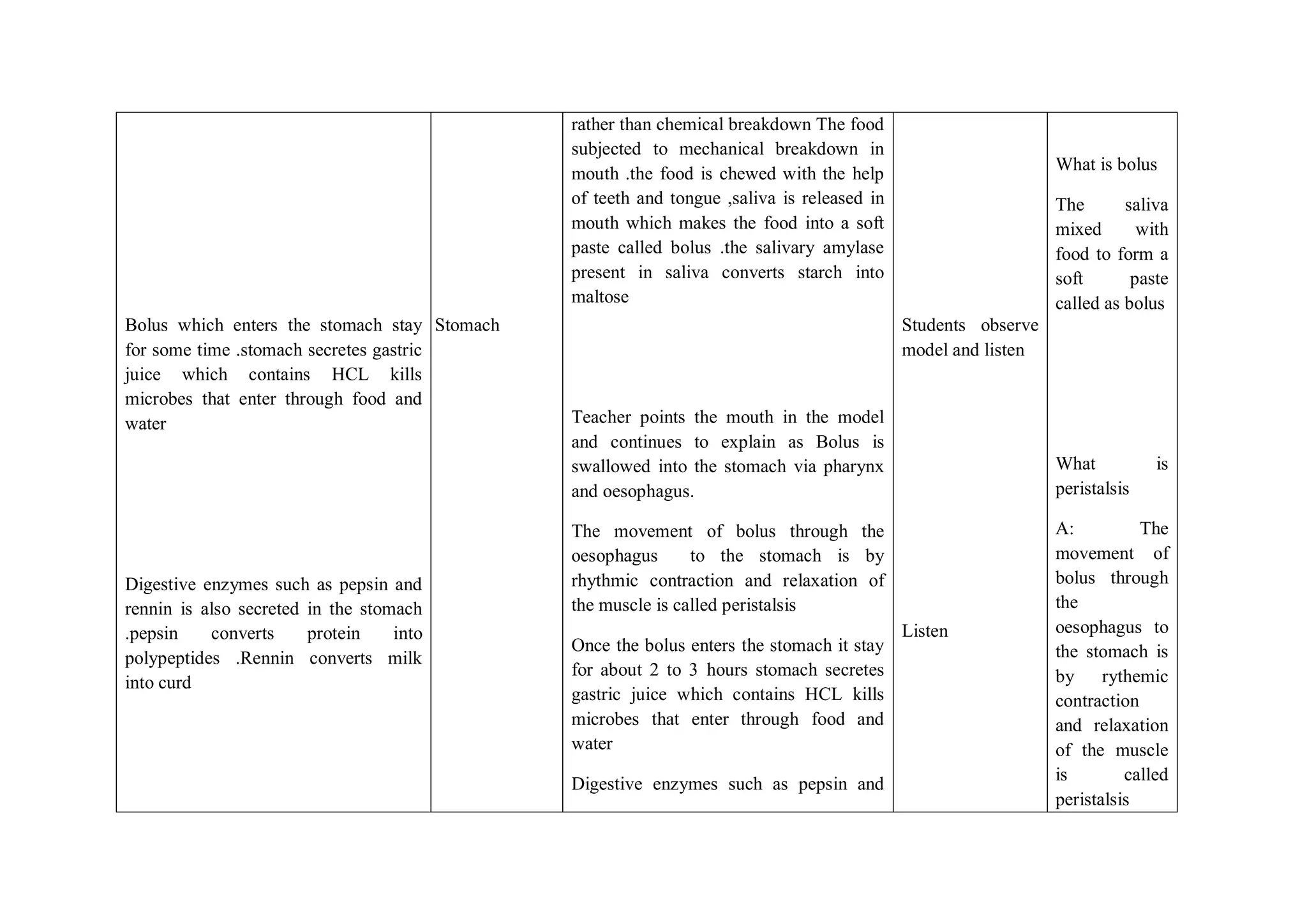
Bolus which enters the stomach stay
for some time .stomach secretes gastric
juice which contains HCL kills
microbes that enter through food and
water
Digestive enzymes such as pepsin and
rennin is also secreted in the stomach
.pepsin converts protein into
polypeptides .Rennin converts milk
into curd
Stomach
rather than chemical breakdown The food
subjected to mechanical breakdown in
mouth .the food is chewed with the help
of teeth and tongue ,saliva is released in
mouth which makes the food into a soft
paste called bolus .the salivary amylase
present in saliva converts starch into
maltose
Teacher points the mouth in the model
and continues to explain as Bolus is
swallowed into the stomach via pharynx
and oesophagus.
The movement of bolus through the
oesophagus to the stomach is by
rhythmic contraction and relaxation of
the muscle is called peristalsis
Once the bolus enters the stomach it stay
for about 2 to 3 hours stomach secretes
gastric juice which contains HCL kills
microbes that enter through food and
water
Digestive enzymes such as pepsin and
Students observe
model and listen
Listen
What is bolus
The saliva
mixed with
food to form a
soft paste
called as bolus
What is
peristalsis
A: The
movement of
bolus through
the
oesophagus to
the stomach is
by rythemic
contraction
and relaxation
of the muscle
is called
peristalsis
A semi liquid food called chime enters
the small intestine where digestion
continues further
Bile juice ,pancreatic juice and
intestinal juice act upon chime and
digest the food further .
Bile is produced by the liver and stored
in the gall bladder .bile juice
emulsifies fats
Pancreatic juice is produced in the
pancreas ,pancreatic juice contains
protease ,amylase and lipase enzymes
Amylase converts starch into maltose
Protease breaks polypeptides into small
peptides whereas lipase converts
complex fats into simple fats
Liver
Pancreas
rennin is also secreted in the stomach
.pepsin converts protein into polypeptides
.Rennin converts milk into curd
Teacher writes the reaction of enzymes in
stomach as
pepsinogen hcl pepsin
proteins pepsin peptides
prorennin hcl rennin
milk rennin paracasein
ask the students to copy the reactions
teacher show the model point at liver and
start explaining as A semi liquid food
called chime enters the small intestine
where digestion continues further
liver is situated just below the stomach
which secretes bile juice and acts on fats
and convert fats into emulsified fat and
writes on board
fat bile emulsified fat
acidic chyme bile alkaline chyme
and shows pancreas in model which just
Students jot down
the reactions in
their note books
Listen
Copy the
reactions
Name the
enzymes
produced in
stomach
A: pepsin and
rennin
Here does bile
produces
A:LIVER
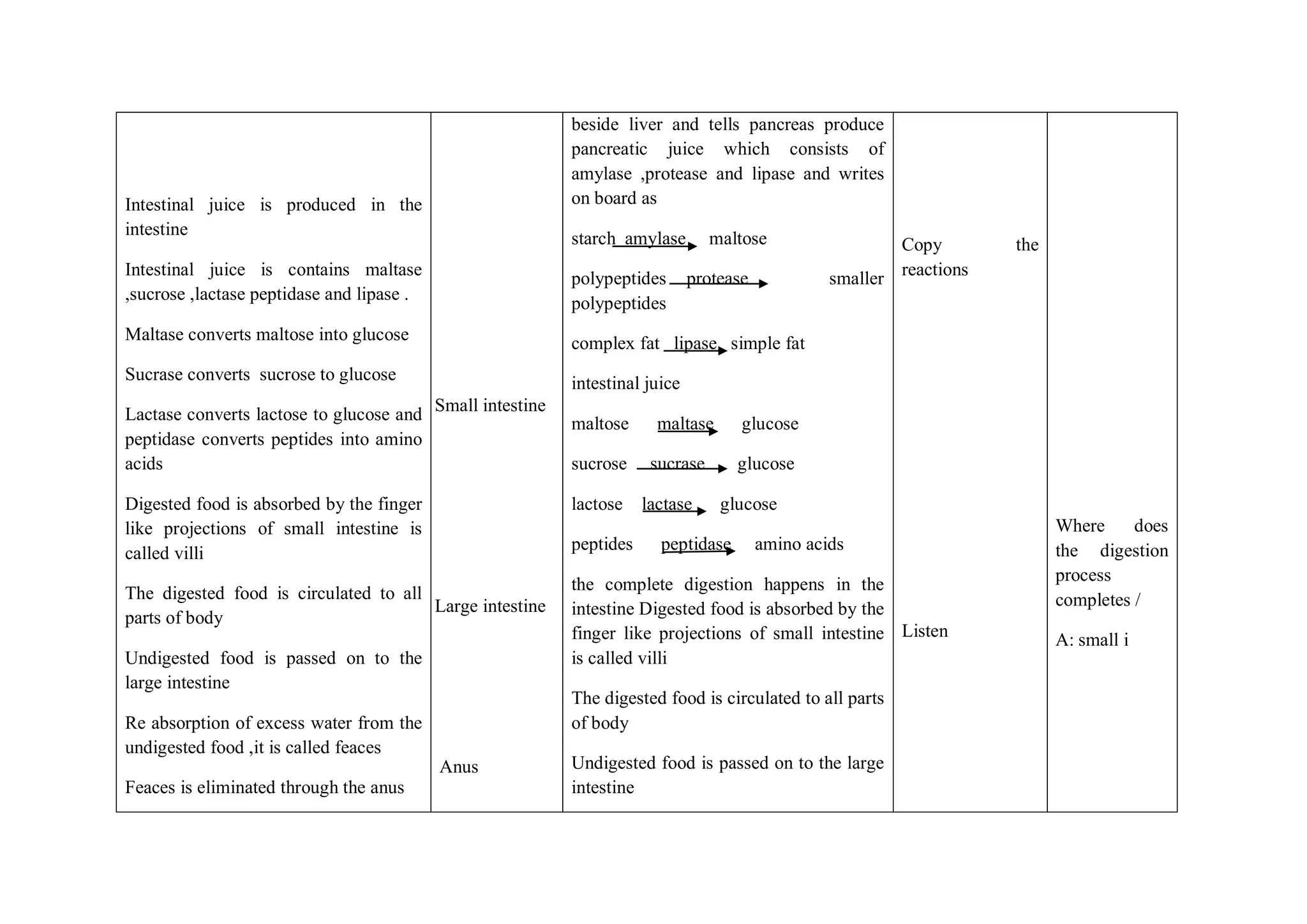
Intestinal juice is produced in the
intestine
Intestinal juice is contains maltase
,sucrose ,lactase peptidase and lipase .
Maltase converts maltose into glucose
Sucrase converts sucrose to glucose
Lactase converts lactose to glucose and
peptidase converts peptides into amino
acids
Digested food is absorbed by the finger
like projections of small intestine is
called villi
The digested food is circulated to all
parts of body
Undigested food is passed on to the
large intestine
Re absorption of excess water from the
undigested food ,it is called feaces
Feaces is eliminated through the anus
Small intestine
Large intestine
Anus
beside liver and tells pancreas produce
pancreatic juice which consists of
amylase ,protease and lipase and writes
on board as
starch amylase maltose
polypeptides protease smaller
polypeptides
complex fat lipase simple fat
intestinal juice
maltose maltase glucose
sucrose sucrase glucose
lactose lactase glucose
peptides peptidase amino acids
the complete digestion happens in the
intestine Digested food is absorbed by the
finger like projections of small intestine
is called villi
The digested food is circulated to all parts
of body
Undigested food is passed on to the large
intestine
Copy the
reactions
Listen
Where does
the digestion
process
completes /
A: small i
Re absorption of excess water from the
undigested food ,it is called feaces
Feaces is eliminated through the anus
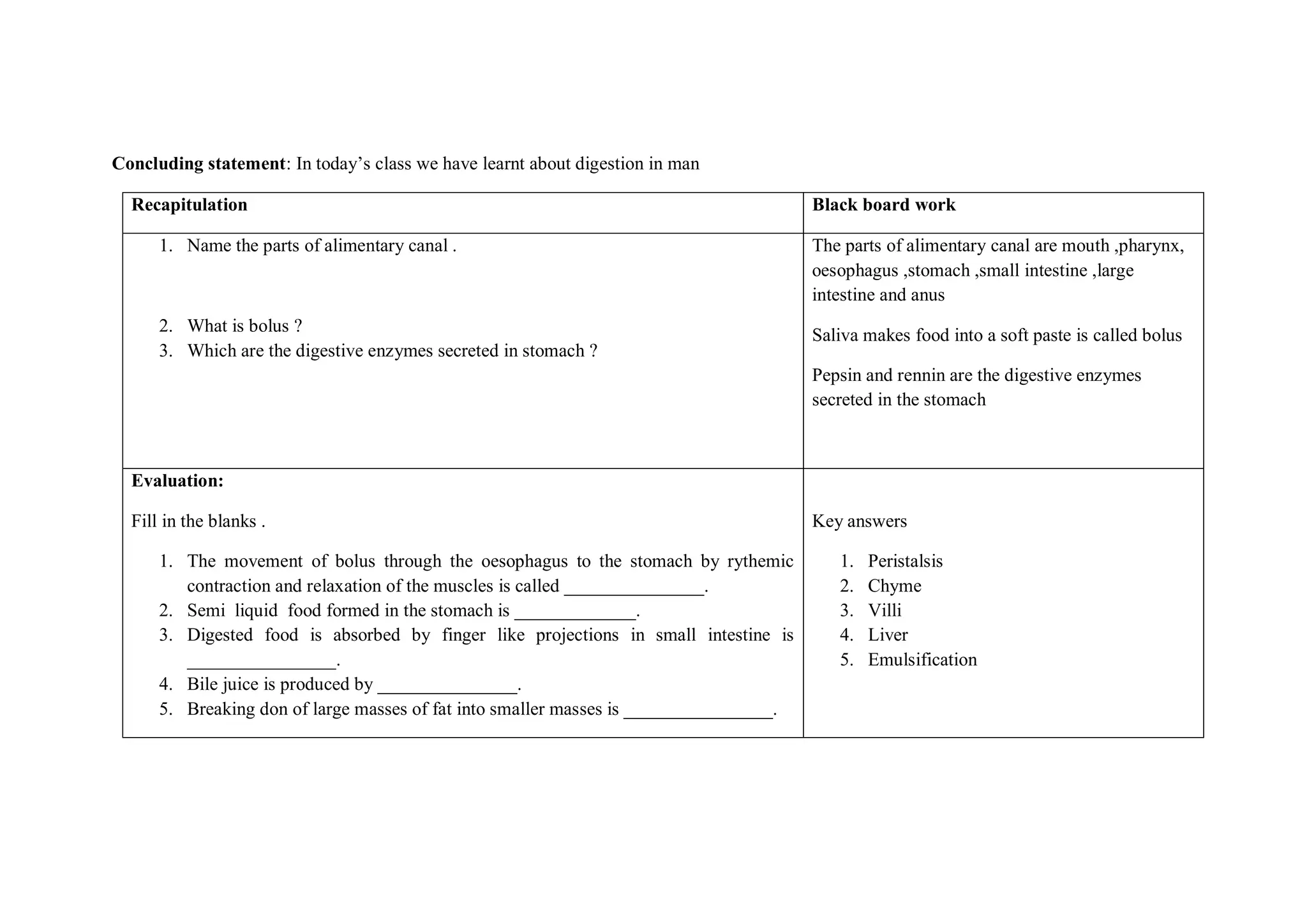
Concluding statement: In today’s class we have learnt about digestion in man
Recapitulation Black board work
1. Name the parts of alimentary canal .
2. What is bolus ?
3. Which are the digestive enzymes secreted in stomach ?
The parts of alimentary canal are mouth ,pharynx,
oesophagus ,stomach ,small intestine ,large
intestine and anus
Saliva makes food into a soft paste is called bolus
Pepsin and rennin are the digestive enzymes
secreted in the stomach
Evaluation: Key answer.
Fill in the blanks .
1. The movement of bolus through the oesophagus to the stomach by rythemic
contraction and relaxation of the muscles is called _______________.
2. Semi liquid food formed in the stomach is _____________.
3. Digested food is absorbed by finger like projections in small intestine is
________________.
4. Bile juice is produced by _______________.
5. Breaking don of large masses of fat into smaller masses is ________________.
Key answers
1. Peristalsis
2. Chyme
3. Villi
4. Liver
5. Emulsification
Home work
1. Draw a neat labelled diagram of digestive system and label the parts

nutrition in man

  • 1.
    Lesson number :1Subject: BIOLOGY Date: 5/12/20 Topic: NUTRITION IN MAN Time: 40 min Class: 8TH Instructional objectives Students will be able to Knowledge : 1.Students will be able to identify organs of digestive system and glands /juices produced in it Understanding 2. Will be able to understand the digestion process . 3.Describe the function of each organ present in digestive system Skill : 4.Draw a neat labelled diagram of human digestive system Application : 5.Students will be able to apply their knowledge in daily life Teaching points • Digestive system • Organs and functions of digestive system Teaching aids • Model of digestive system . • http://goo.gl/images/Cs8xZy • Flash cards of mouth ,oesophagus ,liver ,stomach . Reference books • Biology text book 8th state book • 2nd PUC biology text book .
  • 2.
    Previous knowledge Teacher’sactivity Students activity Students would have seen the pictures of mouth ,oesophagus ,liver ,stomach . Teacher greets the students Teacher shows the flashcards of mouth ,oesophagus ,liver stomach and ask the students to identify So what are these organs meant for What system do they form What is nutrition Student greets the student. Students observe and answer Mouth Stomach Liver Oesophagus Digestion Digestive system The process of taking in food and utilize food for various life activities Statement of aim: In today’s class we are going to learn nutrition in man
  • 3.
    Content Teaching pointsTeacher’s activity Students activity Evaluation Human digestive system includes alimentary canal and digestive glands . The alimentary canal includes the mouth ,pharynx ,oesopagous ,stomach ,small intestine ,large intestine and anus The food subjected to mechanical breakdown in mouth .the food is chewed with the help of teeth and tongue ,saliva is released in mouth which makes the food into a soft paste called bolus .the salivary amylase present in saliva converts starch into maltose Bolus is swallowed into the stomach via pharynx and oesophagus The movement of bolus through the oesophagus to the stomach is by rythemic contraction and relaxation of the muscle is called peristalsis Alimentary canal Mouth Oesophagus Teacher asks the students ,weather the humans are herbivores, carnivores or omnivores .why humans eat cooked food .what happens to the food consumed ? Teacher asks the students ,what are the different constituents of food consumed by humans . Teacher starts to explain that these constituents of food should be simplified for the easy absorption of body hence the humans has a digestive system to simplify or to digest the food it includes alimentary canal and digestive glands . The alimentary canal includes the mouth ,pharynx ,oesophagus ,stomach ,small intestine ,large intestine and anus. shows the model http://goo.gl/images/Cs8xZy The digestion process starts from mouth ,its fully a mechanical breakdown of food Students listen And answer humans are omnivorous ,they eat cooked food for easy digestion Students answer Carbohydrates ,proteins and fats Listen Students listens What does the digestive system consists of A: alimentary canal and digestive glands
  • 4.
    Bolus which entersthe stomach stay for some time .stomach secretes gastric juice which contains HCL kills microbes that enter through food and water Digestive enzymes such as pepsin and rennin is also secreted in the stomach .pepsin converts protein into polypeptides .Rennin converts milk into curd Stomach rather than chemical breakdown The food subjected to mechanical breakdown in mouth .the food is chewed with the help of teeth and tongue ,saliva is released in mouth which makes the food into a soft paste called bolus .the salivary amylase present in saliva converts starch into maltose Teacher points the mouth in the model and continues to explain as Bolus is swallowed into the stomach via pharynx and oesophagus. The movement of bolus through the oesophagus to the stomach is by rhythmic contraction and relaxation of the muscle is called peristalsis Once the bolus enters the stomach it stay for about 2 to 3 hours stomach secretes gastric juice which contains HCL kills microbes that enter through food and water Digestive enzymes such as pepsin and Students observe model and listen Listen What is bolus The saliva mixed with food to form a soft paste called as bolus What is peristalsis A: The movement of bolus through the oesophagus to the stomach is by rythemic contraction and relaxation of the muscle is called peristalsis
  • 5.
    A semi liquidfood called chime enters the small intestine where digestion continues further Bile juice ,pancreatic juice and intestinal juice act upon chime and digest the food further . Bile is produced by the liver and stored in the gall bladder .bile juice emulsifies fats Pancreatic juice is produced in the pancreas ,pancreatic juice contains protease ,amylase and lipase enzymes Amylase converts starch into maltose Protease breaks polypeptides into small peptides whereas lipase converts complex fats into simple fats Liver Pancreas rennin is also secreted in the stomach .pepsin converts protein into polypeptides .Rennin converts milk into curd Teacher writes the reaction of enzymes in stomach as pepsinogen hcl pepsin proteins pepsin peptides prorennin hcl rennin milk rennin paracasein ask the students to copy the reactions teacher show the model point at liver and start explaining as A semi liquid food called chime enters the small intestine where digestion continues further liver is situated just below the stomach which secretes bile juice and acts on fats and convert fats into emulsified fat and writes on board fat bile emulsified fat acidic chyme bile alkaline chyme and shows pancreas in model which just Students jot down the reactions in their note books Listen Copy the reactions Name the enzymes produced in stomach A: pepsin and rennin Here does bile produces A:LIVER
  • 6.
    Intestinal juice isproduced in the intestine Intestinal juice is contains maltase ,sucrose ,lactase peptidase and lipase . Maltase converts maltose into glucose Sucrase converts sucrose to glucose Lactase converts lactose to glucose and peptidase converts peptides into amino acids Digested food is absorbed by the finger like projections of small intestine is called villi The digested food is circulated to all parts of body Undigested food is passed on to the large intestine Re absorption of excess water from the undigested food ,it is called feaces Feaces is eliminated through the anus Small intestine Large intestine Anus beside liver and tells pancreas produce pancreatic juice which consists of amylase ,protease and lipase and writes on board as starch amylase maltose polypeptides protease smaller polypeptides complex fat lipase simple fat intestinal juice maltose maltase glucose sucrose sucrase glucose lactose lactase glucose peptides peptidase amino acids the complete digestion happens in the intestine Digested food is absorbed by the finger like projections of small intestine is called villi The digested food is circulated to all parts of body Undigested food is passed on to the large intestine Copy the reactions Listen Where does the digestion process completes / A: small i
  • 7.
    Re absorption ofexcess water from the undigested food ,it is called feaces Feaces is eliminated through the anus
  • 8.
    Concluding statement: Intoday’s class we have learnt about digestion in man Recapitulation Black board work 1. Name the parts of alimentary canal . 2. What is bolus ? 3. Which are the digestive enzymes secreted in stomach ? The parts of alimentary canal are mouth ,pharynx, oesophagus ,stomach ,small intestine ,large intestine and anus Saliva makes food into a soft paste is called bolus Pepsin and rennin are the digestive enzymes secreted in the stomach Evaluation: Key answer. Fill in the blanks . 1. The movement of bolus through the oesophagus to the stomach by rythemic contraction and relaxation of the muscles is called _______________. 2. Semi liquid food formed in the stomach is _____________. 3. Digested food is absorbed by finger like projections in small intestine is ________________. 4. Bile juice is produced by _______________. 5. Breaking don of large masses of fat into smaller masses is ________________. Key answers 1. Peristalsis 2. Chyme 3. Villi 4. Liver 5. Emulsification
  • 9.
    Home work 1. Drawa neat labelled diagram of digestive system and label the parts