Relationship of genes to transcription and translation
Lesson Objectives At the end of this lesson, you should be able to:  (d) state that DNA is used to carry the genetic code, which is used to synthesize specific polypeptides  (e) state that each gene is a sequence of nucleotides, as part of a DNA molecule
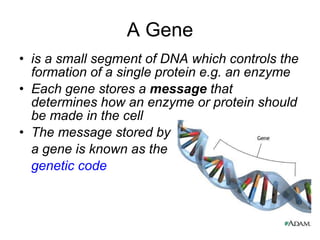
A Gene is a small segment of DNA which controls the formation of a single protein e.g. an enzyme Each gene stores a  message  that determines how an enzyme or protein should be made in the cell The message stored by  a gene is known as the  genetic code
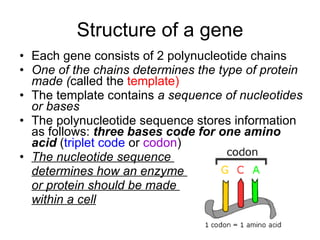
Structure of a gene Each gene consists of 2 polynucleotide chains One of the chains determines the type of protein made ( called the  template) The template contains  a sequence of nucleotides or bases The polynucleotide sequence stores information as follows:  three bases code for one amino acid  ( triplet code  or  codon ) The nucleotide sequence  determines how an enzyme  or protein should be made  within a cell
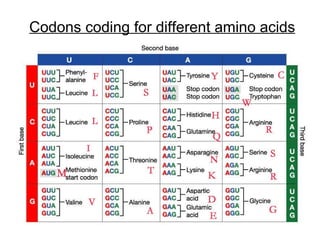
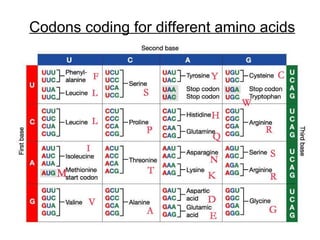
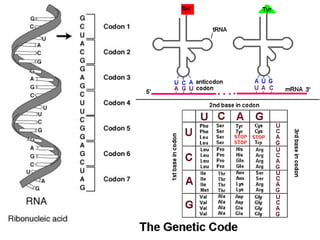
Codons coding for different amino acids
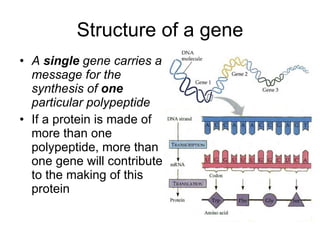
Structure of a gene A  single  gene carries a message for the synthesis of  one  particular polypeptide If a protein is made of more than one polypeptide, more than one gene will contribute to the making of this protein
Gene mutation Since each protein or enzyme contributes to the development of a certain characteristic in your body, the alteration of the message stored by a gene may affect your body structure or function For example, a gene mutation may alter the message stored by the gene that produced haemoglobin, causing  sickle-cell anaemia  (covered in Chapter 19)
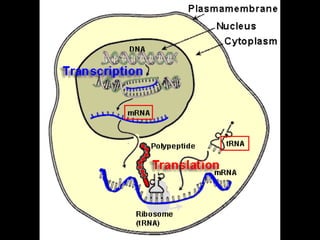
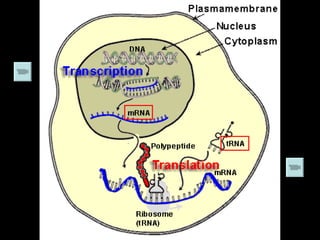
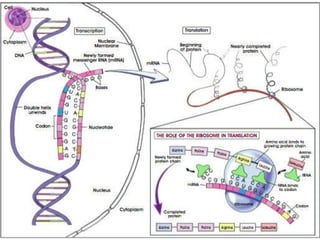
How are proteins made? A cell cannot directly use the DNA template to make proteins Proteins are made through a 2 step process: Transcription   - the process of constructing a  messenger RNA   (mRNA)  molecule using a DNA molecule as a template; this  occurs in the nucleus ; 3 bases in the mRNA make up a codon   Translation  – the process by which the sequence of nucleotides in a mRNA molecule directs the incorporation of amino acids into a protein; this  occurs in the cytoplasm DNA  ->  mRNA  ->  protein transcription translation
 
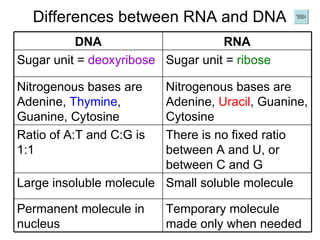
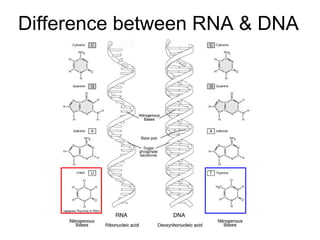
Differences between RNA and DNA Temporary molecule made only when needed Permanent molecule in nucleus Small soluble molecule Large insoluble molecule There is no fixed ratio between A and U, or between C and G Ratio of A:T and C:G is 1:1  Nitrogenous bases are Adenine,  Uracil , Guanine, Cytosine Nitrogenous bases are Adenine,  Thymine , Guanine, Cytosine  Sugar unit =  ribose Sugar unit =  deoxyribose RNA DNA
Difference between RNA & DNA
 
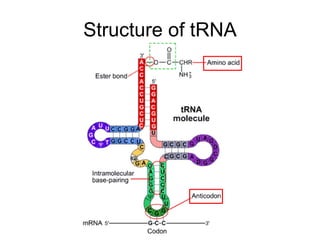
The process of transcription and translation involves… Unzipping of the gene; one strand of gene is used as the  template  to make the  messenger RNA   (mRNA);  the mRNA molecule copies the genetic code in the DNA template, following the rule of base pairing ( transcription ; takes place in the nucleus)  mRNA leaves the nucleus and attaches to a ribosome in the cytoplasm In the cytoplasm, are amino acids and  transfer RNA (tRNA) . tRNA have amino acids attached to one end of their structure.  Each tRNA is very specific and attaches only to its own amino acid ; tRNA has 3 bases at one end (called the  anticodon ) that binds to the complementary codons on mRNA
Structure of tRNA
Codons coding for different amino acids
The process of transcription and translation involves… Translation  starts with mRNA attaching to a ribosome. The first 2 tRNAs together with their amino acids also fit into the ribosome. They attach to codons on the mRNA according to the rule of base pairing. A  peptide bond  is formed between the 2 amino acids Once the peptide bond is formed between the first 2 amino acids, the ribosome moves along one codon to the right of the mRNA. As the ribosome moves to this position, the 1 st  tRNA is released. At the same time, the 3 rd  tRNA and its amino acid slots into the ribosome
 
The process of transcription and translation involves… Another amino acid is attached to the chain The process continues as the ribosome moves along the mRNA. At the end of the mRNA is a  stop codon  ( UGA ,  UAA  or  UAG) .  A stop codon does not have any tRNA with complementary codons . Eventually, the whole chain of polypeptide is produced. The ribosome leaves the mRNA The ribosome may attach to the same mRNA for another round of translation
Breaking the Code Worksheet
 
Transcription, Translation Worksheet
Control of genes Cells can control their genes. Each cell contains a complete set of genes However many of these genes are ‘switched off’ i.e. they do not produce proteins (these genes are  not expressed ) Different cells express different genes  e.g. genes for insulin production are found in liver cells and cells in the pancreas. However, liver cells do not produce insulin, thus the gene for insulin production is not expressed in liver cells, whereas the gene for insulin is expressed in the islets of Langerhans in the pancreas hence they produce insulin
DNA Summary Worksheet
 
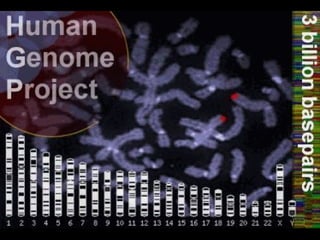
What is the Human Genome Project? The HGP was an initiative started in the early 1990’s that has involved the efforts of hundreds of scientists to generate high-quality reference sequence for the 3 billion base pairs of nucleotide sequence that make up the human genome The complete string of nucleotide letters that make up the DNA sequence in our cells is often referred to as our  genome This DNA sequence contained in a genome contains the complete code that determines which genes and proteins will be present in human cells By reading the sequence of the human genome, scientists hope to  gain an understanding of the underlying code that determines how a complex biological system, such as a human cell, acts and reacts Insights from deciphering the human genome have potential to be applied to a  better understanding of human health and could help to develop better treatments for disease
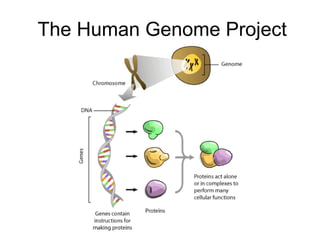
The Human Genome Project
Just for Laughs

Chapter 20 Molecular Genetics Lesson 2 - Genes_Transcription and Translation

  • 1.
    Relationship of genesto transcription and translation
  • 2.
    Lesson Objectives Atthe end of this lesson, you should be able to: (d) state that DNA is used to carry the genetic code, which is used to synthesize specific polypeptides (e) state that each gene is a sequence of nucleotides, as part of a DNA molecule
  • 3.
    A Gene isa small segment of DNA which controls the formation of a single protein e.g. an enzyme Each gene stores a message that determines how an enzyme or protein should be made in the cell The message stored by a gene is known as the genetic code
  • 4.
    Structure of agene Each gene consists of 2 polynucleotide chains One of the chains determines the type of protein made ( called the template) The template contains a sequence of nucleotides or bases The polynucleotide sequence stores information as follows: three bases code for one amino acid ( triplet code or codon ) The nucleotide sequence determines how an enzyme or protein should be made within a cell
  • 5.
    Codons coding fordifferent amino acids
  • 6.
    Structure of agene A single gene carries a message for the synthesis of one particular polypeptide If a protein is made of more than one polypeptide, more than one gene will contribute to the making of this protein
  • 7.
    Gene mutation Sinceeach protein or enzyme contributes to the development of a certain characteristic in your body, the alteration of the message stored by a gene may affect your body structure or function For example, a gene mutation may alter the message stored by the gene that produced haemoglobin, causing sickle-cell anaemia (covered in Chapter 19)
  • 8.
    How are proteinsmade? A cell cannot directly use the DNA template to make proteins Proteins are made through a 2 step process: Transcription - the process of constructing a messenger RNA (mRNA) molecule using a DNA molecule as a template; this occurs in the nucleus ; 3 bases in the mRNA make up a codon Translation – the process by which the sequence of nucleotides in a mRNA molecule directs the incorporation of amino acids into a protein; this occurs in the cytoplasm DNA -> mRNA -> protein transcription translation
  • 9.
  • 10.
    Differences between RNAand DNA Temporary molecule made only when needed Permanent molecule in nucleus Small soluble molecule Large insoluble molecule There is no fixed ratio between A and U, or between C and G Ratio of A:T and C:G is 1:1 Nitrogenous bases are Adenine, Uracil , Guanine, Cytosine Nitrogenous bases are Adenine, Thymine , Guanine, Cytosine Sugar unit = ribose Sugar unit = deoxyribose RNA DNA
  • 11.
  • 12.
  • 13.
    The process oftranscription and translation involves… Unzipping of the gene; one strand of gene is used as the template to make the messenger RNA (mRNA); the mRNA molecule copies the genetic code in the DNA template, following the rule of base pairing ( transcription ; takes place in the nucleus) mRNA leaves the nucleus and attaches to a ribosome in the cytoplasm In the cytoplasm, are amino acids and transfer RNA (tRNA) . tRNA have amino acids attached to one end of their structure. Each tRNA is very specific and attaches only to its own amino acid ; tRNA has 3 bases at one end (called the anticodon ) that binds to the complementary codons on mRNA
  • 14.
  • 15.
    Codons coding fordifferent amino acids
  • 16.
    The process oftranscription and translation involves… Translation starts with mRNA attaching to a ribosome. The first 2 tRNAs together with their amino acids also fit into the ribosome. They attach to codons on the mRNA according to the rule of base pairing. A peptide bond is formed between the 2 amino acids Once the peptide bond is formed between the first 2 amino acids, the ribosome moves along one codon to the right of the mRNA. As the ribosome moves to this position, the 1 st tRNA is released. At the same time, the 3 rd tRNA and its amino acid slots into the ribosome
  • 17.
  • 18.
    The process oftranscription and translation involves… Another amino acid is attached to the chain The process continues as the ribosome moves along the mRNA. At the end of the mRNA is a stop codon ( UGA , UAA or UAG) . A stop codon does not have any tRNA with complementary codons . Eventually, the whole chain of polypeptide is produced. The ribosome leaves the mRNA The ribosome may attach to the same mRNA for another round of translation
  • 19.
  • 20.
  • 21.
  • 22.
    Control of genesCells can control their genes. Each cell contains a complete set of genes However many of these genes are ‘switched off’ i.e. they do not produce proteins (these genes are not expressed ) Different cells express different genes e.g. genes for insulin production are found in liver cells and cells in the pancreas. However, liver cells do not produce insulin, thus the gene for insulin production is not expressed in liver cells, whereas the gene for insulin is expressed in the islets of Langerhans in the pancreas hence they produce insulin
  • 23.
  • 24.
  • 25.
    What is theHuman Genome Project? The HGP was an initiative started in the early 1990’s that has involved the efforts of hundreds of scientists to generate high-quality reference sequence for the 3 billion base pairs of nucleotide sequence that make up the human genome The complete string of nucleotide letters that make up the DNA sequence in our cells is often referred to as our genome This DNA sequence contained in a genome contains the complete code that determines which genes and proteins will be present in human cells By reading the sequence of the human genome, scientists hope to gain an understanding of the underlying code that determines how a complex biological system, such as a human cell, acts and reacts Insights from deciphering the human genome have potential to be applied to a better understanding of human health and could help to develop better treatments for disease
  • 26.
  • 27.