CLASSIFICATION
of
living things
Individual, pair and share
First, answer this question on
your own and then discuss it
with your partner, and then with
your class!
3
mins
What does classification mean?
Why is it important?
Why Classify?
Classifying is sorting organisms into groups.
Classifying helps with:
◦ Identifying Organisms:
◦ Makes it easier to find out which species an organism belongs
◦ Evolutionary Links:
◦ Provides information that can be used to predict how organisms evolved.
Species of the same genus share characteristics which mean they probably
evolved from a common ancestor.
◦ Prediction of Characteristics
◦ Allows you to predict the characteristics of other organisms in similar groups
What do we Classify?
Examples of classification;
Stamps
Coins
Library
Clothes
Animals/Plants
Supermarket
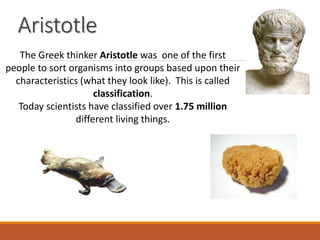
The Greek thinker Aristotle was one of the first
people to sort organisms into groups based upon their
characteristics (what they look like). This is called
classification.
Today scientists have classified over 1.75 million
different living things.
Aristotle
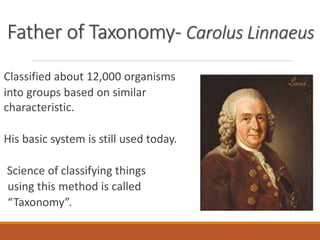
Father of Taxonomy- Carolus Linnaeus
Classified about 12,000 organisms
into groups based on similar
characteristic.
His basic system is still used today.
Science of classifying things
using this method is called
“Taxonomy”.
The Binominal System of
Nomenclature
Each species needs a name so that biologists
around the world can refer to it.
Naming of species is called Nomenclature.
Biologists use the Binomial System
(developed by Carl Linnaeus 1707-1778)
◦ Two names are used to refer to each species
The Binominal System of
Nomenclature
Features of the Binomial System are:
◦ First name is the genus name (uppercase 1st letter)
◦ Second name is the species name (lowercase 1st letter)
◦ Genus and species are usually printed in italics or
written and underlined
e.g: Homo sapiens, Felis tigris
Classification…
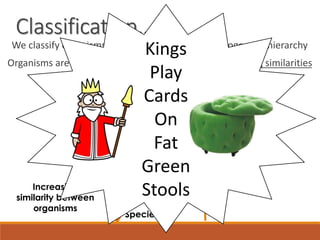
We classify organisms in a system known as a phylogenetic hierarchy
Organisms are placed into groups based on their increasing similarities
Kingdom
Phylum (pl. phyla)
Class
Order
Family
Genus (pl. genera)
Species
Increasing
similarity between
organisms
Increasing number of
species
Kings
Play
Cards
On
Fat
Green
Stools
The Five Kingdom System
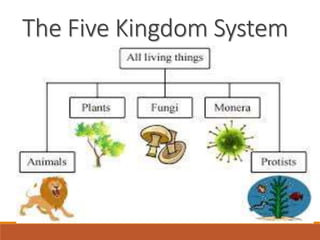
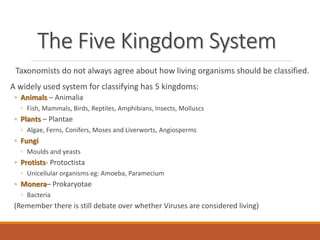
Taxonomists do not always agree about how living organisms should be classified.
A widely used system for classifying has 5 kingdoms:
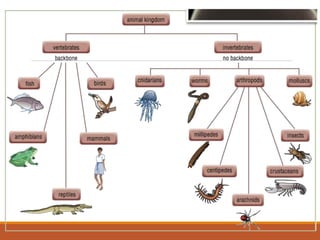
◦ Animals – Animalia
◦ Fish, Mammals, Birds, Reptiles, Amphibians, Insects, Molluscs
◦ Plants – Plantae
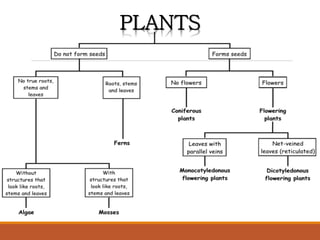
◦ Algae, Ferns, Conifers, Moses and Liverworts, Angiosperms
◦ Fungi
◦ Moulds and yeasts
◦ Protists- Protoctista
◦ Unicellular organisms eg: Amoeba, Paramecium
◦ Monera– Prokaryotae
◦ Bacteria
(Remember there is still debate over whether Viruses are considered living)
PLANTS
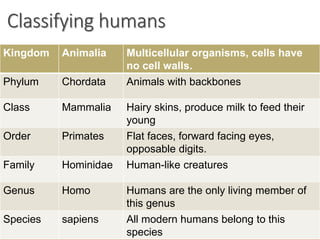
Classifying humans
Kingdom Animalia Multicellular organisms, cells have
no cell walls.
Phylum Chordata Animals with backbones
Class Mammalia Hairy skins, produce milk to feed their
young
Order Primates Flat faces, forward facing eyes,
opposable digits.
Family Hominidae Human-like creatures
Genus Homo Humans are the only living member of
this genus
Species sapiens All modern humans belong to this
species
What is a Key and why use it?
A KEY uses features of animals and plants that are
easily seen and set in a way to identify them.
KEY is really a list of clues.
Each clue tells us something about the structure of
the ‘object’ being identified.
Method of Classification
One method involves using dichotomous keys for
classification.
This method allows an organism to be classified using a
choice of two characteristics at each level.
There are two types of keys used.
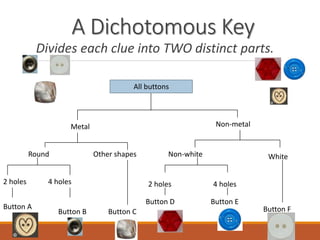
A Dichotomous Key
Divides each clue into TWO distinct parts.
All buttons
Metal Non-metal
Round Other shapes Non-white White
2 holes 4 holes 4 holes
Button C
Button A
Button B Button F
2 holes
Button D Button E
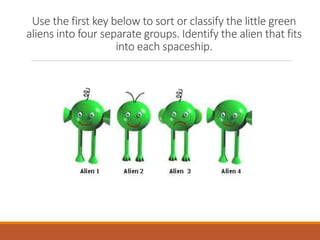
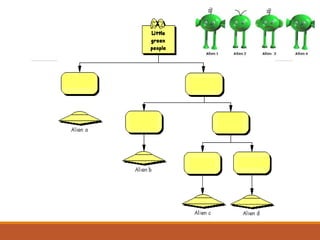
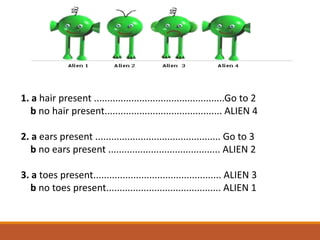
Use the first key below to sort or classify the little green
aliens into four separate groups. Identify the alien that fits
into each spaceship.
no hair hair
curly
hair
straight
hair
no toestoes
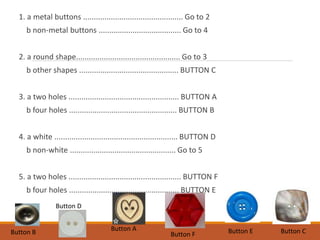
1. a metal buttons ............................................... Go to 2
b non-metal buttons ....................................... Go to 4
2. a round shape................................................. Go to 3
b other shapes ............................................... BUTTON C
3. a two holes .................................................... BUTTON A
b four holes ................................................... BUTTON B
4. a white .......................................................... BUTTON D
b non-white .................................................. Go to 5
5. a two holes ..................................................... BUTTON F
b four holes .................................................... BUTTON E
Button E
Button D
Button F
Button AButton B Button C
1. a hair present .................................................Go to 2
b no hair present............................................ ALIEN 4
2. a ears present ............................................... Go to 3
b no ears present .......................................... ALIEN 2
3. a toes present................................................ ALIEN 3
b no toes present........................................... ALIEN 1
TRY ONE YOURSELF
A Grocer’s Shop Key
Make two keys to classify the grocery items below.
You need to use both method to classify these items.
canned pumpkin soup block of cheese
frozen beans Smiths potato chips
butter chocolate ice cream
baked beans milk
bacon canned asparagus
yoghurt sardines
bread orange juice
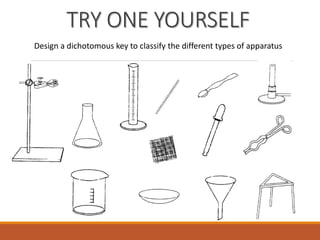
TRY ONE YOURSELF
Design a dichotomous key to classify the different types of apparatus

Lecture 4 classification

  • 1.
  • 2.
    Individual, pair andshare First, answer this question on your own and then discuss it with your partner, and then with your class! 3 mins What does classification mean? Why is it important?
  • 3.
    Why Classify? Classifying issorting organisms into groups. Classifying helps with: ◦ Identifying Organisms: ◦ Makes it easier to find out which species an organism belongs ◦ Evolutionary Links: ◦ Provides information that can be used to predict how organisms evolved. Species of the same genus share characteristics which mean they probably evolved from a common ancestor. ◦ Prediction of Characteristics ◦ Allows you to predict the characteristics of other organisms in similar groups
  • 4.
    What do weClassify? Examples of classification; Stamps Coins Library Clothes Animals/Plants Supermarket
  • 5.
    The Greek thinkerAristotle was one of the first people to sort organisms into groups based upon their characteristics (what they look like). This is called classification. Today scientists have classified over 1.75 million different living things. Aristotle
  • 6.
    Father of Taxonomy-Carolus Linnaeus Classified about 12,000 organisms into groups based on similar characteristic. His basic system is still used today. Science of classifying things using this method is called “Taxonomy”.
  • 7.
    The Binominal Systemof Nomenclature Each species needs a name so that biologists around the world can refer to it. Naming of species is called Nomenclature. Biologists use the Binomial System (developed by Carl Linnaeus 1707-1778) ◦ Two names are used to refer to each species
  • 8.
    The Binominal Systemof Nomenclature Features of the Binomial System are: ◦ First name is the genus name (uppercase 1st letter) ◦ Second name is the species name (lowercase 1st letter) ◦ Genus and species are usually printed in italics or written and underlined e.g: Homo sapiens, Felis tigris
  • 9.
    Classification… We classify organismsin a system known as a phylogenetic hierarchy Organisms are placed into groups based on their increasing similarities Kingdom Phylum (pl. phyla) Class Order Family Genus (pl. genera) Species Increasing similarity between organisms Increasing number of species Kings Play Cards On Fat Green Stools
  • 10.
  • 11.
    The Five KingdomSystem Taxonomists do not always agree about how living organisms should be classified. A widely used system for classifying has 5 kingdoms: ◦ Animals – Animalia ◦ Fish, Mammals, Birds, Reptiles, Amphibians, Insects, Molluscs ◦ Plants – Plantae ◦ Algae, Ferns, Conifers, Moses and Liverworts, Angiosperms ◦ Fungi ◦ Moulds and yeasts ◦ Protists- Protoctista ◦ Unicellular organisms eg: Amoeba, Paramecium ◦ Monera– Prokaryotae ◦ Bacteria (Remember there is still debate over whether Viruses are considered living)
  • 13.
  • 14.
    Classifying humans Kingdom AnimaliaMulticellular organisms, cells have no cell walls. Phylum Chordata Animals with backbones Class Mammalia Hairy skins, produce milk to feed their young Order Primates Flat faces, forward facing eyes, opposable digits. Family Hominidae Human-like creatures Genus Homo Humans are the only living member of this genus Species sapiens All modern humans belong to this species
  • 15.
    What is aKey and why use it? A KEY uses features of animals and plants that are easily seen and set in a way to identify them. KEY is really a list of clues. Each clue tells us something about the structure of the ‘object’ being identified.
  • 16.
    Method of Classification Onemethod involves using dichotomous keys for classification. This method allows an organism to be classified using a choice of two characteristics at each level. There are two types of keys used.
  • 17.
    A Dichotomous Key Divideseach clue into TWO distinct parts. All buttons Metal Non-metal Round Other shapes Non-white White 2 holes 4 holes 4 holes Button C Button A Button B Button F 2 holes Button D Button E
  • 18.
    Use the firstkey below to sort or classify the little green aliens into four separate groups. Identify the alien that fits into each spaceship.
  • 19.
  • 20.
    1. a metalbuttons ............................................... Go to 2 b non-metal buttons ....................................... Go to 4 2. a round shape................................................. Go to 3 b other shapes ............................................... BUTTON C 3. a two holes .................................................... BUTTON A b four holes ................................................... BUTTON B 4. a white .......................................................... BUTTON D b non-white .................................................. Go to 5 5. a two holes ..................................................... BUTTON F b four holes .................................................... BUTTON E Button E Button D Button F Button AButton B Button C
  • 21.
    1. a hairpresent .................................................Go to 2 b no hair present............................................ ALIEN 4 2. a ears present ............................................... Go to 3 b no ears present .......................................... ALIEN 2 3. a toes present................................................ ALIEN 3 b no toes present........................................... ALIEN 1
  • 22.
    TRY ONE YOURSELF AGrocer’s Shop Key Make two keys to classify the grocery items below. You need to use both method to classify these items. canned pumpkin soup block of cheese frozen beans Smiths potato chips butter chocolate ice cream baked beans milk bacon canned asparagus yoghurt sardines bread orange juice
  • 23.
    TRY ONE YOURSELF Designa dichotomous key to classify the different types of apparatus